AQA GCSE Geography Paper 3Geographical Applications: every question, answered
We analysed every Paper 3 sitting AQA has set since 2020, including the actual questions students saw and the mark schemes examiners used. This paper is different from Papers 1 and 2: it always opens with an Issue Evaluation section built around a pre-release resources booklet, always includes a fieldwork question about an unfamiliar enquiry, and in two of our four sittings also included a section on your own fieldwork enquiries. Below is what each recurring question type has asked, what the real sources showed, and a complete worked answer written to the top mark scheme level for each sitting we have, with every paragraph explained.
Questions © AQA, quoted for analysis. Source materials described in our own words, not reproduced. Mark scheme content translated into plain English, not copied. PrepWise is independent and not endorsed by AQA.
The paper is a template
Same 14 question types, every sitting“Study Figure 1 in the resources booklet. Answer a one-mark question that only needs a single reading off it.”
Every sitting opens Section A with the same move: look at Figure 1 and pull out one fact, either by shading a multiple-choice circle or writing a short answer. There is no reasoning here, only accurate reading of a graph or chart.
1×asked“In which year were global urban and rural populations the same?”
“In which year were global urban and rural populations the same?”
What it’s really asking
A pure graph-reading check: find the year on Figure 1 where the urban and rural population lines cross.
What the sources actually showed — June 2020
A resources-booklet graph titled 'An increasingly urban world', showing two lines tracking the percentage of the global population living in urban areas against the percentage living in rural areas from around 1950 to a projected 2030, with the two lines crossing at some point in the 2000s as urban overtook rural for the first time in human history.
The full worked answer — June 2020
2007. This is the year on Figure 1 where the urban and rural population lines cross, marking the point when, for the first time, more than half the world's population lived in urban areas.
Could you have written this? Every fact in this answer is drilled in our quizzes — the writing is the easy part once the evidence is automatic.
Practise resource and data-reading questionsWhat the mark scheme rewarded
- The single correct year, nothing else
- Global urban population overtook rural population for the first time around 2007, a genuine turning point in human settlement history
Traps examiners saw
- Confusing this crossing point with a different milestone year quoted elsewhere in the resources booklet
- Shading two circles, which earns no credit even if one is correct
Full-mark self-check 0 of 1
1×asked“In which year did nuclear power and coal provide the same proportion of the UK's electrical energy mix?”
“In which year did nuclear power and coal provide the same proportion of the UK's electrical energy mix?”
What it’s really asking
Find the year on Figure 1 where the nuclear and coal share-of-mix lines cross.
What the sources actually showed — June 2021
A resources-booklet graph titled 'The changing pattern of energy production and use in the UK', showing the changing percentage share of different sources (including coal and nuclear) in the UK's electricity mix over roughly the 2010s, with coal's share falling sharply as nuclear's share stayed comparatively stable, so the two lines cross once during the decade.
The full worked answer — June 2021
2015. This is the year on Figure 1 where the falling share of coal in the UK's electricity mix crosses the roughly steady share provided by nuclear power.
Could you have written this? Every fact in this answer is drilled in our quizzes — the writing is the easy part once the evidence is automatic.
Practise resource and data-reading questionsWhat the mark scheme rewarded
- The single correct year, nothing else
- Coal's share of UK electricity generation collapsed during the 2010s as older coal power stations closed and were not replaced, while nuclear's share stayed comparatively steady
Traps examiners saw
- Reading off the coal line's steepest fall rather than the actual crossing point with the nuclear line
Full-mark self-check 0 of 1
1×asked“What percentage of waste in the UK was household waste in 2018?”
“What percentage of waste in the UK was household waste in 2018?”
What it’s really asking
Read the correct percentage share for household waste directly off Figure 1's breakdown of UK waste by source.
What the sources actually showed — June 2022
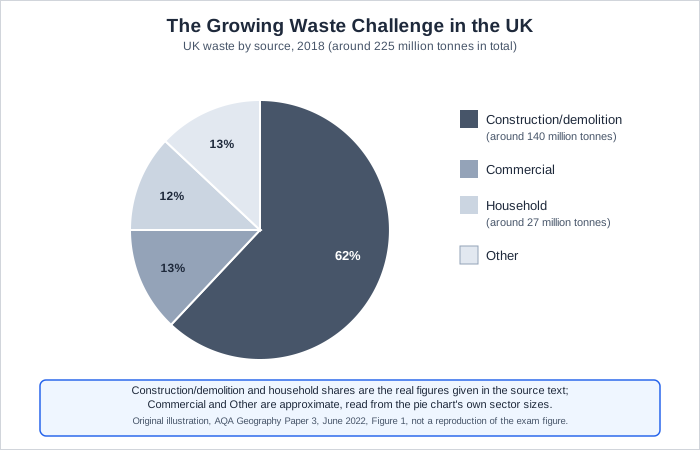
A resources-booklet pie chart titled 'The growing waste challenge in the UK', showing that the UK produced around 225 million tonnes of waste in 2018, broken down by source: construction and demolition waste is by far the largest slice at around 140 million tonnes (about 62%), commercial waste and 'other' waste each take roughly an eighth of the total, and household waste is around 27 million tonnes (about 12%).
The full worked answer — June 2022
12%. This is the share Figure 1 gives for household waste out of total UK waste in 2018 (around 27 million tonnes of the UK's roughly 225 million tonnes total), a much smaller slice than construction and demolition waste, which dominates the UK waste total at around 140 million tonnes, about 62%.
Could you have written this? Every fact in this answer is drilled in our quizzes — the writing is the easy part once the evidence is automatic.
Practise resource and data-reading questionsWhat the mark scheme rewarded
- The single correct percentage
- Household waste is a relatively small share of the UK's total waste stream, with construction, demolition and excavation waste making up the largest single category
Traps examiners saw
- Picking the figure for total recycling rate instead of the household-waste share
Full-mark self-check 0 of 1
1×asked“In 2018, which world region had the largest number of international tourist arrivals?”
“In 2018, which world region had the largest number of international tourist arrivals?”
What it’s really asking
Read the tallest line or bar on Figure 1's chart of tourist arrivals by world region.
What the sources actually showed — June 2023
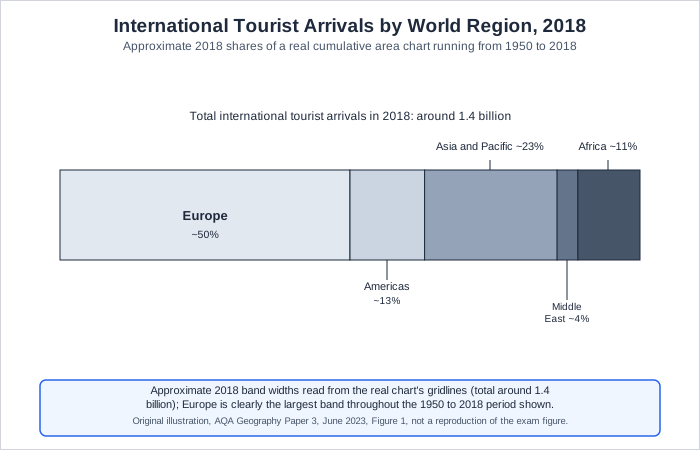
A resources-booklet cumulative (stacked) area chart titled 'International tourist arrivals by world region', running from 1950 to 2018 with the vertical axis in hundreds of millions up to 1.4 billion. Each world region (Europe, Americas, Asia and Pacific, Middle East, Africa) is added as a band on top of the ones below it rather than plotted as a separate line, so the region with the largest number of arrivals in any year is read off as the THICKEST band, not the highest line. Europe forms the base band and by 2018 is clearly the thickest of the five, followed by a substantially narrower Asia and Pacific band, with the Middle East and Africa bands the thinnest.
The full worked answer — June 2023
Europe. Figure 1 is a cumulative area chart, so each region's own arrivals total is shown by the thickness of its band, not by which line sits highest, and Europe's band is clearly the widest of the five in 2018, reflecting its dense cluster of accessible, high-income destination countries.
Could you have written this? Every fact in this answer is drilled in our quizzes — the writing is the easy part once the evidence is automatic.
Practise resource and data-reading questionsWhat the mark scheme rewarded
- The single correct region
- Europe has consistently received the largest number of international tourist arrivals of any world region, helped by short travel distances between wealthy countries
Traps examiners saw
- Confusing highest number of arrivals with highest tourism revenue per visitor, which is a different measure
Full-mark self-check 0 of 1
The method for every Q01.1 / Q01.1 — same every sittingMark bands, steps, timing
What this question type rewards
The topic changes by sitting — the mark scheme never does. Learn this once, then open your question above for that sitting’s sources and a full worked answer.
- Reading the right line, bar or axis on Figure 1 accurately
- Not rushing the opening question and shading the wrong circle under time pressure
The steps
- Find the exact year, category or value the question names
- Trace it to the matching point on Figure 1, not a nearby one that looks similar
- For multiple choice, physically check your chosen circle against the graph one more time before shading
- For a written answer, give only what is asked for, no extra explanation is credited
A student wants to compare the number of tourists visiting five different countries in 2023. Which type of graph is most appropriate?
This looks trivial but under exam pressure it is where careless marks vanish. Practise reading graphs and charts fast and accurately before you ever reach the harder questions.
Practise resource and data-reading questions“Take a figure that is already mostly drawn and add the one missing bar, line, sector or cell using the numbers you are given.”
This is the single most common one-mark skill on the whole paper. It turns up in Section A and Section B in almost every sitting: complete a pie chart, a bar chart, a line graph or a table using a value the question hands you. Losing this mark is pure carelessness, not a knowledge gap.
1×asked“Complete the graph below to show life expectancy in the study area.”
“Complete the graph below to show life expectancy in the study area.”
What it’s really asking
Use the life-expectancy table already given in Figure 6 to draw the final missing segment of the study area's line on the graph beneath it.
What the sources actually showed — June 2020
A table of secondary data used in an urban deprivation enquiry, giving life expectancy in years for the study area and for the city average at four census points: 1981, 1991, 2001 and 2011.
| Year | Study area (years) | City average (years) |
|---|---|---|
| 1981 | 67 | 72 |
| 1991 | 68 | 73 |
| 2001 | 68 | 77 |
| 2011 | 70 | 78 |
The full worked answer — June 2020
I complete the study area line by joining it from the 2001 point at 68 years up to the 2011 point at 70 years, ruling a straight line between them so it clearly touches the 70-year mark on the right hand side of the graph.
Could you have written this? Every fact in this answer is drilled in our quizzes — the writing is the easy part once the evidence is automatic.
Practise graph and chart completion questionsWhat the mark scheme rewarded
- An accurate line, ruled to the correct final data point
- Figure 6's own table values are the only evidence needed, nothing external
Traps examiners saw
- Estimating the line's finishing height by eye instead of transferring the exact table value
Full-mark self-check 0 of 1
1×asked“Complete the graph below (Figure 5) to show the quality of footpath data for Footpath C.”
“Complete the graph below (Figure 5) to show the quality of footpath data for Footpath C.”
What it’s really asking
Use Footpath C's tally data from Figure 4 to add the two missing segments to the top of the part-drawn stacked bar in Figure 5.
What the sources actually showed — June 2021
Figure 4 is a table giving the full tally-mark survey results for all three footpaths (A, B and C), with Footpath C scoring 10 very good, 18 good, 12 fair and 10 poor, summing to the 50 people surveyed. Figure 5 is a single stacked bar for Footpath C with the Poor and Fair segments already shaded in, rising from 0 to 22 visitors, and blank space above that up to the 50 line for the student to add the Good and Very good segments.
The full worked answer — June 2021
Figure 5 already has Footpath C's Poor and Fair segments drawn, rising from 0 to 22 visitors, so I only need to add the two segments above that using Figure 4's tally data for Footpath C: 18 more visitors rated Good, taking the bar from 22 up to 40, then 10 more rated Very good, taking it from 40 up to 50, each shaded to match the key already used for Footpaths A and B.
Could you have written this? Every fact in this answer is drilled in our quizzes — the writing is the easy part once the evidence is automatic.
Practise graph and chart completion questionsWhat the mark scheme rewarded
- Both remaining segments plotted in the correct order at the right heights and shaded to match the existing key
- Footpath C's tally data in Figure 4 (10 very good, 18 good, 12 fair, 10 poor) gives the two missing segment heights
Traps examiners saw
- Using a different shading style to the rest of the chart, or swapping the order of the two remaining segments, which makes the finished chart ambiguous even if the heights are right
Full-mark self-check 0 of 1
1×asked“Complete the table below (Figure 10) for town centre A.”
“Complete the table below (Figure 10) for town centre A.”
What it’s really asking
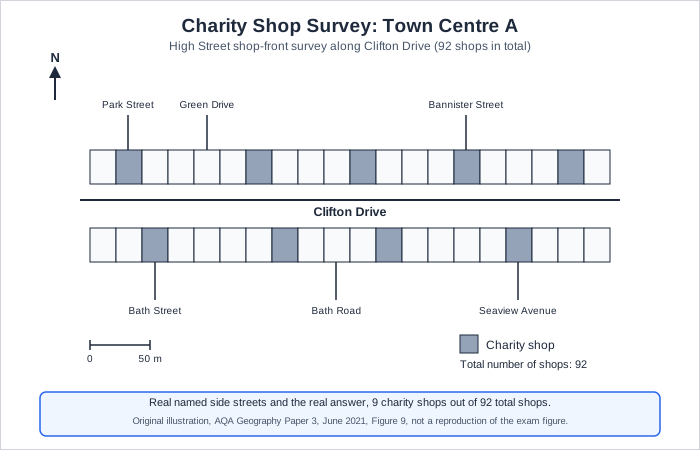
Use the annotated street map in Figure 9 to count the number of charity shops in town centre A and enter it into the blank cell in the Figure 10 summary table.
What the sources actually showed — June 2021
Figure 9 is a simplified street map of town centre A with charity shops marked and a caption stating the total number of shops of any kind in the town centre is 92. Figure 10 is a small summary table comparing the number of charity shops and the total number of shops across three town centres (A, B and C), with B and C's charity-shop counts and all three total-shop counts already filled in, but A's charity-shop count left blank for the student to complete from Figure 9.
| Town centre | Number of charity shops | Total number of shops |
|---|---|---|
| A | ? | 92 |
| B | 19 | 114 |
| C | 18 | 142 |
The full worked answer — June 2021
I count the charity-shop symbols marked on the Figure 9 map for town centre A and write that total into the blank cell, giving town centre A's completed row as 9 charity shops out of the stated 92 shops in total.
Could you have written this? Every fact in this answer is drilled in our quizzes — the writing is the easy part once the evidence is automatic.
Practise graph and chart completion questionsWhat the mark scheme rewarded
- The single correct count transferred into the table
- Figure 9's own symbol count is the only evidence needed
Traps examiners saw
- Miscounting overlapping symbols on a busy street map under time pressure
Full-mark self-check 0 of 1
1×asked“Complete the graph below using the following data. Number of cruise passengers in 2019: 30 million.”
“Complete the graph below using the following data. Number of cruise passengers in 2019: 30 million.”
What it’s really asking
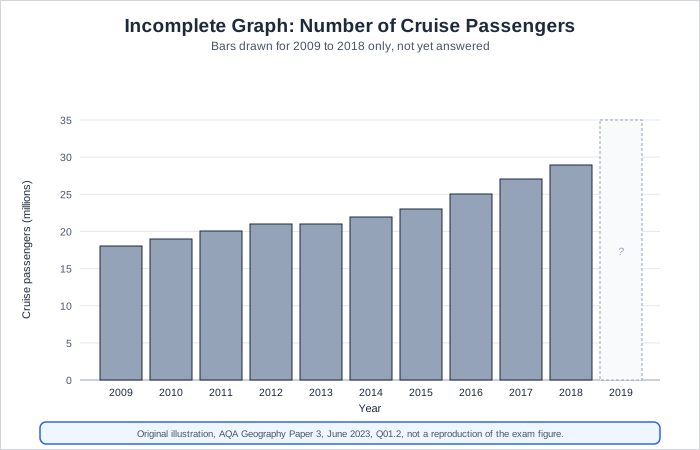
Add the single 2019 bar to an otherwise complete bar chart of cruise passenger numbers running from 2009 to 2019, using only the one value given in the question.
What the sources actually showed — June 2023
A bar chart reprinted on the question paper itself (built from the resources-booklet Figure 1 data on 'the growth of cruise tourism'), showing the number of cruise passengers worldwide in millions on the vertical axis (gridlines every 5 million up to 35 million) against year on the horizontal axis from 2009 to 2019. Real bars are already drawn for 2009 to 2018 at 18, 19, 20, 21, 21, 22, 23, 25, 27 and 29 million passengers, with the final 2019 bar left as blank gridded space for the student to add using the value given in the question.
The full worked answer — June 2023
I draw the final bar above 2019 so that its top touches the 30 million mark on the vertical axis, matching the height and style of the bars already drawn for the earlier years.
Could you have written this? Every fact in this answer is drilled in our quizzes — the writing is the easy part once the evidence is automatic.
Practise graph and chart completion questionsWhat the mark scheme rewarded
- A bar reaching exactly 30 million, the bar does not need to be shaded
- The single value given in the question is the only data needed for this mark
Traps examiners saw
- Trying to estimate what the earlier years' bars 'should' look like instead of simply reading their already-drawn heights, which is not what this question tests
Full-mark self-check 0 of 1
The method for every Q04.7 / Q04.1 / Q04.9 / Q01.2 — same every sittingMark bands, steps, timing
What this question type rewards
The topic changes by sitting — the mark scheme never does. Learn this once, then open your question above for that sitting’s sources and a full worked answer.
- Plotting or shading the exact value given, in the correct position, using the key correctly
- Working within the accuracy the mark scheme tolerates (a ruled line touching the right point, a bar the right height, a sector shaded in the right place in the key's rotation)
The steps
- Identify exactly which value you are being asked to add, and to which axis, sector or cell
- Check the scale on each axis before you plot, misreading the scale is the most common way to lose this mark
- Use a ruler for any straight line or bar edge, freehand lines are marked down for inaccuracy
- Shade any pie-chart sector in the same style shown in the key so it is unambiguous which category it represents
- Never guess a value that has not been given to you, that is a different kind of question
A student wants to compare the number of tourists visiting five different countries in 2023. Which type of graph is most appropriate?
Bring a ruler and practise transferring given data onto a graph, chart or table accurately. This skill is worth a guaranteed mark almost every sitting.
Practise graph and chart completion questions“Look at a graph, map or table and describe the pattern it shows, using real numbers from the source, not just a vague impression.”
A short 'describe the pattern' question appears in both Section A and Section B in most sittings. It rewards using the data, not just describing it in words.
1×asked“Compare levels of access to piped water in urban and rural areas shown in Figure 2.”
“Compare levels of access to piped water in urban and rural areas shown in Figure 2.”
What it’s really asking
State that urban access to piped water is consistently higher than rural access, and back it up with a real comparative figure from Figure 2.
What the sources actually showed — June 2020
A resources-booklet infographic titled 'The growth of slums in LICs and NEEs', comparing the percentage of the population with access to piped water in urban and rural areas across several world regions, alongside separate points about the pace of African urban population growth.
The full worked answer — June 2020
Access to piped water is always higher in urban areas than in rural areas across every region shown in Figure 2. In Southern Asia the gap is especially wide, at around 39 percentage points between the two.
Could you have written this? Every fact in this answer is drilled in our quizzes — the writing is the easy part once the evidence is automatic.
Practise describing and comparing data questionsWhat the mark scheme rewarded
- A general observation that urban access is always higher, developed with a real number or named regional comparison
- Southern Asia shows one of the widest urban-rural piped water access gaps in Figure 2, at around 39 percentage points
Traps examiners saw
- Simply repeating one country's figures without making the higher/lower comparison explicit
Full-mark self-check 0 of 1
1×asked“Describe the trend in the rate of recycling in England between 2000 and 2019.”
“Describe the trend in the rate of recycling in England between 2000 and 2019.”
What it’s really asking
Describe the overall rising trend in England's recycling rate and identify that its pace of growth changed over the period, using the graph's own start and end values.
What the sources actually showed — June 2022
A line graph on the resources-booklet infographic 'Managing waste in the UK', titled 'Rate of recycling in England (2000 to 2019)', tracking England's household recycling rate as a percentage against year. It rises from around 11% in 2000 to around 30% by 2006, around 41% by 2010, then climbs more slowly to a peak of around 47% around 2018 before dipping slightly to around 46% in 2019.
The full worked answer — June 2022
The recycling rate rose overall across the whole period, from around 11% in 2000 to a peak of around 47% around 2018, before dipping slightly to around 46% in 2019. Growth was fastest in the first ten years or so (reaching around 41% by 2010), then the rate became far more static from about 2011 onwards, with a slight dip appearing towards the very end of the period.
Could you have written this? Every fact in this answer is drilled in our quizzes — the writing is the easy part once the evidence is automatic.
Practise describing and comparing data questionsWhat the mark scheme rewarded
- Use of real start/end data plus identification of a change in the rate of growth across the period
- England's recycling rate grew from around 11% in 2000 to a peak of around 47% around 2018, easing back slightly to around 46% by 2019
Traps examiners saw
- Simply saying 'it has stalled' without identifying the earlier period of rapid growth first, which the mark scheme explicitly refuses credit for on its own
Full-mark self-check 0 of 1
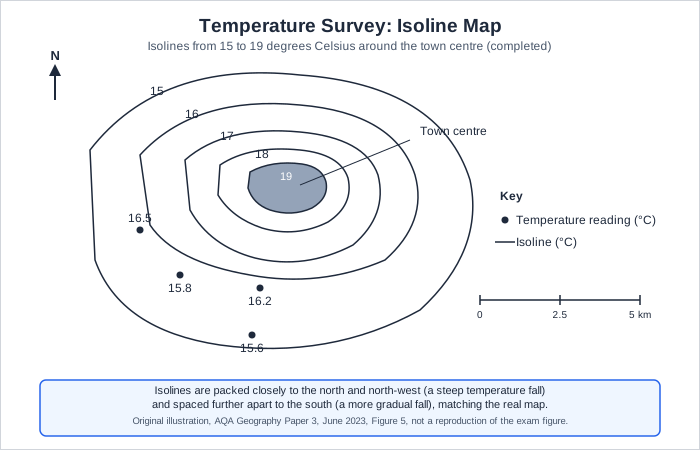
1×asked“Describe the pattern shown by the isoline map (Figure 5).”
“Describe the pattern shown by the isoline map (Figure 5).”
What it’s really asking
Describe how temperature changes with distance from the town centre shown on the isoline map, using direction as well as a rough rate of change.
What the sources actually showed — June 2023
An isoline map from a temperature-variation fieldwork enquiry, showing four individual temperature readings in degrees Celsius taken at different points around a town (16.5, 15.8, 16.2 and 15.6 degrees Celsius, all recorded some distance from the centre), joined into isolines running from 15 up to 19 degrees Celsius in whole-degree steps that form roughly concentric bands radiating outward from the town centre, with the highest readings recorded at the centre and progressively lower readings further out. The 15 to 19 degree isolines are packed closely together towards the north and north-west of the map, showing the fall in temperature is steepest in that direction, and spaced much further apart to the south, where the same five-degree drop happens over a longer distance.
The full worked answer — June 2023
Temperature is highest in the town centre and decreases with distance away from it in every direction. The fall in temperature is more noticeable towards the north and north-west of the map than elsewhere, where the isolines are spaced more closely together.
Could you have written this? Every fact in this answer is drilled in our quizzes — the writing is the easy part once the evidence is automatic.
Practise describing and comparing data questionsWhat the mark scheme rewarded
- An observation of the centre-to-edge fall, developed with a directional or rate-of-change point
- Isolines spaced closer together indicate a steeper rate of temperature change over a shorter distance
Traps examiners saw
- Only describing where it is hottest and coldest without describing the shape of the change between the two
Full-mark self-check 0 of 1
The method for every Q02.2 / Q01.2 / Q04.5 — same every sittingMark bands, steps, timing
What this question type rewards
The topic changes by sitting — the mark scheme never does. Learn this once, then open your question above for that sitting’s sources and a full worked answer.
- One mark for a general, accurate observation about the pattern
- A second mark for developing that observation with an actual number or a comparative point from the source
The steps
- State the overall pattern in one sentence, higher/lower, rising/falling, more/fewer
- Back it up with at least one real figure or named comparison lifted from the source
- Do not explain WHY the pattern exists here, this question only asks what the pattern IS
A student wants to compare the number of tourists visiting five different countries in 2023. Which type of graph is most appropriate?
Always back a description with a real number from the source. A pattern stated without evidence caps at half marks even when the observation itself is correct.
Practise describing and comparing data questions“Explain WHY a relationship holds, for example why economic development and urbanisation are linked, or why particular places attract visitors, not just describe THAT it holds.”
Most sittings include one short explain-the-link question in Section A, worth 2 to 4 marks depending on the year, that tests understanding of a geographical relationship rather than simple data reading.
1×asked“Explain the link between economic development and urbanisation.”
“Explain the link between economic development and urbanisation.”
What it’s really asking
Explain the mechanism connecting rising economic development to rising urbanisation, not just note that richer countries tend to be more urbanised.
What the sources actually showed — June 2020
The same resources-booklet graph of global urban and rural population trends referenced earlier in the paper, alongside contextual points comparing urbanisation rates against countries at different stages of economic development.
The full worked answer — June 2020
There is a clear positive relationship between economic development and urbanisation, because urban areas act as the core growth points where industry and infrastructure concentrate. This creates a wide range of jobs, from skilled factory and office work to informal opportunities like street trading, which pulls migrants in from rural areas in search of higher incomes.
Urban areas also offer better access to education and job-related training than most rural areas, which reinforces the cycle: as more people move to cities for opportunity, further investment follows the growing urban workforce, a pattern geographers sometimes call cumulative causation.
Could you have written this? Every fact in this answer is drilled in our quizzes — the writing is the easy part once the evidence is automatic.
Practise explain-the-link questionsWhat the mark scheme rewarded
- Naming the specific socio-economic opportunities that concentrate in urban 'core' areas, not a vague link
- Urban areas concentrate industry, infrastructure and both formal and informal employment, pulling in rural migrants
Traps examiners saw
- Simply stating 'richer countries are more urban' without explaining the mechanism that connects the two
Full-mark self-check 0 of 1
1×asked“Give two reasons for the growth of energy use in transport.”
“Give two reasons for the growth of energy use in transport.”
What it’s really asking
Give two distinct, reasonable causes of rising transport energy use, each expressed in terms of growth.
What the sources actually showed — June 2021
The resources-booklet graph tracking the changing pattern of UK energy production and use, including a section on how energy use by sector, including transport, has changed over recent decades.
The full worked answer — June 2021
Rising incomes have meant more households can afford to own a car, or a second car, so the total number of vehicle journeys made has grown. Rising levels of online shopping have also meant far more delivery vans and lorries are on the road than a decade ago, adding a whole extra layer of freight-related energy use.
Could you have written this? Every fact in this answer is drilled in our quizzes — the writing is the easy part once the evidence is automatic.
Practise explain-the-link questionsWhat the mark scheme rewarded
- Two distinct reasonable causes, each clearly tied to the idea of growth
- Growth in online shopping has driven a large rise in delivery vehicle mileage
Traps examiners saw
- Giving two versions of the same underlying point, for example 'more cars' and 'more lorries' counted as separate reasons when they are really one point about rising vehicle numbers
Full-mark self-check 0 of 1
1×asked“Explain how physical and cultural factors are important in attracting visitors to the Cayman Islands.”
“Explain how physical and cultural factors are important in attracting visitors to the Cayman Islands.”
What it’s really asking
Explain, not just list, both a physical factor and a cultural factor that attract visitors, developing each with why it matters to tourists.
What the sources actually showed — June 2023
A holiday-brochure style panel within the resources-booklet feature on the new Cayman Islands cruise terminal, headed 'Visit the Cayman Islands', describing physical attractions on Grand Cayman including the award-winning Seven Mile Beach and North Sound (home to a wide variety of marine life), alongside cultural attractions including George Town's traditional architecture, the National Museum of the Cayman Islands, the Turtle Centre, the Mastic Trail through sub-tropical forest, and the islands' traditional craft markets.
The full worked answer — June 2023
A key physical factor is Seven Mile Beach and the marine life of North Sound, which attracts sun-and-sea visitors as well as specialist diving and snorkelling tourists who spend more per visit than average sightseers, because that stretch of coastline and its marine environment cannot be experienced in most visitors' home countries.
A cultural factor is George Town's traditional architecture and attractions such as the National Museum of the Cayman Islands, the Turtle Centre and the islands' traditional craft markets, which give cruise passengers on a short stopover something distinctive to spend time and money on in the few hours they are ashore, rather than treating the islands as interchangeable with any other Caribbean port.
Could you have written this? Every fact in this answer is drilled in our quizzes — the writing is the easy part once the evidence is automatic.
Practise explain-the-link questionsWhat the mark scheme rewarded
- Both a physical and a cultural factor, each developed with why it matters to visitors, not just named
- Seven Mile Beach and North Sound's marine life draw sun-and-sea visitors and specialist, higher-spending divers and snorkellers
- George Town's traditional architecture, the National Museum, the Turtle Centre and craft markets give short-stay cruise passengers something distinctive to spend on
Traps examiners saw
- Naming one physical and one cultural factor but not developing either beyond a single sentence, which caps the answer at Level 1
Full-mark self-check 0 of 1
The method for every Q01.3 / Q01.2 / Q02.4 — same every sittingMark bands, steps, timing
What this question type rewards
The topic changes by sitting — the mark scheme never does. Learn this once, then open your question above for that sitting’s sources and a full worked answer.
- Naming the specific mechanism that links cause to effect, not just stating that a link exists
- Developing at least one point with a named example or a clear chain of reasoning
The steps
- State the link in your own words first
- Explain the mechanism that causes it, using a because-therefore chain
- Add one concrete, specific example or figure rather than staying generic
- Check you have gone beyond simply restating the question
How far in advance of the AQA Paper 3 exam do students receive the pre-release resource booklet for issue evaluation?
Push past stating that a link exists, explain the actual mechanism that causes it. That is the one move examiner reports flag again and again as missing.
Practise explain-the-link questions“Weigh up a statement using evidence from the resources booklet and your own geographical understanding, reaching a view rather than just listing points on both sides.”
Every sitting includes at least one 6-mark discuss or to-what-extent question in Section A, sometimes two. It is the mid-tier judgement question, smaller than the closing 9-mark decision but tested the same way: does the answer weigh evidence, or just list it.
1×asked“'Urban planners are finding it challenging to keep up with the growth of cities in LICs and NEEs.' To what extent do you agree with this statement?”
“'Urban planners are finding it challenging to keep up with the growth of cities in LICs and NEEs.' To what extent do you agree with this statement?”
What it’s really asking
Evaluate how far rapid urban growth genuinely outpaces planners' ability to cope, using resource evidence about specific planning pressures such as housing, services and infrastructure.
What the sources actually showed — June 2020
A resources-booklet infographic on the growth of slums in LICs and NEEs, describing African urban growth as fast enough to be expressed as population growth per hour rather than per year, comparing piped water access between urban and rural areas, and referencing the pressures cities face in providing housing, sanitation and other basic services to fast-growing populations.
The full worked answer — June 2020
I largely agree with the statement, because the sheer speed of urban growth in many LICs and NEEs outstrips what formal planning systems can physically deliver. Figure 2 describes African urban growth happening fast enough to be measured in population added per hour rather than per year, and where growth is that rapid, providing serviced land, piped water, sewage systems and housing at the same pace requires levels of investment and construction capacity that most LIC and NEE city authorities simply do not have, which is why so much growth ends up unplanned in informal settlements instead.
However, the challenge is not purely a lack of planning ability, it is also that much of the growth is driven by relatively poor migrants who cannot afford formally planned housing even where it exists, so authorities are managing an affordability problem as much as a construction problem. Figure 2's comparison of piped water access between urban and rural areas supports this: even though urban areas are consistently better served than rural ones, that headline average still leaves large numbers of the newest, poorest urban arrivals without a household connection, which shows that simply building more capacity in general does not automatically reach the people planners are struggling to keep up with.
Weighing the two points together, the affordability problem matters more than the raw construction problem, because it explains WHY formal planning keeps falling behind even in cities that do build new infrastructure: new capacity is being added, but not always at a price or in a location the fastest-growing, poorest population can access, which is the specific, evidenced reason I largely agree that planners are struggling to keep up.
Could you have written this? Every fact in this answer is drilled in our quizzes — the writing is the easy part once the evidence is automatic.
Practise 6-mark discuss and agree questionsWhat the mark scheme rewarded
- A detailed evaluation of the range of planning challenges, including why rapid growth makes them harder to manage, not just a list of problems
- Rapid population growth in LIC/NEE cities routinely outpaces the capacity of local authorities to extend piped water, sanitation and formal housing
- Much informal urban growth is driven by migrants who cannot afford formally planned housing even where it is built
Traps examiners saw
- Listing several planning problems (housing, water, waste) without ever explaining why growth specifically makes them hard to manage
Full-mark self-check 0 of 1
1×asked“'The use of renewable energy will help to manage climate change.' Discuss this statement.”
“'The use of renewable energy will help to manage climate change.' Discuss this statement.”
What it’s really asking
Discuss the actual causal chain between using more renewable energy and reduced climate change, rather than just asserting that renewables are 'green'.
What the sources actually showed — June 2021
The resources-booklet graph on the changing pattern of UK energy production and use, identifying renewable energy as a growing part of the UK's energy mix and referencing its role as a mitigating factor against climate change.
The full worked answer — June 2021
Renewable energy will help manage climate change because sources like wind and solar do not burn fossil fuels, so generating the same amount of electricity from them releases far fewer greenhouse gases than burning coal or gas, which is the main driver of rising global temperatures.
The impact is still only partial rather than a complete solution, though, because the UK's electricity supply is only one part of total energy use, and switching electricity generation to renewables does nothing on its own to cut emissions from sources like aviation or heavy industry that are much harder to electrify.
Could you have written this? Every fact in this answer is drilled in our quizzes — the writing is the easy part once the evidence is automatic.
Practise 6-mark discuss and agree questionsWhat the mark scheme rewarded
- An understanding that less fossil fuel use means fewer greenhouse gases, discussed rather than simply asserted
- Burning fossil fuels for electricity is a major source of the UK's greenhouse gas emissions
- Electricity generation is only one part of total energy demand, sectors like transport and industry are harder to decarbonise
Traps examiners saw
- Saying renewable energy is 'good for the environment' without explaining the actual greenhouse gas mechanism
Full-mark self-check 0 of 1
1×asked“Waste should be seen as 'a resource opportunity rather than a problem'. Do you agree? Explain your answer.”
“Waste should be seen as 'a resource opportunity rather than a problem'. Do you agree? Explain your answer.”
What it’s really asking
Weigh the case for treating waste as a recoverable resource against the real barriers (cost, contamination, technical limits) that stop all waste being recycled.
What the sources actually showed — June 2022
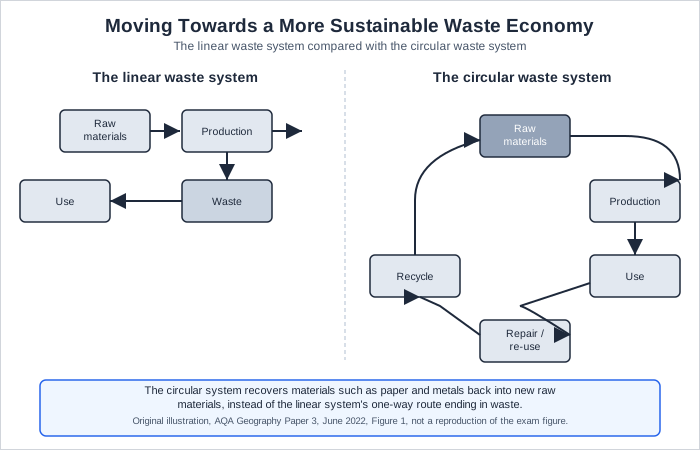
A resources-booklet infographic contrasting 'the linear waste system' (a one-way chain: raw materials, production, use, waste) with 'the circular waste system' (a loop: raw materials, production, use, repair or re-use, recycle, back to raw materials) in which materials such as paper and metals are recovered and reused, alongside a table listing 2018's top five UK plastic waste export destinations (Malaysia around 105,000 tonnes, Turkey around 80,000 tonnes, Poland around 70,000 tonnes, Indonesia around 63,000 tonnes and the Netherlands around 62,000 tonnes) and data on England's household recycling rate.
The full worked answer — June 2022
I largely agree that waste is a resource opportunity, because materials like paper and metals can be recovered and fed back into manufacturing instead of being extracted from the ground as new raw material, which is the entire idea behind a circular waste economy rather than the old take, make, dispose model.
However, treating waste purely as an opportunity risks overstating how much of it is genuinely recoverable. Not every material can be recycled economically, contamination in mixed household waste often makes otherwise recyclable material unusable, and it can sometimes be cheaper to produce brand new material than to sort and reprocess old material, which is exactly why England's own recycling rate levelled off at under half of all waste rather than climbing towards 100%.
Could you have written this? Every fact in this answer is drilled in our quizzes — the writing is the easy part once the evidence is automatic.
Practise 6-mark discuss and agree questionsWhat the mark scheme rewarded
- A discussion balancing the resource-recovery case against real limits such as cost, contamination and technical viability, using the recycling-rate plateau as evidence
- Recovered paper and metal can substitute for newly extracted raw material
- England's household recycling rate plateaued at around 45 percent rather than continuing to rise
Traps examiners saw
- Treating 'waste can be recycled' and 'recycling is good for the environment' as if they were two separate points rather than the same idea repeated
Full-mark self-check 0 of 1
1×asked“To what extent can tourism create opportunities for economic development?”
“To what extent can tourism create opportunities for economic development?”
What it’s really asking
Evaluate how far tourism income genuinely translates into broad-based economic development, weighing the multiplier effect and tax revenue against the industry's structural risks.
What the sources actually showed — June 2023
A resources-booklet profile of global tourism and development, giving figures on international tourist arrivals by region and average visitor spending, and describing how tourism income can support balance of payments and government spending on public services.
The full worked answer — June 2023
Tourism can create real economic development opportunities because visitor spending circulates through the local economy via the multiplier effect, as hotels and restaurants buy supplies and pay staff wages, who then spend that income locally, generating further rounds of economic activity beyond the initial tourist spend.
The opportunity is limited by how reliant an economy becomes on tourism, though, since the industry is vulnerable to external shocks such as economic downturns in visitors' home countries or global health crises, which can cause arrivals and the tax revenue governments depend on to collapse very quickly.
Could you have written this? Every fact in this answer is drilled in our quizzes — the writing is the easy part once the evidence is automatic.
Practise 6-mark discuss and agree questionsWhat the mark scheme rewarded
- An explanation of the multiplier effect and/or the effect on balance of payments and public spending, developed rather than merely stated
- Tourist spending recirculates through local economies via hotel and restaurant wages, the multiplier effect
- Tourism-dependent economies are exposed to external shocks that can sharply cut visitor numbers
Traps examiners saw
- Saying tourism 'brings money and jobs' without explaining the multiplier mechanism that makes the initial spend generate further economic activity
Full-mark self-check 0 of 1
The method for every Q02.4 / Q01.4 / Q01.5 / Q01.4 — same every sittingMark bands, steps, timing
What this question type rewards
The topic changes by sitting — the mark scheme never does. Learn this once, then open your question above for that sitting’s sources and a full worked answer.
- A discussion that develops points from the resources rather than copying them
- Some sense of relative importance between the points made, not just a flat list
The steps
- Identify two or three genuinely different points from the resource booklet or from your own knowledge
- Develop each one, do not just list them, explain what it shows and why it matters to the statement
- Where the question allows, weigh the points against each other rather than presenting a flat list
- Keep this shorter than the 9-mark question, aim for 2 to 3 tight paragraphs, not 5
How far in advance of the AQA Paper 3 exam do students receive the pre-release resource booklet for issue evaluation?
Practise writing a judgement-first opening sentence, then developing two distinct, evidenced points rather than a flat list. That structure alone lifts most answers a full level.
Practise 6-mark discuss and agree questions“Every single sitting closes Section A with the same move: study Figure 3, take a side on a Yes/No question, and defend it using evidence drawn from across the WHOLE resources booklet, not just Figure 3.”
This is the single most reliable question on the entire paper. It is always the last question of Section A, it is always worth 9 marks plus 3 marks for spelling, punctuation, grammar and terminology, and it is always built the same way: reach a judgement and defend it with a wide, synoptic range of evidence. If you learn one exam technique from this paper, learn this one.
1×asked“'Slums of hope or slums of despair?' Which do you think best describes urban slums in LIC/NEE cities? Use evidence from the resources booklet and your own understanding to support your answer.”
“'Slums of hope or slums of despair?' Which do you think best describes urban slums in LIC/NEE cities? Use evidence from the resources booklet and your own understanding to support your answer.”
What it’s really asking
Reach and defend a judgement on whether LIC/NEE urban slums are better characterised as places of opportunity or places of hardship, using evidence spread across the whole resources booklet, not only the named Figure 3.
What the sources actually showed — June 2020
A resources-booklet feature titled 'Slums of hope or slums of despair?', presenting first-hand accounts and data about life in a named LIC/NEE informal settlement, covering both positive elements (informal businesses, community support networks, self-built home improvement over time) and negative elements (overcrowding, poor sanitation, exposure to disease and crime).
The same slum-growth infographic used earlier in the paper, giving comparative urban and rural piped water access figures and describing the scale and pace of African urban growth.
The full worked answer — June 2020
I think 'hope' is the more accurate description overall, because Figure 3 shows that many slum residents actively improve their situation over time, building informal businesses and gradually upgrading their self-built homes, rather than simply enduring fixed, unchanging poverty.
This is not the whole picture, though. Figure 2's comparison of piped water access shows urban areas in general have far better provision than rural areas, but from my own understanding of how citywide averages work, that headline urban figure most likely hides real internal inequality, since slum residents are usually the ones least likely to share in that urban advantage, often still relying on shared standpipes or informal vendors rather than a household connection.
Weighing the two, I still lean towards 'hope' overall, because the alternative for most slum residents is not a comfortable rural life but rural poverty with far fewer economic opportunities, so even an unequal slum still represents a real improvement in most residents' income and life chances compared with where they came from, which is the wider migration pattern driving urban growth across LICs and NEEs in the first place.
Could you have written this? Every fact in this answer is drilled in our quizzes — the writing is the easy part once the evidence is automatic.
Practise the 9-mark decision questionWhat the mark scheme rewarded
- A wide range of evidence drawn from across the resources booklet, not Figure 3 alone, developed into a genuine evaluative discussion supporting a stated judgement
- Slum residents often build informal businesses and incrementally improve self-built housing over time
- Urban averages for services like piped water can mask severe inequality within cities, with slum areas missing out on the urban advantage
- Rural-to-urban migration to slums is usually still an improvement in income and opportunity relative to the rural alternative
Traps examiners saw
- Using only Figure 3 and ignoring the rest of the resources booklet, which caps the answer at Level 1 even with a clearly stated judgement
- Treating 'hope' and 'despair' as needing equal space when a judgement question rewards a clear, argued lean towards one side
Full-mark self-check 0 of 4
1×asked“'Large scale wind energy projects are a suitable option for the Isle of Lewis.' Do you agree with this statement? Use evidence from the resources booklet and your own understanding to explain your answer.”
“'Large scale wind energy projects are a suitable option for the Isle of Lewis.' Do you agree with this statement? Use evidence from the resources booklet and your own understanding to explain your answer.”
What it’s really asking
Reach and defend a Yes/No judgement on whether a large wind farm suits the Isle of Lewis specifically, using its real socio-economic and environmental circumstances from across the resources booklet, not a generic case for or against wind power.
What the sources actually showed — June 2021
A resources-booklet feature on views about a proposed large-scale wind farm development on the Isle of Lewis in the Outer Hebrides, including a population pyramid comparing the age structure of the islands in 2016 against a 2041 projection, and quoted local views both supporting the jobs and investment the project could bring and opposing its visual and environmental impact on the landscape and existing tourism.
The resources-booklet feature on the development of renewable energy sources, giving the growth in UK renewable energy capacity in gigawatts between 2010 and 2018 and comparing onshore against offshore wind locations.
The full worked answer — June 2021
I agree that a large-scale wind farm is a suitable option for the Isle of Lewis, because Figure 3's population pyramid shows the islands' population is projected to age significantly between 2016 and 2041, with fewer working-age residents remaining. A major construction and long-term maintenance project is one of the few realistic ways to create secure, well-paid jobs that could persuade younger residents to stay rather than migrate away for work, which is the islands' underlying economic problem.
Set against this, Figure 3 also records local opposition based on the visual impact of large turbines on a landscape that itself supports the tourism industry, and Figure 2's own data shows UK renewable capacity growing by around 34 gigawatts between 2010 and 2018 through a mix of sites, which in my own judgement suggests the national renewable target does not depend on this one island project succeeding, even though Figure 2 itself does not comment on Lewis specifically.
On balance I still support the project, because the demographic pressure shown in Figure 3 is specific and worsening for Lewis itself, whereas the national renewable capacity point in Figure 2 is only a general observation about the wider UK picture and does not remove the case for this particular island's economy, so the local jobs argument carries more weight than the generic landscape objection.
Could you have written this? Every fact in this answer is drilled in our quizzes — the writing is the easy part once the evidence is automatic.
Practise the 9-mark decision questionWhat the mark scheme rewarded
- Use of evidence across the whole resources booklet, weighing socio-economic gain against environmental and visual cost, to reach and argue for a decision
- The Outer Hebrides population pyramid shows an ageing population with a shrinking working-age share by 2041
- UK renewable energy capacity grew substantially between 2010 and 2018, showing the sector is expanding nationally regardless of any single project
- Large wind farms bring construction and long-term maintenance jobs but can affect tourism-dependent landscapes
Traps examiners saw
- Writing a generic 'wind power is good/bad for the environment' essay that never engages with why the Isle of Lewis specifically needs or does not need this project
Full-mark self-check 0 of 4
1×asked“The proposal to build the waste incinerator was rejected in June 2020. Do you think that this was the correct decision? Use evidence from the resources booklet and your own understanding to explain your answer.”
“The proposal to build the waste incinerator was rejected in June 2020. Do you think that this was the correct decision? Use evidence from the resources booklet and your own understanding to explain your answer.”
What it’s really asking
Reach and defend a judgement on whether rejecting the Cambridge waste incinerator was the right call, weighing the growing city's waste pressures against the incinerator's environmental and locational drawbacks.
What the sources actually showed — June 2022
A resources-booklet feature titled 'Amey push to win planning battle for energy from waste plant', reporting that the existing landfill capacity will soon be full and setting out supporters' case that the incinerator would cut landfill, increase recycling and create jobs, and, thanks to strict environmental guidelines, would not cause an air pollution problem, alongside a quote from the managing director of the Waste Management Park calling it a sustainable solution that would supply electricity to thousands of homes and reduce the carbon footprint. It also includes a second feature headed 'Waste incinerator will dominate the landscape and ruin views of Ely Cathedral', giving the proposed building's real dimensions (141 metres long, 91 metres wide, with an 80-metre chimney), its closeness to the listed Denny Abbey and Denny Farmland Museum, extra heavy traffic from bringing in waste, and concerns raised by the campaign group 'Cambridge Without Incineration' about proximity to the new town. A closing update states the proposal was rejected by the government in June 2020.
The resources-booklet feature and OS map extract on the proposed incinerator site near Waterbeach on the edge of Cambridge. Amey Waste Services already runs a 162-hectare Waste Management Park on the site and currently sends around 200,000 tonnes of waste a year to landfill there. Amey's key facts state that over 80% of this landfilled waste could instead be incinerated, that the new facility could handle up to 250,000 tonnes of waste a year, generate enough electricity for around 63,000 homes, and create over 300 jobs during construction and operation, at a stated cost of around 100 million pounds, and that it would provide a source of energy for the new town planned on the nearby former Barracks site. The feature also quotes a Lincoln council waste manager describing a comparable 125-million-pound energy-from-waste plant that has processed over a million tonnes of waste since 2005, supplied energy to 29,000 homes, produced 215,000 tonnes of ash used in road construction, cut landfill by 92% and saved 91 pounds per tonne in landfill tax, set against a university lecturer's opposing view that incineration adds air pollution, raises carbon dioxide emissions and reduces recycling rates. The real OS map extract itself shows the genuine physical geography around Waterbeach (the flat, low-lying land, its distance from Cambridge, and the nearby site of the new town on the former Barracks) and is not reproduced here, since it is the genuine copyrighted Ordnance Survey cartography of a real location, not an illustrative diagram.
The full worked answer — June 2022
I disagree with the rejection, because Figure 2 shows Cambridge's population is growing and its existing landfill capacity is nearly full, meaning the city needs a genuine alternative waste solution soon, and Figure 2 also shows the incinerator could have supplied heat and energy to a planned new town nearby, turning a waste problem into a useful resource rather than simply exporting the issue elsewhere.
However, Figure 3's concerns about the incinerator's impact on the landscape are a genuine reason for caution, since the 80-metre chimney and huge building would dominate views near the historic Denny Abbey and ruin the setting around Ely Cathedral, and the extra heavy traffic needed to keep the plant supplied would add further pressure to an already-stretched road network close to the new town at the former Barracks site.
Could you have written this? Every fact in this answer is drilled in our quizzes — the writing is the easy part once the evidence is automatic.
Practise the 9-mark decision questionWhat the mark scheme rewarded
- A discussion that uses evidence on both the city's waste pressures and the incinerator's landscape and heritage impact, reaching a stated judgement
- Cambridge's population growth and nearly-full landfill capacity create pressure for a new waste solution
- The proposed incinerator would supply heat and energy to a planned new town nearby
- The 80-metre chimney's closeness to Denny Abbey and Ely Cathedral raises landscape and heritage concerns, and the extra traffic adds pressure to local roads
Traps examiners saw
- Discussing waste incineration in general terms without tying the answer back to Cambridge's specific landfill pressure and the site's specific proximity to housing
Full-mark self-check 0 of 3
1×asked“Do you think that the cruise ship terminal and port facility development proposed by the Cayman Island government in 2019 should go ahead? Use evidence from the resources booklet and your own understanding to explain your answer.”
“Do you think that the cruise ship terminal and port facility development proposed by the Cayman Island government in 2019 should go ahead? Use evidence from the resources booklet and your own understanding to explain your answer.”
What it’s really asking
Reach and defend a Yes/No judgement on the Cayman Islands cruise terminal proposal, weighing its economic and regeneration benefits against the marine environmental risk, using evidence spread across the resources booklet.
What the sources actually showed — June 2023
A resources-booklet feature titled 'Different views about the proposed cruise ship and port facility in Grand Cayman'. The government's case describes a George Town Revitalisation Initiative bringing new living and business space, cafes and restaurants, a pedestrianised area and improved cycling access, and lists real positive impacts (guaranteed growth in cruise tourism, more cruise passengers coming ashore, increased trade for local business, reduced small-boat traffic and marine-accident risk, regeneration of George Town harbour, separation of cruise and cargo trade) against real negative impacts (damage to the coral reef and loss of some snorkelling and diving sites, increased traffic in George Town, the cost of managing rising visitor numbers, lost income for water-sports, diving and small-boat operators, and the risk that more cruise visitors deters stay-over visitors). A named RSPB Caribbean manager states that 15 acres of coral reef, home to the critically endangered Hawksbill Turtle, could be destroyed to build two cruise ship docks, with 22 acres of seabed dredged. Local views quoted include a business owner welcoming year-round wealthy visitors, the National Trust for the Cayman Islands calling the reef a unique marine environment, a Cayman Islands Business Report stating cruise tourism supported over 4,000 jobs and nearly 100 million dollars in wages in 2018, and a Cayman Campaign Group warning of negative consequences for future generations.
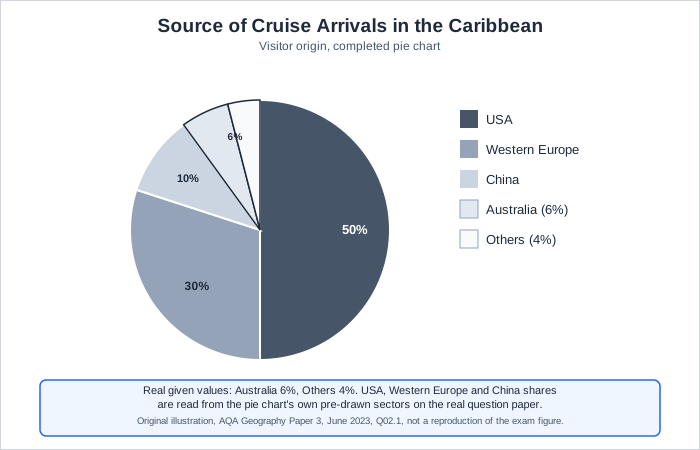
The resources-booklet feature on the proposed cruise terminal. A 'Cayman Islands, growth of trade' table gives real import tonnages and cruise passenger numbers at intervals from 1977 to 2018 (imports rising from 25,000 tonnes in 1977 to 554,844 tonnes in 2018, cruise passengers first recorded in 1998 at 871,400, rising to 1.92 million by 2018), showing the existing 1977-built cargo port sharing facilities with cruise companies is under growing pressure. A pie chart titled 'Source of cruise arrivals in the Caribbean' shows the USA supplying around half of all Caribbean cruise arrivals, Western Europe around 30%, China around 10%, Australia 6% and other origins 4%. A 'Visit the Cayman Islands' brochure panel lists physical and cultural attractions including the award-winning Seven Mile Beach, North Sound's marine life, the Queen Elizabeth II Botanic Park (home to the Cayman blue iguana), and George Town's National Museum, Turtle Centre, Mastic Trail and traditional craft markets.
| Date | Imports (tonnes) | Cruise passengers |
|---|---|---|
| 1977 | 25000 | No data |
| 1978 | 45000 | No data |
| 1988 | 125000 | No data |
| 1998 | 221379 | 871,400 |
| 2008 | 313406 | 1.55 million |
| 2018 | 554844 | 1.92 million |
The full worked answer — June 2023
I think the development should not go ahead in its current form, because Figure 2 identifies North Sound's marine life and the wider natural environment as key physical attractions for visitors, and Figure 3's own National Trust quote names the coral reef itself as the reason thousands of visitors come for diving and snorkelling, so its concern about dredging and construction disturbing coral and marine life threatens to damage the very asset that a large part of the islands' tourism economy already depends on.
Figure 3's case for the development is genuinely strong on its own terms, though, since the scheme is described as a multi-use development regenerating a run-down port area rather than only a tourist facility, which could bring wider local benefits such as improved infrastructure and non-tourism jobs that a narrower cruise-only project would not deliver.
Weighing the two, the regeneration benefits could most likely be achieved through a smaller-scale port upgrade that avoids large-scale dredging near the reef, so the specific environmental risk of the current cruise-terminal-scale proposal is not, in my view, worth accepting when a version of the same economic benefit could plausibly be delivered with less damage to the reef the islands' tourism industry relies on.
Could you have written this? Every fact in this answer is drilled in our quizzes — the writing is the easy part once the evidence is automatic.
Practise the 9-mark decision questionWhat the mark scheme rewarded
- A wide-ranging, evidenced discussion that tests the economic case against the environmental risk and reaches a fully argued judgement
- Figure 2's marine and natural attractions and Figure 3's National Trust quote both identify the coral reef and its marine life as a key draw for visitors to the Cayman Islands
- The proposed development is described as a multi-use scheme regenerating a run-down port area, not purely a tourist facility
- Dredging and construction for large port developments can disturb coral reefs and marine habitats
Traps examiners saw
- Discussing cruise tourism's economic benefits in general without engaging with the specific environmental risk to the coral reef that Figure 3 raises
Full-mark self-check 0 of 4
The method for every Q03 / Q03.2 / Q03 / Q03 — same every sittingMark bands, steps, timing
What this question type rewards
The topic changes by sitting — the mark scheme never does. Learn this once, then open your question above for that sitting’s sources and a full worked answer.
- A stated or clearly implied judgement, reached using a WIDE range of evidence from across the whole resources booklet, not just Figure 3
- Specific links to other parts of the specification (the synoptic element examiners explicitly look for)
- Effective communication, which is separately credited under AO4 alongside the dedicated SPaG marks
The steps
- Decide your position early, tick the box, and let every paragraph build towards it
- Use Figure 3 first, since the question specifically directs you there, but do not stop there
- Pull in at least one more figure or piece of resource-booklet evidence beyond Figure 3, this is what separates Level 2 from Level 1
- Link at least one point to the wider specification beyond just this sitting's topic, for example connecting a local issue to a national or global pattern
- Finish with a short conclusion that explicitly restates your decision and briefly ranks why your strongest point outweighs the other side
- Save time to proofread for SPaG, since this is the only question on the paper where spelling and grammar carry their own marks
What is a stakeholder?
This is the single most reliable question on the whole paper. Practise it until using evidence from beyond Figure 3 and reaching an argued, not just stated, judgement becomes automatic.
Practise the 9-mark decision question“Look at how someone else collected their fieldwork data and suggest genuine, specific ways to make the method better, not just 'collect more data'.”
Every sitting's Section B includes a 'suggest an improvement' question about the unfamiliar student's method. It always wants a specific, practical fix, not a vague general statement.
1×asked“Suggest two ways that the data collection method could be adapted in order to make it more useful.”
“Suggest two ways that the data collection method could be adapted in order to make it more useful.”
What it’s really asking
Suggest two specific, distinct fixes to a pebble-measuring method that only sampled ten pebbles at each of three sites.
What the sources actually showed — June 2020
A table recording the long axis, in millimetres, of ten pebbles sampled at each of three sites (A, B and C) along a river, used to test the hypothesis that pebble size decreases downstream.
The full worked answer — June 2020
A larger sample of pebbles at each site, for example fifty rather than ten, would reduce the effect of one or two unusually large or small pebbles skewing the site's average. A second improvement would be to use a random sampling method, such as a random number generator to pick pebbles along a measuring tape, rather than picking pebbles by eye, which can unconsciously favour larger, more visible pebbles.
Could you have written this? Every fact in this answer is drilled in our quizzes — the writing is the easy part once the evidence is automatic.
Practise improving fieldwork methods questionsWhat the mark scheme rewarded
- Two distinct, specific adaptations, such as larger sample size and a genuinely random sampling method
- A small sample of ten pebbles per site is vulnerable to being skewed by one or two unusually sized pebbles
Traps examiners saw
- Giving 'take a bigger sample' twice in slightly different words instead of two genuinely different improvements
Full-mark self-check 0 of 1
1×asked“Suggest two ways the questionnaire shown in Figure 6 could be improved to make it more useful.”
“Suggest two ways the questionnaire shown in Figure 6 could be improved to make it more useful.”
What it’s really asking
Suggest two specific improvements to a short four-question visitor questionnaire that only asked age, home location, last visit date and mode of transport.
What the sources actually showed — June 2021
A four-question visitor questionnaire used to investigate travel to an out-of-town shopping centre, asking respondents their age, where they live, when they last visited, and what method of transport they used, without offering any pre-set tick-box answer options.
The full worked answer — June 2021
Adding tick-box answer options to the transport and age questions, rather than leaving them open-ended, would make responses much faster and easier to compare and graph afterwards. A second improvement would be to ask how far visitors had travelled in addition to where they live, since a home location alone does not tell the student the actual distance travelled, which is central to the enquiry's aim.
Could you have written this? Every fact in this answer is drilled in our quizzes — the writing is the easy part once the evidence is automatic.
Practise improving fieldwork methods questionsWhat the mark scheme rewarded
- Two distinct, specific improvements, such as adding tick-box options or asking directly about distance travelled
- The questionnaire records home location but not distance travelled, which the enquiry actually needed
Traps examiners saw
- Suggesting an entirely new, unrelated question rather than improving the ones already asked
Full-mark self-check 0 of 1
1×asked“Suggest two ways that the primary data collection methods could be adapted to give more reliable data.”
“Suggest two ways that the primary data collection methods could be adapted to give more reliable data.”
What it’s really asking
Suggest two specific ways of adapting the existing land use, environmental quality and pedestrian count surveys, not new methods entirely.
What the sources actually showed — June 2022
A record of primary data collected in a High Street on one Wednesday in July 2019, comprising a land use survey (counts of shop types), an environmental quality survey using a scored scale, and pedestrian counts at three points, compared against a second pedestrian count taken on one Wednesday in January.
The full worked answer — June 2022
Repeating the pedestrian counts on a Saturday as well as a Wednesday, and at more than two dates across the year, would show whether the July count was typical of the summer tourist season rather than a one-off. A second adaptation would be widening the environmental quality survey to more locations along the High Street rather than a single overall score, so that any variation between the busiest and quietest sections is not hidden in one combined figure.
Could you have written this? Every fact in this answer is drilled in our quizzes — the writing is the easy part once the evidence is automatic.
Practise improving fieldwork methods questionsWhat the mark scheme rewarded
- Adaptations to the EXISTING methods (more days, more locations, wider time coverage), not brand new data collection methods
- Data was collected on only one Wednesday in July and one Wednesday in January, which cannot show a full seasonal or weekly pattern
Traps examiners saw
- Suggesting an entirely new method, such as 'do a questionnaire', when the question specifically asks for adaptations to the methods already used
Full-mark self-check 0 of 1
1×asked“Suggest two ways that the house price survey could be adapted to make it more useful.”
“Suggest two ways that the house price survey could be adapted to make it more useful.”
What it’s really asking
Suggest two specific ways of refining a house price survey that used only seven broad areas and four broad price bands.
What the sources actually showed — June 2023
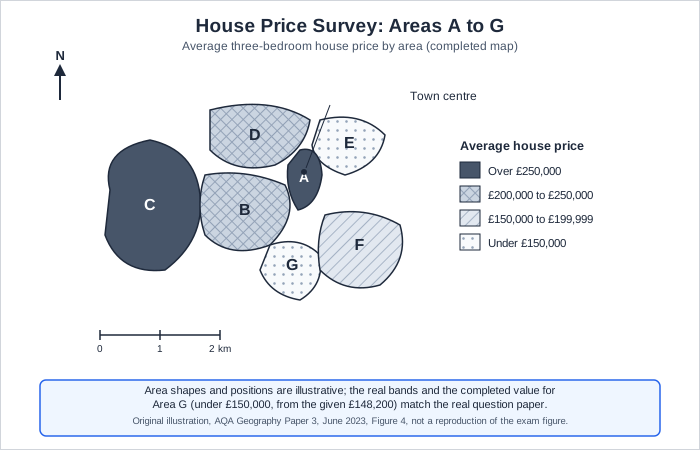
A choropleth map of average three-bedroom house prices across seven named areas (A to G) of a town, shaded into four broad price bands from under £150,000 to over £250,000, collected from estate agents.
The full worked answer — June 2023
Using smaller, more numerous areas instead of seven broad zones would reveal price variation that is currently hidden within each large area. A second improvement would be using narrower price bands than the current four broad categories, so that two areas which both fall in the same wide band, but are actually quite different in price, are not made to look identical on the map.
Could you have written this? Every fact in this answer is drilled in our quizzes — the writing is the easy part once the evidence is automatic.
Practise improving fieldwork methods questionsWhat the mark scheme rewarded
- Specific refinements such as smaller areas or narrower price bands, or a wider range of property types
- Seven broad areas and four broad price bands can hide real internal price variation within a single area or band
Traps examiners saw
- Suggesting a completely different data source (for example 'ask residents directly') instead of refining the existing estate agent survey
Full-mark self-check 0 of 1
The method for every Q04.6 / Q04.5 / Q04.4 / Q04.3 — same every sittingMark bands, steps, timing
What this question type rewards
The topic changes by sitting — the mark scheme never does. Learn this once, then open your question above for that sitting’s sources and a full worked answer.
- Two genuinely distinct, specific suggestions, each tied to a real weakness in the described method
- Suggestions that would actually produce more reliable or more useful data for THIS enquiry, not a generic 'do more of it'
The steps
- Identify what is actually limited about the method described, small sample, one day only, narrow categories, leading questions
- Suggest a specific fix for that exact limitation, not a generic 'collect more data'
- Give a second, genuinely different suggestion rather than a rewording of the first
- Check both suggestions would actually help answer THIS enquiry's aim
Which sampling method involves collecting data at regular, pre-set intervals — for example, every 10 metres along a transect?
Practise naming a SPECIFIC weakness in a described method before suggesting a fix for exactly that weakness, rather than a generic 'collect more data'.
Practise improving fieldwork methods questions“State what the data actually shows in relation to the enquiry's original aim, using a real figure from the source, not a vague general impression.”
A short 'what does this data show' question appears in Section B in every sitting. It rewards linking straight back to the enquiry's stated aim or hypothesis.
1×asked“Outline the conclusions that the students could draw from the data.”
“Outline the conclusions that the students could draw from the data.”
What it’s really asking
State whether the pebble data supports the hypothesis that pebble size decreases downstream, using the median values as evidence.
What the sources actually showed — June 2020
The same table of pebble long-axis measurements from three river sites (A, B and C), where the median pebble size at Place A was 16.5 mm and at Place B was 10.5 mm.
The full worked answer — June 2020
The data supports the original hypothesis that pebbles get smaller further downstream. The median pebble size falls from 16.5 mm at Place A to 10.5 mm at Place B, and falls further still to 9.5 mm at Place C, showing a consistent downstream decrease across all three sites.
Could you have written this? Every fact in this answer is drilled in our quizzes — the writing is the easy part once the evidence is automatic.
Practise drawing conclusions from data questionsWhat the mark scheme rewarded
- A conclusion linked to the hypothesis, developed using the real median figures in sequence
- Median pebble size fell from 16.5 mm to 10.5 mm to 9.5 mm across the three sites, from upstream to downstream
Traps examiners saw
- Describing the data without ever stating whether it supports or contradicts the original hypothesis
Full-mark self-check 0 of 1
1×asked“Outline the conclusions that the students could make from the data (Figure 4).”
“Outline the conclusions that the students could make from the data (Figure 4).”
What it’s really asking
State which footpath rated best and which rated worst for quality, linked to the enquiry's aim of comparing footpath quality.
What the sources actually showed — June 2021
A table recording how 50 visitors rated the quality of three footpaths (A, B and C) using four categories: very good, good, fair and poor.
The full worked answer — June 2021
Footpath A appears to have the highest quality, since it received the most 'very good' and 'good' ratings of the three footpaths. Footpath B appears to have the lowest quality, receiving the highest number of 'poor' ratings, showing that footpath quality does genuinely vary across the National Park as the enquiry set out to investigate.
Could you have written this? Every fact in this answer is drilled in our quizzes — the writing is the easy part once the evidence is automatic.
Practise drawing conclusions from data questionsWhat the mark scheme rewarded
- Naming the highest and/or lowest-rated footpath, linked to the enquiry's aim about whether quality varies
- Footpath A received the most positive ratings, Footpath B received the most poor ratings
Traps examiners saw
- Simply repeating one footpath's rating numbers without comparing it to the others or answering the 'does it vary' question
Full-mark self-check 0 of 1
1×asked“Using the data from Figure 4, state two conclusions that the student might draw about the impact of tourism.”
“Using the data from Figure 4, state two conclusions that the student might draw about the impact of tourism.”
What it’s really asking
State two distinct conclusions about tourism's impact, one drawn from the land use data and one from the pedestrian count data, linked to the enquiry's aim.
What the sources actually showed — June 2022
The same land use, environmental quality and pedestrian count survey of a High Street, recording shop-type counts among 84 shops in total, alongside pedestrian counts at three points on a July Wednesday compared with the same three points on a January Wednesday.
| Land use category | Number |
|---|---|
| Supermarkets | 3 |
| Clothes shops | 18 |
| Souvenir shops | 11 |
| Cafes/restaurants | 14 |
| Hotels/bed and breakfasts | 4 |
| Newsagents/general stores | 10 |
| Services (hairdressers/estate agents) | 6 |
| Financial services | 3 |
| Others | 15 |
| Pedestrian count, eastern end (July / January) | 31 / 11 |
| Pedestrian count, middle (July / January) | 186 / 27 |
| Pedestrian count, western end (July / January) | 93 / 38 |
The full worked answer — June 2022
There is a disproportionate number of tourist-related businesses on the High Street, with 11 souvenir shops and 4 hotels or bed and breakfasts among the 84 shops recorded, suggesting tourism is economically significant to the town. There were also far more pedestrians in July than January, 186 compared with 27 at the same midpoint location, suggesting tourism brings a substantial seasonal increase in visitor numbers.
Could you have written this? Every fact in this answer is drilled in our quizzes — the writing is the easy part once the evidence is automatic.
Practise drawing conclusions from data questionsWhat the mark scheme rewarded
- Two distinct, data-supported conclusions about tourism's impact, not simply 'more pollution' or 'makes the environment worse' with no data link
- 11 souvenir shops and 4 hotels/B&Bs feature among 84 total shops on the High Street
- Pedestrian counts rose from 27 in January to 186 in July at the same location
Traps examiners saw
- Giving a vague conclusion like 'more litter' or 'worse environment' with no supporting figure, which the mark scheme explicitly refuses credit for
Full-mark self-check 0 of 1
1×asked“Suggest what the map shows about the pattern of house prices in the town.”
“Suggest what the map shows about the pattern of house prices in the town.”
What it’s really asking
State the overall spatial pattern of house prices shown on the choropleth map, considering more than one price band.
What the sources actually showed — June 2023
The completed choropleth map of average three-bedroom house prices across seven named areas (A to G) of a town. Area A, right at the town centre, and Area C, to the west, are both in the highest band (over 250,000 pounds). Areas B and D, forming a middle band around the centre and to the north, are in the 200,000 to 250,000 pound band. Areas E (immediately north-east of the centre) and G (south of the centre, completed using the given value of 148,200 pounds) are both in the lowest band (under 150,000 pounds), while Area F, to the east, sits in the 150,000 to 199,999 pound band in between.
The full worked answer — June 2023
There is only a partial pattern rather than a simple centre-to-edge gradient: the highest priced houses are found in Area A at the town centre and Area C to the west, while the lowest priced houses in Areas E and G form a band running roughly north to south just east of the centre, rather than simply being furthest from the centre in every direction.
Could you have written this? Every fact in this answer is drilled in our quizzes — the writing is the easy part once the evidence is automatic.
Practise drawing conclusions from data questionsWhat the mark scheme rewarded
- A description considering more than one price band, describing the actual spatial arrangement, not just repeating individual area values
- Highest prices cluster in Area A (town centre) and Area C (west), lowest prices in Areas E and G form a roughly north-south band just east of the centre
Traps examiners saw
- Simply listing which named areas have which price band, without describing the overall spatial pattern this creates
Full-mark self-check 0 of 1
The method for every Q04.5 / Q04.3 / Q04.3 / Q04.2 — same every sittingMark bands, steps, timing
What this question type rewards
The topic changes by sitting — the mark scheme never does. Learn this once, then open your question above for that sitting’s sources and a full worked answer.
- A conclusion that is explicitly linked back to the enquiry's original aim or hypothesis, not a free-floating observation
- A conclusion supported by an actual figure from the data, not just repeated description
The steps
- Reread the enquiry's stated aim or hypothesis before answering
- State whether the data supports it, refutes it, or is more mixed
- Back this up with one real number or comparison from the source
- Do not explain WHY the pattern happened here, only WHAT it shows
Which sampling method involves collecting data at regular, pre-set intervals — for example, every 10 metres along a transect?
Always link your conclusion explicitly back to the enquiry's stated aim or hypothesis, and back it with a real figure. That is worth the second mark almost every time.
Practise drawing conclusions from data questions“This is the fieldwork section's version of a judgement question: use real numbers, not just impressions, to decide how far the data actually proves the point it is being used for.”
Every single sitting has a real, level-marked, 4-mark version of this question in Section B, though the exact framing changes: how reliable are the conclusions, how does one place compare with another, does the data prove the hypothesis, which option is best supported. In every version the top marks go to genuine data manipulation, not just eyeballing the numbers.
1×asked“To what extent can the student draw reliable conclusions from the data?”
“To what extent can the student draw reliable conclusions from the data?”
What it’s really asking
Judge how far a car park survey covering only two time points and a loosely-linked questionnaire can reliably answer 'does the town centre have a parking problem'.
What the sources actually showed — June 2020
Results of a car park occupancy survey at three car parks (A, B and C), recorded once on a Wednesday afternoon and once on a Saturday morning, alongside a 100-person questionnaire in which 37 people said the town centre had a parking problem, 21 said no, and 42 said they did not know.
| Car park | % full, Wednesday 3pm | % full, Saturday 11am |
|---|---|---|
| A | 32 | 63 |
| B | 74 | 91 |
| C | 52 | 75 |
The full worked answer — June 2020
The data gives a reasonable, but not fully reliable, picture. Car Park B, closest to the main shopping area, runs at 74% full on Wednesday and 91% full on Saturday, which does suggest real pressure on parking near the shops, especially at weekends.
However, the survey was only carried out on two specific days and times, so it cannot show whether this pattern holds on other days of the week. The questionnaire link is also weak, since 42 of the 100 people said they did not know if there was a parking problem, and the two questions were not directly connected, weakening the conclusion that public opinion confirms the car park data.
Could you have written this? Every fact in this answer is drilled in our quizzes — the writing is the easy part once the evidence is automatic.
Practise justifying a conclusion with data questionsWhat the mark scheme rewarded
- Clear analysis of the actual data (using real percentages and figures) in relation to the reliability of the conclusions, not just an assertion that the data is or is not reliable
- Car Park B ran at 74% full on Wednesday and 91% full on Saturday
- 42 of 100 questionnaire respondents said they did not know if there was a parking problem
Traps examiners saw
- Simply asserting 'the data is reliable' or 'the data is unreliable' without pointing to a specific figure or limitation as evidence
Full-mark self-check 0 of 1
1×asked“Using Figure 10, compare the proportion of charity shops between the three town centres.”
“Using Figure 10, compare the proportion of charity shops between the three town centres.”
What it’s really asking
Convert the raw charity-shop counts into a genuine proportion or percentage for each town centre and compare those, not just compare the raw counts.
What the sources actually showed — June 2021
A completed summary table giving the number of charity shops and the total number of shops in three town centres: town centre A with 9 charity shops out of 92 shops, town centre B with 19 out of 114, and town centre C with 18 out of 142.
The full worked answer — June 2021
Converting the raw counts into proportions changes the picture considerably. Town centre B has the highest proportion of charity shops at around 17%, roughly 1 in 6 shops, town centre C is next at around 13%, just under 1 in 8 shops, and town centre A has the lowest proportion at around 10%, just over 1 in 10 shops, even though B and C actually have similar raw numbers of charity shops.
Could you have written this? Every fact in this answer is drilled in our quizzes — the writing is the easy part once the evidence is automatic.
Practise justifying a conclusion with data questionsWhat the mark scheme rewarded
- Accurate percentage or ratio calculations for all three town centres, with an explicit comparative judgement, not just repeating the raw shop counts
- Town centre B has the highest proportion of charity shops at around 17%, town centre A the lowest at around 10%
Traps examiners saw
- Simply repeating 'A has 9 charity shops, B has 19, C has 18' without ever converting these into a genuine proportion of each town's total shops
Full-mark self-check 0 of 1
1×asked“Which area shown in Figure 6 has the highest residential quality? Use the data in Figure 6 to justify your decision.”
“Which area shown in Figure 6 has the highest residential quality? Use the data in Figure 6 to justify your decision.”
What it’s really asking
Use both the overall scores and the individual category scores in the residential quality table to justify which area has the best residential quality, rather than naming an area with no data support.
What the sources actually showed — June 2022
A table scoring four areas of a town (A, B, C and D) from 1 (lowest) to 10 (highest) across five residential quality categories: housing, vandalism, amount of green space, litter and safety.
| Category | Area A | Area B | Area C | Area D |
|---|---|---|---|---|
| Housing | 6 | 4 | 7 | 9 |
| Vandalism | 4 | 5 | 8 | 7 |
| Amount of green space | 4 | 7 | 2 | 7 |
| Litter | 3 | 4 | 9 | 4 |
| Safety | 5 | 6 | 10 | 8 |
The full worked answer — June 2022
Adding up the five category scores gives Area C the highest overall total at 36, just ahead of Area D at 35, with Area B at 26 and Area A lowest at 22, so on the totals alone Area C has the highest residential quality.
The individual categories complicate this slightly, though, since Area C scores only 2 out of 10 for green space, its weakest category by far, while Area D also has one comparatively weak category, litter, at just 4 out of 10, alongside four scores of 7 or above. Neither leading area is consistently strong across all five categories, so the narrow gap between their totals, 36 against 35, is a fairer reflection of how close their overall residential quality really is than either area's single weakest score.
Could you have written this? Every fact in this answer is drilled in our quizzes — the writing is the easy part once the evidence is automatic.
Practise justifying a conclusion with data questionsWhat the mark scheme rewarded
- Clear manipulation of the numerical data, using totals and/or the spread of individual category scores, to reach a reasoned judgement
- Area C has the highest overall total (36) but its weakest category, green space, scores only 2 out of 10
- Area D also has one weak category, litter, at just 4 out of 10, despite four scores of 7 or above
Traps examiners saw
- Naming an area based on one category alone (for example just safety) without calculating an overall total across all five categories
Full-mark self-check 0 of 1
1×asked“To what extent does the data shown in Figure 6 prove the original hypothesis, 'The further visitors travelled the longer they stayed'?”
“To what extent does the data shown in Figure 6 prove the original hypothesis, 'The further visitors travelled the longer they stayed'?”
What it’s really asking
Judge how strongly a scattergraph of distance travelled against length of stay actually supports the stated hypothesis, including naming any clear anomalies.
What the sources actually showed — June 2023
A scattergraph plotting distance travelled, in kilometres, against number of days spent in a coastal town for 20 visitors (real plotted points, in kilometres/days: 15/1, 33/1, 33/2, 45/2, 48/4, 60/4, 65/1, 65/7, 88/3, 90/7, 100/2, 100/5, 115/3, 130/7, 150/10, 178/7, 200/9, 225/2, 228/10, plus a 20th point the student adds from given data at 180 kilometres/5 days). Most short-distance visitors (under around 50 km) stayed only 1 to 2 days and most long-distance visitors (over around 150 km) stayed among the longest, but there is a noticeable scatter of points that do not fit this pattern, including a visitor who travelled 225 km but stayed only 2 days and a visitor who travelled only 65 km but stayed 7 days.
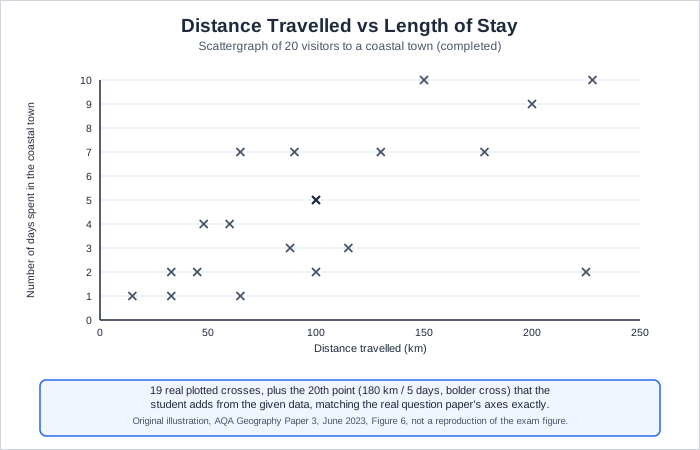
The full worked answer — June 2023
The data suggests a general positive relationship, so the hypothesis is partly proven: visitors who travelled shorter distances, under around 50 km, mostly stayed only 1 to 2 days, while several of the visitors who travelled the furthest, over 200 km, stayed among the longest, up to 9 or 10 days.
The relationship is not strong enough to say the hypothesis is fully proven, though, because there are clear anomalies, including a visitor who travelled a long distance but stayed only around 2 days, and other visitors who travelled a moderate distance but stayed 7 days or more, which shows factors other than distance, such as the length of a planned holiday, must also be affecting how long visitors stay.
Could you have written this? Every fact in this answer is drilled in our quizzes — the writing is the easy part once the evidence is automatic.
Practise justifying a conclusion with data questionsWhat the mark scheme rewarded
- A judgement about the strength, not just the existence, of the relationship, explicitly referencing anomalies in the scatter
- Short-distance visitors (under 50 km) mostly stayed 1 to 2 days, several long-distance visitors (over 200 km) stayed up to 9 or 10 days
- Clear anomalies exist, including long-distance visitors who stayed only briefly
Traps examiners saw
- Saying simply 'yes it proves the hypothesis' or 'no it does not' without discussing the strength of the relationship or naming any anomalies
Full-mark self-check 0 of 1
The method for every Q04.3 / Q04.10 / Q04.8 / Q04.8 — same every sittingMark bands, steps, timing
What this question type rewards
The topic changes by sitting — the mark scheme never does. Learn this once, then open your question above for that sitting’s sources and a full worked answer.
- Actually manipulating the data, calculating a percentage, a total, a range or a proportion, rather than just repeating raw figures
- A judgement about how FAR the data supports the point, not a flat yes/no
The steps
- Do a real calculation, a percentage, a total, or a proportion, do not just quote the raw numbers as given
- State clearly how far the data supports the point, fully, partly, or not really
- Point to a specific anomaly or limitation in the data if one exists, this is what separates a Level 2 answer from a merely descriptive one
- Link your answer back to the enquiry's original aim or hypothesis
Which sampling method involves collecting data at regular, pre-set intervals — for example, every 10 metres along a transect?
Practise doing a real calculation, a percentage, a total or a proportion, rather than eyeballing the numbers. That single habit is what separates Level 1 from Level 2 on this question type.
Practise justifying a conclusion with data questions“Match the type of data described (categories that add up to a whole, or numeric values spread across a map) to the correct presentation technique from a list of options.”
A short 'which technique fits this data' multiple-choice question appears in Section B in some sittings, testing knowledge of the graphical and cartographic skills checklist rather than the data itself.
1×asked“Which of the following methods would be an appropriate way of presenting the land use survey data?”
“Which of the following methods would be an appropriate way of presenting the land use survey data?”
What it’s really asking
Recognise that land use categories which sum to a total number of shops are best shown as proportions of a whole, which is what a pie chart does.
What the sources actually showed — June 2022
The land use survey table recording counts of different shop types (supermarkets, clothes shops, souvenir shops, cafes and so on) that together add up to the High Street's total of 84 shops.
| Land use category | Number |
|---|---|
| Supermarkets | 3 |
| Clothes shops | 18 |
| Souvenir shops | 11 |
| Cafes/restaurants | 14 |
| Hotels/bed and breakfasts | 4 |
| Newsagents/general stores | 10 |
| Services (hairdressers/estate agents) | 6 |
| Financial services | 3 |
| Others | 15 |
The full worked answer — June 2022
A pie chart. Land use categories add up to a single whole, the total number of shops, so a pie chart, which shows each category as a proportion of that whole, fits the data far better than a line graph or scattergraph, which are designed for showing change or relationships between two numeric variables rather than category shares.
Could you have written this? Every fact in this answer is drilled in our quizzes — the writing is the easy part once the evidence is automatic.
Practise choosing presentation techniques questionsWhat the mark scheme rewarded
- The single correct technique, pie chart
- Pie charts suit data made of categories that sum to one total, unlike line graphs or scattergraphs
Traps examiners saw
- Choosing a histogram, which is for continuous numeric data grouped into class intervals, not discrete shop-type categories
Full-mark self-check 0 of 1
1×asked“Which of the following would be an appropriate alternative way of presenting the data shown on Figure 5?”
“Which of the following would be an appropriate alternative way of presenting the data shown on Figure 5?”
What it’s really asking
Recognise that a single numeric value recorded at many points across a map, like temperature, could also be shown with proportional symbols, not with a desire line, dot or flow line map, which suit different data types.
What the sources actually showed — June 2023
The isoline map of temperature readings taken at several points around a town, currently presented as isolines from 15 to 19 degrees Celsius joining points of equal temperature.
The full worked answer — June 2023
A proportional symbol map. Since each point on Figure 5 already has a single numeric value attached to it, temperature in degrees Celsius, a proportional symbol map could show the same data by scaling a symbol's size to each reading, unlike a desire line map or flow line map, which are designed to show movement between two locations rather than a value recorded at a single point.
Could you have written this? Every fact in this answer is drilled in our quizzes — the writing is the easy part once the evidence is automatic.
Practise choosing presentation techniques questionsWhat the mark scheme rewarded
- The single correct technique, proportional symbol map
- Proportional symbol maps suit a single value recorded at many separate points, unlike desire line or flow line maps, which show movement
Traps examiners saw
- Choosing a dot map, which represents frequency or density rather than a single measured value like temperature
Full-mark self-check 0 of 1
The method for every Q04.1 / Q04.6 — same every sittingMark bands, steps, timing
What this question type rewards
The topic changes by sitting — the mark scheme never does. Learn this once, then open your question above for that sitting’s sources and a full worked answer.
- Matching data type to technique correctly: categories that sum to a whole suit a pie chart, point values spread across a map suit an isoline, proportional symbol or dot map
The steps
- Identify what kind of data is being presented, categories, a single set of values at points on a map, or a change over time
- Recall which techniques fit which data type from the AQA skills checklist
- Eliminate options that do not fit the data type before choosing
A student wants to compare the number of tourists visiting five different countries in 2023. Which type of graph is most appropriate?
Learn which technique fits which data shape, categories that sum to a whole, single values at points, or movement between places, from the AQA skills checklist.
Practise choosing presentation techniques questions“Use the raw fieldwork measurements given to calculate a missing statistic, a median, mean, mode or range, correctly.”
Basic statistical calculation from raw fieldwork data (finding a median, or completing a mean/mode/median/range table) appears in Section B in some sittings, testing pure numeracy against the specification's statistical skills checklist.
1×asked“Complete the diagram below by filling in the median pebble size for place C.”
“Complete the diagram below by filling in the median pebble size for place C.”
What it’s really asking
Order Place C's ten raw pebble measurements and find the middle value (the average of the two central values, since ten is an even count).
What the sources actually showed — June 2020
The raw long-axis pebble measurements, in millimetres, for the ten pebbles sampled at Place C: 19, 12, 8, 4, 6, 8, 4, 11, 14, 20.
| Pebble | Long axis at Place C (mm) |
|---|---|
| 1 | 19 |
| 2 | 12 |
| 3 | 8 |
| 4 | 4 |
| 5 | 6 |
| 6 | 8 |
| 7 | 4 |
| 8 | 11 |
| 9 | 14 |
| 10 | 20 |
The full worked answer — June 2020
Ordering Place C's ten measurements gives 4, 4, 6, 8, 8, 11, 12, 14, 19, 20. With ten values there is no single middle number, so the median is the mean of the fifth and sixth values, 8 and 11, giving a median of 9.5 mm.
Could you have written this? Every fact in this answer is drilled in our quizzes — the writing is the easy part once the evidence is automatic.
Practise statistical calculation questionsWhat the mark scheme rewarded
- The correct value, 9.5 mm
- The median of an even-numbered data set is the mean of the two central ordered values
Traps examiners saw
- Forgetting to order the raw data first before finding the middle value
Full-mark self-check 0 of 1
1×asked“Use Figure 5 to complete the following table, which was used to analyse the students' data.”
“Use Figure 5 to complete the following table, which was used to analyse the students' data.”
What it’s really asking
Calculate the mode, median and range of twelve beach width measurements, given that the mean is already provided as 17.6 m.
What the sources actually showed — June 2022
A diagram showing the results of a beach survey testing the hypothesis 'a local beach gets wider from west to east', with beach width measured to the nearest metre at twelve equally spaced points between two groynes (wooden barriers either side of the beach), from the sea wall down to the sea: 17, 16, 16, 17, 17, 17, 18, 18, 18, 19, 19, 20 metres, with the mean of 17.6 m already given in the summary table and the mode, median and range left blank for the student to calculate.
| Point | 1 | 2 | 3 | 4 | 5 | 6 | 7 | 8 | 9 | 10 | 11 | 12 |
|---|---|---|---|---|---|---|---|---|---|---|---|---|
| Beach width (m) | 17 | 16 | 16 | 17 | 17 | 17 | 18 | 18 | 18 | 19 | 19 | 20 |
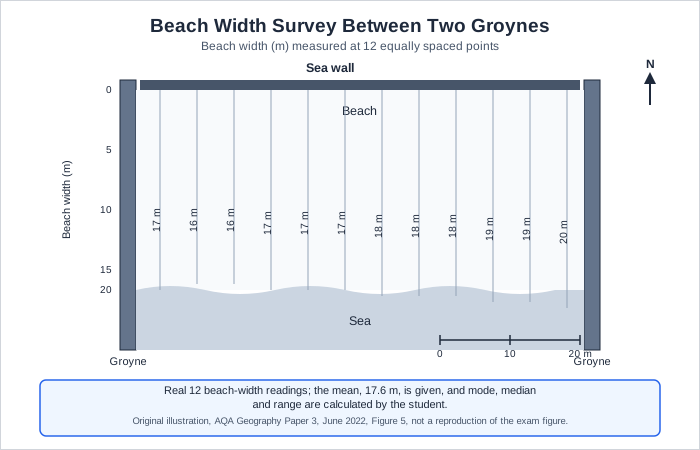
The full worked answer — June 2022
The mode is 17 m, since it appears four times, more often than any other value. Ordering the twelve values, the median is the mean of the sixth and seventh values, 17 and 18, giving a median of 17.5 m. The range is the highest value minus the lowest, 20 minus 16, giving a range of 4 m.
Could you have written this? Every fact in this answer is drilled in our quizzes — the writing is the easy part once the evidence is automatic.
Practise statistical calculation questionsWhat the mark scheme rewarded
- Mode 17, median 17.5, range 4, one mark for each correct value
- 17 is the most frequently occurring beach width, appearing at three of the twelve points
Traps examiners saw
- Confusing mode (most frequent value) with median (middle value) under time pressure
Full-mark self-check 0 of 1
The method for every Q04.4 / Q04.5 — same every sittingMark bands, steps, timing
What this question type rewards
The topic changes by sitting — the mark scheme never does. Learn this once, then open your question above for that sitting’s sources and a full worked answer.
- A mathematically correct value, calculated from the actual raw data given, not estimated
The steps
- Reread which statistic is being asked for, median (middle value when ordered), mode (most frequent), mean (total divided by count), range (highest minus lowest)
- Order the raw data first if you need the median
- Show your working so a method mark can be given even if the final figure is slightly off
- Double check arithmetic on a calculator, since this is one of the few genuinely mathematical questions on the paper
A student wants to compare the number of tourists visiting five different countries in 2023. Which type of graph is most appropriate?
Practise mean, median, mode and range calculations from raw data until they are automatic. This is pure numeracy and it is fully within your control.
Practise statistical calculation questions“Explain not just WHAT technique you used in your own coursework-style enquiry but WHY it was the right choice for that specific enquiry's aim.”
Only June 2020 and June 2023 include Question 5 on this paper, since it was removed for the 2021 and 2022 sittings and reintroduced by 2023. In both sittings we have it, Question 5.2 asks you to justify a technique from your own enquiry, worth 3 marks and building in depth with each justifying step, so if your paper ever includes an own-fieldwork Section C, prepare a three-layer justification for at least one technique per enquiry strand.
1×asked“Justify the use of one of the following in your human geography enquiry: maps, photographs, field sketches.”
“Justify the use of one of the following in your human geography enquiry: maps, photographs, field sketches.”
What it’s really asking
Pick ONE of maps, photographs or field sketches actually used in your human geography enquiry and build a three-layer justification for why it suited that enquiry specifically.
What the sources actually showed — June 2020
This question refers to the student's own human geography fieldwork enquiry, which they name and describe from memory. No resources-booklet source is provided, since the evidence is the student's own coursework-style investigation.
The full worked answer — June 2020
In my human geography enquiry investigating change in a town centre's shopping quality, I used annotated photographs at each of my six survey points. Photographs gave a quick, accurate visual record of each site, which meant I could label specific features, such as an empty shop unit or a well-kept planter, without having to write a lengthy description on the spot while collecting data.
This mattered for my enquiry specifically because I was comparing six different sites and needed a consistent way to check my own environmental quality scores afterwards. Being able to look back at the photographs let me re-check whether I had scored two similar-looking sites consistently, which gave me more confidence in the reliability of my final comparison between sites.
Could you have written this? Every fact in this answer is drilled in our quizzes — the writing is the easy part once the evidence is automatic.
Practise justifying fieldwork technique questionsWhat the mark scheme rewarded
- A developed, layered justification tied to the enquiry's own aim, not just naming a technique and saying it was 'useful'
- Photographs allow a researcher to re-check subjective scoring decisions after leaving the field site
Traps examiners saw
- Naming a technique from a generic, unnamed enquiry rather than a specific, titled investigation, which caps credit under the mark scheme
Full-mark self-check 0 of 1
1×asked“Justify one primary data collection method used in your physical geography enquiry.”
“Justify one primary data collection method used in your physical geography enquiry.”
What it’s really asking
Name a real primary data collection method used in your physical geography enquiry and build a three-layer justification for why it suited that enquiry's own aim, not a generic description of the method.
What the sources actually showed — June 2023
This question refers to the student's own physical geography fieldwork enquiry, which they name and describe from memory. No resources-booklet source is provided, since the evidence is the student's own coursework-style investigation.
The full worked answer — June 2023
In my physical geography enquiry testing the Bradshaw model along a river, I measured the river's velocity at each site using a flow meter timed over a fixed distance. This method gave a direct, repeatable numerical reading at each site, which meant I could plot velocity against distance downstream on the same scale for every site I visited.
This was particularly important for my enquiry because the Bradshaw model specifically predicts that velocity should increase downstream, so having a genuinely numerical, comparable measurement at every site was essential to actually test that prediction, rather than just describing the river qualitatively at each site.
Could you have written this? Every fact in this answer is drilled in our quizzes — the writing is the easy part once the evidence is automatic.
Practise justifying fieldwork technique questionsWhat the mark scheme rewarded
- A developed justification tying the method directly to what the enquiry's own hypothesis or model needed to be tested
- A flow meter gives a repeatable numerical velocity reading that can be directly compared across sites
Traps examiners saw
- Describing HOW a method works in detail without ever explaining WHY it suited this specific enquiry's aim
Full-mark self-check 0 of 1
The method for every Q05.2 / Q05.2 — same every sittingMark bands, steps, timing
What this question type rewards
The topic changes by sitting — the mark scheme never does. Learn this once, then open your question above for that sitting’s sources and a full worked answer.
- Naming a real technique specific to your own enquiry, not a generic geography skill
- Building the justification in layers: what it does, then why that helped this specific enquiry, then a further consequence of that benefit
The steps
- Name the specific technique you actually used, not a generic category
- Give the first reason it was useful
- Develop that reason with a second linked point
- Where possible, add a third layer tying it explicitly back to your enquiry's own aim or title, since 3-mark justify questions credit well-developed reasoning chains, not three separate facts
What does EQS stand for in human geography fieldwork?
Build a genuine two or three layer justification tied to your own enquiry's aim, not a list of separate reasons. Practise this with each technique from both of your own enquiries.
Practise justifying fieldwork technique questions“Go beyond describing your method and actually judge how well it worked: did it collect accurate, appropriate data efficiently, and where did it fall short.”
In both sittings that include Question 5, the paper asks for a 6-mark assessment of one technique from your own physical geography enquiry, either a data collection method or a data presentation technique. The command word 'assess' means the top marks always go to genuine evaluation, not description.
1×asked“Assess the effectiveness of your data collection method(s).”
“Assess the effectiveness of your data collection method(s).”
What it’s really asking
Judge, rather than describe, how well a named data collection method from your own physical geography enquiry actually performed, including at least one real limitation.
What the sources actually showed — June 2020
This question refers to the student's own physical geography fieldwork enquiry. No resources-booklet source is provided.
The full worked answer — June 2020
In my coastal enquiry testing how beach gradient changed along the coastline, I used a clinometer and ranging poles to measure gradient at each of my eight transect sites. This method was effective because it gave a precise numerical angle at every site, using the same standardised procedure each time, which meant my results across the eight sites were genuinely comparable rather than based on rough visual estimates of steepness.
The method was less effective in one respect, though: using ranging poles on a windy beach made it difficult to hold them perfectly vertical at several sites, which likely introduced a small error into some of my gradient readings. I could have improved this by using a tripod-mounted clinometer, which would have removed the human-hold error entirely.
Could you have written this? Every fact in this answer is drilled in our quizzes — the writing is the easy part once the evidence is automatic.
Practise assessing fieldwork effectiveness questionsWhat the mark scheme rewarded
- Genuine evaluative judgements about accuracy and practicality, including a real named limitation, not description of the method
- A clinometer gives a standardised, comparable numerical measurement across multiple sites, but wind can affect ranging pole stability
Traps examiners saw
- Describing how the method works step by step without ever judging whether it actually worked well, which caps the answer at Level 1
Full-mark self-check 0 of 2
1×asked“Assess the effectiveness of your data presentation technique(s) in your physical geography enquiry.”
“Assess the effectiveness of your data presentation technique(s) in your physical geography enquiry.”
What it’s really asking
Judge, rather than describe, how well a named data presentation technique from your own physical geography enquiry actually helped you interpret your results, including at least one real limitation.
What the sources actually showed — June 2023
This question refers to the student's own physical geography fieldwork enquiry. No resources-booklet source is provided.
The full worked answer — June 2023
In my river enquiry testing the Bradshaw model, I presented my velocity results as a scattergraph with distance downstream on one axis and a best-fit line added. This was effective because the best-fit line made the overall downstream trend immediately visible, which was exactly what I needed to judge whether my results supported or contradicted the Bradshaw model's prediction.
It was less effective at showing individual site detail, though, since several points were plotted close together in the middle of the graph and became difficult to read individually, which meant I had to refer back to my raw data table to identify exactly which site had produced an unusually low reading.
Could you have written this? Every fact in this answer is drilled in our quizzes — the writing is the easy part once the evidence is automatic.
Practise assessing fieldwork effectiveness questionsWhat the mark scheme rewarded
- Genuine evaluative judgements about how well the technique served the enquiry's aim, including a real named limitation
- A best-fit line on a scattergraph makes an overall trend visible but can obscure individual data points when they cluster closely together
Traps examiners saw
- Describing how to draw a scattergraph in general terms instead of judging how well it worked for this specific enquiry's own results
Full-mark self-check 0 of 2
The method for every Q05.3 / Q05.3 — same every sittingMark bands, steps, timing
What this question type rewards
The topic changes by sitting — the mark scheme never does. Learn this once, then open your question above for that sitting’s sources and a full worked answer.
- Genuine evaluation of effectiveness, not just a description of how the method or technique works
- Specific reasoning tied to accuracy, appropriateness to the enquiry's aim, or practical constraints such as time, equipment or weather
The steps
- Name the specific technique from your own enquiry, do not answer this generically
- Judge whether it collected or presented accurate, appropriate data for your enquiry's aim
- Judge a practical factor too, time taken, equipment needed, weather dependency, or ease of repeating it
- Where the technique had a real weakness, say so, an honest evaluation with a genuine limitation scores as well as, or better than, an uncritical one
A student drops an orange into a river and times how long it takes to travel 10 metres. Which variable are they measuring?
Practise naming one real, specific limitation of a method from your own enquiry. An honest evaluation with a genuine weakness scores as well as an uncritical one.
Practise assessing fieldwork effectiveness questions“In both sittings where Question 5 appears, this is the very last question on the paper: a 9-mark evaluation of how far YOUR OWN fieldwork results and conclusions were accurate and valid, judged against your enquiry's original aim.”
This is the own-fieldwork mirror of the 9-mark Section A decision question. It only appears in the two sittings that include Question 5, June 2020 and June 2023, but in both of them it closes the paper the same way: a synoptic, level-marked evaluation of your own enquiry against its aim, worth 9 marks plus SPaG. If your exam includes Section C, prepare this question for both a physical and a human enquiry.
1×asked“For one of your fieldwork enquiries, to what extent did your results and conclusions meet the original aim of your enquiry?”
“For one of your fieldwork enquiries, to what extent did your results and conclusions meet the original aim of your enquiry?”
What it’s really asking
Judge, with specific reference to your own real results, how far both your data collection and the conclusions you drew from it actually achieved your enquiry's stated aim.
What the sources actually showed — June 2020
This question refers to the student's own fieldwork enquiry, physical or human, which they name and evaluate from memory against its original aim. No resources-booklet source is provided.
The full worked answer — June 2020
My physical geography enquiry aimed to test whether river velocity increases with distance downstream, in line with the Bradshaw model. My results showed velocity rising from an average of 0.3 metres per second at my most upstream site to 0.9 metres per second at my most downstream site, a clear increase across five sites that broadly followed the pattern the model predicts.
My data collection was reasonably accurate, since I used a flow meter timed over a fixed distance at each site, giving repeatable numerical readings, but one middle site produced an unusually low reading that did not fit the overall trend, most likely because it was measured in a sheltered pool rather than the main channel, which slightly weakens how confident I can be in that single site's result.
Overall, my results and conclusions largely met my original aim: the general trend across four of my five sites clearly supported the Bradshaw model, and I can validly conclude that velocity does increase downstream in this river. However, because one site's result was affected by local conditions rather than the general downstream pattern, I would only class my conclusion as strongly, not completely, supported by the data, which is why a fully thorough answer stops short of claiming the aim was met without any reservation.
Could you have written this? Every fact in this answer is drilled in our quizzes — the writing is the easy part once the evidence is automatic.
Practise the own-fieldwork 9-mark judgement questionWhat the mark scheme rewarded
- A developed evaluation covering BOTH data collection accuracy and the validity of the conclusion, referencing specific real results, reaching an extent-based judgement
- Velocity results rose from 0.3 m/s upstream to 0.9 m/s downstream across five sites, with one anomalous middle-site reading
Traps examiners saw
- Describing the enquiry's method and results without ever explicitly judging HOW FAR they supported the original aim, which is the actual command of the question
Full-mark self-check 0 of 4
1×asked“For one of your fieldwork enquiries, to what extent did the data collected help you to obtain accurate results and reach a valid conclusion(s)?”
“For one of your fieldwork enquiries, to what extent did the data collected help you to obtain accurate results and reach a valid conclusion(s)?”
What it’s really asking
Judge, with specific reference to your own real data, whether the data you collected was accurate enough to genuinely support the conclusion you reached, distinguishing accuracy of results from validity of conclusion.
What the sources actually showed — June 2023
This question refers to the student's own fieldwork enquiry, physical or human, which they name and evaluate from memory against the accuracy of its data and the validity of its conclusion. No resources-booklet source is provided.
The full worked answer — June 2023
My human geography enquiry investigated whether footfall in my local town centre was highest closest to the main shopping street, using pedestrian counts at six points across two different days. My data showed footfall was highest at my two central points, around 140 to 160 people in a five-minute count, falling to under 40 people at my two furthest points, which supported my original aim of finding a clear pattern related to distance from the centre.
The accuracy of my results was reasonably good, since I used the same five-minute counting method at every point, but I only counted on two days, both midweek, so I cannot be fully confident my results reflect a typical week, since a weekend count might have shown a different pattern, particularly at points nearer to any weekend market or event.
This limitation on accuracy affects the VALIDITY of my conclusion too, not just its precision: because I only sampled midweek footfall, my conclusion that footfall is highest closest to the shopping street is only valid for midweek conditions, and I cannot claim it holds for the town centre in general. A weekend market near one of my further points could easily have produced a different overall pattern, so my conclusion should really be stated as 'true for the two days I measured' rather than as a general finding about the town centre.
Could you have written this? Every fact in this answer is drilled in our quizzes — the writing is the easy part once the evidence is automatic.
Practise the own-fieldwork 9-mark judgement questionWhat the mark scheme rewarded
- A developed evaluation linking data accuracy through to the validity of the conclusion specifically, referencing real results, reaching an extent-based judgement. The real mark scheme explicitly caps an answer at Level 2 if it only ever addresses accuracy of results OR validity of conclusions, never both.
- Pedestrian counts of 140 to 160 people at central points fell to under 40 at the furthest points, but only two midweek days were sampled
Traps examiners saw
- Evaluating accuracy of results and validity of conclusions as if they were the same judgement, when the mark scheme credits them as two distinct things to assess, and explicitly caps an accuracy-only or conclusions-only answer at Level 2
Full-mark self-check 0 of 4
The method for every Q05.4 / Q05.4 — same every sittingMark bands, steps, timing
What this question type rewards
The topic changes by sitting — the mark scheme never does. Learn this once, then open your question above for that sitting’s sources and a full worked answer.
- A developed judgement about how far results and conclusions supported the original aim, referencing SPECIFIC results from your own enquiry, not generic reflection
- Linking data collection accuracy through to the validity of the final conclusion, a full chain, not just isolated comments about method or result
The steps
- State your enquiry's title and original aim clearly at the start
- Reference specific real results from your own enquiry, not vague memories
- Explicitly judge whether your DATA COLLECTION was accurate enough to trust your results
- Then judge whether your CONCLUSIONS validly followed from those results, this is a second, separate judgement from the first
- Close with an overall extent judgement, fully, partly, or only in a limited way
- Save time to proofread for SPaG, which carries its own 3 marks here too
Which sampling method involves collecting data at regular, pre-set intervals — for example, every 10 metres along a transect?
Prepare specific, real results from both of your own fieldwork enquiries in advance, and practise judging data collection accuracy and conclusion validity as two separate things.
Practise the own-fieldwork 9-mark judgement questionWhat is guaranteed to come up, and what genuinely varies
Across the 4 sittings we have full papers for, some question types are certainties every single year. Others depend on which topic the resources booklet happens to cover that year.
Not seen as a standalone question type in the 4 sittings we have full papers for
Kite diagrams and dispersion graphs as a standalone completion question (mean, median, mode and range calculation has appeared instead) · Population pyramids as a standalone data-completion question (a population pyramid appeared only as background evidence for the June 2021 wind farm decision question) · GIS (Geographical Information Systems) as a named, standalone skill question in these four papers
These skills are named on the AQA skills checklist and could still appear, but did not carry their own question in any of the four sittings we analysed, so do not build your whole revision plan around them.
Before you revise
Does Paper 3 have the same structure every year?
Mostly, but not entirely. Every sitting we have full papers for opens Section A with Issue Evaluation questions built around a pre-release resources booklet, then moves to a Section B fieldwork question about an unfamiliar enquiry. What changes is whether there is also a Section C about YOUR OWN fieldwork enquiries. June 2020 had it (worth 20 marks, taking the paper to 76 marks total and 1 hour 15 minutes), June 2021 and June 2022 removed it as a temporary Covid-era change (56 marks, 1 hour), and June 2023 reinstated it, back to 76 marks and 1 hour 15 minutes. Always check your own paper's time allowance and total marks on the front cover, since this genuinely changed across real sittings.
Do I need to bring anything special into this exam?
Yes. The paper's own instructions list a pencil, a rubber, a ruler and a calculator as required materials in every sitting we have checked. A significant number of real candidates in the June 2023 series appeared not to have a ruler or calculator, which cost them accuracy marks on graph and calculation questions that had nothing to do with their geographical knowledge.
Is the resources booklet the same every year?
No, it is released before the exam and covers a different real-world issue each year, energy, waste, urban slums, tourism development, and so on. What stays the same is the QUESTION STRUCTURE around it: a short fact-reading question, one or two mid-length judgement questions, and a closing 9-mark decision that always asks you to use evidence from across the WHOLE booklet, not just the figure named in the question.
How much of the 9-mark decision question is about geography knowledge versus using the sources?
Mostly the sources. The mark scheme's top band explicitly requires a 'wide range of evidence' from across the resources booklet and 'thorough use of the resources booklet', with links to the wider specification as a bonus, not a substitute. Answers that ignore the booklet and write a generic essay from memory are capped at the basic band even if the geography in them is accurate.
What is the single biggest way marks are lost on this paper?
According to the real examiner reports for these sittings, students very often IDENTIFY the right idea (data patterns, planning challenges, method weaknesses) but do not DEVELOP it far enough for the second or third mark. A one-sentence observation that is never backed with a real figure, or never explained WHY it matters to the specific enquiry, repeatedly cost marks across every sitting we reviewed.
Practise the questions that are guaranteed to come up
Every question type on this page has practice questions waiting in the app, built the way AQA actually structures Paper 3.
Start revising free