GCSE Physics Paper 2: what to revise (and where marks are lost)
- 1Paper 2 tests electricity, waves, magnetism and space. Different from Paper 1, different style of question.
- 2The formula questions (KE, wave speed, charge) are where most marks are dropped. Not because students don't know the formulas, but because they can't rearrange them.
- 3Series vs parallel circuits is the single most-tested topic. Know the rules cold: voltage adds in series, current stays the same; current splits in parallel, voltage stays the same.
- 4Waves questions reward students who can link wave properties to real examples. Speed, frequency, wavelength, and what changes when you change medium.
- 5Use the last week to do one timed practice per day, not to learn new content. If you don't know it by now, the mark scheme will tell you what to write in 10 minutes.
Physics Paper 2 is coming up. Some students have been solid on electricity for weeks. Others spent two hours last night convinced they had rearranged the wave speed equation correctly and got the wrong answer both times. Different problems, same paper.
This post covers both. What Paper 2 actually tests, where the marks go, and what the last week should look like.
What makes Paper 2 different from Paper 1
Paper 1 is energy, forces, and atomic structure. Paper 2 is electricity, waves, magnetism, and space. They test different physics, but they test it the same way: short-answer calculations, explain-the-graph questions, and the occasional extended write.
The shift that catches students out is this: Paper 2 has more circuit questions where you have to hold two rules in your head at once (series rules and parallel rules) and apply whichever is relevant. Paper 1 energy questions tend to be one-formula-at-a-time.
AQA Physics Paper 2 (8463/2)
1h 45m, 100 marks. Covers topics 4-7: Electricity, Magnetism and Electromagnetism, Particle Model of Matter, Atomic Structure. Waves is split between Paper 1 (properties) and Paper 2 (EM spectrum, uses/dangers).
Higher tier only: transformers, solenoids, the motor effect calculation (F = BIl), and nuclear equations. These are reliable 4-6 mark questions that many students skip. Don't skip them if you're aiming for a 7+.
Edexcel Physics Paper 2 (1PH0/2)
1h 45m, 100 marks. Topics 5-8: Waves in Matter, Light and the Electromagnetic Spectrum, Radioactivity, Astronomy. Electricity is in Paper 1 for Edexcel. Check your spec before revising.
Edexcel Paper 2 tends to have more context-based questions (a scenario, then 3-4 linked parts). Practice reading the scenario first and underlining the numbers before attempting any calculations.
OCR Gateway Physics Paper 2 (J249/02)
1h 45m, 90 marks. Modules P4-P6: Explaining Motion, Radioactivity, Energy, Global Challenges. Electricity is in Paper 1 (P2-P3) for OCR Gateway. Same check applies.
OCR Gateway uses a structured question format with parts (a), (b), (c). Marks are distributed differently from AQA. A single question can run to 8-10 marks across parts. Read part (c) before you start part (a).
The formula questions (this is where marks are lost)
Physics teachers have told us the same thing for years: students know the formulas. They write Ek = mv2 on the formula sheet. They just cannot rearrange them under exam pressure.
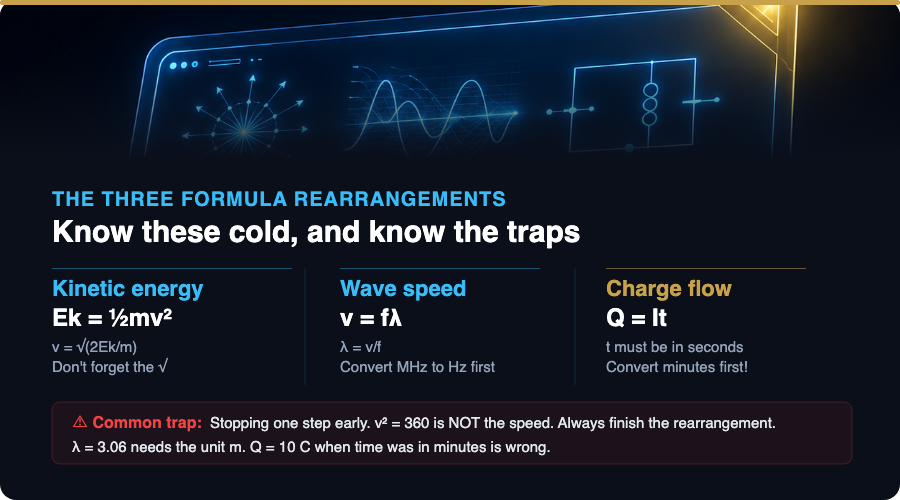
The mark scheme doesn't care how you felt about the question. It cares whether the correct rearrangement is on the page.
Kinetic energy: Ek = ½mv²
Three things get tested: find Ek (straightforward), find m (divide both sides by v², then halve), find v (multiply by 2, divide by m, then square root). The square root step is where marks disappear.
Worked example
A 1,200 kg car is travelling at 15 m/s. Calculate its kinetic energy.
- 1Write the formula: Ek = ½mv²
- 2Substitute: Ek = 0.5 × 1200 × 15²
- 3Calculate 15² = 225 first, THEN multiply: 0.5 × 1200 × 225
- 4Ek = 135,000 J (or 135 kJ). Common trap: squaring 15 × 1200 before halving gives the same answer, but squaring the whole bracket (1200 × 15)² does not.
Worked example
A 0.5 kg ball has 90 J of kinetic energy. Find its speed.
- 1Rearrange for v²: v² = 2Ek / m
- 2Substitute: v² = (2 × 90) / 0.5 = 360
- 3Square root: v = √360 = 19.0 m/s (to 3 s.f.)
- 4The trap: stopping at v² = 360 and writing 360 as the answer. Always complete the square root.
✕ Loses marks
Writes v² = 360, then writes 'v = 360 m/s'. stops before the square root step.
✓ Wins marks
Writes v² = 360, then explicitly writes v = √360 = 19.0 m/s. The square root step gets a mark on its own.
Wave speed: v = fλ
Wave speed questions almost always ask you to find wavelength from speed and frequency, or frequency from speed and wavelength. The rearrangement is simple. the trap is units. Frequency must be in Hz, wavelength in metres, speed in m/s. Converting kHz to Hz or cm to m before substituting saves a wrong-unit error.
Worked example
A radio wave has a frequency of 98 MHz and travels at 3 × 10&sup8; m/s. Find the wavelength.
- 1Convert frequency: 98 MHz = 98 × 10&sup6; Hz = 9.8 × 10&sup7; Hz
- 2Rearrange: λ = v / f
- 3λ = (3 × 10&sup8;) / (9.8 × 10&sup7;)
- 4λ = 3.06 m. Write the unit. A number without a unit scores 0 on the final mark.
Charge flow: Q = It
Straightforward but regularly dropped. Q = charge (coulombs), I = current (amps), t = time (seconds). The trap: time given in minutes. Multiply by 60 before substituting.
Worked example
A current of 2.5 A flows through a circuit for 4 minutes. Find the charge.
- 1Convert time: 4 minutes = 4 × 60 = 240 seconds
- 2Substitute: Q = I × t = 2.5 × 240
- 3Q = 600 C
- 4The trap: Q = 2.5 × 4 = 10 C. Always convert minutes to seconds first.
✕ Loses marks
Uses time in minutes: Q = 2.5 × 4 = 10 C. Loses 2 marks.
✓ Wins marks
Converts first: 4 min = 240 s, then Q = 2.5 × 240 = 600 C. Correct unit included.
Electricity: the rules you need cold
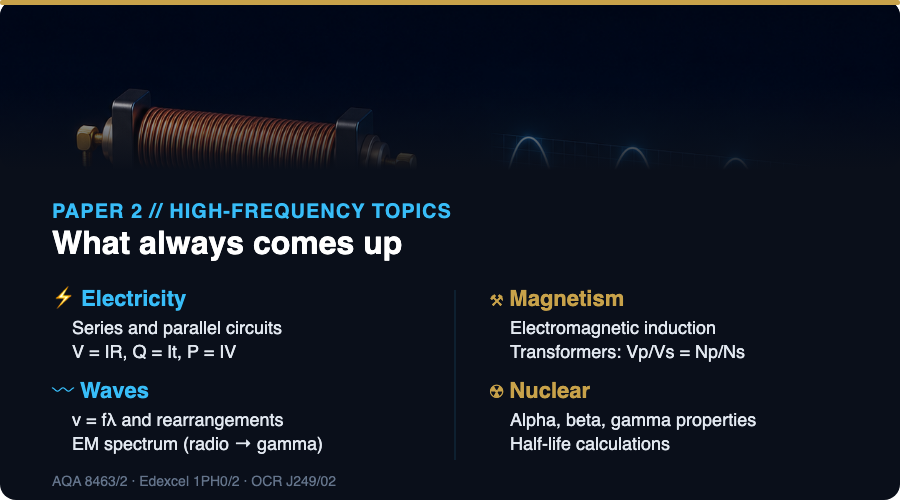
Series and parallel circuits come up in every sitting. Not always as a calculation. Sometimes as a describe or explain. Both require you to know which rule applies where.
| Property | Series circuit | Parallel circuit |
|---|---|---|
| Current | Same everywhere | Splits at junctions |
| Voltage | Shared (adds up to supply) | Same across each branch |
| Resistance | Adds up: R = R1 + R2 | Less than smallest branch |
| One bulb fails | All go out | Others stay on |
Worked example
In a series circuit, two resistors of 4Ω and 6Ω are connected to a 10 V supply. Find the current.
- 1Total resistance: R = R1 + R2 = 4 + 6 = 10 Ω
- 2Use V = IR, rearrange: I = V / R = 10 / 10 = 1 A
- 3Check: voltage across 4Ω resistor = IR = 1 × 4 = 4 V; across 6Ω = 6 V. Total = 10 V. Correct.
✕ Loses marks
Applies parallel rules to a series circuit. tries to say "voltage is the same across both resistors."
✓ Wins marks
Identifies circuit type FIRST. Series: current is the same, voltage divides. Calculate total resistance, then use V = IR.
Higher tier: the resistance formula for parallel circuits (1/R = 1/R1 + 1/R2) is in the equation list in some boards. Know where to find it and practise the algebra. dividing fractions under time pressure is where it falls apart.
Waves: properties, EM spectrum, and the questions that link them
Waves questions are often the ones students find "not too bad" then lose 3-4 marks on through vague language. The mark scheme wants specific terms: wavelength, frequency, amplitude, wave speed. Not "how high it is" or "how many waves there are."
The electromagnetic spectrum comes up in describe and explain questions. Know the order (radio, microwave, infrared, visible, UV, X-ray, gamma), what increases from left to right (frequency, energy), and what increases from right to left (wavelength). One reliable question: "Explain why gamma rays are more dangerous to living cells than infrared." The answer is frequency, energy, ionising ability. in that chain.
Worked example
Explain why ultraviolet radiation is more harmful to human skin than visible light.
- 1UV has a higher frequency than visible light.
- 2Higher frequency means higher energy per photon.
- 3High-energy photons can ionise atoms in skin cells. removing electrons and breaking chemical bonds.
- 4This can damage DNA and cause mutations that lead to skin cancer.
- 5Visible light photons have too little energy to ionise atoms, so they do not cause this damage.
"Because it's stronger" or "because it has more energy" alone scores 0. The mark is on the chain: frequency → energy → ionisation → cell damage.
Magnetism and space (Higher: don't skip these)
Magnetism questions often ask about electromagnetic induction (moving a magnet in a coil, changing flux, induced current and voltage). The key word the mark scheme wants is "change". the current is induced by the change in magnetic flux, not just by the field existing. No movement, no change, no current.
Transformers follow from this: a changing current in the primary coil creates a changing magnetic field, which induces a changing voltage in the secondary. The turns ratio: Vp / Vs = Np / Ns. Most exam questions give you three of these four values and ask for the fourth.
Worked example
A transformer has 200 turns on the primary coil and 50 turns on the secondary. The primary voltage is 240 V. Find the secondary voltage.
- 1Write the turns ratio: Vp / Vs = Np / Ns
- 2Substitute: 240 / Vs = 200 / 50
- 3200 / 50 = 4, so: 240 / Vs = 4
- 4Rearrange: Vs = 240 / 4 = 60 V
- 5This is a step-down transformer (secondary voltage lower than primary). Check: makes sense, fewer turns on secondary.
Space questions (AQA Higher) tend to be descriptive: the life cycle of stars, red-shift as evidence for the expanding universe, the Big Bang. These are paragraph-style answers. three points, each in a separate sentence, each linked to the next. Don't bullet them; write them as a chain of reasoning.
What to do in the last week
By this point, broad learning is over. The last week is about activating what you already know under timed conditions.
One timed practice paper per day. not the whole paper if time is short, but a full section under exam conditions. Mark it immediately with the mark scheme. Find the three things you got wrong. Drill those three things. Repeat tomorrow with a different section.
The biggest mistake in the last week: re-reading notes. Re-reading feels productive. It is not retrieval. The brain does not remember things it has seen. it remembers things it has tried and struggled with. Attempting the question, getting it wrong, and immediately reading why: that is what sticks.
✕ Loses marks
Spends 3 hours re-reading the electricity chapter. Feels confident. Gets the circuit question wrong anyway.
✓ Wins marks
Does 5 circuit calculations from a past paper, marks them immediately, identifies the mistake, does 3 more of that specific type. Scores the marks.
If you use GCSE Physics revision on PrepWise, the adaptive quiz does this automatically. it finds which Paper 2 topics you keep getting wrong and builds your daily plan around those. But the principle works without an app too: test yourself, mark it, fix the gap.
Practice the questions
See all Physics Paper 2 exam questions with model answers
Every question that comes up on AQA and Edexcel Paper 2: with full model answers and mark schemes. Sorted by what examiners test most.
Browse exam questions →Related reading
- GCSE Physics Paper 1: where to start (and what to skip)
- GCSE Maths calculator papers: what actually comes up
- Physics exam questions by paper — AQA and Edexcel
- GCSE Physics revision: every topic, flashcards and quizzes
Get the full benefit
The app finds which of these topics you keep getting wrong, and builds your daily plan around them.
Free now. Or browse the Physics revision library first.
Start on the app →