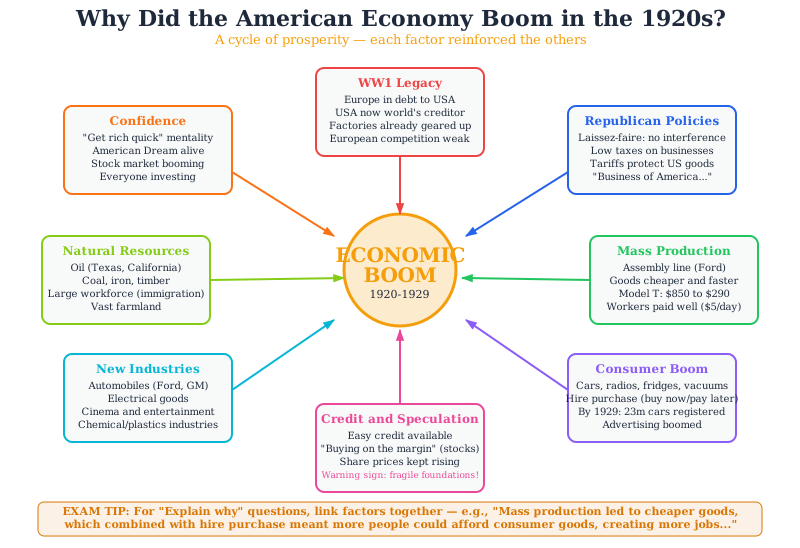
America 1920-1973Diagram

The 1920s Economic Boom: Causes

Part of The Economic BoomGCSE History

This diagram covers The 1920s Economic Boom: Causes within The Economic Boom for GCSE History. Revise The Economic Boom in America 1920-1973 for GCSE History with 10 exam-style questions and 9 flashcards. This topic shows up very often in GCSE exams, so students should be able to explain it clearly, not just recognise the term. It is section 3 of 12 in this topic. Focus on the labels, the relationships between parts, and the explanation that turns the diagram into an exam-ready answer.

Topic position

Section 3 of 12

Practice

10 questions

Recall

9 flashcards

📊 The 1920s Economic Boom: Causes

Circular diagram showing the interconnected causes of the 1920s economic boom: WW1 Legacy, Republican Policies, Mass Production, Consumer Boom, Credit and Speculation, New Industries, Natural Resources, and Confidence - all reinforcing each other in a cycle of prosperity

All factors reinforced each other in a "virtuous cycle" of prosperity

Keep building this topic

Read this section alongside the surrounding pages in The Economic Boom. That gives you the full topic sequence instead of a single isolated revision point.

Practice Questions for The Economic Boom

By how much did Henry Ford's assembly line reduce the time to build a Model T car?

  • A. From 12 hours to 6 hours
  • B. From 12 hours to 93 minutes
  • C. From 8 hours to 2 hours
  • D. From 24 hours to 4 hours
1 markfoundation

What was the purpose of the Fordney-McCumber Tariff introduced by Republicans in 1922?

  • A. To reduce taxes on American workers' wages
  • B. To place high taxes on imports to protect American businesses
  • C. To increase government spending on public works
  • D. To regulate the advertising industry
1 markfoundation

Quick Recall Flashcards

Model T price drop?
$850 (1908) → $290 (1925)
What % of cars bought on credit?
60%

Want to test your knowledge?

PrepWise has 10 exam-style questions and 9 flashcards for The Economic Boom — with adaptive difficulty and instant feedback.

Join Alpha