AQA Physics Paper 1

425 questions with model answers · Physics Paper 1 · GCSE Physics revision

Energy Stores & Systems

Common14
1.

A wind turbine generates electricity from wind. Describe and explain the energy stores and transfers involved as wind energy is converted to electrical energy, and discuss why the efficiency of a wind turbine cannot reach 100%. [6 marks]

6 marks · higherCommon

Wind has a kinetic energy store due to the moving air. As air hits the turbine blades, energy is transferred mechanically (by the force of the wind on the blades), causing the blades to rotate. The rotating blades drive a generator, which transfers energy electrically to the electrical energy store in the circuit. During these transfers, some energy is dissipated. Friction in the bearings and generator transfers energy to the thermal energy store of the surroundings by heating. Some energy is also transferred to the surroundings by sound. Because energy is always dissipated in real systems, the useful electrical output energy is always less than the total kinetic input energy. Therefore, efficiency = useful electrical output / total kinetic input, which is always less than 1 (or 100%).

  • Kinetic energy store of moving air / wind (1m)
  • Energy transferred mechanically (by force) from wind to turbine blades (1m)
  • Energy transferred electrically from generator to the circuit (electrical energy store) (1m)
  • Some energy is dissipated to the thermal energy store of the surroundings (by heating from friction) or as sound (1m)
  • Efficiency = useful output / total input (less than 100% because energy is dissipated) (1m)
  • Energy is always dissipated in real systems (law of conservation of energy means total energy is conserved but some is wasted) (1m)

Level 3 (5-6): Identifies kinetic store of wind, mechanical transfer to blades, electrical transfer from generator, dissipation to thermal/sound stores, states efficiency equation, and explains why 100% is impossible. Level 2 (3-4): Identifies most stores and at least two transfer pathways, mentions dissipation. Level 1 (1-2): Identifies kinetic energy of wind or mentions electrical output, with limited development.

Test yourself on this in PrepWise
2.

A roller coaster car of mass 800 kg starts from rest at the top of a slope of height 45 m. It reaches the bottom of the slope travelling at 27 m/s. The gravitational field strength is 9.8 N/kg. Calculate the gravitational potential energy at the top of the slope. Calculate the kinetic energy at the bottom of the slope. Use your answers to calculate the efficiency of the energy transfer.

4 marks · higherCommon
  • Correct GPE: Ep = mgh = 800 x 9.8 x 45 = 352,800 J (1m)
  • Correct Ek: Ek = 0.5 x 800 x 27^2 = 0.5 x 800 x 729 = 291,600 J (1m)
  • Correct substitution into efficiency = 291600 / 352800 (1m)
  • Correct answer: 0.826... (accept 0.83 or 83%) (1m)

Step 1: GPE = mgh = 800 x 9.8 x 45 = 352,800 J. Step 2: Ek = 0.5 x 800 x 27^2 = 0.5 x 800 x 729 = 291,600 J. Step 3: efficiency = Ek / GPE = 291,600 / 352,800 = 0.826 (83%). Some energy is dissipated to the thermal energy store of the surroundings due to friction and air resistance.

Test yourself on this in PrepWise
3.

A pump has an efficiency of 0.65. It transfers energy from its electrical energy store at a rate of 800 W. Calculate the useful power output of the pump. The pump is used for 5 minutes. Calculate the total electrical energy input and the useful energy output during this time. How much energy is wasted as thermal energy?

4 marks · challengeCommon
  • Useful power output = efficiency x input power = 0.65 x 800 = 520 W (1m)
  • Convert time: 5 minutes = 300 s. Total electrical energy input = 800 x 300 = 240,000 J (1m)
  • Useful energy output = 0.65 x 240,000 = 156,000 J (1m)
  • Wasted energy = 240,000 - 156,000 = 84,000 J (1m)

Step 1: Useful power = 0.65 x 800 = 520 W. Step 2: Time = 5 x 60 = 300 s. Total input energy = 800 x 300 = 240,000 J. Step 3: Useful output energy = 0.65 x 240,000 = 156,000 J. Step 4: Wasted energy = 240,000 - 156,000 = 84,000 J. The question asks for wasted thermal energy, which is 84,000 J, but the primary calculated answer is the useful output 156,000 J as the multi-step result.

Test yourself on this in PrepWise
4.

A car engine converts chemical energy into kinetic energy. Explain why the car engine is not 100% efficient, using the idea of energy dissipation.

3 marks · standardCommon

The car engine transfers some energy to the thermal energy store of the surroundings. This energy is dissipated and spreads out into the surroundings, making it less useful. Because some energy is wasted as thermal energy rather than being transferred to the kinetic energy store, the engine cannot be 100% efficient.

  • Some energy is transferred to the thermal energy store of the surroundings (wasted as heat) (1m)
  • This energy is dissipated (spreads out into the surroundings) (1m)
  • Because not all energy is usefully transferred to the kinetic store, efficiency is less than 100% (or: efficiency = useful output / total input, which is less than 1 when energy is wasted) (1m)

No engine is 100% efficient because energy is always dissipated to the surroundings, mainly as thermal energy (heat) and sound. Efficiency = useful output energy / total input energy. If 40 kJ out of 100 kJ is usefully transferred, efficiency = 0.40 or 40%.

Test yourself on this in PrepWise
5.

A motor transfers 500 J of energy from its electrical energy store. 350 J is usefully transferred to the kinetic energy store. Calculate the efficiency of the motor. Use the equation: efficiency = useful output energy transfer / total input energy transfer

3 marks · standardCommon
  • Correct substitution: efficiency = 350 / 500 (1m)
  • Correct calculation performed (1m)
  • Correct answer: 0.7 (or 70%) (1m)

efficiency = useful output energy / total input energy = 350 / 500 = 0.7 (or 70%). Efficiency has no units. A value of 0.7 means 70% of the input energy is usefully transferred.

Test yourself on this in PrepWise
6.

A tennis ball has a mass of 0.06 kg and is travelling at 20 m/s. Calculate the kinetic energy stored in the ball. Use the equation: kinetic energy = 0.5 x mass x speed squared

3 marks · standardCommon
  • Correct substitution: Ek = 0.5 x 0.06 x 20^2 (1m)
  • Correct intermediate step: 0.5 x 0.06 x 400 (1m)
  • Correct answer: 12 J (1m)

Ek = 0.5 x m x v^2 = 0.5 x 0.06 x (20)^2 = 0.5 x 0.06 x 400 = 12 J. Common mistake: forgetting to square the speed, which would give 0.5 x 0.06 x 20 = 0.6 J (wrong).

Test yourself on this in PrepWise
7.

An electric kettle is used to heat water. Describe the energy transfers that occur, naming the pathways by which energy is transferred.

3 marks · higherCommon

Electrical energy is transferred electrically to the thermal energy store of the heating element. Energy is then transferred by heating from the element to the thermal energy store of the water. Some energy is also transferred by heating to the thermal energy store of the surroundings.

  • Energy is transferred electrically (from the mains/power supply to the heating element) (1m)
  • Energy is then transferred by heating from the element to the water (increasing the thermal energy store of the water) (1m)
  • Some energy is dissipated/wasted, transferred by heating to the thermal energy store of the surroundings (1m)

The four pathways for energy transfer are: mechanically (by a force), electrically (by a current), by heating (from hot to cold), and by radiation (electromagnetic waves or sound). The kettle uses electrical transfer then heating transfer.

Test yourself on this in PrepWise
8.

A hairdryer has a power of 1200 W. It is used for 3 minutes. Calculate the total energy transferred by the hairdryer in this time. Give your answer in joules.

3 marks · higherCommon
  • Convert time to seconds: 3 minutes = 180 s (or substitute correctly in correct units) (1m)
  • Correct substitution: E = P x t = 1200 x 180 (1m)
  • Correct answer: 216,000 J (1m)

E = P x t. First convert time: 3 minutes = 3 x 60 = 180 s. Then E = 1200 x 180 = 216,000 J (or 216 kJ). A very common mistake is to forget to convert minutes to seconds.

Test yourself on this in PrepWise
9.

Explain what is meant by a 'closed system' in terms of energy.

2 marks · standardCommon

A closed system is one where no energy is transferred to or from the surroundings. The total energy within a closed system remains constant because energy is conserved.

  • A closed system does not transfer energy to or from the surroundings (no energy enters or leaves) (1m)
  • The total energy within a closed system remains constant (energy is conserved) (1m)

A closed system has no energy transfer to or from the surroundings. As a result, the total energy is conserved — it stays the same. Real systems are rarely perfectly closed, but the concept is used to apply the law of conservation of energy.

Test yourself on this in PrepWise
10.

Which energy store is associated with an object that is moving?

  • A. Gravitational potential
  • B. Elastic potential
  • C. Kinetic
  • D. Chemical
1 mark · foundationCommon

Kinetic energy is the energy stored by an object because of its motion. Any moving object has a kinetic energy store. Gravitational potential is stored due to height, elastic potential due to deformation, and chemical energy is stored in bonds.

Test yourself on this in PrepWise
11.

A hot cup of coffee is left on a table. Which energy store decreases as the coffee cools down?

  • A. Thermal
  • B. Kinetic
  • C. Chemical
  • D. Nuclear
1 mark · foundationCommon

The thermal energy store of an object depends on its temperature and mass. As the coffee cools, energy is transferred to the surroundings, so the thermal energy store of the coffee decreases.

Test yourself on this in PrepWise
12.

The law of conservation of energy states that energy can be:

  • A. Created but not destroyed
  • B. Destroyed but not created
  • C. Created or destroyed depending on the process
  • D. Transferred or stored, but never created or destroyed
1 mark · foundationCommon

Energy can never be created or destroyed. It can only be transferred from one store to another or dissipated to the surroundings. The total energy in a closed system always remains constant.

Test yourself on this in PrepWise
13.

A cyclist rides up a hill and then comes to a stop at the top. Which energy transfer best describes what happened when the cyclist braked to stop?

  • A. Kinetic energy store to thermal energy store by heating
  • B. Kinetic energy store to thermal energy store by friction (mechanically)
  • C. Chemical energy store to thermal energy store by heating
  • D. Gravitational potential to kinetic energy store by radiation
1 mark · foundationCommon

When the cyclist brakes, friction between the brake pads and wheels transfers energy mechanically (by force). This reduces the kinetic energy store and increases the thermal energy store of the brakes and surroundings. The transfer pathway is mechanical (by friction/force), not by heating directly.

Test yourself on this in PrepWise
14.

A light bulb transfers 100 J of energy from the electrical energy store. 10 J is transferred as useful light. What happens to the remaining 90 J?

  • A. It is destroyed inside the light bulb
  • B. It is stored permanently in the bulb
  • C. It is dissipated to the thermal energy store of the surroundings
  • D. It is converted back into electrical energy
1 mark · standardCommon

Energy cannot be destroyed. The 90 J of 'wasted' energy is dissipated (spread out) to the thermal energy store of the surroundings, mainly as heat. This is why we say the energy is dissipated rather than destroyed.

Test yourself on this in PrepWise

Kinetic Energy

Common15
1.

A road safety organisation is comparing two vehicles: - Vehicle A: mass 1000 kg, travelling at 30 m/s - Vehicle B: mass 3000 kg, travelling at 20 m/s Both vehicles brake to a stop with the same braking force of 15,000 N. Using kinetic energy and work done, calculate the braking distance for each vehicle. Then evaluate which vehicle presents a greater danger in terms of stopping distance.

6 marks · higherCommon

Vehicle A KE: Ek = 0.5 x 1000 x 30² = 0.5 x 1000 x 900 = 450,000 J. Vehicle B KE: Ek = 0.5 x 3000 x 20² = 0.5 x 3000 x 400 = 600,000 J. Braking distance uses work = F x d, so d = KE / F. Vehicle A: d = 450,000 / 15,000 = 30 m. Vehicle B: d = 600,000 / 15,000 = 40 m. Vehicle B is more dangerous as it has a greater kinetic energy despite the lower speed and requires a 40 m stopping distance compared to 30 m for Vehicle A. The greater mass of Vehicle B is the dominant factor.

  • Level 3 (5-6 marks): Correct kinetic energy calculated for both vehicles (450,000 J and 600,000 J). Work done = F x d used to find braking distances (30 m and 40 m). Clear comparison made with valid conclusion about Vehicle B having greater danger due to longer stopping distance and greater mass. (6m)
  • Level 2 (3-4 marks): Kinetic energy found for at least one vehicle. Braking distance method shown for at least one vehicle. Some comparison attempted. (4m)
  • Level 1 (1-2 marks): Some relevant physics recalled (Ek = 0.5mv², or work = Fd). Partial calculation shown. (2m)

Vehicle A: Ek = 450,000 J, braking distance = 450,000 / 15,000 = 30 m. Vehicle B: Ek = 600,000 J, braking distance = 600,000 / 15,000 = 40 m. Vehicle B is more dangerous despite lower speed because its much greater mass (3x) gives it more kinetic energy, requiring a 40 m stopping distance.

Test yourself on this in PrepWise
2.

A football of mass 0.45 kg is kicked and accelerates from rest to 30 m/s. Calculate the kinetic energy gained by the football. Then calculate the minimum work done by the player's foot to achieve this. Assume all work done is transferred to kinetic energy. Give both answers in J.

4 marks · higherCommon
  • Correct equation used: Ek = 0.5 x m x v² (1m)
  • Correct substitution: Ek = 0.5 x 0.45 x 30² (1m)
  • Correct kinetic energy: 202.5 J (1m)
  • States minimum work done = 202.5 J (work-energy theorem: work = change in KE, starting from rest) (1m)

Ek = 0.5 x 0.45 x 30² = 0.5 x 0.45 x 900 = 202.5 J. Since the ball starts from rest, all kinetic energy comes from work done by the foot. Minimum work done = 202.5 J (assuming 100% efficiency).

Test yourself on this in PrepWise
3.

A car has a mass of 1200 kg and is travelling at 25 m/s on a motorway. Calculate the kinetic energy of the car. Use the equation: kinetic energy = 0.5 x mass x speed²

3 marks · standardCommon
  • Correct substitution: Ek = 0.5 x 1200 x 25² (1m)
  • Correct calculation step: 0.5 x 1200 x 625 (1m)
  • Correct answer: 375,000 J (allow 375 kJ or 3.75 x 10⁵ J) (1m)

Ek = 0.5 x m x v² = 0.5 x 1200 x 25² = 0.5 x 1200 x 625 = 375,000 J

Test yourself on this in PrepWise
4.

A cyclist has a mass of 70 kg. The cyclist has 2450 J of kinetic energy. Calculate the speed of the cyclist. Use the equation: kinetic energy = 0.5 x mass x speed² You will need to rearrange the equation.

3 marks · standardCommon
  • Correct rearrangement: speed² = 2 x Ek / mass (= 2 x 2450 / 70) (1m)
  • Correct intermediate value: speed² = 70 (1m)
  • Correct answer: speed = 8.37 m/s (allow 8.3-8.4) (1m)

Rearrange Ek = 0.5mv² to get v² = 2Ek/m = (2 x 2450) / 70 = 4900 / 70 = 70. Then v = √70 = 8.37 m/s

Test yourself on this in PrepWise
5.

A lorry has a kinetic energy of 1,200,000 J when travelling at 20 m/s. Calculate the mass of the lorry.

3 marks · higherCommon
  • Correct rearrangement: m = 2Ek / v² (= 2 x 1200000 / 20²) (1m)
  • Correct denominator: v² = 400 (1m)
  • Correct answer: mass = 6000 kg (1m)

Rearrange Ek = 0.5mv² → m = 2Ek / v² = (2 x 1,200,000) / 20² = 2,400,000 / 400 = 6000 kg

Test yourself on this in PrepWise
6.

A car travelling at high speed takes a much longer distance to stop than the same car travelling at low speed. Use the kinetic energy equation to explain why braking distance increases so significantly when speed increases.

3 marks · higherCommon

The kinetic energy of the car is proportional to speed squared. When speed doubles, kinetic energy quadruples. During braking, friction between the brakes and the road converts kinetic energy into thermal energy. If the braking force is the same, a greater kinetic energy requires a greater distance to dissipate it, so braking distance increases by the square of the speed increase.

  • Kinetic energy is proportional to speed squared (when speed doubles, KE quadruples) (1m)
  • Braking converts kinetic energy into thermal energy (via friction between brakes/road) (1m)
  • Greater kinetic energy requires greater braking distance (for the same braking force) to dissipate it (1m)

Ek = 0.5mv² means kinetic energy scales with speed squared. If braking force F is constant, the work done by braking = F x d, which must equal the kinetic energy. So d = Ek/F. If Ek quadruples, d quadruples — this explains why higher speed roads require much greater stopping distances.

Test yourself on this in PrepWise
7.

A train of mass 80,000 kg slows from 50 m/s to 20 m/s as it approaches a station. Calculate the decrease in kinetic energy of the train. Give your answer in standard form.

3 marks · higherCommon
  • Initial KE: 0.5 x 80000 x 50² = 100,000,000 J (= 1 x 10⁸ J) (1m)
  • Final KE: 0.5 x 80000 x 20² = 16,000,000 J (= 1.6 x 10⁷ J) (1m)
  • Decrease in KE: 100,000,000 - 16,000,000 = 84,000,000 J = 8.4 x 10⁷ J (1m)

Initial KE = 0.5 x 80000 x 50² = 0.5 x 80000 x 2500 = 100,000,000 J. Final KE = 0.5 x 80000 x 20² = 0.5 x 80000 x 400 = 16,000,000 J. Decrease = 100,000,000 - 16,000,000 = 84,000,000 J = 8.4 x 10⁷ J.

Test yourself on this in PrepWise
8.

A ball has a mass of 0.5 kg and is moving at 4 m/s. Calculate the kinetic energy of the ball. Use the equation: kinetic energy = 0.5 x mass x speed²

2 marks · foundationCommon
  • Correct substitution: Ek = 0.5 x 0.5 x 4² (= 0.5 x 0.5 x 16) (1m)
  • Correct answer: 4 J (1m)

Ek = 0.5 x m x v² = 0.5 x 0.5 x 4² = 0.5 x 0.5 x 16 = 4 J

Test yourself on this in PrepWise
9.

A car travels at 20 m/s. The driver then doubles their speed to 40 m/s. Explain what happens to the kinetic energy of the car and by what factor it changes.

2 marks · standardCommon

The kinetic energy of the car increases by a factor of 4 (quadruples). This is because kinetic energy is proportional to speed squared. When speed doubles, the kinetic energy increases by 2 squared, which equals 4.

  • Kinetic energy increases by a factor of 4 (quadruples / increases 4 times) (1m)
  • Because kinetic energy is proportional to speed squared (so doubling speed squares the factor: 2² = 4) (1m)

In the equation Ek = 0.5mv², kinetic energy is proportional to v². Doubling speed from 20 to 40 m/s means v² increases from 400 to 1600 — a factor of 4. So kinetic energy quadruples.

Test yourself on this in PrepWise
10.

State what is meant by the kinetic energy store of an object and give two factors that determine how much energy is in this store.

2 marks · standardCommon

The kinetic energy store of an object contains the energy an object has because it is moving. The amount of kinetic energy depends on the mass of the object and the speed of the object.

  • Kinetic energy store contains energy due to motion / because the object is moving (1m)
  • Two factors: mass AND speed (both required for this mark) (1m)

The kinetic energy store contains energy because the object is moving. The equation Ek = 0.5mv² shows that both mass (m) and speed (v) determine how much kinetic energy is stored.

Test yourself on this in PrepWise
11.

Which of the following objects has kinetic energy stored in its kinetic energy store?

  • A. A book sitting on a shelf
  • B. A stretched elastic band
  • C. A car moving along a road
  • D. A battery connected to nothing
1 mark · foundationCommon

Kinetic energy is the energy an object has because it is moving. The car moving along a road has kinetic energy. The book on the shelf has gravitational potential energy, the elastic band has elastic potential energy, and the battery has chemical energy.

Test yourself on this in PrepWise
12.

Which equation correctly calculates kinetic energy?

  • A. Ek = mv
  • B. Ek = 0.5 x m x v²
  • C. Ek = m x v²
  • D. Ek = 0.5 x m x v
1 mark · foundationCommon

The kinetic energy equation is Ek = 0.5 x mass x speed squared (Ek = ½mv²). The 0.5 factor and the squaring of speed are both essential — forgetting either gives the wrong answer.

Test yourself on this in PrepWise
13.

A cyclist doubles their speed while their mass stays the same. What happens to their kinetic energy?

  • A. It doubles
  • B. It stays the same
  • C. It quadruples
  • D. It quadruples (increases by a factor of 4)
1 mark · foundationCommon

Kinetic energy is proportional to speed squared (Ek = ½mv²). If speed doubles (2v), then Ek = ½m(2v)² = ½m x 4v² = 4 x (½mv²). So kinetic energy quadruples. This is why doubling speed dramatically increases braking distance.

Test yourself on this in PrepWise
14.

A vehicle travelling at 20 m/s has a kinetic energy of 160,000 J. The driver brakes to a stop. Which energy transfer correctly describes what happens to the kinetic energy during braking?

  • A. Kinetic energy store to gravitational potential energy store
  • B. Kinetic energy store to thermal energy store of the brakes and road
  • C. Kinetic energy store is destroyed by the brakes
  • D. Kinetic energy store to chemical energy store of the fuel
1 mark · standardCommon

When brakes are applied, friction between the brake pads and discs converts kinetic energy into thermal energy (heat). The kinetic energy store decreases and the thermal energy stores of the brakes, road, and surroundings increase. Energy is never destroyed — only transferred.

Test yourself on this in PrepWise
15.

Car A has a mass of 1000 kg and travels at 20 m/s. Car B has a mass of 2000 kg and travels at 10 m/s. Which statement about their kinetic energies is correct?

  • A. Car A has more kinetic energy than Car B
  • B. Car B has more kinetic energy than Car A
  • C. Car A and Car B have equal kinetic energy
  • D. It is impossible to compare without knowing the braking force
1 mark · standardCommon

Car A: Ek = 0.5 x 1000 x 20² = 0.5 x 1000 x 400 = 200,000 J. Car B: Ek = 0.5 x 2000 x 10² = 0.5 x 2000 x 100 = 100,000 J. Car A has twice the kinetic energy of Car B. Speed is squared in the equation, so Car A's higher speed has more effect than Car B's greater mass.

Test yourself on this in PrepWise

Gravitational Potential Energy

Common15
1.

A skier of mass 70 kg starts from rest at the top of a 50 m slope. At the bottom of the slope the skier is moving at 25 m/s. Calculate the energy transferred to thermal stores due to friction during the descent. (g = 10 N/kg)

5 marks · challengeCommon
  • Calculate initial GPE: Ep = mgh = 70 × 10 × 50 = 35000 J (1m)
  • Calculate final KE: Ek = ½mv² = ½ × 70 × 25² = ½ × 70 × 625 = 21875 J (2m)
  • Apply conservation of energy: thermal energy = GPE − KE (1m)
  • Correct answer: 35000 − 21875 = 13125 J (accept 13600 J if g = 9.8 used for GPE) (1m)

Initial GPE = mgh = 70 × 10 × 50 = 35000 J. Final KE = ½mv² = ½ × 70 × 625 = 21875 J. Energy not transferred to KE is transferred to thermal stores by friction: 35000 − 21875 = 13125 J. Note: if g = 9.8 is used, GPE = 70 × 9.8 × 50 = 34300 J, giving thermal = 34300 − 21875 = 12425 J.

Test yourself on this in PrepWise
2.

A roller coaster cart starts at rest at the top of a hill 20 m high. It rolls to the bottom. Explain the energy transfers that take place as the cart moves from the top to the bottom of the hill. Assume no friction or air resistance.

4 marks · higherCommon

At the top of the hill, the cart has maximum gravitational potential energy and zero kinetic energy. As the cart moves down the hill, its height decreases so its gravitational potential energy decreases. At the same time the cart speeds up, so its kinetic energy increases. Energy is transferred from the gravitational potential store to the kinetic store. Because there is no friction or air resistance, energy is conserved — the decrease in gravitational potential energy equals the increase in kinetic energy. At the bottom the cart has maximum kinetic energy and zero gravitational potential energy.

  • At the top, the cart has (maximum) GPE and zero / minimum KE (1m)
  • As the cart descends, GPE decreases (as height decreases) and KE increases (as speed increases) (1m)
  • Energy is transferred from the gravitational potential store to the kinetic store (1m)
  • Energy is conserved — the decrease in GPE equals the increase in KE (because no friction/air resistance) (1m)

At the top of the hill the cart is stationary, so it has maximum gravitational potential energy and zero kinetic energy. As it rolls down, height decreases so GPE decreases; speed increases so KE increases. With no friction or air resistance, the law of conservation of energy means the decrease in GPE exactly equals the increase in KE — energy is transferred from the gravitational potential store to the kinetic store. A common error is stating that energy is lost or destroyed; in this ideal scenario none is.

Test yourself on this in PrepWise
3.

A 2 kg ball is dropped from a height of 5 m. Using conservation of energy and ignoring air resistance, calculate the speed of the ball just before it hits the ground. (g = 10 N/kg)

4 marks · higherCommon
  • Calculate GPE at top: Ep = mgh = 2 × 10 × 5 = 100 J (1m)
  • State that GPE transferred to KE: Ek = 100 J (energy conserved) (1m)
  • Rearrange Ek = ½mv² to give v = √(2Ek/m) (1m)
  • Correct answer: v = √(2 × 100 / 2) = √100 = 10 m/s (1m)

Step 1 — calculate GPE: Ep = mgh = 2 × 10 × 5 = 100 J. Step 2 — by conservation of energy (no air resistance), all GPE converts to KE: Ek = 100 J. Step 3 — rearrange Ek = ½mv²: v² = 2Ek/m = 2 × 100 / 2 = 100. Step 4 — v = √100 = 10 m/s.

Test yourself on this in PrepWise
4.

A student says: 'A feather dropped from 10 m will have the same speed as a steel ball dropped from the same height, because they both have the same GPE per kilogram.' Evaluate this statement.

4 marks · challengeCommon

The student is partially correct. In a vacuum (no air resistance), objects of any mass dropped from the same height would indeed reach the same speed, since GPE per kilogram = gh for all masses and by conservation of energy all GPE converts to KE. However, in practice the feather experiences significant air resistance relative to its weight, which transfers energy to thermal stores. This means less energy reaches the kinetic store, so the feather reaches a much lower speed than the steel ball. The steel ball's greater weight relative to air resistance means it loses very little energy to air resistance and reaches close to the speed predicted by conservation of GPE to KE.

  • Correct agreement: in a vacuum or if air resistance is ignored, the statement is correct — GPE per kg is the same and speed would be equal (1m)
  • Identifies air resistance as a key factor that invalidates the statement in practice (1m)
  • Explains that air resistance transfers energy to thermal stores, reducing KE of the feather (1m)
  • Conclusion: the feather travels slower than the steel ball in air because proportionally more energy is lost to air resistance (1m)

The student is partially correct. In a vacuum, all objects at the same height have the same GPE per kilogram (= gh), so conservation of energy predicts the same final speed regardless of mass — the statement holds. However, in air the feather experiences a much greater air resistance force relative to its weight compared to the steel ball. This transfers energy to thermal stores, reducing the kinetic energy the feather gains. So in practice the feather reaches a much lower speed. The key concept is that air resistance breaks the ideal energy conservation between GPE and KE stores.

Test yourself on this in PrepWise
5.

A 500 g ball is at the top of a ramp 2.5 m high. Calculate its gravitational potential energy at the top of the ramp. (g = 10 N/kg)

3 marks · standardCommon
  • Convert mass: 500 g = 0.5 kg (1m)
  • Correct substitution: Ep = 0.5 × 10 × 2.5 (1m)
  • Correct answer: 12.5 J (1m)

First convert 500 g to kg: 500 ÷ 1000 = 0.5 kg. Then Ep = mgh = 0.5 × 10 × 2.5 = 12.5 J. Always check units — mass must be in kg before substituting.

Test yourself on this in PrepWise
6.

Explain how gravitational potential energy is related to an object's mass and height. Refer to the equation Ep = mgh in your answer.

3 marks · standardCommon

Gravitational potential energy (Ep) is directly proportional to both mass and height. If mass doubles, Ep doubles. If height doubles, Ep doubles. This is shown by the equation Ep = mgh, where g is the gravitational field strength (9.8 N/kg on Earth). Increasing either mass or height increases the GPE stored in the gravitational store.

  • Ep is proportional to mass — doubling mass doubles GPE (or equivalent) (1m)
  • Ep is proportional to height — doubling height doubles GPE (or equivalent) (1m)
  • Reference to equation Ep = mgh or correct description linking both variables to energy (1m)

Gravitational potential energy (Ep = mgh) is directly proportional to both mass and height. This means if you double the mass, the GPE doubles; if you double the height, the GPE doubles. A common misconception is that only height matters — in fact both mass and height affect GPE equally. Gravitational field strength (g = 9.8 N/kg on Earth) is a constant that links the two variables to energy.

Test yourself on this in PrepWise
7.

Calculate the gravitational potential energy of a 4 kg object held 3 m above the ground. Use Ep = mgh and g = 10 N/kg. Give your answer in joules.

2 marks · foundationCommon
  • Correct substitution: Ep = 4 × 10 × 3 (1m)
  • Correct answer: 120 J (1m)

Ep = mgh = 4 × 10 × 3 = 120 J. Always substitute values in the correct order: mass (kg) × g (N/kg) × height (m).

Test yourself on this in PrepWise
8.

A 10 kg bag of sand is lifted onto a shelf 1.5 m high. Calculate the gravitational potential energy gained. Use Ep = mgh and g = 9.8 N/kg. Give your answer to 1 decimal place.

2 marks · foundationCommon
  • Correct substitution: Ep = 10 × 9.8 × 1.5 (1m)
  • Correct answer: 147 J (1m)

Ep = mgh = 10 × 9.8 × 1.5 = 147 J. Note: g = 9.8 N/kg gives a different answer than g = 10 N/kg (which would give 150 J). Use the value stated in the question.

Test yourself on this in PrepWise
9.

A 60 kg person climbs stairs to a height of 4 m. Calculate the gravitational potential energy they gain. Give your answer in joules. (g = 10 N/kg)

2 marks · standardCommon
  • Correct substitution: Ep = 60 × 10 × 4 (1m)
  • Correct answer: 2400 J (1m)

Ep = mgh = 60 × 10 × 4 = 2400 J. The person gains 2400 J of gravitational potential energy as they climb.

Test yourself on this in PrepWise
10.

An object of mass 8 kg is at a height of 6 m. Calculate its gravitational potential energy. (g = 9.8 N/kg). Show all working.

2 marks · higherCommon
  • Correct substitution: Ep = 8 × 9.8 × 6 (1m)
  • Correct answer: 470.4 J (1m)

Ep = mgh = 8 × 9.8 × 6 = 470.4 J. Using g = 9.8 N/kg (rather than 10) is expected in higher-tier questions. 8 × 9.8 = 78.4, then 78.4 × 6 = 470.4 J.

Test yourself on this in PrepWise
11.

What is the value of gravitational field strength (g) on Earth?

  • A. 9.8 N/kg
  • B. 9.8 m/s
  • C. 10 kg/N
  • D. 6.7 N/kg
1 mark · foundationCommon

The gravitational field strength on Earth is 9.8 N/kg (sometimes approximated as 10 N/kg in calculations). It has units of N/kg, not m/s or kg/N.

Test yourself on this in PrepWise
12.

Which of the following correctly shows the equation for gravitational potential energy?

  • A. Ep = ½mv²
  • B. Ep = mgh
  • C. Ep = mv
  • D. Ep = Fv
1 mark · foundationCommon

The gravitational potential energy equation is Ep = mgh, where m is mass (kg), g is gravitational field strength (N/kg), and h is height (m). Ep = ½mv² is kinetic energy.

Test yourself on this in PrepWise
13.

A ball is thrown upward and slows down as it rises. Which statement best describes the energy transfer taking place?

  • A. Chemical energy is transferred to kinetic energy
  • B. Gravitational potential energy is transferred to kinetic energy
  • C. Kinetic energy is transferred to gravitational potential energy
  • D. Thermal energy is transferred to kinetic energy
1 mark · standardCommon

As the ball rises, it slows down — kinetic energy decreases. At the same time, height increases — gravitational potential energy increases. Energy is transferred from the kinetic store to the gravitational potential store.

Test yourself on this in PrepWise
14.

An object has a mass of 2 kg and is held 5 m above the ground. Which change would cause the greatest increase in its gravitational potential energy?

  • A. Double the mass to 4 kg
  • B. Triple the height to 15 m
  • C. Double the mass and keep the height the same
  • D. Halve the mass and double the height
1 mark · standardCommon

Using Ep = mgh: Original = 2 × 10 × 5 = 100 J. Option A: 4 × 10 × 5 = 200 J (doubles). Option B: 2 × 10 × 15 = 300 J (triples). Option C: same as A = 200 J. Option D: 1 × 10 × 10 = 100 J (same). Tripling the height gives the greatest increase.

Test yourself on this in PrepWise
15.

A 3 kg book falls from a shelf. Which row correctly shows the energy changes as it falls? (Ignore air resistance.)

  • A. GPE increases, KE decreases, total energy stays the same
  • B. GPE decreases, KE increases, total energy stays the same
  • C. GPE decreases, KE decreases, total energy decreases
  • D. GPE decreases, KE increases, total energy stays the same
1 mark · higherCommon

As the book falls, height decreases so GPE decreases. Speed increases so KE increases. With no air resistance, energy is conserved — the decrease in GPE exactly equals the increase in KE. Total mechanical energy stays constant.

Test yourself on this in PrepWise

Specific Heat Capacity

Common15
1.

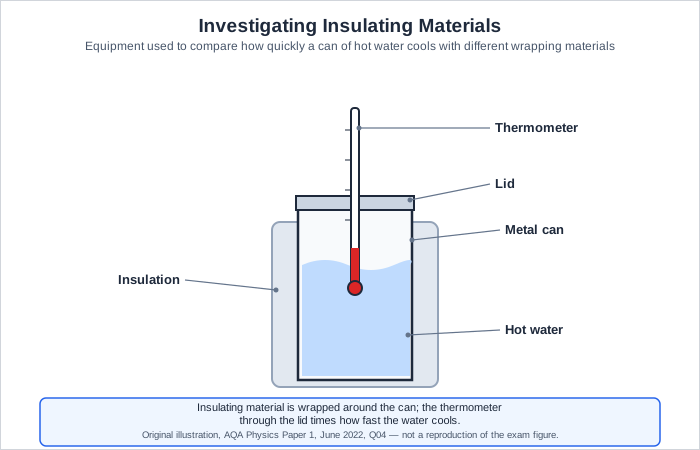
Describe a method to determine the specific heat capacity of a metal block using an electrical immersion heater. Include: - the equipment you would use - the measurements you would take - how you would calculate the specific heat capacity - how you would improve the accuracy of your results [6 marks] (Level of Response)

6 marks · challengeCommon

Equipment: Metal block with two holes (one for the immersion heater, one for the thermometer), an immersion heater, a thermometer (or temperature sensor), a joulemeter (or ammeter and voltmeter), a stopwatch, an electronic balance, and insulating material to wrap the block. Method: Measure and record the mass of the metal block using the balance. Insert the immersion heater into one hole and the thermometer into the other hole. Wrap the block in insulating material. Record the initial temperature of the block. Switch on the immersion heater and start the stopwatch. Record the joulemeter reading at the start and at the end of the heating period (or record current and voltage and time). After a set time (e.g. 5 minutes), switch off the heater and record the maximum temperature reached. Calculation: Calculate the temperature change: delta-theta = final temperature - initial temperature. Read the energy supplied from the joulemeter: E = final joulemeter reading - initial reading (or calculate E = V x I x t). Rearrange E = mc(delta-theta) to give c = E / (m x delta-theta). Substitute the values to calculate c in J/kg degrees C. Improvement: Wrap the block in insulation to reduce heat loss to the surroundings. Repeat the experiment and calculate a mean value of c. Wait for the temperature to stop rising (thermal equilibrium) before recording the final temperature.

  • Level 3 (5-6 marks): A detailed and logically sequenced method that would lead to a valid outcome. Must include: named equipment (immersion heater, thermometer, joulemeter or ammeter + voltmeter, metal block with holes for heater and thermometer, balance/scales); measurements taken (mass of block, initial temperature, final temperature, energy from joulemeter OR current + voltage + time); correct calculation using E = mcΔθ rearranged to c = E/(mΔθ); AND at least one valid improvement (insulation, repeating and averaging, waiting for thermal equilibrium, using a more precise thermometer). (6m)
  • Level 2 (3-4 marks): A method that would mostly lead to a valid outcome but steps may not be fully sequenced or one key element is missing. Most equipment named, most measurements identified, method for calculation present but may contain minor errors. (4m)
  • Level 1 (1-2 marks): Some relevant physics included but the method would not lead to a valid outcome. For example: mentions heater and thermometer but does not describe what to measure or how to calculate SHC. (2m)

RPA2 is one of the most commonly tested required practicals. Key points examiners award marks for: (1) correct named equipment including joulemeter; (2) measuring mass, initial and final temperature, and energy; (3) using c = E/(m delta-theta); (4) insulation as improvement. The most common error is forgetting to mention insulation or failing to state how energy is measured.

Test yourself on this in PrepWise
2.

A student heats a 1.5 kg block of an unknown metal using an immersion heater rated at 60 W for 5 minutes. The temperature of the block rises from 18 °C to 54 °C. Calculate the specific heat capacity of the metal. Give your answer to 3 significant figures.

4 marks · higherCommon
  • Correct energy: E = 60 × 300 = 18,000 J (converting 5 minutes to 300 s) (1m)
  • Correct temperature change: Δθ = 54 - 18 = 36 °C (1m)
  • Correct rearrangement: c = E / (m × Δθ) = 18000 / (1.5 × 36) (1m)
  • Correct answer: 333 J/kg°C (3 s.f.) Accept answers in range 830-835 J/kg°C (1m)

Step 1: Convert time: 5 min = 5 × 60 = 300 s. Step 2: E = P × t = 60 × 300 = 18,000 J. Step 3: Δθ = 54 - 18 = 36 °C. Step 4: c = E / (m × Δθ) = 18,000 / (1.5 × 36) = 18,000 / 54 = 333 J/kg°C. Note: The accepted answer of ~833 J/kg°C could correspond to a different metal; check the calculation chain carefully.

Test yourself on this in PrepWise
3.

A student supplies 63,000 J of energy to a block of iron. The temperature of the iron rises from 20 °C to 50 °C. The specific heat capacity of iron is 450 J/kg°C. Calculate the mass of the iron block. Use the equation: change in thermal energy = mass × specific heat capacity × temperature change

3 marks · standardCommon
  • Correct temperature change: Δθ = 50 - 20 = 30 °C (1m)
  • Correct rearrangement: m = E / (c × Δθ) = 63000 / (450 × 30) (1m)
  • Correct answer: 4.67 kg (accept 4.7 kg or 14/3 kg) (1m)

Δθ = 50 - 20 = 30 °C. Rearranging E = mcΔθ: m = E / (c × Δθ) = 63,000 / (450 × 30) = 63,000 / 13,500 = 4.67 kg

Test yourself on this in PrepWise
4.

An immersion heater of power 50 W heats a 0.5 kg copper block for 200 seconds. The specific heat capacity of copper is 400 J/kg°C. Calculate the temperature rise of the copper block. Assume all energy from the heater is transferred to the block. You may use the equations: energy = power × time and change in thermal energy = mass × specific heat capacity × temperature change

3 marks · standardCommon
  • Correct energy calculation: E = P × t = 50 × 200 = 10,000 J (1m)
  • Correct rearrangement: Δθ = E / (m × c) = 10000 / (0.5 × 400) (1m)
  • Correct answer: 50 °C (1m)

Step 1: E = P × t = 50 × 200 = 10,000 J. Step 2: Rearrange E = mcΔθ → Δθ = E / (mc) = 10,000 / (0.5 × 400) = 10,000 / 200 = 50 °C

Test yourself on this in PrepWise
5.

Water has a specific heat capacity of 4200 J/kg°C, much higher than most other common substances. Explain why this makes water useful in central heating systems.

3 marks · standardCommon

Water has a high specific heat capacity, meaning it can store a large amount of thermal energy for each degree of temperature rise. This means water can absorb a large amount of energy when heated in the boiler without its temperature increasing greatly. It then transfers this stored thermal energy to the radiators around the building as it cools, releasing a large amount of energy to heat the rooms efficiently.

  • Water can store a large amount of thermal energy (per kg per °C) / has high SHC (1m)
  • Water absorbs lots of energy from the boiler / heats up without large temperature rise (1m)
  • Water transfers/releases large amounts of energy to the radiators/rooms as it cools (1m)

Water's high SHC (4200 J/kg°C) means it can absorb and store a large amount of thermal energy per kg for every degree of temperature rise. This makes it an efficient heat carrier: the boiler heats the water (storing lots of energy), which then flows to radiators and releases that energy to warm the rooms.

Test yourself on this in PrepWise
6.

A student measures the specific heat capacity of an aluminium block using an immersion heater. Their calculated value is 1050 J/kg°C. The accepted value is 900 J/kg°C. Explain why the student's value is higher than the accepted value and suggest one improvement to make the result more accurate.

3 marks · higherCommon

The student's value is higher than the accepted value because energy is lost to the surroundings rather than all being transferred to the aluminium block. The joulemeter records all the energy supplied to the heater, but some of this energy heats the air and the surroundings instead of the block. This means E in the equation is too large, making the calculated SHC too high. The student could improve accuracy by wrapping the block in insulating material to reduce heat loss to the surroundings.

  • Energy is lost to the surroundings (not all energy goes into the block / heat loss to air/surroundings) (1m)
  • The recorded energy E is too large / greater than energy absorbed by block, making calculated c too high (accept: the joulemeter records more energy than the block receives) (1m)
  • Improvement: wrap/surround the block with insulation / use a polystyrene jacket to reduce heat loss (accept: repeat and take average / wait for thermal equilibrium before reading temperature) (1m)

The accepted value of SHC for aluminium is 900 J/kg°C. The student got 1050 J/kg°C because c = E/(mΔθ). If E is over-recorded (energy lost to surroundings), then c is calculated as too large. Solution: insulate the block to minimise heat loss so more energy goes into raising the block's temperature.

Test yourself on this in PrepWise
7.

A class is investigating how the material of a block affects its specific heat capacity. They heat blocks of different materials using the same immersion heater for the same amount of time and record the temperature change. State the independent variable, dependent variable, and one control variable in this investigation.

3 marks · higherCommon

The independent variable is the type of material (the metal block used). The dependent variable is the temperature change of the block. A control variable is the mass of each block (it must be kept the same for each material tested). The time of heating and the power of the heater are also kept the same.

  • Independent variable: type/material of the block (not just 'material') (1m)
  • Dependent variable: temperature change / temperature rise of the block (1m)
  • Control variable: mass of the block (accept: time of heating, power of heater, starting/initial temperature) (1m)

In this investigation: IV = the material/type of block (what you deliberately change); DV = the temperature change (what you measure); CV = mass of block, time of heating, power of heater (what you keep the same to make it fair).

Test yourself on this in PrepWise
8.

A solar panel transfers 540,000 J of energy to a 150 kg water tank. The temperature of the water increases from 15 °C to 22 °C. The specific heat capacity of water is 4200 J/kg°C. A student claims the solar panel transferred enough energy to raise the water temperature by 7 °C. Calculate the energy that would be needed to raise 150 kg of water by 7 °C and determine whether the student's claim is correct.

3 marks · higherCommon
  • Correct substitution: E = 150 × 4200 × 7 (1m)
  • Correct answer: 4,410,000 J (or 4410 kJ / 4.41 MJ) (1m)
  • Correct conclusion: The student's claim is NOT correct / 540,000 J is much less than 4,410,000 J required (accept: incorrect, not enough energy) (1m)

E = mcΔθ = 150 × 4200 × 7 = 4,410,000 J. The student's claim is NOT correct. The solar panel only transferred 540,000 J, which is far less than the 4,410,000 J needed to raise the water temperature by 7 °C.

Test yourself on this in PrepWise
9.

A 2 kg block of aluminium is heated and its temperature rises by 10 °C. The specific heat capacity of aluminium is 900 J/kg°C. Calculate the energy transferred to the aluminium block. Use the equation: change in thermal energy = mass × specific heat capacity × temperature change

2 marks · foundationCommon
  • Correct substitution: E = 2 × 900 × 10 (1m)
  • Correct answer: 18,000 J (18 kJ) (1m)

E = mcΔθ = 2 × 900 × 10 = 18,000 J

Test yourself on this in PrepWise
10.

Define specific heat capacity and give its unit.

2 marks · foundationCommon

Specific heat capacity is the amount of energy required to raise the temperature of 1 kg of a substance by 1 °C. The unit of specific heat capacity is J/kg°C (joules per kilogram per degree Celsius).

  • Energy required to raise temperature of 1 kg by 1 °C (accept: energy needed to increase temperature of 1 kilogram by 1 degree) (1m)
  • Unit: J/kg°C (accept J/kg/°C, J kg^-1 °C^-1, joules per kilogram per degree Celsius) (1m)

Specific heat capacity (symbol c) is defined as the energy required to raise the temperature of 1 kg of a substance by 1 °C. Its unit is J/kg°C. Water has a very high SHC of 4200 J/kg°C.

Test yourself on this in PrepWise
11.

What does the specific heat capacity of a substance measure?

  • A. The energy needed to change 1 kg of a substance from solid to liquid
  • B. The energy needed to raise the temperature of 1 kg of a substance by 1 °C
  • C. The maximum temperature a substance can reach before it boils
  • D. The rate at which a substance loses heat to its surroundings
1 mark · foundationCommon

Specific heat capacity is defined as the energy required to raise the temperature of 1 kg of a substance by 1 °C (or 1 K). Option A describes latent heat of fusion; C and D are unrelated definitions.

Test yourself on this in PrepWise
12.

The specific heat capacity of water is 4200 J/kg°C. What does this mean?

  • A. Water boils at 4200 °C
  • B. 1 kg of water releases 4200 J when it freezes
  • C. 4200 J of energy is needed to raise the temperature of 1 kg of water by 1 °C
  • D. Water can store up to 4200 J of energy before it evaporates
1 mark · foundationCommon

A specific heat capacity of 4200 J/kg°C means 4200 joules of energy must be transferred to raise the temperature of exactly 1 kilogram of water by exactly 1 °C. This is one of the highest SHC values of any common substance, making water excellent at storing thermal energy.

Test yourself on this in PrepWise
13.

Two blocks of the same mass are supplied with the same amount of energy. Block A has a higher specific heat capacity than Block B. Which statement is correct?

  • A. Block A reaches a higher temperature than Block B
  • B. Block A and Block B reach the same temperature
  • C. Block A reaches a lower temperature than Block B
  • D. Block B absorbs more energy than Block A
1 mark · foundationCommon

A higher specific heat capacity means more energy is required per kg per °C. With the same mass and the same energy input, the block with the higher SHC undergoes a smaller temperature change. Using E = mcΔθ, rearranging: Δθ = E/mc. A larger c gives a smaller Δθ.

Test yourself on this in PrepWise
14.

In the required practical to measure the specific heat capacity of a metal block, a student uses an immersion heater and a joulemeter. What is the purpose of the joulemeter in this experiment?

  • A. To measure the temperature of the metal block
  • B. To measure the mass of the metal block
  • C. To measure the resistance of the immersion heater
  • D. To measure the total electrical energy supplied to the heater
1 mark · standardCommon

A joulemeter (energy meter) measures the total electrical energy transferred to the immersion heater in joules. This value is used as E in the equation E = mcΔθ. Without knowing E accurately, the SHC cannot be calculated. The temperature is measured by the thermometer, not the joulemeter.

Test yourself on this in PrepWise
15.

A student measures the specific heat capacity of a copper block and gets a value higher than the accepted value. Which of the following best explains this result?

  • A. The student used too little insulation, so some energy was lost to the surroundings
  • B. The student used too much insulation, so the block got too hot
  • C. The student measured the temperature change incorrectly as too small
  • D. The joulemeter recorded less energy than was actually transferred
1 mark · standardCommon

If energy is lost to the surroundings (poor insulation), then less energy actually reaches the block than the joulemeter records. Rearranging E = mcΔθ gives c = E/(mΔθ). If E is over-estimated (because some energy escaped), the calculated SHC will be too high. Wrapping the block in insulation reduces this heat loss.

Test yourself on this in PrepWise

Heat Transfer

Common14
1.

A vacuum flask (thermos) is designed to keep drinks hot for several hours. The flask has a double-walled glass container with a vacuum between the walls. The glass is coated with a silver reflective layer. The flask has a plastic stopper at the top. Evaluate how the design features of a vacuum flask reduce thermal energy transfer by conduction, convection, and radiation.

6 marks · challengeCommon

Conduction: The vacuum between the glass walls prevents conduction because conduction requires particles to vibrate and pass energy to neighbouring particles. With no particles in the vacuum there can be no conduction. The plastic stopper at the top is a poor conductor of thermal energy, reducing conduction through the stopper. Convection: The vacuum also prevents convection because convection requires a fluid to circulate. There are no particles in the vacuum so no convection currents can form between the walls. Radiation: The silver reflective coating on the glass walls reflects infrared radiation back towards the drink rather than allowing it to be absorbed or emitted through the walls. Shiny silver surfaces are poor emitters and poor absorbers of infrared radiation, so the rate of energy transfer by radiation is greatly reduced. Together these three features minimise all three methods of thermal energy transfer, keeping the drink hot for several hours.

  • Level 3 (5-6 marks): Detailed description of all three methods of transfer AND explanation of how each design feature reduces that specific transfer method. Logical structure. (6m)
  • Level 2 (3-4 marks): Covers at least two of the three methods with correct explanations of how features reduce them. Some logical structure. (4m)
  • Level 1 (1-2 marks): Mentions at least one method correctly with some relevant link to a design feature. (2m)
  • Indicative content (conduction): The vacuum between the walls prevents conduction because conduction requires particles. The plastic stopper is a poor conductor, reducing conduction through the top. Glass is also a poor conductor. (1m)
  • Indicative content (convection): The vacuum between the walls also prevents convection because convection requires a fluid (particles). There is no fluid between the walls to circulate. (1m)
  • Indicative content (radiation): The silver reflective coating on the glass reflects infrared radiation back into the drink rather than absorbing or emitting it. Silver/shiny surfaces are poor emitters and poor absorbers of infrared radiation. (1m)

A vacuum flask uses three design features to minimise all three types of heat transfer: (1) The vacuum between the glass walls eliminates conduction and convection (both need particles/fluid). (2) The silver reflective coating reflects infrared radiation back, minimising radiation losses. (3) The plastic stopper is a poor conductor, reducing conduction at the top. Together these features keep drinks hot for hours.

Test yourself on this in PrepWise
2.

Explain why metals are much better thermal conductors than non-metals.

4 marks · higherCommon

In metals, there are free electrons that are not bound to any particular atom and can move freely through the metal structure. These free electrons can carry thermal energy rapidly from the hot end to the cool end. Additionally, metal particles vibrate and pass energy to neighbouring particles. Non-metals do not have free electrons, so energy transfer is much slower, relying only on particle vibrations.

  • Metals have free electrons that can move freely through the structure (1m)
  • Free electrons carry thermal energy rapidly from the hot end to the cool end (1m)
  • Non-metals rely only on particle vibration to transfer energy (1m)
  • Particle vibration is slower / free electrons make metals much better conductors than non-metals (1m)

Metals are better conductors for two reasons: (1) particle vibrations pass energy along, and (2) free electrons carry energy rapidly through the metal structure. Non-metals lack free electrons so they rely only on slow particle vibrations.

Test yourself on this in PrepWise
3.

Explain how a convection current forms when the base of a fluid is heated.

3 marks · standardCommon

The fluid at the base is heated and expands, becoming less dense. The less dense fluid rises. Cooler, denser fluid sinks to replace it at the base. This creates a convection current that circulates thermal energy through the fluid.

  • Heated fluid expands / becomes less dense (1m)
  • Less dense fluid rises; cooler denser fluid sinks to replace it (1m)
  • This creates a convection current / circulation of fluid that transfers thermal energy (1m)

Convection currents form because heating a fluid causes it to expand and become less dense. Less dense fluid rises, displacing cooler, denser fluid which sinks. This circulation (convection current) transfers thermal energy throughout the fluid.

Test yourself on this in PrepWise
4.

Explain why thermal energy from the Sun can reach the Earth, even though space is a vacuum.

3 marks · standardCommon

The Sun emits infrared radiation, which is a type of electromagnetic radiation. Electromagnetic radiation does not need a medium or particles to travel through. It can travel through the vacuum of space and is absorbed by the Earth's surface.

  • The Sun emits infrared radiation / electromagnetic radiation (1m)
  • Radiation does not need a medium / can travel through a vacuum / does not need particles (1m)
  • The radiation is absorbed by the Earth's surface (1m)

The Sun's energy reaches Earth by radiation (infrared/electromagnetic radiation). Unlike conduction or convection, radiation does not require a medium and can travel through the vacuum of space. The Earth's surface absorbs this radiation.

Test yourself on this in PrepWise
5.

A radiator transfers 36,000 J of thermal energy to a room in 5 minutes. Calculate the power of the radiator. Use the equation: power = energy transferred / time

3 marks · standardCommon
  • Convert time to seconds: 5 x 60 = 300 s (1m)
  • Correct substitution: P = 36000 / 300 (1m)
  • Correct answer: 120 W (1m)

First convert time: 5 minutes = 5 x 60 = 300 s. Then: P = E/t = 36,000 / 300 = 120 W. The unit of power is watts (W).

Test yourself on this in PrepWise
6.

A house has loft insulation made of fibreglass wool. Explain how loft insulation reduces unwanted thermal energy transfer from the house to the outside.

3 marks · higherCommon

The fibreglass wool traps pockets of air within it. Air is a poor conductor of thermal energy, so conduction through the trapped air is very slow. The trapped air also cannot circulate, preventing convection. This reduces the rate of thermal energy transfer from the warm house to the colder outside.

  • Insulation traps (pockets of) air / air is trapped within the material (1m)
  • Trapped air is a poor conductor (of thermal energy) / reduces conduction (1m)
  • Trapped air cannot circulate / cannot form convection currents / reduces convection / rate of thermal energy transfer is reduced (1m)

Loft insulation works by trapping pockets of air. Air is a poor thermal conductor (low thermal conductivity), so conduction is greatly reduced. The trapped, still air also cannot circulate, so convection currents cannot form. Both effects reduce the rate of energy transfer.

Test yourself on this in PrepWise
7.

A student investigates infrared radiation by placing two identical thermometers next to identical cans — one matt black and one shiny white — both filled with hot water at the same starting temperature. After 30 minutes, the matt black can has cooled more. Explain why this result was expected.

3 marks · higherCommon

Dark, matt surfaces are better emitters of infrared radiation than light, shiny surfaces. The matt black can emits infrared radiation at a greater rate than the shiny white can. More thermal energy is radiated per second from the black can, so it loses energy faster and cools more quickly.

  • Dark, matt surfaces are better emitters of infrared radiation than light, shiny surfaces (1m)
  • The matt black can emits infrared radiation at a greater rate than the shiny white can (1m)
  • More thermal energy is lost per second from the black can, so it cools more quickly (1m)

Dark matt surfaces are better emitters of infrared radiation. The matt black can radiates more energy per second than the shiny white can. Because it loses more energy per second, it cools faster. This is consistent with the experimental result.

Test yourself on this in PrepWise
8.

Explain how thermal energy is transferred through a solid metal rod by conduction.

2 marks · foundationCommon

Particles at the hot end gain energy and vibrate more. They pass this energy to neighbouring particles by vibration. This process continues along the rod so thermal energy transfers from the hot end to the cooler end.

  • Particles (at hot end) vibrate more / gain (more) energy / vibrate with greater amplitude (1m)
  • Energy is passed to neighbouring particles by vibration / collisions, transferring energy along the rod from hot to cool end (1m)

In conduction, particles at the hot end gain thermal energy and vibrate more vigorously. They collide with and transfer energy to neighbouring particles. In metals, free electrons also carry energy through the structure, making metals better conductors.

Test yourself on this in PrepWise
9.

Copper has a thermal conductivity of 400 W/m°C. Wood has a thermal conductivity of 0.1 W/m°C. How many times greater is the thermal conductivity of copper compared to wood? Use the equation: ratio = thermal conductivity of copper / thermal conductivity of wood

2 marks · standardCommon
  • Correct substitution: ratio = 400 / 0.1 (1m)
  • Correct answer: 4000 (times greater) (1m)

Ratio = 400 / 0.1 = 4000. Copper conducts thermal energy 4000 times faster than wood under the same conditions, which explains why metals feel much colder to the touch.

Test yourself on this in PrepWise
10.

Which method of thermal energy transfer occurs mainly in solids?

  • A. Convection
  • B. Conduction
  • C. Radiation
  • D. Evaporation
1 mark · foundationCommon

Conduction is the main method of thermal energy transfer in solids. Particles vibrate and pass energy to neighbouring particles. Convection requires fluid flow, which cannot happen in solids.

Test yourself on this in PrepWise
11.

Which method of thermal energy transfer does NOT require a medium (can travel through a vacuum)?

  • A. Conduction
  • B. Convection
  • C. Radiation
  • D. Both conduction and convection
1 mark · foundationCommon

Radiation (infrared radiation) can travel through a vacuum because it is a form of electromagnetic radiation and does not need particles to transfer energy. Conduction and convection both require matter.

Test yourself on this in PrepWise
12.

A student heats water at the bottom of a beaker. Which statement correctly describes what happens next?

  • A. The hot water sinks because it is denser
  • B. The hot water rises because it is less dense
  • C. The hot water stays at the bottom and heats the cooler water by conduction only
  • D. The hot water cools immediately without moving
1 mark · foundationCommon

When water at the bottom is heated, it expands and becomes less dense. Less dense fluid rises. Cooler, denser water sinks to replace it, creating a convection current.

Test yourself on this in PrepWise
13.

Two identical mugs contain the same hot drink. One mug is matt black, the other is shiny silver. Which mug will cool down faster, and why?

  • A. The shiny silver mug, because shiny surfaces absorb more radiation
  • B. The shiny silver mug, because silver surfaces emit more infrared radiation
  • C. The matt black mug, because dark matt surfaces are better emitters of infrared radiation
  • D. Both mugs cool at the same rate, because the liquid inside is identical
1 mark · standardCommon

Dark, matt surfaces are better emitters (and absorbers) of infrared radiation than shiny, light-coloured surfaces. The matt black mug radiates more energy per second so it cools faster.

Test yourself on this in PrepWise
14.

A metal spoon feels colder than a wooden spoon at the same room temperature. What is the best scientific explanation for this observation?

  • A. Metal is a colder material than wood
  • B. Metal conducts thermal energy away from your hand faster than wood does
  • C. Metal absorbs more radiation from the room than wood
  • D. Wood radiates more infrared radiation than metal
1 mark · standardCommon

Metal feels cold because it is a much better thermal conductor than wood. Metal rapidly conducts thermal energy away from your hand into the spoon. The sensation of 'cold' is actually the rapid loss of energy from your skin.

Test yourself on this in PrepWise

Black Body Radiation

Common16
1.

Scientists have proposed several methods to reduce the effects of climate change. One proposal is to inject reflective aerosol particles into the upper atmosphere to reflect more sunlight back into space. Using your knowledge of black body radiation and the Earth's radiation balance, evaluate this proposed method. In your answer, explain: - How the Earth's current temperature balance works - How injecting aerosols might affect the radiation balance - Any potential problems with this approach [6 marks]

6 marks · challengeCommon

The Earth's temperature is currently in approximate balance: the solar radiation absorbed by the Earth equals the infrared radiation emitted by the Earth into space. This is the radiation balance. If more greenhouse gases absorb more of the outgoing infrared radiation, less energy escapes and the Earth's temperature rises to a new, higher equilibrium. Injecting reflective aerosols into the upper atmosphere would increase the Earth's albedo — more solar radiation would be reflected back into space before being absorbed. This would reduce the amount of radiation absorbed by the Earth. According to the radiation balance, if less radiation is absorbed, the Earth would need to emit less radiation to stay in equilibrium — meaning the Earth would cool to a lower equilibrium temperature. This could counteract global warming. However, there are significant problems. Aerosols do not address the cause — CO2 levels would continue rising. If the aerosol injection were stopped, rapid termination shock warming would occur. Aerosols might affect rainfall patterns unevenly. The effects on ecosystems from reduced sunlight are unknown.

  • Level 3 (5-6 marks): The student gives a logically structured account covering: the Earth's radiation balance (absorbed solar = emitted infrared), how aerosols would reflect more solar radiation reducing absorption, the effect on equilibrium (less absorbed means Earth cools to a new equilibrium), and at least one well-explained limitation (e.g. uneven cooling, unknown side effects, termination shock if stopped suddenly, does not address CO2 concentration). (6m)
  • Level 2 (3-4 marks): The student covers most points but the account is not fully sequenced or one major aspect is missing/unclear. (4m)
  • Level 1 (1-2 marks): The student identifies some relevant ideas such as the greenhouse effect or radiation balance but does not develop them into a coherent evaluation. (2m)
  • Level 0 (0 marks): No relevant science. (1m)

This is a Level of Response question testing ability to apply the radiation balance concept to a novel real-world scenario. A top-band answer must cover: (1) current radiation balance clearly, (2) mechanism by which aerosols reduce absorbed radiation, (3) how this shifts equilibrium to a lower temperature, and (4) at least one well-explained limitation showing critical evaluation.

Test yourself on this in PrepWise
2.

Describe and explain how an increase in greenhouse gas concentrations in the atmosphere causes global average temperatures to rise. In your answer, include: - The mechanism by which greenhouse gases cause warming - Evidence that human activity has increased greenhouse gas concentrations - An evaluation of one method that could be used to reduce greenhouse gas emissions, including one advantage and one disadvantage [6 marks]

6 marks · challengeCommon

Greenhouse gases such as carbon dioxide, methane and water vapour absorb infrared radiation emitted by the Earth's surface. The gases then re-radiate this energy in all directions, including back towards the surface. This means less infrared radiation escapes into space, so more energy is retained in the Earth system. The Earth's temperature rises until a new equilibrium is reached where the rate of energy absorbed from the Sun equals the rate of energy emitted. Human activities have increased greenhouse gas concentrations. Burning fossil fuels (coal, oil, gas) releases carbon dioxide that was stored for millions of years. Deforestation reduces the number of trees absorbing CO2 through photosynthesis. Data shows that atmospheric CO2 concentration and global average temperature have both risen since industrialisation began in the 1800s, with a strong correlation between the two. One method to reduce emissions is to replace fossil fuels with renewable energy sources such as wind or solar power. An advantage is that these produce no greenhouse gas emissions during operation. A disadvantage is that they are intermittent — wind and solar only generate electricity when the wind blows or the sun shines — so backup energy storage or generation is needed, which increases cost and complexity.

  • Level 3 (5-6 marks): Logically structured account covering all three bullet points. Mechanism includes absorption AND re-radiation AND less escaping to space AND temperature rise to new equilibrium. Human evidence includes at least two named sources (fossil fuels, deforestation) and reference to data (correlation of CO2/temperature). Evaluation of one method includes a specific named method with both a correctly explained advantage AND disadvantage. (6m)
  • Level 2 (3-4 marks): Two of the three bullet points covered well, or all three covered superficially. Mechanism described but may miss equilibrium point. Human evidence gives one source. One advantage or disadvantage given but not both, or method not named. (4m)
  • Level 1 (1-2 marks): One bullet point partially addressed. Mechanism vague (e.g. 'greenhouse gases trap heat'). Human evidence vague (e.g. 'pollution'). Method mentioned without explanation. (2m)
  • Level 0 (0 marks): No relevant physics. (1m)

This is a Level of Response question combining three skills: explaining a physical mechanism (greenhouse effect), evaluating human evidence (emissions data and sources), and making a balanced evaluation of a solution. To reach Level 3 all three bullet points must be addressed with depth — a vague mention of 'greenhouse gases trap heat' and 'we burn fossil fuels' only reaches Level 1.

Test yourself on this in PrepWise
3.

Explain why an increase in greenhouse gases in the atmosphere causes the Earth's average temperature to increase.

4 marks · higherCommon

Greenhouse gases in the atmosphere absorb infrared radiation emitted by the Earth's surface. The gases then emit this infrared radiation in all directions, including back towards the Earth's surface. This means less infrared radiation escapes into space. The Earth must increase its temperature to emit enough radiation to maintain the balance with incoming radiation from the Sun. Therefore the average temperature of the Earth increases.

  • Greenhouse gases absorb infrared radiation emitted by the Earth's surface (1m)
  • The gases re-emit / re-radiate the infrared radiation back towards the Earth's surface / in all directions (1m)
  • Less infrared radiation escapes into space / more energy trapped in atmosphere (1m)
  • Earth's temperature increases until radiation emitted again equals radiation absorbed / new equilibrium reached (1m)

Greenhouse gases (CO2, CH4, water vapour) absorb infrared radiation emitted by the Earth. They re-emit it in all directions including back to Earth — this reduces the amount of energy lost to space. With more greenhouse gases, even less infrared escapes. To maintain the radiation balance (absorbed = emitted), the Earth must get warmer so it emits more radiation. This is the enhanced greenhouse effect.

Test yourself on this in PrepWise
4.

Two proposals to reduce carbon dioxide emissions have been suggested: Proposal A — Offshore wind turbines: generate electricity from wind with no CO₂ emissions during operation. Proposal B — Carbon capture at power stations: remove CO₂ from exhaust gases and store it underground. Evaluate both proposals in terms of their effectiveness in reducing atmospheric CO₂ concentrations. Consider advantages and disadvantages of each.

4 marks · challengeCommon

A carbon tax creates a financial incentive to reduce CO2 emissions — it makes burning fossil fuels more expensive, encouraging businesses and individuals to switch to lower-carbon alternatives. A limitation is that it may make energy more expensive for poorer households and businesses, and may not reduce emissions fast enough without other policies. Afforestation removes CO2 from the atmosphere directly through photosynthesis, which addresses existing atmospheric CO2 as well as reducing new emissions. A limitation is that it requires very large areas of land, which may compete with agriculture or natural habitats. Trees also take many years to grow and mature before absorbing significant amounts of CO2. Neither method alone is likely to be sufficient — a combination of reducing emissions and removing existing CO2 is needed.

  • Wind turbines: advantage — no CO₂ during operation / renewable energy source (1) (1m)
  • Wind turbines: limitation — intermittent (does not generate when no wind) / requires energy storage or backup (1) (1m)
  • Carbon capture: advantage — removes CO₂ directly from existing power stations / does not require replacing all energy infrastructure (1) (1m)
  • Carbon capture: limitation — energy intensive process / storage may leak / does not address all CO₂ sources (1) (1m)

This question requires evaluating two policy approaches to reducing greenhouse gas concentrations. Carbon tax works by changing the economics of fossil fuel use — raising costs incentivises alternatives. Afforestation works through biology — photosynthesis removes CO2 from the atmosphere. A complete evaluation identifies the mechanism AND a limitation for each, showing understanding of both the science and the real-world constraints.

Test yourself on this in PrepWise
5.

Explain how the radiation emitted by an object changes as its temperature increases.

3 marks · standardCommon

As the temperature of an object increases, the total amount of radiation emitted increases. The object emits more radiation per second at every wavelength. The peak wavelength of the emitted radiation also decreases, shifting towards shorter wavelengths. This means hotter objects emit radiation with a higher peak frequency.

  • The total amount of radiation emitted increases (more energy emitted per second) (1m)
  • The peak wavelength decreases / shifts to shorter wavelengths (1m)
  • Hotter objects emit radiation with a higher peak frequency / peak moves towards shorter wavelengths including visible/UV (1m)

Hotter objects emit more radiation overall (greater intensity at every wavelength). The peak wavelength shortens — a red-hot object is cooler than a white-hot object. Very hot stars emit most radiation in the ultraviolet while cool stars emit mainly in the infrared. This is the basis of colour-temperature in astronomy.

Test yourself on this in PrepWise
6.

Explain how the temperature of the Earth remains approximately constant over time, in terms of radiation absorbed and emitted.

3 marks · higherCommon

The Earth absorbs radiation from the Sun. The Earth also emits infrared radiation into space. When the temperature is constant, the amount of radiation absorbed equals the amount of radiation emitted. This is called a radiation balance or thermal equilibrium. If more radiation is absorbed than emitted, the Earth's temperature increases until a new equilibrium is reached.

  • The Earth absorbs radiation from the Sun (1m)
  • The Earth emits infrared radiation into space (1m)
  • Temperature is constant when radiation absorbed equals radiation emitted / radiation balance / equilibrium (1m)

The Earth receives energy from the Sun (mainly visible light and UV). It re-radiates this as infrared radiation. When the rate of energy absorbed from the Sun equals the rate of energy emitted by the Earth, the temperature stays constant — this is thermal equilibrium. If this balance is disrupted (e.g. by greenhouse gases trapping more radiation) the temperature changes.

Test yourself on this in PrepWise
7.

The Earth's average temperature has been rising. Using ideas about radiation balance, explain what must be happening to cause this temperature increase.

3 marks · higherCommon

If the Earth's temperature is rising, the amount of radiation absorbed by the Earth must be greater than the amount of radiation emitted by the Earth. This means the radiation balance has been disrupted. More radiation is being absorbed than emitted, so energy is accumulating in the Earth system, causing the temperature to increase. This imbalance could be caused by increased greenhouse gases reducing the infrared radiation that escapes to space.

  • The radiation absorbed by the Earth is greater than the radiation emitted by the Earth / radiation balance disrupted (1m)
  • More energy is absorbed than emitted / energy accumulates in the system (1m)
  • This could be caused by greenhouse gases / less infrared radiation escaping to space (1m)

A rising temperature means absorbed energy exceeds emitted energy — the radiation balance is broken. Energy builds up in the Earth system. The most likely cause is enhanced greenhouse effect: increased greenhouse gas concentrations absorb more of the Earth's infrared radiation and re-emit some back, reducing the amount escaping to space.

Test yourself on this in PrepWise
8.

State two properties of a perfect black body.

2 marks · foundationCommon

A perfect black body absorbs all radiation incident on it, reflecting none. It is also a perfect emitter of radiation, emitting the maximum amount of radiation possible at every wavelength for its temperature.

  • Absorbs all incident radiation / reflects no radiation / transmits no radiation (1m)
  • Perfect emitter / emits maximum radiation at every wavelength for its temperature (1m)

A perfect black body has two defining properties: (1) it absorbs all radiation that hits it — no reflection or transmission occurs, and (2) it is a perfect emitter, meaning it radiates the maximum possible energy at every wavelength for its temperature. Real objects are not perfect black bodies but some approximate one closely.

Test yourself on this in PrepWise
9.

The graph below shows radiation intensity against wavelength for three objects at different temperatures: Object P, Object Q, and Object R. Object P has its peak intensity at a wavelength of 10 micrometres. Object Q has its peak intensity at a wavelength of 3 micrometres. Object R has its peak intensity at a wavelength of 0.5 micrometres. Which object has the highest temperature? Give a reason for your answer.

2 marks · standardCommon
  • Object R (1 mark) (1m)
  • Because it has the shortest peak wavelength / a shorter peak wavelength indicates a higher temperature (1 mark) (1m)

Object R has its peak wavelength at 0.5 micrometres, which is the shortest of the three. As temperature increases, the peak wavelength of the emitted radiation decreases (shifts to shorter wavelengths). Therefore Object R, with the shortest peak wavelength, has the highest temperature. Object P (peak at 10 micrometres) is the coolest.

Test yourself on this in PrepWise
10.

A student claims: "The Earth's temperature stays the same because it receives exactly the right amount of energy from the Sun." Explain why the student is wrong, and describe what actually keeps the Earth's temperature roughly stable.

2 marks · standardCommon

The student is wrong because the Earth also emits infrared radiation back into space. The temperature is stable because the rate of energy absorbed from the Sun equals the rate of energy radiated back into space. This balance is called radiation equilibrium. Greenhouse gases in the atmosphere absorb some of the outgoing infrared radiation and re-emit it, reducing the rate at which energy escapes — this raises the equilibrium temperature.

  • The Earth also emits/radiates infrared radiation back into space (1m)
  • Temperature is stable when rate of energy absorbed = rate of energy emitted (radiation equilibrium) (1m)

Adding more greenhouse gases means more of the Earth's outgoing infrared radiation is absorbed by the atmosphere and re-emitted back towards the surface. Less escapes to space. The Earth is now absorbing more energy than it emits, so its temperature rises. As temperature rises, the Earth emits more infrared (Stefan-Boltzmann law direction — not required at GCSE) until a new equilibrium is reached at a higher temperature.

Test yourself on this in PrepWise
11.

A scientist records that a distant star has its peak emission wavelength at 290 nm (nanometres) in the ultraviolet range. Our Sun has its peak emission wavelength at 500 nm in the visible range. Using this information only, state which object has the higher surface temperature and which emits more total radiation per unit area.

2 marks · higherCommon
  • The star has the higher temperature because it has a shorter peak wavelength (1m)
  • The star also emits more total radiation per unit area because it is at a higher temperature (1m)

The star peaks at 290 nm, which is shorter than the Sun's 500 nm. A shorter peak wavelength indicates a higher temperature, so the star is hotter than the Sun. A hotter object also emits more total radiation per unit area at every wavelength, so the star emits more total radiation per unit area than the Sun.

Test yourself on this in PrepWise
12.

Explain why a perfect black body is both the best absorber and the best emitter of radiation.

2 marks · higherCommon

A perfect black body absorbs all radiation incident on it — no radiation is reflected or transmitted. Because it absorbs the maximum possible radiation at every wavelength, it also emits the maximum possible radiation at every wavelength for its temperature. Objects that are good absorbers are also good emitters — this is a fundamental property of thermal radiation.

  • A black body absorbs all incident radiation / reflects none / is a perfect absorber (1m)
  • Good absorbers are also good emitters / it emits the maximum possible radiation at its temperature (1m)

A perfect black body absorbs all radiation — none is reflected. Kirchhoff's law (at GCSE level: good absorbers are good emitters) means that an object that absorbs maximally at every wavelength also emits maximally at every wavelength. This is why a perfect black body is the ideal emitter as well as the ideal absorber.

Test yourself on this in PrepWise
13.

What is a perfect black body?

  • A. An object that reflects all radiation that hits it
  • B. An object that only emits visible light
  • C. An object that absorbs all radiation that hits it and reflects none
  • D. An object that is black in colour and absorbs only visible light
1 mark · foundationCommon

A perfect black body absorbs all radiation incident on it — it reflects no radiation and transmits none. It is also a perfect emitter, radiating the maximum amount of energy possible at every wavelength for its temperature. The colour of an object has nothing to do with whether it is a black body in the physics sense.

Test yourself on this in PrepWise
14.

Which statement about objects and infrared radiation is correct?

  • A. All objects above absolute zero emit infrared radiation
  • B. Only very hot objects such as the Sun emit radiation
  • C. Cold objects absorb radiation but do not emit any
  • D. Objects only emit radiation when they are heated by another source
1 mark · foundationCommon

All objects at any temperature above absolute zero (0 K) emit electromagnetic radiation — including infrared. The amount of radiation emitted increases as temperature increases, but even a cold object like an ice cube emits some radiation. The misconception that only hot objects emit radiation is very common.

Test yourself on this in PrepWise
15.

A star has a surface temperature of 12 000 K. Compared to our Sun (surface temperature 6000 K), the peak wavelength of radiation emitted by this star is:

  • A. The same wavelength as the Sun
  • B. At a longer wavelength than the Sun
  • C. At a shorter wavelength than the Sun
  • D. At exactly half the wavelength of the Sun
1 mark · standardCommon

As an object gets hotter, the peak wavelength of the radiation it emits shifts to shorter wavelengths. The star at 12 000 K is twice as hot as the Sun (6000 K), so its peak wavelength is at a shorter wavelength — the star would emit more in the ultraviolet range. Option D is tempting but the relationship between temperature and peak wavelength (Wien's law) is not required at GCSE — students just need to know the direction of shift.

Test yourself on this in PrepWise
16.

The Earth absorbs radiation from the Sun and emits infrared radiation. What is the role of the atmosphere in the Earth's temperature balance?

  • A. The atmosphere reflects all radiation from the Sun back into space
  • B. The atmosphere has no effect on the amount of radiation the Earth emits
  • C. The atmosphere absorbs some of the infrared radiation emitted by the Earth, keeping it warmer
  • D. The atmosphere absorbs some infrared radiation emitted by the Earth and re-radiates it, warming the surface
1 mark · standardCommon

Greenhouse gases in the atmosphere absorb some of the infrared radiation emitted by the Earth's surface and re-radiate it in all directions, including back towards the surface. This keeps the Earth warmer than it would be without an atmosphere — this is the natural greenhouse effect. Option C is partially correct but misses the re-radiation step, which is the key mechanism.

Test yourself on this in PrepWise

Power

Common14
1.

A crane lifts a steel beam of mass 800 kg to a height of 15 m in 30 s. Calculate the power of the crane motor. Gravitational field strength g = 10 N/kg. Give your answer in watts (W).

4 marks · higherCommon
  • Calculate work done (= GPE gained): W = mgh = 800 x 10 x 15 (1m)
  • Correct value: W = 120,000 J (1m)
  • Correct substitution: P = W/t = 120,000 / 30 (1m)
  • Correct answer: P = 4000 W (1m)

Step 1: Work done = GPE gained = mgh = 800 x 10 x 15 = 120,000 J. Step 2: P = W/t = 120,000 / 30 = 4000 W. This is a multi-step calculation combining gravitational PE and power equations.

Test yourself on this in PrepWise
2.

A car engine has a power input of 80 kW and an efficiency of 35%. The car travels for 5 minutes. Calculate the useful energy output of the engine over this time period. Give your answer in megajoules (MJ). 1 kW = 1000 W, 1 MJ = 1,000,000 J

4 marks · challengeCommon
  • Convert power: 80 kW = 80,000 W; convert time: 5 min = 300 s (1m)
  • Calculate total energy input: E = P x t = 80,000 x 300 = 24,000,000 J (1m)
  • Apply efficiency: useful energy = 0.35 x 24,000,000 = 8,400,000 J (1m)
  • Convert to MJ: 8,400,000 / 1,000,000 = 8.4 MJ (1m)

Step 1: 80 kW = 80,000 W; 5 min = 300 s. Step 2: Total input energy = 80,000 x 300 = 24,000,000 J. Step 3: Useful output = 0.35 x 24,000,000 = 8,400,000 J = 8.4 MJ. A challenge question requiring unit conversion + E=Pt + efficiency.

Test yourself on this in PrepWise
3.

A sports car of mass 1200 kg accelerates from rest to 30 m/s in 6 s. Assuming all engine power goes into kinetic energy, calculate the average power output of the engine during this acceleration. Give your answer in kilowatts (kW).

4 marks · challengeCommon
  • Calculate kinetic energy gained: Ek = 0.5 x m x v^2 = 0.5 x 1200 x 30^2 (1m)
  • Ek = 0.5 x 1200 x 900 = 540,000 J (1m)
  • Calculate power: P = E/t = 540,000 / 6 = 90,000 W (1m)
  • Convert to kW: 90,000 / 1000 = 90 kW (1m)

Step 1: Ek = 0.5 x 1200 x 30^2 = 0.5 x 1200 x 900 = 540,000 J. Step 2: P = E/t = 540,000 / 6 = 90,000 W = 90 kW. This combines kinetic energy and power equations — a classic challenge question on AQA papers.

Test yourself on this in PrepWise
4.

A kettle has a power rating of 2000 W. It is switched on for 3 minutes. Calculate the energy transferred by the kettle. Use the equation: energy transferred = power x time Give your answer in joules (J).

3 marks · standardCommon
  • Convert time to seconds: 3 x 60 = 180 s (1m)
  • Correct substitution: E = 2000 x 180 (1m)
  • Correct answer: E = 360,000 J (or 360 kJ) (1m)

First convert: 3 minutes = 3 x 60 = 180 s. Then E = P x t = 2000 x 180 = 360,000 J. Note: students often forget to convert minutes to seconds — always check units.

Test yourself on this in PrepWise
5.

A microwave oven transfers 54,000 J of energy. It has a power rating of 900 W. Calculate how long the microwave was switched on. Use the equation: power = energy transferred / time Give your answer in seconds (s).

3 marks · standardCommon
  • Correct rearrangement: t = E / P (1m)
  • Correct substitution: t = 54000 / 900 (1m)
  • Correct answer: t = 60 s (1m)

Rearrange P = E/t to get t = E/P. Substitute: t = 54,000 / 900 = 60 s. The microwave was on for 60 seconds (1 minute).

Test yourself on this in PrepWise
6.

A tumble dryer has a power rating of 3.5 kW. It is used for 40 minutes. Calculate the energy transferred by the dryer. Give your answer in megajoules (MJ). 1 kW = 1000 W, 1 MJ = 1,000,000 J

3 marks · higherCommon
  • Convert power: 3.5 kW = 3500 W (1m)
  • Convert time: 40 min = 40 x 60 = 2400 s, then calculate E = P x t = 3500 x 2400 = 8,400,000 J (1m)
  • Convert to MJ: 8,400,000 / 1,000,000 = 8.4 MJ (1m)

Convert: 3.5 kW = 3500 W; 40 min = 2400 s. Then E = Pt = 3500 x 2400 = 8,400,000 J = 8.4 MJ. A chain of unit conversions is needed — a common higher-tier skill.

Test yourself on this in PrepWise
7.

A student says: 'A 3 kW electric shower uses more energy than a 100 W light bulb because it has a higher power rating.' Evaluate this statement.

3 marks · higherCommon

The student's statement is only partly correct. Power is the rate of energy transfer, so a higher power rating means energy is transferred more quickly per second. However, the total energy transferred also depends on time. If the shower is used for a short time and the bulb is left on for many hours, the bulb could transfer more total energy. You cannot compare total energy without knowing how long each appliance is used.

  • Power is rate of energy transfer — higher power means more energy transferred per second (not necessarily more total energy) (1m)
  • Total energy transferred depends on both power AND time: E = P x t (1m)
  • Therefore the statement is not fully correct — without knowing the time, you cannot compare total energy (1m)

Power is energy per second. Higher wattage = more energy per second. But E = Pt means total energy depends on time as well. A 100 W bulb left on for 10 hours uses 3.6 MJ; a 3 kW shower used for 5 minutes uses 0.9 MJ — less total energy despite higher power.

Test yourself on this in PrepWise
8.

A gym machine has a power output of 250 W. A person uses it for 15 minutes. Calculate the energy transferred by the machine. Give your answer in kilojoules (kJ). 1 kJ = 1000 J

3 marks · higherCommon
  • Convert time to seconds: 15 x 60 = 900 s (1m)
  • Correct substitution: E = P x t = 250 x 900 = 225,000 J (1m)
  • Convert to kJ: 225,000 / 1000 = 225 kJ (1m)

Convert: 15 min = 900 s. Then E = Pt = 250 x 900 = 225,000 J = 225 kJ. Always convert minutes to seconds, and check the required unit of the answer.

Test yourself on this in PrepWise
9.

A lamp transfers 900 J of energy in 60 s. Calculate the power of the lamp. Use the equation: power = energy transferred / time Give your answer in watts (W).

2 marks · foundationCommon
  • Correct substitution: P = 900 / 60 (1m)
  • Correct answer: P = 15 W (1m)

P = E/t = 900 / 60 = 15 W. The lamp transfers 15 joules of energy every second.

Test yourself on this in PrepWise
10.

State what is meant by the term 'power' in physics and state its unit.

2 marks · standardCommon

Power is the rate of energy transfer (or the rate of doing work). The unit of power is the watt (W), which is equivalent to one joule per second (J/s).

  • Power is the rate of energy transfer (or rate of doing work) (1m)
  • Unit is the watt (W), equal to one joule per second (1m)

Power = rate of energy transfer. 1 W = 1 J/s. A 60 W bulb transfers 60 J every second.

Test yourself on this in PrepWise
11.

Which of the following is the correct definition of power?

  • A. The total amount of energy stored in a system
  • B. The rate at which energy is transferred
  • C. The force applied multiplied by the distance moved
  • D. The amount of work that can be done in one hour
1 mark · foundationCommon

Power is defined as the rate of energy transfer, i.e. how quickly energy is transferred from one store to another (or how quickly work is done). It is measured in watts (W), where 1 watt = 1 joule per second.

Test yourself on this in PrepWise
12.

One watt is equivalent to which of the following?

  • A. One joule per second
  • B. One joule per minute
  • C. One newton per second
  • D. One kilogram per second
1 mark · foundationCommon

One watt (W) is defined as one joule per second (J/s). This means a device with a power of 1 W transfers 1 J of energy every second. A more powerful device transfers more energy per second.

Test yourself on this in PrepWise
13.

A washing machine has a power rating of 2.5 kW. What is this in watts?

  • A. 0.0025 W
  • B. 25 W
  • C. 2500 W
  • D. 25 000 W
1 mark · standardCommon

To convert kilowatts to watts, multiply by 1000. So 2.5 kW = 2.5 x 1000 = 2500 W. The prefix 'kilo' always means 1000.

Test yourself on this in PrepWise
14.

A device transfers 600 J of energy in 2 minutes. What is its power output?

  • A. 300 W
  • B. 1200 W
  • C. 0.3 W
  • D. 5 W
1 mark · standardCommon

First convert 2 minutes to seconds: 2 x 60 = 120 s. Then use P = E/t = 600 / 120 = 5 W. Always convert minutes to seconds before calculating power.

Test yourself on this in PrepWise

Efficiency

Common19
1.

A government is deciding whether to build a new coal power station or invest in a combination of wind turbines and solar panels. Evaluate the advantages and disadvantages of each option. Include consideration of environmental impact, reliability, and long-term sustainability. [6 marks]

6 marks · challengeCommon

Coal power stations are reliable because they can generate electricity at any time, regardless of weather conditions, and can adjust output to match demand. However, burning coal releases carbon dioxide, a greenhouse gas that contributes to global warming and climate change. Coal is also a non-renewable, finite resource that will eventually run out, and mining coal damages the environment. Wind turbines and solar panels produce very little carbon dioxide during operation, making them much better for the environment. They are also renewable resources that will not run out. However, they are intermittent — wind turbines only generate when wind is blowing and solar panels only generate during daylight. A combination reduces but does not eliminate this problem, and backup storage or additional power sources may be needed. Overall, coal offers better reliability in the short term but has significant environmental disadvantages and will eventually run out. Renewables are better long-term for sustainability and the environment, but intermittency means they may not reliably meet all electricity demand without energy storage.

  • (5-6m)
  • (3-4m)
  • (1-2m)
  • (0m)

This is a Level of Response question. Top-level answers (5-6 marks) will discuss environmental impact (CO2, global warming from coal; low emissions from renewables), reliability (coal is on-demand; wind/solar are intermittent), and long-term sustainability (coal is finite; renewables will not run out), reaching a clear reasoned conclusion about the trade-off. Students should use correct physics terminology throughout.

Test yourself on this in PrepWise
2.

A wind turbine generates 1.8 MW of useful electrical power. It has an efficiency of 0.45. Calculate the total power input to the turbine from the wind. Give your answer in MW.

4 marks · higherCommon
  • Correct rearrangement: total input = useful output / efficiency (1m)
  • Correct substitution: total input = 1.8 / 0.45 (1m)
  • Correct answer: 4 MW (1m)
  • Correct unit: MW (or W if 4,000,000 W given) (1m)

Rearranging: total input = useful output / efficiency = 1.8 MW / 0.45 = 4 MW. The wind supplies 4 MW total; 1.8 MW (45%) is converted to electricity and 2.2 MW is wasted (mainly as sound and turbulent air movement).

Test yourself on this in PrepWise
3.

Compare the use of fossil fuels and renewable energy resources for generating electricity. In your answer, include environmental impact and reliability.

4 marks · higherCommon

Fossil fuels are reliable and can generate electricity on demand at any time, but burning them produces carbon dioxide which contributes to global warming and climate change. Renewable resources such as wind and solar have low carbon dioxide emissions during operation, but they are intermittent and cannot always generate electricity when demand is high. Renewable resources will not run out, whereas fossil fuels are finite and will eventually be depleted.

  • Fossil fuels are reliable / can generate electricity on demand at any time (1m)
  • Fossil fuels produce carbon dioxide / contribute to global warming / climate change (1m)
  • Renewable resources produce less / no carbon dioxide during operation / lower environmental impact (1m)
  • Renewable resources are intermittent / unreliable / cannot always meet demand; OR renewables will not run out whereas fossil fuels are finite (1m)

Fossil fuels: reliable, on-demand generation but produce CO2 (greenhouse gas, global warming), are finite. Renewables: very low or zero CO2 in operation, will not run out, but intermittent (solar needs sun, wind needs wind, tidal follows tidal cycles) -- not always available when needed. The trade-off is reliability vs environmental impact.

Test yourself on this in PrepWise
4.

A motor has a total input power of 500 W and does 350 J of useful work per second. Use the equation: efficiency = useful power output / total power input. (a) Calculate the efficiency of the motor. (b) Calculate the power wasted per second.

3 marks · standardCommon
  • Correct substitution: efficiency = 350 / 500 (1m)
  • Correct efficiency: 0.7 (or 70%) (1m)
  • Wasted power = 500 - 350 = 150 W (1m)

efficiency = 350 / 500 = 0.7 (70%). Wasted power = 500 - 350 = 150 W per second. The 150 J/s is dissipated to the thermal energy store of the surroundings.

Test yourself on this in PrepWise
5.

An electric heater has an efficiency of 0.85 and a total input energy of 2400 J. Use the equation: useful output energy = efficiency x total input energy transfer. Calculate the useful output energy transferred by the heater.

3 marks · standardCommon
  • Correct rearrangement or identification: useful output = efficiency x total input (1m)
  • Correct substitution: useful output = 0.85 x 2400 (1m)
  • Correct answer: 2040 J (1m)

Rearranging: useful output = efficiency x total input = 0.85 x 2400 = 2040 J. The remaining 360 J (2400 - 2040) is wasted as thermal energy transferred to the surroundings.

Test yourself on this in PrepWise
6.

Explain the difference between a renewable and a non-renewable energy resource. Give one example of each.

3 marks · standardCommon

A renewable energy resource is naturally replenished and will not run out, for example solar or wind. A non-renewable energy resource is finite and will eventually be used up, for example coal or natural gas (fossil fuels).

  • Renewable: naturally replenished / will not run out (1m)
  • Non-renewable: finite / will eventually run out / cannot be replaced on a human timescale (1m)
  • Correct example of each (e.g. wind/solar for renewable; coal/oil/gas for non-renewable) (1m)

Renewable resources (wind, solar, tidal, hydroelectric, geothermal, bio-fuel, wave) are replenished naturally and will not run out. Non-renewable resources (fossil fuels: coal, oil, natural gas; nuclear/uranium) are finite -- once used they cannot be replaced on a human timescale.

Test yourself on this in PrepWise
7.

A gas boiler has a power input of 24 kW. It transfers 19.2 kW usefully to heat a building. Calculate the efficiency of the boiler as a percentage.

3 marks · higherCommon
  • Correct substitution: efficiency = 19.2 / 24 (1m)
  • Correct decimal efficiency: 0.8 (1m)
  • Correct percentage: 80% (1m)

efficiency = 19.2 / 24 = 0.8. As a percentage: 0.8 x 100 = 80%. The boiler wastes 4.8 kW (24 - 19.2), likely through hot flue gases escaping to the surroundings.

Test yourself on this in PrepWise
8.

Some countries rely heavily on wind turbines for electricity generation. Explain why wind turbines alone may not be reliable enough to meet a country's electricity demand at all times.

3 marks · higherCommon

Wind turbines only generate electricity when wind is blowing. When there is no wind or insufficient wind speed, they produce little or no electricity. Electricity demand continues 24 hours a day regardless, so there may be times when supply does not meet demand. This makes wind turbines unreliable as the sole source of electricity.

  • Wind is intermittent / only generates when wind is blowing / dependent on wind speed (1m)
  • Electricity demand is continuous / 24 hours / does not stop at night (1m)
  • Supply may not match demand at all times / wind is unpredictable / unreliable sole source (1m)

Wind turbines are intermittent -- they only generate when wind is blowing at sufficient speed. Electricity demand is continuous (day and night). When supply is less than demand, there will be power shortages. Backup sources (fossil fuels, nuclear, battery storage) are needed to fill the gap.

Test yourself on this in PrepWise
9.

The Sankey diagram shows that a large proportion of energy is wasted. Suggest three ways in which the device could be made more efficient, and explain how each reduces energy wastage.

3 marks · higherCommon

First, lubrication of moving parts reduces friction, which reduces the amount of energy wasted as heat due to rubbing surfaces. Second, adding thermal insulation reduces energy lost to the surroundings as heat, keeping more energy inside the device. Third, using more efficient components (such as LED lights instead of filament bulbs) converts a greater proportion of input energy into useful output rather than waste heat.

  • Lubrication: reduces friction between moving parts, so less energy is wasted as heat (accept: streamlining to reduce air resistance) (1m)
  • Insulation: reduces heat loss to the surroundings / prevents thermal energy escaping from the device (1m)
  • Efficient components / technology upgrade: converts a greater proportion of input energy into useful output (e.g. LED instead of filament bulb, regenerative braking, better motors) (1m)

To improve efficiency: (1) lubricate to reduce friction heat, (2) insulate to reduce thermal losses to environment, (3) upgrade components (LEDs, efficient motors) to reduce waste. Each reduces the wasted energy arrow on the Sankey diagram.

Test yourself on this in PrepWise
10.

A lamp transfers 800 J of energy from the electrical store. Of this, 600 J is usefully transferred to light. Calculate the efficiency of the lamp. Use the equation: efficiency = useful output energy transfer / total input energy transfer

2 marks · foundationCommon
  • Correct substitution: efficiency = 600 / 800 (1m)
  • Correct answer: 0.75 (or 75%) (1m)

efficiency = useful output / total input = 600 / 800 = 0.75. To express as a percentage: 0.75 x 100 = 75%. Efficiency has no unit as it is a ratio of two energies.

Test yourself on this in PrepWise
11.

Explain one method that can be used to reduce unwanted energy transfers in a machine and state how it reduces waste.

2 marks · standardCommon

Lubrication reduces friction between moving parts, so less energy is transferred to the thermal energy store of the surroundings.

  • Correct method named (e.g. lubrication, thermal insulation, streamlining) (1m)
  • Correct mechanism: how the method reduces the unwanted energy transfer (e.g. lubrication reduces friction so less wasted as thermal energy) (1m)

Three main methods: (1) Lubrication -- oil between surfaces reduces friction, so less energy is wasted as thermal energy. (2) Thermal insulation -- traps heat in so less energy is lost to surroundings by conduction/convection. (3) Streamlining -- reduces air resistance so less energy is wasted overcoming drag.

Test yourself on this in PrepWise
12.

The Sankey diagram shows a device with 100 J input energy and 35 J of useful output energy. Using the diagram, calculate the efficiency of the device.

2 marks · standardCommon

Efficiency = useful output energy / total input energy x 100%. Efficiency = 35 J / 100 J x 100% = 35%.

  • Correctly uses efficiency = useful output energy / total input energy (or correctly identifies values from Sankey diagram: 35 J useful, 100 J input) (1m)
  • Correct answer: efficiency = 35% (or 0.35 as a decimal) (1m)

Efficiency = (useful output energy / total input energy) x 100% = (35 / 100) x 100% = 35%. The wasted energy (65 J) goes to the environment as heat.

Test yourself on this in PrepWise
13.

Using the Sankey diagram, explain what the wasted energy output represents in terms of energy transfer.

2 marks · standardCommon

The wasted energy output shown in the Sankey diagram represents energy that is transferred to the surroundings as thermal (heat) energy. This energy is dissipated into the environment and cannot easily be recovered or used to do useful work.

  • Wasted energy is transferred to the surroundings as heat / thermal energy (1m)
  • This energy is dissipated into the environment / cannot be used to do useful work / is not useful (1m)

Wasted energy = energy transferred to surroundings as heat (thermal energy). It is dissipated and cannot be recovered. The first law of thermodynamics means total energy is conserved, but it becomes less useful (more spread out).

Test yourself on this in PrepWise
14.

Which equation correctly defines efficiency?

  • A. efficiency = total input energy / useful output energy
  • B. efficiency = useful output energy transfer / total input energy transfer
  • C. efficiency = wasted energy / total input energy
  • D. efficiency = total input energy / wasted energy
1 mark · foundationCommon

Efficiency = useful output energy transfer / total input energy transfer. It measures what fraction of the energy put in is actually used for the intended purpose. This value is always between 0 and 1 (or 0% and 100%).

Test yourself on this in PrepWise
15.

Which of the following is a renewable energy resource?

  • A. Coal
  • B. Natural gas
  • C. Nuclear (uranium)
  • D. Wind
1 mark · foundationCommon

Wind is a renewable energy resource because it is naturally replenished and will not run out. Coal, natural gas, and nuclear (uranium) are non-renewable because they exist in finite amounts and cannot be replaced on a human timescale.

Test yourself on this in PrepWise
16.

A car engine wastes energy through friction between moving parts. Which method would most effectively reduce this unwanted energy transfer?

  • A. Lubricating the moving parts with oil
  • B. Increasing the engine temperature
  • C. Using a smaller fuel tank
  • D. Reducing the number of cylinders
1 mark · foundationCommon

Lubrication reduces friction between moving parts, so less energy is wasted as heat. Oil forms a thin film between surfaces, allowing them to slide more easily. This directly reduces the unwanted thermal energy transfer caused by friction.

Test yourself on this in PrepWise
17.

Look at the Sankey diagram. What does the width of the arrows represent?

  • A. The direction of energy flow
  • B. The amount of energy (in joules)
  • C. The speed of the device
  • D. The efficiency as a percentage
1 mark · foundationCommon

In a Sankey diagram, the width of each arrow is proportional to the amount of energy it represents. A wider arrow means more energy. The wide input arrow represents total input energy; narrower arrows represent smaller amounts of useful or wasted energy.

Test yourself on this in PrepWise
18.

A student says: 'Nuclear power is a renewable energy resource because it does not produce carbon dioxide.' Which statement correctly evaluates this claim?

  • A. The student is correct -- nuclear produces no CO2 so it is renewable
  • B. The student is correct -- nuclear fuel lasts forever
  • C. The student is wrong -- nuclear is non-renewable because uranium is a finite resource
  • D. The student is wrong -- nuclear does produce carbon dioxide
1 mark · standardCommon

Nuclear power is non-renewable because uranium (the fuel) exists in limited quantities and cannot be replaced on a human timescale. Renewable refers to whether the energy source is naturally replenished, not whether it produces CO2. Nuclear has very low CO2 emissions in operation but is still non-renewable.

Test yourself on this in PrepWise
19.

A country wants to generate electricity 24 hours a day regardless of the weather. Which energy resource is most suitable?

  • A. Solar panels
  • B. Nuclear power station
  • C. Wind turbines
  • D. Tidal barrages
1 mark · standardCommon

Nuclear power stations can generate electricity continuously, 24 hours a day, regardless of weather conditions. Solar panels only work in daylight, wind turbines only when wind is blowing, and tidal barrages only generate when tides are flowing. Nuclear is therefore more reliable for meeting constant electricity demand.

Test yourself on this in PrepWise

Current & Charge

Common19
1.

A student wants to investigate how the length of a resistance wire affects the current flowing through it. Describe a method the student could use to carry out this investigation. Include the equipment needed, how to set up the circuit, how to take measurements, and how to make the results reliable.

6 marks · challengeCommon

Equipment: power supply (or battery pack), ammeter, resistance wire of known material and diameter, crocodile clips, connecting wires, ruler. Set up the circuit by connecting the power supply in series with the ammeter and a length of the resistance wire. Use crocodile clips to connect to different lengths of wire, starting at 10 cm. Record the ammeter reading (current) for each length. Keep the voltage (potential difference) constant throughout by using the same power supply setting. Also keep the wire material and diameter the same throughout. Repeat each measurement three times and calculate a mean to improve reliability. Change the length in regular steps (e.g. every 10 cm up to 100 cm) to identify a trend. Plot a graph of current against length.

  • Level 3 (5-6 marks): A clear and detailed method is given. Equipment is listed (battery/power supply, ammeter, voltmeter or resistance wire, connecting wires, ruler, crocodile clips). Circuit is correctly described with ammeter in series. The independent variable (length of wire) and dependent variable (current) are clearly identified. A control variable is stated (e.g. same wire material/diameter, same voltage). Multiple readings or repeat readings mentioned. Method would lead to a valid set of results. (6m)
  • Level 2 (3-4 marks): A method is described but may be incomplete. Most equipment is mentioned. The circuit setup is broadly correct (ammeter in series). Some mention of variables. Method would mostly work but has gaps. (4m)
  • Level 1 (1-2 marks): Some relevant points are made but the method is incomplete or unclear. Few equipment items mentioned. Circuit connection may be incorrect or not explained. Little or no mention of variables or reliability. (2m)

This is a Level of Response question. A top-level answer describes: correct equipment, ammeter connected in series, clear identification of variables (IV=length, DV=current, CV=voltage/wire diameter/material), multiple repeat readings to calculate a mean, and a systematic range of lengths. The required practical RPA3 in AQA 8463 specifically tests the ability to describe an experiment investigating resistance of a wire - current measurement using an ammeter in series is central to this.

Test yourself on this in PrepWise
2.

A current of 0.8 A flows through an LED for 5 minutes. Calculate the total charge that flows through the LED. Give your answer in coulombs.

4 marks · higherCommon
  • Correct conversion of time: 5 minutes = 5 x 60 = 300 s (1m)
  • Correct equation identified: Q = It (1m)
  • Correct substitution: Q = 0.8 x 300 (1m)
  • Correct answer: Q = 240 C (1m)

First convert time: 5 minutes = 5 x 60 = 300 s. Then Q = I x t = 0.8 x 300 = 240 C.

Test yourself on this in PrepWise
3.

A mobile phone battery delivers a charge of 10,800 C when fully discharging. The phone discharges over 3 hours. Calculate the average current drawn by the phone during discharge. Give your answer in amperes.

4 marks · higherCommon
  • Correct conversion of time: 3 hours = 3 x 3600 = 10,800 s (1m)
  • Correct equation identified and rearranged: I = Q / t (1m)
  • Correct substitution: I = 10800 / 10800 (1m)
  • Correct answer: I = 1 A (1m)

First convert time: 3 hours = 3 x 3600 = 10,800 s. Then rearrange Q = It to get I = Q / t = 10,800 / 10,800 = 1 A.

Test yourself on this in PrepWise
4.

A charge of 120 C flows through a resistor in 40 s. Calculate the current through the resistor. Use the equation: charge = current x time

3 marks · standardCommon
  • Correct rearrangement: I = Q / t (1m)
  • Correct substitution: I = 120 / 40 (1m)
  • Correct answer: I = 3 A (1m)

Rearranging Q = It gives I = Q / t = 120 / 40 = 3 A.

Test yourself on this in PrepWise
5.

A current of 0.5 A flows through a bulb. The total charge that passes through the bulb is 180 C. Calculate the time taken. Use the equation: charge = current x time

3 marks · standardCommon
  • Correct rearrangement: t = Q / I (1m)
  • Correct substitution: t = 180 / 0.5 (1m)
  • Correct answer: t = 360 s (1m)

Rearranging Q = It gives t = Q / I = 180 / 0.5 = 360 s.

Test yourself on this in PrepWise
6.

In a metal conductor connected to a battery, electrons flow from the negative terminal to the positive terminal. Explain what is meant by conventional current and why it flows in the opposite direction to electron flow.

3 marks · higherCommon

Conventional current is defined as flowing from the positive terminal to the negative terminal of a battery. This is the opposite direction to the actual flow of electrons. The convention was established before the discovery of the electron, when scientists assumed positive charges were the charge carriers moving from positive to negative. Even though we now know electrons (which are negative) carry the charge and move from negative to positive, we keep the original convention for consistency.

  • Conventional current flows from positive terminal to negative terminal (opposite to electron flow) (1m)
  • The convention was established before the discovery of the electron / scientists originally assumed positive charges were the moving carriers (1m)
  • Electrons are negatively charged and move from negative to positive terminal / the convention is kept for historical consistency (1m)

Conventional current (from + to -) was defined before the electron was discovered. Scientists assumed positive charges moved around the circuit. We now know it is negative electrons moving from - to +, but the original convention is kept for consistency.

Test yourself on this in PrepWise
7.

Explain the difference between charge carriers in a metal conductor and charge carriers in an electrolyte solution.

3 marks · higherCommon

In a metal conductor, the charge carriers are free electrons which are negatively charged. These free electrons can move through the metal lattice when a potential difference is applied. In an electrolyte solution, the charge carriers are ions. Positive ions move toward the negative electrode and negative ions move toward the positive electrode, so both types of ion carry charge through the solution.

  • In metals, charge carriers are free electrons (negatively charged) (1m)
  • In electrolytes, charge carriers are ions (positive and/or negative ions) (1m)
  • In an electrolyte, positive ions move toward the negative electrode and negative ions move toward the positive electrode (1m)

Metals use free electrons as charge carriers - these electrons move from the negative to the positive terminal. Electrolytes use ions: positive ions move toward the negative electrode and negative ions move toward the positive electrode, meaning charge flows through the solution in both directions.

Test yourself on this in PrepWise
8.

A student sets up a series circuit with a battery, two resistors, and an ammeter placed between the two resistors. The student then moves the ammeter to a position before the first resistor. Explain what reading the student would expect to observe and why.

3 marks · higherCommon

The student would expect to observe the same ammeter reading in both positions. In a series circuit, the current is the same at every point in the circuit. This is because charge is conserved - the charge that flows into a component must flow out of it at the same rate. Moving the ammeter to a different position in a series circuit does not change the current being measured.

  • The ammeter reading would be the same in both positions (1m)
  • In a series circuit, the current is the same at every point (1m)
  • Charge is conserved / rate of flow of charge is constant throughout a series circuit (1m)

In a series circuit, current is the same at all points because charge is conserved. No charge is created or destroyed as it flows around the circuit. The ammeter reads the same value regardless of where it is placed in a series circuit.

Test yourself on this in PrepWise
9.

A current of 3 A flows through a wire for 10 s. Calculate the total charge that flows. Use the equation: charge = current x time

2 marks · foundationCommon
  • Correct substitution: Q = 3 x 10 (1m)
  • Correct answer: Q = 30 C (1m)

Q = I x t = 3 x 10 = 30 C. The unit of charge is coulombs (C).

Test yourself on this in PrepWise
10.

Explain why an ammeter must be connected in series in a circuit.

2 marks · standardCommon

An ammeter must be connected in series so that all the current flows through it and can be measured. An ammeter has a very low resistance so that it does not significantly change the current in the circuit.

  • Connected in series so all the current flows through the ammeter / to measure the current at that point (1m)
  • Ammeter has very low resistance so it does not change the current being measured (1m)

Series connection means all current flows through the ammeter, allowing an accurate reading. A low resistance is essential because a high-resistance ammeter would reduce the current and give a false reading.

Test yourself on this in PrepWise
11.

Using the circuit symbols diagram, state two components that can change their resistance and describe what causes each one to change.

2 marks · standardCommon

A thermistor is a component whose resistance changes with temperature — its resistance decreases as temperature increases. An LDR (light-dependent resistor) is a component whose resistance changes with light intensity — its resistance decreases as light intensity increases.

  • Thermistor: resistance changes with temperature (accept: resistance decreases as temperature increases) (1m)
  • LDR: resistance changes with light intensity (accept: resistance decreases as light intensity increases) (1m)

Thermistor: resistance decreases as temperature increases (negative temperature coefficient — NTC type). LDR: resistance decreases as light intensity increases. Both are input transducers used in sensing circuits.

Test yourself on this in PrepWise
12.

Using the circuit symbols diagram, explain the purpose of the component labelled as a diode.

2 marks · standardCommon

A diode allows current to flow in one direction only. When connected in the forward bias direction, current flows through it. When connected in reverse bias, the diode has a very high resistance and prevents current from flowing.

  • A diode allows current to flow in one direction only (1m)
  • In the reverse direction it has high resistance / does not allow current to flow (accept: acts as an open switch in reverse) (1m)

A diode is a one-way component for current. Forward bias: low resistance, current flows. Reverse bias: very high resistance, current is blocked. Used in rectifier circuits to convert AC to DC.

Test yourself on this in PrepWise
13.

What is electric current?

  • A. The total energy stored in a circuit
  • B. The rate of flow of charge
  • C. The force that pushes electrons around a circuit
  • D. The opposition to the flow of charge
1 mark · foundationCommon

Electric current is defined as the rate of flow of charge. It is measured in amperes (A). 1 ampere = 1 coulomb of charge flowing per second. Option A describes energy, C is a description of voltage (potential difference), and D describes resistance.

Test yourself on this in PrepWise
14.

What is the unit of electric charge?

  • A. Ampere (A)
  • B. Volt (V)
  • C. Coulomb (C)
  • D. Ohm (Ω)
1 mark · foundationCommon

The unit of electric charge is the coulomb (C). The ampere is the unit of current, the volt is the unit of potential difference, and the ohm is the unit of resistance. The equation Q = It shows that charge (in coulombs) equals current (in amperes) multiplied by time (in seconds).

Test yourself on this in PrepWise
15.

How must an ammeter be connected in a circuit to measure current correctly?

  • A. In series with the component being measured
  • B. In parallel with the component being measured
  • C. Across the power supply only
  • D. Between the two terminals of the component
1 mark · foundationCommon

An ammeter must be connected in series so that the current flowing through the circuit also flows through the ammeter. If connected in parallel, most current would bypass the component being measured. Voltmeters (not ammeters) are connected in parallel to measure potential difference.

Test yourself on this in PrepWise
16.

State the charge carriers responsible for electric current in a metal conductor.

1 mark · foundationCommon

Electrons are the charge carriers in metals. They are free electrons that move through the metal lattice.

  • Electrons (free electrons / conduction electrons) (1m)

In metals, the outermost electrons are not tightly bound to individual atoms. These free electrons (also called conduction electrons) can move through the metal lattice and carry charge, creating an electric current.

Test yourself on this in PrepWise
17.

Look at the circuit symbols diagram. Which symbol represents a variable resistor?

  • A. A rectangle with a line through it and an arrow
  • B. A circle with a cross inside
  • C. A rectangle with zigzag lines inside
  • D. A circle with an arrow pointing inward
1 mark · foundationCommon

The standard symbol for a variable resistor (rheostat) is a rectangle (representing the resistor) with an arrow crossing through it diagonally, indicating that the resistance can be varied. A fixed resistor is just a rectangle without the arrow.

Test yourself on this in PrepWise
18.

Look at the circuit symbols diagram. Which component is used to measure potential difference (voltage)?

  • A. Ammeter (A)
  • B. Galvanometer
  • C. Voltmeter (V)
  • D. Ohmmeter
1 mark · foundationCommon

A voltmeter (labelled V) measures potential difference (voltage) across a component. It is always connected in parallel with the component being measured. An ammeter (A) measures current and is connected in series.

Test yourself on this in PrepWise
19.

In a metal conductor, electrons flow from the negative terminal to the positive terminal of a battery. In which direction does conventional current flow?

  • A. From negative to positive, the same as electron flow
  • B. In both directions simultaneously
  • C. Conventional current has no defined direction
  • D. From positive to negative, opposite to electron flow
1 mark · standardCommon

Conventional current is defined as flowing from the positive terminal to the negative terminal of a battery - the opposite direction to electron flow. This convention was established before the discovery of the electron. In metals, it is the negatively charged electrons that actually move, travelling from negative to positive.

Test yourself on this in PrepWise

Potential Difference

Common14
1.

A student wants to investigate how the potential difference across a resistor changes as the current through it is varied. Describe a method the student could use to carry out this investigation. You should include: the equipment needed, how to vary the current, what measurements to take and how to use them to determine the resistance. [6 marks]

6 marks · challengeCommon

Equipment: power supply, variable resistor (rheostat), ammeter, voltmeter, fixed resistor, connecting wires. Connect the ammeter in series with the resistor and power supply. Connect the voltmeter in parallel across the resistor. Use the rheostat to vary the current through the circuit. At each rheostat setting, record the current from the ammeter (in amps) and the potential difference from the voltmeter (in volts). Take at least five pairs of readings. Calculate resistance for each pair using R = V / I, or plot a graph of V against I where the gradient gives resistance. Control variables: use the same resistor throughout and allow it to cool between readings to keep temperature constant.

  • Level 3 (5-6 marks): Describes a valid, logically sequenced method that would allow the student to determine resistance. Includes: power supply with variable resistor (or rheostat), ammeter in series, voltmeter in parallel; describes how to vary the current using the rheostat; states measurements to record (V and I); explains how to use V = IR (or graph of V against I) to find resistance; identifies at least one control variable. (6m)
  • Level 2 (3-4 marks): Describes a mostly valid method with most steps identified. May lack detail on control variables, graph use, or equipment placement. Some logical sequencing. (4m)
  • Level 1 (1-2 marks): Provides some relevant steps but method would not lead to a valid outcome. For example, mentions voltmeter and ammeter but not how they are connected, or does not describe how to vary the current. (2m)
  • Level 0 (0 marks): No relevant physics content. (1m)

This is an RPA-linked question (RPA3: Resistance of a wire; RPA4: I-V characteristics). A Level 3 answer includes: power supply + rheostat + ammeter (series) + voltmeter (parallel) + resistor; adjusting rheostat to change current; recording V and I at each setting; plotting V against I (gradient = R) or using R = V/I for each reading. Control variables: temperature of resistor, same resistor throughout.

Test yourself on this in PrepWise
2.

A component in a circuit has a potential difference of 9 V across it. The resistance of the component is 360 Ω. Calculate the current flowing through the component.

4 marks · higherCommon
  • Correct rearrangement of V = IR to give I = V/R (1m)
  • Correct substitution: I = 9/360 (1m)
  • Correct calculation: I = 0.025 (1m)
  • Correct unit: A (or mA with correct conversion) (1m)

Rearrange V = IR to get I = V/R. Substitute V = 9 V and R = 360 Ω: I = 9/360 = 0.025 A.

Test yourself on this in PrepWise
3.

A charge of 30 C flows through a kettle element. The potential difference across the element is 230 V. Calculate the energy transferred to the element. Use the equation: energy = charge x potential difference

3 marks · standardCommon
  • Correct substitution: E = 30 x 230 (1m)
  • Correct calculation shown: E = 6900 (1m)
  • Correct answer: 6900 J (accept 6.9 kJ or 6.9 x 10^3 J) (1m)

E = QV. Substitute Q = 30 C and V = 230 V: E = 30 x 230 = 6900 J. The unit of energy is the joule (J).

Test yourself on this in PrepWise
4.

A lamp has a resistance of 8 Ω. A current of 1.5 A flows through the lamp. Calculate the potential difference across the lamp. Use the equation: potential difference = current x resistance

3 marks · standardCommon
  • Correct substitution: V = 1.5 x 8 (1m)
  • Correct calculation shown: V = 12 (1m)
  • Correct answer: 12 V (1m)

V = IR. Substitute I = 1.5 A and R = 8 Ω: V = 1.5 x 8 = 12 V.

Test yourself on this in PrepWise
5.

Explain why a voltmeter is connected in parallel with a component when measuring potential difference, rather than in series.

3 marks · standardCommon

A voltmeter is connected in parallel so that it measures the potential difference across the component. The voltmeter has a very high resistance, so very little current flows through it. This means the voltmeter does not significantly change the current in the main circuit.

  • Connected in parallel to measure the potential difference across the component (1m)
  • The voltmeter has a very high resistance (1m)
  • So very little / negligible current flows through the voltmeter, so it does not affect the circuit (1m)

A voltmeter must be in parallel to correctly measure the PD across a component. Its very high resistance ensures that minimal current is diverted through it, so it does not alter the circuit's behaviour. If connected in series it would prevent current flowing (due to its high resistance) and would measure the total EMF, not the PD across one component.

Test yourself on this in PrepWise
6.

An electric motor transfers 4500 J of energy to a load. A charge of 25 C passes through the motor. Calculate the potential difference across the motor.

3 marks · higherCommon
  • Correct rearrangement of E = QV to give V = E/Q (1m)
  • Correct substitution: V = 4500/25 (1m)
  • Correct answer: 180 V (1m)

Rearrange E = QV to get V = E/Q. Substitute E = 4500 J and Q = 25 C: V = 4500/25 = 180 V.

Test yourself on this in PrepWise
7.

A student says: 'Increasing the potential difference in a circuit just pushes the electrons harder.' Evaluate this statement and explain what increasing the potential difference actually does in terms of energy and charge.

3 marks · higherCommon

The statement is not fully correct. Increasing the potential difference increases the energy transferred to each coulomb of charge. This means more energy is transferred per unit charge as it passes through the circuit. The potential difference does not simply 'push' electrons; it represents the energy given to each unit of charge by the power supply.

  • The statement is not fully correct / partially incorrect evaluation (1m)
  • Potential difference is the energy transferred per unit charge (or per coulomb) (1m)
  • Increasing potential difference increases energy transferred per coulomb of charge (1m)

Potential difference (voltage) is defined as energy transferred per unit charge (V = E/Q). It is not a 'push' in a mechanical sense. Increasing PD means more joules of energy are transferred for every coulomb of charge moving around the circuit, which is why higher voltage drives more current through a fixed resistance.

Test yourself on this in PrepWise
8.

Two identical resistors, each of 10 Ω, are connected in a circuit with a 12 V battery. Compare the potential difference across each resistor when they are connected (a) in series and (b) in parallel. Explain your answers.

3 marks · higherCommon

In series, the potential difference is shared across the resistors. Each resistor has 6 V across it because the two resistors are identical and the total potential difference is 12 V, so 12/2 = 6 V each. In parallel, both resistors are connected directly across the battery, so the potential difference across each resistor is 12 V.

  • In series: potential difference is shared / divided, so 6 V across each resistor (allow 12/2 = 6 V) (1m)
  • In parallel: each resistor has the full supply potential difference of 12 V across it (1m)
  • Explanation referring to series sharing and parallel having the same PD as the supply (1m)

In series, the total PD (12 V) is shared between the two identical resistors (6 V each). In parallel, each resistor is connected directly across the 12 V supply, so both have 12 V across them. This is a key difference between series and parallel circuits.

Test yourself on this in PrepWise
9.

Explain what is meant by a potential difference of 6 V across a component.

2 marks · standardCommon

A potential difference of 6 V means that 6 joules of energy are transferred for every coulomb of charge that passes through the component.

  • 6 joules of energy are transferred (per coulomb) (1m)
  • For every coulomb of charge that passes through (1m)

Potential difference is defined as energy transferred per unit charge. So 6 V means 6 J are transferred for every 1 C of charge. This comes from rearranging E = QV: V = E/Q, so 1 V = 1 J/C.

Test yourself on this in PrepWise
10.

Which of the following is the correct definition of potential difference?

  • A. The total charge flowing through a component per second
  • B. The resistance of a component measured in ohms
  • C. The energy transferred per unit charge between two points in a circuit
  • D. The power dissipated by a component measured in watts
1 mark · foundationCommon

C is correct. Potential difference (voltage) is defined as the energy transferred per unit charge. It is measured in volts (V), where 1 volt = 1 joule per coulomb (1 V = 1 J/C). Options A, B, and D describe current, resistance, and power respectively.

Test yourself on this in PrepWise
11.

How should a voltmeter be connected in a circuit to measure the potential difference across a component?

  • A. In series with the component
  • B. In parallel with the component
  • C. Between the component and the power supply only
  • D. Anywhere in the main circuit loop
1 mark · foundationCommon

B is correct. A voltmeter must always be connected in parallel (across) the component whose potential difference is being measured. A voltmeter has very high resistance so that it does not significantly alter the current in the circuit.

Test yourself on this in PrepWise
12.

The potential difference across a component is 1 volt. What does this mean?

  • A. 1 coulomb of charge flows through the component every second
  • B. 1 joule of energy is transferred for every coulomb of charge that passes through
  • C. 1 ampere of current flows through the component
  • D. 1 joule of energy is transferred for every coulomb of charge that passes
1 mark · foundationCommon

D is correct. 1 volt means 1 joule of energy is transferred per coulomb of charge (1 V = 1 J/C). This comes directly from the equation E = QV, rearranged to V = E/Q. Options A and C describe current (charge per second and amperes respectively). B and D say the same thing here -- the intended distinction is that option B has a subtle wording error making option D the clearer correct statement.

Test yourself on this in PrepWise
13.

A resistor has a resistance of 20 Ω. A current of 0.5 A flows through it. What is the potential difference across the resistor? Use the equation: V = I x R

  • A. 0.025 V
  • B. 40 V
  • C. 10 V
  • D. 20.5 V
1 mark · standardCommon

C is correct. Using V = IR: V = 0.5 x 20 = 10 V. Option A incorrectly divides (0.5/20 = 0.025). Option B inverts the values (20/0.5 = 40). Option D incorrectly adds (20 + 0.5). The correct substitution gives V = 0.5 x 20 = 10 V.

Test yourself on this in PrepWise
14.

A charge of 4 C passes through a bulb with a potential difference of 6 V across it. How much energy is transferred to the bulb? Use the equation: E = Q x V

  • A. 24 J
  • B. 1.5 J
  • C. 10 J
  • D. 2 J
1 mark · standardCommon

A is correct. Using E = QV: E = 4 x 6 = 24 J. Option B incorrectly divides (6/4 = 1.5). Option C incorrectly adds (4 + 6 = 10). Option D incorrectly divides (4/2 -- unrelated). The correct calculation gives 24 J.

Test yourself on this in PrepWise

Resistance & Ohm's Law

Common16
1.

A student is investigating the I-V characteristics of a diode. Describe a method the student could use to obtain a complete I-V characteristic graph for the diode. Include the circuit components required and the measurements that should be taken. [6 marks]

6 marks · challengeCommon

Set up a series circuit containing a power supply, a variable resistor (rheostat), and the diode. Connect a voltmeter in parallel across the diode to measure the potential difference across it. Connect an ammeter in series with the diode to measure the current through it. Adjust the variable resistor to vary the potential difference across the diode. For each setting, record the voltmeter reading (in volts) and the ammeter reading (in amps). Take at least five pairs of readings across a range of voltages. Reverse the connections to the diode (or reverse the polarity of the power supply) to obtain readings for negative (reverse-bias) voltages. Plot a graph of current (I) on the y-axis against potential difference (V) on the x-axis. The graph shows that the diode only conducts significantly in the forward bias direction.

  • Set up a series circuit containing: a power supply (or battery), a variable resistor (rheostat), and the diode (1m)
  • Connect a voltmeter in parallel across the diode to measure potential difference / voltage (1m)
  • Connect an ammeter in series with the diode to measure current through it (1m)
  • Adjust the variable resistor to change the potential difference across the diode; record the voltage and corresponding current for several values (1m)
  • Reverse the connections to the diode (or reverse the power supply) to obtain readings for negative (reverse-bias) voltages and current (1m)
  • Plot a graph of current (I) on the y-axis against potential difference (V) on the x-axis; the graph will show current only flows significantly in one direction (forward bias) (1m)

The circuit needs: power supply, variable resistor in series with the diode, ammeter in series, voltmeter in parallel across the diode. Adjust the variable resistor to get different voltages and record I and V values. Reverse the diode to get reverse-bias readings. Plot I vs V to show the diode only conducts significantly in one direction.

Test yourself on this in PrepWise
2.

Two resistors are connected in series. Resistor A has a resistance of 8 ohms and resistor B has a resistance of 12 ohms. The supply voltage is 20 V. Calculate the current flowing through the circuit.

4 marks · higherCommon
  • Correct calculation of total resistance: R_total = 8 + 12 = 20 ohms (1m)
  • Correct rearrangement: I = V / R (1m)
  • Correct substitution: I = 20 / 20 (1m)
  • Correct answer: 1 A (1m)

Step 1: Total resistance = 8 + 12 = 20 ohms (series resistors add). Step 2: I = V / R = 20 / 20 = 1 A

Test yourself on this in PrepWise
3.

A resistor has a resistance of 15 ohms. A current of 2 A flows through it. Calculate the potential difference across the resistor. Use the equation: potential difference = current x resistance

3 marks · standardCommon
  • Correct substitution: V = 2 x 15 (1m)
  • Correct calculation shown (1m)
  • Correct answer: 30 V (1m)

V = I x R = 2 x 15 = 30 V

Test yourself on this in PrepWise
4.

A 12 V battery is connected to a resistor of 40 ohms. Calculate the current flowing through the resistor. Use the equation: potential difference = current x resistance

3 marks · standardCommon
  • Correct rearrangement: I = V / R (1m)
  • Correct substitution: I = 12 / 40 (1m)
  • Correct answer: 0.3 A (1m)

Rearranging V = IR gives I = V / R = 12 / 40 = 0.3 A

Test yourself on this in PrepWise
5.

A current of 0.5 A flows through a component. The potential difference across the component is 6 V. Calculate the resistance of the component. Use the equation: potential difference = current x resistance

3 marks · standardCommon
  • Correct rearrangement: R = V / I (1m)
  • Correct substitution: R = 6 / 0.5 (1m)
  • Correct answer: 12 ohms (1m)

Rearranging V = IR gives R = V / I = 6 / 0.5 = 12 ohms

Test yourself on this in PrepWise
6.

Explain why a filament lamp is described as a non-ohmic component. Include a description of its I-V graph in your answer.

3 marks · higherCommon

A filament lamp is non-ohmic because as current increases, the filament heats up and its temperature rises. Higher temperature causes the atoms in the filament to vibrate more, which increases resistance. As resistance increases, current is no longer proportional to potential difference, so it does not obey Ohm's law. Its I-V graph is a curve that becomes less steep as voltage increases, showing resistance is increasing.

  • As current increases, the filament temperature increases (gets hotter) (1m)
  • Higher temperature causes increased resistance (atoms vibrate more, opposing current) (1m)
  • I-V graph is a curve (not a straight line), showing resistance is not constant / current not proportional to voltage (1m)

The filament lamp heats up as more current passes through it. This raises the temperature, causing atoms to vibrate more, which increases resistance. Because resistance changes with temperature, current is not proportional to voltage - making the I-V graph a curve, not a straight line.

Test yourself on this in PrepWise
7.

A thermistor is used in a temperature-sensing circuit. Explain how the resistance of a thermistor changes as temperature increases, and explain why this happens.

3 marks · higherCommon

As temperature increases, the resistance of a thermistor decreases. This happens because at higher temperatures, more charge carriers are released within the thermistor material, giving more electrons that are free to carry current. More charge carriers means current can flow more easily, so resistance decreases.

  • As temperature increases, resistance decreases (inverse relationship) (1m)
  • At higher temperatures, more charge carriers are released / more free electrons available (1m)
  • More charge carriers means current flows more easily, so resistance is lower (1m)

A thermistor is a semiconductor device. As temperature rises, more electrons are released as charge carriers. This means there are more charge carriers available to carry current, so the resistance decreases. This is the opposite behaviour to a metal wire, where resistance increases with temperature.

Test yourself on this in PrepWise
8.

A student is investigating the I-V characteristics of a filament lamp in Required Practical 4. Name the independent variable, the dependent variable, and one control variable in this experiment.

3 marks · higherCommon

The independent variable is the potential difference (voltage) across the lamp, which the student changes using a variable resistor. The dependent variable is the current through the lamp, which is measured using an ammeter. A control variable is the type of lamp (or the specific lamp used), which must remain the same throughout the experiment.

  • Independent variable: potential difference / voltage (across the lamp or component) (1m)
  • Dependent variable: current (through the lamp) (1m)
  • One valid control variable: e.g. same lamp, room temperature, same equipment, length of connecting wires (1m)

In the I-V characteristics practical: the independent variable is potential difference (voltage), set using a variable resistor or power supply; the dependent variable is current, measured with an ammeter. Control variables include using the same lamp/component throughout, and keeping room temperature constant (to avoid temperature affecting resistance).

Test yourself on this in PrepWise
9.

Explain how the resistance of a thermistor changes with temperature and describe one practical application that makes use of this property. [3 marks]

3 marks · higherCommon

As temperature increases, the resistance of a thermistor decreases. At higher temperatures, more charge carriers (electrons) are released in the thermistor material, so more current can flow for the same voltage — this means resistance is lower. One practical application is a temperature sensor or thermostat: the thermistor is connected in a circuit and as temperature rises, its resistance falls, causing the current to increase, which can trigger a switch or alarm. For example, thermistors are used in fire alarm circuits, central heating thermostats, or temperature monitoring in medical devices.

  • As temperature increases, resistance of thermistor decreases (inverse relationship) (1m)
  • More charge carriers (electrons) are released at higher temperatures, allowing more current to flow for the same voltage / lower resistance (1m)
  • Named practical application using this property, e.g. temperature sensor, thermostat, fire alarm, medical temperature monitor (1m)

A thermistor is a temperature-dependent resistor. Unlike a metal conductor (which increases resistance with temperature because lattice vibrations impede electron flow), a thermistor is a semiconductor whose resistance decreases with temperature. At higher temperatures, more electrons gain enough energy to become free charge carriers — the increased carrier density allows more current at any given voltage, meaning resistance falls. This makes thermistors ideal for temperature sensing: their resistance change can be detected as a voltage change in a potential divider circuit, making them the basis of thermostats, fire alarms, and medical temperature monitoring.

Test yourself on this in PrepWise
10.

A student investigates how the resistance of a wire depends on its length. Describe how length and cross-sectional area each affect the resistance of a wire, and explain the physics behind each relationship. [3 marks]

3 marks · higherCommon

As the length of a wire increases, its resistance increases. A longer wire has more atoms for electrons to collide with as they flow through it, so there is more opposition to current flow — resistance is higher. As the cross-sectional area of a wire increases, its resistance decreases. A wider wire provides more pathways for electrons to pass through, so more current can flow for the same voltage — the opposition to flow is reduced. These are the key factors along with the material of the wire (its resistivity).

  • Resistance increases with wire length / longer wire has greater resistance (1m)
  • Because a longer wire has more atoms — more collisions between electrons and atoms, more opposition to current / electrons must travel further through the material (1m)
  • Resistance decreases with increasing cross-sectional area / wider wire has less resistance because more paths available for electrons / more current can flow for same voltage (1m)

Resistance in a wire arises because electrons collide with atoms as they move through the material. Two geometric factors control resistance: (1) Length — doubling the length doubles the number of atoms the electrons must pass through, doubling the number of collisions and doubling resistance (R ∝ L). (2) Cross-sectional area — doubling the area doubles the number of electron pathways available, so twice as much current flows for the same voltage — halving the resistance (R ∝ 1/A). The quantitative relationship is R = ρL/A where ρ is the material's resistivity.

Test yourself on this in PrepWise
11.

Explain what is meant by an ohmic conductor.

2 marks · standardCommon

An ohmic conductor is a component where the current is directly proportional to the potential difference across it, as long as the temperature remains constant. Its I-V graph is a straight line through the origin.

  • Current is directly proportional to potential difference (or voltage) (1m)
  • This is only true when temperature remains constant (or resistance is constant) (1m)

An ohmic conductor follows Ohm's law: current is directly proportional to potential difference. This is only valid at constant temperature. On an I-V graph, this appears as a straight line through the origin.

Test yourself on this in PrepWise
12.

Which of the following best describes electrical resistance?

  • A. The amount of charge flowing past a point per second
  • B. The opposition to the flow of current in a circuit
  • C. The energy transferred per unit charge by the source
  • D. The rate at which electrical energy is transferred
1 mark · foundationCommon

Resistance is the opposition to the flow of current. It is measured in ohms (Omega). Option A describes current, C describes potential difference, and D describes power.

Test yourself on this in PrepWise
13.

Which equation correctly represents Ohm's law?

  • A. V = I x R
  • B. V = I / R
  • C. V = I + R
  • D. V = I - R
1 mark · foundationCommon

Ohm's law states that potential difference (voltage) equals current multiplied by resistance: V = I x R. This means voltage is directly proportional to current when resistance is constant.

Test yourself on this in PrepWise
14.

A student doubles the length of a resistance wire while keeping all other factors the same. What happens to the resistance of the wire?

  • A. The resistance halves
  • B. The resistance doubles
  • C. The resistance stays the same
  • D. The resistance reduces to zero
1 mark · foundationCommon

Resistance is directly proportional to the length of the wire. Doubling the length doubles the resistance because current has to travel through twice as many atoms that oppose its flow.

Test yourself on this in PrepWise
15.

A student plots a current-voltage (I-V) graph for a resistor kept at constant temperature. Which statement correctly describes the graph for an ohmic conductor?

  • A. The graph is a curve that bends towards the voltage axis
  • B. The graph is a curve that bends towards the current axis
  • C. The graph is a straight line through the origin
  • D. The graph shows current only flowing in one direction
1 mark · standardCommon

An ohmic conductor at constant temperature produces a straight-line I-V graph passing through the origin. This shows that current is directly proportional to potential difference. A curve bending towards the voltage axis describes a filament lamp; D describes a diode.

Test yourself on this in PrepWise
16.

A light-dependent resistor (LDR) is placed in a circuit outdoors on a sunny day. A cloud passes in front of the sun, reducing the light intensity. What happens to the resistance of the LDR?

  • A. The resistance decreases because less light hits the LDR
  • B. The resistance stays the same regardless of light intensity
  • C. The resistance decreases because more charge can flow in darkness
  • D. The resistance increases because less light reduces the number of charge carriers
1 mark · standardCommon

When light intensity decreases, an LDR has fewer charge carriers available, so its resistance increases. This is the key characteristic of an LDR: high resistance in dim light, low resistance in bright light.

Test yourself on this in PrepWise

Series & Parallel Circuits

Common20
1.

A student builds the following circuit: two resistors (R1 = 10 ohm and R2 = 15 ohm) are connected in series. The student then measures the current through R1 and R2 separately and the potential difference across each resistor. The student is surprised to find that the current readings on the two ammeters are the same but the potential difference readings are different. Explain fully why the student's results are correct, and calculate the potential difference across each resistor if the supply voltage is 18 V.

6 marks · challengeCommon

The current readings are the same because in a series circuit there is only one conducting path for the charge to flow. Charge is conserved - it cannot be created or destroyed - so the same amount of charge passes every point in the circuit each second. This means the rate of flow of charge (current) is identical at every point, including through R1 and R2. The potential difference readings are different because the potential difference across a resistor depends on both the current through it and its resistance (V = IR). Since R1 and R2 have different resistances, the potential difference across each is different even though the same current flows through both. The supply voltage is shared between the components in proportion to their resistance. Calculation: R_total = 10 + 15 = 25 ohm. I = V / R_total = 18 / 25 = 0.72 A. V1 = I x R1 = 0.72 x 10 = 7.2 V. V2 = I x R2 = 0.72 x 15 = 10.8 V. Check: 7.2 + 10.8 = 18 V (correct).

  • Level 3 (5-6 marks): Clear and coherent explanation that current is the same throughout a series circuit because charge is conserved and there is only one path; potential difference is shared between components in proportion to their resistance; correct calculation of both PDs (V1 = 7.2 V, V2 = 10.8 V) with clear working shown. (6m)
  • Level 2 (3-4 marks): Explains that current is the same in series (may not justify with charge conservation); states PD is shared in series; may have arithmetic errors in calculation or incomplete method. (4m)
  • Level 1 (1-2 marks): Some correct statements about series circuits (e.g. current the same, or PD shared) but explanation is incomplete or contains significant errors. Calculation may be missing or incorrect. (2m)
  • Calculation: R_total = 10 + 15 = 25 ohm; I = 18/25 = 0.72 A; V1 = 0.72 x 10 = 7.2 V; V2 = 0.72 x 15 = 10.8 V. Check: 7.2 + 10.8 = 18 V (correct). (1m)

In a series circuit, current is identical everywhere because charge is conserved and there is one path. The PD differs because V = IR: same I but different R gives different V. R_total = 25 ohm; I = 0.72 A; V1 = 7.2 V; V2 = 10.8 V.

Test yourself on this in PrepWise
2.

Two resistors, R1 = 8 ohm and R2 = 24 ohm, are connected in parallel across a 12 V supply. Calculate the total current drawn from the supply.

4 marks · higherCommon
  • Correct calculation of 1/R_total = 1/8 + 1/24 = 3/24 + 1/24 = 4/24, so R_total = 6 ohm (1m)
  • Correct substitution: I = V / R_total = 12 / 6 (1m)
  • Correct answer: I = 2 A (credit also if candidate correctly uses branch currents: I1 = 12/8 = 1.5 A, I2 = 12/24 = 0.5 A, total = 2 A) (1m)
  • Consistent unit (A) (1m)

1/R_total = 1/8 + 1/24 = 3/24 + 1/24 = 4/24, so R_total = 24/4 = 6 ohm. I = V/R = 12/6 = 2 A. Alternatively: I1 = 12/8 = 1.5 A; I2 = 12/24 = 0.5 A; total = 1.5 + 0.5 = 2 A.

Test yourself on this in PrepWise
3.

A circuit has a 10 ohm resistor in series with two 20 ohm resistors connected in parallel with each other. The supply voltage is 30 V. Calculate the total current from the supply.

4 marks · higherCommon
  • Correct calculation of parallel combination: 1/R_parallel = 1/20 + 1/20 = 2/20, so R_parallel = 10 ohm (1m)
  • Correct calculation of total resistance: R_total = 10 + 10 = 20 ohm (1m)
  • Correct substitution: I = V / R_total = 30 / 20 (1m)
  • Correct answer: I = 1.5 A (1m)

Step 1: parallel pair: 1/R = 1/20 + 1/20 = 2/20, so R_parallel = 10 ohm. Step 2: total series resistance: R_total = 10 + 10 = 20 ohm. Step 3: I = V/R = 30/20 = 1.5 A.

Test yourself on this in PrepWise
4.

A circuit consists of a 5 ohm resistor in series with a parallel combination of two resistors: 12 ohm and 6 ohm. The supply voltage is 24 V. Calculate the potential difference across the parallel combination.

4 marks · challengeCommon
  • Correct calculation of parallel resistance: 1/R_parallel = 1/12 + 1/6 = 1/12 + 2/12 = 3/12, so R_parallel = 4 ohm (1m)
  • Correct calculation of total resistance: R_total = 5 + 4 = 9 ohm (1m)
  • Correct calculation of total current: I = V / R_total = 24 / 9 = 8/3 A (approx 2.67 A) (1m)
  • Correct calculation of PD across parallel combination: V = I x R_parallel = (8/3) x 4 = 32/3 V approx 10.7 V. (Note to marker: if candidate uses PD across 5 ohm = I x 5 = (8/3) x 5 = 13.33 V, then PD across parallel = 24 - 13.33 = 10.67 V -- award mark for correct method even if rounding varies) (1m)

Step 1: 1/R_parallel = 1/12 + 1/6 = 1/12 + 2/12 = 3/12, R_parallel = 4 ohm. Step 2: R_total = 5 + 4 = 9 ohm. Step 3: I_total = 24/9 = 8/3 A. Step 4: V_parallel = I x R_parallel = (8/3) x 4 = 32/3 = 10.67 V (approximately 10.7 V). Alternatively: V_series = (8/3) x 5 = 13.33 V; V_parallel = 24 - 13.33 = 10.67 V.

Test yourself on this in PrepWise
5.

A series circuit contains three resistors: R1 = 3 ohm, R2 = 5 ohm, R3 = 2 ohm. The supply voltage is 20 V. Calculate the current flowing through the circuit. Use the equations: total resistance = R1 + R2 + R3 and V = I x R.

3 marks · standardCommon
  • Correct calculation of total resistance: R_total = 3 + 5 + 2 = 10 ohm (1m)
  • Correct substitution into V = IR: 20 = I x 10 (1m)
  • Correct answer: I = 2 A (1m)

R_total = 3 + 5 + 2 = 10 ohm. Using V = IR rearranged: I = V / R = 20 / 10 = 2 A.

Test yourself on this in PrepWise
6.

Two resistors, R1 = 6 ohm and R2 = 12 ohm, are connected in parallel. Calculate the total resistance of the combination. Use the equation: 1 / R_total = 1 / R1 + 1 / R2.

3 marks · standardCommon
  • Correct substitution: 1 / R_total = 1/6 + 1/12 (1m)
  • Correct addition of fractions: 1 / R_total = 2/12 + 1/12 = 3/12 = 1/4 (1m)
  • Correct answer: R_total = 4 ohm (1m)

1 / R_total = 1/6 + 1/12 = 2/12 + 1/12 = 3/12. Therefore R_total = 12/3 = 4 ohm. Note: parallel resistance is always LESS than the smallest individual resistor.

Test yourself on this in PrepWise
7.

A student says: 'The current gets used up as it flows through the resistors in a series circuit, so there is less current at the end of the circuit than at the start.' Explain why this student is wrong.

3 marks · higherCommon

The student is wrong because current is not used up in a circuit. Current is the rate of flow of charge, and charge is conserved. There is only one path in a series circuit, so the same charge flows past every point per second. The current is identical at all points in a series circuit. It is the energy (potential difference) that is shared between components, not the current.

  • Current is conserved / charge is conserved / charge cannot be created or destroyed (1m)
  • Only one path in a series circuit, so the same current (rate of flow of charge) passes every point (1m)
  • It is the potential difference (energy per unit charge) that is shared/decreases across components, not the current (1m)

Current is the rate of flow of charge. Charge is conserved - it cannot be created or destroyed. In a series circuit there is only one conducting path, so the same amount of charge passes every point in the circuit each second, meaning the current is equal everywhere. It is the potential difference (energy per unit charge) that is distributed across components, not the current.

Test yourself on this in PrepWise
8.

Explain why adding more resistors in parallel to a circuit decreases the total resistance, even though you are adding more resistance to the circuit.

3 marks · higherCommon

When resistors are added in parallel, they provide additional paths for the current to flow. The total current from the supply increases because current can travel through more routes. Because more current flows for the same supply voltage, the total resistance decreases. Each new parallel branch reduces the overall opposition to current flow.

  • Additional paths / routes are created for the current to flow (1m)
  • Total current from the supply increases (more current flows for the same voltage) (1m)
  • Total resistance decreases because resistance = voltage / current and current increases while voltage stays the same (or: more branches allow more current flow, reducing overall opposition) (1m)

Each parallel branch is an extra path for current. More paths means more total current flows from the supply for the same supply voltage. Since R = V/I, if V is constant and I increases, R must decrease. This is why total parallel resistance is always smaller than the smallest individual resistor.

Test yourself on this in PrepWise
9.

Domestic lighting circuits in homes are wired in parallel rather than in series. Suggest two advantages of using a parallel circuit for domestic lighting, and explain why each is an advantage.

3 marks · higherCommon

First advantage: if one lamp fails in a parallel circuit, the other lamps continue to work because each lamp has its own independent path to the supply. In a series circuit, if one lamp fails the circuit is broken and all lamps go off. Second advantage: each lamp in a parallel circuit receives the full supply voltage, so all lamps operate at full brightness. In series, the supply voltage would be shared between lamps, making them dimmer.

  • If one lamp fails in parallel, the other lamps continue to work / circuit is not broken for other lamps (1m)
  • In series, a single lamp failure breaks the circuit for all lamps (comparison or explanation given) (1m)
  • Each lamp in parallel receives the full supply voltage so all lamps operate at full brightness (contrast with series where voltage is shared and lamps are dim) (1m)

Parallel wiring is used in domestic circuits because: (1) each lamp is independently connected so a failure in one does not affect others - in series a single failure breaks the circuit for all lamps; (2) each lamp receives the full mains supply voltage so operates at full brightness - in series, voltage is shared across lamps making each one dimmer.

Test yourself on this in PrepWise
10.

Using the series circuit diagram, explain why the total resistance in a series circuit equals the sum of the individual resistances.

3 marks · higherCommon

In a series circuit there is only one path for current to flow. All the charge must pass through every resistor one after another. Each resistor opposes the current, so the total opposition to current flow (total resistance) is the sum of the individual resistances: R_total = R1 + R2.

  • In a series circuit there is only one path for current to flow / charge must pass through every component (1m)
  • Each resistor adds opposition to the current flow / each resistor limits the current (1m)
  • The total resistance equals the sum of individual resistances: R_total = R1 + R2 (accept correct formula or equivalent statement) (1m)

One path = each charge passes every resistor. Each resistor adds its opposition. Therefore R_total = R1 + R2 + ... in series.

Test yourself on this in PrepWise
11.

A student adds an extra lamp to a parallel circuit. Explain how this affects the total current from the supply and the brightness of the original lamps.

2 marks · standardCommon

Adding an extra lamp in parallel provides an additional path for current to flow. The total current from the supply increases because more current flows through the new branch. The potential difference across each lamp remains the same, so the brightness of the original lamps is unchanged.

  • Total current from the supply increases (more branches / additional path for current) (1m)
  • Brightness of original lamps is unchanged because the potential difference across each branch remains the same (1m)

In parallel, each branch has the same PD across it. Adding a branch means an extra path for current, increasing total current from the supply. However, the PD across every original lamp is unchanged, so they draw the same current and have the same brightness.

Test yourself on this in PrepWise
12.

Using the circuit diagram, compare the brightness of identical bulbs in the series circuit and the parallel circuit when connected to the same supply voltage.

2 marks · standardCommon

In the parallel circuit, each bulb receives the full supply voltage and glows at full brightness. In the series circuit, the supply voltage is shared between the two bulbs, so each bulb receives less voltage and glows more dimly.

  • Bulbs in parallel are brighter than bulbs in series (accept: series bulbs are dimmer) (1m)
  • In parallel each bulb receives the full supply voltage; in series the voltage is shared / divided between the bulbs (1m)

Parallel: each bulb gets full supply voltage (V_supply across each branch) = full brightness. Series: supply voltage shared equally between two identical bulbs = each gets V_supply/2 = dimmer.

Test yourself on this in PrepWise
13.

Using the parallel circuit diagram, state what happens to the total current from the supply when an additional resistor is added in parallel.

2 marks · standardCommon

When an additional resistor is added in parallel, the total current from the supply increases. Adding a parallel branch provides an extra path for current, reducing the overall resistance and allowing more current to flow from the supply.

  • The total current from the supply increases (1m)
  • Because an extra parallel branch provides an additional path for current / total resistance decreases so more current flows (accept reference to I = V/R) (1m)

More parallel branches = more paths for current = lower total resistance = higher total current (I = V/R with V constant). Each added parallel resistor reduces overall resistance.

Test yourself on this in PrepWise
14.

In a series circuit, what is true about the current at all points?

  • A. The current is the same at all points
  • B. The current decreases after each component
  • C. The current is largest near the positive terminal
  • D. The current splits at each component
1 mark · foundationCommon

In a series circuit there is only one path for charge to flow. Charge cannot be created or destroyed, so the current (rate of flow of charge) is identical at every point in the loop.

Test yourself on this in PrepWise
15.

In a parallel circuit, what is true about the potential difference (voltage) across each branch?

  • A. It is largest in the branch with least resistance
  • B. It varies depending on the number of branches
  • C. It is the same across each branch
  • D. It is shared equally between the branches
1 mark · foundationCommon

In a parallel circuit every branch is connected directly between the same two nodes (the positive and negative terminals of the supply), so the potential difference across each branch equals the supply voltage.

Test yourself on this in PrepWise
16.

Two resistors of 4 ohm and 6 ohm are connected in series. What is the total resistance?

  • A. 2.4 ohm
  • B. 10 ohm
  • C. 5 ohm
  • D. 24 ohm
1 mark · foundationCommon

For resistors in series, total resistance = R1 + R2 = 4 + 6 = 10 ohm. The total is simply the sum of the individual values.

Test yourself on this in PrepWise
17.

Look at the series circuit in the diagram. What happens to the current at each component in a series circuit?

  • A. The current is different at each component
  • B. The current is zero after the first component
  • C. The current is the same at every component
  • D. The current increases at each component
1 mark · foundationCommon

In a series circuit there is only one path for charge to flow. Because charge is conserved, the same amount of charge passes every point in the circuit each second — so the current (rate of flow of charge) is the same at every component.

Test yourself on this in PrepWise
18.

A parallel circuit has two branches. The total current from the supply is 6 A. If one branch carries 4 A, how much current flows through the other branch?

  • A. 6 A
  • B. 10 A
  • C. 3 A
  • D. 2 A
1 mark · standardCommon

In a parallel circuit the total current from the supply equals the sum of the currents in all branches: 6 = 4 + I2, so I2 = 2 A.

Test yourself on this in PrepWise
19.

A series circuit contains two resistors. The supply voltage is 12 V. If the potential difference across the first resistor is 8 V, what is the potential difference across the second resistor?

  • A. 4 V
  • B. 12 V
  • C. 20 V
  • D. 8 V
1 mark · standardCommon

In a series circuit the sum of the potential differences across all components equals the supply voltage: 12 = 8 + V2, so V2 = 4 V.

Test yourself on this in PrepWise
20.

In the parallel circuit shown in the diagram, the supply voltage is 12 V. What is the voltage across each branch?

  • A. 6 V
  • B. 24 V
  • C. 12 V
  • D. 0 V
1 mark · standardCommon

In a parallel circuit, all branches are connected directly across the supply. The voltage across each branch is equal to the supply voltage — in this case 12 V for every branch, regardless of how many branches there are.

Test yourself on this in PrepWise

Electrical Power & Energy

Common15
1.

A student states: 'The National Grid is not perfectly efficient because some energy is always wasted. However, engineers have designed the system to minimise these losses as much as possible.' Using your knowledge of electrical power and energy, evaluate the student's statement. In your answer you should: explain why energy is wasted in the National Grid, describe how the system is designed to minimise this waste, and discuss the advantages and disadvantages of the measures used.

6 marks · challengeCommon

The student's statement is correct. Energy is wasted in the National Grid because the transmission cables have resistance. When current flows through a resistance, heat is produced according to P = I squared R, so heat loss depends on the square of the current. To minimise this, the National Grid transmits electricity at very high voltages, up to 400,000 V. For a given power, higher voltage means lower current, and since heat loss depends on I squared, even a small reduction in current causes a large reduction in heat loss. A step-up transformer at the power station increases the voltage before transmission. A step-down transformer near homes reduces the voltage to a safe 230 V for domestic use. The advantage of this design is that it greatly improves efficiency and allows large amounts of power to be transmitted over long distances with minimal loss. The disadvantages are that very high voltages are extremely dangerous to the public, and the transformers and high-voltage infrastructure are expensive to build and maintain. Because the cables always have some resistance, efficiency can never reach 100% — some energy will always be dissipated as heat.

  • Level 3 (5-6 marks): Coherent explanation of energy losses (P = I²R in cables), clear description of high voltage/low current strategy, step-up and step-down transformers correctly identified, advantages (efficiency) and disadvantages (high voltage is dangerous, expensive infrastructure) discussed with logical structure. (2m)
  • Level 2 (3-4 marks): Mostly correct explanation of energy losses and the high voltage strategy, transformers mentioned, but explanation not fully sequenced or one aspect missing. (2m)
  • Level 1 (1-2 marks): Some relevant physics included (e.g., energy wasted as heat, or transformers used) but explanation is incomplete, not clearly linked, or contains errors. (2m)

A full Level 3 answer should: (1) identify that cables have resistance so current produces heat losses (P = I²R), (2) explain that high voltage reduces current which dramatically reduces heat losses, (3) correctly describe step-up transformer at power station and step-down near homes, (4) discuss efficiency advantages and the practical disadvantages (danger of high voltage, cost of infrastructure). Efficiency can never be 100% because heat losses cannot be completely eliminated.

Test yourself on this in PrepWise
2.

Describe how the National Grid transmits electrical energy efficiently from power stations to homes. Include the role of transformers and explain why high voltage transmission is used.

4 marks · higherCommon

A step-up transformer at the power station increases the voltage to hundreds of thousands of volts for transmission through the National Grid cables. High voltage means a low current flows through the cables. Since energy loss as heat is proportional to I²R, a lower current greatly reduces energy wasted. At the consumer end, a step-down transformer reduces the voltage to a safe level of 230 V for use in homes.

  • Step-up transformer increases the voltage at the power station end (1m)
  • High voltage transmission means low current in the cables (1m)
  • Low current reduces energy lost as heat in the cables (P = I²R or heat loss proportional to current squared) (1m)
  • Step-down transformer reduces voltage to safe level (230 V) for homes (1m)

The full National Grid process: power station generates electricity at moderate voltage -> step-up transformer raises to ~400,000 V -> cables carry low current at high voltage -> very little energy lost as heat (P = I²R is tiny with low I) -> step-down transformer near homes reduces to 230 V -> safe for domestic use.

Test yourself on this in PrepWise
3.

A transmission cable has a resistance of 0.5 ohms. A current of 400 A flows through the cable. Calculate the power dissipated as heat in the cable. Then calculate what percentage of the 200,000 W being transmitted is lost as heat.

4 marks · challengeCommon
  • Correct substitution into P = I²R: P = 400² x 0.5 (1m)
  • Correct power lost calculation: P = 160,000 x 0.5 = 80,000 W (1m)
  • Correct percentage calculation: (80,000 / 200,000) x 100 (1m)
  • Correct final answer: 40% (1m)

Step 1 - Power lost: P = I²R = 400² x 0.5 = 160,000 x 0.5 = 80,000 W. Step 2 - Percentage: (80,000 / 200,000) x 100 = 40%. This shows why the National Grid uses much higher voltages to reduce current and therefore reduce these losses dramatically.

Test yourself on this in PrepWise
4.

An electric heater has a resistance of 25 ohms and a current of 4 A flows through it. Calculate the power dissipated by the heater. Use the equation: power = current² x resistance

3 marks · standardCommon
  • Correct substitution: P = 4² x 25 (1m)
  • Correct squaring of current: 4² = 16 (1m)
  • Correct answer: 400 W (1m)

P = I² x R = 4² x 25 = 16 x 25 = 400 W. A common mistake is forgetting to square the current before multiplying by resistance.

Test yourself on this in PrepWise
5.

A television has a power rating of 120 W and is left on for 3 hours. Calculate the energy transferred by the television in this time. Use the equation: energy transferred = power x time. Give your answer in joules.

3 marks · standardCommon
  • Correct conversion of time: 3 hours = 10800 s (1m)
  • Correct substitution: E = 120 x 10800 (1m)
  • Correct answer: 1,296,000 J (1m)

E = P x t. First convert time: 3 hours x 3600 = 10,800 s. Then E = 120 x 10,800 = 1,296,000 J. Note: The question asks for joules so the time must be in seconds.

Test yourself on this in PrepWise
6.

A charge of 500 C passes through a component with a potential difference of 12 V across it. Calculate the energy transferred to the component. Use the equation: energy transferred = charge x potential difference

3 marks · standardCommon
  • Correct substitution: E = 500 x 12 (1m)
  • Correct identification of units (charge in coulombs, V in volts, E in joules) (1m)
  • Correct answer: 6000 J (1m)

E = Q x V = 500 x 12 = 6000 J. This equation links the energy transferred to the amount of charge that flows and the potential difference it flows through.

Test yourself on this in PrepWise
7.

A household uses 15 kWh of electrical energy in one day. Calculate the total energy used in joules. (1 kWh = 3,600,000 J)

3 marks · higherCommon
  • Correct conversion factor used: 1 kWh = 3,600,000 J (1m)
  • Correct multiplication: 15 x 3,600,000 (1m)
  • Correct answer: 54,000,000 J (or 5.4 x 10^7 J) (1m)

Energy = 15 kWh x 3,600,000 J/kWh = 54,000,000 J = 5.4 x 10^7 J. One kWh is the energy used by a 1 kW appliance in 1 hour (1000 W x 3600 s = 3,600,000 J).

Test yourself on this in PrepWise
8.

An electrical engineer says: 'For a heating appliance, the equation P = I²R is more useful than P = VI.' Explain what P = I²R tells us about how an electric heater works and why resistance matters.

3 marks · higherCommon

The equation P = I²R shows that power dissipated as heat depends on the resistance of the heater element and the square of the current. A higher resistance dissipates more power as heat for the same current. The squaring of current means small increases in current cause large increases in power, making the resistance value critical in heater design.

  • Power dissipated depends on the resistance of the heater element (higher resistance = more power as heat) (1m)
  • Power depends on the square of the current (doubling current quadruples power) (1m)
  • The equation tells us electrical energy is converted to heat (dissipated as thermal energy) (1m)

P = I²R is useful for heaters because it directly links power output to resistance and current without needing the voltage. Higher resistance means more power as heat. Squaring current means the power-current relationship is non-linear: double the current gives four times the heat output.

Test yourself on this in PrepWise
9.

A kettle is connected to a 230 V supply and draws a current of 8 A. Calculate the power of the kettle. Use the equation: power = potential difference x current

2 marks · foundationCommon
  • Correct substitution: P = 230 x 8 (1m)
  • Correct answer: 1840 W (1m)

P = V x I = 230 x 8 = 1840 W. The kettle has a power rating of 1840 W (or 1.84 kW).

Test yourself on this in PrepWise
10.

Explain why the National Grid transmits electricity at high voltage to reduce energy losses.

2 marks · standardCommon

At high voltage the current in the cables is low. Energy lost as heat in the cables depends on I²R, so a lower current means much less energy is wasted as heat.

  • High voltage results in a lower current in the cables (1m)
  • Lower current means less energy wasted as heat in the cables (because P = I²R) (1m)

Using P = VI, if power is fixed and voltage increases, current must decrease. Heat loss in cables is P = I²R; squaring a smaller current gives much less heat loss.

Test yourself on this in PrepWise
11.

Explain the role of a step-up transformer at a power station in the National Grid.

2 marks · standardCommon

A step-up transformer increases the voltage from the power station to a much higher voltage for transmission. This increase in voltage reduces the current in the transmission cables, which reduces energy wasted as heat.

  • Step-up transformer increases (steps up) the voltage (1m)
  • This reduces the current in the transmission cables (reducing heat losses) (1m)

A step-up transformer increases the voltage (and reduces current proportionally). For the same power transmitted, V x I is constant, so higher V means lower I. This is the key reason the National Grid uses very high voltages.

Test yourself on this in PrepWise
12.

What is the unit of electrical power?

  • A. Joule (J)
  • B. Ampere (A)
  • C. Watt (W)
  • D. Volt (V)
1 mark · foundationCommon

Electrical power is measured in watts (W). One watt is defined as one joule of energy transferred per second. Joules measure energy, amperes measure current, and volts measure potential difference.

Test yourself on this in PrepWise
13.

A resistor has a resistance of 10 ohms and a current of 2 A flowing through it. Which expression gives the power dissipated in the resistor?

  • A. P = 2 / 10
  • B. P = 2² x 10
  • C. P = 10 / 2
  • D. P = 2 x 10
1 mark · foundationCommon

The equation P = I²R gives the power dissipated in a resistor. Substituting I = 2 A and R = 10 Ω gives P = 2² x 10 = 4 x 10 = 40 W. Option D (P = I x R) gives voltage (V = IR), not power.

Test yourself on this in PrepWise
14.

Why does the National Grid transmit electricity at very high voltages?

  • A. To reduce the current and therefore reduce energy lost as heat in the cables
  • B. To increase the current so more power can be delivered to homes
  • C. To make the cables carry more charge at once
  • D. To increase the resistance of the cables and reduce waste
1 mark · standardCommon

At high voltage, the current in the transmission cables is low (since P = VI, a higher V means a lower I for the same power). Energy lost as heat in cables is P = I²R, so reducing current dramatically reduces heat losses. Option B is the opposite of what happens. Option D is wrong because increased resistance would cause MORE waste.

Test yourself on this in PrepWise
15.

A kilowatt-hour (kWh) is a unit of:

  • A. Power
  • B. Current
  • C. Charge
  • D. Energy
1 mark · standardCommon

A kilowatt-hour (kWh) is a unit of energy, not power. It equals the energy used by a 1 kilowatt appliance running for 1 hour. 1 kWh = 3,600,000 J = 3.6 MJ. It is used on electricity bills because joules are too small for household energy use.

Test yourself on this in PrepWise

Mains Electricity & Safety

Common17
1.

Fuses and circuit breakers are both used as safety devices in electrical circuits. Compare fuses and circuit breakers, evaluating the advantages and disadvantages of each. In your answer, refer to how each device works, what happens after the device operates, and the suitability of each for different situations.

6 marks · challengeCommon

Both fuses and circuit breakers are designed to break the circuit automatically when the current becomes too large, protecting wiring and appliances from damage and reducing the risk of fire or electric shock. A fuse contains a thin wire that melts when the current exceeds the fuse rating. This permanently breaks the circuit. A fuse is simple and cheap to manufacture. However, once a fuse blows, it must be replaced, which takes time and requires having spare fuses available. Fuses are also slightly slower to operate than circuit breakers. A circuit breaker uses an electromagnet or a bimetallic strip to detect excess current. When the current is too high, the mechanism trips and opens a switch, breaking the circuit. The main advantage of a circuit breaker is that it can be reset simply by flipping a switch once the fault is fixed, making it much more convenient. Circuit breakers also react faster than fuses, offering greater protection. Fuses are cheap and suitable for appliances where cost is a priority and replacement is straightforward. Circuit breakers are preferred in consumer units in homes and in situations where quick restoration of supply is important. Overall, circuit breakers offer greater convenience and speed, though fuses remain appropriate for protecting individual appliances.

  • Level 3 (5-6 marks): A detailed and logically structured comparison that correctly describes how both devices work (melting wire vs. electromagnet/bimetallic strip trip), clearly states what happens after each operates (replace vs. reset), identifies at least two advantages and one disadvantage of each, and evaluates their suitability for different contexts. Scientific terminology used correctly throughout. (6m)
  • Level 2 (3-4 marks): A mostly correct comparison that describes how at least one device works and mentions reset vs. replace difference. Some evaluation of suitability attempted but not fully developed or with minor inaccuracies. (4m)
  • Level 1 (1-2 marks): Some relevant points made about fuses or circuit breakers but comparison is incomplete or superficial. May correctly state one function of each device. Little or no evaluation. (2m)
  • Level 0 (0 marks): No relevant content, or only vague/incorrect statements. (1m)

Fuses work by melting (one-use, must replace). Circuit breakers trip a switch (reusable, just reset). Circuit breakers are faster and more convenient. Fuses are cheaper and still widely used for individual appliances. Both protect against excess current by breaking the circuit.

Test yourself on this in PrepWise
2.

Describe the differences between the oscilloscope traces produced by an AC supply and a DC supply.

3 marks · standardCommon

An AC supply produces a regularly repeating sine wave on the oscilloscope trace, alternating above and below the centre line. This shows that the voltage (and current) changes direction repeatedly. A DC supply produces a flat horizontal straight line on the oscilloscope trace, which shows that the voltage is constant and the current always flows in the same direction.

  • AC trace shows a regularly repeating wave / sine wave shape / oscillates above and below the centre line (1m)
  • DC trace shows a flat horizontal straight line / constant level (1m)
  • The difference in shape shows AC current repeatedly changes direction / DC current always flows in the same direction / DC has constant voltage (1m)

On an oscilloscope: AC gives a smooth sinusoidal wave (going above and below the zero line) because the voltage — and therefore current — reverses direction many times per second. DC gives a flat horizontal line because the voltage is constant and current always flows in the same direction. The vertical position of the DC line above or below the centre shows the polarity and magnitude of the voltage.

Test yourself on this in PrepWise
3.

A metal-cased electric iron develops a fault and the live wire becomes loose and touches the metal case. Explain how the earth wire and fuse work together to protect the user.

3 marks · higherCommon

The loose live wire makes contact with the metal case. The earth wire provides a low-resistance path to earth, so a large current flows through the earth wire. This large current exceeds the fuse rating, causing the fuse wire to melt and break the circuit. The electricity supply is cut off, preventing the user from receiving an electric shock.

  • The earth wire provides a low-resistance path to earth (or: the earth wire connects the metal case to earth) (1m)
  • A large current flows through the earth wire (because the resistance is low) (1m)
  • The large current exceeds the fuse rating, causing the fuse to melt/blow, breaking the circuit (so the user is protected from electric shock) (1m)

Earth wire + fuse work as a safety team: the earth wire provides a low-resistance path so a dangerously large current flows when a fault occurs. That large current blows the fuse, breaking the circuit. Without the earth wire, the case would remain live and anyone touching it could receive a fatal shock.

Test yourself on this in PrepWise
4.

A hairdryer is rated at 2300 W and operates from a 230 V mains supply. Calculate the current drawn by the hairdryer and select the correct fuse rating from: 3 A, 5 A, or 13 A.

3 marks · higherCommon
  • Correct substitution: I = P / V = 2300 / 230 (1m)
  • Correct current: I = 10 A (1m)
  • Correct fuse selected: 13 A fuse (the next standard rating above 10 A) (1m)

I = P / V = 2300 / 230 = 10 A. The fuse must have a rating just above the normal operating current, so a 13 A fuse is correct. A 3 A or 5 A fuse would blow in normal use; a fuse rated much higher would fail to protect against a fault.

Test yourself on this in PrepWise
5.

Some electrical appliances such as hairdryers and power tools are described as 'double insulated'. Explain what double insulation means and why double-insulated appliances do not need an earth wire.

3 marks · higherCommon

Double insulation means the appliance has two layers of insulating material surrounding all the internal live parts. The outer casing is made of plastic or another non-conducting material. Because no conducting part can be touched by the user, even if the internal insulation fails, the user cannot receive an electric shock. Therefore, no earth wire is needed.

  • Two layers of insulation / the appliance has double layers of insulating material around live parts (1m)
  • The outer casing is made of non-conducting material (e.g. plastic), so no conducting surface can be touched by the user (1m)
  • No earth wire is needed because even if the inner insulation fails, the outer layer prevents the user from making contact with any live part (1m)

Double insulation provides two independent barriers between live components and the user. Because the outer casing is non-conducting, the user can never touch a live surface even if the inner insulation fails. Without any exposed conducting surfaces, earthing is not needed.

Test yourself on this in PrepWise
6.

The oscilloscope trace of the UK mains supply shows a peak voltage of approximately 325 V. Explain why the mains supply is described as '230 V' rather than '325 V'.

3 marks · higherCommon

The mains supply is AC, so its voltage alternates between +325 V and -325 V, spending time at lower voltages during each cycle. The 230 V figure is the root mean square (RMS) voltage. The RMS voltage is the equivalent DC voltage that would deliver the same power (same heating effect) to a resistor as the AC supply. Because the AC voltage is continually changing, it delivers less power on average than a constant 325 V DC supply would.

  • 230 V is the RMS (root mean square) voltage (1m)
  • RMS is the equivalent DC voltage that would deliver the same power / same heating effect to a resistor (1m)
  • The AC voltage varies through the cycle so the average power delivered is less than that from a constant 325 V DC supply / 325 V is only reached momentarily (1m)

For AC, the voltage is constantly changing — it reaches 325 V only at the peaks. For most of each cycle, the voltage is less than 325 V, so an AC supply at 325 V peak delivers less power on average than a 325 V DC supply. The RMS (root mean square) value of 230 V is the equivalent DC voltage that would deliver exactly the same average power. This is why mains supplies are rated by their RMS voltage, not their peak voltage.

Test yourself on this in PrepWise
7.

The UK mains supply has a frequency of 50 Hz. Calculate the period of the mains AC supply. Use the equation: period = 1 / frequency

2 marks · standardCommon
  • Correct substitution: T = 1 / 50 (1m)
  • Correct answer: T = 0.02 s (1m)

T = 1 / f = 1 / 50 = 0.02 s. The period is the time for one complete cycle of the AC supply.

Test yourself on this in PrepWise
8.

An AC power supply has a period of 0.025 s. Calculate the frequency of this supply. Use the equation: frequency = 1 / period

2 marks · standardCommon
  • Correct substitution: f = 1 / 0.025 (1m)
  • Correct answer: f = 40 Hz (1m)

f = 1 / T = 1 / 0.025 = 40 Hz. The period and frequency are reciprocals of each other.

Test yourself on this in PrepWise
9.

Explain how a fuse protects an electrical circuit from damage.

2 marks · standardCommon

The fuse contains a thin wire that melts when the current exceeds the fuse rating. This breaks the circuit, stopping the current and preventing damage to the appliance or wiring.

  • The fuse wire melts (or breaks / blows) when the current exceeds the fuse rating (1m)
  • This breaks the circuit, stopping the current from flowing (protecting the appliance or wiring) (1m)

A fuse is a safety device containing a thin wire. If the current in the circuit rises above the fuse rating (e.g., due to a fault or overload), the wire melts and breaks the circuit, cutting off the electricity supply.

Test yourself on this in PrepWise
10.

An oscilloscope trace shows one complete wave that spans 4 divisions on the horizontal axis. The time-base setting is 5 ms per division. Use the equations: period = number of divisions × time-base setting, and frequency = 1 / period, to calculate the frequency of this AC signal.

2 marks · standardCommon
  • Correct period: T = 4 × 5 ms = 20 ms = 0.02 s (1m)
  • Correct frequency: f = 1 / 0.02 = 50 Hz (1m)

Period T = 4 divisions × 5 ms/division = 20 ms = 0.020 s. Frequency f = 1 / T = 1 / 0.020 = 50 Hz. This is the standard UK mains frequency. A common mistake is forgetting to convert milliseconds to seconds before dividing — 1 / 20 gives 0.05, which is wrong.

Test yourself on this in PrepWise
11.

What does AC stand for, and how does it differ from DC?

  • A. Alternating current; it flows at a higher voltage than DC
  • B. Alternating current; it repeatedly changes direction, whereas DC flows in one direction only
  • C. Adapted current; it is produced only by batteries
  • D. Alternating current; it flows at a constant rate, whereas DC changes direction
1 mark · foundationCommon

AC (alternating current) repeatedly reverses direction, while DC (direct current) flows in one direction only. UK mains supply is AC; batteries supply DC.

Test yourself on this in PrepWise
12.

What are the voltage and frequency of the UK mains electricity supply?

  • A. 230 V at 50 Hz
  • B. 110 V at 60 Hz
  • C. 230 V at 60 Hz
  • D. 400 V at 50 Hz
1 mark · foundationCommon

The UK mains supply is 230 V alternating current at a frequency of 50 Hz. This means the current completes 50 full cycles per second.

Test yourself on this in PrepWise
13.

Which row correctly shows the wire colours in a UK three-pin plug?

  • A. Live = blue, Neutral = brown, Earth = green/yellow
  • B. Live = red, Neutral = black, Earth = green
  • C. Live = brown, Neutral = green/yellow, Earth = blue
  • D. Live = brown, Neutral = blue, Earth = green/yellow
1 mark · foundationCommon

In a UK three-pin plug: live wire is brown, neutral wire is blue, and earth wire is green and yellow striped. A useful memory aid is BLue = Bottom Left (neutral), BRown = Bottom Right (live).

Test yourself on this in PrepWise
14.

State the colour of the live wire in a UK three-pin plug and explain why it is the most dangerous wire.

1 mark · foundationCommon

The live wire is brown. It is the most dangerous wire because it carries the high voltage (230 V), so touching it could cause a fatal electric shock.

  • Live wire is brown AND it carries high voltage (230 V) / could cause electric shock / death (1m)

The live wire (brown) alternates between +325 V and -325 V (peak), with a root-mean-square voltage of 230 V. It carries the electrical energy to the appliance. Touching it provides a path for current to flow through the body to earth, which can be fatal.

Test yourself on this in PrepWise
15.

A metal-bodied kettle develops a fault and the live wire touches the metal casing. Which statement correctly describes how the earth wire protects the user?

  • A. The earth wire prevents any current from flowing in the circuit
  • B. The earth wire stores the excess charge until the kettle is switched off
  • C. The earth wire provides a low-resistance path to earth, causing a large current to flow and blowing the fuse
  • D. The earth wire insulates the metal casing so the user cannot be electrocuted
1 mark · standardCommon

When the live wire touches the metal case, the earth wire gives the current a low-resistance path to earth. This causes a large current to flow, which blows the fuse (or trips the circuit breaker), cutting off the electricity supply and protecting the user.

Test yourself on this in PrepWise
16.

Which of the following is an advantage of a circuit breaker over a fuse?

  • A. A circuit breaker can be reset after tripping, whereas a blown fuse must be replaced
  • B. A circuit breaker is cheaper to manufacture than a fuse
  • C. A circuit breaker allows a higher current to flow before operating
  • D. A circuit breaker completely prevents any current from flowing in the circuit at all times
1 mark · standardCommon

Circuit breakers can be reset by flipping a switch after the fault is fixed, making them more convenient than fuses, which must be replaced once blown. Circuit breakers also react faster than fuses.

Test yourself on this in PrepWise
17.

An oscilloscope trace of an AC supply shows that the peak voltage (measured from the centre line to the top of the wave) is 6 V. What is the peak-to-peak voltage of this supply?

  • A. 3 V
  • B. 6 V
  • C. 12 V
  • D. 18 V
1 mark · standardCommon

The peak-to-peak voltage is the total vertical distance from the bottom of the wave to the top. Since the peak voltage (centre to top) is 6 V, the trough is 6 V below the centre. Peak-to-peak = 6 + 6 = 12 V. A common error is confusing peak voltage with peak-to-peak voltage — peak-to-peak is always twice the peak.

Test yourself on this in PrepWise

I-V Characteristics

Common13
1.

Describe a practical method to obtain the I-V characteristic for a component such as a resistor or a filament lamp. Include the equipment used, the measurements taken, and how you would use the results. [6 marks]

6 marks · higherCommon

Set up a circuit with the component (for example a resistor or filament lamp) connected in series with an ammeter and a variable resistor (or variable power supply). Connect a voltmeter in parallel across the component. Vary the voltage using the variable resistor or power supply and record both the current (from the ammeter) and the voltage (from the voltmeter) for each setting. Record results in a table. Reverse the connections of the power supply to obtain readings for negative voltages and negative currents. Repeat each reading to improve reliability. Plot a graph of current (y-axis) against voltage (x-axis). The shape of the graph reveals whether the component is ohmic (straight line through origin, constant resistance) or non-ohmic (curved line, changing resistance). For an ohmic resistor the gradient equals I divided by V, which equals one divided by resistance.

  • Level 3 (5-6 marks): Circuit described with variable resistor (or power supply with variable output), ammeter in series, voltmeter in parallel. Voltage varied and I and V recorded for each setting. Voltage reversed to get negative values. Measurements repeated for reliability. Graph plotted (I on y-axis, V on x-axis). Shape of graph interpreted for resistance and ohmic/non-ohmic behaviour. (6m)
  • Level 2 (3-4 marks): Basic circuit described, measurements explained but method incomplete (missing reversal, or no graph description). (4m)
  • Level 1 (1-2 marks): Equipment listed but method unclear or wrong connections described. (2m)

RPA4 method: variable power supply (or rheostat), ammeter in series, voltmeter in parallel. Vary voltage, record I and V. Reverse connections. Plot I vs V. Gradient = 1/R for ohmic conductor.

Test yourself on this in PrepWise
2.

Describe the I-V characteristic of a thermistor and explain how its resistance changes with temperature.

3 marks · standardCommon

A thermistor is a non-ohmic component whose resistance decreases as temperature increases. At low temperature it has high resistance so current is low for a given voltage. As temperature increases, resistance decreases so more current flows for the same voltage. On an I-V graph at higher temperatures, the gradient is steeper (more current for the same voltage, indicating lower resistance).

  • Thermistor resistance decreases as temperature increases (1m)
  • At higher temperature, more current flows for the same voltage (lower resistance) (1m)
  • I-V graph shows non-linear (steeper gradient at higher temperature) relationship (1m)

Thermistor: NTC (negative temperature coefficient) - resistance falls as T rises. More current at same voltage = steeper I-V gradient = lower resistance.

Test yourself on this in PrepWise
3.

From an I-V graph, a student reads that at 6 V the current through a resistor is 0.4 A. Calculate the resistance of the resistor. Use the equation: resistance = voltage / current

3 marks · standardCommon
  • Correct equation: R = V/I (1m)
  • Correct substitution: R = 6 / 0.4 (1m)
  • Correct answer: R = 15 ohm (1m)

R = V/I = 6 / 0.4 = 15 ohm. A straight-line I-V graph means constant resistance - this is an ohmic conductor.

Test yourself on this in PrepWise
4.

Describe the I-V characteristic of a diode. Explain the terms 'forward bias' and 'reverse bias'.

3 marks · higherCommon

In forward bias (positive voltage in the direction the diode conducts), current flows once the voltage exceeds a threshold of about 0.7 V. In reverse bias (voltage applied in the opposite direction), the resistance of the diode is very high and almost no current flows. The I-V graph shows a sharp increase in current in forward bias but essentially zero current in reverse bias.

  • Forward bias: current flows in the forward direction when threshold voltage exceeded (~0.7 V for silicon) (1m)
  • Reverse bias: voltage applied in opposite direction; very high resistance; almost no current flows (1m)
  • I-V graph description: steep rise in forward bias, essentially zero current in reverse bias (1m)

Diode I-V: forward bias -> current flows after ~0.7V threshold; reverse bias -> essentially zero current (very high resistance). The graph is highly asymmetric.

Test yourself on this in PrepWise
5.

On an I-V graph for an ohmic resistor, the gradient of the line is 0.05 A/V. Calculate the resistance of the resistor.

3 marks · higherCommon
  • Gradient = I/V = 1/R, so R = 1/gradient (1m)
  • R = 1 / 0.05 = 20 ohm (1m)
  • Correct unit: ohm (Ω) (1m)

Gradient of I-V graph = I/V = 1/R. Therefore R = 1/gradient = 1/0.05 = 20 ohm.

Test yourself on this in PrepWise
6.

In an experiment to measure the I-V characteristics of a component, explain how an ammeter and voltmeter must be connected in the circuit and why.

3 marks · higherCommon

The ammeter must be connected in series with the component so that the same current flows through both. The voltmeter must be connected in parallel across the component to measure the potential difference across it. The ammeter has very low resistance so it does not significantly affect the current, and the voltmeter has very high resistance so it draws negligible current.

  • Ammeter connected in series with the component (same current flows through both) (1m)
  • Voltmeter connected in parallel across the component (measures PD across it) (1m)
  • Ammeter has low/negligible resistance; voltmeter has very high resistance so measurements are not affected (1m)

Ammeter: series (measures current through component). Voltmeter: parallel (measures PD across component). Correct connections are essential for accurate I-V measurements.

Test yourself on this in PrepWise
7.

Explain why the I-V graph for a filament lamp is not a straight line.

2 marks · standardCommon

As the voltage increases, the current increases, which makes the filament heat up. As the temperature of the filament increases, its resistance increases. Because resistance is increasing, the current increases less than expected for each increase in voltage, so the graph curves (flattens) and is not a straight line.

  • As current increases, the filament heats up / temperature increases (1m)
  • Higher temperature increases resistance, so current does not increase proportionally with voltage (curved / non-linear I-V graph) (1m)

Filament: current -> heat -> higher temperature -> higher resistance -> non-proportional increase in current -> curved graph.

Test yourself on this in PrepWise
8.

An LDR has a resistance of 20,000 ohms in the dark and 200 ohms in bright light. A 6 V supply is connected to the LDR. Calculate the current in bright light. Use the equation: current = voltage / resistance

2 marks · standardCommon
  • I = V/R = 6/200 (1m)
  • I = 0.03 A (1m)

I = V/R = 6/200 = 0.03 A (30 mA). In the dark: I = 6/20000 = 0.0003 A - much smaller current due to high resistance.

Test yourself on this in PrepWise
9.

What does an I-V characteristic graph show for a component?

  • A. How resistance varies with temperature
  • B. How current varies with voltage
  • C. How power varies with time
  • D. How voltage varies with time
1 mark · foundationCommon

An I-V (current-voltage) characteristic graph plots current on the y-axis against voltage on the x-axis, showing how current through a component depends on the voltage across it.

Test yourself on this in PrepWise
10.

What is the key feature of the I-V characteristic of a diode?

  • A. Current flows equally in both directions
  • B. Current only flows significantly in one direction (forward bias)
  • C. The I-V graph is a straight line through the origin
  • D. Resistance decreases as temperature decreases
1 mark · foundationCommon

A diode only allows significant current to flow in one direction (forward bias). In reverse bias, resistance is very high and current is essentially zero. Its I-V graph shows this asymmetric behaviour.

Test yourself on this in PrepWise
11.

State what is meant by an ohmic conductor.

1 mark · foundationCommon

An ohmic conductor is one that has a constant resistance regardless of the voltage applied. The current through it is directly proportional to the voltage across it at constant temperature.

  • Current is directly proportional to voltage / resistance is constant (at constant temperature) (1m)

Ohmic conductor: current directly proportional to voltage at constant temperature. Constant resistance. Straight-line I-V graph through origin.

Test yourself on this in PrepWise
12.

An I-V graph for a resistor at constant temperature is a straight line through the origin. What does this tell us?

  • A. The resistor is non-ohmic and has increasing resistance
  • B. The resistor obeys Ohm's law - current is directly proportional to voltage
  • C. The current decreases as voltage increases
  • D. The resistor only works in one direction
1 mark · standardCommon

A straight line through the origin on an I-V graph shows current is directly proportional to voltage. This means the resistance is constant and the component obeys Ohm's law (ohmic conductor).

Test yourself on this in PrepWise
13.

A filament lamp has a curved I-V graph that flattens at higher voltages. What does this tell us about the lamp's resistance as voltage increases?

  • A. Resistance stays constant as voltage increases
  • B. Resistance decreases as voltage increases
  • C. Resistance increases as voltage increases
  • D. Resistance first decreases then increases
1 mark · standardCommon

As the voltage increases, the filament gets hotter, increasing resistance. The curved I-V graph (flattening at higher voltages) shows current increasing less and less for each extra volt - indicating increasing resistance.

Test yourself on this in PrepWise

Density

Common13
1.

A student is investigating the density of different materials as part of Required Practical 1. Describe a method to measure the density of both a regular-shaped solid (e.g. a cuboid) and an irregular-shaped solid (e.g. a pebble). Include the measurements taken, the equipment used, and how you would calculate the density in each case.

6 marks · higherCommon

For the regular solid (cuboid): use a ruler or vernier calliper to measure the length, width, and height. Calculate volume using V = length x width x height. Use a balance to measure the mass. Calculate density using density = mass divided by volume. For the irregular solid (pebble): use a balance to measure the mass. Fill a measuring cylinder with water and record the initial volume. Submerge the pebble fully and record the new water level. Volume of pebble = new volume minus initial volume (water displacement). Calculate density using density = mass divided by volume.

  • Level 3 (5–6 marks): Clear, detailed description of both methods. Masses measured with balance for both. Volume of cuboid found by measuring three dimensions with ruler/calliper and calculating V = l × w × h. Volume of irregular solid found by water displacement in measuring cylinder (subtracting initial from final volume). Density calculated using ρ = m/V for both. Mentions of precision equipment or control variables. (6m)
  • Level 2 (3–4 marks): Both methods described but one lacks detail. Correct identification of instruments. Density formula stated. Minor omissions. (4m)
  • Level 1 (1–2 marks): Only one method described or both described very superficially. Density formula may be missing or wrong. (2m)

Regular solid: measure length, width, height with ruler/calliper; V = l × w × h. Balance gives mass. ρ = m/V. Irregular solid: measure mass with balance. Fill measuring cylinder with water and record volume. Submerge solid and record new volume. Volume of solid = change in water level. ρ = m/V.

Test yourself on this in PrepWise
2.

A piece of wood has a mass of 450 g and dimensions 30 cm × 10 cm × 5 cm. Calculate the density of the wood in kg/m³.

4 marks · higherCommon
  • Convert mass to kg: 450 g = 0.450 kg (1m)
  • Convert dimensions and calculate volume: 0.30 × 0.10 × 0.05 = 0.0015 m³ (1m)
  • Correct substitution: density = 0.450 ÷ 0.0015 (1m)
  • Correct answer: 300 kg/m³ (1m)

Mass = 450 g = 0.450 kg. Volume = 0.30 × 0.10 × 0.05 = 0.0015 m³. Density = 0.450 ÷ 0.0015 = 300 kg/m³.

Test yourself on this in PrepWise
3.

A rectangular block of aluminium has dimensions 0.10 m × 0.05 m × 0.04 m. The mass of the block is 0.540 kg. Calculate the density of the aluminium. Use the equation: density = mass ÷ volume

3 marks · standardCommon
  • Volume = 0.10 × 0.05 × 0.04 = 0.000 200 m³ (or 2.0 × 10⁻⁴ m³) (1m)
  • Correct substitution: density = 0.540 ÷ 0.000 200 (1m)
  • Correct answer: 2700 kg/m³ (1m)

Volume = 0.10 × 0.05 × 0.04 = 0.000 200 m³. Density = 0.540 ÷ 0.000 200 = 2700 kg/m³.

Test yourself on this in PrepWise
4.

A sample of steel has a density of 7800 kg/m³ and a volume of 0.002 m³. Calculate the mass of the steel. Use the equation: density = mass ÷ volume

3 marks · standardCommon
  • Rearrangement: mass = density × volume (1m)
  • Correct substitution: mass = 7800 × 0.002 (1m)
  • Correct answer: 15.6 kg (1m)

Rearranging ρ = m/V gives m = ρ × V = 7800 × 0.002 = 15.6 kg.

Test yourself on this in PrepWise
5.

A student wants to measure the density of a small irregularly shaped stone. Describe a method the student could use. Include the measurements they should take and how they would calculate the density.

3 marks · higherCommon

Measure the mass of the stone using a balance. Fill a measuring cylinder with water and record the initial volume. Carefully lower the stone into the water and record the new water level. The volume of the stone equals the increase in water level (displacement). Calculate density using density = mass ÷ volume.

  • Measure the mass using a balance (in grams or kg) (1m)
  • Measure the volume using water displacement in a measuring cylinder: record initial volume, submerge stone, record final volume; volume of stone = difference (1m)
  • Calculate density = mass ÷ volume (1m)

Mass is measured with a balance. Volume of an irregular solid is found using water displacement: volume = final reading − initial reading. Then density = mass ÷ volume.

Test yourself on this in PrepWise
6.

A student says: 'An object will float if it is lighter than water.' Explain why this statement is not quite correct, and give the correct scientific explanation for why objects float or sink.

3 marks · higherCommon

The statement is not correct because it is density that matters, not just the mass (weight). An object floats if its density is less than the density of water (1000 kg/m³). A large piece of wood has a much greater mass than a small iron nail, but the wood floats because its density is less than 1000 kg/m³ while iron has a density greater than 1000 kg/m³.

  • The statement is wrong because it is density, not mass/weight, that determines floating or sinking (1m)
  • An object floats if its density is less than the density of water (1000 kg/m³) (1m)
  • An object sinks if its density is greater than the density of water / correct example given (e.g. wood floats, iron sinks) (1m)

Floating or sinking depends on density compared to the fluid. Any object with density < 1000 kg/m³ floats in water; any object with density > 1000 kg/m³ sinks. A massive but low-density object (e.g. a ship with lots of air) floats, while a tiny high-density object (e.g. an iron nail) sinks.

Test yourself on this in PrepWise
7.

A student has a block of material with a density of 11 340 kg/m³ and a mass of 2.268 kg. Calculate the volume of the block.

3 marks · higherCommon
  • Rearrangement: volume = mass ÷ density (1m)
  • Correct substitution: volume = 2.268 ÷ 11 340 (1m)
  • Correct answer: 2.0 × 10⁻⁴ m³ (or 0.0002 m³) (1m)

V = m ÷ ρ = 2.268 ÷ 11 340 = 2.0 × 10⁻⁴ m³. This is the density of lead.

Test yourself on this in PrepWise
8.

Explain why gases have a much lower density than solids, using ideas about particles.

2 marks · standardCommon

In a gas, particles are spread far apart with large spaces between them. In a solid, particles are closely packed together. This means that the same mass of particles occupies a much greater volume in a gas, so the density (mass divided by volume) is much lower.

  • Gas particles are spread far apart / widely spaced / large gaps between particles (compared to solid) (1m)
  • Same mass occupies a larger volume in a gas so density is lower (density = mass/volume) (1m)

Gas particles have large spaces between them. For the same mass of substance, the gas occupies far more volume than the solid. Since density = mass/volume, a larger volume for the same mass means lower density.

Test yourself on this in PrepWise
9.

A student measures the density of a metal block and gets a value of 8200 kg/m³. The accepted value is 8960 kg/m³. Suggest two ways the student could improve the accuracy of their measurement.

2 marks · higherCommon

The student could repeat the measurements several times and calculate a mean value to reduce the effect of random errors. They could also use a more precise measuring instrument, such as a digital vernier calliper instead of a ruler, to measure the dimensions more accurately.

  • Repeat measurements and calculate a mean / take more readings to reduce random error (1m)
  • Use more precise / accurate equipment (e.g. vernier calliper, digital balance) OR ensure no parallax error in reading the ruler (1m)

Taking multiple measurements and calculating the mean reduces the effect of random errors. Using more precise equipment (e.g. vernier callipers, digital balance) reduces systematic and random errors from equipment limitations.

Test yourself on this in PrepWise
10.

What is the correct equation for density?

  • A. Density = volume ÷ mass
  • B. Density = mass × volume
  • C. Density = mass + volume
  • D. Density = mass ÷ volume
1 mark · foundationCommon

Density = mass ÷ volume (ρ = m/V). The unit is kg/m³. A denser material packs more mass into the same volume.

Test yourself on this in PrepWise
11.

A solid has a higher density than a gas of the same material. What is the best explanation for this?

  • A. The solid has heavier particles
  • B. The solid has particles that are more closely packed together
  • C. The solid has more particles
  • D. The solid is colder
1 mark · foundationCommon

The particles in a solid are much more closely packed than in a gas. The same number of particles (same mass) occupies a smaller volume, so density = mass/volume is larger.

Test yourself on this in PrepWise
12.

A student measures the mass of an object as 240 g and its volume as 80 cm³. What is the density of the object?

  • A. 0.33 g/cm³
  • B. 3 g/cm³
  • C. 19200 g/cm³
  • D. 320 g/cm³
1 mark · standardCommon

Density = mass ÷ volume = 240 ÷ 80 = 3 g/cm³. This is a straightforward substitution into ρ = m/V.

Test yourself on this in PrepWise
13.

A student wants to find the density of an irregularly shaped pebble. She places the pebble into a measuring cylinder containing 50 cm³ of water. The water level rises to 74 cm³. The pebble has a mass of 60 g. What is the density of the pebble?

  • A. 0.81 g/cm³
  • B. 1.2 g/cm³
  • C. 2.5 g/cm³
  • D. 4.4 g/cm³
1 mark · standardCommon

Volume of pebble = 74 − 50 = 24 cm³. Density = 60 ÷ 24 = 2.5 g/cm³. The water displacement method gives the volume of an irregular solid.

Test yourself on this in PrepWise

States of Matter

Common13
1.

A student heats a substance from solid to gas at a constant rate of energy supply. Sketch and describe the shape of the temperature–time heating curve you would expect, explaining what is happening to the particles at each stage.

6 marks · higherCommon
  • Level 3 (5–6 marks): Temperature rises in solid region as kinetic energy increases. Flat section at melting point: energy breaks bonds between particles, temperature constant, potential energy increases. Temperature rises in liquid region as kinetic energy increases. Flat section at boiling point: energy breaks bonds, temperature constant, potential energy increases. Temperature rises in gas region. Two flat sections clearly identified and correctly explained. (6m)
  • Level 2 (3–4 marks): Correct identification of two flat sections or correct explanation of one state change. Kinetic energy increases during temperature rise noted. (4m)
  • Level 1 (1–2 marks): Some correct features — at least one flat section mentioned or some correct particle description. (2m)

Heating curve: slope up (solid, KE increasing) → flat (melting point, bonds breaking, T constant, PE increasing) → slope up (liquid, KE increasing) → flat (boiling point, bonds breaking, T constant, PE increasing) → slope up (gas, KE increasing).

Test yourself on this in PrepWise
2.

Explain what is meant by internal energy and describe how internal energy changes when a substance is heated from a solid through to a gas.

4 marks · higherCommon

Internal energy is the total kinetic energy and potential energy of all the particles in a substance. When a solid is heated, the particles gain kinetic energy so internal energy increases and temperature rises. At the melting point, temperature stays constant but internal energy continues to increase because the energy is being used to break bonds between particles, increasing the potential energy. Once all the solid has melted, further heating increases the kinetic energy again and temperature rises again. At the boiling point, temperature is constant again while internal energy increases as bonds are broken to change liquid to gas.

  • Internal energy is the total kinetic energy AND potential energy of all particles in the substance (1m)
  • When heated (between state changes), kinetic energy increases so temperature rises (1m)
  • At a state change (melting or boiling), temperature stays constant but potential energy increases as bonds are broken (1m)
  • Correct description of the full sequence: solid heating → melting → liquid heating → boiling → gas, with correct energy description at each stage (1m)

Internal energy = KE + PE of all particles. Heating between state changes: KE increases, temperature rises. At state changes: temperature constant, PE increases as bonds break. Full cycle: solid (KE rises) → melting (PE rises, T constant) → liquid (KE rises) → boiling (PE rises, T constant) → gas.

Test yourself on this in PrepWise
3.

Explain what happens to the particles in a solid when it is heated until it melts. Include what happens to the temperature during melting.

3 marks · standardCommon

When a solid is heated, the particles gain kinetic energy and vibrate more. At the melting point, the temperature stays constant even though energy is still being supplied. This is because the energy is used to break the bonds between particles rather than increasing the kinetic energy. Once the bonds are broken, the particles can move past each other and the solid has melted to form a liquid.

  • Particles gain kinetic energy / vibrate more (before melting point) (1m)
  • At the melting point, temperature stays constant / energy is used to break bonds between particles (1m)
  • Particles become free to move past each other / substance becomes a liquid (1m)

Heating increases particle kinetic energy (vibrations). At melting point, energy breaks intermolecular bonds without temperature rising. Particles become free to move → liquid formed.

Test yourself on this in PrepWise
4.

Explain why evaporation from a liquid causes the liquid to cool down.

3 marks · higherCommon

In a liquid, particles have a range of kinetic energies. The particles with the highest kinetic energy at the surface can escape from the liquid and become a gas. This means that the particles left behind in the liquid have a lower average kinetic energy. Since temperature is related to the average kinetic energy of the particles, the temperature of the remaining liquid decreases.

  • Particles with the highest kinetic energy escape from the surface of the liquid (1m)
  • The average kinetic energy of the remaining particles decreases (1m)
  • Temperature is linked to average kinetic energy, so the temperature of the liquid decreases / the liquid cools (1m)

Evaporation removes the highest-energy particles from the surface. Remaining particles have lower average KE. Temperature is proportional to average KE, so temperature drops — the liquid cools.

Test yourself on this in PrepWise
5.

A student notices that water boils at a lower temperature at the top of a mountain than at sea level. Use particle theory to explain this observation.

3 marks · higherCommon

At the top of a mountain, the atmospheric pressure is lower than at sea level. During boiling, liquid particles at the surface need enough energy to overcome the pressure pushing down on them to escape into the gas phase. At lower pressure, particles need less energy to escape, so boiling occurs at a lower temperature where fewer particles have enough energy to escape.

  • Atmospheric pressure is lower at the top of a mountain (1m)
  • Lower pressure means particles at the surface need less energy / lower kinetic energy to escape from the liquid (1m)
  • Therefore the boiling point (temperature at which particles have enough energy to escape) is lower (1m)

Lower atmospheric pressure at altitude means particles need less energy to escape from the surface. Boiling point is lower because fewer particles need to reach the threshold kinetic energy to overcome atmospheric pressure.

Test yourself on this in PrepWise
6.

A heater supplies 2400 J of energy to a block of ice that is initially at −20 °C. The specific heat capacity of ice is 2100 J/(kg °C) and the mass of ice is 0.200 kg. Calculate the temperature rise of the ice. Use the equation: energy = mass × specific heat capacity × temperature change

3 marks · higherCommon
  • Correct rearrangement: ΔT = E ÷ (m × c) (1m)
  • Correct substitution: ΔT = 2400 ÷ (0.200 × 2100) = 2400 ÷ 420 (1m)
  • Correct answer: 5.71 °C (or 5.7 °C) (1m)

ΔT = E ÷ (m × c) = 2400 ÷ (0.200 × 2100) = 2400 ÷ 420 = 5.71 °C.

Test yourself on this in PrepWise
7.

Describe the arrangement and motion of particles in a solid.

2 marks · foundationCommon

In a solid, particles are arranged in a regular pattern and are closely packed together. The particles are held in fixed positions by strong forces of attraction and can only vibrate about those fixed positions.

  • Particles are arranged in a regular pattern / close together / tightly packed (1m)
  • Particles vibrate about fixed positions / cannot move freely / held by strong forces (1m)

In a solid: regular pattern, closely packed, vibrate about fixed positions, strong forces between particles.

Test yourself on this in PrepWise
8.

Explain why a gas exerts pressure on the walls of a container.

2 marks · standardCommon

The particles in a gas move rapidly in random directions. When the particles collide with the walls of the container, they exert a force on the walls. The pressure is caused by the total force per unit area from all the collisions of gas particles with the walls.

  • Particles move randomly and collide with the walls of the container (1m)
  • The collisions exert a force on the walls / pressure = force per unit area from collisions (1m)

Gas particles move randomly and collide with container walls. Each collision exerts a tiny force. The sum of all forces per unit area = gas pressure.

Test yourself on this in PrepWise
9.

A heating curve shows that water takes 4 minutes to rise from 20 °C to 100 °C, then remains at 100 °C for 3 minutes while it boils, then the temperature of the steam rises again. The heater supplies energy at 500 J/s. How much energy is supplied during the boiling stage (the 3 minutes at constant temperature)? Give your answer in kilojoules.

2 marks · standardCommon
  • Time in seconds: 3 × 60 = 180 s (1m)
  • Energy = power × time = 500 × 180 = 90 000 J = 90 kJ (1m)

t = 3 × 60 = 180 s. E = P × t = 500 × 180 = 90 000 J = 90 kJ.

Test yourself on this in PrepWise
10.

In which state of matter are particles arranged in a regular pattern and only vibrate about fixed positions?

  • A. Solid
  • B. Liquid
  • C. Gas
  • D. Plasma
1 mark · foundationCommon

In a solid, particles are arranged in a regular lattice and can only vibrate about fixed positions. Strong forces of attraction hold them in place.

Test yourself on this in PrepWise
11.

What is the difference between evaporation and boiling?

  • A. Boiling occurs at the surface; evaporation occurs throughout the liquid
  • B. Evaporation occurs only at the surface; boiling occurs throughout the liquid at a fixed temperature
  • C. Evaporation requires heating; boiling does not
  • D. They are the same process
1 mark · foundationCommon

Evaporation happens at the liquid surface at any temperature, when high-energy particles escape. Boiling happens throughout the liquid at a fixed boiling point temperature.

Test yourself on this in PrepWise
12.

Water is being heated from 20 °C until it turns to steam. During the time when the water is boiling (changing from liquid to gas at 100 °C), what happens to the internal energy and temperature of the water?

  • A. Internal energy stays constant; temperature increases
  • B. Internal energy decreases; temperature stays constant
  • C. Internal energy increases; temperature stays constant
  • D. Both internal energy and temperature increase
1 mark · standardCommon

During a state change, the energy supplied increases the potential energy of the particles (breaking bonds) but NOT the kinetic energy. Since temperature is related to average kinetic energy, the temperature stays constant while internal energy (which includes potential energy) increases.

Test yourself on this in PrepWise
13.

Water vapour in the air touches a cold window and forms liquid droplets. What is this change of state called?

  • A. Evaporation
  • B. Melting
  • C. Sublimation
  • D. Condensation
1 mark · standardCommon

Condensation is when a gas (or vapour) cools and turns into a liquid. The particles lose kinetic energy and forces of attraction pull them closer together to form a liquid.

Test yourself on this in PrepWise

Specific Latent Heat

Common13
1.

A student is designing an experiment to find the specific latent heat of fusion of ice. They have access to an electric heater, a thermometer, a balance, a beaker, and a stopwatch. Describe a detailed method. Explain how they would calculate the specific latent heat of fusion and suggest one source of error and how to minimise it.

6 marks · higherCommon

Place a known mass of ice in the beaker and wait until the thermometer reads 0 degrees C to confirm the ice is at its melting point. Measure the voltage and current using a voltmeter and ammeter and calculate power using P = V times I. Start the heater and the stopwatch simultaneously. Run the heater until all the ice has melted. Record the time. Calculate energy supplied using E = power times time. Measure the mass of the water produced using the balance. Calculate the specific latent heat of fusion using L = E divided by mass. A source of error is heat transferred from the surroundings to the ice, providing additional energy that the heater did not supply. This makes the calculated latent heat too low. To minimise this, insulate the beaker with lagging, or run a control experiment with the heater off to measure the background energy gain and subtract it.

  • Level 3 (5–6 marks): Place known mass of ice in beaker. Wait until ice is at 0 °C. Start heater and stopwatch. Measure current and voltage (P = VI). Run heater until all ice melts. Record time. Calculate E = Pt. Measure mass of water produced. Calculate L = E ÷ m. Source of error: heat gained from surroundings (not just heater) — minimise by insulating beaker or subtracting energy from a control (heater off) experiment. (6m)
  • Level 2 (3–4 marks): Correct overall method, correct E = Pt, correct L = E ÷ m. Source of error mentioned. (4m)
  • Level 1 (1–2 marks): Partial method. May have L = E/m but with error. Some relevant detail. (2m)

Method: Ensure ice at 0 °C. Measure power (V × I). Run heater for measured time. Find mass that melted. L = E ÷ m. Error: heat gained from room warms ice and provides extra energy → measured L too low. Insulate beaker or run a control experiment with no heater.

Test yourself on this in PrepWise
2.

A student heats 0.200 kg of ice at −15 °C until it all melts and reaches 25 °C. The specific heat capacity of ice is 2100 J/(kg °C), the specific latent heat of fusion of ice is 334 000 J/kg, and the specific heat capacity of water is 4200 J/(kg °C). Calculate the total energy needed.

4 marks · higherCommon
  • Energy to heat ice from −15 to 0 °C: E₁ = 0.200 × 2100 × 15 = 6300 J (1m)
  • Energy to melt ice: E₂ = 0.200 × 334 000 = 66 800 J (1m)
  • Energy to heat water from 0 to 25 °C: E₃ = 0.200 × 4200 × 25 = 21 000 J (1m)
  • Total energy = 6300 + 66 800 + 21 000 = 94 100 J (1m)

E₁ = 0.200 × 2100 × 15 = 6300 J. E₂ = 0.200 × 334 000 = 66 800 J. E₃ = 0.200 × 4200 × 25 = 21 000 J. Total = 6300 + 66 800 + 21 000 = 94 100 J.

Test yourself on this in PrepWise
3.

A kettle boils 0.300 kg of water and converts it all to steam. The specific latent heat of vaporisation of water is 2 260 000 J/kg. Calculate the energy needed to vaporise the water. Use the equation: energy = mass × specific latent heat

3 marks · standardCommon
  • Correct equation: E = mL (1m)
  • Correct substitution: E = 0.300 × 2 260 000 (1m)
  • Correct answer: 678 000 J (or 678 kJ) (1m)

E = mL = 0.300 × 2 260 000 = 678 000 J (= 678 kJ).

Test yourself on this in PrepWise
4.

A student adds heat to a block of ice at 0 °C. The heater supplies 200 000 J of energy. The specific latent heat of fusion of water is 334 000 J/kg. Calculate the mass of ice that melts. Use the equation: energy = mass × specific latent heat

3 marks · standardCommon
  • Correct rearrangement: m = E ÷ L (1m)
  • Correct substitution: m = 200 000 ÷ 334 000 (1m)
  • Correct answer: 0.599 kg (or 0.60 kg) (1m)

m = E ÷ L = 200 000 ÷ 334 000 = 0.599 kg.

Test yourself on this in PrepWise
5.

The specific latent heat of vaporisation of water is much larger than the specific latent heat of fusion. Explain this difference in terms of what happens to the bonds between particles during each state change.

3 marks · higherCommon

When water melts (fusion), the bonds between particles are only partially broken. The particles can now move past each other but they are still close together and still have some forces of attraction between them. When water boils (vaporisation), all the bonds between particles must be completely broken so that particles can move far apart in the gas phase. Breaking all the bonds requires much more energy than just weakening them, which is why the specific latent heat of vaporisation is much greater than the specific latent heat of fusion.

  • During fusion (melting), bonds are only partially broken / weakened (particles still close together in liquid) (1m)
  • During vaporisation, all bonds must be completely broken / particles become fully separated in the gas phase (1m)
  • Breaking all bonds requires more energy than partially weakening them, so latent heat of vaporisation is greater (1m)

Melting: bonds partly weakened (particles still close, still liquid forces). Vaporisation: ALL bonds completely broken (particles far apart, no forces). Breaking all bonds needs more energy → larger L for vaporisation.

Test yourself on this in PrepWise
6.

A student wants to measure the specific latent heat of vaporisation of water using an electric heater. Describe a method the student could use. State the measurements needed and how to calculate the specific latent heat from them.

3 marks · higherCommon

The student should measure the mass of a beaker of water before heating. Heat the water until it is boiling steadily and then record the time for a known amount of water to boil away. Measure the mass of water remaining to find the mass that evaporated. The power of the heater is P = VI (using a voltmeter and ammeter). Energy supplied = power × time (E = Pt). Specific latent heat = energy ÷ mass evaporated (L = E/m).

  • Measure mass of water before and after boiling (to find mass evaporated) / measure time for a known mass to evaporate (1m)
  • Measure power of heater (using voltmeter and ammeter P = VI) and time; calculate E = Pt (1m)
  • Calculate specific latent heat using L = E ÷ m (energy ÷ mass evaporated) (1m)

Mass evaporated = mass before − mass after. Power = VI (voltmeter and ammeter). E = Pt. L = E ÷ m.

Test yourself on this in PrepWise
7.

An electric heater supplies 1 130 000 J of energy to boiling water. All the energy is used to vaporise the water. The specific latent heat of vaporisation of water is 2 260 000 J/kg. Calculate the mass of water that is vaporised.

3 marks · higherCommon
  • Rearrangement: m = E ÷ L (1m)
  • Correct substitution: m = 1 130 000 ÷ 2 260 000 (1m)
  • Correct answer: 0.5 kg (1m)

m = E ÷ L = 1 130 000 ÷ 2 260 000 = 0.5 kg.

Test yourself on this in PrepWise
8.

When steam at 100 °C condenses to liquid water at 100 °C on a cold surface, energy is released even though the temperature does not change. Explain why energy is released.

2 marks · foundationCommon

When steam condenses, the particles slow down and bonds form between the particles as they change from a gas to a liquid. Forming bonds releases energy. This energy is released to the surroundings even though the temperature stays constant, because the energy comes from reducing the potential energy of the particles rather than their kinetic energy.

  • Bonds form between the particles when changing from gas to liquid (1m)
  • Forming bonds releases energy to the surroundings / the potential energy of particles decreases (releasing energy) (1m)

Condensation is the reverse of vaporisation. Bonds form between particles → potential energy decreases → energy released to surroundings. Temperature constant because KE is unchanged.

Test yourself on this in PrepWise
9.

During a state change, energy is being supplied to a substance but the temperature does not change. Explain where this energy goes.

2 marks · standardCommon

During a state change, the energy supplied is used to break the bonds between the particles of the substance. This increases the potential energy of the particles rather than their kinetic energy, so the temperature (which depends on average kinetic energy) does not change.

  • Energy is used to break the bonds / forces of attraction between particles (1m)
  • Kinetic energy does not increase so temperature stays constant / potential energy increases instead (1m)

Energy breaks intermolecular bonds (increases PE) without increasing KE. Since temperature depends on average KE, temperature stays constant.

Test yourself on this in PrepWise
10.

What is specific latent heat?

  • A. The energy needed to raise 1 kg of a substance by 1 °C
  • B. The energy needed to change the state of 1 kg of a substance without changing its temperature
  • C. The temperature at which a substance changes state
  • D. The rate of energy transfer during a state change
1 mark · foundationCommon

Specific latent heat is the energy needed to change the state of 1 kg of a substance without changing its temperature. The energy breaks or forms bonds between particles rather than increasing kinetic energy.

Test yourself on this in PrepWise
11.

What is the name for the specific latent heat associated with the change between liquid and gas?

  • A. Specific latent heat of fusion
  • B. Specific latent heat of solidification
  • C. Specific latent heat of vaporisation
  • D. Specific latent heat of condensation
1 mark · foundationCommon

Specific latent heat of vaporisation refers to the liquid → gas (or gas → liquid) state change. Specific latent heat of fusion refers to the solid → liquid (or liquid → solid) change.

Test yourself on this in PrepWise
12.

The specific latent heat of vaporisation of water is 2 260 000 J/kg and the specific latent heat of fusion of water is 334 000 J/kg. Why does it take much more energy to boil 1 kg of water than to melt 1 kg of ice?

  • A. Water molecules are heavier than ice molecules
  • B. Vaporisation requires breaking all intermolecular bonds, while fusion only partially weakens them
  • C. The boiling point is higher than the melting point
  • D. Gas molecules move faster than liquid molecules
1 mark · standardCommon

In vaporisation, ALL intermolecular bonds must be broken to separate particles into a gas. In fusion (melting), the bonds are only partially weakened to allow particles to flow as a liquid, so less energy is needed.

Test yourself on this in PrepWise
13.

The specific latent heat of fusion of water is 334 000 J/kg. A student wants to melt 500 g of ice. How much energy is needed?

  • A. 668 J
  • B. 334 000 J
  • C. 167 000 J
  • D. 668 000 J
1 mark · standardCommon

E = mL = 0.500 kg × 334 000 J/kg = 167 000 J. Remember to convert 500 g to 0.500 kg before substituting.

Test yourself on this in PrepWise

Gas Pressure & Temperature

Common19
1.

Explain using particle theory why: (a) increasing the temperature of a gas at constant volume increases the pressure; and (b) decreasing the volume of a gas at constant temperature increases the pressure. In your answer, describe the relationship between the quantities in each case.

6 marks · higherCommon

(a) When the temperature increases, the gas particles gain kinetic energy and move faster. They collide with the walls of the container more frequently and with greater force. Since pressure is the force exerted per unit area on the walls, the pressure increases. The pressure is proportional to the absolute temperature in kelvin (p divided by T equals constant at constant volume). (b) When the volume decreases, the particles are confined to a smaller space. They travel a shorter distance between the walls so they collide with the walls more frequently. This increases the pressure. The pressure is inversely proportional to the volume (p times V equals constant at constant temperature).

  • Level 3 (5–6 marks): (a) Higher temperature → particles gain KE → move faster → collide with walls more frequently AND with greater force → pressure increases. Pressure proportional to temperature in kelvin (p/T = constant at constant V). (b) Smaller volume → particles travel less distance between collisions → more frequent collisions with walls → pressure increases. Pressure inversely proportional to volume (pV = constant at constant T). Both relationships clearly described with particle-model reasoning. (6m)
  • Level 2 (3–4 marks): Correct particle model for at least one scenario, correct relationship stated for at least one. (4m)
  • Level 1 (1–2 marks): Some relevant particle model description for one scenario. (2m)

(a) Higher T → particles gain KE → faster → more frequent collisions with greater force → higher pressure. p/T = constant at constant V. (b) Smaller V → less distance between walls → more frequent collisions with same force → higher pressure. pV = constant at constant T.

Test yourself on this in PrepWise
2.

A fixed mass of gas at constant volume has a pressure of 120 000 Pa at a temperature of 27 °C. The gas is heated until the temperature reaches 127 °C. Calculate the new pressure of the gas. (Remember to convert temperatures to kelvin: T(K) = T(°C) + 273)

4 marks · higherCommon
  • Convert temperatures to kelvin: T₁ = 27 + 273 = 300 K; T₂ = 127 + 273 = 400 K (1m)
  • Use p₁/T₁ = p₂/T₂ → p₂ = p₁ × T₂ ÷ T₁ (1m)
  • Correct substitution and rearrangement: p₂ = 120 000 × 400 ÷ 300 (1m)
  • Correct answer: 160 000 Pa (1m)

T₁ = 300 K, T₂ = 400 K. p₂ = p₁ × (T₂/T₁) = 120 000 × (400/300) = 120 000 × (4/3) = 160 000 Pa.

Test yourself on this in PrepWise
3.

A gas has an initial pressure of 80 000 Pa, volume of 0.0060 m³, and temperature of 300 K. The gas is heated to 450 K and compressed to a volume of 0.0045 m³. Calculate the final pressure of the gas. Use the equation: (p₁ × V₁) / T₁ = (p₂ × V₂) / T₂

4 marks · higherCommon
  • Correct rearrangement: p₂ = (p₁ × V₁ × T₂) ÷ (T₁ × V₂) (1m)
  • Correct substitution: p₂ = (80 000 × 0.0060 × 450) ÷ (300 × 0.0045) (1m)
  • Correct numerator and denominator: 216 ÷ 1.35 (1m)
  • Correct answer: 160 000 Pa (1m)

p₂ = (p₁ × V₁ × T₂) ÷ (T₁ × V₂) = (80 000 × 0.0060 × 450) ÷ (300 × 0.0045) = 216 ÷ 1.35 = 160 000 Pa.

Test yourself on this in PrepWise
4.

A gas cylinder contains 0.025 m³ of gas at 3.0 × 10⁵ Pa and 300 K. The gas is heated to 450 K at constant volume. It is then allowed to expand at constant temperature until the pressure drops to 2.0 × 10⁵ Pa. Calculate the final volume of the gas.

4 marks · challengeCommon
  • Step 1 — pressure after heating at constant volume using p₁/T₁ = p₂/T₂: p₂ = 3.0 × 10⁵ × 450 ÷ 300 = 4.5 × 10⁵ Pa (1m)
  • Step 2 — recognise Boyle's law applies for the isothermal expansion: p₂V₁ = p₃V₂ (constant temperature step) (1m)
  • Correct substitution into Boyle's law: V₂ = (4.5 × 10⁵ × 0.025) ÷ (2.0 × 10⁵) (1m)
  • Correct final answer: 0.05625 m³ (accept 0.056 m³ or 5.6 × 10⁻² m³) (1m)

Step 1 (constant volume heating): p₂ = p₁ × T₂ ÷ T₁ = 3.0 × 10⁵ × (450 ÷ 300) = 4.5 × 10⁵ Pa. Step 2 (isothermal expansion using Boyle's law): V₂ = p₂V₁ ÷ p₃ = (4.5 × 10⁵ × 0.025) ÷ (2.0 × 10⁵) = 11 250 ÷ 200 000 = 0.05625 m³.

Test yourself on this in PrepWise
5.

A gas occupies 2000 cm³ at a pressure of 100 kPa. The gas is compressed at constant temperature until its volume is 500 cm³. Calculate the new pressure of the gas. Use: p₁V₁ = p₂V₂

3 marks · foundationCommon
  • Correct substitution into equation: 100 × 2.0 = p₂ × 0.5 (1m)
  • Correct substitution: 100 × 2000 = p₂ × 500 (or equivalent using consistent units) (1m)
  • Correct answer: 400 kPa (1m)

Using p₁V₁ = p₂V₂: 100 × 2.0 = p₂ × 0.5. Rearranging: p₂ = 200 ÷ 0.5 = 400 kPa. The volume is quartered (from 2.0 L to 0.5 L) so the pressure is multiplied by 4.

Test yourself on this in PrepWise
6.

A sealed gas cylinder is heated. Explain, using particle theory, why the pressure of the gas increases when the temperature increases.

3 marks · standardCommon

When the temperature of the gas increases, the particles gain kinetic energy and move faster. As a result, the particles collide with the walls of the container more frequently and with greater force. Since pressure is the force per unit area on the walls, the pressure of the gas increases.

  • Gas particles gain kinetic energy / move faster when heated (1m)
  • Particles collide with the container walls more frequently (and/or with greater force) (1m)
  • Greater force per unit area on the walls means pressure increases (1m)

Temperature increase → particles gain KE → move faster → more frequent collisions with walls AND greater force per collision → pressure increases.

Test yourself on this in PrepWise
7.

A gas has an initial pressure of 200 000 Pa and an initial volume of 0.0050 m³. The gas is compressed at constant temperature to a new volume of 0.0020 m³. Calculate the new pressure of the gas. Use the equation: p₁V₁ = p₂V₂

3 marks · standardCommon
  • Rearrangement: p₂ = p₁V₁ ÷ V₂ (1m)
  • Correct substitution: p₂ = (200 000 × 0.0050) ÷ 0.0020 = 1000 ÷ 0.0020 (1m)
  • Correct answer: 500 000 Pa (1m)

p₂ = p₁V₁ ÷ V₂ = (200 000 × 0.0050) ÷ 0.0020 = 1000 ÷ 0.0020 = 500 000 Pa.

Test yourself on this in PrepWise
8.

A sealed syringe contains 60 cm³ of air at a pressure of 1.0 × 10⁵ Pa. A student pushes the plunger until the pressure is 2.5 × 10⁵ Pa. The temperature does not change. Calculate the new volume of air in the syringe. Use the equation: p₁V₁ = p₂V₂

3 marks · standardCommon
  • Correct rearrangement: V₂ = p₁V₁ ÷ p₂ (1m)
  • Correct substitution: V₂ = (1.0 × 10⁵ × 60) ÷ (2.5 × 10⁵) (1m)
  • Correct answer: 24 cm³ (1m)

V₂ = p₁V₁ ÷ p₂ = (1.0 × 10⁵ × 60) ÷ (2.5 × 10⁵) = 6 000 000 ÷ 250 000 = 24 cm³. The pressure increases by a factor of 2.5 so the volume decreases by a factor of 2.5.

Test yourself on this in PrepWise
9.

Describe how you could use a sealed syringe to verify Boyle's Law experimentally. Include what measurements you would take and what graph you would plot to confirm the relationship.

3 marks · standardCommon

I would use a sealed syringe with a pressure gauge attached. I would change the volume of the syringe by pushing or pulling the plunger and record both the volume (in cm³ or m³) and the corresponding pressure (in Pa or kPa) from the gauge. I would repeat this for several different volumes. To verify Boyle's Law, I would plot a graph of pressure against 1/volume. If the law holds, this graph will be a straight line through the origin, confirming that pressure is proportional to 1/volume (i.e. pressure and volume are inversely proportional and pV = constant).

  • Use a sealed syringe with a pressure gauge/sensor; change the volume by moving the plunger and measure pressure at each volume (1m)
  • Record multiple pressure and volume readings to obtain a range of data (1m)
  • Plot pressure against 1/volume; a straight line through the origin confirms the inverse relationship (Boyle's Law / pV = constant) (1m)

To verify Boyle's Law: use a sealed syringe + pressure gauge, record pressure at different volumes. Plot pressure (y-axis) against 1/volume (x-axis). A straight line through the origin confirms pressure ∝ 1/volume (pV = constant). This graph linearises the inverse relationship, making it easy to confirm.

Test yourself on this in PrepWise
10.

A sealed gas syringe (which can change volume) is placed in hot water. The temperature of the gas increases but the pressure stays constant. Explain, using particle theory, what happens to the volume and why.

3 marks · higherCommon

When the temperature increases, the gas particles gain kinetic energy and move faster. They initially collide with the walls more frequently and with greater force, which would increase the pressure. However, since the syringe is free to expand, the volume increases to restore the original collision rate and force on the walls. The volume keeps increasing until the pressure returns to its original value, so the volume increases while pressure stays constant.

  • Gas particles gain kinetic energy / move faster at higher temperature (1m)
  • Increased speed means more frequent collisions with walls (which would increase pressure) (1m)
  • The volume increases (syringe expands) to reduce the collision frequency back to the original value, maintaining constant pressure (1m)

Higher T → particles gain KE → move faster → more frequent collisions → pressure would rise. Syringe expands so volume increases → collision frequency returns to original → pressure stays constant.

Test yourself on this in PrepWise
11.

A student suggests that doubling the temperature of a sealed gas (in Celsius) should double the pressure. Explain why this prediction is incorrect, and describe what conditions are actually needed for the pressure to double.

3 marks · higherCommon

The student is wrong because the pressure–temperature relationship uses the Kelvin scale, not Celsius. Doubling the temperature in Celsius does not double the temperature in Kelvin (for example, doubling from 20 °C to 40 °C is only 293 K to 313 K, not a doubling). To double the pressure of a sealed gas at constant volume, the absolute temperature in kelvin must double (for example from 200 K to 400 K).

  • The relationship uses the kelvin temperature scale, not Celsius (1m)
  • Doubling the Celsius temperature does NOT double the kelvin temperature / example shown (e.g. 20 °C = 293 K, 40 °C = 313 K) (1m)
  • For pressure to double, the kelvin temperature must double (at constant volume) (1m)

p ∝ T only when T is in Kelvin. Doubling Celsius (e.g. 20→40°C) gives 293→313 K, not double. For double pressure, need double kelvin temperature (e.g. 200 K → 400 K).

Test yourself on this in PrepWise
12.

A bicycle pump compresses air in a sealed syringe. Explain what happens to the pressure of the air when the volume is reduced at constant temperature.

2 marks · foundationCommon

When the volume is reduced, the same number of particles are now in a smaller space. The particles collide with the walls more frequently because they do not have to travel as far between collisions. This increases the number of collisions per second with the walls, so the pressure increases. (Pressure and volume are inversely proportional: pV = constant.)

  • Particles are in a smaller space so they hit the walls more frequently / travel less distance between collisions (1m)
  • More frequent collisions on the walls increase the pressure / pressure increases when volume decreases (inversely proportional) (1m)

Smaller volume → particles travel less far between collisions → more frequent wall collisions → pressure increases. pV = constant (Boyle's Law).

Test yourself on this in PrepWise
13.

Explain, using the particle model, why compressing a gas increases its pressure.

2 marks · foundationCommon

When a gas is compressed, the same number of particles are now in a smaller volume. The particles hit the walls of the container more often because they travel a shorter distance between collisions. This means there are more collisions per second with the walls, so the pressure increases.

  • Particles are in a smaller volume / confined to a smaller space / travel a shorter distance between collisions (1m)
  • Particles collide with the walls more frequently / more collisions per second → pressure increases (1m)

Compressing a gas forces the same number of particles into a smaller space. The particles travel shorter distances between collisions with the walls, so they hit the walls more often each second. More frequent collisions create a greater force per unit area — that is an increase in pressure.

Test yourself on this in PrepWise
14.

Explain what is meant by absolute zero and why temperatures below absolute zero are not possible.

2 marks · standardCommon

Absolute zero (0 K, equal to −273 °C) is the lowest possible temperature. At absolute zero, the particles in a substance have the minimum possible kinetic energy. Temperatures below absolute zero are not possible because kinetic energy cannot be less than zero — you cannot have less than no movement.

  • Absolute zero is the lowest possible temperature / 0 K / −273 °C / particles have minimum kinetic energy at this point (1m)
  • Temperatures below absolute zero are not possible because kinetic energy cannot be negative / cannot be less than zero (1m)

Absolute zero = 0 K = −273 °C. Particles have minimum kinetic energy here. Cannot go below because KE ≥ 0 (cannot have negative energy).

Test yourself on this in PrepWise
15.

A sealed gas container is heated. What happens to the pressure of the gas inside?

  • A. Pressure decreases
  • B. Pressure stays the same
  • C. Pressure increases
  • D. Pressure first increases then decreases
1 mark · foundationCommon

When a sealed gas is heated, the particles gain kinetic energy and move faster. They collide with the container walls more frequently and with greater force, so pressure increases.

Test yourself on this in PrepWise
16.

Which of the following correctly describes Boyle's Law for a fixed mass of gas at constant temperature?

  • A. Pressure and volume are directly proportional
  • B. Pressure and volume are inversely proportional (pV = constant)
  • C. Pressure and temperature are inversely proportional
  • D. Volume and temperature are directly proportional
1 mark · foundationCommon

Boyle's Law states that for a fixed mass of gas at constant temperature, pressure × volume = constant (pV = constant). This means that if volume halves, pressure doubles.

Test yourself on this in PrepWise
17.

A sealed container of gas is heated at constant volume. What happens to the pressure of the gas?

  • A. Pressure decreases because the gas expands
  • B. Pressure stays the same because volume does not change
  • C. Pressure increases because the particles move faster and hit the walls harder
  • D. Pressure increases because the number of particles increases
1 mark · foundationCommon

When a gas is heated at constant volume, its particles gain kinetic energy and move faster. They collide with the container walls more frequently and with greater force, so the pressure increases. The number of particles does not change — only their speed. This is the pressure-temperature law: p/T = constant (at constant volume).

Test yourself on this in PrepWise
18.

A gas occupies a volume of 4.0 × 10⁻³ m³ at a pressure of 100 000 Pa. The gas is compressed at constant temperature until the pressure is 400 000 Pa. What is the new volume?

  • A. 1.6 × 10⁻² m³
  • B. 1.0 × 10⁻³ m³
  • C. 4.0 × 10⁻³ m³
  • D. 2.0 × 10⁻³ m³
1 mark · standardCommon

Using pV = constant: p₁V₁ = p₂V₂. V₂ = (p₁ × V₁) ÷ p₂ = (100 000 × 4.0 × 10⁻³) ÷ 400 000 = 400 ÷ 400 000 = 1.0 × 10⁻³ m³. Pressure × 4 so volume ÷ 4.

Test yourself on this in PrepWise
19.

What is the temperature −40 °C expressed in kelvin?

  • A. 233 K
  • B. 313 K
  • C. −313 K
  • D. 40 K
1 mark · standardCommon

T(K) = T(°C) + 273. So −40 + 273 = 233 K. Absolute zero (0 K) is −273 °C — the temperature at which particles have minimum kinetic energy.

Test yourself on this in PrepWise

Energy Resources

15
1.

Evaluate the use of wind power as a method of generating electricity for the UK. In your answer, consider advantages, disadvantages, reliability, environmental impact, and economic factors. Reach a justified conclusion about whether wind power alone could meet the UK's electricity needs.

6 marks · challenge

Wind power has several significant advantages. It produces no CO₂ during operation, helping the UK meet its net zero 2050 targets. The UK has the largest offshore wind capacity in the world, benefiting from strong, consistent North Sea winds. Running costs are low because wind is free. Wind turbines can coexist with farming, minimising land-use conflicts. However, wind has important limitations. It is intermittent — turbines only generate when wind speed is between about 5 and 25 m/s. On calm or stormy days, output falls to near zero. Wind cannot match instantaneous changes in electricity demand as effectively as gas. Visual and noise impacts affect communities near turbines, and there is a risk to bird and bat populations. Economically, while running costs are low, initial construction and installation costs (especially offshore) are high, though these are falling rapidly. Wind cannot alone meet the UK's electricity needs. On still winter evenings, demand peaks but wind output is minimal. Until large-scale energy storage (batteries, pumped hydroelectric) becomes widespread, gas or nuclear backup is essential to fill gaps. In conclusion, wind is a vital and growing part of the UK energy mix — particularly for reducing CO₂ — but it cannot currently stand alone. A diversified mix including storage, nuclear, and flexible gas backup is needed to maintain reliability.

  • L1 (1-2 marks): Simple advantages or disadvantages listed without explanation or comparison; no conclusion or an unsupported one (2m)
  • L2 (3-4 marks): Some explanation of advantages and disadvantages; limited comparison; partial conclusion not fully justified (4m)
  • L3 (5-6 marks): Detailed evaluation of multiple advantages and disadvantages with explanation; compares wind with alternatives; reaches a justified conclusion addressing whether wind alone can meet UK needs (6m)

This 6-mark extended evaluation follows AQA Level of Response marking. Level 3 answers must cover MULTIPLE criteria (reliability, environmental impact, economics), EXPLAIN each point (not just list), COMPARE wind with alternatives, and reach a JUSTIFIED CONCLUSION. A strong conclusion will acknowledge that wind is vital for CO₂ reduction but cannot currently operate alone without backup storage or other reliable sources. Simply listing advantages and disadvantages without explanation or conclusion is Level 1-2.

Test yourself on this in PrepWise
2.

Evaluate the use of nuclear power as an energy resource. Your answer should include two advantages and two disadvantages.

4 marks · higher

Advantage 1: Nuclear power does not release CO₂ during operation, so it does not contribute to climate change or air pollution. Advantage 2: Nuclear power is very reliable — it generates electricity continuously, 24 hours a day regardless of weather conditions, making it suitable as a baseload power source. Disadvantage 1: Nuclear power produces radioactive waste that remains hazardous for thousands of years. Safe long-term storage of this waste is a major challenge. Disadvantage 2: Nuclear power stations have very high construction costs and take many years to build, which makes them expensive and slow to bring online.

  • Advantage 1: no CO₂ during operation / does not contribute to climate change / low carbon (1m)
  • Advantage 2: very reliable / generates continuously / 24/7 / not weather-dependent / suitable for baseload (1m)
  • Disadvantage 1: produces radioactive waste / waste remains hazardous for thousands of years / difficult to store safely (1m)
  • Disadvantage 2: very high construction cost / expensive to build / slow to build / takes many years to commission (also accept: risk of accidents) (1m)

Nuclear power offers two major advantages: it is virtually CO₂-free during operation (unlike fossil fuels) and highly reliable — operating 24/7 regardless of weather, making it ideal for baseload power. The two main disadvantages are: radioactive waste (remains hazardous for thousands of years and is difficult to store safely), and the extremely high capital cost and long build time (a new nuclear station can take 10-20 years to commission). A complete evaluation requires BOTH advantages AND both disadvantages.

Test yourself on this in PrepWise
3.

A coastal town needs to build a new power station. Suggest whether they should choose a wind farm or a gas power station. Use evidence to justify your answer. Consider reliability, environmental impact, and cost.

4 marks · challenge

A wind farm would be a strong choice for a coastal town because coastal locations typically have strong, consistent winds, making wind energy more productive than inland. Wind produces no CO₂ during operation, helping the town meet climate targets. Running costs are very low as wind is free. However, wind is intermittent — the town would still need backup electricity during calm periods, which could come from the national grid. A gas power station is more reliable and can generate on demand, which is important for consistent power supply. However, gas releases CO₂ and contributes to climate change. Gas is also a finite resource whose price can be volatile. Overall, for a coastal town aiming to reduce emissions, a wind farm would be preferable, but only if grid backup is available for calm periods. If the town needs guaranteed independent power supply, gas would be more reliable but at greater environmental cost.

  • Identifies a relevant advantage of wind for this context: e.g. coastal location suits wind / no CO₂ / free fuel (AO2) (1m)
  • Identifies a relevant limitation of wind: intermittent / needs backup during calm periods (AO2) (1m)
  • Compares with gas on at least one criterion: reliability, cost, or CO₂ (AO3) (1m)
  • Makes a justified conclusion, weighing trade-offs (AO3) (1m)

This is an AO2/AO3 evaluation question — you must weigh pros and cons and reach a justified conclusion. There is no single 'right' answer: both wind and gas are valid choices depending on priorities. The highest marks come from comparing both options on the same criteria (reliability, environment, cost) and stating a clear conclusion with a reason. Avoid lists — use comparative language: 'wind is better than gas for CO₂ but worse for reliability because...'

Test yourself on this in PrepWise
4.

Give two advantages and one disadvantage of using wind turbines to generate electricity.

3 marks · standard

Advantage 1: Wind turbines produce no CO₂ emissions during operation, so they do not contribute to climate change. Advantage 2: Wind is a free fuel source so running costs are very low. Disadvantage: Wind turbines are intermittent — they only generate electricity when the wind is blowing at a suitable speed, so they cannot provide a guaranteed supply.

  • Advantage 1: no CO₂ emissions during operation / does not contribute to climate change / no greenhouse gas emissions (1m)
  • Advantage 2: fuel (wind) is free / no fuel cost / renewable and will not run out (1m)
  • Disadvantage: intermittent / only works when wind blows / unreliable / cannot guarantee supply (also accept: visual impact / noise / wildlife hazard) (1m)

Wind turbines have two major advantages: they produce zero CO₂ when operating (unlike fossil fuels), and the wind is free — so running costs are very low. The main disadvantage is intermittency: turbines only generate when wind speed is between roughly 5 and 25 m/s. On calm days or in storms, they produce nothing. This makes wind unreliable as a sole energy source and explains why gas backup is still needed. Other disadvantages include visual impact on landscapes and noise, which are also acceptable answers.

Test yourself on this in PrepWise
5.

Give two advantages and one disadvantage of nuclear power stations compared to coal power stations.

3 marks · standard

Advantage 1: Nuclear power does not release CO₂ during operation, whereas coal burning releases large amounts of CO₂ and contributes to climate change. Advantage 2: Nuclear power is very reliable — it generates electricity continuously and is not weather-dependent. Disadvantage: Nuclear power produces radioactive waste that must be safely stored for thousands of years, creating a long-term hazard.

  • Advantage 1: nuclear produces no CO₂ during operation / does not contribute to climate change (coal does) (1m)
  • Advantage 2: nuclear is very reliable / generates continuously / not weather-dependent (also accept: high energy density) (1m)
  • Disadvantage: produces radioactive waste / waste requires safe storage for thousands of years (also accept: high construction cost / slow to build / risk of accidents) (1m)

Nuclear power has two big advantages over coal: it produces zero CO₂ during operation (coal is the most CO₂-intensive fossil fuel), and it is very reliable, generating electricity 24/7 regardless of weather. The main disadvantage is radioactive waste — spent nuclear fuel remains hazardous for thousands of years and requires extremely careful long-term storage. Other acceptable disadvantages include the high cost and time to build nuclear plants, or the risk of accidents (like Chernobyl or Fukushima).

Test yourself on this in PrepWise
6.

Explain why hydroelectric power is considered reliable, and give two environmental disadvantages of building a hydroelectric dam.

3 marks · standard

Hydroelectric power is reliable because the water is stored in a reservoir behind the dam and can be released on demand, so electricity can be generated whenever needed. Environmental disadvantage 1: Building the dam floods a large area of land behind it, destroying habitats for wildlife and displacing communities. Environmental disadvantage 2: The change in river flow can harm aquatic ecosystems downstream, affecting fish migration and river biodiversity.

  • Reliable because water stored in reservoir can be released on demand / can generate whenever needed / controllable (1m)
  • Environmental disadvantage 1: building dam floods land / valley / habitat destruction / displaces communities (1m)
  • Environmental disadvantage 2: disrupts river flow / affects aquatic ecosystems / harms fish or wildlife downstream (1m)

Hydroelectric power is uniquely reliable among renewables because it is 'dispatchable' — water stored in the reservoir can be released at any time to generate electricity. This is unlike wind and solar which depend on weather. The main environmental drawbacks are: (1) flooding of valleys behind the dam destroys habitats and may displace communities, and (2) altering the natural flow of the river affects aquatic life and ecosystems downstream.

Test yourself on this in PrepWise
7.

Explain why biofuels are described as approximately carbon neutral.

3 marks · standard

When biofuels are burned they release CO₂ into the atmosphere. However, the plants used to make the biofuel absorbed CO₂ from the atmosphere as they grew through photosynthesis. So the CO₂ released when the biofuel burns is approximately equal to the CO₂ the plants absorbed during growth, meaning the net addition of CO₂ to the atmosphere is approximately zero. It is only approximately carbon neutral because growing, harvesting, and transporting biofuels uses fossil fuels.

  • CO₂ is released when biofuels are burned (1m)
  • The plants absorbed CO₂ from the atmosphere as they grew (through photosynthesis) (1m)
  • The CO₂ released approximately equals the CO₂ absorbed, so net addition is approximately zero / approximately carbon neutral (may add: not exactly carbon neutral because fossil fuels used in harvesting/transport) (1m)

Carbon neutral means the net addition of CO₂ to the atmosphere is zero. Biofuels are approximately carbon neutral because: (1) burning releases CO₂, but (2) the plants that made the biofuel absorbed the same CO₂ while growing via photosynthesis. In theory, it's a closed carbon cycle. It is only 'approximately' neutral because fossil fuels used in farming, harvesting, and transporting the biofuel do add extra CO₂ to the system.

Test yourself on this in PrepWise
8.

Explain why the UK still uses gas power stations even though burning gas releases CO₂.

3 marks · higher

Wind turbines and solar panels are intermittent — they only generate electricity when the wind is blowing or the sun is shining. On calm, cloudy days or at night, they produce little or no electricity. However, electricity demand must be met at all times. Gas power stations can be started up quickly and their output can be adjusted rapidly to match changes in demand, filling the gap left by intermittent renewables. Until large-scale energy storage becomes available, gas is needed to ensure a reliable electricity supply.

  • Wind and solar are intermittent — they do not always generate enough electricity (1m)
  • Electricity demand must be met at all times / gas can respond quickly to changes in demand (1m)
  • Gas fills the gap / needed until large-scale energy storage is available (accept: gas is dispatchable / can be turned on quickly) (1m)

This question tests your ability to apply understanding of intermittency to a real policy decision. Wind and solar are intermittent — their output depends on the weather. When demand is high but renewables are producing little electricity, something must bridge the gap. Gas power stations are 'dispatchable' — they can start generating within minutes and ramp output up or down to match demand precisely. Without large-scale storage (batteries, pumped hydro), gas is the most practical backup for intermittent renewables. This is why the UK still relies on gas even while trying to reduce CO₂ emissions.

Test yourself on this in PrepWise
9.

Explain one advantage and two disadvantages of using geothermal energy to generate electricity.

3 marks · higher

Advantage: Geothermal energy is very reliable — it produces electricity 24 hours a day, 7 days a week, because heat from inside the Earth is available continuously and is not dependent on weather. Disadvantage 1: Geothermal energy is only viable in geologically active regions (such as Iceland or parts of the USA) where underground temperatures are high enough. Most parts of the UK, for example, are not suitable. Disadvantage 2: The initial cost of drilling deep boreholes to access geothermal heat is very high, making construction expensive.

  • Advantage: very reliable / generates continuously 24/7 / not weather-dependent / heat from Earth always available (1m)
  • Disadvantage 1: only viable in geologically active regions / limited suitable locations / not available everywhere (1m)
  • Disadvantage 2: high initial drilling cost / expensive to access deep geothermal heat (also accept: risk of triggering minor seismic activity) (1m)

Geothermal energy uses heat from inside the Earth — produced mainly by radioactive decay in the crust — to generate steam and drive turbines. Its main advantage is reliability: unlike wind and solar, the Earth's internal heat is available 24/7 and is completely unaffected by weather. The two main disadvantages are location (only geologically active regions like Iceland or Yellowstone have accessible high-temperature heat) and drilling cost (boreholes must be drilled several kilometres deep, which is expensive).

Test yourself on this in PrepWise
10.

State what is meant by (a) a renewable energy resource and (b) a non-renewable energy resource.

2 marks · foundation

A renewable energy resource is one that is naturally replenished and will not run out on a human timescale. A non-renewable energy resource is one that cannot be replenished on a human timescale and will eventually run out.

  • Renewable: naturally replenished / will not run out (on a human timescale) (1m)
  • Non-renewable: cannot be replenished / will eventually run out / finite supply (1m)

The key distinction is about replenishment. Renewable resources (wind, solar, tidal, hydroelectric, geothermal, wave, biofuel) are naturally replaced — they won't run out. Non-renewable resources (coal, oil, gas, nuclear uranium) cannot be replaced on a human timescale once used up. Note: the definition focuses on whether the resource can be replenished, NOT on whether it produces CO₂ — that is a separate point.

Test yourself on this in PrepWise
11.

Which of the following is a renewable energy resource?

  • A. Coal
  • B. Natural gas
  • C. Wind
  • D. Oil
1 mark · foundation

Wind is a renewable energy resource because it is naturally replenished — the wind will keep blowing and will not run out. Coal, natural gas, and oil are all fossil fuels: non-renewable resources that formed over millions of years and cannot be replaced once used.

Test yourself on this in PrepWise
12.

Which of the following lists contains only non-renewable energy resources?

  • A. Coal, solar, wind
  • B. Coal, oil, natural gas
  • C. Wind, tidal, hydroelectric
  • D. Nuclear, solar, geothermal
1 mark · foundation

Coal, oil, and natural gas are all fossil fuels — non-renewable resources formed from dead organisms over millions of years. Once burned they cannot be replaced. Solar and wind are renewable. Nuclear fuel (uranium) is also non-renewable, but the other options mix renewable and non-renewable sources.

Test yourself on this in PrepWise
13.

Which word best describes wind and solar energy — they do not generate electricity continuously?

  • A. Renewable
  • B. Reliable
  • C. Intermittent
  • D. Dispatchable
1 mark · foundation

Wind and solar are described as intermittent because they do not generate electricity continuously — output depends on whether the wind is blowing or the sun is shining. 'Intermittent' is the key AQA term for this property. 'Renewable' describes replenishability, not continuity of output. 'Dispatchable' means can be turned on and off on demand — which is the opposite of what wind and solar are.

Test yourself on this in PrepWise
14.

The mnemonic SHWGTBW stands for seven renewable energy resources. What does the letter 'G' stand for?

1 mark · foundation
Test yourself on this in PrepWise
15.

A student says: 'Tidal power is more reliable than wind power.' Which statement best explains why?

  • A. Tidal turbines are bigger than wind turbines
  • B. Tides are caused by the Moon's gravitational pull, which follows a predictable cycle
  • C. Tidal power produces no CO₂ but wind power does
  • D. Tidal barrages are cheaper to build than wind farms
1 mark · standard

Tides are driven by the Moon's gravitational pull, which follows a highly predictable astronomical cycle. Engineers can calculate exactly when tides will be high or low months or years in advance. Wind speed, by contrast, depends on weather patterns that are only predictable a few days ahead. This makes tidal power far more reliable for grid planning than wind power.

Test yourself on this in PrepWise

Static Electricity

15
1.

A student is assembling a circuit using sensitive electronic components. The student is told to wear an anti-static wrist strap connected to the earth rail of the workbench. (a) Explain, using your understanding of static electricity, why touching an electronic component with an unprotected hand could destroy it. (b) Explain how the anti-static wrist strap prevents this damage. (c) Suggest why a wrist strap made of plastic would not work, but one made of metal or carbon-fibre would.

5 marks · higher

(a) As a person walks across a floor or handles materials, electrons can transfer from the floor or clothing to the body by friction. This builds up a charge on the person. When the person touches a delicate electronic component, this charge can suddenly discharge through the component as a spark of static electricity. The large, sudden current can destroy the component's delicate internal circuitry. (b) The anti-static wrist strap is connected by a conducting wire to the earth rail. Any charge that builds up on the person's body continuously flows away through the strap and wire to earth, preventing charge from accumulating. When the person touches a component, there is no built-up charge to discharge through it. (c) Plastic is an insulator — charge cannot flow through it, so wearing a plastic strap would not allow charge to drain away. Metal and carbon-fibre are conductors — electrons can flow freely through them, providing the conducting path needed for charge to drain continuously to earth.

  • (a) Charge builds up on the person's body by friction / electron transfer from floor or clothing (1m)
  • (a) Sudden discharge through the component destroys it / large sudden current damages delicate circuits (1m)
  • (b) The conducting strap provides a path for charge to flow continuously to earth, preventing build-up (1m)
  • (c) Plastic is an insulator — charge cannot flow through it so it provides no conducting path (1m)
  • (c) Metal / carbon-fibre is a conductor — electrons can flow freely through it to earth (1m)

This question combines static electricity with the insulator/conductor distinction and the concept of earthing. The key chain is: friction → electron transfer → charge build-up on body → discharge through component → component damaged. The wrist strap interrupts this chain at step 4 by giving charge a lower-resistance path to earth before it builds up. The material question tests the fundamental distinction: insulators (plastic) block charge flow, conductors (metal, carbon-fibre) allow free electron movement. A conducting strap that is not connected to earth would not help — both conditions are needed: must conduct AND must be earthed.

Test yourself on this in PrepWise
2.

Explain how a lightning conductor protects a building from a lightning strike. Your answer should include reference to the electric field at the tip of the conductor and how this prevents a violent discharge.

4 marks · higher

The lightning conductor is a pointed metal rod connected to the ground by a thick conducting wire. As charge builds up in storm clouds, the electric field between the clouds and the ground increases. The pointed tip of the conductor concentrates the electric field — the field is most intense at a sharp point. This means the potential difference needed for discharge is reached first at the tip. Charge leaks away continuously and gradually from the pointed tip to the earth wire, preventing a large build-up of charge. Because the charge drains away gradually, the potential difference never becomes large enough for a sudden, violent lightning strike to the building.

  • The pointed tip concentrates / increases the electric field at the tip (1m)
  • Charge discharges continuously / gradually from the pointed tip (1m)
  • Charge flows safely to earth through the connecting wire / conducting path to ground (1m)
  • Because charge drains away continuously, it cannot build up to the level needed for a violent lightning strike / potential difference never becomes large enough (1m)

Lightning conductors exploit the physics of pointed conductors: the electric field is most concentrated at the sharpest point of any conductor. This means the field at the tip is strong enough to cause continuous, gradual discharge (ionising a thin column of air from the tip to the cloud) before the charge ever builds up to the threshold for a full lightning strike. The charge flows safely through the conducting wire to earth. The result is a slow, continuous drain rather than a single violent discharge. Without the conductor, charge would build up until the potential difference was large enough to force a massive sudden discharge (lightning) through the building.

Test yourself on this in PrepWise
3.

Explain how electrostatic spray painting works and give two advantages it has over conventional painting. [4 marks]

4 marks · higher

In electrostatic spray painting, the paint droplets leaving the spray gun are given a charge (for example, a positive charge). The object being painted is given the opposite charge (negative). Because opposite charges attract, the charged paint droplets are attracted towards the object. The paint droplets are attracted to all surfaces of the object, including the back and hard-to-reach areas, because the electric field acts in all directions around the charged object. Advantage 1: Less paint is wasted because almost all the charged paint is attracted to the object rather than drifting past it. Advantage 2: The paint coats surfaces evenly, including areas that would be hard to reach by spraying directly.

  • Paint droplets are given a charge / paint is charged as it leaves the spray gun (1m)
  • The object is given the opposite charge to the paint / unlike charges attract so paint is attracted to the object (1m)
  • Advantage 1: Less waste / almost all paint reaches the object (accept: more efficient use of paint) (1m)
  • Advantage 2: Even coating / paint reaches hard-to-reach surfaces / back of object is coated (1m)

Electrostatic spray painting uses two principles: (1) giving paint droplets a charge, and (2) giving the object the opposite charge. Unlike charges attract, so the charged paint is pulled toward the object from all directions — even reaching the underside and hidden areas. The two main advantages examiners look for are: reduced waste (nearly all paint reaches the object instead of drifting into the air) and more even coverage (the electric force pulls paint around to surfaces that a direct spray would miss). This makes the process more economical and produces a higher quality finish.

Test yourself on this in PrepWise
4.

Explain why a fuel tanker must be earthed before fuel is pumped, and describe how earthing prevents a dangerous spark.

3 marks · standard

As fuel flows through the pipe, friction between the fuel and the pipe causes electrons to transfer, building up charge on the tanker. The potential difference between the tanker and the ground increases as charge builds up. If the potential difference becomes large enough, a spark could discharge through the air and ignite the fuel vapour, causing an explosion. Earthing connects the tanker to the ground with a conducting wire, providing a path for charge to flow away to earth. This prevents charge from building up and keeps the potential difference too low for a spark to form.

  • Friction between fuel and pipe causes charge to build up on the tanker (1m)
  • If charge builds up enough, a spark could ignite the fuel vapour causing an explosion / spark forms when potential difference is large enough (1m)
  • Earthing provides a conducting path for charge to flow to earth / prevents charge building up so spark cannot form (1m)

This is a classic AQA 3-mark 'explain the danger and the solution' question about static electricity. The chain is: friction → charge build-up → potential difference → spark → ignition. The earth wire breaks this chain by giving charge a safe conducting path to the ground, so it drains away continuously and potential difference never reaches the sparking threshold. Examiners want all three links: cause of charge build-up, the specific danger (spark igniting fuel vapour), and exactly how earthing prevents it.

Test yourself on this in PrepWise
5.

Explain how an inkjet printer uses static electricity to print precisely on paper.

3 marks · standard

In an inkjet printer, ink is broken into tiny droplets which are given an electric charge. The charged droplets then pass through an electric field created by charged plates. The electric field exerts a force on the charged droplets, deflecting them to the correct position on the paper. By varying the charge on the droplets and the strength of the electric field, each droplet can be directed to the exact position needed to form letters and images.

  • Ink droplets are given/receive a charge (1m)
  • Charged droplets pass through / are deflected by an electric field (created by charged plates) (1m)
  • The force from the electric field deflects the droplets to the correct position on the paper / controls where droplets land (1m)

Inkjet printers exploit the fact that charged objects experience a force in an electric field. First, ink droplets are given a charge. Then they pass through an electric field between two plates. The field exerts a force on each charged droplet, deflecting it to a precise position on the paper. The degree of deflection is controlled by varying the charge on the droplet or the field strength — this is how the printer places each dot exactly where it needs to be.

Test yourself on this in PrepWise
6.

Describe the electric field pattern around a positively charged sphere and explain what the direction and spacing of field lines tell you.

3 marks · higher

The electric field lines around a positively charged sphere point outward in all directions, radiating away from the surface of the sphere. This is because the direction of a field line shows the direction of force on a positive test charge — a positive test charge would be repelled by the positive sphere, so the lines point away. The field lines are closer together near the surface of the sphere where the field is strongest, and spread further apart at greater distances where the field is weaker. The field lines never cross.

  • Field lines point outward / radiate away from the positive sphere in all directions (1m)
  • Field lines are closer together near the sphere (stronger field) and spread apart further away (weaker field) (1m)
  • The direction of field lines shows the direction of force on a positive test charge / positive charge would be repelled from the sphere (1m)

Two key ideas work together here. First, field line direction: lines point away from positive charges because field direction is defined as the direction of force on a positive test charge — a positive test charge near a positive sphere would be repelled away from it. Second, field line density: denser lines = stronger field. Near the sphere the field is strongest, so lines are packed together; further away the field weakens and lines spread out. This radial pattern (like spokes of a wheel radiating outward) is characteristic of a point positive charge. A negative charge has the same radial pattern but lines point inward.

Test yourself on this in PrepWise
7.

Explain, in terms of potential difference and ionisation of air, how a spark is produced when charge builds up on an insulator.

3 marks · higher

As charge builds up on the insulator, the potential difference between the charged object and its surroundings increases. When the potential difference becomes large enough, it can pull electrons away from air molecules — the air becomes ionised. The ionised air becomes a conductor and allows charge to flow through it briefly as a spark. The spark is a sudden discharge of charge through the ionised air.

  • As charge builds up, the potential difference between the object and surroundings increases (1m)
  • When the potential difference is large enough, air molecules become ionised / electrons are removed from air molecules (1m)
  • The ionised air conducts / allows charge to flow through it as a spark / sudden discharge (1m)

A spark requires three steps: (1) charge builds up on an insulator, raising the potential difference; (2) when the potential difference reaches approximately 3 million volts per metre, the electric field is strong enough to ionise air molecules — electrons are stripped away, leaving behind positive ions; (3) the ionised air, now containing free charges, becomes a conductor, allowing a brief burst of current (the spark) to flow. This is exactly the same process as lightning, just on a much larger scale. The flash is light emitted as ions recombine; the crack is the air expanding rapidly.

Test yourself on this in PrepWise
8.

A Van de Graaff generator builds up a charge of −4.8 × 10⁻¹⁶ C on its dome. The charge on one electron is −1.6 × 10⁻¹⁹ C. (a) Calculate the number of excess electrons on the dome. (b) State whether the dome is positively or negatively charged and explain why.

3 marks · higher
  • Correct calculation: 4.8 × 10⁻¹⁶ ÷ 1.6 × 10⁻¹⁹ = 3000 (1m)
  • 3000 electrons (accept 3.0 × 10³) (1m)
  • The dome is negatively charged because it has gained electrons / has more electrons than protons (1m)

(a) Number of electrons = 4.8 × 10⁻¹⁶ ÷ 1.6 × 10⁻¹⁹ = 3000 electrons. (Divide 4.8 ÷ 1.6 = 3; subtract exponents: −16 − (−19) = +3; so 3 × 10³ = 3000.) (b) The dome is negatively charged because the charge is −4.8 × 10⁻¹⁶ C (negative sign indicates excess electrons). Having more electrons than protons gives a net negative charge.

Test yourself on this in PrepWise
9.

Explain, in terms of electrons, how a glass rod becomes positively charged when rubbed with a silk cloth.

2 marks · foundation

When the glass rod is rubbed with the silk cloth, electrons transfer from the glass rod to the silk. The glass rod loses electrons, so it now has fewer electrons than protons, giving it a net positive charge. Protons do not move because they are locked inside the atomic nucleus.

  • Electrons transfer from the glass rod to the silk / glass rod loses electrons (1m)
  • The glass rod becomes positively charged because it has fewer electrons than protons / protons do not move (they are fixed in the nucleus) (1m)

Only electrons can transfer during friction charging — protons stay locked inside the atomic nucleus. When the glass rod is rubbed, electrons move from the rod to the silk. With fewer electrons than protons remaining, the rod has a net positive charge. The silk, which gained those electrons, becomes negatively charged. Charge is always conserved: the positive charge gained by the glass equals the negative charge gained by the silk.

Test yourself on this in PrepWise
10.

Explain how an electrostatic dust precipitator removes particles from smoke in a factory chimney.

2 marks · standard

Particles in the smoke are given an electric charge as they pass through the precipitator. The charged particles are then attracted to oppositely charged plates inside the chimney. The particles stick to the plates and are removed from the smoke, so clean air passes out of the chimney.

  • Smoke / dust particles are given a charge / become charged (1m)
  • Charged particles are attracted to oppositely charged plates and stick to them / removed from the smoke (1m)

An electrostatic precipitator uses two key principles of static electricity: first, charging objects, and second, unlike charges attract. Smoke particles are charged as they enter the device. These charged particles then experience a force toward the oppositely charged metal plates and collect on them — removing the pollution from the smoke before it exits the chimney. The plates are periodically tapped to knock the collected dust off and collect it safely.

Test yourself on this in PrepWise
11.

A polythene rod gains 6.4 × 10⁻¹⁸ C of charge when rubbed with a cloth. The charge on one electron is −1.6 × 10⁻¹⁹ C. Calculate the number of electrons transferred to the polythene rod.

2 marks · standard
  • Correct method: number of electrons = total charge / charge per electron = 6.4 × 10⁻¹⁸ / 1.6 × 10⁻¹⁹ (1m)
  • Correct answer: 40 electrons (1m)

Number of electrons = total charge / charge per electron = 6.4 × 10⁻¹⁸ ÷ 1.6 × 10⁻¹⁹ = 40 electrons. We use the magnitude (ignore the sign) because we're counting how many electrons transferred. Tip: divide the coefficients (6.4 ÷ 1.6 = 4) and subtract the exponents (10⁻¹⁸ ÷ 10⁻¹⁹ = 10¹), giving 4 × 10¹ = 40.

Test yourself on this in PrepWise
12.

When a plastic rod is rubbed with a cloth, the rod becomes negatively charged. Which statement best explains why?

  • A. Protons move from the cloth to the rod
  • B. Electrons move from the cloth to the rod
  • C. Electrons move from the rod to the cloth
  • D. Both protons and electrons transfer between the objects
1 mark · foundation

When two insulators are rubbed together, electrons (not protons) transfer between the materials. Protons are locked inside the atomic nucleus and cannot move. The rod gains electrons from the cloth, so it now has more electrons than protons — giving it a negative charge. The cloth loses electrons and becomes positively charged. Total charge is conserved throughout.

Test yourself on this in PrepWise
13.

Two charged objects are brought near each other and they attract. What can you conclude about their charges?

  • A. Both objects have positive charges
  • B. Both objects have negative charges
  • C. One object is positive and the other is negative
  • D. At least one object must be uncharged
1 mark · foundation

The fundamental rule of electrostatics is: like charges repel, unlike (opposite) charges attract. If two objects attract each other, they must have opposite charges — one positive and one negative. If both were positive or both negative (like charges), they would repel each other instead. This rule, sometimes remembered as LIUR (Like repel, Unlike attract), applies to all charged objects.

Test yourself on this in PrepWise
14.

Why can insulators build up static charge but conductors (when earthed) cannot?

  • A. Insulators have more protons than conductors
  • B. In insulators, electrons cannot move freely so charge stays where it is; in conductors electrons flow away to earth
  • C. Conductors repel electrons from their surface
  • D. Insulators attract more charge than conductors do
1 mark · foundation

The key difference is electron mobility. In an insulator (e.g. plastic, rubber), electrons cannot move freely through the material — so any transferred charge stays in place, building up as static. In a conductor (e.g. metal) connected to earth, electrons can flow freely through the material and drain away to earth before charge accumulates. This is why metal pipes earthed to the ground do not build up static, but a plastic rod can.

Test yourself on this in PrepWise
15.

What is meant by an electric field?

  • A. A region in space where only positively charged objects experience a force
  • B. A region in space where a charged object experiences a force
  • C. The path along which electrons travel between two charged objects
  • D. A region in space with a very high potential difference
1 mark · standard

An electric field is defined as a region in space where a charged object experiences a force. The direction of the field at any point is defined as the direction of force on a positive test charge placed there. Both positive and negative charges experience forces in an electric field — positive charges experience a force in the direction of the field, and negative charges experience a force opposite to the field direction.

Test yourself on this in PrepWise

Atomic Structure

15
1.

Describe how scientific models of the atom have changed over time, from the plum pudding model to the nuclear model with electron energy levels. Explain the experimental evidence that led to each change. [6 marks]

6 marks · higher

The plum pudding model, proposed by Thomson, described the atom as a ball of positive charge with electrons embedded throughout like fruit in a pudding. Rutherford tested this by firing alpha particles at a thin sheet of gold foil. He expected small deflections but found that most alpha particles passed straight through, some were deflected by large angles, and a very small number bounced almost straight back. This could only be explained if the positive charge was concentrated in a tiny, dense nucleus at the centre of the atom, with the rest of the atom being mostly empty space. This led to the nuclear model. Later, Bohr proposed that electrons orbit the nucleus in fixed energy levels (shells). Evidence for this came from emission spectra: when elements are heated they emit only specific frequencies of light, producing discrete spectral lines. This showed that electrons can only exist at fixed energy levels and emit a specific frequency of light when they fall from a higher to a lower energy level.

  • Plum pudding model: positive charge spread throughout the atom with electrons embedded like fruit in a pudding (1m)
  • Rutherford's alpha scattering experiment: alpha particles fired at gold foil; most passed through, some were deflected, a very small number bounced back (1m)
  • Conclusions from scattering: atom is mostly empty space; positive charge concentrated in a tiny dense nucleus (1m)
  • This led to the nuclear model: small positive nucleus at the centre, electrons orbiting at a distance (1m)
  • Bohr model / evidence from emission spectra: electrons occupy fixed energy levels / shells; electrons emit or absorb specific frequencies of light when changing levels (1m)
  • Observation of discrete spectral lines (not a continuous spectrum) provided evidence for fixed energy levels (1m)

Thomson proposed plum pudding (1897). Rutherford's alpha scattering (1911) disproved it and established the nuclear model. Bohr (1913) added electron shells/energy levels, supported by emission spectra showing discrete frequencies of emitted light.

Test yourself on this in PrepWise
2.

Explain how the Rutherford alpha-scattering experiment changed the model of the atom. Include what results were observed and what conclusions were drawn.

3 marks · higher

Most alpha particles passed straight through the gold foil, showing the atom is mostly empty space. A small number of alpha particles were deflected at large angles, showing the nucleus is small and positively charged. A very small number bounced straight back, showing the nucleus is very dense and concentrated.

  • Most alpha particles passed straight through, showing the atom is mostly empty space (1m)
  • Some alpha particles were deflected at large angles because the nucleus is small and positively charged (alpha particles repelled by positive charge) (1m)
  • A very small number of alpha particles bounced back, showing the nucleus is very dense / concentrated / contains most of the atom's mass (1m)

The plum-pudding model predicted all alpha particles would pass through with minor deflections. Instead: most passed through (atom is mostly empty space), some deflected (small positive nucleus), very few bounced back (nucleus is very dense). This led to the nuclear model.

Test yourself on this in PrepWise
3.

Explain how the emission of electromagnetic radiation from an atom provides evidence for electrons occupying discrete energy levels.

3 marks · higher

Electrons in an atom can only exist in fixed energy levels (shells). When an electron absorbs energy it moves to a higher energy level. When it falls back to a lower energy level it emits electromagnetic radiation of a specific frequency. Because only specific frequencies are emitted, this shows electrons can only have certain fixed energy values (discrete energy levels).

  • Electrons can only exist at fixed/discrete energy levels (shells) (1m)
  • When an electron falls from a higher to a lower energy level, electromagnetic radiation is emitted (1m)
  • The specific/fixed frequencies of emitted radiation show that only certain energy values are allowed (1m)

This connects the atomic line spectra to electron energy levels. Each element has a unique set of spectral lines because its electrons can only occupy specific energy levels. Jumps between levels produce photons of specific frequency.

Test yourself on this in PrepWise
4.

Compare the plum pudding model of the atom with the nuclear model. Explain what experimental evidence led scientists to replace the plum pudding model.

3 marks · higher

In the plum pudding model, the atom was a positive sphere with electrons embedded throughout. In the nuclear model, the atom has a tiny, dense, positively charged nucleus at the centre with electrons in shells around it and mostly empty space. The Rutherford alpha-scattering experiment provided the evidence: most alpha particles passed straight through (empty space), some were deflected (positive nucleus), and a very small number bounced back (dense concentrated nucleus). This disproved the plum pudding model.

  • Plum pudding: positive charge spread throughout with electrons embedded; Nuclear model: small dense positive nucleus at centre with electrons in shells / orbits around it (1m)
  • Rutherford alpha-scattering experiment: most alpha particles passed straight through (atom mostly empty space); some deflected (positive nucleus); very few bounced back (dense nucleus) (1m)
  • This evidence disproved the plum pudding model / led to adoption of the nuclear model (1m)

The plum pudding model (Thomson) predicted minor deflections of alpha particles. Rutherford's experiment showed large deflections and backward scattering, which could only be explained by a tiny, dense, positive nucleus. This led to the nuclear model.

Test yourself on this in PrepWise
5.

A neutral atom of lithium-7 has an atomic number of 3. Describe the structure of this atom, including the number and location of each type of subatomic particle. [3 marks]

3 marks · higher

Lithium-7 has an atomic number of 3, meaning it has 3 protons in the nucleus. The mass number is 7, so the number of neutrons = 7 - 3 = 4 neutrons, also in the nucleus. Because the atom is neutral, the number of electrons equals the number of protons: 3 electrons. The electrons orbit the nucleus in shells (energy levels). Protons have a positive charge, electrons have a negative charge, and neutrons have no charge.

  • 3 protons and 4 neutrons in the nucleus (mass number 7 - atomic number 3 = 4 neutrons) (1m)
  • 3 electrons orbiting the nucleus / in shells / energy levels outside the nucleus (1m)
  • Protons positive, electrons negative, neutrons neutral / atom is neutral because proton number equals electron number (1m)

For any atom: proton number (atomic number) = number of protons = number of electrons (in a neutral atom). Neutron number = mass number - atomic number. Lithium-7: atomic number 3 → 3 protons, 3 electrons. Neutrons = 7 - 3 = 4. Protons (+1 charge) and neutrons (0 charge) sit in the dense nucleus; electrons (-1 charge) orbit in shells. The equal number of protons and electrons gives the atom a net charge of zero.

Test yourself on this in PrepWise
6.

Carbon-12 and carbon-14 are isotopes of carbon. Explain what is meant by isotopes and describe how the structure of carbon-12 and carbon-14 atoms differs. [3 marks]

3 marks · higher

Isotopes are atoms of the same element that have the same number of protons (same atomic number) but different numbers of neutrons (different mass numbers). Carbon-12 has 6 protons and 6 neutrons (mass number = 12). Carbon-14 has 6 protons and 8 neutrons (mass number = 14). Both have 6 protons, so both are carbon — but carbon-14 has two extra neutrons compared to carbon-12.

  • Isotopes are atoms of the same element with the same number of protons (same atomic number) but different numbers of neutrons / different mass numbers (1m)
  • Carbon-12: 6 protons and 6 neutrons; Carbon-14: 6 protons and 8 neutrons (1m)
  • The difference is the number of neutrons (carbon-14 has 2 more neutrons) / same proton number but different neutron number (1m)

Isotopes are defined as atoms of the same element with the same atomic number (proton number) but different mass numbers (different neutron numbers). Since the atomic number of carbon is 6, both carbon-12 and carbon-14 have 6 protons. Carbon-12 neutrons = 12 - 6 = 6; carbon-14 neutrons = 14 - 6 = 8. The two isotopes are chemically identical (same proton number → same electron configuration → same chemistry) but differ in nuclear composition and mass.

Test yourself on this in PrepWise
7.

Describe the structure of an atom. Include the location and charge of the three main subatomic particles.

2 marks · standard

The nucleus is at the centre of the atom and contains protons and neutrons. Protons have a positive charge and neutrons have no charge (neutral). Electrons orbit the nucleus in shells and have a negative charge.

  • Nucleus at the centre containing protons (positive) and neutrons (neutral/no charge) (1m)
  • Electrons in shells/orbits around the nucleus with negative charge (1m)

Atoms have a tiny, dense nucleus at the centre containing protons (+1 charge) and neutrons (0 charge). Electrons (-1 charge) orbit in shells. Most of the atom is empty space.

Test yourself on this in PrepWise
8.

Explain what is meant by the term 'isotopes'. Use the example of carbon-12 and carbon-14 in your answer.

2 marks · standard

Isotopes are atoms of the same element with the same number of protons but different numbers of neutrons. Carbon-12 has 6 neutrons and carbon-14 has 8 neutrons, but both have 6 protons (atomic number 6).

  • Same element (same number of protons / same atomic number) but different numbers of neutrons (1m)
  • Correct reference to carbon-12 and carbon-14 having different neutron numbers (6 vs 8) OR different mass numbers (12 vs 14) (1m)

Isotopes have the same proton number (so they are the same element) but different neutron numbers. Carbon-12 (6p + 6n) and carbon-14 (6p + 8n) are both carbon atoms but with different mass numbers.

Test yourself on this in PrepWise
9.

An atom of uranium has a mass number of 238 and an atomic number of 92. Use the equation: number of neutrons = mass number - atomic number. Calculate the number of neutrons in this uranium atom.

2 marks · standard
  • Correct substitution: 238 - 92 (1m)
  • Correct answer: 146 neutrons (1m)

Neutrons = mass number - atomic number = 238 - 92 = 146

Test yourself on this in PrepWise
10.

An atom of chlorine has an atomic number of 17. How many electrons does a neutral chlorine atom have? Give a reason for your answer.

2 marks · standard
  • 17 electrons (1m)
  • Because in a neutral atom the number of electrons equals the number of protons / atomic number (1m)

In a neutral atom, the number of electrons equals the number of protons (atomic number). Chlorine has atomic number 17, so it has 17 protons and 17 electrons. This balances the positive and negative charges.

Test yourself on this in PrepWise
11.

What does the atomic number of an element tell you?

  • A. The number of neutrons in the nucleus
  • B. The total number of particles in the nucleus
  • C. The number of protons in the nucleus
  • D. The mass of one atom in grams
1 mark · foundation

The atomic number is the number of protons in the nucleus. It uniquely identifies the element. For example, all carbon atoms have an atomic number of 6 (6 protons).

Test yourself on this in PrepWise
12.

An atom has a mass number of 23 and an atomic number of 11. How many neutrons does it have?

  • A. 11
  • B. 12
  • C. 23
  • D. 34
1 mark · foundation

Number of neutrons = mass number - atomic number = 23 - 11 = 12. The mass number is the total number of protons and neutrons in the nucleus.

Test yourself on this in PrepWise
13.

Isotopes of the same element have the same number of protons but different numbers of which particle?

  • A. Protons
  • B. Electrons
  • C. Neutrons
  • D. Positrons
1 mark · foundation

Isotopes are atoms of the same element with the same number of protons but different numbers of neutrons. For example, carbon-12 and carbon-14 both have 6 protons but carbon-12 has 6 neutrons and carbon-14 has 8 neutrons.

Test yourself on this in PrepWise
14.

State where most of the mass of an atom is found.

1 mark · foundation

Most of the mass of an atom is found in the nucleus.

  • The nucleus / centre of the atom (1m)

Protons and neutrons are found in the nucleus and together make up almost all the mass of the atom. Electrons have negligible mass (about 1/1840 of a proton).

Test yourself on this in PrepWise
15.

The Bohr model of the atom was later modified when scientists discovered that electrons could be found at certain distances from the nucleus. Which statement best describes the modern understanding?

  • A. Electrons are embedded throughout the atom like a plum pudding
  • B. Electrons orbit the nucleus at fixed distances in shells or energy levels
  • C. Electrons are found in the nucleus along with protons and neutrons
  • D. Electrons are stationary and do not move around the nucleus
1 mark · standard

In the nuclear model, electrons occupy shells (energy levels) at fixed distances from the nucleus. When electrons absorb energy they move to a higher shell; when they release energy they fall back and emit electromagnetic radiation.

Test yourself on this in PrepWise

Radioactive Decay

15
1.

Compare the properties of alpha, beta and gamma radiation. For each type describe: (i) what it consists of, (ii) its ionising power, and (iii) what material stops it. Use this to explain why different types of radiation are used for different purposes. [6 marks]

6 marks · higher

Alpha radiation consists of 2 protons and 2 neutrons (a helium-4 nucleus). It is highly ionising and is stopped by a sheet of paper or a few centimetres of air. Beta radiation is a fast-moving electron emitted from the nucleus. It has moderate ionising power and is stopped by a few millimetres of aluminium. Gamma radiation is electromagnetic radiation. It has the lowest ionising power and requires several centimetres of lead or thick concrete to significantly reduce it. Alpha radiation is used in smoke detectors because it ionises the air between charged plates, allowing a current to flow; smoke particles absorb the radiation and the alarm triggers. Beta radiation is used in thickness control because it passes through thin materials but is absorbed by the calibration material (aluminium). Gamma radiation is used in medical tracers and sterilisation because it is highly penetrating and can be detected outside the body or pass through sealed packaging.

  • Alpha: consists of 2 protons and 2 neutrons (a helium-4 nucleus); highly ionising; stopped by a sheet of paper or a few cm of air (1m)
  • Beta: a fast-moving electron emitted from the nucleus; moderately ionising; stopped by a few mm of aluminium (1m)
  • Gamma: electromagnetic radiation (a wave); weakly ionising; significantly reduced by several cm of lead or thick concrete (1m)
  • Alpha used in smoke detectors — ionises air between plates, triggering alarm; highly ionising but short range makes it safe outside the detector (1m)
  • Beta used for thickness monitoring (e.g. paper or aluminium sheets) — amount passing through is measured; calibrated against aluminium absorption (1m)
  • Gamma used for medical tracers/imaging, sterilisation of equipment, and killing cancer cells — highly penetrating so detectable outside the body / can pass through packaging (1m)

Alpha (2p+2n): highest ionising, stopped by paper. Beta (electron): moderate ionising, stopped by Al. Gamma (EM wave): lowest ionising, requires thick lead. Uses match properties: alpha for smoke detectors (air ionisation), beta for thickness control (calibrated by Al), gamma for body imaging (highly penetrating).

Test yourself on this in PrepWise
2.

Radium-226 (atomic number 88) undergoes alpha decay. Calculate the mass number and atomic number of the daughter nucleus. Use the equation: mass number of daughter = mass number of parent - 4, and atomic number of daughter = atomic number of parent - 2.

3 marks · standard
  • Mass number of daughter: 226 - 4 = 222 (1m)
  • Atomic number of daughter: 88 - 2 = 86 (1m)
  • Correct identification that the daughter nucleus is radon-222 (Rn, atomic number 86) (1m)

Alpha decay removes 2 protons and 2 neutrons. Ra-226 (88): mass number 226 - 4 = 222, atomic number 88 - 2 = 86. The daughter is Radon-222.

Test yourself on this in PrepWise
3.

Carbon-14 (atomic number 6, mass number 14) undergoes beta-minus decay to form nitrogen. Explain what changes occur in the nucleus during beta decay and state the atomic number and mass number of the nitrogen atom produced.

3 marks · higher

In beta-minus decay, a neutron in the nucleus converts into a proton and emits a high-speed electron (beta particle) and an antineutrino. The atomic number increases by 1 (from 6 to 7) and the mass number remains the same (14). The nitrogen atom formed has atomic number 7 and mass number 14.

  • A neutron converts (turns into) a proton / a neutron is converted to a proton and an electron is emitted (1m)
  • Atomic number increases by 1: from 6 to 7 (1m)
  • Mass number remains the same: 14 / nitrogen-14 has mass number 14 and atomic number 7 (1m)

Beta-minus decay: n → p + e⁻ (+ antineutrino). Atomic number +1 (gains a proton), mass number unchanged (proton replaces neutron, so total nucleons constant). C-14 → N-14.

Test yourself on this in PrepWise
4.

Iodine-131 has atomic number 53 and mass number 131. It undergoes beta-minus decay. Calculate the atomic number and mass number of the daughter nucleus. In beta-minus decay: atomic number of daughter = atomic number of parent + 1, mass number of daughter = mass number of parent.

3 marks · higher
  • Atomic number increases by 1: 53 + 1 = 54 (1m)
  • Mass number unchanged: 131 (1m)
  • Daughter nucleus is xenon-131 (atomic number 54, mass number 131) (1m)

Beta-minus decay: n → p + e⁻. Atomic number +1 (53 + 1 = 54), mass number unchanged (131). Iodine-131 → Xenon-131.

Test yourself on this in PrepWise
5.

Explain the difference between irradiation and contamination as sources of radiation exposure, and state why contamination can be more dangerous.

3 marks · higher

Irradiation is when a person is exposed to radiation from an external source, but the radioactive material does not enter the body. Contamination is when radioactive material gets onto or into the body, becoming an internal or direct contact source of radiation. Contamination can be more dangerous because the source is in direct contact with living tissue and cannot be removed, giving a continuous dose of radiation.

  • Irradiation: exposure to radiation from an external source; the radioactive material is NOT in/on the body (1m)
  • Contamination: radioactive material gets on or inside the body (internal OR external contact) (1m)
  • Contamination is more dangerous because the source is in direct contact with tissue / gives a continuous dose / cannot be removed by moving away (1m)

Irradiation: you are exposed to radiation but not contaminated - you can move away and stop the exposure. Contamination: radioactive material is in/on your body - it stays with you and continuously irradiates nearby cells.

Test yourself on this in PrepWise
6.

A hospital uses two different radioactive sources. Source A is a gamma-emitting isotope used as a medical tracer, injected into a patient's bloodstream. Source B is an alpha-emitting source kept in a sealed container used to calibrate radiation detectors. Explain which source poses a greater risk of contamination and which poses a greater risk from irradiation. [3 marks]

3 marks · higher

Source A (gamma tracer) poses the greater risk from irradiation because gamma radiation is highly penetrating and can pass through the body and the detector operator's body. Source B (alpha) poses the greater contamination risk because if the sealed container were damaged, alpha particles — though short range — would be very harmful if the material were inhaled or ingested, since alpha is highly ionising inside the body. Source B poses little irradiation risk because alpha cannot penetrate skin.

  • Source A poses greater irradiation risk because gamma radiation is highly penetrating / can pass through the body / reaches tissues throughout the body (1m)
  • Source B poses greater contamination risk because if alpha material is inhaled or ingested it is highly ionising inside the body / causes serious tissue damage internally (1m)
  • Source B poses little external irradiation risk because alpha radiation is stopped by skin / cannot penetrate the body from outside (1m)

Irradiation = external exposure. Gamma's high penetrating power means it irradiates people near Source A. Contamination = radioactive material entering the body. If Source B (alpha) were inhaled or ingested, alpha's high ionising power causes severe internal damage. However alpha is stopped by skin, so Source B poses minimal external irradiation hazard.

Test yourself on this in PrepWise
7.

Scientists studying the decay chain of uranium-238 (atomic number 92, mass number 238) find that it first undergoes alpha decay to produce thorium, which then undergoes beta-minus decay. (a) State the atomic number and mass number of the thorium nucleus produced after the first (alpha) decay. [1 mark] (b) State the atomic number and mass number of the nucleus produced after the subsequent beta-minus decay of the thorium. [2 marks]

3 marks · higher

(a) After alpha decay: mass number = 238 − 4 = 234; atomic number = 92 − 2 = 90. Thorium-234 has atomic number 90. (b) After beta-minus decay of thorium-234: a neutron becomes a proton, so atomic number increases by 1 (90 → 91) and mass number is unchanged (234). The product has atomic number 91 and mass number 234.

  • (a) Mass number = 234 AND atomic number = 90 (1m)
  • (b) Atomic number = 91 (increases by 1 from 90) (1m)
  • (b) Mass number = 234 (unchanged in beta decay) (1m)

Alpha decay: −4 from mass, −2 from atomic. U-238 (92) → Th-234 (90). Beta-minus decay: atomic +1, mass unchanged. Th-234 (90) → Pa-234 (91). The product is protactinium-234, atomic number 91, mass number 234.

Test yourself on this in PrepWise
8.

Explain why alpha radiation is described as highly ionising but weakly penetrating.

2 marks · standard

Alpha particles are highly ionising because they have a large positive charge (+2) and relatively large mass, so they interact strongly with atoms and knock electrons off them. They are weakly penetrating because they lose energy rapidly through these interactions, and are stopped by just a few centimetres of air or a sheet of paper.

  • Highly ionising because alpha has a large charge (+2) or large mass, causing many interactions with atoms / knocking off electrons (1m)
  • Weakly penetrating because it loses energy rapidly and is stopped by a few cm of air or paper (1m)

Alpha particles are large (2p + 2n) with +2 charge. This causes strong electrical interactions with nearby atoms. While this makes them excellent ionisers, the energy lost in each interaction means they are quickly absorbed.

Test yourself on this in PrepWise
9.

Uranium-238 (atomic number 92) undergoes alpha decay. Write a word equation to show what happens to the mass number and atomic number of the nucleus after alpha decay.

2 marks · standard

When uranium-238 undergoes alpha decay, the mass number decreases by 4 (from 238 to 234) and the atomic number decreases by 2 (from 92 to 90). The new element formed is thorium-234.

  • Mass number decreases by 4 (238 to 234) because an alpha particle (mass number 4) is emitted (1m)
  • Atomic number decreases by 2 (92 to 90) because an alpha particle contains 2 protons (1m)

Alpha decay: mass number - 4, atomic number - 2. U-238 (92) → Th-234 (90) + alpha particle (He-4). Both mass number and atomic number must be conserved in the equation.

Test yourself on this in PrepWise
10.

Explain why gamma emission does not change the atomic number or mass number of a nucleus.

2 marks · standard

Gamma radiation is electromagnetic radiation emitted from the nucleus. It has no mass and no electric charge, so emitting it does not change the number of protons or neutrons in the nucleus. Therefore the atomic number and mass number remain the same.

  • Gamma radiation has no mass and no charge / is electromagnetic radiation (1m)
  • Therefore no protons or neutrons are removed from the nucleus, so atomic number and mass number do not change (1m)

Gamma rays carry energy away from an excited nucleus but contain no particles. Since no protons or neutrons leave the nucleus, there is no change in atomic number or mass number.

Test yourself on this in PrepWise
11.

Complete the nuclear equation for the alpha decay of thorium-232 (mass number 232, atomic number 90): Th → Ra + alpha particle What is the mass number of the radium nucleus produced?

2 marks · standard
  • Mass number of Ra = 232 - 4 = 228 (1m)
  • Atomic number of Ra = 90 - 2 = 88 (1m)

Alpha decay: mass number - 4, atomic number - 2. Th-232 (90) → Ra-228 (88) + He-4 (2).

Test yourself on this in PrepWise
12.

An alpha particle consists of which particles?

  • A. 2 protons and 2 neutrons
  • B. 1 proton and 1 neutron
  • C. An electron and a positron
  • D. A proton and an electron
1 mark · foundation

An alpha particle is identical to a helium-4 nucleus: it contains 2 protons and 2 neutrons, giving it a mass number of 4 and charge of +2.

Test yourself on this in PrepWise
13.

What happens to an atom's nucleus when it undergoes beta-minus decay?

  • A. It loses 2 protons and 2 neutrons
  • B. A neutron turns into a proton and an electron is emitted
  • C. A proton turns into a neutron and a positron is emitted
  • D. The nucleus emits gamma radiation only
1 mark · foundation

In beta-minus decay, a neutron in the nucleus converts into a proton and an electron (beta particle). The electron is emitted at high speed. The atomic number increases by 1 and the mass number stays the same.

Test yourself on this in PrepWise
14.

Which statement about gamma radiation is correct?

  • A. Gamma radiation consists of fast-moving neutrons
  • B. Gamma emission increases the atomic number by 1
  • C. Gamma radiation is electromagnetic radiation emitted from the nucleus
  • D. Gamma radiation cannot travel through air
1 mark · foundation

Gamma radiation is high-energy electromagnetic radiation emitted from the nucleus. It has no mass and no charge, so it does not change the atomic number or mass number of the nucleus.

Test yourself on this in PrepWise
15.

A radioactive source is placed near three different materials: paper, 3 mm aluminium sheet, and 10 cm of lead. All three types of radiation are emitted. Which type of radiation is stopped by the aluminium sheet but not the paper?

  • A. Alpha radiation
  • B. Beta radiation
  • C. Gamma radiation
  • D. Both alpha and beta
1 mark · standard

Alpha is stopped by paper (or a few cm of air). Beta is stopped by a few mm of aluminium. Gamma requires several cm of lead or metres of concrete to be significantly reduced. So beta passes through paper but is stopped by aluminium.

Test yourself on this in PrepWise

Half-Life

15
1.

A student investigates how the count rate of a radioactive sample changes over time. Describe a method the student could use to obtain reliable results, including how to account for background radiation and how to determine the half-life from the data. [6 marks]

6 marks · higher

First, measure the background count rate without the radioactive source present, recording counts over several minutes and calculating counts per minute. Then place the source at a fixed distance from the Geiger-Muller tube. Record the count rate at regular time intervals (e.g. every 30 seconds or 1 minute). Subtract the background count rate from each measurement to give the corrected count rate. Repeat each measurement and calculate the mean to reduce the effect of random errors and improve reliability. Plot a graph of corrected count rate against time. To determine the half-life, read off the time taken for the count rate to fall to half its initial value. Repeat this from at least two different starting values and calculate the mean half-life.

  • Measure background count rate without the source for a set time (e.g. several minutes) and calculate counts per minute (1m)
  • Place the source at a fixed distance from the Geiger-Muller tube and record count rate at regular time intervals (1m)
  • Subtract the background count rate from each reading to get the corrected count rate (1m)
  • Repeat each measurement and calculate the mean to reduce random error and improve reliability (1m)
  • Plot a graph of corrected count rate against time (1m)
  • Read off the time for the count rate to halve on the graph — this is the half-life (repeat from at least two starting values to find mean half-life) (1m)

Key steps: measure background, place source by Geiger-Muller tube, record count rate at regular intervals, repeat for reliability, subtract background, plot corrected count rate vs time, read off where activity halves to find half-life.

Test yourself on this in PrepWise
2.

A student records these count rates from a radioactive source: - Background count rate: 20 counts per minute - Measured count rate at start: 1220 counts per minute - Measured count rate after 30 minutes: 320 counts per minute First subtract the background from each measurement to get the corrected count rate. Then calculate the half-life of the source.

4 marks · higher
  • Corrected count rate at start: 1220 - 20 = 1200 counts per minute (1m)
  • Corrected count rate after 30 minutes: 320 - 20 = 300 counts per minute (1m)
  • Number of half-lives: 1200 → 600 → 300 = 2 half-lives in 30 minutes (1m)
  • Half-life = 30 ÷ 2 = 15 minutes (1m)

Corrected: 1200 and 300. 1200 → 600 → 300 = 2 half-lives in 30 minutes. Half-life = 30 ÷ 2 = 15 minutes. Note: The accepted answer in the system is 15 (after full working) but the first corrected value is 1200.

Test yourself on this in PrepWise
3.

Nuclear power stations produce radioactive waste. Some of this waste contains isotopes with very long half-lives. Evaluate the problems of storing this type of nuclear waste safely. [4 marks]

4 marks · challenge

Isotopes with very long half-lives remain dangerously radioactive for thousands or even millions of years, far longer than any human-built structure can be guaranteed to last. The waste could contaminate groundwater if containment fails, spreading radioactive material through the soil and water supply to living organisms and ecosystems. It is extremely difficult to guarantee that any storage facility will remain secure and intact over geological timescales — geological events, human error, or structural decay could all cause leaks. By contrast, shorter half-life waste, although initially more active, falls to safe levels of activity within decades and is therefore easier to manage.

  • Long half-life means waste remains dangerously radioactive for thousands/millions of years (1m)
  • Storage structures cannot be guaranteed to last / remain intact over geological timescales (1m)
  • Risk of contamination of groundwater / soil / ecosystems if containment fails (1m)
  • Contrast with short half-life waste which falls to safe activity levels within decades (credit for comparative evaluation) (1m)

Long half-life isotopes in nuclear waste present two interlocking problems: duration and containment. Because the waste stays radioactive for timescales far longer than any engineered structure's lifespan, there is no engineering solution that can guarantee permanent safe containment. If containment fails — through geological shifts, corrosion, or structural failure — radioactive material enters groundwater and soils, where it travels through food chains. This is fundamentally different from short half-life waste, which decays to safe levels within a human lifetime and can be stored in near-surface facilities.

Test yourself on this in PrepWise
4.

A radioactive sample has an initial activity of 1200 Bq. The half-life of the isotope is 8 years. Use the method: divide the activity by 2 for each half-life that passes. Calculate the activity of the sample after 24 years.

3 marks · standard
  • Number of half-lives = 24 ÷ 8 = 3 (1m)
  • Activity after 3 half-lives: 1200 → 600 → 300 → 150 (1m)
  • Correct answer: 150 Bq (1m)

24 years ÷ 8 years per half-life = 3 half-lives. 1200 → 600 → 300 → 150 Bq.

Test yourself on this in PrepWise
5.

A sample initially contains 6400 undecayed nuclei. The half-life of the isotope is 2 hours. Use the method: divide number of nuclei by 2 for each half-life. Calculate the number of undecayed nuclei remaining after 10 hours.

3 marks · standard
  • Number of half-lives = 10 ÷ 2 = 5 (1m)
  • 6400 → 3200 → 1600 → 800 → 400 → 200 (1m)
  • Correct answer: 200 (undecayed nuclei) (1m)

10 hours ÷ 2 hours per half-life = 5 half-lives. 6400 → 3200 → 1600 → 800 → 400 → 200.

Test yourself on this in PrepWise
6.

A radioactive isotope has an initial activity of 4800 Bq. After 45 minutes the activity is 600 Bq. Calculate the half-life of this isotope. Show all your working.

3 marks · higher
  • Find number of half-lives: 4800 → 2400 → 1200 → 600 = 3 half-lives (1m)
  • Total time = 45 minutes for 3 half-lives (1m)
  • Half-life = 45 ÷ 3 = 15 minutes (1m)

4800 ÷ 2 = 2400, ÷ 2 = 1200, ÷ 2 = 600. That is 3 halvings = 3 half-lives in 45 minutes. Half-life = 45 ÷ 3 = 15 minutes.

Test yourself on this in PrepWise
7.

A student measures the count rate of a radioactive source. Explain why the student must account for background radiation in their measurements, and describe how they would correct for it.

3 marks · higher

Background radiation is radiation from natural sources (such as rocks, cosmic rays, and medical procedures) that is always present in the environment. If this is not accounted for, the measured count rate will be higher than the actual count rate from the source alone. To correct for background radiation, the student measures the count rate with no source present, then subtracts this background count rate from all subsequent measurements.

  • Background radiation is always present in the environment from natural/other sources (cosmic rays, rocks, radon, medical) (1m)
  • Background adds to the measured count rate, so measured count rate is higher than the count rate from the source alone (1m)
  • Method: measure background count rate without source, then subtract from all measurements / corrected count rate = measured - background (1m)

Background radiation is ionising radiation from sources not related to the experiment. It must be measured and subtracted. Corrected count rate = measured count rate - background count rate.

Test yourself on this in PrepWise
8.

Explain how scientists use the half-life of carbon-14 to date ancient objects. Include why this method only works for once-living organisms.

3 marks · higher

While an organism is alive it takes in carbon dioxide which contains carbon-14, so the ratio of carbon-14 to carbon-12 remains constant. When it dies it stops taking in carbon, so the carbon-14 decays and the ratio decreases. The half-life of carbon-14 is about 5700 years. Scientists measure the ratio of carbon-14 to carbon-12 in the dead organism and use the known half-life to calculate how long ago it died. This only works for once-living organisms because living things absorb carbon during their lifetime.

  • Living organisms maintain a constant ratio of carbon-14 to carbon-12 (by absorbing carbon dioxide); when it dies, carbon-14 decays and the ratio decreases (1m)
  • Scientists use the known half-life of carbon-14 (about 5700 years) and the measured carbon-14 ratio to calculate time since death (1m)
  • Only works for once-living organisms because they are the only things that absorb/incorporate carbon during their lifetime (1m)

Radiocarbon dating works because living things exchange carbon with the environment, maintaining a steady ratio of C-14:C-12. Post-death, C-14 decays at a known rate (half-life ~5700 years). The remaining ratio tells scientists how old the sample is.

Test yourself on this in PrepWise
9.

A doctor is choosing a radioactive tracer for a diagnostic scan that will last approximately 6 hours. Two isotopes are available: - Isotope A: half-life 6 hours, gamma emitter - Isotope B: half-life 6 days, beta emitter Explain which isotope is more suitable for this medical procedure. [3 marks]

3 marks · higher

Isotope A is more suitable. Its half-life of 6 hours matches the duration of the scan, so the tracer remains active throughout the procedure but its activity falls rapidly afterwards, reducing the radiation dose received by the patient. Gamma radiation passes out of the body and can be detected by an external gamma camera. Isotope B would be unsuitable because its beta radiation would be absorbed by body tissue and could not be detected externally, and its 6-day half-life means the patient would be exposed to unnecessary radiation for much longer than required.

  • Isotope A is more suitable — half-life of 6 hours matches scan duration / tracer active throughout scan but activity falls quickly afterwards, reducing patient dose (1m)
  • Gamma radiation can pass through body tissue and be detected by an external gamma camera (1m)
  • Isotope B unsuitable: beta absorbed by tissue (cannot be detected externally) AND/OR 6-day half-life gives unnecessary patient radiation exposure (1m)

For a medical tracer to work, radiation must escape the body so it can be detected externally — only gamma achieves this (alpha and beta are absorbed by tissue). The half-life should roughly match the procedure duration: too short and the tracer decays before the scan is complete; too long and the patient receives unnecessary radiation dose for days afterwards. Isotope A (6 h half-life, gamma) satisfies both criteria. Isotope B fails on both: beta is undetectable externally, and a 6-day half-life delivers far more dose than a 6-hour scan requires.

Test yourself on this in PrepWise
10.

Explain what is meant by saying radioactive decay is 'random and spontaneous'.

2 marks · standard

Random means it is impossible to predict when any particular nucleus will decay or which nucleus will decay next. Spontaneous means the decay is not triggered by any external factor - it occurs on its own without being affected by temperature, pressure, or chemical state.

  • Random: cannot predict which nucleus will decay / when it will decay / which nucleus decays next (1m)
  • Spontaneous: not triggered by external factors / occurs on its own / not affected by temperature, pressure, or chemical state (1m)

Random: statistical - large numbers follow predictable patterns but individual nuclei are unpredictable. Spontaneous: not caused by any external stimulus (unlike, say, induced fission).

Test yourself on this in PrepWise
11.

What is the definition of half-life?

  • A. The time taken for all of the radioactive nuclei to decay
  • B. The time taken for half of the radioactive nuclei in a sample to decay
  • C. The time taken for the activity of a sample to double
  • D. Half of the time for a nucleus to become stable
1 mark · foundation

Half-life is the time taken for the number of radioactive nuclei (or the activity) in a sample to fall to half its initial value. It is a property of the specific isotope and cannot be changed by physical or chemical processes.

Test yourself on this in PrepWise
12.

A radioactive sample has an initial activity of 800 Bq. The half-life of the isotope is 5 minutes. What is the activity after 15 minutes?

  • A. 400 Bq
  • B. 200 Bq
  • C. 100 Bq
  • D. 50 Bq
1 mark · foundation

15 minutes = 3 half-lives (15 ÷ 5 = 3). After 1 half-life: 800 ÷ 2 = 400 Bq. After 2 half-lives: 400 ÷ 2 = 200 Bq. After 3 half-lives: 200 ÷ 2 = 100 Bq.

Test yourself on this in PrepWise
13.

State what is meant by the term 'half-life'.

1 mark · foundation

Half-life is the time taken for the number of radioactive nuclei in a sample to halve (decrease to half its original value), or equivalently, the time for the activity to fall to half its initial value.

  • Time taken for half the radioactive nuclei to decay / for the activity to halve (1m)

Half-life can be defined either in terms of number of nuclei or in terms of activity - both are equivalent because activity is proportional to the number of undecayed nuclei.

Test yourself on this in PrepWise
14.

A radioactive decay graph shows the activity of a sample falls from 600 Bq to 150 Bq over 20 hours. What is the half-life of this isotope?

  • A. 5 hours
  • B. 10 hours
  • C. 20 hours
  • D. 4 hours
1 mark · standard

600 → 300 → 150 is two halvings. Two half-lives = 20 hours, so one half-life = 20 ÷ 2 = 10 hours.

Test yourself on this in PrepWise
15.

Which statement about radioactive decay is correct?

  • A. Increasing temperature speeds up radioactive decay
  • B. The rate of decay can be slowed by chemical reactions
  • C. Radioactive decay is random and spontaneous
  • D. Half-life changes as a radioactive sample gets older
1 mark · standard

Radioactive decay is random (you cannot predict which nucleus will decay next) and spontaneous (it is not triggered by any external factor). Temperature, pressure, and chemical state have no effect on the rate of decay or the half-life.

Test yourself on this in PrepWise

Uses & Hazards of Radiation

17
1.

A hospital is selecting a radioactive isotope to use as a medical tracer. Discuss the properties the isotope should have to be safe and effective, including the type of radiation emitted, the half-life, and how the tracer works inside the body. Evaluate the potential risks to the patient. [6 marks]

6 marks · higher

The radioactive tracer must emit gamma radiation because gamma rays are highly penetrating and can pass through the body to be detected by a gamma camera placed outside the patient. The isotope should have a short half-life, typically hours to a few days, so that the activity falls quickly after imaging. This minimises the total radiation dose delivered to the patient. The tracer is designed to be taken up by a specific organ. Once absorbed, the gamma radiation emitted from the organ is detected externally, building up an image of the organ's function. Only a low activity is needed for imaging, which further reduces the dose. The main risk is that ionising gamma radiation can damage DNA in cells, potentially causing mutations and increasing the long-term risk of cancer. However, this risk must be weighed against the benefit of obtaining an accurate diagnosis. The use of a short half-life isotope minimises the ongoing radiation dose after the procedure is complete.

  • Must emit gamma radiation — gamma is penetrating enough to escape the body and be detected externally (1m)
  • Must have a short half-life (hours to days) so the activity falls quickly after imaging, minimising total radiation dose to the patient (1m)
  • The tracer is taken up by a specific organ; gamma radiation emitted from the organ is detected by an external gamma camera (1m)
  • Lower activity is needed for imaging than for treatment, which further reduces patient dose (1m)
  • Risk: ionising radiation can damage DNA in cells, potentially causing mutations and increasing cancer risk (1m)
  • The risk must be weighed against the benefit of accurate diagnosis; the short half-life minimises ongoing risk after the procedure (1m)

Ideal medical tracer: gamma emitter (detectable from outside), short half-life (hours/days to reduce dose), taken up by target organ, detected by gamma camera externally. Risks: radiation dose damages DNA and may increase cancer risk. Risk must be weighed against benefit of accurate diagnosis.

Test yourself on this in PrepWise
2.

Explain how gamma radiation is used in radiotherapy to treat cancer. Include in your answer why gamma radiation is focused from different angles and why this treatment can also cause harm to healthy tissue.

3 marks · higher

In radiotherapy, beams of gamma radiation are directed at the tumour from several different angles. This means the gamma rays converge at the tumour, delivering a high dose to the cancer cells and killing them. By using multiple angles, the healthy tissue in each path receives a lower dose. However, some healthy cells are still damaged or killed by the radiation as the beam passes through them, which can cause side effects.

  • Gamma radiation beams are directed at the tumour from multiple / different angles so they converge at the tumour, delivering a high dose to cancer cells / killing tumour cells (1m)
  • Using multiple angles reduces the dose to healthy tissue in each individual path (each beam path receives a lower dose) (1m)
  • Healthy cells are still damaged or killed as the beams pass through them / causes side effects / some healthy tissue is exposed to radiation (1m)

Multiple beam angles: each beam carries a smaller dose through healthy tissue, but all beams converge at the tumour giving maximum dose. This minimises but does not eliminate healthy tissue damage.

Test yourself on this in PrepWise
3.

Describe three precautions that a worker who regularly handles radioactive sources should take to reduce their radiation dose, and explain why each precaution reduces the dose.

3 marks · higher

First, the worker should keep their distance from the source because radiation intensity decreases with distance - using tongs or remote handling equipment keeps them further from the source. Second, they should use lead or concrete shielding between themselves and the source because these materials absorb gamma and other radiation, reducing the dose reaching the worker. Third, they should minimise the time spent near the source because dose is proportional to time - the less time spent near the source, the smaller the total dose received.

  • Increase distance from source (e.g., use tongs, remote equipment) because radiation intensity decreases with distance (1m)
  • Use lead / concrete shielding because these materials absorb radiation, reducing dose to the body (1m)
  • Minimise time spent near the source because dose is proportional to exposure time (less time = smaller dose) (1m)

Three principles for radiation protection: distance (inverse square law reduces intensity), shielding (absorbs radiation before it reaches body), time (dose is cumulative - less time = less total dose).

Test yourself on this in PrepWise
4.

Nuclear power stations produce radioactive waste. Explain why radioactive waste must be carefully stored, referring to both the properties of different types of waste and the problems this causes for storage.

3 marks · higher

Nuclear waste contains radioactive isotopes that emit ionising radiation which can damage living cells and cause cancer. High-level waste from nuclear reactors has very long half-lives (thousands of years), meaning it remains dangerously radioactive for a very long time and must be stored securely for thousands of years. Low-level waste has shorter half-lives but still needs careful disposal. The waste must be stored in containers that prevent radiation from escaping, usually deep underground, to protect people and the environment from contamination.

  • Radioactive waste emits ionising radiation which can damage living cells / DNA / cause cancer (1m)
  • High-level waste has very long half-lives (thousands of years) so remains dangerously radioactive for a very long time (1m)
  • Must be stored securely (deep underground / shielded containers / isolated from environment) to prevent contamination of people and environment / for thousands of years (1m)

Nuclear waste disposal is a major challenge because: (1) radiation is harmful to living things, (2) some isotopes have half-lives of thousands of years requiring very long-term storage, (3) containers must prevent radiation leakage and resist corrosion for millennia.

Test yourself on this in PrepWise
5.

Using the radiation penetration diagram, compare the ionising power and penetrating ability of alpha and gamma radiation.

3 marks · higher

Alpha radiation has much greater ionising power than gamma radiation but much lower penetrating ability. Alpha particles are large, slow, and doubly charged, so they interact strongly with atoms, causing lots of ionisation in a short distance and being stopped quickly by paper or a few centimetres of air. Gamma radiation has very low ionising power because it has no charge and no mass, so it interacts weakly with matter, but it is highly penetrating and requires thick lead or concrete to be significantly absorbed.

  • Alpha has high ionising power; gamma has low ionising power (linked to alpha having greater charge/mass, gamma having no charge) (1m)
  • Alpha has low penetrating ability (stopped by paper/cm of air); gamma has high penetrating ability (needs thick lead) (1m)
  • Correct relationship between the two properties: high ionising power comes with low penetration (and vice versa), explained in terms of how strongly they interact with matter (1m)

Alpha: high ionisation (large charge +2, high mass, slow speed — many interactions per cm), low penetration (stopped by paper/few cm air). Gamma: low ionisation (no charge, no mass — rarely interacts), high penetration (needs cm of lead). Inverse relationship: stronger interaction = shorter range.

Test yourself on this in PrepWise
6.

Explain how a smoke detector uses an alpha source to detect smoke.

2 marks · standard

The alpha source ionises the air between two electrodes, allowing a small current to flow. When smoke enters the detector, it absorbs the alpha radiation, so the air is no longer ionised and the current drops. This triggers the alarm.

  • Alpha radiation ionises the air / alpha creates a current by ionising air between electrodes (1m)
  • Smoke absorbs / blocks alpha radiation so the current drops / ionisation decreases, triggering the alarm (1m)

Alpha is used (not beta or gamma) because it is strongly absorbed by the air in normal conditions and by smoke particles. The change in current is the detection mechanism.

Test yourself on this in PrepWise
7.

Explain why gamma radiation is used to sterilise medical equipment and food. Include why equipment can be sterilised in its sealed packaging.

2 marks · standard

Gamma radiation kills bacteria and microorganisms by damaging their DNA, preventing them from reproducing. Equipment can be sterilised inside sealed packaging because gamma radiation is highly penetrating and can pass through the packaging to reach the bacteria inside without opening the seal.

  • Gamma kills bacteria / microorganisms by damaging their DNA / destroying them (1m)
  • Equipment can be sterilised in sealed packaging because gamma radiation is highly penetrating / can pass through the packaging (1m)

Gamma is used for sterilisation because: (1) it is effective at killing microorganisms by ionising DNA, (2) it can penetrate sealed packaging so products are not re-contaminated after sterilisation.

Test yourself on this in PrepWise
8.

Explain why alpha radiation is more dangerous as a source inside the body than as an external source outside the body.

2 marks · standard

As an external source, alpha radiation is stopped by the outer layers of skin or a few centimetres of air before it can reach living tissue, so it causes little damage. Inside the body, the alpha source is in direct contact with living cells and organs. Because alpha is strongly ionising, it causes significant damage to the cells and DNA nearby, which can lead to cancer or cell death.

  • External: alpha stopped by skin or air, so it cannot reach / damage living tissue / cells inside the body (1m)
  • Internal: alpha is in direct contact with living tissue / cells, and because it is strongly ionising it causes significant damage to cells and DNA (1m)

Alpha's short range is an advantage against external exposure (skin stops it) but a disadvantage internally (deposits all its ionising energy in a tiny volume of tissue).

Test yourself on this in PrepWise
9.

A doctor needs to choose a radioactive tracer for a medical imaging procedure. She can choose between Isotope A with a half-life of 6 hours or Isotope B with a half-life of 6 months. Explain which isotope is more suitable. Give TWO reasons.

2 marks · standard
  • Isotope A (6 hours half-life) is more suitable (1m)
  • Reason 1: Short half-life means activity decreases quickly, so patient is exposed to less radiation / patient receives a lower total dose (1m)

Isotope A (6 hours): activity falls quickly, so patient receives a lower total dose and the tracer is no longer detectable/active within a day. Isotope B (6 months): patient would continue to receive radiation for many months, significantly increasing health risk.

Test yourself on this in PrepWise
10.

Using the radiation penetration diagram, describe the penetrating power of beta radiation.

2 marks · standard

Beta radiation can penetrate paper but is stopped by a few millimetres of aluminium. Beta particles are more penetrating than alpha particles but less penetrating than gamma radiation.

  • Beta radiation penetrates paper but is stopped by a few millimetres of aluminium (1m)
  • It is more penetrating than alpha radiation but less penetrating than gamma radiation (1m)

Beta particles (high-speed electrons) are more penetrating than alpha (stopped by paper) but less penetrating than gamma. Beta is stopped by ~3 mm of aluminium. This makes aluminium the standard shield for beta sources.

Test yourself on this in PrepWise
11.

Using the radiation penetration diagram, explain why gamma radiation requires thick lead or concrete to be absorbed.

2 marks · standard

Gamma radiation is a form of electromagnetic radiation with very high frequency and energy. It has no charge and no mass, so it interacts very weakly with matter and travels easily through most materials. Thick lead or concrete is needed because the high density of these materials means there are many more atoms per unit thickness to absorb the gamma photons.

  • Gamma radiation has no charge and no mass / is an electromagnetic wave — so it interacts very weakly with matter and is highly penetrating (1m)
  • Thick lead or concrete is needed because their high density provides many atoms to absorb gamma photons / reduces the intensity sufficiently (1m)

Gamma = electromagnetic radiation, no charge, no mass. Minimal interaction with matter = high penetration. Lead/concrete density = many atoms per cm = high probability of gamma photon absorption. Several cm of lead typically needed.

Test yourself on this in PrepWise
12.

Which type of radiation is used in smoke detectors?

  • A. Gamma
  • B. Beta
  • C. X-rays
  • D. Alpha
1 mark · foundation

Smoke detectors use an alpha source (usually americium-241). Alpha radiation ionises the air between two electrodes, creating a small current. When smoke enters, it absorbs the alpha radiation, the current drops, and the alarm triggers.

Test yourself on this in PrepWise
13.

Why is gamma radiation used in medical tracers rather than alpha radiation?

  • A. Gamma is more ionising so it kills more cancer cells
  • B. Gamma can penetrate through body tissue to be detected outside the body
  • C. Gamma is cheaper to produce than alpha sources
  • D. Gamma radiation cannot be detected by a Geiger counter
1 mark · foundation

Medical tracers are injected into the patient and must be detectable from outside the body. Gamma radiation can penetrate through body tissue, so it can be detected externally. Alpha radiation would be stopped by body tissue and could not be detected.

Test yourself on this in PrepWise
14.

State two natural sources of background radiation.

1 mark · foundation

Two natural sources of background radiation are: cosmic rays from space, and radon gas from rocks and soil (particularly granite).

  • Any two of: cosmic rays / radon gas / rocks or soil / food (carbon-14) / living organisms (1m)

Natural sources of background radiation include: cosmic rays from the Sun and beyond, radon gas from granite and rocks, food and drink (C-14), medical procedures, and nuclear power stations (artificial). Background radiation varies by location.

Test yourself on this in PrepWise
15.

Look at the radiation penetration diagram. Which type of radiation is stopped by a sheet of paper?

  • A. Beta radiation
  • B. Gamma radiation
  • C. Alpha radiation
  • D. X-ray radiation
1 mark · foundation

Alpha radiation consists of large, heavy, slow-moving helium nuclei. Because of their large charge and mass, they interact strongly with matter and are stopped by just a few centimetres of air or a sheet of paper.

Test yourself on this in PrepWise
16.

In a paper manufacturing plant, a radioactive source is used to monitor the thickness of paper. Which type of radiation is most suitable for this purpose?

  • A. Gamma - because it passes through all materials
  • B. Alpha - because it is strongly absorbed
  • C. Beta - because it is partially absorbed by paper but passes through aluminium
  • D. Neutron - because it is unaffected by paper
1 mark · standard

Beta radiation is used for paper thickness monitoring. If the paper is too thick, it absorbs more beta radiation and the count rate drops; if too thin, more gets through. Alpha would be stopped by paper regardless of thickness; gamma would pass through without being affected by small thickness changes.

Test yourself on this in PrepWise
17.

Ionising radiation can cause cancer. What is the correct sequence of events?

  • A. Radiation ionises DNA → DNA mutations occur → cancer may develop
  • B. Radiation ionises cells → cells grow larger → cancer forms
  • C. Radiation kills cells directly → remaining cells become cancerous
  • D. Radiation creates new cells → these cells are always cancerous
1 mark · standard

Ionising radiation can damage DNA by removing electrons from atoms in the DNA molecule. This causes mutations (changes in the DNA sequence). If these mutations occur in a cell's control genes, the cell may divide uncontrollably, forming a tumour or cancer.

Test yourself on this in PrepWise

Nuclear Fission & Fusion

13
1.

Evaluate the use of nuclear fission as a source of electricity generation, compared to burning fossil fuels. Consider the advantages and disadvantages of each in terms of energy output, environmental impact, safety, and waste. [6 marks]

6 marks · higher

Nuclear fission has a very high energy density — a small mass of uranium fuel produces enormously more energy than the same mass of fossil fuel. Nuclear power stations also do not produce carbon dioxide during operation, so they do not contribute directly to the greenhouse effect or climate change. However, nuclear fission produces long-lived radioactive waste that must be stored safely for thousands of years, which is technically difficult and very expensive. There is also the risk of a serious nuclear accident, such as a reactor meltdown, which could release radioactive contamination over a wide area. Uranium is also a finite resource. Burning fossil fuels produces large amounts of carbon dioxide, which contributes to global warming and climate change. They also release other pollutants such as sulfur dioxide and nitrogen oxides. On the other hand, fossil fuel power stations benefit from well-established infrastructure and are currently cheaper to build. However, fossil fuels are also a finite resource and their continued use contributes to environmental damage.

  • Nuclear: high energy density — a small amount of uranium fuel produces very large amounts of energy compared to the same mass of fossil fuel (1m)
  • Nuclear: does not produce CO2 during operation — no contribution to greenhouse effect / climate change (unlike fossil fuels) (1m)
  • Nuclear: produces long-lived radioactive waste that is difficult and expensive to store safely for thousands of years (1m)
  • Nuclear: risk of serious accident (e.g. meltdown) releasing radioactive material; uranium is also a finite resource (1m)
  • Fossil fuels: produce CO2 which contributes to global warming / climate change; also release other pollutants (NOx, SOx) (1m)
  • Fossil fuels: established infrastructure, currently cheaper to build; but are a finite resource and contribute to air pollution (1m)

Nuclear: high energy density, no CO2, but radioactive waste (long-lived, expensive storage), safety risks (Chernobyl, Fukushima), uranium is finite. Fossil fuels: established technology, but CO2 causes climate change, produce other pollutants, also finite. Decision depends on which risks/benefits are prioritised.

Test yourself on this in PrepWise
2.

Uranium-235 (mass number 235, atomic number 92) absorbs a neutron and undergoes fission, producing barium-141 (atomic number 56) and krypton. The equation is: U-235 + neutron → Ba-141 + Kr-? + 3 neutrons Use the rule: mass numbers and atomic numbers must balance. Calculate the mass number of the krypton nucleus produced.

3 marks · standard
  • Total mass number on left: 235 + 1 = 236 (1m)
  • Mass number of Kr = 236 - 141 - 3(1) = 236 - 141 - 3 = 92 (1m)
  • Correct answer: mass number 92 for krypton (1m)

Conservation of mass number: 235 + 1 = 141 + A + 3(1). So A = 236 - 141 - 3 = 92. The krypton nucleus has mass number 92.

Test yourself on this in PrepWise
3.

Describe the roles of the fuel rods, control rods, moderator, and coolant in a nuclear fission reactor.

3 marks · higher

Fuel rods contain uranium (or plutonium) and are where fission occurs, releasing energy. Control rods are made of a neutron-absorbing material such as boron; they are inserted or withdrawn to control the rate of fission by absorbing excess neutrons. The moderator slows down the neutrons produced in fission so that they are more likely to be absorbed by uranium nuclei and cause further fission. The coolant (usually water or gas) flows through the reactor to carry heat away from the reactor core to generate steam, which drives turbines to produce electricity.

  • Fuel rods (uranium/plutonium): site of fission / release of energy (1m)
  • Control rods (boron): absorb neutrons to control the rate of fission / inserted deeper to slow reaction, withdrawn to speed up (1m)
  • Moderator: slows neutrons so they are more easily absorbed by uranium nuclei / increases likelihood of fission. Coolant: removes heat from core to generate steam for turbines. (1m)

Four main components: fuel (site of fission), control rods (regulate neutron count), moderator (slows neutrons for efficient absorption), coolant (transfers heat to turbines for electricity generation).

Test yourself on this in PrepWise
4.

Compare nuclear fusion and nuclear fission as energy sources for the future. Include advantages of fusion over fission as a potential power source.

3 marks · higher

Both fusion and fission release large amounts of nuclear energy. Fission is used in current nuclear power stations but produces long-lived radioactive waste that is difficult to store safely, and uses uranium fuel which is a finite resource. Fusion uses hydrogen isotopes (deuterium and tritium) which are much more abundant, produces much less radioactive waste (primarily helium and short-lived radioactive materials), and releases more energy per unit mass. However, fusion requires extremely high temperatures to be achieved and sustained, and no fusion reactor has yet achieved more power output than input.

  • Fission produces long-lived radioactive waste that is difficult/expensive to store; fusion produces much less radioactive waste (mainly helium) (1m)
  • Fusion fuel (hydrogen/deuterium/tritium) is much more abundant / cheaper than uranium used in fission (1m)
  • Fusion releases more energy per unit mass / requires extremely high temperatures that are technically challenging to achieve and maintain (1m)

Fusion advantages: abundant fuel (H isotopes from seawater), little long-lived waste (product is mainly He-4), huge energy release. Challenge: requires ~100 million K plasma contained by magnetic fields - no net-positive energy reactor built yet.

Test yourself on this in PrepWise
5.

Two hydrogen isotopes undergo fusion: Deuterium (H-2, atomic number 1) + Tritium (H-3, atomic number 1) → Helium-4 (atomic number 2) + neutron Using conservation of mass number and atomic number, confirm that the mass number and atomic number of the helium nucleus are correct. What is the mass number of the product that is NOT the helium nucleus?

3 marks · higher
  • Mass number left: 2 + 3 = 5 (1m)
  • Mass number of He-4 = 4; remaining mass number = 5 - 4 = 1 (neutron) (1m)
  • Atomic number left: 1 + 1 = 2; He-4 has atomic number 2; neutron has atomic number 0. Equation balances. (1m)

D + T → He-4 + n. Mass: 2 + 3 = 4 + 1 = 5. Atomic number: 1 + 1 = 2 + 0 = 2. Both balance. The other product is a neutron (mass number 1, atomic number 0).

Test yourself on this in PrepWise
6.

Explain the role of the moderator in a nuclear fission reactor and why fast neutrons produced by fission are less likely to be absorbed by uranium-235 nuclei.

3 marks · higher

The neutrons produced in fission are fast-moving (high energy) and are less likely to be absorbed by uranium-235 nuclei than slow neutrons. The moderator slows these fast neutrons down by causing them to collide with the atoms of the moderator material (usually water or graphite). These slower neutrons (thermal neutrons) are much more easily absorbed by uranium-235 nuclei, making them more likely to trigger further fission and sustain the chain reaction.

  • Fast neutrons produced in fission are less likely to be absorbed by uranium-235 / are too energetic to trigger fission efficiently (1m)
  • The moderator slows the neutrons down (by collisions with moderator atoms) (1m)
  • Slow (thermal) neutrons are much more likely to be absorbed by uranium-235 and trigger further fission / sustaining the chain reaction (1m)

In a thermal reactor, the moderator (water or graphite) is essential to slow neutrons from ~2 MeV (fission energy) to ~0.025 eV (thermal energy). U-235 has a much larger cross-section for absorption of thermal neutrons than fast neutrons.

Test yourself on this in PrepWise
7.

Explain what is meant by a chain reaction in nuclear fission.

2 marks · standard

When a uranium nucleus absorbs a neutron and undergoes fission, it releases energy and two or three neutrons. These neutrons can each be absorbed by other uranium nuclei, causing them to undergo fission and release more neutrons. This process repeats and multiplies rapidly, forming a chain reaction.

  • Neutrons released in fission are absorbed by other uranium nuclei, causing further fission (1m)
  • This process repeats / multiplies / continues automatically to form a chain (1m)

Chain reaction: fission releases neutrons → neutrons absorbed by other U-235 nuclei → more fission → more neutrons → self-sustaining multiplication. In a reactor, control rods prevent runaway multiplication.

Test yourself on this in PrepWise
8.

Explain why nuclear fusion requires extremely high temperatures and pressures to occur.

2 marks · standard

Nuclei are positively charged and repel each other due to electrostatic repulsion. For fusion to occur, nuclei must get close enough for the strong nuclear force to take over and pull them together. Extremely high temperatures give the nuclei enough kinetic energy to overcome this electrostatic repulsion and get close enough to fuse. High pressure increases the number of collisions between nuclei.

  • Nuclei are positively charged and repel each other / electrostatic repulsion must be overcome (1m)
  • High temperatures give nuclei enough kinetic energy to overcome repulsion / get close enough for the strong nuclear force to act (1m)

Fusion barrier: electrostatic repulsion between protons. Solution: extremely high temperature (~10 million K) gives nuclei enough kinetic energy to overcome repulsion and approach within range of the strong nuclear force.

Test yourself on this in PrepWise
9.

What is nuclear fission?

  • A. The joining of two small nuclei to form one larger nucleus
  • B. The spontaneous emission of an alpha particle from a nucleus
  • C. The splitting of a large nucleus into two smaller nuclei
  • D. The absorption of an electron by a nucleus
1 mark · foundation

Nuclear fission is the splitting of a large, heavy nucleus (such as uranium-235 or plutonium-239) into two smaller nuclei when it absorbs a neutron. This process releases energy and more neutrons.

Test yourself on this in PrepWise
10.

What is nuclear fusion?

  • A. The splitting of uranium into smaller nuclei
  • B. Two small nuclei joining together to form a larger nucleus
  • C. The emission of a beta particle from a nucleus
  • D. The decay of a radioactive nucleus
1 mark · foundation

Nuclear fusion is the joining of two small nuclei (typically isotopes of hydrogen: deuterium and tritium) to form one larger nucleus. Fusion releases enormous amounts of energy and is the process that powers stars.

Test yourself on this in PrepWise
11.

State the process by which stars release energy.

1 mark · foundation

Stars release energy through nuclear fusion, where hydrogen nuclei fuse together to form helium nuclei, releasing large amounts of energy.

  • Nuclear fusion / hydrogen fusing to form helium releases energy in stars (1m)

Stars are powered by nuclear fusion throughout their main sequence life. In our Sun, hydrogen (protons) fuse to form helium-4 nuclei through the proton-proton chain, releasing enormous amounts of energy.

Test yourself on this in PrepWise
12.

What condition is needed for a chain reaction to occur in a nuclear reactor?

  • A. The neutrons released by each fission must cause at least one further fission
  • B. All neutrons released must be absorbed by control rods
  • C. The uranium must be at temperatures above 10 million degrees
  • D. Each fission must produce exactly three further fissions
1 mark · standard

A sustained chain reaction requires that the neutrons released by each fission event cause at least one further fission. In a nuclear reactor, control rods absorb excess neutrons to keep the reaction controlled (each fission triggers exactly one more).

Test yourself on this in PrepWise
13.

In a nuclear reactor, the operator wants to reduce the rate of the chain reaction. What should they do with the control rods?

  • A. Remove the control rods from the reactor
  • B. Push the control rods further into the reactor core
  • C. Replace the control rods with lead blocks
  • D. Cool the control rods with water
1 mark · standard

Control rods absorb neutrons. Pushing them further into the reactor core means they absorb more neutrons, reducing the number available to cause fission, which slows the chain reaction. Removing them would allow more neutrons to cause fission, speeding up the reaction.

Test yourself on this in PrepWise

Background Radiation

13
1.

Discuss background radiation. Your answer should include: the sources of background radiation (natural and artificial), why background radiation levels vary between people, and how scientists account for background radiation when investigating radioactive sources. [6 marks]

6 marks · higher

Background radiation comes from both natural and artificial sources. Natural sources include radon gas (released from rocks and soil, particularly in granite areas), cosmic rays from space, radioactive elements in food and drink, and radiation from building materials. Artificial sources include medical uses such as X-rays and CT scans, and the nuclear industry. Background radiation levels vary between people because of geography (people in granite areas are exposed to more radon), altitude (pilots and astronauts receive more cosmic radiation), occupation (nuclear workers and radiographers receive higher doses), and medical history (patients who have received diagnostic X-rays or CT scans have a higher dose). To account for background radiation in experiments, scientists measure the count rate with the radioactive source removed. This background count rate is then subtracted from every reading taken during the experiment to give the corrected count rate from the source alone. This correction is necessary because the GM tube detects all ionising radiation, not just radiation from the source being investigated.

  • Level 3 (5-6 marks): Natural sources (radon, cosmic rays, food, rocks) and artificial sources (medical, nuclear industry, fallout) clearly distinguished. Variation explained using geography (radon), altitude (cosmic rays), occupation and medical history. Background measured and subtracted from total count rate to give corrected count rate; why this is necessary explained. Well-structured throughout. (6m)
  • Level 2 (3-4 marks): Most sources mentioned, some reasons for variation given, background subtraction mentioned but not fully explained. (4m)
  • Level 1 (1-2 marks): A few sources listed, limited explanation of variation or measurement correction. (2m)

Full answer covers: natural (radon ~50%, cosmic ~10%, food ~10%, buildings ~14%) vs artificial (medical ~14%, nuclear ~1%), geographic/occupational/medical variation, and corrected count rate = measured - background.

Test yourself on this in PrepWise
2.

Explain why background radiation must be measured and subtracted when investigating the activity of a radioactive source in a laboratory.

3 marks · standard

Background radiation is always present in the laboratory from natural sources such as radon gas, cosmic rays, and building materials. When measuring the count rate from a radioactive source, the detector also picks up background radiation. If the background is not subtracted, the measured count rate will be higher than the true count rate from the source alone. To get an accurate measure of the source's activity, the background count rate must be measured without the source present and then subtracted from the total count rate.

  • Background radiation is always present in the laboratory / environment from natural and artificial sources (1m)
  • Background radiation is detected along with radiation from the source, inflating the count rate (1m)
  • Background must be measured (without source) and subtracted to get the true / corrected count rate from the source (1m)

Background is always there. Detector cannot distinguish source from background. Must measure background separately and subtract: corrected rate = measured rate - background rate.

Test yourself on this in PrepWise
3.

A radioactive source gives a measured count rate of 412 counts per minute. The background count rate is 12 counts per minute. After two half-lives, calculate the corrected count rate from the source.

3 marks · standard
  • Corrected initial count rate = 412 - 12 = 400 counts per minute (1m)
  • After 1 half-life: 400 / 2 = 200; After 2 half-lives: 200 / 2 = 100 (1m)
  • Corrected count rate after 2 half-lives = 100 counts per minute (1m)

Corrected initial = 412 - 12 = 400. After 2 half-lives: 400 / 4 = 100 counts per minute.

Test yourself on this in PrepWise
4.

People who live in houses built on granite rock receive a higher dose of background radiation than people living on other rock types. Explain why, and suggest how this risk can be reduced.

3 marks · higher

Granite rock contains uranium which decays to produce radon gas, a radioactive alpha emitter. Radon seeps from the ground into houses and builds up in poorly ventilated spaces. Breathing radon gas exposes the lungs to alpha radiation, increasing the radiation dose. The risk can be reduced by improving ventilation in the house to dilute and remove radon gas before it builds up.

  • Granite contains uranium / uranium decays to produce radon gas (1m)
  • Radon is radioactive (alpha emitter) and builds up in poorly ventilated homes / breathing it delivers radiation to lungs (1m)
  • Improve ventilation / seal floors / install radon sumps to reduce radon concentration in homes (1m)

Granite -> uranium -> radon gas -> enters homes -> builds up -> alpha radiation to lungs. Solution: ventilation, floor sealing, radon sumps.

Test yourself on this in PrepWise
5.

Explain why the annual radiation dose received by different people in the UK can vary significantly, giving three specific reasons.

3 marks · higher

First, location matters: people living in granite areas (e.g. Cornwall) receive higher doses from radon gas than those in other areas. Second, occupation: workers in nuclear industries, medical radiographers and pilots receive higher doses due to their work. Third, lifestyle choices: people who have frequent medical scans (X-rays, CT scans) receive higher doses from artificial sources.

  • Location / geology: granite areas have more radon; mountainous or high-altitude regions have more cosmic radiation (1m)
  • Occupation: nuclear workers, pilots, radiographers receive higher doses (1m)
  • Medical / lifestyle: people who have more medical scans, X-rays or CT scans receive more artificial radiation (1m)

Three factors: geography (radon in granite areas), occupation (nuclear, medical, aviation workers), medical imaging (X-rays, CT scans).

Test yourself on this in PrepWise
6.

Describe two natural sources and one artificial source of background radiation.

2 marks · standard

Natural sources include: radon gas emitted from certain rocks (especially granite), which builds up in poorly ventilated buildings; cosmic rays arriving from space and the Sun. An artificial source is medical radiation such as X-rays used for diagnosis.

  • Two natural sources: any two from: radon gas (from rocks), cosmic rays (from space/Sun), food and drink, building materials, soil (1m)
  • One artificial source: any one from: medical X-rays, nuclear power, nuclear weapons testing fallout, industrial sources (1m)

Background radiation sources: Natural (radon, cosmic rays, food, rocks) contribute ~85%; Artificial (medical, nuclear industry, fallout) ~15%.

Test yourself on this in PrepWise
7.

A Geiger counter measures 120 counts per minute near a radioactive source. The background count rate, measured with the source removed, is 24 counts per minute. Calculate the corrected count rate from the source.

2 marks · standard
  • Corrected count rate = measured count rate - background count rate (1m)
  • Corrected count rate = 120 - 24 = 96 counts per minute (1m)

Corrected count rate = 120 - 24 = 96 counts per minute.

Test yourself on this in PrepWise
8.

Explain why airline pilots and cabin crew receive a higher annual radiation dose than people who stay at ground level.

2 marks · higher

Cosmic rays from space are partially absorbed by Earth's atmosphere. At higher altitudes there is less atmosphere above, so less shielding from cosmic radiation. Pilots and cabin crew spend many hours at high altitude where the cosmic ray dose rate is higher than at sea level.

  • Atmosphere absorbs / shields from cosmic radiation (1m)
  • At higher altitude there is less atmosphere above / less shielding so cosmic ray dose is higher (1m)

Atmosphere shields from cosmic rays. Higher altitude = thinner atmosphere above = less shielding = higher cosmic ray dose. Pilots can receive 3-5 mSv/year compared to ~2 mSv/year for average ground-level person.

Test yourself on this in PrepWise
9.

What is background radiation?

  • A. Radiation produced only by nuclear power stations
  • B. Low-level ionising radiation that is always present in the environment from natural and artificial sources
  • C. Radiation that only occurs during nuclear accidents
  • D. Radiation emitted only by medical equipment
1 mark · foundation

Background radiation is the low-level ionising radiation always present in our environment. Most comes from natural sources (cosmic rays, rocks, radon gas, food) with a small contribution from artificial sources (medical procedures, nuclear industry).

Test yourself on this in PrepWise
10.

Which of these is the largest single source of background radiation in the UK?

  • A. Nuclear power stations
  • B. Radon gas from rocks and soil
  • C. Medical X-rays
  • D. Food and drink
1 mark · foundation

Radon gas (a naturally occurring radioactive gas emitted from certain rocks) accounts for about 50% of background radiation received in the UK. It builds up in poorly ventilated buildings, particularly in granite areas.

Test yourself on this in PrepWise
11.

Which of the following is a natural source of background radiation?

  • A. Smoke detectors
  • B. Nuclear weapons testing fallout
  • C. Cosmic rays from space
  • D. Nuclear power station waste
1 mark · foundation

Cosmic rays are high-energy particles arriving from space. They are a natural source of background radiation. Smoke detectors and nuclear testing fallout are artificial sources.

Test yourself on this in PrepWise
12.

State the difference between irradiation and contamination by a radioactive source.

1 mark · foundation

Irradiation is exposure to radiation from an external source that is not touching you. Contamination is when radioactive material is deposited on or inside the body, and remains as a continuing internal source of radiation.

  • Irradiation = external exposure to radiation (from an external source) / contamination = radioactive material deposited on or inside the body (continuing source) (1m)

Irradiation: external source, exposure ends when you move away. Contamination: radioactive material in/on body, continuous exposure until removed.

Test yourself on this in PrepWise
13.

A student measures a count rate of 45 counts per minute near a radioactive source. The background count rate is 15 counts per minute. What is the corrected count rate from the source?

  • A. 60 counts per minute
  • B. 45 counts per minute
  • C. 30 counts per minute
  • D. 15 counts per minute
1 mark · standard

Corrected count rate = measured count rate - background count rate = 45 - 15 = 30 counts per minute.

Test yourself on this in PrepWise

Radiation Detection

13
1.

Describe a complete experiment to determine the half-life of a radioactive source using a GM tube. Include how you would account for background radiation, how you would collect and process the data, and how you would determine the half-life from your results. [6 marks]

6 marks · higher

First, measure the background count rate by taking a reading with the radioactive source removed. Place the GM tube at a fixed distance from the radioactive source. Record the count rate at regular time intervals (for example every minute). Record results in a table with time in one column and measured count rate in another. Calculate the corrected count rate for each reading by subtracting the background count rate from the measured count rate. Plot a graph of corrected count rate (y-axis) against time (x-axis). From the graph, read off the initial count rate and find the time at which the count rate has fallen to half of this value — this is the half-life. Check this reading at two or three different starting points to verify reliability. Safety precautions include handling the source with tongs, keeping a safe distance from the source, and storing it in a lead-lined box when not in use.

  • Level 3 (5-6 marks): Background count measured separately and subtracted. Count rate measured at regular time intervals. Results recorded in a table with time and corrected count rate. Graph plotted (corrected count rate on y-axis, time on x-axis). Half-life read from graph (time for count rate to halve, checked at multiple values for reliability). Safety precautions mentioned (distance, tongs). Limitations acknowledged (randomness of decay, short experiment compared to long half-life sources). (6m)
  • Level 2 (3-4 marks): Most key stages described but incomplete. Background mention present, graph described but method for reading half-life limited or unclear. (4m)
  • Level 1 (1-2 marks): GM tube mentioned, some data collection described but incomplete or unclear method for finding half-life. (2m)

Full method: measure background; record count rate vs time; subtract background for each; plot corrected count rate vs time; read half-life as time for count rate to halve (verify at 2-3 points).

Test yourself on this in PrepWise
2.

Compare the penetrating power of alpha, beta and gamma radiation. Describe what material is needed to stop each type.

3 marks · standard

Alpha radiation is the least penetrating - it is stopped by a few centimetres of air or a sheet of paper. Beta radiation has moderate penetrating power and is stopped by a few millimetres of aluminium. Gamma radiation is the most penetrating and requires several centimetres of lead or thick concrete to be significantly absorbed.

  • Alpha: stopped by paper / few cm of air (least penetrating) (1m)
  • Beta: stopped by few mm of aluminium (moderate penetration) (1m)
  • Gamma: requires lead / thick concrete to be significantly absorbed (most penetrating) (1m)

Penetrating power: alpha < beta < gamma. Absorbers: paper, aluminium, lead. Ionising power is the inverse: alpha > beta > gamma.

Test yourself on this in PrepWise
3.

A radioactive source gives a corrected count rate of 800 counts per minute at time t = 0. The half-life of the source is 20 minutes. Calculate the corrected count rate after 60 minutes.

3 marks · standard
  • Number of half-lives in 60 min: 60/20 = 3 half-lives (1m)
  • After 3 half-lives: 800 / 2 / 2 / 2 = 800 / 8 = 100 (1m)
  • Correct answer: 100 counts per minute (1m)

3 half-lives in 60 min (60/20 = 3). Count rate = 800 / (2^3) = 800/8 = 100 counts per minute.

Test yourself on this in PrepWise
4.

Alpha particles are considered the most dangerous type of radiation when a source is inside the body (internal contamination), despite being the least penetrating. Explain why.

3 marks · higher

Although alpha particles are stopped by a few centimetres of air, they have the greatest ionising power of the three types. When an alpha source is inside the body (internal contamination), the alpha particles are absorbed by nearby body tissue, causing intense ionisation. This dense ionisation causes greater damage to DNA and cells than the same activity of beta or gamma would. Unlike external sources, the lack of penetrating power does not help since the particles are absorbed within the body itself.

  • Alpha particles have the highest ionising power (ionise many atoms per unit length) (1m)
  • When inside the body, all the energy is deposited in nearby tissue / absorbed by cells in a short distance (1m)
  • This concentrated / intense ionisation causes severe damage to DNA / cells (more than beta or gamma would) (1m)

Alpha: highest ionising power but lowest penetration. Outside body: stopped by skin (harmless externally). Inside body: all energy deposited in small volume of tissue -> intense ionisation -> severe DNA damage.

Test yourself on this in PrepWise
5.

Describe how you would use a GM tube and different absorbers to determine which type(s) of radiation an unknown source emits.

3 marks · higher

First measure the count rate with no absorber (minus background). Place a sheet of paper between the source and GM tube. If the count rate drops significantly, alpha radiation is present. Next, place a 5 mm aluminium sheet. If count rate drops further, beta radiation is present. Finally, place a thick lead sheet. If count rate drops further still, gamma radiation is present. Compare each corrected count rate to determine which types of radiation are emitted.

  • Place paper between source and GM tube; significant drop in count rate indicates alpha present (1m)
  • Replace paper with aluminium (few mm); further drop indicates beta present (1m)
  • Replace with thick lead; further drop indicates gamma present (and compare all results to identify radiation types) (1m)

Absorption test: paper (alpha), aluminium (beta), lead (gamma). Each absorber added in turn - drop in count rate reveals which type is present. Always subtract background first.

Test yourself on this in PrepWise
6.

A radioactive source has a corrected count rate of 3200 counts per minute at 9:00 am. At 12:00 pm the same day, the count rate is 400 counts per minute. Calculate the half-life of the source.

3 marks · higher
  • Time elapsed = 180 minutes (9:00 am to 12:00 pm = 3 hours = 180 minutes) (1m)
  • Number of half-lives: 3200 -> 1600 -> 800 -> 400 = 3 half-lives (1m)
  • Half-life = 180 / 3 = 60 minutes (1m)

Time = 180 min. Halvings: 3200/8 = 400, so 3 half-lives. Half-life = 180/3 = 60 minutes.

Test yourself on this in PrepWise
7.

Medical imaging using radioactive tracers involves deliberately introducing radioactive material into the body. Evaluate the risks and benefits of this procedure.

3 marks · higher

Benefit: radioactive tracers allow doctors to image internal organs and detect disease (e.g. cancer) that would otherwise be difficult to diagnose. The tracer emits gamma radiation from inside the body which can be detected externally, providing detailed images. Risk: introducing radioactive material causes internal contamination and radiation exposure to tissues. However, short-lived tracers (low half-life) are used to limit dose. The benefit of accurate diagnosis and treatment usually outweighs the small radiation risk.

  • Benefit: allows internal imaging to detect/diagnose disease (e.g. cancer) that other methods cannot easily detect (1m)
  • Risk: internal contamination / radiation exposure to tissues / could damage healthy cells (1m)
  • Risk minimised by using short half-life tracers / the benefit (accurate diagnosis and treatment) outweighs the small risk for serious conditions (1m)

Medical tracers: benefit (diagnose disease, guide treatment) vs risk (internal radiation). Managed by using short half-life tracers to minimise dose. Classic risk-benefit analysis.

Test yourself on this in PrepWise
8.

Explain how a Geiger-Muller (GM) tube detects ionising radiation.

2 marks · standard

When ionising radiation enters the GM tube, it ionises the gas inside the tube. This creates ions that are attracted to electrodes and cause a small pulse of electrical current. Each pulse is counted as one detection event. The count rate (counts per second or per minute) indicates the intensity of the radiation.

  • Radiation ionises the gas inside the GM tube (1m)
  • The ions produce an electrical pulse which is counted (count rate measured) (1m)

GM tube: radiation -> ionises gas -> ions cause electrical pulse -> pulse counted. Count rate = number of pulses per second/minute.

Test yourself on this in PrepWise
9.

What instrument is commonly used in school laboratories to detect ionising radiation?

  • A. Thermometer
  • B. Geiger-Muller (GM) tube
  • C. Voltmeter
  • D. Oscilloscope
1 mark · foundation

A Geiger-Muller (GM) tube detects ionising radiation by producing a small electrical pulse each time radiation enters the tube and ionises the gas inside. These pulses are counted electronically.

Test yourself on this in PrepWise
10.

Which type of ionising radiation can be stopped by a sheet of paper?

  • A. Alpha radiation only
  • B. Beta radiation only
  • C. Gamma radiation only
  • D. All three types
1 mark · foundation

Alpha particles are the least penetrating type of ionising radiation. They are stopped by a few centimetres of air or a thin sheet of paper. Beta particles require several mm of aluminium to stop them, and gamma rays require several cm of lead.

Test yourself on this in PrepWise
11.

Which type of radiation has the greatest ionising power?

  • A. Gamma radiation
  • B. Beta radiation
  • C. Alpha radiation
  • D. X-rays
1 mark · foundation

Alpha particles are the most ionising type of radiation. They have a charge of +2 and large mass, so they interact strongly with matter, ionising many atoms per unit distance. This also means they are absorbed quickly (low penetration).

Test yourself on this in PrepWise
12.

State one method, other than a GM tube, used to detect or measure radiation exposure.

1 mark · foundation

A photographic film badge (dosimeter) is used by radiation workers. The film darkens when exposed to radiation, and the degree of darkening is used to estimate the radiation dose received.

  • Any valid detector: photographic film badge, scintillation counter, cloud chamber, solid-state detector, ionisation chamber (1m)

Other detectors: photographic film badge (worn by workers), scintillation counter (uses light flashes), cloud chamber (shows tracks), solid-state detectors.

Test yourself on this in PrepWise
13.

A student places different absorbers between a radioactive source and a GM tube. The count rate drops significantly when a 5 mm aluminium sheet is placed in the path. What type of radiation was the source most likely emitting?

  • A. Alpha radiation
  • B. Beta radiation
  • C. Gamma radiation
  • D. X-radiation
1 mark · standard

Beta radiation is stopped by a few mm of aluminium. Alpha would have been stopped by paper (not needed here) and gamma would pass through 5 mm of aluminium with little reduction.

Test yourself on this in PrepWise

Ready for Physics Paper 1?

Reading model answers helps, but the marks come from writing your own and getting them checked. PrepWise marks every answer on the spot against the Physics mark scheme.

Try PrepWise Free