
This deep dive covers Life Cycle of a Star Like Our Sun within Life Cycle of Stars for GCSE Physics. Revise Life Cycle of Stars in Space Physics for GCSE Physics with 13 exam-style questions and 12 flashcards. This topic appears regularly enough that it should still be part of a steady revision cycle. It is section 3 of 14 in this topic. Use this deep dive to connect the idea to the wider topic before moving on to questions and flashcards.
Topic position
Section 3 of 14
Practice
13 questions
Recall
12 flashcards
🚀 Life Cycle of a Star Like Our Sun
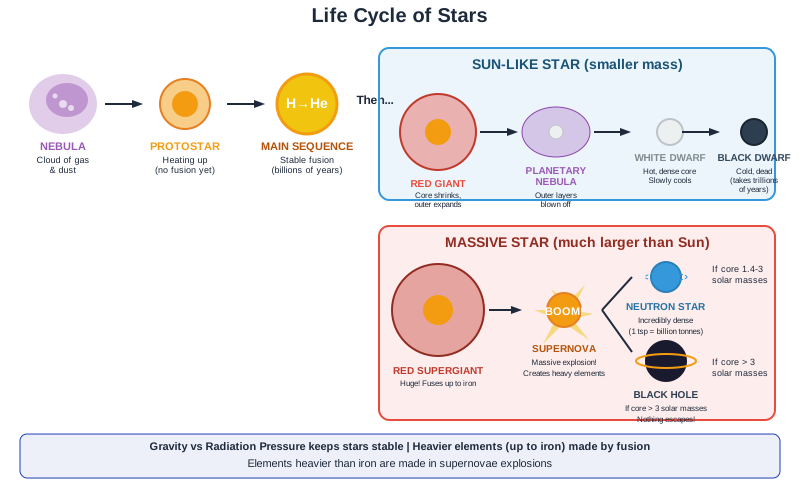
Figure 2: Life cycles of stars — the path taken depends on the star's mass
After billions of years on the main sequence, the hydrogen fuel in the core begins to run out. What happens next depends on the star's mass.
Sun-Like Stars (Low to Medium Mass)
- Red giant: When core hydrogen runs out, fusion stops. With no radiation pressure, gravity causes the core to contract and heat up. This extra heat causes the outer layers to expand enormously and cool — the star swells to tens or hundreds of times its original size. The cooler outer surface glows red. The core is now hot enough to fuse helium into carbon and oxygen.
- Planetary nebula: The outer layers of the red giant are eventually blown off into space, creating a shell of glowing gas called a planetary nebula (poorly named — nothing to do with planets). The name comes from their round appearance through early telescopes.
- White dwarf: The exposed hot core remains as a white dwarf — an incredibly dense, Earth-sized object made mostly of carbon and oxygen, about a million times denser than water. It has no source of energy and slowly cools over billions of years.