
GCSE Chemistry Paper 2: what to revise (and where marks are lost)
- 1Paper 2 tests rates of reaction, organic chemistry, equilibrium and chemical analysis. Different content from Paper 1, different style of calculation.
- 2Percentage yield and atom economy calculations are dropped constantly. Not because the formulas are hard, but because students confuse which number goes on top.
- 3Rates of reaction questions reward students who use collision theory to explain. Writing "more collisions" alone scores 0. The mark is on WHY there are more collisions and WHY that increases rate.
- 4Le Chatelier's principle is the single most-tested equilibrium concept. Know which way the equilibrium shifts for each change, and why. Examiners want the word "shift", not just "increases."
- 5The last week is for timed past paper sections, not re-reading notes. One section per day, mark immediately, fix the three things you got wrong.
Chemistry Paper 2 is on 12 June. Some students have been solid on organic chemistry for weeks. Others spent last night convinced they knew percentage yield, then got a question with two products and could not work out which mass to put on top. Different problems, same paper.
This post covers both. What Paper 2 actually tests, where the marks go, and what the last week should look like.
What makes Paper 2 different from Paper 1
Paper 1 covers atomic structure, bonding, quantitative chemistry, and chemical changes. Paper 2 is rates of reaction, organic chemistry, chemical analysis, the atmosphere, and using resources. They test different chemistry in a similar format: short-answer recall, explain-the-graph questions, and multi-mark calculations.
The shift that catches students out is this: Paper 2 has more explain-the-trend questions where you have to link a change in conditions to a change in rate or equilibrium position. Paper 1 calculations tend to be more straightforward substitution. Paper 2 requires more reasoning.
AQA Chemistry Paper 2 (8462/2)
1h 45m, 100 marks. Covers topics 6-10: Rate and Extent of Chemical Change, Organic Chemistry, Chemical Analysis, Chemistry of the Atmosphere, Using Resources.
Higher tier only: Le Chatelier's principle calculations, reversible reactions and Kc, alcohols and carboxylic acids, NMR spectroscopy. These are reliable 4-6 mark questions. Do not skip them if you are aiming for a 7+.
Edexcel Chemistry Paper 2 (1CH0/2)
1h 45m, 100 marks. Topics 8-16: Rates of Reaction, Fuels, Electrolytic Processes, Obtaining and Using Metals, Reversible Reactions and Equilibria, Chemical Cells and Fuel Cells, Transition Metals, Groups 1, 7, and 0.
Edexcel separates the content differently from AQA. Check which topics are in which paper for your spec before revising. Electrolysis calculations appear in Paper 2 for Edexcel.
OCR Gateway Chemistry Paper 2 (J248/02)
1h 45m, 90 marks. Modules C4-C6: Predicting and Identifying Reactions and Products, Monitoring and Controlling Chemical Reactions, Global Challenges.
OCR Gateway uses a structured question format with parts (a), (b), (c). A single question can run 8-10 marks across parts. Read part (c) before you start part (a), so you know where the question is heading.
The calculation questions (this is where marks are lost)
Chemistry Paper 2 has two calculations that come up in almost every sitting: percentage yield and atom economy. Students know they exist. They often cannot remember which number goes where.
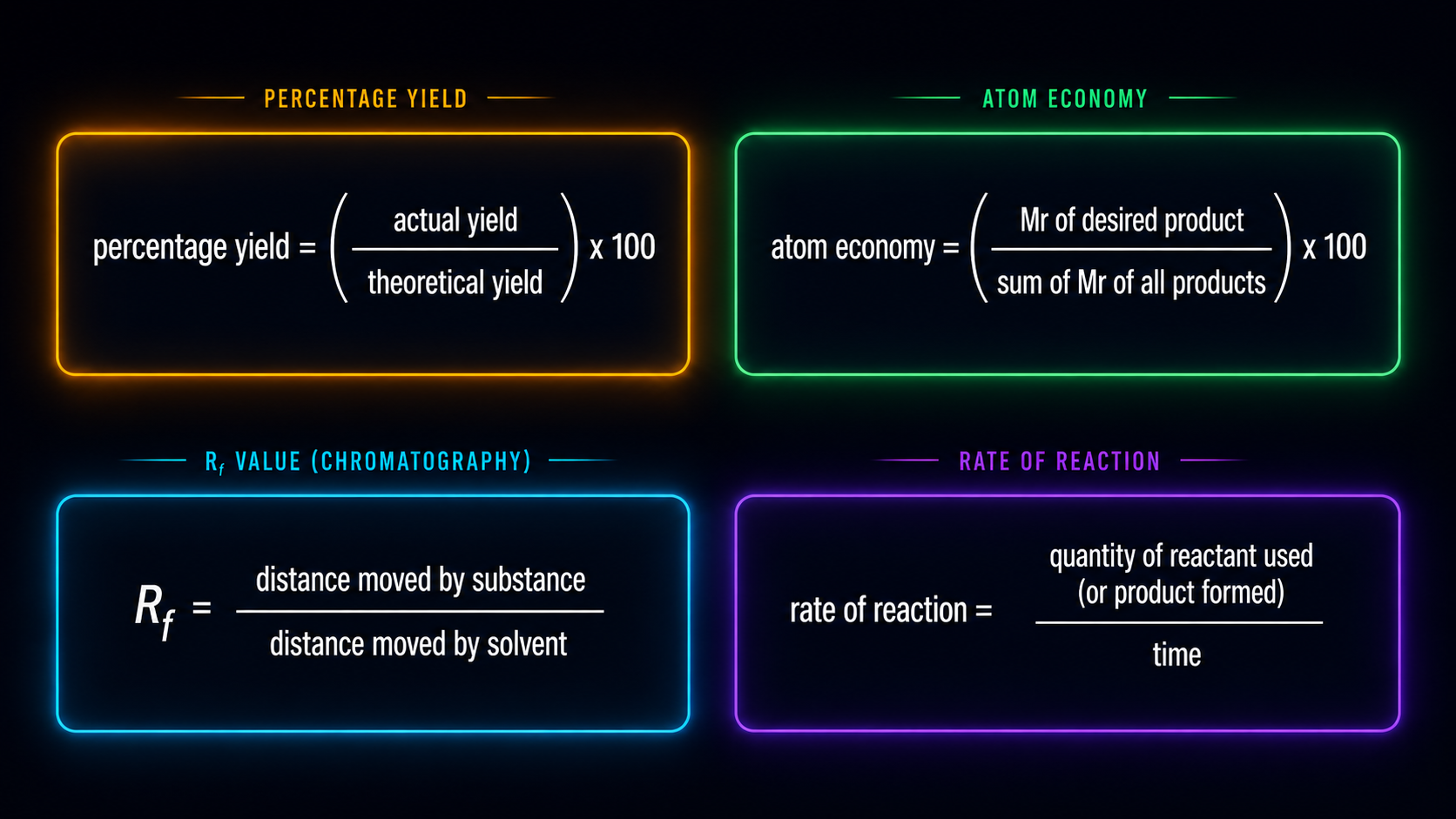
Percentage yield and atom economy look similar. They measure completely different things. Confusing them costs 4 marks.
Percentage yield
Percentage yield measures how much of the theoretical maximum you actually got in a real reaction. Theoretical yield is what you would get if everything reacted perfectly. Actual yield is what you collected from the experiment.
Worked example
A student reacts magnesium with hydrochloric acid. The theoretical yield of magnesium chloride is 9.5 g. The student collects 7.2 g. Calculate the percentage yield.
- 1Write the formula: % yield = (actual yield / theoretical yield) × 100
- 2Substitute: % yield = (7.2 / 9.5) × 100
- 3Calculate: % yield = 75.8% (to 3 s.f.)
- 4Common trap: putting theoretical yield on top. Actual yield is always on top, theoretical on the bottom.
✕ Loses marks
Writes (9.5 / 7.2) × 100 = 131.9%. A yield over 100% is impossible. This is always the wrong way up.
✓ Wins marks
Writes (7.2 / 9.5) × 100 = 75.8%. Actual on top. Theoretical on the bottom. Check: answer is below 100%.
Atom economy
Atom economy measures how much of the total mass of reactants ends up in the desired product. It says nothing about how much you actually made. A reaction can have 100% atom economy and 10% yield. They are different questions about different things.
Worked example
Ethene (C₂H₄, Mr = 28) reacts with water (Mr = 18) to form ethanol (C₂H₅OH, Mr = 46). Calculate the atom economy for producing ethanol.
- 1Write the formula: atom economy = (Mr of desired product / sum of Mr of all products) × 100
- 2This reaction has only one product (ethanol), so: atom economy = (46 / 46) × 100 = 100%
- 3This is an addition reaction. Addition reactions always have 100% atom economy because every atom ends up in the product.
- 4Contrast with a reaction that produces a by-product: if the by-product has Mr = 44, total products = 46 + 44 = 90, atom economy = (46 / 90) × 100 = 51.1%
Rf value (chromatography)
Rf value questions appear in the chemical analysis section. They are short calculations that are easy marks if you have practised the formula. They are dropped constantly because students divide the wrong distance.
Worked example
In a chromatography experiment, a substance travels 4.8 cm. The solvent front travels 12.0 cm. Calculate the Rf value.
- 1Write the formula: Rf = distance moved by substance / distance moved by solvent front
- 2Substitute: Rf = 4.8 / 12.0
- 3Rf = 0.40 (no units, always between 0 and 1)
- 4Common trap: putting the solvent distance on top. The substance is always on top. Check: if your Rf is above 1, it is wrong.
✕ Loses marks
Writes Rf = 12.0 / 4.8 = 2.5. An Rf above 1 is impossible. The substance cannot travel further than the solvent.
✓ Wins marks
Writes Rf = 4.8 / 12.0 = 0.40. Substance distance on top. Solvent distance on the bottom. Answer is always between 0 and 1.
Rates of reaction: why collision theory is the whole answer
Every rates of reaction question has the same structure: a condition changes (temperature, concentration, surface area, catalyst), the rate changes, and you have to explain why.
The mark scheme wants collision theory in three parts: (1) what changes about the particles, (2) what happens to collision frequency or energy, and (3) what that does to the rate. Writing only "there are more collisions" scores 1 of 3 marks.
Worked example
Explain why increasing the temperature increases the rate of reaction between hydrochloric acid and marble chips.
- 1Higher temperature means the particles have more kinetic energy.
- 2They move faster, so they collide more frequently.
- 3A higher proportion of collisions have energy greater than or equal to the activation energy.
- 4More successful collisions per second means a higher rate of reaction.
✕ Loses marks
"Increasing temperature makes particles move faster so they react more." This scores 1 mark. It misses activation energy and successful collisions.
✓ Wins marks
"Higher temperature gives particles more kinetic energy, increasing collision frequency. More collisions exceed the activation energy, so the rate increases." This hits all three marks.
Surface area questions follow the same pattern. Smaller particles, larger surface area, more particles exposed, more collisions per second. The trap: students say "smaller particles" and stop. The mark is on "greater surface area for the same mass" and "more frequent collisions."
Equilibrium and Le Chatelier's principle (Higher: this is always on the paper)
Le Chatelier's principle states that if you change the conditions of a system at equilibrium, the equilibrium shifts to oppose that change. The exam tests three conditions: temperature, pressure, and concentration.
| Change | Equilibrium shifts | Why |
|---|---|---|
| Increase temperature | Toward endothermic side | Opposes the increase by absorbing heat |
| Decrease temperature | Toward exothermic side | Opposes the decrease by releasing heat |
| Increase pressure | Toward fewer moles of gas | Reduces volume to oppose pressure increase |
| Add more reactant | Toward products | Removes the extra reactant by reacting it |
Worked example
The Haber process: N₂(g) + 3H₂(g) ⇌ 2NH₃(g). The forward reaction is exothermic. Explain why increasing pressure increases the yield of ammonia.
- 1Count moles of gas on each side: 4 moles on the left (1 + 3), 2 moles on the right.
- 2Increasing pressure causes the equilibrium to shift toward fewer moles of gas.
- 3Fewer moles of gas is on the right (products) side, so the equilibrium shifts right.
- 4More ammonia is produced. The yield increases.
The word the mark scheme is looking for is "shift." "The equilibrium moves toward products" scores 0. "The equilibrium shifts toward the right" or "shifts toward products" scores the mark.
Organic chemistry: cracking, alkenes, and what students mix up
Organic chemistry questions split into two types: describe (what happens) and explain (why it happens or how you can tell). The most common topic is cracking, followed by the properties of alkenes vs alkanes.
Cracking: a long-chain alkane is broken into a shorter alkane and one or more alkenes. It requires high temperature and a catalyst. The reason cracking is done industrially is that short-chain hydrocarbons are more useful as fuels and as monomers for polymers.
Worked example
Decane (C₁₀H₂₂) is cracked to produce octane (C₈H₁₈) and one other product. Identify the other product and explain how you can test for it.
- 1Balance the carbon atoms: 10 carbons in decane, 8 in octane. The other product has 2 carbons: C₂H₄ (ethene).
- 2Check hydrogen: 22 H in decane = 18 H in octane + 4 H in ethene. Balanced.
- 3Ethene is an alkene. Test: add bromine water to the product.
- 4Alkenes decolourise bromine water (orange to colourless). Alkanes do not react.
✕ Loses marks
"Add bromine water. It will change colour." The mark is on WHICH colour change: orange to colourless, not just any colour change.
✓ Wins marks
"Add bromine water. It decolourises from orange to colourless. This confirms the product is an alkene (unsaturated)."
Flame tests and gas tests also appear in chemical analysis. These are recall marks. Memorise them:
| Test | Positive result | Indicates |
|---|---|---|
| Flame test | Yellow flame | Sodium (Na&sup+;) |
| Flame test | Lilac flame | Potassium (K&sup+;) |
| Flame test | Brick red / orange-red | Calcium (Ca²&sup+;) |
| Limewater test | Turns milky / cloudy | Carbon dioxide (CO₂) |
| Burning splint test | Squeaky pop | Hydrogen (H₂) |
| Glowing splint test | Relights | Oxygen (O₂) |
What to do in the last 10 days
The exam is 12 June. That is 10 days away. Broad learning is over. The next 10 days are about activating what is already in your head under timed conditions.
One timed past paper section per day. Not the whole paper if time is short, but a complete section under exam conditions. No notes, timer running. Mark it immediately with the mark scheme. Find the three things you got wrong. Drill those three things. Start again tomorrow with a different section.
Chemistry students often lose marks not because they do not know the content but because they run out of time on long calculations. Practise the percentage yield and atom economy questions until you can do them in under 2 minutes each. They are worth 4-6 marks and the method never changes.
✕ Loses marks
Spends 4 hours re-reading the organic chemistry chapter. Feels confident. Gets the cracking question wrong because they could not balance it under pressure.
✓ Wins marks
Does 6 cracking questions from two past papers, marks them, identifies the balance error, does 3 more. The method becomes automatic.
If you use GCSE Chemistry revision on PrepWise, the adaptive quiz builds your daily plan around the topics you keep getting wrong. It finds that you are dropping percentage yield marks before you do. But the principle works without an app too: test yourself, mark immediately, fix the gap.
10 days. One section per day. Three things fixed per section. That is 30 targeted fixes before the exam. That is what moves a 5 to a 7.
Related reading
- GCSE Physics Paper 2: what to revise (and where marks are lost)
- GCSE Maths calculator papers: what actually comes up
- Chemistry exam questions by paper — AQA, OCR B and Edexcel
- GCSE Chemistry revision: every topic, flashcards and quizzes
Practice the questions
See all Chemistry Paper 2 exam questions with model answers
Every question that comes up on AQA, OCR B and Edexcel Paper 2 — with full model answers and mark schemes. Sorted by what examiners test most.
Browse exam questions →Get the full benefit
The app finds which of these topics you keep getting wrong — and builds your daily plan around them.
Free during alpha. Or browse the Chemistry revision library first.
Start on the app →