ElectrolysisDiagram

Electrolysis of Brine

Part of Electrolysis of Aqueous SolutionsGCSE Chemistry

This diagram covers Electrolysis of Brine within Electrolysis of Aqueous Solutions for GCSE Chemistry. Revise Electrolysis of Aqueous Solutions in Electrolysis for GCSE Chemistry with 20 exam-style questions and 0 flashcards. This is a high-frequency topic, so it is worth revising until the explanation feels precise and repeatable. It is section 2 of 13 in this topic. Focus on the labels, the relationships between parts, and the explanation that turns the diagram into an exam-ready answer.

Topic position

Section 2 of 13

Practice

20 questions

Recall

0 flashcards

📐 Electrolysis of Brine
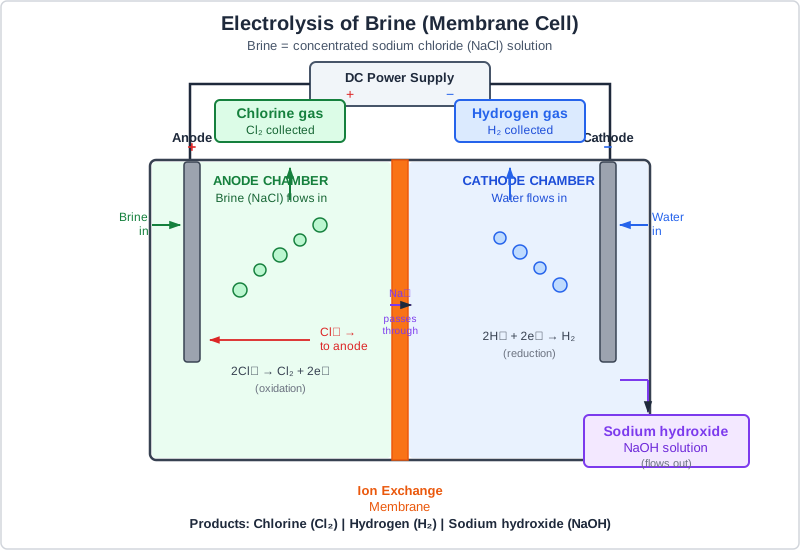
Electrolysis of brine showing membrane cell with chlorine gas produced at anode, hydrogen gas at cathode, and sodium hydroxide solution as the third product

Figure 1: Electrolysis of brine (concentrated sodium chloride solution) in an industrial membrane cell

Keep building this topic

Read this section alongside the surrounding pages in Electrolysis of Aqueous Solutions. That gives you the full topic sequence instead of a single isolated revision point.

Practice Questions for Electrolysis of Aqueous Solutions

When sodium chloride (NaCl) is dissolved in water, which four types of ion are present in the solution?

  • A. Na⁺, Cl⁻, H⁺ and OH⁻
  • B. Na⁺, Cl⁻, H₂O and OH⁻
  • C. Na⁺, Cl⁻ only
  • D. Na⁺, Cl⁻, H₂ and O²⁻
1 markfoundation

Describe the three products formed when concentrated brine is electrolysed, and state where each is produced.

3 marksstandard

Quick Recall Flashcards

State the cathode rule for aqueous electrolysis.
If the metal is MORE reactive than hydrogen (above H in reactivity series) → hydrogen gas forms. If the metal is LESS reactive than hydrogen (below H) → the metal deposits. Examples: Na above H → H₂ forms. Cu below H → Cu deposits.
State the anode rule for aqueous electrolysis.
If a halide ion (Cl⁻, Br⁻, or I⁻) is present → the halogen gas forms. If NO halide is present → oxygen gas forms from the OH⁻ ions. Example: Cl⁻ present → Cl₂ forms. SO₄²⁻ present (no halide) → O₂ forms.

20 questions on Electrolysis of Aqueous Solutions — practise free

Instant marking, adaptive difficulty, and spaced repetition flashcards. Free until your GCSEs.

Try PrepWise Free