The Water Complication
📖 The Water Complication
Aqueous electrolysis is like a talent show audition! At each electrode, ions compete to react. At the cathode, it's H⁺ vs. metal ions — hydrogen often wins if the metal is reactive. At the anode, it's OH⁻ vs. halide ions — halogens win if concentrated. The reactivity series is your judge's scorecard!
The Four Ions in Aqueous NaCl:
From water: H⁺ and OH⁻
At the cathode, both Na⁺ and H⁺ want to gain electrons. Who wins?
At the anode, both Cl⁻ and OH⁻ want to lose electrons. Who wins?
THE CATHODE RULE — Use the Reactivity Series:
- If the metal is MORE reactive than hydrogen (above H in the series) → HYDROGEN gas forms
- If the metal is LESS reactive than hydrogen (below H in the series) → The METAL forms
Why? Very reactive metals like sodium hold onto their electrons incredibly tightly — they form stable ions and don't want to change back to atoms. Hydrogen ions are easier to reduce, so they get the electrons instead. But less reactive metals like copper are happy to accept electrons and become metal atoms.
THE ANODE RULE — Check for Halides:
- If a halide ion (Cl⁻, Br⁻, or I⁻) is present → The HALOGEN gas forms
- If NO halide present (e.g., sulfate SO₄²⁻ or nitrate NO₃⁻) → OXYGEN gas forms from OH⁻
Why? Halide ions are easier to oxidise than hydroxide ions — they lose their electrons more readily. But if there's no halide, the OH⁻ ions from water get oxidised instead, releasing oxygen gas.
Let's Apply These Rules:
• Cathode: Cu is BELOW H → Copper metal forms ✓
• Anode: SO₄²⁻ is NOT a halide → Oxygen gas forms ✓
Sodium Chloride (NaCl) Solution:
• Cathode: Na is ABOVE H → Hydrogen gas forms ✓
• Anode: Cl⁻ IS a halide → Chlorine gas forms ✓
The Chlor-Alkali Industry:
Electrolysis of brine (concentrated NaCl solution) is hugely important industrially. It produces three valuable products:
- Hydrogen (cathode) — used as fuel and in making ammonia
- Chlorine (anode) — used to make bleach, PVC plastic, and kill bacteria in water
- Sodium hydroxide (left in solution) — used in soap, paper, and cleaning products
Electrolysis of brine — click each part to zoom in and explore the discharge rules.
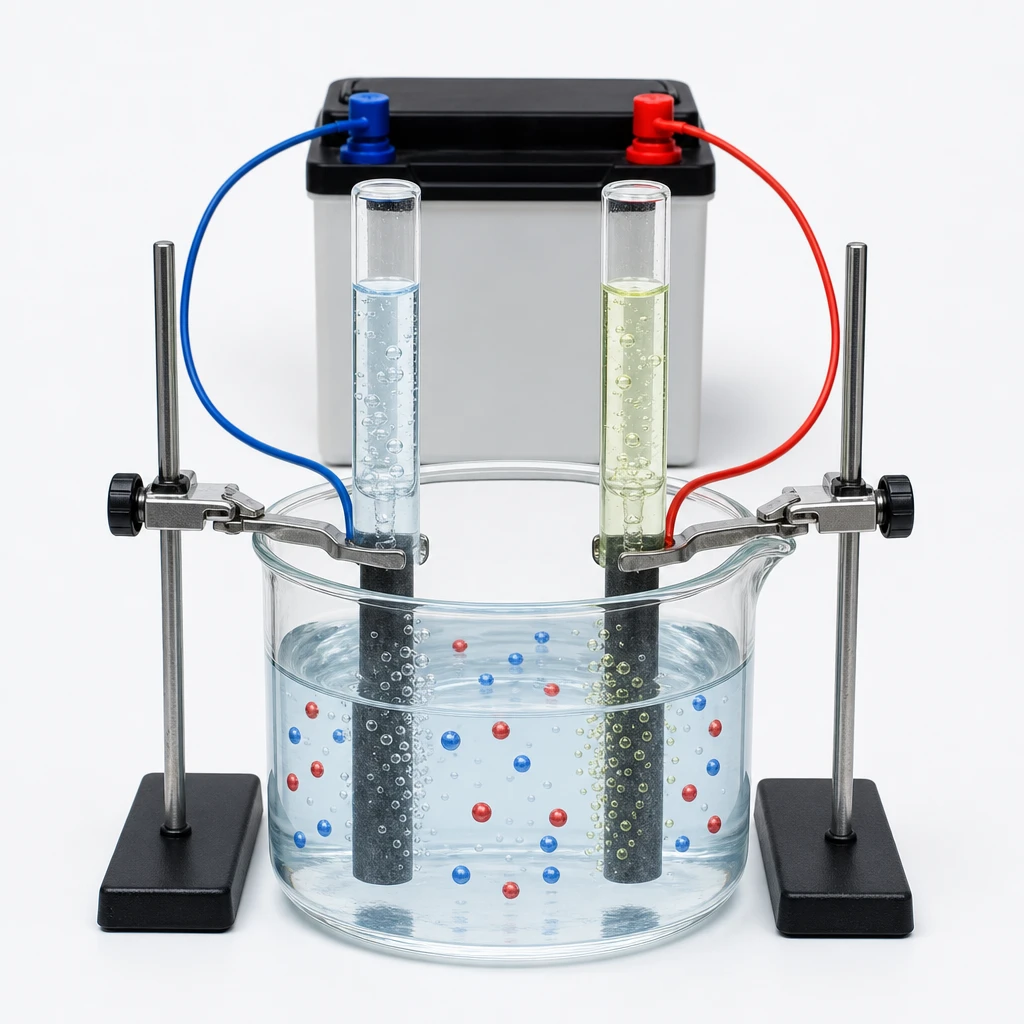
- 1Cathode: hydrogen gas —
- 2Anode: chlorine gas —
- 3Aqueous solution —
- 4Gas collection and testing —
Figure 1: Electrolysis of brine — click each part to zoom in and explore the discharge rules.
When an ionic compound dissolves in water, it completely dissociates into its component ions. However, water itself also partially ionises: H₂O ⇌ H⁺ + OH⁻. This means that in any aqueous solution, there are always at least four types of ion present — the two from the dissolved salt, plus H⁺ and OH⁻ from water.
Earn the mark scheme marks
🧠 Memory Aids
For the CATHODE rule: "If the metal is ABOVE hydrogen, HYDROGEN forms — it takes its place!"
Think of it as hydrogen "jumping the queue" above reactive metals — because the metal is so reactive (so keen to stay ionic), hydrogen gets the electrons instead.
For the ANODE rule: "HALIDE = Halogen at the anode. No halide = no halogen = OXYGEN instead."
Remember the three halides: Cl⁻, Br⁻, I⁻ — if any of these are present in solution, a halogen gas forms at the anode.
Brine products mnemonic: "3 Hs from Brine — Hydrogen, cHlorine, Hydroxide (sodium)" — three useful products from one reaction!
Now try it yourself
Quiz · Question 1 of 21
When sodium chloride (NaCl) is dissolved in water, which four types of ion are present in the solution?
Tap an answer to check it
This topic in real past papers
Every real exam question we've found on electrolysis of aqueous solutions, with a full worked answer.