Breaking Free — The Prison Break of Ions
📖 Breaking Free — The Prison Break of Ions
This is the fundamental reason why solid ionic compounds don't conduct electricity but molten (liquid) ionic compounds DO conduct. The ions must be free to move to carry electrical charge from one electrode to the other.
What happens when we electrolyse molten ionic compounds?
- Positive ions (cations) are attracted to the negative cathode
- At the cathode, they GAIN electrons → This is REDUCTION
- The cations become neutral metal atoms → METAL forms at the cathode
- Negative ions (anions) are attracted to the positive anode
- At the anode, they LOSE electrons → This is OXIDATION
- The anions become neutral atoms/molecules → NON-METAL forms at the anode
The beautiful simplicity of molten electrolysis: There are only TWO types of ion present (the metal cation and the non-metal anion), so predicting products is straightforward:
ANODE: Always the NON-METAL
Example — Molten Lead Bromide (PbBr₂):
At cathode: Pb²⁺ + 2e⁻ → Pb (silvery lead metal forms)
At anode: 2Br⁻ → Br₂ + 2e⁻ (orange/brown bromine vapour)
Observations: Silvery liquid metal at cathode, orange/brown fumes at anode
Memory trick for electrodes:
• CATions go to the CAThode (positive ions → negative electrode)
• REDuction at Cathode (both have the letter C in "ReDuCtion"!)
• ANions go to the ANode (negative ions → positive electrode)
• Oxidation at Anode (both are vowels!)
Electrolysis of molten lead bromide — click each part to zoom in and explore.
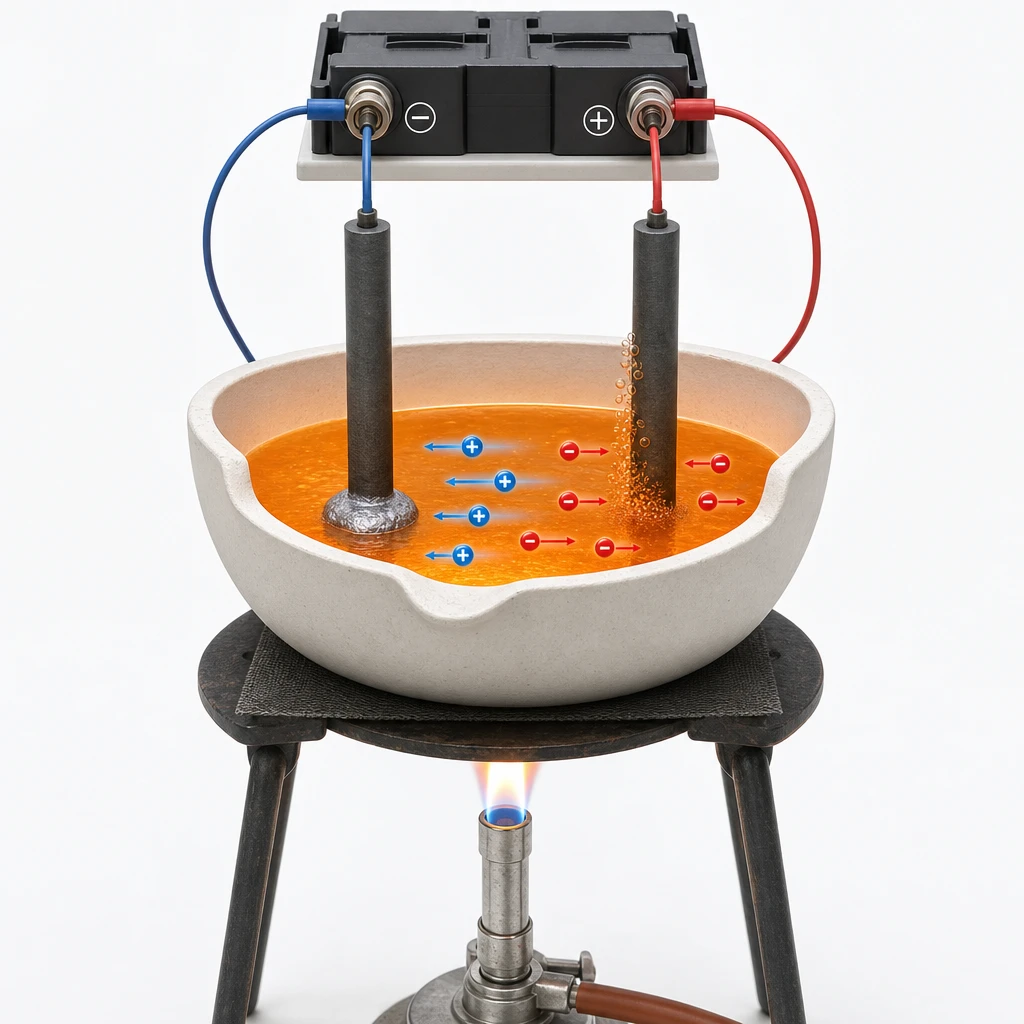
- 1DC power supply —
- 2Cathode (negative) —
- 3Anode (positive) —
- 4Molten electrolyte —
Figure 1: Electrolysis of molten lead bromide — click each part to zoom in and explore.
In a molten ionic compound, the ionic lattice has broken down due to the high temperature. This means the positive metal ions (cations) and negative non-metal ions (anions) are no longer fixed in position — they can move freely through the liquid.
Earn the mark scheme marks
🧠 Memory Aids
CATions go to the CAThode, ANions go to the ANode
Both "CATion" and "CAThode" start with "CAT". Both "ANion" and "ANode" start with "AN". This makes it easy to remember which ion goes where.
OIL RIG — Oxidation Is Loss (of electrons), Reduction Is Gain (of electrons)
At the Anode = Oxidation (A and O are both vowels!)
At the Cathode = Reduction (both contain the letter C!)
For predicting molten products: "Metal at the Minus, Non-metal at the Plus" — cathode is negative (minus) → metal; anode is positive (plus) → non-metal.
Now try it yourself
Quiz · Question 1 of 21
Which condition is required for electrolysis to occur with an ionic compound?
Tap an answer to check it
This topic in real past papers
Every real exam question we've found on electrolysis of molten compounds, with a full worked answer.