The Metal That Changed History
📖 The Metal That Changed History
Carbon works as a reducing agent for iron because iron doesn't hold oxygen very tightly — carbon can pull oxygen away from iron oxide and release the iron metal. Think of carbon as a magnet that is strong enough to attract oxygen away from iron. But aluminium grips oxygen far more strongly. Carbon's "pull" simply isn't strong enough to prise oxygen away from aluminium ions. The only way to separate them is to add or remove electrons directly — and that requires electricity. This is what makes aluminium extraction fundamentally different from iron extraction.
Here's the problem in a single line: aluminium holds oxygen so tightly that only electrical energy can break the bond. The solution is electrolysis — passing direct current through molten aluminium oxide to force electron transfer at each electrode.
The Hall-Heroult cell for aluminium extraction — click each part to zoom in and explore.
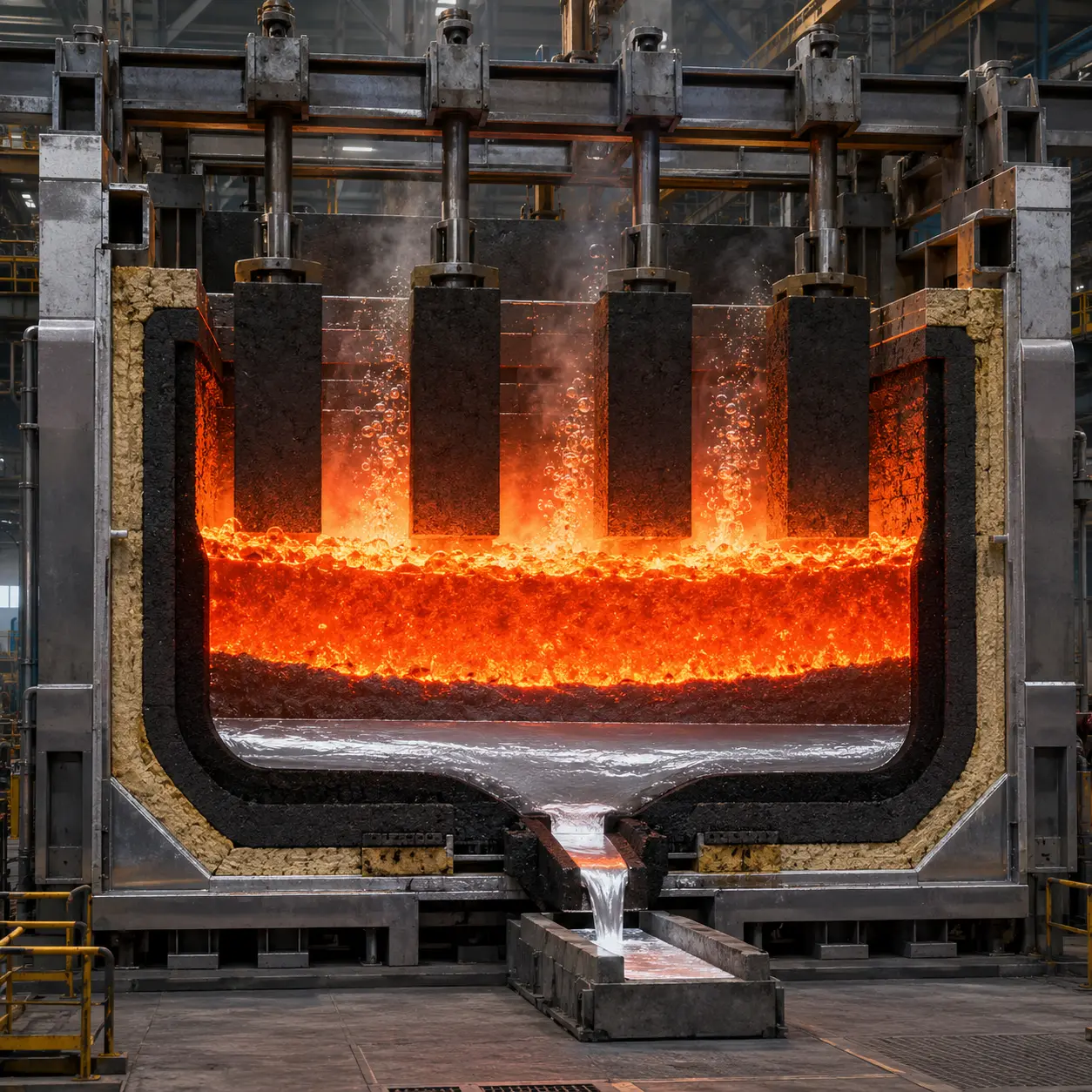
- 1Carbon anodes (positive) —
- 2Molten cryolite + alumina —
- 3Carbon cathode lining —
- 4Molten aluminium output —
Figure 1: The Hall-Heroult cell for aluminium extraction — click each part to zoom in and explore.
The challenge with extracting aluminium is not just the chemistry — it is the extreme temperature required. Pure aluminium oxide melts at 2072°C. Heating to this temperature would consume vast amounts of energy, making the process uneconomical.
Earn the mark scheme marks
🧠 Memory Aids
PANIC = Positive Anode, Negative Is Cathode
Use this to remember which electrode is which: the Positive electrode is the Anode, the Negative Is the Cathode.
CATions go to the CAThode — both start with "CAT". ANions go to the ANode — both start with "AN".
OIL RIG — Oxidation Is Loss (of electrons), Reduction Is Gain (of electrons). At the anode = oxidation (loss). At the cathode = reduction (gain).
For the anode burning away: "The ANODE gets ATE — it reacts with oxygen and burns away as CO₂!"
Now try it yourself
Quiz · Question 1 of 21
Why is aluminium extracted by electrolysis rather than by reduction with carbon?
Tap an answer to check it