Edexcel GCSE Chemistry Paper 1, Higher Tier (1CH0/1H)Paper 1: every question, answered
We read the real Higher Tier papers Edexcel has published for Chemistry Paper 1 in June 2019, June 2022 and June 2023, plus the mark schemes examiners actually used to grade them. Below is what real sub-questions on each recurring topic have asked, what a full mark answer looks like against that year's mark scheme, and what tripped candidates up.
Questions © Pearson Education Ltd, quoted for analysis. Diagrams, tables and apparatus described in our own words, not reproduced. Mark scheme content translated into plain English, not copied. PrepWise is independent and not endorsed by Pearson or Edexcel.
The paper is a template
Same 10 question types, every sitting“Use the data given to calculate a percentage yield”
Every sitting we have gives you an actual mass produced and either a theoretical mass or enough data to work one out, then asks for percentage yield as a straight two-mark calculation.
1×asked“Use the information in Figure 3 to calculate the percentage yield of ethanol in this experiment.”
“Use the information in Figure 3 to calculate the percentage yield of ethanol in this experiment.”
What it’s really asking
You are given the actual mass of ethanol obtained from fermenting sucrose and the theoretical mass the balanced equation predicts, and asked to apply the percentage yield formula the question itself provides.
What the sources actually showed — June 2022
A small results table giving the mass of sucrose used, the mass of ethanol actually obtained from fermenting it with yeast, and the theoretical mass of ethanol the reaction should produce. The percentage yield formula (actual yield divided by theoretical yield, times 100) is printed directly above the question.
| mass in g | |
|---|---|
| mass of sucrose | 100.00 |
| mass of ethanol obtained from the reaction | 8.07 |
| theoretical mass of ethanol formed | 53.80 |
The full worked answer — June 2022
Percentage yield = actual yield / theoretical yield x 100 = 8.07 / 53.80 x 100 = 15.0%.
Could you have written this? Every fact in this answer is drilled in our quizzes — the writing is the easy part once the evidence is automatic.
Practise percentage yield questionsWhat the mark scheme rewarded
- Dividing the actual yield by the theoretical yield, using the two correct figures from the data given
- Multiplying by 100 to give a percentage
- The real mark scheme awards the fraction step even without the final answer, and separately credits a correct x100 conversion of a value genuinely derived from the question's data
- Percentage yield = (actual yield / theoretical yield) x 100
- Actual yield is the mass of product you actually collect after the reaction and any purification
- Theoretical yield is the maximum possible mass calculated from the balanced equation, assuming every reactant converts with no losses
Traps examiners saw
- Dividing theoretical yield by actual yield the wrong way round, which gives an answer over 100%
- Forgetting to multiply by 100 and giving a decimal fraction instead of a percentage
- Rounding too early and losing accuracy in the final answer
Full-mark self-check 0 of 4
1×asked“Using a different amount of sulfur trioxide, it was calculated that 700 tonnes of sulfuric acid could be made. The actual mass produced was 672 tonnes. Calculate the percentage yield of sulfuric acid.”
“Using a different amount of sulfur trioxide, it was calculated that 700 tonnes of sulfuric acid could be made. The actual mass produced was 672 tonnes. Calculate the percentage yield of sulfuric acid.”
What it’s really asking
You are given the theoretical mass (700 tonnes) and actual mass (672 tonnes) directly in the question, in the context of an industrial sulfuric acid production stage, and asked to apply the percentage yield formula.
What the sources actually showed — June 2023
Continues from an earlier part of the same question about the industrial production of sulfuric acid from sulfur trioxide, giving both the calculated theoretical mass and the actual mass produced directly as numbers in the text, with no table or diagram.
The full worked answer — June 2023
Percentage yield = 672 / 700 x 100 = 96%.
Could you have written this? Every fact in this answer is drilled in our quizzes — the writing is the easy part once the evidence is automatic.
Practise percentage yield questionsWhat the mark scheme rewarded
- Dividing 672 by 700 to get 0.96
- Multiplying by 100 to give 96%
- The real mark scheme gives no credit for the x100 step unless it follows a value genuinely worked out from the question's own numbers
- Percentage yield = (actual yield / theoretical yield) x 100
- The theoretical yield in an industrial process is calculated from the balanced equation assuming complete conversion with no losses
Traps examiners saw
- Swapping actual and theoretical yield in the fraction
- Not showing the intermediate fraction, which loses a mark if the final answer is wrong
Full-mark self-check 0 of 3
1×asked“Use the information in Figure 3 to calculate the percentage yield of calcium oxide in this experiment.”
“Use the information in Figure 3 to calculate the percentage yield of calcium oxide in this experiment.”
What it’s really asking
You are given the theoretical yield of calcium oxide directly (5.600 g) and the actual mass remaining in the crucible after heating calcium carbonate (5.450 g), and asked to apply the percentage yield formula.
What the sources actually showed — June 2019
The mass of calcium oxide remaining in a crucible after strongly heating a sample of calcium carbonate until no further loss in mass, alongside a stated theoretical yield of calcium oxide for the same experiment.
The full worked answer — June 2019
Percentage yield = 5.450 / 5.600 x 100 = 97.3%.
Could you have written this? Every fact in this answer is drilled in our quizzes — the writing is the easy part once the evidence is automatic.
Practise percentage yield questionsWhat the mark scheme rewarded
- Dividing the actual mass by the theoretical mass in the correct order
- Multiplying by 100 to give a percentage to an appropriate number of significant figures
- Percentage yield = (actual yield / theoretical yield) x 100
- The mass remaining in a crucible only equals the theoretical yield if the reaction goes to completion with no losses
Traps examiners saw
- Confusing the mass of solid remaining with the mass of gas given off, which is a different calculation asked elsewhere in the same question
- Rounding the final percentage incorrectly
Full-mark self-check 0 of 3
The method for every Q4 — same every sittingMark bands, steps, timing
What this question type rewards
The topic changes by sitting — the mark scheme never does. Learn this once, then open your question above for that sitting’s sources and a full worked answer.
- Substituting the correct actual and theoretical masses into the formula, in the right order
- Multiplying by 100 to convert the fraction into a percentage, using a value that was actually derived from the question's own numbers
The steps
- Identify the actual yield (the mass actually obtained) and the theoretical yield (the maximum possible mass, either given directly or found from the balanced equation)
- Divide actual yield by theoretical yield
- Multiply by 100 and give the answer as a percentage
- Check your answer is sensible: percentage yield can never be over 100%
One mole of any substance contains how many particles?
Percentage yield calculations appear in every sitting we analysed, always worth 2 marks. Learn the formula cold and always check your final answer is under 100%.
Practise percentage yield questions“Calculate the atom economy for a named product of a reaction”
Every sitting gives you a balanced equation and relative formula masses, then asks you to calculate the atom economy for one specific product, not the whole reaction.
1×asked“Calculate the atom economy for the production of sulfur dioxide, SO2, in this reaction. Give your answer to two significant figures.”
“Calculate the atom economy for the production of sulfur dioxide, SO2, in this reaction. Give your answer to two significant figures.”
What it’s really asking
You are given the balanced equation Cu2S + O2 -> 2Cu + SO2 with relative atomic and formula masses, and asked what fraction of the total mass of everything made ends up as the useful product, sulfur dioxide.
What the sources actually showed — June 2023
The balanced equation for heating copper sulfide in excess air to form copper and sulfur dioxide, with relative atomic mass of copper and relative formula masses of oxygen, copper sulfide and sulfur dioxide all given directly in the question.
The full worked answer — June 2023
Total mass of reactants = Mr(Cu2S) + Mr(O2) = 159.0 + 32.0 = 191. Atom economy = (Mr of SO2 / total mass) x 100 = (64 / 191) x 100 = 33.507...%, which rounds to 34% to 2 significant figures.
Could you have written this? Every fact in this answer is drilled in our quizzes — the writing is the easy part once the evidence is automatic.
Practise atom economy questionsWhat the mark scheme rewarded
- Correctly adding Mr(Cu2S) and Mr(O2) to get the total reactant mass of 191
- Forming the fraction using 64 (the Mr of SO2, the named desired product) over that total
- Multiplying by 100
- Rounding to exactly 2 significant figures as instructed, and giving an answer under 100%
- Atom economy = (Mr of desired product / total Mr of all reactants) x 100
- Mass is conserved in a reaction, so the total Mr of reactants always equals the total Mr of all products combined
- Copper sulfide, Cu2S, has a formula mass of 159.0, given directly in the question
Traps examiners saw
- Using the total mass of all the products (2Cu + SO2) instead of the total mass of reactants, which the real mark scheme explicitly does not accept as an alternative route here
- Rounding to the wrong number of significant figures when the question specifies exactly how many are needed
- Confusing atom economy with percentage yield, which is a completely different calculation using actual versus theoretical mass rather than formula masses
Full-mark self-check 0 of 4
1×asked“Calculate the atom economy of this reaction to produce ethanol. Give your answer to two significant figures.”
“Calculate the atom economy of this reaction to produce ethanol. Give your answer to two significant figures.”
What it’s really asking
You are given the balanced equation for the fermentation of sucrose (C12H22O11 + H2O -> 4C2H5OH + 4CO2) with relative formula masses, and asked for the atom economy for the desired product, ethanol.
What the sources actually showed — June 2022
The balanced equation for the fermentation of sucrose with water to form ethanol and carbon dioxide, with the relative formula masses of sucrose, water, ethanol and carbon dioxide all given.
The full worked answer — June 2022
Total mass of reactants = 342 + 18 = 360. Mass of desired product = 4 x 46 = 184. Atom economy = (184 / 360) x 100 = 51.111...%, which rounds to 51% to 2 significant figures.
Could you have written this? Every fact in this answer is drilled in our quizzes — the writing is the easy part once the evidence is automatic.
Practise atom economy questionsWhat the mark scheme rewarded
- Multiplying the Mr of ethanol by 4 to account for the 4 molecules the balanced equation actually produces
- Dividing by the correct total reactant mass of 360
- Rounding the final answer to exactly 2 significant figures
- Atom economy = (Mr of desired product / total Mr of reactants) x 100
- When a balanced equation has a number in front of the desired product, that number must be included in the atom economy calculation
Traps examiners saw
- Forgetting to multiply the ethanol's Mr by 4, using just 46 instead of 184, which the mark scheme explicitly flags as an error some candidates make
- Dividing by the wrong total mass
Full-mark self-check 0 of 3
1×asked“Calculate the atom economy for the formation of calcium oxide in this reaction. You must show your working.”
“Calculate the atom economy for the formation of calcium oxide in this reaction. You must show your working.”
What it’s really asking
You are given the equation CaCO3 -> CaO + CO2 with relative atomic masses and the relative formula mass of calcium oxide, and asked for the atom economy for calcium oxide, the desired product of thermal decomposition.
What the sources actually showed — June 2019
The equation for the thermal decomposition of calcium carbonate into calcium oxide and carbon dioxide, with relative atomic masses of carbon, oxygen and calcium given, plus the relative formula mass of calcium oxide.
The full worked answer — June 2019
Mr of calcium carbonate = 40 + 12 + (3 x 16) = 100. Atom economy = (56 / 100) x 100 = 56%.
Could you have written this? Every fact in this answer is drilled in our quizzes — the writing is the easy part once the evidence is automatic.
Practise atom economy questionsWhat the mark scheme rewarded
- Correctly calculating the Mr of calcium carbonate as the total reactant mass
- Dividing the Mr of calcium oxide by this total and multiplying by 100
- Atom economy = (Mr of desired product / total Mr of reactants) x 100
- In a decomposition reaction with only one reactant, that reactant's Mr is the whole total reactant mass
Traps examiners saw
- Using the Mr of carbon dioxide (the unwanted product) instead of calcium oxide (the desired product) in the numerator
- Miscalculating the Mr of calcium carbonate by adding the atomic masses incorrectly
Full-mark self-check 0 of 3
The method for every Q4 — same every sittingMark bands, steps, timing
What this question type rewards
The topic changes by sitting — the mark scheme never does. Learn this once, then open your question above for that sitting’s sources and a full worked answer.
- Correctly identifying the Mr of the desired product from the equation
- Correctly identifying the total Mr of all reactants (or all products, since they must be equal in a balanced equation)
- Dividing and multiplying by 100 in the right order, then rounding to the number of significant figures asked for
The steps
- Write out the Mr of every reactant and product using the relative atomic masses given
- Add up the Mr of all the reactants (this equals the total Mr of all products too, since mass is conserved)
- Divide the Mr of the desired product by this total
- Multiply by 100 and round to the number of significant figures the question asks for
One mole of any substance contains how many particles?
Atom economy questions always name one specific product and always give you every Mr you need. The marks are lost by using the wrong product's mass or the wrong total, not by the arithmetic itself.
Practise atom economy questions“Calculate the number of atoms in a given mass or moles of a substance”
Every sitting asks you to use the Avogadro constant to convert from a given mass, via moles, into an actual number of atoms, though the exact number of steps needed varies with what is given.
1×asked“Calculate the number of copper atoms in 74 mg of copper.”
“Calculate the number of copper atoms in 74 mg of copper.”
What it’s really asking
You are given a mass of pure copper metal formed at an electrode during electrolysis, in milligrams, and asked to convert it via moles into a number of individual copper atoms using the Avogadro constant.
What the sources actually showed — June 2023
A given mass of copper formed during an electrolysis experiment, stated in milligrams, alongside the relative atomic mass of copper and the value of the Avogadro constant.
The full worked answer — June 2023
Mass of copper in g = 74 / 1000 = 0.074 g. Moles of copper = 0.074 / 63.5 = 1.165... x 10^-3 mol. Number of atoms = 1.165... x 10^-3 x 6.02 x 10^23 = 7.015 x 10^20.
Could you have written this? Every fact in this answer is drilled in our quizzes — the writing is the easy part once the evidence is automatic.
Practise moles and Avogadro constant questionsWhat the mark scheme rewarded
- Correctly converting 74 mg to 0.074 g before dividing by the relative atomic mass
- Dividing by 63.5 to get the correct number of moles
- Multiplying by 6.02 x 10^23 using the moles value calculated
- Moles = mass in grams / relative atomic (or formula) mass
- Number of particles = moles x Avogadro constant (6.02 x 10^23)
- 1000 mg = 1 g, so a mass given in milligrams must be divided by 1000 before use in the moles formula
Traps examiners saw
- Forgetting to convert milligrams to grams before dividing by the relative atomic mass, which gives an answer 1000 times too large
- Using the wrong relative atomic mass
Full-mark self-check 0 of 3
1×asked“Calculate the total number of atoms that combine to form 5.13 g of aluminium sulfate.”
“Calculate the total number of atoms that combine to form 5.13 g of aluminium sulfate.”
What it’s really asking
You are given the formula of aluminium sulfate, Al2(SO4)3, and a mass in grams, and asked for the total number of atoms of every element combined, not just the number of formula units.
What the sources actually showed — June 2022
The formula of aluminium sulfate given as Al2(SO4)3, with relative atomic masses of oxygen, aluminium and sulfur, and the value of the Avogadro constant, alongside a stated mass in grams of the compound.
The full worked answer — June 2022
Formula mass of Al2(SO4)3 = (2 x 27) + 3 x (32 + 16 x 4) = 342. Moles of Al2(SO4)3 = 5.13 / 342 = 0.015 mol. Number of atoms in the formula Al2(SO4)3 = 2 + 3 + 12 = 17. Number of atoms in 0.015 moles = 17 x 0.015 x 6.02 x 10^23 = 1.5351 x 10^23.
Could you have written this? Every fact in this answer is drilled in our quizzes — the writing is the easy part once the evidence is automatic.
Practise moles and Avogadro constant questionsWhat the mark scheme rewarded
- Correctly calculating the formula mass of Al2(SO4)3 as 342
- Dividing the given mass by this formula mass to get 0.015 moles
- Correctly identifying that there are 17 atoms in total in the formula Al2(SO4)3
- Multiplying moles x 17 x the Avogadro constant to give the total number of atoms
- The formula Al2(SO4)3 contains 2 aluminium atoms, 3 sulfur atoms, and 3 x 4 = 12 oxygen atoms, giving 17 atoms in total
- Number of atoms = moles x number of atoms per formula unit x Avogadro constant
Traps examiners saw
- Calculating the number of formula units rather than the number of atoms, which is 17 times too small since it ignores how many atoms are actually in each formula unit
- Miscounting the number of oxygen atoms in the bracketed part of the formula, forgetting the subscript 3 outside the bracket multiplies the 4 oxygens inside it
Full-mark self-check 0 of 4
1×asked“Calculate the number of atoms combined in one mole of copper iodide, CuI2.”
“Calculate the number of atoms combined in one mole of copper iodide, CuI2.”
What it’s really asking
You are given the formula CuI2 and the Avogadro constant, and asked directly for the total number of atoms in one mole of the compound, without needing a mass-to-moles conversion first.
What the sources actually showed — June 2019
The formula of copper iodide, CuI2, alongside the value of the Avogadro constant (6.02 x 10^23), with the question already specifying one mole so no mass conversion step is needed.
The full worked answer — June 2019
Number of atoms in one formula unit of CuI2 = 3 (1 copper and 2 iodine). Number of atoms in 1 mole = 3 x 6.02 x 10^23 = 1.8 x 10^24.
Could you have written this? Every fact in this answer is drilled in our quizzes — the writing is the easy part once the evidence is automatic.
Practise moles and Avogadro constant questionsWhat the mark scheme rewarded
- Correctly identifying that CuI2 contains 3 atoms per formula unit (1 copper, 2 iodine)
- Multiplying this by the Avogadro constant to get the number of atoms in one mole
- The subscript number after an element's symbol in a formula shows how many atoms of that element are in one formula unit
- One mole of any substance contains the Avogadro constant, 6.02 x 10^23, formula units of that substance
Traps examiners saw
- Only counting 2 atoms (missing that copper itself is also one atom) or miscounting the iodine subscript
- Multiplying by the Avogadro constant to get the number of formula units, then forgetting to also multiply by the number of atoms per unit
Full-mark self-check 0 of 2
The method for every Q6 — same every sittingMark bands, steps, timing
What this question type rewards
The topic changes by sitting — the mark scheme never does. Learn this once, then open your question above for that sitting’s sources and a full worked answer.
- Converting the given mass into moles using the correct Mr
- Multiplying moles by the Avogadro constant to get a number of formula units or molecules
- Multiplying again by the number of atoms in one formula unit, if the question asks for atoms rather than molecules or ions
The steps
- Work out the number of moles of the substance from the mass given, using moles = mass / Mr
- Multiply the number of moles by the Avogadro constant (6.02 x 10^23) to get the number of particles
- If the question asks for atoms rather than particles, multiply by however many atoms are in one formula unit
- Check whether the question wants a specific number of significant figures
One mole of any substance contains how many particles?
These calculations always start from mass or moles, given clearly in the question, and always need the Avogadro constant. The marks are lost in the unit conversions and atom-counting, not the final multiplication.
Practise moles and Avogadro constant questions“Explain how the conditions chosen affect both equilibrium yield and rate of attainment of equilibrium”
Both sittings we have full papers for give you a reversible industrial reaction and a list of conditions used, then ask you to explain the effect on BOTH yield and rate using the same three-band, six-mark level of response scheme.
1×asked“Suggest, with explanations, suitable conditions that the manufacturer could use to maximise the yield and rate of production of propene from propane.”
“Suggest, with explanations, suitable conditions that the manufacturer could use to maximise the yield and rate of production of propene from propane.”
What it’s really asking
For the endothermic dehydrogenation of propane to propene and hydrogen (C3H8 <=> C3H6 + H2), you must suggest and justify conditions of temperature and pressure that maximise both the equilibrium yield of propene and how quickly equilibrium is reached.
What the sources actually showed — June 2022
The reversible equation for the dehydrogenation of propane into propene and hydrogen, stating that the forward reaction takes in heat energy (is endothermic), used by a manufacturer producing large quantities of propene.
The full worked answer — June 2022
Since the forward reaction is endothermic, using a high temperature favours the forward reaction, moving the equilibrium position towards propene and hydrogen, which increases the equilibrium yield of propene. A high temperature also increases the rate at which equilibrium is reached, since particles collide more frequently and with more energy.
The equation shows 1 molecule of propane on the left and 2 molecules of gas (propene and hydrogen) on the right, so a low pressure favours the side with more gas molecules, moving equilibrium towards propene and increasing yield. However, low pressure decreases the rate of reaching equilibrium, since gas particles are more spread out and collide less frequently, so this is a trade-off the manufacturer must balance.
Using a catalyst increases the rate at which both the forward and backward reactions occur, so equilibrium is reached faster, but a catalyst has no effect on the position of equilibrium and so does not change the equilibrium yield of propene.
Could you have written this? Every fact in this answer is drilled in our quizzes — the writing is the easy part once the evidence is automatic.
Practise reversible reactions and equilibrium questionsWhat the mark scheme rewarded
- Correctly identifying that excess air/oxygen or fewer gas molecules on one side shifts equilibrium and explaining why, using the actual equation given
- Explaining the effect of temperature by linking it to whether the forward reaction is exothermic or endothermic, not just asserting a direction
- Explaining rate separately from yield for each factor, since a factor can increase rate while decreasing yield or vice versa
- Correctly stating that a catalyst affects rate only, never equilibrium yield
- Increasing temperature favours whichever direction is endothermic, since the system opposes the change
- Higher pressure favours the side of an equation with fewer gas molecules; lower pressure favours the side with more
- A catalyst provides an alternative reaction pathway with lower activation energy, increasing the rate of both forward and reverse reactions equally, so it never shifts equilibrium position
- Industrial conditions are usually a compromise between maximising yield and reaching equilibrium quickly enough to be economical
Traps examiners saw
- Discussing only yield or only rate for a factor, when the question and mark scheme require both to be addressed
- Getting the direction of the pressure effect backwards by miscounting the gas molecules on each side of the specific equation given
- Saying a catalyst increases yield, which is never correct
Full-mark self-check 0 of 4
1×asked“In another stage in the production of nitric acid, ammonia is reacted with oxygen to form nitrogen oxide and water. Explain the effect of the conditions chosen on the equilibrium yield of nitrogen oxide and on the rate of attainment of equilibrium.”
“In another stage in the production of nitric acid, ammonia is reacted with oxygen to form nitrogen oxide and water. Explain the effect of the conditions chosen on the equilibrium yield of nitrogen oxide and on the rate of attainment of equilibrium.”
What it’s really asking
For the reversible, exothermic reaction 4NH3(g) + 5O2(g) <=> 4NO(g) + 6H2O(g), using excess air, a pressure of 10 atm, and a temperature of 900C, you must explain the effect of each of these three named conditions on both equilibrium yield and rate.
What the sources actually showed — June 2019
The reversible equation for ammonia reacting with oxygen to form nitrogen oxide and water, stating that heat energy is given out (the forward reaction is exothermic), with three specific conditions named: excess air rather than the exact stoichiometric amount, a pressure of 10 atm rather than atmospheric pressure, and a temperature of 900C rather than room temperature.
The full worked answer — June 2019
Using excess air increases the concentration of oxygen, which shifts the equilibrium towards the products, favouring the right hand side of the equation and giving a higher yield of nitrogen oxide. The increased concentration of oxygen also means more frequent collisions between reacting particles, so equilibrium is reached faster.
The equation has 9 molecules of gas on the left (4 ammonia plus 5 oxygen) and 10 molecules of gas on the right (4 nitrogen oxide plus 6 water), so a higher pressure favours the side with fewer gas molecules, which is the left hand side, giving a lower equilibrium yield of nitrogen oxide. However, higher pressure increases the concentration of all the gases, so collisions are more frequent and equilibrium is reached faster.
Since the forward reaction gives out heat energy, it is exothermic, so a higher temperature favours the reverse (endothermic) reaction, shifting equilibrium away from nitrogen oxide and giving a lower equilibrium yield. A higher temperature does increase the rate of attainment of equilibrium though, since particles move faster and collide more frequently with more energy.
Could you have written this? Every fact in this answer is drilled in our quizzes — the writing is the easy part once the evidence is automatic.
Practise reversible reactions and equilibrium questionsWhat the mark scheme rewarded
- Correctly linking excess air (excess oxygen) to increased oxygen concentration, favouring the product side and increasing rate
- Correctly counting 9 gas molecules on the reactant side against 10 on the product side, and concluding higher pressure favours the reactant side and lowers yield, while still increasing rate
- Correctly using the given fact that the forward reaction is exothermic to conclude higher temperature favours the reverse reaction and lowers yield, while still increasing rate
- Discussing both yield and rate for each of the three named conditions
- Increasing the concentration of a reactant shifts equilibrium towards the products and increases collision frequency
- Higher pressure favours the side of a gaseous equilibrium with fewer molecules of gas; here that is the reactant side with 9 molecules against 10
- Raising the temperature always favours the endothermic direction of a reversible reaction, regardless of what happens to rate
- Higher temperature and higher pressure both increase the rate of reaching equilibrium even when they reduce the equilibrium yield, since rate depends on collision frequency and energy, not on which side is favoured
Traps examiners saw
- Assuming higher pressure always increases yield, without actually counting the gas molecules on each side of this specific equation
- Assuming higher temperature always increases yield, without checking whether the forward reaction is exothermic or endothermic
- Only discussing yield and forgetting to separately address rate for each condition
Full-mark self-check 0 of 4
The method for every Q10 — same every sittingMark bands, steps, timing
What this question type rewards
The topic changes by sitting — the mark scheme never does. Learn this once, then open your question above for that sitting’s sources and a full worked answer.
- Discussing all three factors given (typically some combination of concentration/excess of a reactant, pressure, and temperature)
- Explaining the effect on equilibrium POSITION (and therefore yield) using Le Chatelier-style reasoning, not just describing what happens
- Explaining the effect on RATE of reaching equilibrium separately from the effect on yield, since these are not the same thing
The steps
- List every condition mentioned in the question before writing anything
- For each condition, work out which side of the equilibrium it favours and why (using the number of gas molecules on each side for pressure, and whether the forward reaction is exothermic or endothermic for temperature)
- State the effect on yield first for each factor, then separately explain the effect on the RATE of reaching equilibrium
- Do not forget that a catalyst changes rate but never changes equilibrium yield, if a catalyst is one of the factors given
- Structure your answer factor by factor so the examiner can see you have covered everything
At dynamic equilibrium, which of the following is true?
This 6-mark question always wants BOTH yield and rate explained for every condition given, and the pressure and temperature effects depend entirely on counting molecules and checking whether the reaction is exothermic in the specific equation you are given, not on memorised generic rules.
Practise reversible reactions and equilibrium questions“Calculate the volume of a gas produced or required, using the molar gas volume”
Both sittings we have full papers for give you a balanced equation, a mass, the value of the molar gas volume (24 dm3 per mole at room temperature and pressure), and ask for a volume of gas in a multi-step calculation.
1×asked“Calculate the maximum volume, in cm3, of nitrogen produced from 110 g of sodium azide.”
“Calculate the maximum volume, in cm3, of nitrogen produced from 110 g of sodium azide.”
What it’s really asking
For the decomposition 2NaN3 -> 2Na + 3N2, given a mass of sodium azide and the molar gas volume, you must find the moles of sodium azide, use the 2:3 mole ratio to find moles of nitrogen, then convert to a volume in cm3.
What the sources actually showed — June 2023
The balanced equation for the decomposition of sodium azide (used in vehicle safety systems and referenced here in the context of nitrogen-filled sprinkler pipes) into sodium and nitrogen gas, with the relative formula mass of sodium azide and the molar gas volume (24 dm3 per mole) both given.
The full worked answer — June 2023
Moles of sodium azide = 110 / 65 = 1.692... mol. Moles of nitrogen = 3/2 x 1.692... = 2.538... mol. Volume of nitrogen = 24 x 2.538... = 60.923... dm3. Volume in cm3 = 60.923... x 1000 = 60923 cm3 (or 61000 cm3 to 2 significant figures).
Could you have written this? Every fact in this answer is drilled in our quizzes — the writing is the easy part once the evidence is automatic.
Practise molar gas volume questionsWhat the mark scheme rewarded
- Dividing 110 by the relative formula mass of sodium azide (65) to get moles
- Correctly applying the 2:3 ratio between sodium azide and nitrogen from the balanced equation
- Multiplying by the molar gas volume of 24 dm3/mol
- Converting the final answer from dm3 to cm3 as the question specifically requests
- Moles = mass / relative formula mass
- The numbers in front of substances in a balanced equation give the mole ratio between them
- 1 dm3 = 1000 cm3
- Volume of a gas (in dm3, at the conditions stated) = moles x molar gas volume
Traps examiners saw
- Using a 1:1 mole ratio between sodium azide and nitrogen instead of the correct 2:3 ratio from the balanced equation
- Forgetting to convert the final answer from dm3 into cm3, since the question specifically asks for cm3
Full-mark self-check 0 of 4
1×asked“Calculate the minimum volume of air, measured at room temperature and pressure, required to react with 1000 g nitrogen oxide to form nitrogen dioxide. Assume that the air contains 20% oxygen by volume.”
“Calculate the minimum volume of air, measured at room temperature and pressure, required to react with 1000 g nitrogen oxide to form nitrogen dioxide. Assume that the air contains 20% oxygen by volume.”
What it’s really asking
For the equation 2NO + O2 -> 2NO2, given a mass of nitrogen oxide, the molar gas volume, and that air is 20% oxygen by volume, you must find the moles and volume of oxygen needed, then scale this up to a total volume of air.
What the sources actually showed — June 2019
The balanced equation for nitrogen oxide reacting with oxygen to form nitrogen dioxide, with relative atomic masses of nitrogen and oxygen given, the molar gas volume (24 dm3 per mole at room temperature and pressure), and the statement that air contains 20% oxygen by volume.
The full worked answer — June 2019
Moles of NO = 1000 / 30 = 33.3... mol. Moles of O2 = moles of NO / 2 = 16.666... mol (using the 2:1 ratio between NO and O2 in the equation). Volume of O2 = 16.666... x 24 = 400 dm3. Volume of air = volume of O2 x 100/20 = 400 x 5 = 2000 dm3.
Could you have written this? Every fact in this answer is drilled in our quizzes — the writing is the easy part once the evidence is automatic.
Practise molar gas volume questionsWhat the mark scheme rewarded
- Dividing 1000 by the relative formula mass of NO (30) to get moles
- Correctly applying the 2:1 mole ratio between NO and O2 to halve the moles
- Multiplying by the molar gas volume of 24 dm3/mol to get the volume of oxygen
- Scaling the oxygen volume up by a factor of 100/20 to find the total volume of air, since oxygen is only 20% of air
- Moles = mass / relative formula mass
- The numbers in front of substances in a balanced equation give the mole ratio between them
- If oxygen makes up 20% of air by volume, then the total volume of air is 5 times the volume of oxygen it contains
- Volume of a gas = moles x molar gas volume
Traps examiners saw
- Giving the volume of oxygen as the final answer and forgetting the question actually asks for the volume of air, which requires one further scaling step
- Using a 1:1 ratio between NO and O2 instead of the correct 2:1 ratio shown in the balanced equation
Full-mark self-check 0 of 4
The method for every Q10 — same every sittingMark bands, steps, timing
What this question type rewards
The topic changes by sitting — the mark scheme never does. Learn this once, then open your question above for that sitting’s sources and a full worked answer.
- Converting the given mass into moles using the correct Mr
- Using the mole ratio from the balanced equation to find the moles of the gas asked about
- Multiplying by the molar gas volume (24 dm3/mol) to get the volume in dm3
- Any unit conversion needed, such as converting a percentage of air into an actual air volume
The steps
- Calculate the number of moles of the substance you are given the mass of, using moles = mass / Mr
- Use the ratio of the balanced equation to convert this into moles of the gas the question actually asks about
- Multiply by the molar gas volume given (usually 24 dm3 per mole) to get a volume
- Check if there is an extra step, such as the gas being part of air at a stated percentage, which needs a further conversion
One mole of any substance contains how many particles?
These four-stage gas volume calculations always start from a mass and a balanced equation. Write out the mole ratio explicitly before multiplying by the molar gas volume, and check whether an extra scaling step (like converting oxygen volume to air volume) is needed.
Practise molar gas volume questions“Explain, in terms of ions, why one electrode loses mass and another gains mass during electrolysis”
Both sittings give you real mass-change data from an electrolysis experiment using aqueous copper compounds and ask you to explain the changes in terms of ions moving to and reacting at each electrode.
1×asked“Explain, in terms of ions, the changes in mass of the two electrodes shown in the results in Figure 4.”
“Explain, in terms of ions, the changes in mass of the two electrodes shown in the results in Figure 4.”
What it’s really asking
Given real data showing the anode losing 0.81 g and the cathode gaining 0.78 g during the electrolysis of copper sulfate solution using copper electrodes, you must explain both changes in terms of copper ions.
What the sources actually showed — June 2022
A results table showing the mass of the anode and cathode before and after 10 minutes of electrolysing copper sulfate solution using copper electrodes, showing the anode losing mass and the cathode gaining a similar (but not identical) amount of mass.
| Electrode | Mass change after 10 minutes |
|---|---|
| Anode | Lost 0.81 g |
| Cathode | Gained 0.78 g |
The full worked answer — June 2022
At the anode, copper atoms lose electrons and become copper ions, Cu -> Cu2+ + 2e-, which leave the electrode and enter the solution, causing the anode to lose mass. These copper ions then move through the solution towards the cathode. At the cathode, copper ions gain electrons and become copper atoms, Cu2+ + 2e- -> Cu, which deposit on the electrode, causing the cathode to gain mass.
Could you have written this? Every fact in this answer is drilled in our quizzes — the writing is the easy part once the evidence is automatic.
Practise electrolysis questionsWhat the mark scheme rewarded
- Stating that at the anode, copper atoms (or ions) lose electrons and leave the electrode, causing mass loss
- Stating that copper ions in solution move towards the cathode
- Stating that at the cathode, copper ions gain electrons and are deposited as copper atoms, causing mass gain
- Cu -> Cu2+ + 2e- happens at the anode during the electrolysis of copper sulfate solution with copper electrodes
- Cu2+ + 2e- -> Cu happens at the cathode
- Copper electrodes are used specifically so the anode itself dissolves into solution as the cathode gains a coating of pure copper
Traps examiners saw
- Saying the mass loss is 'due to loss of electrons' without saying WHAT loses the electrons (copper atoms) or where they go
- Not explaining the movement of ions through the solution, which links the anode and cathode processes together
Full-mark self-check 0 of 3
1×asked“State and explain the trend shown in these results.”
“State and explain the trend shown in these results.”
What it’s really asking
Given a table showing that the mass of copper formed at the cathode increases as current increases, when electrolysing copper chloride solution with inert electrodes, you must state the trend and explain it in terms of electron flow and copper ions.
What the sources actually showed — June 2023
A results table showing current in amps against mass of copper formed in grams, from 0.0 A up to 1.0 A in steps of 0.2 A, showing the mass of copper formed steadily increasing as current increases, from an electrolysis of copper chloride solution using inert electrodes.
| current in A | mass of copper formed in g |
|---|---|
| 0.0 | 0.000 |
| 0.2 | 0.040 |
| 0.4 | 0.080 |
| 0.6 | 0.118 |
| 0.8 | 0.158 |
| 1.0 | 0.196 |
The full worked answer — June 2023
As the current increases, the mass of copper formed at the cathode increases, roughly proportionally. This is because a higher current means a greater flow of electrons through the circuit, so more copper ions gain electrons and are reduced to copper atoms at the cathode in the same amount of time, forming a greater mass of copper.
Could you have written this? Every fact in this answer is drilled in our quizzes — the writing is the easy part once the evidence is automatic.
Practise electrolysis questionsWhat the mark scheme rewarded
- Stating the overall trend that mass increases as current increases
- Explaining that a higher current means a higher rate (or greater flow) of electrons
- Linking this to more copper ions being reduced (gaining electrons) at the cathode, forming more copper
- Current is a measure of the rate of flow of electrons around a circuit
- Cu2+ + 2e- -> Cu happens at the cathode when copper chloride solution is electrolysed
- Copper is formed at the cathode because copper ions are positively charged and are attracted to and reduced at the negative electrode
Traps examiners saw
- Only stating the trend from the data without explaining WHY it happens in terms of electrons and ions
- Describing the trend using only two data points instead of the overall pattern across all the current values given
Full-mark self-check 0 of 3
The method for every Q5 — same every sittingMark bands, steps, timing
What this question type rewards
The topic changes by sitting — the mark scheme never does. Learn this once, then open your question above for that sitting’s sources and a full worked answer.
- Explaining what happens at the electrode losing mass (or where reaction happens at that electrode)
- Explaining that ions move through the solution towards the appropriate electrode
- Explaining what happens at the electrode gaining mass, in terms of ions gaining or losing electrons
The steps
- Identify which electrode is the anode (positive) and which is the cathode (negative)
- State that copper atoms at the anode lose electrons, becoming copper ions that enter the solution, which is why the anode loses mass
- State that these (or other) copper ions in solution move towards the cathode
- State that copper ions at the cathode gain electrons, becoming copper atoms that deposit on the electrode, which is why the cathode gains mass
When sodium chloride (NaCl) is dissolved in water, which four types of ion are present in the solution?
Electrolysis mass-change questions always want you to talk about electrons and ions moving at BOTH electrodes, not just describe what you would observe. Learn the half-equations for copper deposition and dissolution.
Practise electrolysis questions“Explain which particles have been oxidised and which have been reduced, in terms of electrons”
Every sitting includes a displacement or extraction reaction and asks you to explain oxidation and reduction specifically in terms of electron transfer, not the older oxygen-gain/loss definitions.
1×asked“This reaction is described as a redox reaction. Explain, in terms of electrons, which particles have been oxidised and which particles have been reduced in this reaction.”
“This reaction is described as a redox reaction. Explain, in terms of electrons, which particles have been oxidised and which particles have been reduced in this reaction.”
What it’s really asking
For the reaction Zn(s) + CuSO4(aq) -> ZnSO4(aq) + Cu(s), you must explain which particles lose electrons and which gain electrons, identifying the oxidation and reduction processes separately.
What the sources actually showed — June 2019
The balanced equation for zinc metal displacing copper from copper sulfate solution, forming zinc sulfate solution and solid copper, given at the start of the question alongside the observation that zinc sulfate solution is colourless.
The full worked answer — June 2019
Zinc is oxidised, because zinc atoms lose electrons to form zinc ions (Zn -> Zn2+ + 2e-). Copper ions are reduced, because copper ions gain electrons to form copper atoms (Cu2+ + 2e- -> Cu).
Could you have written this? Every fact in this answer is drilled in our quizzes — the writing is the easy part once the evidence is automatic.
Practise oxidation and reduction questionsWhat the mark scheme rewarded
- Stating that zinc is oxidised
- Explaining this in terms of zinc atoms losing electrons
- Stating that copper (ions) is reduced
- Explaining this in terms of copper ions gaining electrons
- Oxidation Is Loss (of electrons), Reduction Is Gain (of electrons) - the OIL RIG mnemonic
- Zn -> Zn2+ + 2e-
- Cu2+ + 2e- -> Cu
- In a displacement reaction between a metal and a metal salt solution, the more reactive metal always loses electrons and the less reactive metal ion always gains them
Traps examiners saw
- Saying 'copper sulfate is reduced' instead of specifically 'copper ions are reduced', which the mark scheme does not accept since copper sulfate as a whole compound is not the reduced species
- Mixing up which species is oxidised and which is reduced
Full-mark self-check 0 of 4
1×asked“Explain why this displacement reaction can be described as a redox reaction.”
“Explain why this displacement reaction can be described as a redox reaction.”
What it’s really asking
For the simplified ionic equation Ti4+ + 2Mg -> Ti + 2Mg2+ in the extraction of titanium, you must explain why the reaction involves both oxidation and reduction happening together.
What the sources actually showed — June 2022
The full equation and a simplified ionic equation for magnesium displacing titanium from titanium chloride during the industrial extraction of titanium metal.
The full worked answer — June 2022
This is a redox reaction because it involves both reduction and oxidation happening at the same time. Magnesium atoms lose electrons and are oxidised (Mg -> Mg2+ + 2e-), while titanium ions gain electrons and are reduced (Ti4+ + 4e- -> Ti).
Could you have written this? Every fact in this answer is drilled in our quizzes — the writing is the easy part once the evidence is automatic.
Practise oxidation and reduction questionsWhat the mark scheme rewarded
- Stating that redox involves both reduction AND oxidation happening in the same reaction
- Stating that magnesium (atoms) lose electrons and are oxidised
- Stating that titanium ions gain electrons and are reduced
- Redox reactions involve simultaneous oxidation and reduction
- Mg -> Mg2+ + 2e-
- Ti4+ + 4e- -> Ti
Traps examiners saw
- Only describing one half of the process (just oxidation or just reduction) without explaining why this makes it a redox reaction overall
- Describing the reaction only in terms of oxygen gain/loss, which does not apply here since no oxygen is involved
Full-mark self-check 0 of 3
1×asked“In this reaction, copper oxide, CuO, forms copper sulfate, CuSO4. Explain, in terms of electrons, whether the copper in copper oxide has been oxidised, has been reduced, or has not been oxidised or reduced.”
“In this reaction, copper oxide, CuO, forms copper sulfate, CuSO4. Explain, in terms of electrons, whether the copper in copper oxide has been oxidised, has been reduced, or has not been oxidised or reduced.”
What it’s really asking
For the reaction of copper oxide with dilute sulfuric acid to form copper sulfate, you must recognise this is a neutralisation reaction, not a redox reaction, since copper stays as Cu2+ throughout and neither gains nor loses electrons.
What the sources actually showed — June 2023
The reaction of copper oxide, a black powder, with dilute sulfuric acid, forming aqueous copper sulfate, in the context of a practical to prepare copper sulfate crystals.
The full worked answer — June 2023
The copper has neither been oxidised nor reduced, because the copper ions do not lose or gain any electrons: copper is present as Cu2+ in both copper oxide and copper sulfate.
Could you have written this? Every fact in this answer is drilled in our quizzes — the writing is the easy part once the evidence is automatic.
Practise oxidation and reduction questionsWhat the mark scheme rewarded
- Correctly stating that the copper is neither oxidised nor reduced
- Explaining this by stating the copper ions have the same charge (or do not lose or gain electrons) at the start and end of the reaction
- Copper is present as Cu2+ in both copper oxide (CuO) and copper sulfate (CuSO4)
- A reaction is only a redox reaction if electrons are actually transferred; a neutralisation reaction between a metal oxide and an acid does not necessarily involve electron transfer for the metal itself
Traps examiners saw
- Assuming every reaction involving a metal compound must be a redox reaction, when this one is actually a straightforward acid-base neutralisation
- Forgetting to state that copper's charge (or electron count) is unchanged, which is the actual reason no oxidation or reduction has occurred
Full-mark self-check 0 of 2
The method for every Q8/Q6/Q8 — same every sittingMark bands, steps, timing
What this question type rewards
The topic changes by sitting — the mark scheme never does. Learn this once, then open your question above for that sitting’s sources and a full worked answer.
- Identifying which species loses electrons (is oxidised)
- Identifying which species gains electrons (is reduced)
- Using the modern electron-transfer definitions of oxidation and reduction rather than the oxygen-based ones
The steps
- Identify the two species that are changing in the reaction (usually a metal atom and a metal ion, or two different metal ions)
- State which one loses electrons: this one is oxidised
- State which one gains electrons: this one is reduced
- If asked, write the half-equation for each process to show the electrons explicitly
What does OIL stand for in the mnemonic OIL RIG?
Redox questions always want the modern electron-transfer definitions (OIL RIG), and one real sitting specifically tests whether you can recognise when a reaction is NOT a redox reaction at all.
Practise oxidation and reduction questions“Explain practical steps that ensure an accurate titre volume”
Both sittings ask you to explain practical steps in a titration that lead to an accurate titre volume, though one sitting frames this around burette technique specifically and the other around the titration process generally.
1×asked“Explain two other practical steps that should be used in the titration to ensure that an accurate titre volume is obtained.”
“Explain two other practical steps that should be used in the titration to ensure that an accurate titre volume is obtained.”
What it’s really asking
Given that volumes of ammonia solution and dilute sulfuric acid were already measured accurately, you must suggest two FURTHER practical steps in the titration itself (not measuring volumes) that improve the accuracy of the titre, each with a reason.
What the sources actually showed — June 2022
Continues from an earlier part describing a titration of ammonia solution against dilute sulfuric acid using methyl orange indicator, stating that the volumes of both solutions were already measured accurately, and asking for two OTHER practical steps.
The full worked answer — June 2022
Add the acid drop by drop from the burette as the mixture gets close to the end point, so that the exact volume needed to just neutralise the ammonia is not overshot, since adding too much acid too quickly could give a titre reading that is too high.
Swirl the conical flask constantly while adding the acid, so that the acid and ammonia solution mix completely and the indicator changes colour evenly and reliably, rather than showing a temporary local colour change that does not reflect the true end point.
Could you have written this? Every fact in this answer is drilled in our quizzes — the writing is the easy part once the evidence is automatic.
Practise titration technique questionsWhat the mark scheme rewarded
- Naming the step of adding acid dropwise (or in small quantities) close to the end point, linked to avoiding overshooting the true end point
- Naming the step of swirling the flask while adding acid, linked to ensuring complete mixing
- Alternative accepted steps included rinsing the burette or flask beforehand to avoid dilution, and removing the funnel from the burette to stop extra drops falling in unexpectedly
- Adding titrant dropwise near the expected end point prevents overshooting the true volume needed for neutralisation
- Swirling the flask ensures the reacting solutions mix completely so the indicator's colour change reliably reflects the point of neutralisation
- Rinsing apparatus with the solution it will actually contain (rather than only with water) prevents dilution errors
Traps examiners saw
- Repeating a step already stated as done in the question (measuring volumes accurately), which the question explicitly says has already happened
- Giving a step without linking it to why it improves accuracy, which only earns partial credit on this higher-mark version of the question
Full-mark self-check 0 of 3
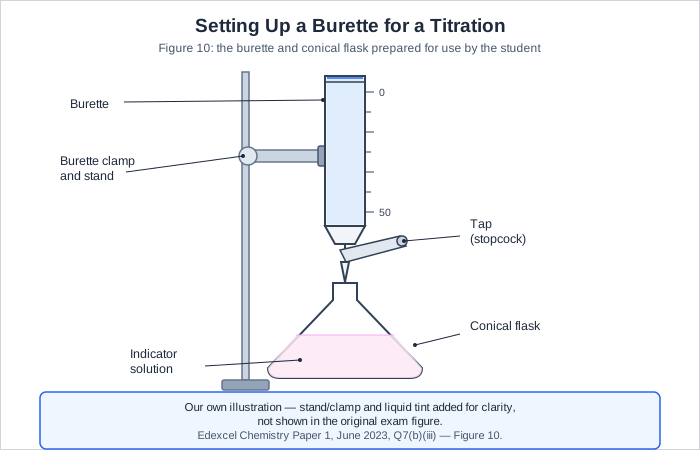
1×asked“Give three improvements to the way that the student used the burette.”
“Give three improvements to the way that the student used the burette.”
What it’s really asking
Given a student's written description of a flawed titration method ('I took the burette from the cupboard, closed the tap, filled the burette, and added the solution drop by drop until the indicator changed colour'), you must identify three specific mistakes in the burette technique and state the correct version.
What the sources actually showed — June 2023
A short first-person description a student wrote of how they used the burette: taking it from the cupboard, closing the tap and filling it with the correct solution, then adding the solution drop by drop to the flask until the indicator changed colour, alongside a labelled diagram showing the burette and flask set up for use.
The full worked answer — June 2023
First, the burette should be rinsed with the solution it is going to contain (the titrant), not just used straight from the cupboard, otherwise any water left inside would dilute the solution and give an inaccurate titre. Second, the student should make sure the jet (the tip below the tap) is filled with solution, with no air bubble trapped, since an air bubble that escapes during the titration would add to the recorded volume of solution added without actually reacting. Third, the student should not add the solution drop by drop for the whole titration; instead they should do a rough titration first to find an approximate end point, then add the solution more quickly at first and only drop by drop once they are close to that end point, otherwise a full drop-by-drop titration from the very start would take an unnecessarily long time and increases the risk of accidentally overshooting near the end anyway.
Could you have written this? Every fact in this answer is drilled in our quizzes — the writing is the easy part once the evidence is automatic.
Practise titration technique questionsWhat the mark scheme rewarded
- Stating the burette should be rinsed with the titrant solution before use
- Stating the jet (tip) of the burette should be filled with solution, with no air bubble present
- Stating a rough titration should be carried out first, then repeats added dropwise only near the end point, rather than going drop by drop for the entire titration
- The real mark scheme also credits not overfilling the burette above the 0 cm3 mark, since the diagram given shows it overfilled
- Rinsing a burette with the solution it will hold prevents dilution by any water left inside from washing
- An air bubble in the burette's jet that escapes during the titration adds to the recorded volume without contributing to the reaction, causing an inaccurate reading
- A rough titration first identifies an approximate end point, so the accurate repeat titrations can be added quickly at first and only drop by drop near that known point, saving time and improving precision
Traps examiners saw
- Giving general titration advice unrelated to the burette specifically, when the question asks only about the BURETTE
- Repeating something the student's method already correctly states, such as filling the burette with the correct solution
Full-mark self-check 0 of 3
The method for every Q7 — same every sittingMark bands, steps, timing
What this question type rewards
The topic changes by sitting — the mark scheme never does. Learn this once, then open your question above for that sitting’s sources and a full worked answer.
- Naming a specific, correct practical step rather than a vague statement like 'be careful'
- Linking each step to why it improves accuracy, not just describing what to do
The steps
- Think through the whole titration process in order: rinsing equipment, filling the burette, doing a rough titration first, then repeat titrations added dropwise near the end point
- For each step you name, be specific about the apparatus involved (burette, pipette, flask) rather than vague
- If reasons are asked for, link each step to the specific error it prevents (for example, rinsing the burette with water only would dilute the solution and give an inaccurate titre)
What is the purpose of a titration?
Titration technique questions often quote a flawed method back at you and ask you to spot the mistakes, or ask for further steps beyond the ones already stated. Read exactly what has already been done before answering.
Practise titration technique questions“Explain why a metal is extracted using a particular method, based on its position in the reactivity series”
Both sittings we have full papers for use the reactivity series to justify why a specific metal needs a specific extraction method, whether that is electrolysis for a very reactive metal or a simpler chemical method for a less reactive one.
1×asked“Aluminium is extracted from its ore by electrolysis. Explain why this method is used to extract aluminium from its ore.”
“Aluminium is extracted from its ore by electrolysis. Explain why this method is used to extract aluminium from its ore.”
What it’s really asking
You must explain why aluminium, a metal above carbon in the reactivity series, cannot be extracted by heating with carbon and instead requires electrolysis.
What the sources actually showed — June 2022
A brief statement that the method used to extract a metal from its ore depends on the metal's position in the reactivity series, followed directly by the fact that aluminium is extracted by electrolysis.
The full worked answer — June 2022
Aluminium is very high in the reactivity series, more reactive than carbon, so it cannot be displaced from its ore by heating with carbon. A large amount of energy is needed to remove the oxygen from aluminium oxide, and electrolysis is able to supply this.
Could you have written this? Every fact in this answer is drilled in our quizzes — the writing is the easy part once the evidence is automatic.
Practise metal extraction questionsWhat the mark scheme rewarded
- Stating aluminium is (very) high in the reactivity series, or more reactive than carbon
- Stating that extracting aluminium needs a large amount of energy, which electrolysis can supply, since it cannot be displaced by carbon
- Metals more reactive than carbon cannot be extracted from their ores by heating with carbon, since carbon cannot displace them
- Electrolysis uses electrical energy to force apart strongly bonded ions, making it suitable for very reactive metals whose oxides need a large energy input to break down
Traps examiners saw
- Saying aluminium is extracted by electrolysis just because 'it is a metal', without linking this to its specific position in the reactivity series relative to carbon
- Forgetting to mention the large energy requirement, which is the actual reason electrolysis (rather than some other method) is chosen
Full-mark self-check 0 of 2
1×asked“Copper is low down in the reactivity series and can be obtained from copper oxide. Devise a simple method to obtain a sample of copper from copper oxide in the laboratory.”
“Copper is low down in the reactivity series and can be obtained from copper oxide. Devise a simple method to obtain a sample of copper from copper oxide in the laboratory.”
What it’s really asking
Since copper is unreactive and low in the reactivity series, you must devise a laboratory method (such as heating with carbon) to extract copper metal from copper oxide, rather than needing electrolysis.
What the sources actually showed — June 2022
A statement that copper is low down in the reactivity series and can be obtained from copper oxide, asking for a simple laboratory method to obtain a sample of copper.
The full worked answer — June 2022
Mix copper oxide with powdered carbon in a suitable container and heat the mixture strongly (or until no further change occurs). The carbon displaces the copper from the copper oxide, since carbon is more reactive than copper, leaving solid copper behind.
Could you have written this? Every fact in this answer is drilled in our quizzes — the writing is the easy part once the evidence is automatic.
Practise metal extraction questionsWhat the mark scheme rewarded
- Mixing copper oxide with carbon (or powdered charcoal) in a suitable container
- Heating the mixture (strongly, until no further change)
- The real mark scheme also credited alternative valid methods, such as reacting copper oxide with dilute acid then electrolysing the resulting solution, or passing hydrogen gas over heated copper oxide
- Metals below carbon in the reactivity series can be extracted from their oxides by heating with carbon, since carbon displaces the less reactive metal
- 2CuO + C -> 2Cu + CO2 is one possible equation for this reaction
Traps examiners saw
- Giving only one half of the method (for example just saying 'heat it' without saying what to heat it with)
- Suggesting electrolysis, which is not needed for an unreactive metal like copper and is not the simplest available method
Full-mark self-check 0 of 3
The method for every Q6 — same every sittingMark bands, steps, timing
What this question type rewards
The topic changes by sitting — the mark scheme never does. Learn this once, then open your question above for that sitting’s sources and a full worked answer.
- Correctly stating where the metal sits in the reactivity series relative to carbon
- Linking a highly reactive metal's position to the need for electrolysis rather than heating with carbon
- Suggesting a correct, safe, practical method for extracting a less reactive metal from its oxide or salt
The steps
- State where the metal sits in the reactivity series
- If the metal is above carbon: explain that carbon cannot displace it, so electrolysis is needed, which requires a lot of energy
- If the metal is below carbon (or is only moderately reactive): suggest heating its oxide with carbon, or another named chemical method, to displace the metal
- Make sure any method you suggest is chemically valid and specific, not just 'use chemicals to extract it'
Extraction method questions always come back to one idea: where the metal sits relative to carbon in the reactivity series. Learn which methods go with which part of the series.
Practise metal extraction questions“Explain, in terms of the particles present, why the pH changes as a base is added to an acid (or vice versa)”
Both sittings ask you to explain a pH change happening in real experimental data, in terms of hydrogen ions and hydroxide ions, rather than just describing that the pH goes up or down.
1×asked“Explain why the pH starts at a low value and ends at a higher value.”
“Explain why the pH starts at a low value and ends at a higher value.”
What it’s really asking
Given a real graph showing pH rising from about 1 to about 12 as powdered calcium hydroxide is added to dilute hydrochloric acid, you must explain the change in terms of hydrogen ions reacting and their concentration falling.
What the sources actually showed — June 2023
A real graph of pH (vertical axis, 0 to 14) against mass of calcium hydroxide added in grams (horizontal axis, 0 to 1.0), showing pH starting low at around 1, rising gently at first, then rising very steeply between about 0.7 g and 0.8 g added, before levelling off at around pH 12.
The full worked answer — June 2023
At the start, the solution is a dilute acid, which has a high concentration of hydrogen ions, giving a low pH. As calcium hydroxide (a base) is added, its hydroxide ions react with (neutralise) the hydrogen ions present, H+ + OH- -> H2O. As more calcium hydroxide is added, the concentration of hydrogen ions falls (and the concentration of hydroxide ions rises), so the pH increases and eventually reaches a higher value once excess hydroxide ions remain in solution.
Could you have written this? Every fact in this answer is drilled in our quizzes — the writing is the easy part once the evidence is automatic.
Practise acids, alkalis and neutralisation questionsWhat the mark scheme rewarded
- Stating the solution is acidic at the start, with a high concentration of (or excess) H+ ions
- Describing the neutralisation reaction between H+ and OH- ions
- Stating that the concentration of H+ ions has reduced (or OH- ions has increased) by the end, giving a pH greater than 7
- Acids have a high concentration of hydrogen ions in solution, giving a low pH
- H+ + OH- -> H2O is the ionic equation for neutralisation
- Once all the hydrogen ions have reacted and excess hydroxide ions remain, the solution becomes alkaline
Traps examiners saw
- Just describing the pattern in the graph (pH increases as calcium hydroxide is added) without ever mentioning ions, which the real mark scheme specifically does not credit for this question
- Forgetting to mention the starting acidic condition, only describing the reaction and the end state
Full-mark self-check 0 of 3
1×asked“Explain, in terms of the particles present, why the pH increases during the experiment.”
“Explain, in terms of the particles present, why the pH increases during the experiment.”
What it’s really asking
As a powdered base is added repeatedly to dilute hydrochloric acid and the pH is measured after each addition, changing from 2 up towards 10, you must explain the rising pH in terms of hydrogen ions and hydroxide ions.
What the sources actually showed — June 2019
A described method where a powdered base is added in stages to dilute hydrochloric acid, with the pH measured using universal indicator paper after each addition, stating the pH changes from 2 to 10 over the course of the experiment.
The full worked answer — June 2019
Hydrogen ions in the acid react with (are neutralised by) the base as it is added. As more base is added, the concentration of hydrogen ions falls, and the concentration of hydroxide ions rises, so the pH increases.
Could you have written this? Every fact in this answer is drilled in our quizzes — the writing is the easy part once the evidence is automatic.
Practise acids, alkalis and neutralisation questionsWhat the mark scheme rewarded
- Stating that hydrogen ions react with (are neutralised by) the base as it is added
- Stating that the concentration of hydrogen ions falls, or the concentration of hydroxide ions rises, as the pH increases
- H+ + OH- -> H2O
- As a base neutralises an acid, the excess hydrogen ions are used up, and if enough base is added, hydroxide ions become present in excess
Traps examiners saw
- Describing the colour change of the indicator instead of explaining the actual chemistry behind the changing pH
- Stating only that 'the acid gets weaker' without any reference to the actual ions reacting or changing in concentration
Full-mark self-check 0 of 2
The method for every Q9 — same every sittingMark bands, steps, timing
What this question type rewards
The topic changes by sitting — the mark scheme never does. Learn this once, then open your question above for that sitting’s sources and a full worked answer.
- Explaining the reaction between hydrogen ions and hydroxide ions (or the base reacting with hydrogen ions)
- Linking this to the falling concentration of hydrogen ions and/or the rising concentration of hydroxide ions
- Not just describing the trend in the data without any reference to ions
The steps
- State the starting condition in terms of ions (for example, excess H+ ions present, giving a low pH)
- Describe the reaction taking place: H+ + OH- -> H2O
- State how the concentration of H+ (or OH-) ions changes as the reaction proceeds
- Link this changing ion concentration to the changing pH value
Which word equation correctly represents a neutralisation reaction?
pH change questions always want the explanation in terms of hydrogen and hydroxide ion concentrations changing, not a description of the graph or the colour of an indicator.
Practise acids, alkalis and neutralisation questionsThe topics that keep coming up
Across the 3 sittings we have full papers for, these are the recurring question types and marks at stake on Paper 1.
Not the primary focus in the 3 sittings we have full papers for
Nanoparticles and their uses as a standalone extended response topic in these three papers · Group 0, Group 1 and Group 7 trends as a standalone extended response topic in these three papers · Empirical formula calculations beyond the shorter structured question seen in June 2019
These topics have not carried a full extended response question in the papers we analysed, but can still appear as shorter structured questions, so do not skip them entirely.
Before you revise
Are these real mark scheme answers?
The data, tables and apparatus are described in our own words, not reproduced, and the worked answers are written entirely by us, aimed at the actual level descriptors and mark points of the real Edexcel mark schemes for each sitting. They are not copied from Edexcel's own exemplar materials, since that would breach copyright, but they are built to hit exactly what the real mark scheme rewarded that year. PrepWise is independent of Pearson and Edexcel and not endorsed by them.
Will the exact same questions come up again this year?
Percentage yield, atom economy and Avogadro constant calculations return in some form in every single sitting we analysed, and redox explanations, equilibrium yield/rate questions and titration technique all return regularly too. But you cannot rely on repeats alone, since the exact substance, numbers and context change every time even when the question type is similar. Use this page to see which QUESTION TYPES keep returning and make sure you know the underlying chemistry cold, whatever the exact wording turns out to be.
Is PrepWise free to use for this?
Yes, PrepWise is free now. You can practise every topic on this page without paying anything.
Stop guessing, start practising the actual questions
Every topic on this page has practice questions waiting in the app, scored the way Edexcel actually marks them.
Start revising free