Bonding & StructureDiagram

Nanoparticle Size Scale and Applications

Part of Nanoparticles (HT)GCSE Chemistry

This diagram covers Nanoparticle Size Scale and Applications within Nanoparticles (HT) for GCSE Chemistry. Revise Nanoparticles (HT) in Bonding & Structure for GCSE Chemistry with 20 exam-style questions and 20 flashcards. This is a high-frequency topic, so it is worth revising until the explanation feels precise and repeatable. It is section 3 of 12 in this topic. Focus on the labels, the relationships between parts, and the explanation that turns the diagram into an exam-ready answer.

Topic position

Section 3 of 12

Practice

20 questions

Recall

20 flashcards

📐 Nanoparticle Size Scale and Applications
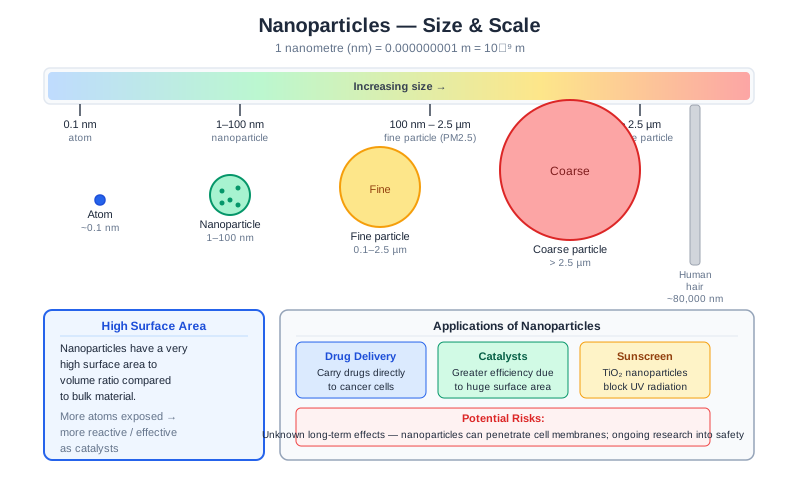
Size comparison from atoms to nanoparticles to fine and coarse particles with applications

The nanoscale sits between atomic scale and the visible world. Nanoparticles (1-100 nm) have dramatically higher surface area to volume ratios than bulk materials of the same composition, giving them different and often more useful properties.

Keep building this topic

Read this section alongside the surrounding pages in Nanoparticles (HT). That gives you the full topic sequence instead of a single isolated revision point.

Practice Questions for Nanoparticles (HT)

What is the size range of nanoparticles?

  • A. 1-100 millimetres
  • B. 1-100 micrometres
  • C. 1-100 nanometres
  • D. 1-100 picometres
1 markfoundation

Describe the structure of graphene and state one property that arises from this structure.

2 marksstandard

Quick Recall Flashcards

What are fullerenes?
Hollow carbon nanoparticles (like C₆₀) that can carry drug molecules
What is a nanometre in metres?
1 × 10⁻⁹ m (one billionth of a metre)

Want to test your knowledge?

PrepWise has 20 exam-style questions and 20 flashcards for Nanoparticles (HT) — with adaptive difficulty and instant feedback.

Join Alpha