The Tiny Revolution
📖 The Tiny Revolution
Think about cutting a pizza into smaller and smaller slices. As the slices get tinier, the ratio of crust (surface) to cheese (inside) increases — more edge, less middle. Nanoparticles work the same way: shrinking materials means a MUCH higher proportion of atoms are on the surface. More surface atoms = more reactivity, different properties, and new possibilities!
Nanoparticles are particles between 1 and 100 nanometres in size. To put that in perspective: a nanometre is one billionth of a metre (10⁻⁹ m). A human hair is about 80,000 nanometres thick. These particles are so small that they behave differently from bulk materials.
The key concept is surface area to volume ratio. When you make particles smaller, the proportion of atoms on the surface (compared to inside) increases dramatically. Think of cutting a cake into smaller and smaller pieces — you get more and more surface area relative to the total amount of cake. This matters because:
- More reactive — more atoms exposed for reactions
- Better catalysts — more surface for reactions to occur on
- Different properties — colour, strength, conductivity can change
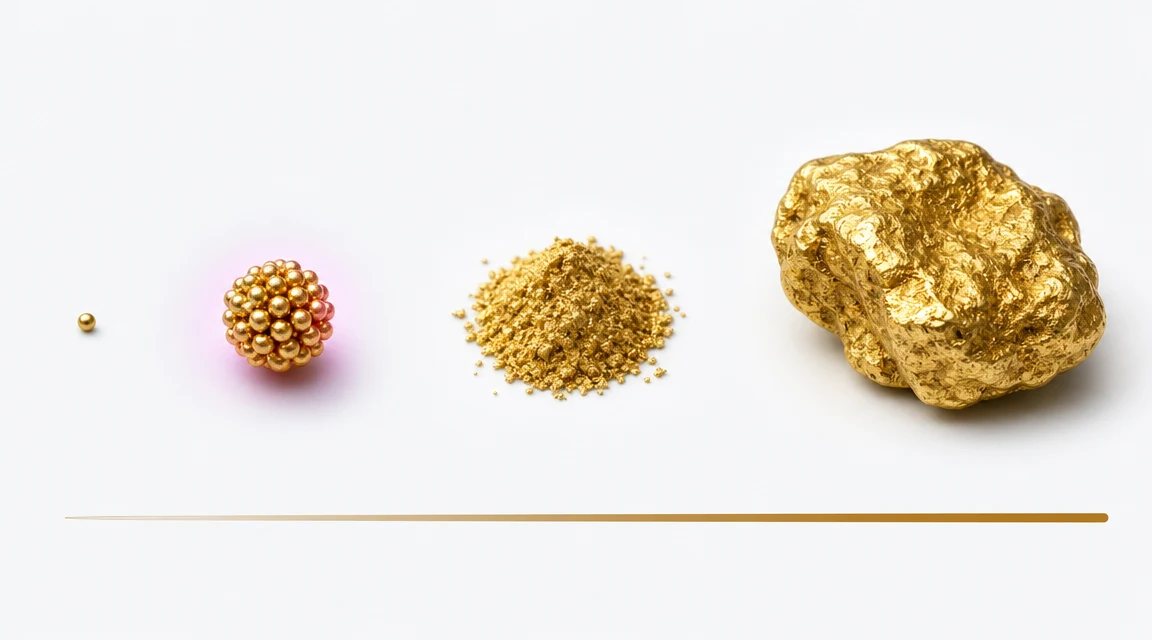
- 1Single atom —
- 2Nanoparticle —
- 3Fine particle —
- 4Bulk material —
Chemistry glossary
- What is a nanometre in metres?
- 1 × 10⁻⁹ m (one billionth of a metre)
Earn the mark scheme marks
🧠 Memory Aids
NANO = billionth (10⁻⁹): "NANO sounds like 'no no' — as in, particles THIS small are SO tiny it's unbelievable." 1 nanometre is 0.000000001 metres.
Bigger surface = more reactive: Imagine grinding up chalk — powdery chalk dissolves much faster in acid than a lump, because more surface is exposed. Nanoparticles take this to an extreme.
Uses of nanoparticles (SCARE):
- Sunscreens — TiO₂ blocks UV invisibly
- Catalysts — high surface area, more efficient
- Antimicrobials — silver nanoparticles kill bacteria
- Remote drug delivery — fullerenes carry drugs to target cells
- Electronics — smaller, faster circuits
Now try it yourself
Quiz · Question 1 of 22
What is the size range of nanoparticles?
Tap an answer to check it