Test yourself on The Periodic Table with exam style questions, marked instantly.
Flashcards that come back just before you would forget them.
A revision plan that remembers what you know and shows what to do next.
See which topics you have nailed and which need another look.
Quiz yourself on The Periodic TableGet your flashcardsBuild my revision planTrack my progress📖 The Chemist's Map
The periodic table is like a library's filing system. Just as books are organised by genre (groups) and you find similar stories together, elements are organised by their electron configuration. All the romance novels are in one section, all the thrillers in another — just like all elements with 1 outer electron are in Group 1, and all with 7 are in Group 7. Once you know the system, you can predict where any "book" belongs!
📊 The Periodic Table — Key Features
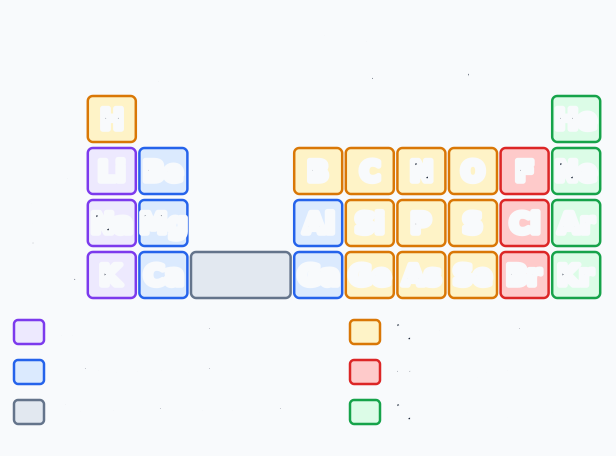
KEY: Elements are arranged by atomic number (not mass!). The table reveals patterns — elements in the same group have similar chemical properties.
⚙️ Why Elements in the Same Group Have Similar Properties
The periodic table is not just a convenient list — it reveals a deep truth about atomic structure. Elements in the same vertical group have identical numbers of electrons in their outermost shell. Since chemical reactions involve the outer electrons (either losing, gaining, or sharing them), elements with the same outer electron count react in the same way. For example, all Group 1 metals have 1 outer electron. When they react with water, that single electron is transferred to form a +1 ion, producing hydrogen gas and a metal hydroxide. Lithium, sodium, and potassium all do exactly this — because they all have 1 outer electron. The difference in reactivity between them is explained by atomic size: larger atoms down the group hold the outer electron less tightly (it is further from the nucleus and more shielded), so it is lost more easily, making the element more reactive. This link between electronic structure and the pattern of the periodic table is one of the most elegant ideas in all of chemistry.
📌 Understanding the Structure
The periodic table is organised into:
- Groups — Vertical columns numbered 1-7 and 0. Elements in the same group have the same number of outer electrons and similar chemical properties.
- Periods — Horizontal rows numbered 1-7. Elements in the same period have the same number of electron shells.
Key sections:
- Metals — Found on the left and centre of the table (most elements are metals!)
- Non-metals — Found on the right side of the table
- A "staircase" line separates metals from non-metals
Remember: Elements are arranged by ATOMIC NUMBER (number of protons), NOT by atomic mass. This is the modern arrangement since 1914.
🧪 The Key Groups You Must Know
Group 1 — The Alkali Metals (Li, Na, K, Rb, Cs, Fr)
- 1 electron in outer shell — easily lost to form +1 ions
- Very reactive metals (reactivity INCREASES down the group)
- React vigorously with water to produce hydrogen gas
- Soft, low density, low melting points for metals
Group 7 — The Halogens (F, Cl, Br, I, At)
- 7 electrons in outer shell — easily gain 1 to form -1 ions
- Very reactive non-metals (reactivity DECREASES down the group)
- Exist as diatomic molecules (F₂, Cl₂, Br₂, I₂)
- Form salts when reacting with metals (halogen means "salt-former")
Group 0 — The Noble Gases (He, Ne, Ar, Kr, Xe, Rn)
- Full outer shell — extremely stable, no need to react
- Very unreactive (also called inert gases)
- Exist as single atoms (monatomic)
- Used where unreactive gases are needed (light bulbs, balloons)
📈 Trends in the Periodic Table
Down a group:
- Atomic radius increases (more electron shells)
- Group 1 reactivity INCREASES (outer electron further from nucleus, easier to lose)
- Group 7 reactivity DECREASES (harder to attract an electron into a larger atom)
- Melting/boiling points — trend varies by group
Across a period (left to right):
- Atomic radius decreases (more protons pull electrons closer)
- Metallic character decreases (metals → non-metals)
- Elements go from highly reactive metals → non-metals → noble gas
Quick Check: An element is in Group 2, Period 3. How many outer electrons does it have and how many electron shells?
2 outer electrons (Group 2) and 3 electron shells (Period 3). This is magnesium, with electronic configuration 2,8,2.
⚖️ Metals vs Non-metals
Exam questions on every board often ask you to compare metals and non-metals. This table covers all the key contrasts.
| Property | Metals | Non-metals |
|---|---|---|
| Position in periodic table | Left side and centre (majority of elements) | Right side (smaller group) |
| Typical structure | Giant metallic lattice | Simple molecular (usually), or giant covalent (e.g., diamond) |
| Melting / boiling point | Usually high (strong metallic bonding) | Usually low (simple molecules have weak intermolecular forces) |
| Electrical conductivity | Good — delocalised electrons carry charge | Poor — no free electrons (except graphite) |
| Thermal conductivity | Good | Poor (usually) |
| In reactions (electrons) | Lose electrons → form positive ions (e.g., Na⁺, Mg²⁺) | Gain electrons → form negative ions (e.g., Cl⁻, O²⁻) |
| Physical properties | Shiny, malleable, ductile | Brittle in solid form, dull |
| Example elements | Na, Mg, Fe, Cu, Al | C, N, O, Cl, S, P |
Exception to know: Graphite (a form of carbon, a non-metal) conducts electricity because it has delocalised electrons. It is the standard "exception" examiners use in exam questions to test your depth of understanding.
📖 Key Definitions
Group: A vertical column in the periodic table. Elements in the same group have the same number of outer shell electrons and similar chemical properties.
Period: A horizontal row in the periodic table. Elements in the same period have the same number of occupied electron shells.
Metal: An element that is typically shiny, malleable, conducts electricity and heat, and forms positive ions. Found on the left and centre of the periodic table.
Non-metal: An element with properties opposite to metals — poor conductors, brittle in solid form, often gases. Found on the right of the periodic table.
Atomic number: The number of protons in the nucleus; the property used to order elements in the modern periodic table.
⚠️ Common Misconceptions
Misconception 1: "All metals are solid at room temperature"
Mercury (Hg) is a metal that is liquid at room temperature — it has a melting point of -39°C. This is a favourite exam trick! When asked to identify metals on the periodic table, do not assume all metals are solids; their position (left/centre of table) is the reliable indicator, not their state.
Misconception 2: "Group 7 reactivity increases going down the group (like Group 1)"
This is the most common error when comparing groups. Group 1 reactivity increases going down because it gets easier to lose an electron. Group 7 reactivity decreases going down because it gets harder to gain an electron — the outer shell is further from the nucleus and less attractive to a new electron. The two groups show opposite trends.
Misconception 3: "Elements are arranged in the periodic table by atomic mass"
The modern periodic table (since Moseley's work in 1913) is arranged by atomic number (number of protons), not atomic mass. Mendeleev used mass and had to make awkward exceptions. Atomic number gives a perfect, unambiguous ordering with no exceptions needed.
🧠 Memory Aids
Groups = Families: Elements in the same group are like family members — they share the same "personality" (chemical properties) because they have the same number of outer electrons.
Periods = School Years: Moving across a period is like moving through a school year — you progress from the most metallic elements on the left to non-metals, finishing with the noble gas "graduation" at the end.
Reactivity trends mnemonic: "Group 1 Goes Up (reactivity increases down), Group 7 Goes Down (reactivity decreases down)" — think of them as opposites.
Quick Check: Why do elements in the same group have similar chemical properties?
They have the same number of electrons in their outer shell. Since chemical reactions involve outer electrons (being lost, gained, or shared), same outer electron count means the same type of reactions.
🎯 Exam Focus
Frequently Examined
The periodic table underpins all of GCSE Chemistry — it appears in almost every topic. Specific exam questions on "the periodic table" typically test: identifying group and period from electronic configuration, explaining why elements in the same group have similar properties, describing trends in reactivity for Groups 1 and 7, and distinguishing metals from non-metals. A favourite 3-mark question asks students to explain why a particular element is reactive by linking outer electron count to ease of gaining or losing electrons.
Edexcel 1CH0: Examined in Paper 1 (1CH0/1). Edexcel questions frequently ask you to use the periodic table to predict properties of elements, explain periodic trends, and link electronic configuration to group/period position. The development of the periodic table (Newlands, Mendeleev) is a common short-answer topic. In Edexcel-style questions, the command word "Suggest" appears frequently — use your chemistry knowledge to apply to an unfamiliar context.
💡 Exam Tips — The Periodic Table
🎯 Common Question Types:
- Use electronic configuration to identify group and period (2 marks)
- Explain why elements in same group have similar properties (3 marks)
- Compare reactivity trends in Group 1 and Group 7 (4 marks)
- Explain why noble gases are unreactive (2 marks)
📝 Key Command Words:
- Explain: Link to outer electrons, not just state the trend
- Compare: Describe both Group 1 and Group 7 trends explicitly
- State: Give the group/period number directly
- Predict: Use the group trend to forecast properties of unknown elements
⚠️ Common Mistakes to Avoid:
- Confusing groups (columns) with periods (rows)
- Saying Group 7 reactivity increases down — it DECREASES
- Forgetting that Group 0 noble gases have FULL outer shells (8, except He which has 2)
- Saying elements are arranged by mass — they are arranged by ATOMIC NUMBER
Make this stick
Signing in gives access to all PrepWise features.