Why Can't You Melt Salt on a Kitchen Stove?
📖 Why Can't You Melt Salt on a Kitchen Stove?
An ionic lattice is like a 3D LEGO tower where every piece is glued to its neighbours. Imagine building with red and blue LEGO bricks where every red brick must touch only blue bricks and vice versa. The glue (electrostatic attraction) holds them so strongly that you'd need to heat the whole structure to over 800°C to break it apart. That's why ionic compounds have such high melting points!
When we talked about ionic bonding, we focused on ONE sodium giving ONE electron to ONE chlorine. But here's what really happens when you make sodium chloride: you don't make billions of tiny NaCl "molecules" floating around. Instead, you create something much more impressive — a giant ionic lattice.
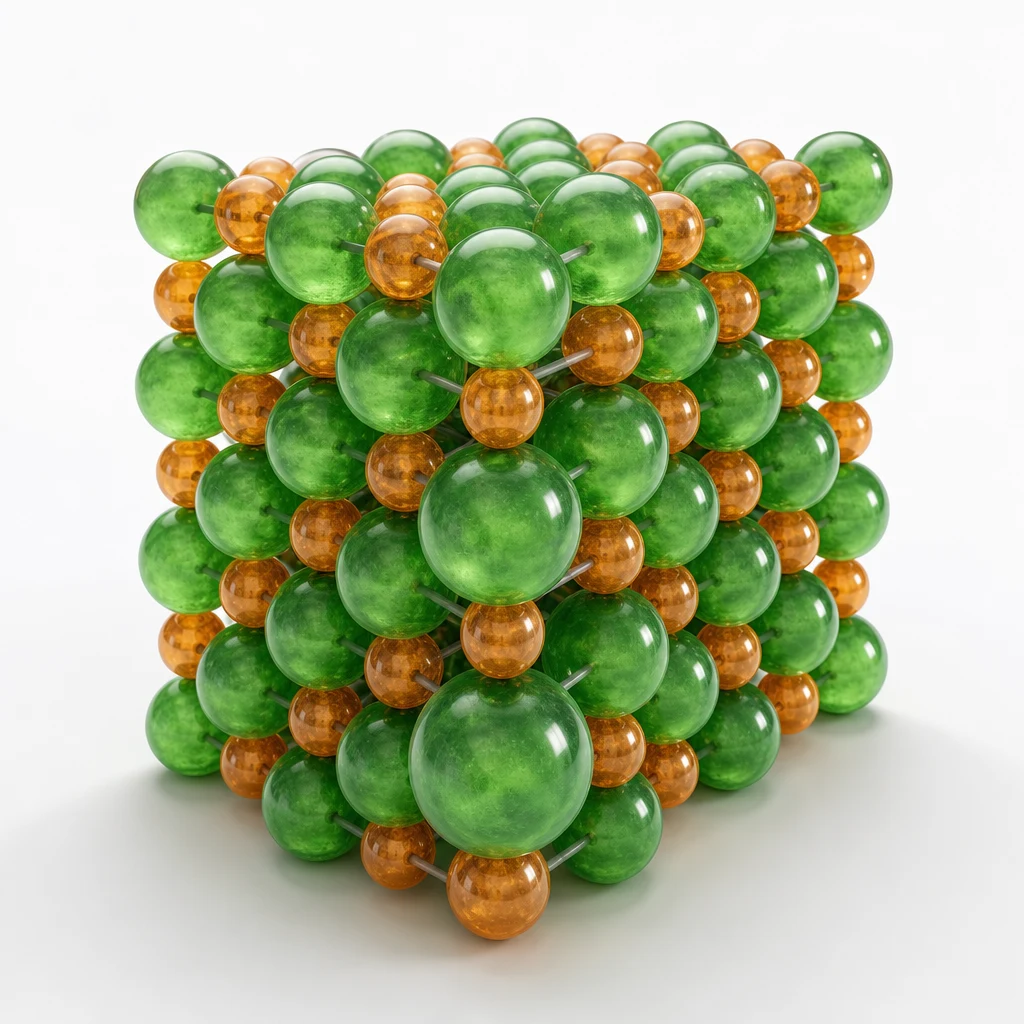
Imagine building with LEGO, but instead of random stacking, every single piece must alternate in a perfect 3D pattern. Each Na⁺ ion is surrounded by Cl⁻ ions, and each Cl⁻ is surrounded by Na⁺ ions. Not just next to each other — but above, below, in front, behind, left, and right. This pattern repeats BILLIONS of times in every direction. The result is a crystal — a rigid, geometric structure held together by countless electrostatic attractions.
This is why salt is hard to melt. To melt something, you need to break the structure apart. But in a giant ionic lattice, you're not breaking just one or two bonds — you're fighting against BILLIONS of strong electrostatic attractions all at once! That takes an enormous amount of energy. Salt doesn't melt until 801°C — hot enough to glow bright red!
And here's the electricity puzzle: Salt is made of charged ions, yet solid salt doesn't conduct electricity. Put two wires into a pile of salt, connect it to a battery — nothing happens. But dissolve that salt in water, and suddenly electricity flows! Why? In solid salt, the ions are locked in fixed positions — they can't move to carry the charge. When you melt or dissolve salt, the lattice breaks apart and the ions become free to move. Moving charges = electric current!
The giant ionic lattice of NaCl — click each part to explore the ions, bonding, and properties.
- 1Na+ ion —
- 2Cl- ion —
- 3Electrostatic attraction —
- 4Giant ionic lattice —
Figure 1: The giant ionic lattice of NaCl — click each part to explore the ions, bonding, and properties.
Chemistry glossary
- What is a giant ionic lattice?
- A regular 3D arrangement of alternating positive and negative ions extending in all directions
Earn the mark scheme marks
🧠 Memory Aids
Conductivity states: "Solid = stuck, Liquid = loose, Solution = swimming"
- Solid ionic compound — ions are stuck in the lattice → NO conduction
- Molten (liquid) ionic compound — lattice gone, ions loose → CONDUCTS
- Dissolved in solution — ions swimming freely → CONDUCTS
Melting point comparison: Think of "CHARGES matter MOST" — higher charges mean stronger attractions mean higher melting points. MgO (2+, 2-) beats NaCl (1+, 1-).
Brittleness: "Shift = Same = Shatter" — when layers shift, same charges align, and the crystal shatters due to repulsion.
Now try it yourself
Quiz · Question 1 of 21
What type of structure is found in all ionic compounds?
Tap an answer to check it