Bonding & StructureDiagram

Giant Ionic Lattice Structure

Part of Ionic CompoundsGCSE Chemistry

This diagram covers Giant Ionic Lattice Structure within Ionic Compounds for GCSE Chemistry. Revise Ionic Compounds in Bonding & Structure for GCSE Chemistry with 20 exam-style questions and 20 flashcards. This is a high-frequency topic, so it is worth revising until the explanation feels precise and repeatable. It is section 3 of 12 in this topic. Focus on the labels, the relationships between parts, and the explanation that turns the diagram into an exam-ready answer.

Topic position

Section 3 of 12

Practice

20 questions

Recall

20 flashcards

📐 Giant Ionic Lattice Structure
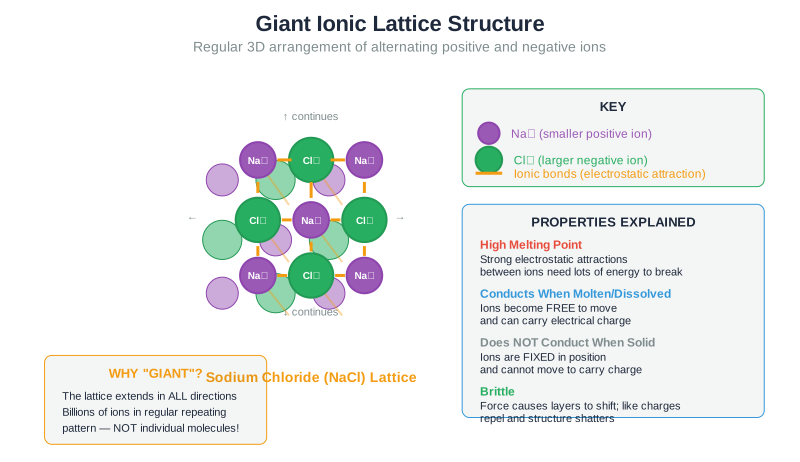
Sodium chloride giant ionic lattice showing alternating positive and negative ions

The giant ionic lattice of NaCl. Each ion is surrounded by oppositely charged ions in a regular, repeating 3D pattern. The structure extends in all directions — there are no individual "molecules."

Keep building this topic

Read this section alongside the surrounding pages in Ionic Compounds. That gives you the full topic sequence instead of a single isolated revision point.

Practice Questions for Ionic Compounds

What type of structure is found in all ionic compounds?

  • A. Giant ionic lattice
  • B. Simple molecular
  • C. Giant covalent
  • D. Metallic lattice
1 markfoundation

Explain why magnesium oxide conducts electricity when it is molten but not when it is solid.

2 marksstandard

Quick Recall Flashcards

What is a giant ionic lattice?
A regular 3D arrangement of alternating positive and negative ions extending in all directions
Why are ionic compounds brittle?
Force shifts ion layers, bringing like charges together — they repel and the structure shatters

Want to test your knowledge?

PrepWise has 20 exam-style questions and 20 flashcards for Ionic Compounds — with adaptive difficulty and instant feedback.

Join Alpha