Test yourself on Reversible Reactions with exam style questions, marked instantly.
Flashcards that come back just before you would forget them.
A revision plan that remembers what you know and shows what to do next.
See which topics you have nailed and which need another look.
Quiz yourself on Reversible ReactionsGet your flashcardsBuild my revision planTrack my progress📖 The Reaction That Runs Backwards
Reversible reactions are like a revolving door! People can go in (forward reaction) AND come out (backward reaction) through the same door. Both directions happen at the same time. The ⇌ symbol shows this two-way traffic. Just like a revolving door, both processes are happening constantly — it just looks still when the same number enter as leave!
📐 Reversible Reactions Diagram
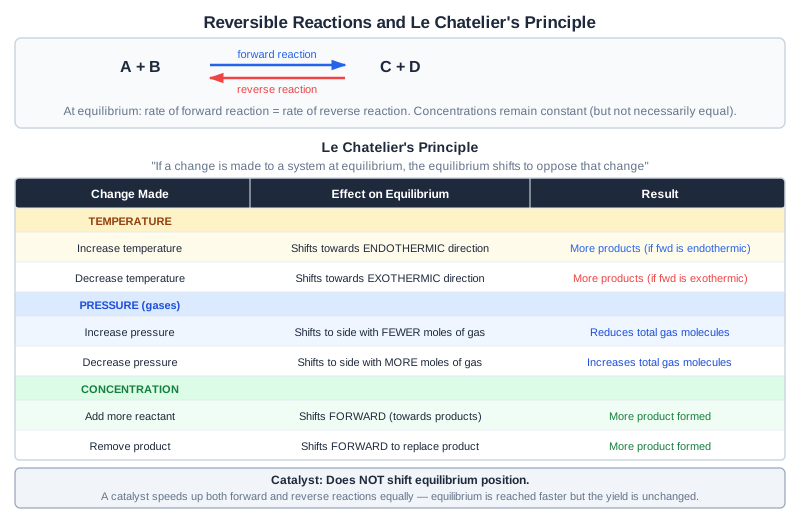
Figure 1: In a reversible reaction, the ⇌ symbol shows that products can reform into reactants. The direction favoured depends on conditions.
🔬 Deep Dive: The Reversible Symbol
A + B ⇌ C + D
The ⇌ symbol means the reaction is reversible
- Forward reaction: Reactants (A + B) → Products (C + D)
- Backward reaction: Products (C + D) → Reactants (A + B)
- Both reactions happen at the same time
- Changing conditions can favour one direction or the other
⚙️ How Reversible Reactions Work
In a reversible reaction, the products of the forward reaction can themselves react together to regenerate the original reactants. This means the system never reaches 100% products — instead, it reaches a state of balance.
At the start of a closed reaction, only the forward reaction happens (reactants convert to products). As products accumulate, the backward reaction begins to occur. Over time:
- The forward reaction slows down (reactants being used up)
- The backward reaction speeds up (products accumulating)
- Eventually, the rates of both reactions equalise
- The system reaches dynamic equilibrium
This is why you cannot get 100% conversion in a reversible reaction. The Haber process for making ammonia only achieves about 15% conversion per pass — the gases are recycled to get an economical overall yield.
Energy Rule for Reversible Reactions
If the forward reaction is EXOTHERMIC, the backward reaction is ENDOTHERMIC (and vice versa). The energy values are equal in magnitude but opposite in sign.
📌 Key Facts: Energy in Reversible Reactions
If the forward reaction is EXOTHERMIC... then the backward reaction is ENDOTHERMIC (and vice versa). The energy released going forward equals the energy absorbed going backward.
Example: Hydration of copper sulfate
CuSO₄·5H₂O(s) ⇌ CuSO₄(s) + 5H₂O(g)
| ← Add water | Heat → |
|---|---|
| Exothermic — mixture gets hot; white powder turns blue | Endothermic — needs heat; blue crystals turn white |
Quick Check: If the forward reaction of a reversible reaction releases 180 kJ/mol, how much energy does the backward reaction absorb?
Exactly 180 kJ/mol. In a reversible reaction, the energy change in the forward direction is exactly equal and opposite to the energy change in the backward direction. If the forward reaction is exothermic (releases 180 kJ/mol), the backward reaction is endothermic and absorbs exactly 180 kJ/mol. This follows from conservation of energy.
🧪 Examples of Reversible Reactions
- Copper sulfate hydration: CuSO₄·5H₂O(s) ⇌ CuSO₄(s) + 5H₂O(g)
- Ammonium chloride decomposition: NH₄Cl(s) ⇌ NH₃(g) + HCl(g)
- Haber process: N₂(g) + 3H₂(g) ⇌ 2NH₃(g)
- Thermal decomposition of limestone: CaCO₃(s) ⇌ CaO(s) + CO₂(g)
The copper sulfate hydration test is the classic example:
- Anhydrous CuSO₄ is white
- Hydrated CuSO₄·5H₂O is blue
- Adding water to white powder → turns blue + gets warm (exothermic)
- Heating blue crystals → turns white + steam released (endothermic)
- This test is used to detect the presence of water
📖 Key Definitions
Reversible reaction: A reaction in which the products can react together to reform the original reactants. Shown by the ⇌ symbol in an equation.
Forward reaction: The reaction proceeding from left to right in the equation (reactants → products).
Backward reaction: The reaction proceeding from right to left in the equation (products → reactants).
Closed system: A system where no substances can enter or leave. Reversible reactions can reach equilibrium only in a closed system.
⚠️ Common Misconceptions
Misconception 1: "Reversible means the reaction goes backwards"
A reversible reaction does not simply "go backwards" — both directions happen simultaneously. Even as products are forming, some are reacting together to reform reactants. The ⇌ symbol explicitly shows that both the forward and backward reactions are occurring at the same time. The net direction just depends on which reaction is currently faster.
Misconception 2: "Reversible reactions reach 100% products eventually"
In a closed system, a reversible reaction never reaches 100% conversion. The system reaches a state of dynamic equilibrium where both forward and backward rates are equal. This is why industrial processes like the Haber process must recycle unreacted gases — you can never convert all the reactants in one pass.
Misconception 3: "The energy values are different for forward and backward reactions"
The energy released in the exothermic direction always equals the energy absorbed in the endothermic direction. If the forward reaction releases 100 kJ/mol, the backward reaction absorbs exactly 100 kJ/mol. This follows from conservation of energy.
🧠 Memory Aid: Double Arrow = Two-Way Traffic
The ⇌ symbol is your key visual reminder:
- → = one-way street (irreversible reaction)
- ⇌ = two-way road (reversible reaction, traffic flows both ways)
For the energy rule, remember the phrase: "FORWARD EXO = BACKWARD ENDO" — if energy is released going forward, it must be absorbed going backward. Think of a ball rolling down a hill (exothermic forward) — you need to push it back up the same hill (endothermic backward), using exactly the same energy it released coming down.
For copper sulfate: Blue has water, White has none — heat makes it white, add water makes it blue.
🎯 Exam Focus: Reversible Reactions
high Energy questions (2-3 marks): State the direction (forward/backward), whether it is exo or endothermic, and the energy rule.
high Copper sulfate test (2 marks): Know the colour change (white → blue with water) and explain using the reversible reaction equation.
medium Symbol questions (1 mark): Use ⇌ not → in equations for reversible reactions. This is a commonly penalised error.
Common exam question: "Explain what happens when water is added to anhydrous copper sulfate" — must include: colour change, exothermic, equation with ⇌ symbol.
Edexcel 1CH0: Examined in Paper 2 (1CH0/2). Edexcel tests the concept of dynamic equilibrium and the effect of changing conditions on reversible reactions. In Edexcel-style questions, the command word "Suggest" appears frequently — use your chemistry knowledge to apply to an unfamiliar context.
💡 Exam Tips: Reversible Reactions
🎯 Common Question Types:
- Describe the copper sulfate water test (2 marks)
- State what the ⇌ symbol means (1 mark)
- Explain the energy relationship in a reversible reaction (2 marks)
- Write a reversible equation with correct symbol (1 mark)
📝 Key Command Words:
- State: Give the direction and energy type
- Explain: Link to the equation and energy rule
- Write: Use ⇌ symbol, balance the equation
⚠️ Common Mistakes to Avoid:
- Using → instead of ⇌ for reversible reactions (costs 1 mark)
- Saying "both exothermic" — it must be one exo, one endo
- Forgetting to mention water is detected (not just "colour change")
Quick Check: Heating blue copper sulfate crystals is endothermic. What can you say about adding water to the white anhydrous product?
Adding water to anhydrous copper sulfate (the backward reaction) is exothermic — it releases heat. The reaction is: CuSO₄(s) + 5H₂O(l) → CuSO₄·5H₂O(s) + heat. The mixture gets warm and the solid turns blue.
Quick Check: Why does a reversible reaction in a closed system never reach 100% products?
As products build up, the backward reaction begins to occur, reforming the reactants. The reaction reaches dynamic equilibrium where the forward and backward rates are equal, but both are still happening. The mixture always contains both reactants and products.
Make this stick
Signing in gives access to all PrepWise features.