Rates of ReactionDiagram

Reversible Reactions Diagram

Part of Reversible ReactionsGCSE Chemistry

This diagram covers Reversible Reactions Diagram within Reversible Reactions for GCSE Chemistry. Revise Reversible Reactions in Rates of Reaction for GCSE Chemistry with 20 exam-style questions and 12 flashcards. This topic appears regularly enough that it should still be part of a steady revision cycle. It is section 2 of 12 in this topic. Focus on the labels, the relationships between parts, and the explanation that turns the diagram into an exam-ready answer.

Topic position

Section 2 of 12

Practice

20 questions

Recall

12 flashcards

📐 Reversible Reactions Diagram

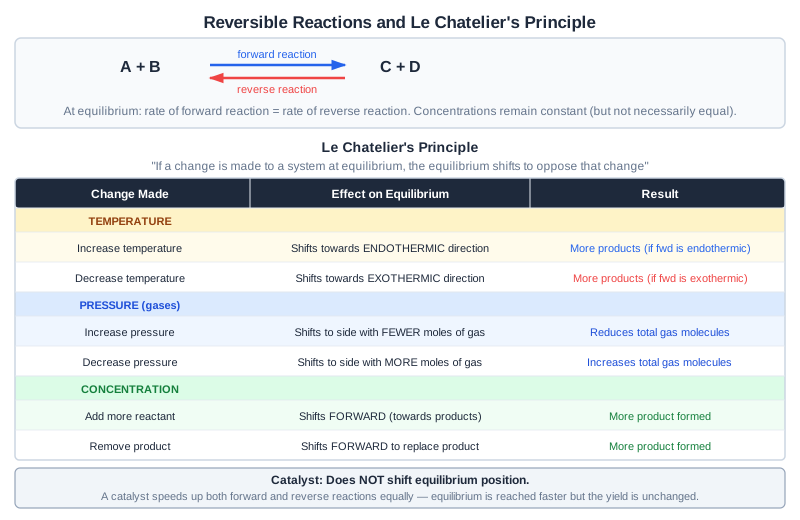
Reversible reactions and Le Chatelier principle showing effects of changing conditions on equilibrium

Figure 1: In a reversible reaction, the ⇌ symbol shows that products can reform into reactants. The direction favoured depends on conditions.

Keep building this topic

Read this section alongside the surrounding pages in Reversible Reactions. That gives you the full topic sequence instead of a single isolated revision point.

Practice Questions for Reversible Reactions

What does the symbol ⇌ mean when used in a chemical equation?

  • A. The reaction is very fast
  • B. The reaction produces a gas
  • C. The reaction can proceed in both the forward and backward directions
  • D. The reaction requires a catalyst
1 markfoundation

Explain the relationship between the energy changes in the forward and reverse reactions of a reversible reaction.

2 marksstandard

Quick Recall Flashcards

What symbol shows a reaction is reversible?
⇌ (double arrow)
What is a reversible reaction?
A reaction where products can react together to reform the original reactants

Want to test your knowledge?

PrepWise has 20 exam-style questions and 12 flashcards for Reversible Reactions — with adaptive difficulty and instant feedback.

Join Alpha