Languages & IDEsDiagram

Programming Language Levels and Translators

Part of High & Low Level LanguagesGCSE Computer Science

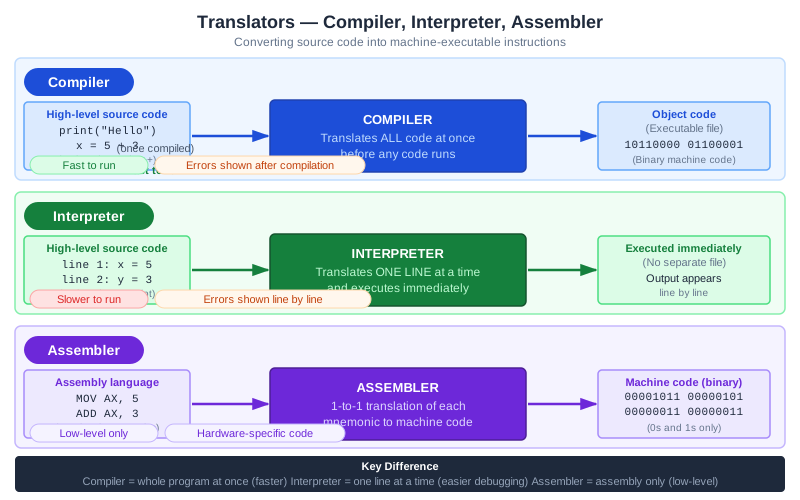
This diagram covers Programming Language Levels and Translators within High & Low Level Languages for GCSE Computer Science. Revise High & Low Level Languages in Languages & IDEs for GCSE Computer Science with 15 exam-style questions and 8 flashcards. This topic appears regularly enough that it should still be part of a steady revision cycle. It is section 3 of 8 in this topic. Focus on the labels, the relationships between parts, and the explanation that turns the diagram into an exam-ready answer.

Topic position

Section 3 of 8

Practice

15 questions

Recall

8 flashcards

Programming Language Levels and Translators

Programming language levels diagram showing the hierarchy from high-level languages (Python, Java, C++) at the top requiring a compiler or interpreter, to assembly language in the middle requiring an assembler, down to machine code (binary 0s and 1s) at the bottom that the CPU understands directly, with arrows showing the translation steps between each level

Keep building this topic

Read this section alongside the surrounding pages in High & Low Level Languages. That gives you the full topic sequence instead of a single isolated revision point.

Practice Questions for High & Low Level Languages

Which of the following best describes machine code?

  • A. Instructions written using English-like keywords such as PRINT and IF
  • B. Instructions written as binary patterns of 0s and 1s that the CPU executes directly
  • C. Instructions written using short mnemonics such as MOV and ADD
  • D. Instructions that must be compiled before the CPU can run them
1 markfoundation

Give two advantages of low-level languages over high-level languages.

2 marksstandard

Quick Recall Flashcards

Want to test your knowledge?

PrepWise has 15 exam-style questions and 8 flashcards for High & Low Level Languages — with adaptive difficulty and instant feedback.

Join Alpha