Test yourself on High & Low Level Languages with exam style questions, marked instantly.
Flashcards that come back just before you would forget them.
A revision plan that remembers what you know and shows what to do next.
See which topics you have nailed and which need another look.
Quiz yourself on High & Low Level LanguagesGet your flashcardsBuild my revision planTrack my progressVideo Lesson
Craig'n'Dave: High and Low Level LanguagesSpeaking to Computers
Computers only understand machine code - pure binary (1s and 0s). But humans can't easily read or write binary! High-level languages like Python are like speaking English - easy for us but need translating. Low-level languages like Assembly are closer to machine code - harder for us but faster for computers. It's a trade-off: programmer convenience vs computer efficiency.
Programming Language Levels and Translators
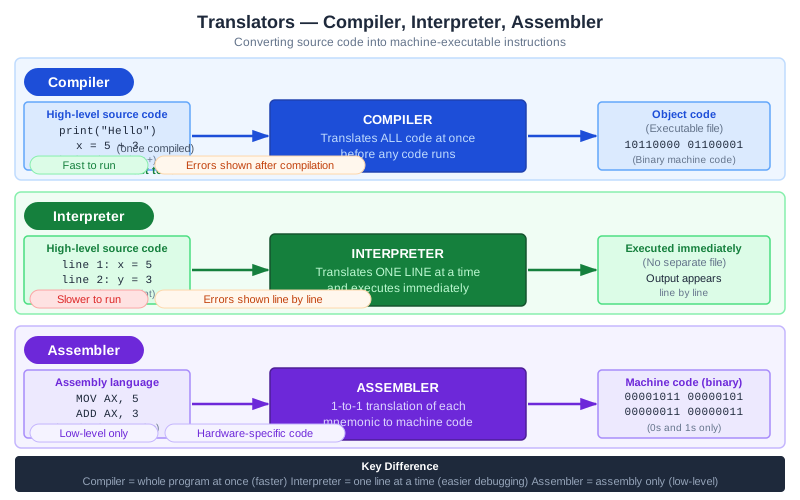
The CPU only runs machine code, so high-level code needs a translator. A compiler translates all of it at once into machine code. An interpreter translates it line by line as the program runs. Assembly language is a low-level language that needs an assembler. Exam board note: OCR says understanding of assemblers is not required.
High vs Low Level Languages
| Aspect | High-Level (Python, Java) | Low-Level (Assembly, Machine Code) |
|---|---|---|
| Readability | Easy to read/write | Difficult to understand |
| Portability | Works on different systems | Specific to one processor type |
| Abstraction | Hides hardware details | Direct hardware control |
| Translation | Needs compiler/interpreter | Minimal/no translation needed |
| Speed | Slower (translation overhead) | Very fast |
| Use Case | Apps, websites, games | Drivers, embedded systems, OS kernels |
Deep Dive: Code Comparison
| Language | Example: Add two numbers |
|---|---|
| High-Level (Python) | result = a + b |
| Assembly | LDA a ADD b STA result |
| Machine Code | 00111010 10000011 00110010 |
Deep Dive: Why Use Low-Level?
- Embedded systems: Washing machines, car engines - limited memory
- Device drivers: Need direct hardware communication
- Time-critical: Real-time systems where speed matters
- OS development: Operating system kernels need hardware access
Memory Trick
HIGH = Human-friendly, Interpreted/compiled, Generic (portable), Helpful abstractions
LOW = Laborious to write, One processor only, Wicked fast
Exam Tips
- Portable means: Can run on different processor types without changes
- Assembly ≠ Machine code: Assembly uses mnemonics (LDA, ADD), machine code is pure binary
- Always translated: High-level code must be translated before CPU can run it
Make this stick
Signing in gives access to all PrepWise features.