Test yourself on Computational Thinking with exam style questions, marked instantly.
Flashcards that come back just before you would forget them.
A revision plan that remembers what you know and shows what to do next.
See which topics you have nailed and which need another look.
Quiz yourself on Computational ThinkingGet your flashcardsBuild my revision planTrack my progressVideo Lesson
Craig'n'Dave: Computational ThinkingThinking Like a Computer Scientist
Imagine you're planning a birthday party. Decomposition is breaking it into smaller tasks: venue, food, invites, decorations. Abstraction is focusing on what matters (who's coming) and ignoring details (what colour their socks are). Pattern recognition is noticing every party needs a cake. Algorithmic thinking is creating step-by-step instructions for the DJ. These four skills help solve ANY problem - not just computing ones!
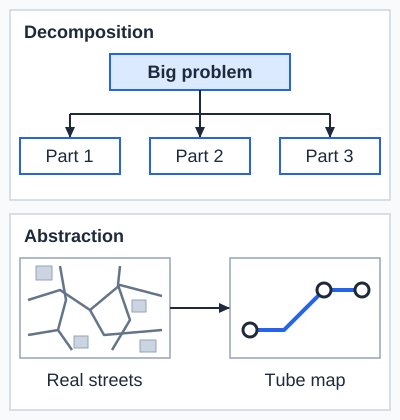
This figure shows two of the four skills: decomposition and abstraction. Pattern recognition and algorithmic thinking are in the table below. AQA, OCR and Edexcel all name decomposition and abstraction. OCR also names algorithmic thinking.
The Four Pillars
| Concept | Definition | Example |
|---|---|---|
| Decomposition | Breaking a problem into smaller, manageable parts | Building a game: graphics, sound, controls, scoring |
| Abstraction | Removing unnecessary details to focus on what's important | London Tube map ignores actual geography |
| Pattern Recognition | Identifying similarities or trends in problems | All login systems need username + password validation |
| Algorithmic Thinking | Developing step-by-step solutions | Recipe instructions for making a cake |
Deep Dive: Why Abstraction Matters
Abstraction is about creating models that simplify reality:
- Maps - Show roads, ignore trees and buildings
- Variables - "score" abstracts the actual memory location
- Functions - "print()" abstracts complex output operations
- Classes - "Car" abstracts engine, wheels, steering into one concept
Good abstraction hides complexity while keeping essential details. The Tube map is genius abstraction - you don't need geography to plan your journey!
Memory Trick
DAPA - the four pillars:
Decomposition (Divide)
Abstraction (Abbreviate)
Pattern recognition (Patterns)
Algorithmic thinking (Actions)
Exam Tips
- Define + Example: Always give an example when defining these terms
- Decomposition questions: Show how you'd break a problem into sub-problems
- Common mistake: Confusing abstraction (simplifying) with decomposition (breaking down)
Make this stick
Signing in gives access to all PrepWise features.