Test yourself on Cultural & Privacy Issues with exam style questions, marked instantly.
Flashcards that come back just before you would forget them.
A revision plan that remembers what you know and shows what to do next.
See which topics you have nailed and which need another look.
Quiz yourself on Cultural & Privacy IssuesGet your flashcardsBuild my revision planTrack my progressA Connected World
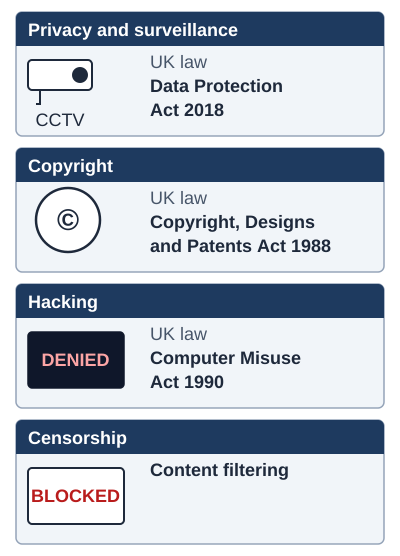
This figure shows privacy, copyright, hacking and censorship. The digital divide is not in the figure, so it is explained in the text below.
Key Cultural and Privacy Issues
1. Digital Footprint
The trail of data left by online activity that can affect your reputation and future opportunities.
- Active footprint: Data you deliberately share (posts, photos, comments)
- Passive footprint: Data collected without you knowing (browsing history, IP addresses, location)
- Employers and universities check social media profiles
- Difficult to remove once online - "the internet never forgets"
- Can affect job prospects, relationships, reputation
2. Social Media Impact
How technology changes communication and social interaction.
- Positive: Connects people globally, shares information quickly, builds communities
- Negative: Addiction, cyberbullying, mental health issues, FOMO (fear of missing out)
- Echo chambers - only seeing views that match your own
- Filter bubbles - algorithms show content based on past behavior
- Reduced face-to-face interaction and social skills
3. Misinformation and Fake News
False or misleading information spread online, often rapidly.
- Spreads faster than fact-checking can verify
- Affects elections, public health decisions, trust in institutions
- Deepfakes - AI-generated fake videos and images
- Bots and automated accounts amplify false information
- Difficult to distinguish from legitimate news
4. Internet Censorship
Governments controlling what content can be accessed online.
- Limits freedom of speech and access to information
- Some countries block social media, news sites, search engines
- Can prevent harmful content but also suppress dissent
- Creates inequality in information access globally
- VPNs used to bypass censorship
5. Globalisation
Technology connecting world economies and cultures.
- Positive: Access to global markets, cultural exchange, remote opportunities
- Negative: Cultural homogenisation, local business displacement, language dominance
- E-commerce enables worldwide trade
- Remote work creates global talent pool
- Digital platforms dominate local alternatives
6. Changing Workplace
Technology transforming how and where we work.
- Remote/hybrid working now commonplace
- Gig economy - flexible but insecure employment
- Automation changing required skills
- Work-life balance challenges with always-on culture
- Digital skills now essential for most jobs
7. Digital Divide
The gap between people who have good access to digital technology and the internet, and people who do not.
- Causes: the cost of devices and data, poor broadband in rural areas, and a lack of digital skills
- Older people and people on low incomes are often affected most
- Effects: less access to jobs, education, online services and information
- Ways to reduce it: free public Wi-Fi and computers in libraries, school loan schemes, digital skills training
Deep Dive: Understanding Your Digital Footprint
Passive Footprint: Data collected without you actively providing it
- Websites tracking your browsing behavior
- IP addresses logged by servers
- Location data from smartphones
- Cookies tracking sites you visit
- Search history and queries
Active Footprint: Data you deliberately share
- Social media posts, photos, and comments
- Online forms and account registrations
- Emails and instant messages
- Product reviews and ratings
- Blog posts and forum contributions
Why it matters: Once online, always online. Employers check social media. Universities check applicants. Think before you post - your digital footprint can follow you for life!
Deep Dive: Echo Chambers and Filter Bubbles
Echo Chamber: Online environment where you only encounter opinions matching your own, reinforcing existing beliefs.
- People follow others with similar views
- Dissenting opinions are unfollowed or blocked
- Creates polarization and reduces understanding
Filter Bubble: Algorithms show content based on your past behavior, limiting exposure to diverse viewpoints.
- News feeds personalized to your interests
- Search results tailored to your history
- Recommendations reinforce existing preferences
- May not see important opposing perspectives
Memory Trick: DMGCF
Remember digital cultural impacts with DMGCF:
- Digital footprint - your online trail
- Misinformation - fake news and false information
- Globalisation - connecting world economies and cultures
- Censorship - controlling online content
- Future of work - changing workplace and employment
Exam Tips - Cultural & Privacy Issues
Key points for exam success:
- Show awareness of multiple perspectives - discuss questions need balanced answers
- Know both active and passive digital footprints
- Use real examples - mention specific platforms or events if relevant
- Understand difference between echo chambers (people) and filter bubbles (algorithms)
Common exam mistakes to avoid:
- Only mentioning negative impacts - social media has both benefits and risks
- Confusing digital footprint (your trail) with privacy (control of data)
- Vague answers - "social media is bad" needs specific examples like addiction, cyberbullying
- Not explaining WHY digital footprint matters (employers check, affects reputation)
Make this stick
Signing in gives access to all PrepWise features.