Test yourself on Embedded Systems with exam style questions, marked instantly.
Flashcards that come back just before you would forget them.
A revision plan that remembers what you know and shows what to do next.
See which topics you have nailed and which need another look.
Quiz yourself on Embedded SystemsGet your flashcardsBuild my revision planTrack my progressThe Specialist vs. The Multi-Tasker
Deep Dive: Why Embedded Systems Are Everywhere
You probably interact with 50+ embedded systems every day without realizing it! Your phone has one (plus it's also a general-purpose computer), your car has dozens, your washing machine, microwave, TV remote, digital watch, smart thermostat, fitness tracker - all contain embedded systems.
Why are they so popular? Because they're cheaper, smaller, use less power, and more reliable than using a full computer for every task. Imagine if your microwave needed a full Windows PC inside it - it would cost £500, take 2 minutes to boot up, and need antivirus software!
Market size: There are about 2 billion general-purpose computers in the world (laptops, desktops, tablets), but over 100 billion embedded systems! They outnumber general-purpose computers 50 to 1.
What Is an Embedded System?
Definition:
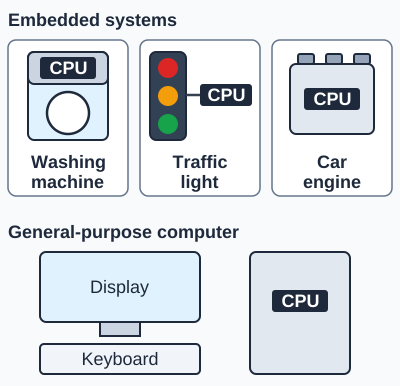
An embedded system is a computer system with a dedicated function within a larger mechanical or electrical system. It's built to do one specific job, not to be a general-purpose computer.
Key Characteristics:
- Dedicated function: Designed for ONE specific task (e.g., washing clothes, controlling traffic lights)
- Integrated: Built into the device it controls (you can't remove it and use it elsewhere)
- Limited user interface: Usually just a few buttons/LEDs, not a full keyboard and screen
- Real-time operation: Must respond instantly (e.g., car airbag system must react in milliseconds)
- Reliable and stable: Must work 24/7 without crashing or needing updates
Components of an Embedded System:
- Microcontroller/Microprocessor: A small, simple CPU designed for specific tasks
- Memory: Usually ROM (for the fixed program) and a small amount of RAM
- Input sensors: Temperature sensors, buttons, motion detectors, etc.
- Output actuators: Motors, LEDs, displays, heating elements, etc.
- Power supply: Often battery-powered or low-power
Embedded Systems vs. General-Purpose Computers
| Aspect | Embedded System | General-Purpose Computer |
|---|---|---|
| Purpose | One specific task only (dedicated) | Many different tasks (versatile) |
| Examples | Washing machine, microwave, car engine control, traffic lights, smart watch | Laptop, desktop PC, tablet, smartphone |
| Software | Fixed program (stored in ROM), rarely updated | Can install/remove programs, frequent updates |
| User Interface | Limited - few buttons, simple display or LEDs | Full - keyboard, mouse, touchscreen, large display |
| Power Consumption | Very low (often battery-powered for years) | High (needs constant charging/mains power) |
| Cost | Cheap (£5-£50 for microcontroller) | Expensive (£300-£2000+) |
| Size | Small (can fit on a fingernail) | Large (laptop/desktop size) |
| Response Time | Real-time (instant response required) | Can have delays (loading, processing) |
| Reliability | Must work 24/7 without failure | Can crash, restart, need maintenance |
| Upgradability | Cannot upgrade (fixed hardware/software) | Can upgrade RAM, storage, software |
Real-World Examples of Embedded Systems
Household Appliances:
- Washing Machine: Controls water temperature, spin speed, cycle timing
- Microwave: Controls heating time, power level, automatic defrost
- Smart Thermostat: Maintains room temperature, learns your schedule
- Digital Watch: Keeps time, counts steps, monitors heart rate
Transportation:
- Car Engine Management: Controls fuel injection, ignition timing, emissions
- ABS Brakes: Prevents wheel lock-up during emergency braking (must respond in milliseconds!)
- Airbag System: Detects collision and deploys airbag in 30 milliseconds
- Traffic Lights: Controls light sequences, responds to traffic sensors
Entertainment:
- TV Remote Control: Sends infrared signals when buttons pressed
- Games Console Controller: Reads button presses, joystick movements
- Digital Camera: Controls focus, exposure, image processing
Medical Devices:
- Pacemaker: Regulates heartbeat (must be 100% reliable!)
- Insulin Pump: Delivers precise doses of insulin
- MRI Scanner: Controls magnetic field, processes scan data
Advantages and Disadvantages
Advantages of Embedded Systems:
- Small size: Can fit into tiny spaces (e.g., inside a watch)
- Low cost: Much cheaper than a full computer
- Low power consumption: Battery can last months or years
- High reliability: Designed to work continuously without failure
- Real-time performance: Guaranteed instant response to inputs
- Optimized: Hardware and software designed for one specific task = maximum efficiency
Disadvantages of Embedded Systems:
- Not upgradeable: Can't add new features or change function
- Limited flexibility: Does one job only, can't be repurposed
- Difficult to update: Software fixes require hardware replacement or complex reprogramming
- Hard to troubleshoot: Limited interface makes diagnosing problems difficult
Exam Tips - Embedded Systems
Key points to always mention:
- "Dedicated function" is the most important phrase - embedded systems do ONE specific job
- Compare to general-purpose: Embedded = specific task, General = many tasks
- Use real examples: washing machine, microwave, car engine, traffic lights
Common exam questions:
- "What is an embedded system?" → Computer with dedicated function built into a larger device
- "Give an example" → Washing machine, car engine control, microwave (with explanation)
- "Advantage over general-purpose?" → Smaller, cheaper, lower power, more reliable
- "Disadvantage?" → Cannot be upgraded or repurposed for different tasks
Common mistakes:
- Saying a smartphone is an embedded system - it's NOT (it's general-purpose!)
- Forgetting to explain WHY it's embedded (the "dedicated function" part)
- Not giving specific examples from everyday life
Make this stick
Signing in gives access to all PrepWise features.