Test yourself on Environmental Issues with exam style questions, marked instantly.
Flashcards that come back just before you would forget them.
A revision plan that remembers what you know and shows what to do next.
See which topics you have nailed and which need another look.
Quiz yourself on Environmental IssuesGet your flashcardsBuild my revision planTrack my progressThe Hidden Cost of Tech
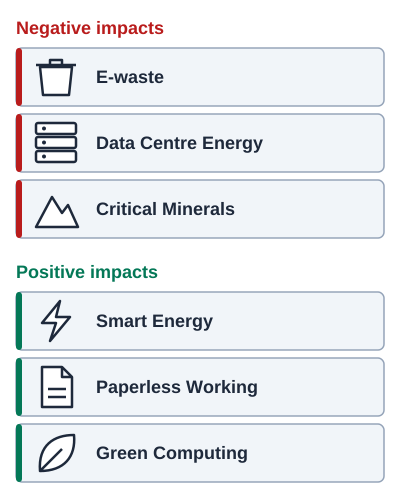
Environmental Impacts of Technology
1. Energy Consumption
Problem: Data centres and devices use massive amounts of electricity, contributing to carbon emissions.
- Data centres use a small but growing share of the world's electricity (estimates are about 1 to 3 percent)
- Servers in data centres run 24 hours a day, 7 days a week (24/7), so they use power and cooling all the time
- Streaming video and cloud services require constant power
- Cryptocurrency mining uses enormous energy
- Always-on devices consume standby power
Solutions:
- Use renewable energy (solar, wind) to power data centres
- More efficient hardware and cooling systems
- Enable sleep modes and power-saving settings
- Optimize software to reduce processing needs
2. E-waste (Electronic Waste)
Problem: Discarded electronics contain toxic materials and valuable resources that are wasted.
- More than 50 million tonnes of e-waste are generated every year
- Toxic waste: contains lead, mercury and cadmium that leak into soil and water
- Only about 1 in 5 (about 20 percent) of e-waste is properly recycled
- Short product lifecycles encourage frequent replacement
Solutions:
- Recycling programs to recover valuable materials
- Extend device lifespans through repair and upgrades
- Design products for easier disassembly and recycling
- Right to repair legislation
3. Manufacturing Impact
Problem: Mining critical minerals and factory production cause environmental damage.
- Mining destroys habitats and pollutes water sources
- Factory emissions contribute to air pollution
- Transportation of components adds to carbon footprint
- Conflict minerals from war zones
Solutions:
- Ethical sourcing of materials
- Use recyclable and sustainable materials
- Local manufacturing to reduce transport
- Circular economy models (reuse, refurbish, recycle)
4. Carbon Footprint
Problem: CO2 emissions from power generation and production contribute to climate change.
- Digital technology (devices, networks and data centres together) is estimated to produce a few percent of global greenhouse gas emissions
- Making a smartphone produces tens of kilograms of CO2
- Digital activities seem "clean" but require physical infrastructure
- Growth of tech sector increases overall emissions
Solutions:
- Carbon offsetting programs
- Renewable energy for data centres
- Efficient algorithms and compression
- Use efficient software and store less data
Deep Dive: Positive Environmental Impacts
While technology has negative environmental impacts, it also enables solutions:
- Remote working - Reduces commuting, fewer cars on roads, less office energy use
- Digital documents - Reduces paper usage, saving trees and reducing deforestation
- Smart systems - Optimize heating, lighting, and transport for efficiency
- Green computing: Designing and using computers to use less energy and make less waste, for example low-power hardware, sleep modes and recycling
- Video conferencing - Reduces business travel and aviation emissions
- Environmental monitoring - Satellites and sensors track climate change and pollution
- Electric vehicles - Enabled by battery and software technology
- Smart grids - Balance energy supply and demand, integrate renewables
- Precision agriculture - Drones and sensors reduce water and pesticide use
Why this matters: Technology has both positive and negative environmental impacts. The key is to maximize benefits while minimizing harm through sustainable design, renewable energy, recycling, and responsible consumption.
Memory Trick: MECE
Remember the negative environmental impacts with MECE:
- Manufacturing - mining, pollution, factory emissions
- E-waste - toxic landfills, wasted resources
- Carbon footprint - CO2 emissions from production and use
- Energy consumption - data centres, devices, infrastructure
Exam Tips - Environmental Issues
Key points for exam success:
- Balance your answer - mention BOTH negative AND positive impacts
- Be specific - "data centres use lots of energy" is better than "computers are bad"
- If asked for solutions, suggest realistic ones (recycling, renewable energy, efficiency)
- Use concrete examples - "more than 50 million tonnes of e-waste every year"
Common exam mistakes to avoid:
- Being one-sided - always show awareness of both sides
- Vague answers - "technology is bad for environment" needs specific examples
- Forgetting positive impacts - remote working, digital documents, smart systems
- Not linking e-waste to specific toxic materials (lead, mercury, cadmium)
Make this stick
Signing in gives access to all PrepWise features.