Test yourself on Legal Issues in Computing with exam style questions, marked instantly.
Flashcards that come back just before you would forget them.
A revision plan that remembers what you know and shows what to do next.
See which topics you have nailed and which need another look.
Quiz yourself on Legal Issues in ComputingGet your flashcardsBuild my revision planTrack my progressThe Rules of the Digital World
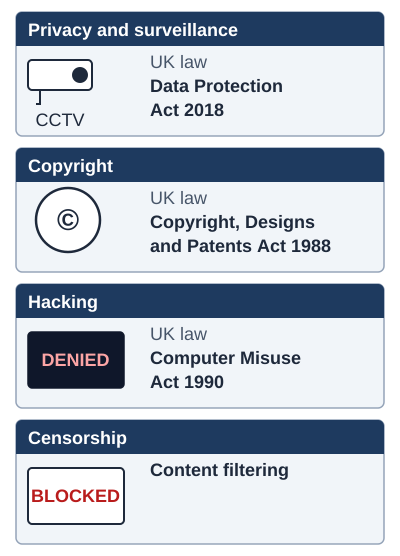
Exam boards: the Computer Misuse Act 1990 is named by OCR. The Data Protection Act is named by OCR and Edexcel. The Copyright, Designs and Patents Act 1988 is named by OCR. Edexcel names copyright, patents, trademarks and licencing without the Act. AQA names neither. Censorship is not a law in this figure; it is an ethical issue.
Key UK Legislation
1. Data Protection Act 2018 (inc. UK GDPR)
Purpose: Protects personal data and gives individuals control over their information.
- Data must be collected fairly and lawfully
- Data must be kept secure from unauthorized access
- Data must not be kept longer than necessary
- Data must be accurate and up to date
- Data must be used only for specified purposes
- Individuals can ask for their data to be deleted (the right to erasure) in many cases
2. Computer Misuse Act 1990
Purpose: Prevents computer crimes and unauthorized access to systems.
- Section 1: Unauthorised access to computer material (hacking) - up to 2 years prison
- Section 2: Unauthorised access with intent to commit further offences - up to 5 years
- Section 3: Unauthorised modification of computer material (viruses, deleting data) - up to 10 years (the highest maximum of these four sections)
- Section 3A: Making, supplying, or obtaining tools for computer misuse - up to 2 years
3. Copyright, Designs and Patents Act 1988
Purpose: Protects intellectual property and creative works.
- Illegal to copy software without a license
- Illegal to download music, films, books without permission
- Illegal to copy images and text from websites without permission
- Copying or selling pirated software can be a criminal offence
- Protects creators' rights to profit from their work
4. Software licences (OCR names open source and proprietary; Edexcel names licencing)
Purpose: A licence says how a user is allowed to use a piece of software.
- Open source: the code can be viewed, changed and shared
- Proprietary: licensed for use only; copying it is illegal
Deep Dive: Computer Misuse Act Offences
Section 1: Basic Hacking
Accessing a computer without permission, even if you don't do any damage. Like breaking into someone's house just to look around.
- Penalty: Up to 2 years in prison
- Example: Guessing someone's password and reading their emails
Section 2: Hacking to Commit Further Crimes
Accessing a computer with the intention of committing another crime, like stealing money or blackmail.
- Penalty: Up to 5 years in prison
- Example: Hacking a bank account to steal money
Section 3: Unauthorized Modification
Changing, deleting, or damaging data without permission. The most serious of these four offences.
- Penalty: Up to 10 years in prison (this section only)
- Example: Creating viruses, deleting company files, DDoS attacks
Section 3A: Making Tools for Hacking
Creating, distributing, or possessing tools designed for hacking.
- Penalty: Up to 2 years in prison
- Example: Selling password cracking software
Deep Dive: Data Protection Principles (UK GDPR)
The main data protection principles say personal data must be:
- Processed lawfully, fairly, transparently - Tell people what you're collecting and why
- Collected for specific purposes - You can't collect it for one reason and use it for another
- Adequate, relevant, limited - Only collect what you actually need
- Accurate - Keep data up to date and correct errors
- Kept no longer than necessary - Delete data when you don't need it anymore
- Processed securely - Protect it from unauthorized access, loss, or damage
Individual Rights:
- Right to access their data (see what you hold)
- Right to have data corrected if inaccurate
- Right to ask for data to be deleted in many cases (the right to erasure)
- Right to data portability (move data to another service)
Memory Trick: CCC-F
Older notes call this trick CCC-F. The version to learn is CCD: Computer Misuse, Copyright, Data Protection. Three laws to know:
- Computer Misuse Act (OCR names it) - hacking and unauthorised access
- Copyright, Designs and Patents Act (OCR names it) - copying creative works
- Data Protection Act - collecting and using personal data
Exam Tips - Legal Issues
Key points to remember:
- Know what each act covers - Data Protection (personal data), Computer Misuse (hacking), Copyright (creative works)
- For scenario questions, identify which law applies to the situation
- Common mistake: Confusing Data Protection (personal data like names, addresses) with Copyright (creative works like music, software)
- Computer Misuse Act has 4 sections - know what each covers (the maximum penalties are extra detail, not in the specification)
Common exam mistakes to avoid:
- Saying "Data Protection Act protects software" - that's Copyright!
- Forgetting that unauthorized access is illegal EVEN if no damage is done
- Not mentioning that individuals have rights under GDPR (access, correction, deletion)
- Vague answers - be specific about which section or principle applies
Make this stick
Signing in gives access to all PrepWise features.