AQA GCSE Computer Science Paper 2Computing concepts: every question, answered
AQA GCSE Computer Science (8525) was first examined in June 2022. We analysed every Paper 2 sitting we could obtain the real question paper and mark scheme for: June 2022 and June 2023 (the June 2024 and June 2025 papers exist but are not yet public on AQA's own filestore, which keeps live series behind a login wall for roughly two years after the exam). Paper 2 covers everything Paper 1 does not: data representation (binary, hexadecimal, images and sound), computer systems, networks, cyber security, databases and SQL, and the ethical and legal impacts of computing. Almost none of it involves writing code. Below is what each recurring question type has asked across the two sittings we have, with a complete worked answer written to the mark scheme for each one, every paragraph explained.
Questions © AQA, quoted for analysis. Diagrams, images and data tables described or recreated in our own words, not reproduced verbatim. Mark scheme content translated into plain English, not copied. PrepWise is independent and not endorsed by AQA.
The paper is a template
Same 12 question types, every sitting“Both sittings we have full papers for open with quick number-base conversions worth 1 to 2 marks each, and both include a separate bits-to-larger-unit conversion later in the paper.”
Every sitting we have full papers for tests at least one binary-to-denary or denary-to-binary conversion, one conversion involving hexadecimal, and one conversion between bits and a larger storage unit, always without a calculator.
1×asked“Convert the binary number 11010100 into decimal.”
“Convert the binary number 11010100 into decimal.”
What it’s really asking
Add up the place values of every column that holds a 1.
The full worked answer — June 2022
Reading 11010100 against the place values 128, 64, 32, 16, 8, 4, 2, 1, the 1s sit in the 128, 64, 16 and 4 columns. Adding these gives 128 + 64 + 16 + 4 = 212.
Could you have written this? Every fact in this answer is drilled in our quizzes — the writing is the easy part once the evidence is automatic.
Practise conversion questionsWhat the mark scheme rewarded
- The single correct answer, 212
- The 8 place values of a byte, left to right, are 128, 64, 32, 16, 8, 4, 2 and 1
Traps examiners saw
- Misreading the bit pattern from right to left instead of left to right, which reverses which columns hold a 1
Full-mark self-check 0 of 1
1×asked“Convert the binary number 10111001 into hexadecimal. You should show your working.”
“Convert the binary number 10111001 into hexadecimal. You should show your working.”
What it’s really asking
Split the byte into its two 4-bit halves and convert each half to a single hex digit.
The full worked answer — June 2022
Splitting 10111001 into two nibbles gives 1011 and 1001. 1011 is 11 in decimal, which is B in hexadecimal, and 1001 is 9 in decimal, which stays as 9. The answer is B9.
Could you have written this? Every fact in this answer is drilled in our quizzes — the writing is the easy part once the evidence is automatic.
Practise conversion questionsWhat the mark scheme rewarded
- B for the left nibble and 9 for the right nibble, each worth a separate mark
- A single hex digit always represents exactly 4 bits, so an 8-bit byte becomes exactly 2 hex digits
Traps examiners saw
- Converting the whole byte to decimal first (185) and then trying to convert 185 to hex directly, which is slower and easier to make an arithmetic slip on than converting nibble by nibble
Full-mark self-check 0 of 2
1×asked“State the largest decimal number that can be represented using 6 bits.”
“State the largest decimal number that can be represented using 6 bits.”
What it’s really asking
Recall that n bits can represent 2 to the power n different values, from 0 up to 2 to the power n minus 1.
The full worked answer — June 2022
The largest value 6 bits can hold is when every bit is 1, which is 2 to the power 6 minus 1. 2 to the power 6 is 64, so the answer is 63.
Could you have written this? Every fact in this answer is drilled in our quizzes — the writing is the easy part once the evidence is automatic.
Practise conversion questionsWhat the mark scheme rewarded
- 63, or the equivalent expression 2 to the power 6 minus 1
- 6 bits give 2 to the power 6, which is 64, distinct values, counting from 0
Traps examiners saw
- Answering 64 instead of 63, forgetting that the range starts at 0, not 1
Full-mark self-check 0 of 1
1×asked“Convert the decimal number 171 into binary.”
“Convert the decimal number 171 into binary.”
What it’s really asking
Break 171 down into a sum of place values that are all powers of 2.
The full worked answer — June 2023
171 breaks down as 128 + 32 + 8 + 2 + 1. Setting a 1 in the 128, 32, 8, 2 and 1 columns and a 0 everywhere else gives 10101011.
Could you have written this? Every fact in this answer is drilled in our quizzes — the writing is the easy part once the evidence is automatic.
Practise conversion questionsWhat the mark scheme rewarded
- The single correct answer, 10101011
- Every denary number can be written as a unique sum of powers of 2, which is exactly what a binary bit pattern represents
Traps examiners saw
- Missing leading zeros, though the real mark scheme ignores this specific slip
Full-mark self-check 0 of 1
1×asked“Convert the hexadecimal number 2D into binary. You should show your working.”
“Convert the hexadecimal number 2D into binary. You should show your working.”
What it’s really asking
Convert each hex digit to its own 4-bit nibble and combine them.
The full worked answer — June 2023
2 in hexadecimal is 0010 in binary. D in hexadecimal is 13 in decimal, which is 1101 in binary. Combining the two nibbles gives 00101101.
Could you have written this? Every fact in this answer is drilled in our quizzes — the writing is the easy part once the evidence is automatic.
Practise conversion questionsWhat the mark scheme rewarded
- 0010 for the digit 2, and 1101 for the digit D, either of which earns a working mark, combined into 00101101 for both marks
- The hex digits A to F stand for the decimal values 10 to 15
Traps examiners saw
- Converting D to 13 in decimal but forgetting to then convert 13 into its 4-bit binary form
Full-mark self-check 0 of 1
1×asked“How many bits are there in two kilobytes? Show your working.”
“How many bits are there in two kilobytes? Show your working.”
What it’s really asking
Convert kilobytes to bytes, then bytes to bits, in two clear steps.
The full worked answer — June 2022
2 kilobytes is 2 times 1000 bytes, which is 2000 bytes. Each byte is 8 bits, so 2000 times 8 gives 16 000 bits.
Could you have written this? Every fact in this answer is drilled in our quizzes — the writing is the easy part once the evidence is automatic.
Practise conversion questionsWhat the mark scheme rewarded
- 16 000, with a working mark available for multiplying by 1000 or by 8 even if the final total is wrong
- This mark scheme uses 1000 as the multiplier between a kilobyte and a byte, not 1024, and explicitly rejects 1024 as a working step
Traps examiners saw
- Using 1024 instead of 1000, which the real mark scheme specifically does not credit as a working step this year
Full-mark self-check 0 of 1
1×asked“Convert 16 000 000 bits to megabytes (MB). You should show your working.”
“Convert 16 000 000 bits to megabytes (MB). You should show your working.”
What it’s really asking
Convert bits to bytes, then bytes to megabytes, in two clear steps.
The full worked answer — June 2023
16 000 000 bits divided by 8 gives 2 000 000 bytes. Dividing 2 000 000 bytes by 1 000 000 gives 2 megabytes.
Could you have written this? Every fact in this answer is drilled in our quizzes — the writing is the easy part once the evidence is automatic.
Practise conversion questionsWhat the mark scheme rewarded
- 2, with a working mark available for dividing by 8 or by 1 000 000 even if the final total is wrong
- This mark scheme divides by 1 000 000 to go straight from bytes to megabytes, the same 1000-based convention used throughout this paper
Traps examiners saw
- Dividing by 1024 or 1 048 576 instead of 1 000 000, which does not match this mark scheme's convention
Full-mark self-check 0 of 1
The method for every Q01.1-Q01.3, Q10 (Jun22) / Q02.1-Q02.2, Q04 (Jun23) — same every sittingMark bands, steps, timing
What this question type rewards
The topic changes by sitting — the mark scheme never does. Learn this once, then open your question above for that sitting’s sources and a full worked answer.
- Showing your working, since the 2-mark versions award a working mark even when the final answer is wrong
- Knowing the powers of 2 (1, 2, 4, 8, 16, 32, 64, 128) and the hex digits (0 to 9, then A to F for 10 to 15) without a calculator
- Converting storage units in the correct order: bits to bytes by dividing by 8, then bytes to kilobytes or megabytes using the multiplier the question implies
The steps
- For binary to denary, add up the place values (128, 64, 32, 16, 8, 4, 2, 1) wherever there is a 1
- For denary to binary, subtract the largest place value that fits, repeating until you reach 0
- For hexadecimal, split the byte into two 4-bit nibbles and convert each nibble separately
- For storage units, convert one step at a time (bits to bytes, then bytes to the final unit), writing down each intermediate value
- Double-check your answer has the right number of digits for the space given (usually 8 bits for a byte)
Which of the following correctly describes the hexadecimal number system?
Number-base and storage-unit conversions open every sitting we have, worth 1 to 2 marks each. Practise converting without a calculator until the powers of 2 and hex digits are automatic.
Practise conversion questions“Both sittings we have full papers for include a binary addition worth 2 marks and at least one binary shift question worth 1 mark.”
This appears in every sitting we have full papers for. June 2022 asks about shifts three separate times; June 2023 asks once, but always tests the same underlying idea, that a left shift multiplies and a right shift divides by a power of 2.
2×asked“Add together the following three binary numbers and give your answer in binary.”
“Add together the following three binary numbers and give your answer in binary.”
What it’s really asking
Add three binary numbers column by column, carrying correctly, the same way you would add three decimal numbers.
What the sources actually showed — June 2022
00110110, 10010010 and 00100001, stacked for column addition.
The full worked answer — June 2022
Adding 00110110, 10010010 and 00100001 column by column and carrying where needed gives 11101001. Splitting this into nibbles, 1110 and 1001, is a useful way to check the answer against the mark scheme's own layout.
Could you have written this? Every fact in this answer is drilled in our quizzes — the writing is the easy part once the evidence is automatic.
Practise binary arithmetic questionsWhat the sources actually showed — June 2023
01011000, 00011001 and 01001011, stacked for column addition.
The full worked answer — June 2023
Adding 01011000, 00011001 and 01001011 column by column and carrying where needed gives 10111100.
Could you have written this? Every fact in this answer is drilled in our quizzes — the writing is the easy part once the evidence is automatic.
Practise binary arithmetic questionsWhat the mark scheme rewarded
- The fully correct 8-bit binary total, with a working mark available for the correct answer split across two nibbles even if not joined together
- Binary addition carries a 1 into the next column whenever a column sums to 2 or 3, exactly as decimal addition carries at 10
Traps examiners saw
- Forgetting to carry a 1 forward when three numbers being added in the same column produce a carry, which is easy to lose track of with three numbers instead of two
Full-mark self-check 0 of 2
1×asked“Apply a binary shift three places to the right on the bit pattern 10101000. Give the result using 8 bits.”
“Apply a binary shift three places to the right on the bit pattern 10101000. Give the result using 8 bits.”
What it’s really asking
Move every bit three places to the right, filling the three new leftmost places with 0 and dropping the three rightmost bits that fall off the end.
The full worked answer — June 2022
Shifting 10101000 three places to the right drops the rightmost three bits (000) and fills the left with three new 0s, giving 00010101.
Could you have written this? Every fact in this answer is drilled in our quizzes — the writing is the easy part once the evidence is automatic.
Practise binary arithmetic questionsWhat the mark scheme rewarded
- The single correct 8-bit result, 00010101
- A right shift always fills the vacated leftmost positions with 0, since this is an unsigned binary shift, not a signed one
Traps examiners saw
- Shifting the wrong number of places, or filling the vacated positions on the wrong side of the pattern
Full-mark self-check 0 of 1
1×asked“State the arithmetic effect of applying a left binary shift of four to a binary number.”
“State the arithmetic effect of applying a left binary shift of four to a binary number.”
What it’s really asking
Recall that a left shift of n places always multiplies the number by 2 to the power n.
The full worked answer — June 2022
A left shift of 4 multiplies the number by 2 to the power 4, which is 16.
Could you have written this? Every fact in this answer is drilled in our quizzes — the writing is the easy part once the evidence is automatic.
Practise binary arithmetic questionsWhat the mark scheme rewarded
- Multiplied by 16, or the equivalent expression 2 to the power 4
- Each single left shift doubles the number, so 4 shifts in a row means doubling 4 times, which is multiplying by 16
Traps examiners saw
- Confusing left shift with right shift and stating a division instead of a multiplication
Full-mark self-check 0 of 2
1×asked“State the arithmetic effect of applying a left binary shift of three followed by a right binary shift of five to a binary number.”
“State the arithmetic effect of applying a left binary shift of three followed by a right binary shift of five to a binary number.”
What it’s really asking
Work out the net power of 2 once a multiplying shift and a dividing shift are both applied in sequence.
The full worked answer — June 2022
A left shift of 3 multiplies by 8, and a right shift of 5 divides by 32. Applying both in sequence is the same as dividing by 32 over 8, which simplifies to dividing by 4.
Could you have written this? Every fact in this answer is drilled in our quizzes — the writing is the easy part once the evidence is automatic.
Practise binary arithmetic questionsWhat the mark scheme rewarded
- Divide by 4, or an equivalent correct description such as multiply by 8 then divide by 32
- Two shifts in sequence combine by subtracting their powers of 2: a left shift of 3 (2 to the power 3) followed by a right shift of 5 (2 to the power 5) leaves a net right shift of 2 (2 to the power 2, dividing by 4)
Traps examiners saw
- Adding the two shift amounts (3 plus 5 equals 8) instead of finding the net direction and size correctly
Full-mark self-check 0 of 1
1×asked“Describe the binary shift that would be used to divide a binary number by four.”
“Describe the binary shift that would be used to divide a binary number by four.”
What it’s really asking
Work backwards from the target division (by 4) to the shift direction and size that achieves it.
The full worked answer — June 2023
Dividing by 4 is the same as dividing by 2 to the power 2, so the number needs to be shifted two places to the right.
Could you have written this? Every fact in this answer is drilled in our quizzes — the writing is the easy part once the evidence is automatic.
Practise binary arithmetic questionsWhat the mark scheme rewarded
- Shift two places to the right
- A right shift of n places always divides by 2 to the power n, so dividing by 4 needs n equal to 2
Traps examiners saw
- Answering with a left shift, which multiplies rather than divides
Full-mark self-check 0 of 1
The method for every Q02.1-Q02.4 (Jun22) / Q03, Q05 (Jun23) — same every sittingMark bands, steps, timing
What this question type rewards
The topic changes by sitting — the mark scheme never does. Learn this once, then open your question above for that sitting’s sources and a full worked answer.
- Adding binary numbers column by column from the right, carrying exactly as you would in decimal addition
- Remembering that a left shift of n places multiplies by 2 to the power n, and a right shift of n places divides by 2 to the power n
- Combining two shifts by adding or subtracting their powers of 2 rather than trying to work out the combined bit pattern directly
The steps
- For addition, work from the rightmost column, carrying a 1 into the next column whenever three 1s are added together
- For a shift, work out whether it is a left shift (multiply) or a right shift (divide)
- Work out the power of 2 the shift represents (a shift of n places is always 2 to the power n)
- For a combined shift, work out the net power of 2 by subtracting the right shift amount from the left shift amount
In binary addition, what is the result of 1 + 1?
Binary addition and shifts come up in every sitting we have, worth 1 to 2 marks each. Practise recognising a shift's power of 2 without drawing out the full bit pattern.
Practise binary arithmetic questions“Both sittings we have full papers for test the XOR truth table with the identical stem, and both ask you to write a Boolean expression for a logic circuit.”
The XOR truth table question is asked with word-for-word identical wording in both sittings we have full papers for. Writing a Boolean expression for a circuit appears in both sittings too, though the specific circuit is different each time.
2×asked“Complete the truth table for the XOR logic gate.”
“Complete the truth table for the XOR logic gate.”
What it’s really asking
Fill in the output column for all 4 input combinations of a 2-input XOR gate.
The full worked answer — June 2022
XOR outputs 1 only when its two inputs are different. For A and B of 0,0 the output is 0; for 0,1 it is 1; for 1,0 it is 1; for 1,1 it is 0.
Could you have written this? Every fact in this answer is drilled in our quizzes — the writing is the easy part once the evidence is automatic.
Practise logic gate questionsThe full worked answer — June 2023
The same XOR rule applies: 0,0 gives 0; 0,1 gives 1; 1,0 gives 1; 1,1 gives 0, since XOR only outputs 1 when A and B are different values.
Could you have written this? Every fact in this answer is drilled in our quizzes — the writing is the easy part once the evidence is automatic.
Practise logic gate questionsWhat the mark scheme rewarded
- A fully correct column of 0, 1, 1, 0 for the four rows in order
- XOR (exclusive OR) is the one basic gate whose output is 1 only when its inputs differ, unlike ordinary OR, which also outputs 1 when both inputs are 1
Traps examiners saw
- Confusing XOR with ordinary OR and giving a 1 for the 1,1 row, which is correct for OR but wrong for XOR
Full-mark self-check 0 of 1
1×asked“A green light (G) in the game switches on if all of the following conditions are true: sensor D is off, sensor L is off, sensor W is on. Write a Boolean expression for this logic circuit. You must use Boolean expression operators in your answer.”
“A green light (G) in the game switches on if all of the following conditions are true: sensor D is off, sensor L is off, sensor W is on. Write a Boolean expression for this logic circuit. You must use Boolean expression operators in your answer.”
What it’s really asking
Translate three plain-English conditions, two of them negated, into a single Boolean expression using NOT and AND.
The full worked answer — June 2022
D must be off, so the expression needs NOT D. L must be off, so it needs NOT L. W must be on, so it needs W as it stands. All three conditions must be true together, so they are joined with AND: NOT D AND NOT L AND W.
Could you have written this? Every fact in this answer is drilled in our quizzes — the writing is the easy part once the evidence is automatic.
Practise logic gate questionsWhat the mark scheme rewarded
- 2 marks for a logically correct expression using words instead of symbols, such as NOT D AND NOT L AND W, and a third mark reserved specifically for June 2022 for using Boolean operator symbols (a bar over a negated letter, a dot for AND) throughout instead of the English words
- A condition stated as 'is off' or 'is false' always becomes a NOT in the expression; a condition stated as 'is on' or 'is true' is used as it stands
Traps examiners saw
- Forgetting to negate one of the two conditions that must be off, or joining the terms with OR instead of AND when the question says all conditions must be true together
- Writing NOT and AND as English words rather than the correct symbols, which is logically correct but caps this specific June 2022 question at 2 of its 3 marks
Full-mark self-check 0 of 3
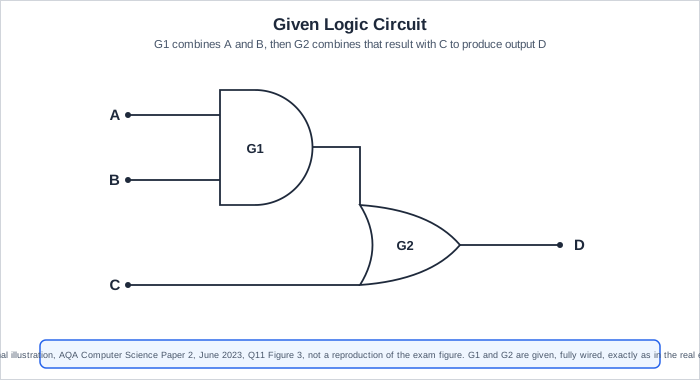
1×asked“Write a Boolean expression to show how the output D is calculated from the inputs A, B and C in Figure 3.”
“Write a Boolean expression to show how the output D is calculated from the inputs A, B and C in Figure 3.”
What it’s really asking
Trace the given circuit's gates in order from the inputs A, B and C through to the labelled output D.
What the sources actually showed — June 2023
A logic circuit diagram with three inputs, A, B and C. An AND gate labelled G1 combines A and B, and the output of G1 is combined with C using an OR gate to produce the final output D.
The full worked answer — June 2023
A and B feed into the first gate, G1, which is an AND gate, giving A.B. The output of G1 is then combined with C using an OR gate, giving the final expression D = A.B + C.
Could you have written this? Every fact in this answer is drilled in our quizzes — the writing is the easy part once the evidence is automatic.
Practise logic gate questionsWhat the mark scheme rewarded
- 1 mark for A.B, and 1 mark for combining it with C using OR
- A dot symbol between two letters means AND, and a plus symbol means OR, when writing a Boolean expression using symbols rather than words
Traps examiners saw
- Writing the terms in the wrong order, or using the word AND or OR instead of the correct symbol, which the mark scheme specifically rejects for this year
Full-mark self-check 0 of 2
The method for every Q03.1, Q03.4 (Jun22) / Q11.1, Q11.3 (Jun23) — same every sittingMark bands, steps, timing
What this question type rewards
The topic changes by sitting — the mark scheme never does. Learn this once, then open your question above for that sitting’s sources and a full worked answer.
- Knowing that XOR outputs 1 only when its two inputs are different from each other, never when they are the same
- Reading a logic circuit's gates in the correct order, tracing signals from the inputs through to the final output
- Using the correct Boolean operator symbols throughout (a dot for AND, a plus for OR, a bar over a letter for NOT), not the English words
The steps
- For a truth table, work through all 4 input combinations for a 2-input gate, or 8 for a 3-input gate
- For XOR specifically, the output is 1 whenever the two inputs are different, and 0 whenever they are the same
- For a circuit, identify each gate in order from the inputs to the final output
- Write the expression for each gate as you go, then combine them into one final expression using the correct symbols
- Double-check brackets are used correctly, since AND is normally evaluated before OR unless brackets say otherwise
An AND gate has inputs A=1 and B=0. What is the output?
The XOR truth table and writing a Boolean expression from a circuit both come up in every sitting we have. Practise using the correct symbols, not the English words AND, OR and NOT.
Practise logic gate questions“Both sittings we have full papers for close the paper's middle section with a big discussion question: 6 marks about autonomous vehicles in June 2022, and 9 marks about wearable devices in June 2023.”
This appears once in both sittings we have full papers for, always the biggest discussion question outside the databases section, and always structured as a genuine 3-band level of response.
1×asked“An autonomous vehicle is controlled by a computer system, senses its environment and requires no input from a human driver. Discuss the legal and ethical impacts that need to be considered when replacing manual, human-driven vehicles with autonomous vehicles.”
“An autonomous vehicle is controlled by a computer system, senses its environment and requires no input from a human driver. Discuss the legal and ethical impacts that need to be considered when replacing manual, human-driven vehicles with autonomous vehicles.”
What it’s really asking
Cover both an ethical strand (trust, decision-making, data collection) and a legal strand (liability, insurance, data protection) with genuine explanation, not just a list of words.
The full worked answer — June 2022
One ethical issue is trust: a passenger has to trust the vehicle's algorithms to make correct, human-like decisions in unusual situations, such as choosing how to react safely if a pedestrian steps into the road unexpectedly. This is a genuine shift from a human driver's own instinctive judgement to a decision made entirely by code written in advance.
A second ethical issue is data collection: autonomous vehicles constantly sense their environment and are likely to record data about where a passenger has travelled, which passengers may reasonably want kept private, even though the manufacturer has a legitimate use for that data in improving the vehicle's decision-making.
One legal issue is liability: if an autonomous vehicle is involved in a collision, it is currently unclear whether the manufacturer, who wrote the decision-making software, or the person sitting in the vehicle, who was not actually driving, should be held legally responsible.
A second legal issue is data protection: because autonomous vehicles collect and store location and journey data, manufacturers must keep this data secure in line with data protection law, and a breach could expose passengers' movements to people who have no right to see them.
Could you have written this? Every fact in this answer is drilled in our quizzes — the writing is the easy part once the evidence is automatic.
Practise ethical and legal discussion questionsWhat the mark scheme rewarded
- A structured discussion that genuinely covers both the ethical and legal strands with explained, specific points, drawn from named ideas such as trust, decision making, data collection, liability, insurance, data protection and security
- Ethical points centre on trust in the vehicle's own decision-making and the privacy of data it collects; legal points centre on who is liable and how that data must be protected
Traps examiners saw
- Writing only about one strand (all ethical, or all legal) when the question explicitly asks for both, which caps the answer below the top band regardless of how well-developed that one strand is
- Repeating the same underlying idea twice in different words rather than raising two genuinely distinct points per strand
Full-mark self-check 0 of 3
1×asked“Wearable devices, such as smartwatches and fitness trackers, have become more popular in recent years. This has led to an increase in the amount of personal, health-related data being collected by technology companies. Discuss the benefits of collecting personal, health-related data using wearable devices, the data privacy issues related to the collection of personal, health-related data, and the legal issues related to the collection of personal, health-related data.”
“Wearable devices, such as smartwatches and fitness trackers, have become more popular in recent years. This has led to an increase in the amount of personal, health-related data being collected by technology companies. Discuss the benefits of collecting personal, health-related data using wearable devices, the data privacy issues related to the collection of personal, health-related data, and the legal issues related to the collection of personal, health-related data.”
What it’s really asking
Cover three named strands (benefits, data privacy, legal issues) with genuine explanation, all specifically about wearable devices rather than data collection in general.
The full worked answer — June 2023
One benefit is early identification of health issues: sharing health data collected by a wearable device, such as an irregular heart rate, could allow a problem to be identified and treated before it becomes serious, which would not be caught without continuous tracking.
A second benefit is motivation for maintaining fitness: seeing personal progress data over time, such as daily step counts or workout history, can motivate a user to keep up healthy habits, and sharing this data with friends can increase social engagement around fitness.
One data privacy issue is that users are often unaware of exactly how much data is collected about them or what it is used for, and this health data could be sold to other companies, such as insurance firms, who might use it to affect the cost of a user's life insurance without the user's clear knowledge.
A second privacy issue is security risk: because health data is valuable, companies that collect it are attractive targets for criminals, and if a company holding this data is hacked, very personal information could be exposed, which could be embarrassing or, for some vulnerable users, could increase the risk of being targeted for crimes such as burglary when their location patterns are exposed.
One legal issue is unclear consent: users may not fully understand what they are agreeing to when they accept a wearable device's terms and conditions, and it is often unclear how long a company can keep using that consent to justify future, different uses of the data.
A second legal issue is responsibility for a data breach: if a wearable device or its app is insecure and a user's data is stolen, it may be unclear whether the device manufacturer or the app developer is legally responsible for the resulting harm, such as identity theft.
Could you have written this? Every fact in this answer is drilled in our quizzes — the writing is the easy part once the evidence is automatic.
Practise ethical and legal discussion questionsWhat the mark scheme rewarded
- A well-developed, logically structured discussion genuinely covering all three named strands (benefits, data privacy, legal issues) with a range of relevant, explained points
- Benefits centre on early detection and motivation; privacy issues centre on unawareness of data use and breach risk; legal issues centre on unclear consent and unclear liability for a breach
Traps examiners saw
- Only covering two of the three named strands, which caps the mark below the top band even if those two strands are excellent
- Writing generically about 'data collection' rather than keeping every point specifically about wearable devices, which the mark scheme's own note says is required for credit
Full-mark self-check 0 of 3
The method for every Q05 (Jun22) / Q15 (Jun23) — same every sittingMark bands, steps, timing
What this question type rewards
The topic changes by sitting — the mark scheme never does. Learn this once, then open your question above for that sitting’s sources and a full worked answer.
- Naming distinct, specific points rather than one vague idea repeated in different words
- Covering every strand the question names (for example both ethical and legal, or benefits, privacy and legal issues), not just the easiest one
- Explaining WHY each point matters, not just stating it, since the mark scheme's own indicative content is written as short bullet ideas that need developing into full sentences
The steps
- Reread the question's bullet points (if any) and treat each one as a section you must cover
- Plan 2 points per strand before you start writing, so you are not searching for a second idea mid-answer
- Write each point as its own short paragraph: name the issue, then explain its actual consequence
- Keep every point tied to the named technology in the question, not a generic statement about computers in general
- If time allows, finish with a sentence that draws the strands together
Which of the following best describes a digital footprint?
The extended discussion question is worth 6 to 9 marks every sitting we have. Practise planning two distinct, explained points per named strand before you start writing.
Practise ethical and legal discussion questions“Both sittings we have full papers for test the distinction between system software and application software, though June 2022 also asks for operating system functions and June 2023 splits the definitions into three separate short questions.”
This appears once in both sittings we have full papers for.
1×asked“Describe what is meant by the terms system software and application software.”
“Describe what is meant by the terms system software and application software.”
What it’s really asking
State the core distinguishing idea for each term: system software manages the computer, application software is for the user's own tasks.
The full worked answer — June 2022
System software manages and controls the computer's hardware and provides a platform for other software to run on. Application software is software that end users directly use to carry out their own tasks, such as word processing or web browsing.
Could you have written this? Every fact in this answer is drilled in our quizzes — the writing is the easy part once the evidence is automatic.
Practise operating systems questionsWhat the mark scheme rewarded
- 1 mark for system software managing or controlling the computer or its hardware, and 1 mark for application software being for end-user tasks
- The operating system is the clearest example of system software; a word processor or web browser is a clear example of application software
Traps examiners saw
- Giving only an example of each (such as Windows, or Word) without stating the actual distinguishing definition the mark scheme wants
Full-mark self-check 0 of 2
1×asked“State four functions of an operating system.”
“State four functions of an operating system.”
What it’s really asking
List four genuinely different management roles the operating system performs.
The full worked answer — June 2022
An operating system performs processor management, deciding which process runs when. It performs memory management, allocating memory to running programs. It performs file management, organising and storing files on secondary storage. It performs security management, controlling access through user accounts and permissions.
Could you have written this? Every fact in this answer is drilled in our quizzes — the writing is the easy part once the evidence is automatic.
Practise operating systems questionsWhat the mark scheme rewarded
- Up to 4 marks for any four distinct functions from: processor/task management, memory management, I/O device management, applications management, security management, file/storage management, network management
- The mark scheme accepts any four of these seven named functions, so it is worth over-preparing five or six so a slip on one does not cost a mark
Traps examiners saw
- Naming the same function twice using different words, such as 'manages memory' and 'controls RAM', which the mark scheme treats as one idea repeated
Full-mark self-check 0 of 1
1×asked“Define the term software.”
“Define the term software.”
What it’s really asking
State that software is program instructions, not the physical hardware.
The full worked answer — June 2023
Software is the program, code or instructions that control the operation of the hardware.
Could you have written this? Every fact in this answer is drilled in our quizzes — the writing is the easy part once the evidence is automatic.
Practise operating systems questionsWhat the mark scheme rewarded
- Software described as program, code or instructions that control or are executed by the hardware
- Hardware is the physical components; software is what runs on that hardware
Traps examiners saw
- Confusing software with hardware in the definition, or giving only an example rather than a definition
Full-mark self-check 0 of 1
1×asked“Define the term system software.”
“Define the term system software.”
What it’s really asking
State that system software manages the computer or provides a platform for other software.
The full worked answer — June 2023
System software controls and manages the computer, enabling it to function and providing a platform for application software to run on.
Could you have written this? Every fact in this answer is drilled in our quizzes — the writing is the easy part once the evidence is automatic.
Practise operating systems questionsWhat the mark scheme rewarded
- System software described as controlling, managing or enabling the computer to function, or providing a platform for other software
- The operating system and utility software are both examples of system software
Traps examiners saw
- Naming a specific brand of operating system instead of giving the actual definition
Full-mark self-check 0 of 1
1×asked“Define the term application software.”
“Define the term application software.”
What it’s really asking
State that application software is for the end user's own tasks.
The full worked answer — June 2023
Application software is software designed to carry out tasks for the end user, such as writing documents or editing photos, rather than managing the computer itself.
Could you have written this? Every fact in this answer is drilled in our quizzes — the writing is the easy part once the evidence is automatic.
Practise operating systems questionsWhat the mark scheme rewarded
- Application software described as being for end-user tasks
- A word processor, a web browser and a photo editor are all examples of application software the user directly interacts with to do their own work
Traps examiners saw
- Naming a brand instead of giving the actual definition
Full-mark self-check 0 of 1
The method for every Q04.1, Q04.2 (Jun22) / Q09.1-Q09.3 (Jun23) — same every sittingMark bands, steps, timing
What this question type rewards
The topic changes by sitting — the mark scheme never does. Learn this once, then open your question above for that sitting’s sources and a full worked answer.
- Keeping each definition to the single distinguishing idea the mark scheme wants, not a long description
- For operating system functions, naming distinct management roles (processor, memory, files, devices, security, network), not describing the same role twice in different words
- Using the word 'manages' or 'controls' for system software, and 'end-user tasks' for application software, since these are the exact ideas both mark schemes reward
The steps
- Recall that system software manages or controls the computer and its hardware, providing a platform for other software to run on
- Recall that application software is software the end user directly uses to complete their own tasks
- For operating system functions, list distinct management roles rather than restating 'runs the computer' several times
- Match your answer length to the marks: a 1-mark definition needs one clear sentence, not several
Which of the following best describes the role of an operating system?
System software, application software and operating system functions come up in every sitting we have. Practise keeping each definition to the single distinguishing idea the mark scheme wants.
Practise operating systems questions“Both sittings we have full papers for compare low-level and high-level languages and test knowledge of at least one program translator.”
This appears in both sittings we have full papers for, though June 2022 focuses on interpreters and June 2023 focuses on assembly language and translator facts generally.
1×asked“Programming languages can be classified as low-level or high-level. Shade two lozenges to show the statements that are true about code written using a low-level language instead of a high-level language.”
“Programming languages can be classified as low-level or high-level. Shade two lozenges to show the statements that are true about code written using a low-level language instead of a high-level language.”
What it’s really asking
Pick the two options that are genuinely true about low-level language code, out of six options where most are either reversed facts or apply to high-level languages instead.
What the sources actually showed — June 2022
Six statements about low-level languages: the code resembles English; the code is easier to write; the code is not translated using a compiler; the code is quicker to write; the code can directly manipulate computer registers; the code never needs to be translated before being executed.
The full worked answer — June 2022
The two true statements are that the code is not translated using a compiler (assembly language is translated by an assembler instead, not a compiler), and that the code can directly manipulate computer registers, which is exactly what makes low-level language useful for hardware-level work.
Could you have written this? Every fact in this answer is drilled in our quizzes — the writing is the easy part once the evidence is automatic.
Practise translator questionsWhat the mark scheme rewarded
- The two options stating that the code is not translated using a compiler, and that the code can directly manipulate computer registers
- Low-level (assembly) language is translated by an assembler, not a compiler, and its instructions map closely enough to machine code to control hardware directly
Traps examiners saw
- Selecting 'the code more closely resembles English', which describes high-level languages, the opposite of what the question asks
Full-mark self-check 0 of 1
1×asked“State the purpose of an assembler.”
“State the purpose of an assembler.”
What it’s really asking
State that an assembler converts assembly language into machine code.
The full worked answer — June 2022
An assembler translates assembly language into machine code.
Could you have written this? Every fact in this answer is drilled in our quizzes — the writing is the easy part once the evidence is automatic.
Practise translator questionsWhat the mark scheme rewarded
- Converting or translating assembly language into machine code
- An assembler is specifically for assembly language, distinct from a compiler or interpreter, which both translate high-level language
Traps examiners saw
- Saying only 'it translates the code' without naming assembly language and machine code specifically, which is not enough for the mark
Full-mark self-check 0 of 1
1×asked“Explain how an interpreter works.”
“Explain how an interpreter works.”
What it’s really asking
Explain the specific mechanism of interpretation: translating and executing one line at a time, every time the program runs, stopping immediately on a runtime error.
The full worked answer — June 2022
An interpreter translates and executes a program one line or statement at a time, rather than translating the whole program in advance. This means the source code needs to be translated again every single time it is run.
As each line is translated it calls a machine code subroutine to actually carry out that instruction directly, rather than producing a saved machine code file. If a runtime error is found while a line is being executed, the interpreter stops immediately, rather than continuing.
Could you have written this? Every fact in this answer is drilled in our quizzes — the writing is the easy part once the evidence is automatic.
Practise translator questionsWhat the mark scheme rewarded
- A coherent explanation covering line-by-line translation and execution, the re-translation happening on every run, calling machine code subroutines rather than saving a translated program, and stopping immediately on a runtime error
- An interpreter never produces a standalone machine code file, unlike a compiler, which is why interpreted code must be re-translated every single time it runs
Traps examiners saw
- Describing what a compiler does instead of an interpreter, which is the single most common way this exact question loses marks
Full-mark self-check 0 of 3
1×asked“Figure 4 shows three programs (A, B, C) that add two numbers and output the result, written in different programming languages. Identify the type of programming language used for each program shown in Figure 4.”
“Figure 4 shows three programs (A, B, C) that add two numbers and output the result, written in different programming languages. Identify the type of programming language used for each program shown in Figure 4.”
What it’s really asking
Match three short code samples to assembly language, high-level language and machine code, based on their appearance.
What the sources actually showed — June 2023
Three short programs that each add two numbers and output the result. Program A is Python-style code (x = 14, y = 3, z = x + y, OUTPUT(z)). Program B uses assembly-style mnemonics (LDR, ADD, STR, OUT with register names). Program C is a list of raw binary instructions.
The full worked answer — June 2023
Program B, which uses mnemonics like LDR and ADD with register names, is assembly language. Program A, which uses readable variable names and English-like commands, is a high-level language. Program C, which is entirely binary digits, is machine code.
Could you have written this? Every fact in this answer is drilled in our quizzes — the writing is the easy part once the evidence is automatic.
Practise translator questionsWhat the mark scheme rewarded
- 1 mark for any one correct row, 2 marks if all three rows are correct
- Machine code is pure binary; assembly language uses short text mnemonics that map one-to-one onto machine code instructions; high-level language reads closer to English
Traps examiners saw
- Confusing assembly language and machine code, since both are considered low-level, unlike the clearly different high-level program
Full-mark self-check 0 of 1
1×asked“State one advantage of writing programs in assembly language instead of a high-level language.”
“State one advantage of writing programs in assembly language instead of a high-level language.”
What it’s really asking
State a genuine, specific advantage, such as faster execution or direct hardware access, not a vague statement.
The full worked answer — June 2023
Programs written in assembly language can run faster, because they use less processor time than an equivalent program that has been compiled from a high-level language with extra, unnecessary code added.
Could you have written this? Every fact in this answer is drilled in our quizzes — the writing is the easy part once the evidence is automatic.
Practise translator questionsWhat the mark scheme rewarded
- Any one specific advantage from: faster execution, direct hardware interaction, less memory used, or no unnecessary compiler-added code
- A programmer writing directly in assembly language has full control over the exact instructions executed, unlike a compiler, which can add extra generated code
Traps examiners saw
- Answering that assembly language is 'easier to write', which is false, the opposite of the real trade-off
Full-mark self-check 0 of 1
1×asked“Shade one lozenge to show which statement is true about program translators.”
“Shade one lozenge to show which statement is true about program translators.”
What it’s really asking
Pick the one statement that is genuinely true about how compilers and interpreters translate code, out of four options where three each contain a specific error.
What the sources actually showed — June 2023
Four statements about translators: a compiler translates all the original code before execution; compiled code still needs the original code to execute; compiled code executes more slowly than interpreted code; interpreters generate machine code directly.
The full worked answer — June 2023
The true statement is that a compiler translates all the original program code before execution, since this is exactly how a compiler differs from an interpreter, which translates and executes one line at a time as the program runs.
Could you have written this? Every fact in this answer is drilled in our quizzes — the writing is the easy part once the evidence is automatic.
Practise translator questionsWhat the mark scheme rewarded
- The single correct statement, that a compiler translates all the original code before execution
- Once a program is compiled, the original source code is no longer needed to run it, since a standalone machine code file has been produced
Traps examiners saw
- Choosing 'compiled code executes more slowly than interpreted code', which reverses the real trade-off: compiled code is generally the faster of the two to run
Full-mark self-check 0 of 1
The method for every Q06, Q07.1, Q07.2 (Jun22) / Q12.1-Q12.3 (Jun23) — same every sittingMark bands, steps, timing
What this question type rewards
The topic changes by sitting — the mark scheme never does. Learn this once, then open your question above for that sitting’s sources and a full worked answer.
- Knowing the genuine trade-offs between low-level and high-level languages, not just that one is 'harder'
- Explaining a translator's actual mechanism (what it does to the code, step by step), not just what it is called
- Reading MCQ statements carefully for the specific word that makes them true or false, since these questions are designed with one small precise difference between the correct and incorrect options
The steps
- Recall that low-level language code maps closely to machine code and can directly manipulate hardware, while high-level language code reads more like English
- Recall that a compiler translates the whole program before it runs, while an interpreter translates and executes it line by line, every time it runs
- For MCQs, eliminate any option that reverses a true fact (states the opposite of what is actually true)
- For a describe/explain question, sequence your points in the order the process actually happens
Which type of translator converts an entire high-level language program into machine code before the program runs?
Low-level versus high-level languages and program translators come up in every sitting we have. Practise the actual mechanism of each translator, not just its name.
Practise translator questions“Both sittings we have full papers for ask a networking-characteristics question worth 2 to 3 marks. June 2022 compares LAN to WAN and separately asks for wireless networking advantages; June 2023 compares PAN to WAN and separately asks about bus versus star topology.”
A networking-characteristics question appears in both sittings we have full papers for, though the specific shape differs each time: June 2022 pairs a genuine LAN-vs-WAN comparison with a wireless-advantages list (not a comparison at all), while June 2023 pairs a PAN-vs-WAN comparison with a bus-vs-star topology comparison.
1×asked“Describe two differences between a Local Area Network (LAN) and a Wide Area Network (WAN).”
“Describe two differences between a Local Area Network (LAN) and a Wide Area Network (WAN).”
What it’s really asking
State two genuinely distinct differences, each one comparing both networks directly.
The full worked answer — June 2022
A LAN covers a relatively small geographical area, such as a single building, while a WAN covers a wide geographical area, often across multiple cities or countries. A LAN is usually owned and managed by a single organisation, while a WAN is often under the collective or distributed ownership of multiple organisations.
Could you have written this? Every fact in this answer is drilled in our quizzes — the writing is the easy part once the evidence is automatic.
Practise network comparison questionsWhat the mark scheme rewarded
- Up to 2 marks for any two distinct differences from: geographic size, ownership/control, number of devices connected, latency, speed, cost, or protocols used
- A WAN is essentially several LANs connected together, which is why it naturally covers a larger area and involves more devices and owners
Traps examiners saw
- Stating a fact about only one network without directly comparing it to the other, which the mark scheme's implicit-comparison rule does not credit on its own
Full-mark self-check 0 of 2
1×asked“Give three advantages of using a wireless network instead of a wired network.”
“Give three advantages of using a wireless network instead of a wired network.”
What it’s really asking
State three genuinely distinct practical advantages of wireless networking over cabled networking.
The full worked answer — June 2022
A wireless network gives users mobility, letting devices move around freely rather than being tied to a fixed cable point. It is more flexible to expand, since new users or devices can join without needing new cabling installed. It removes the need to drill holes or install cabling in the first place, which also removes trip hazards from trailing cables.
Could you have written this? Every fact in this answer is drilled in our quizzes — the writing is the easy part once the evidence is automatic.
Practise network comparison questionsWhat the mark scheme rewarded
- Up to 3 marks for any three distinct advantages from: flexibility to add users/devices, no cabling needed, mobility, modern devices connecting wirelessly by default, guest access, or no trip hazards
- Wireless networking removes the physical constraint of a cable's fixed length and route, which is the underlying reason for most of its practical advantages
Traps examiners saw
- Listing three points that are all really the same underlying idea (mobility, flexibility, convenience) restated in different words
Full-mark self-check 0 of 1
1×asked“Describe two differences between a PAN and a WAN.”
“Describe two differences between a PAN and a WAN.”
What it’s really asking
State two genuinely distinct differences, each one comparing both networks directly.
The full worked answer — June 2023
A PAN is centred around a single person and typically covers up to around 10 metres, while a WAN covers a large geographical area, often spanning cities or countries. A PAN usually has one user and connects only a few personal devices, while a WAN has many users and connects a very large number of devices.
Could you have written this? Every fact in this answer is drilled in our quizzes — the writing is the easy part once the evidence is automatic.
Practise network comparison questionsWhat the mark scheme rewarded
- Up to 2 marks for any two distinct differences from: physical range, number of users, number of devices, ownership, or protocols used, provided both PAN and WAN are referred to
- A PAN is designed around one person's own devices, such as a phone connecting to a smartwatch, while a WAN connects entire networks together across large distances
Traps examiners saw
- Saying 'personal' on its own without comparing it to anything about the WAN, which the mark scheme specifically does not credit alone
Full-mark self-check 0 of 1
1×asked“State two differences between a bus topology and a star topology.”
“State two differences between a bus topology and a star topology.”
What it’s really asking
State two genuinely distinct structural or reliability differences between the two topologies.
The full worked answer — June 2023
In a bus topology every computer connects to a single shared backbone cable, while in a star topology every computer connects individually to a central device, such as a switch. If the backbone cable fails on a bus network, the whole network goes down, while on a star network a single cable breaking usually only affects that one device.
Could you have written this? Every fact in this answer is drilled in our quizzes — the writing is the easy part once the evidence is automatic.
Practise network comparison questionsWhat the mark scheme rewarded
- Up to 2 marks for any two distinct differences from: the physical wiring structure, what happens if the main cable fails, how widely transmitted data is seen, terminators, or data collision frequency
- A switched star network only sends data to the device it is actually intended for, while every device on a bus network sees all the data travelling along the shared cable
Traps examiners saw
- Describing only one topology in detail without stating the actual point of contrast with the other
Full-mark self-check 0 of 1
The method for every Q14.2, Q14.3 (Jun22) / Q13.1, Q13.3 (Jun23) — same every sittingMark bands, steps, timing
What this question type rewards
The topic changes by sitting — the mark scheme never does. Learn this once, then open your question above for that sitting’s sources and a full worked answer.
- Referring to BOTH named networks in every comparison point, even implicitly (for example 'WAN connects more devices' compares by saying more), since the mark scheme explicitly requires this
- Choosing genuinely distinct comparison points (geographic size, ownership, number of devices, speed), not the same point restated
- Naming a specific, real difference for topologies (how devices are physically connected, and what happens if the central point or shared cable fails)
The steps
- List every comparison dimension you know for the two networks or topologies named
- Pick the 2 or 3 dimensions that give the clearest, most confidently correct contrast
- Write each point so both networks are explicitly compared in the same sentence
- Avoid repeating the same underlying idea (for example size and number of devices are related but should be kept as separate, clearly distinct points if both are used)
What does LAN stand for?
Comparing network types and topologies comes up in every sitting we have, worth 2 to 3 marks. Practise writing comparison sentences that explicitly reference both networks.
Practise network comparison questions“Both sittings we have full papers for test knowledge of network protocols, worth 1 to 2 marks per question.”
This appears once in both sittings we have full papers for, though the specific protocol fact tested is different each time.
1×asked“Shade one lozenge to indicate the application layer protocol used for sending emails from a client device to a mail server.”
“Shade one lozenge to indicate the application layer protocol used for sending emails from a client device to a mail server.”
What it’s really asking
Pick the one protocol, out of FTP, HTTP, SMTP and UDP, that is specifically used for sending email.
The full worked answer — June 2022
SMTP is the protocol used for sending emails from a client device to a mail server.
Could you have written this? Every fact in this answer is drilled in our quizzes — the writing is the easy part once the evidence is automatic.
Practise protocol questionsWhat the mark scheme rewarded
- SMTP, the single correct option
- SMTP stands for Simple Mail Transfer Protocol and is specifically the protocol for sending, not receiving, email
Traps examiners saw
- Confusing SMTP with HTTP, which is for web pages rather than email
Full-mark self-check 0 of 1
1×asked“Explain the purpose of the HTTPS protocol.”
“Explain the purpose of the HTTPS protocol.”
What it’s really asking
State that HTTPS is the encrypted version of HTTP, used to make web transactions secure.
The full worked answer — June 2022
HTTPS is used for sending and receiving web pages using an encrypted connection, which provides a secure, encrypted version of the ordinary HTTP protocol.
Could you have written this? Every fact in this answer is drilled in our quizzes — the writing is the easy part once the evidence is automatic.
Practise protocol questionsWhat the mark scheme rewarded
- Up to 2 marks for stating it sends/receives web pages and that it does so using an encrypted connection, or reduces man-in-the-middle attacks, or authenticates the website
- The encryption HTTPS adds protects data travelling between the browser and the server from being read or altered by anyone intercepting it
Traps examiners saw
- Saying only 'it makes websites secure' without stating the specific mechanism, encryption of the connection
Full-mark self-check 0 of 1
1×asked“HTTP is an example of a network protocol. Define the term network protocol.”
“HTTP is an example of a network protocol. Define the term network protocol.”
What it’s really asking
Give the two-part definition: a set of rules that allow devices or networks to communicate.
The full worked answer — June 2023
A network protocol is a set of rules that allow devices or networks to communicate and transfer data with each other.
Could you have written this? Every fact in this answer is drilled in our quizzes — the writing is the easy part once the evidence is automatic.
Practise protocol questionsWhat the mark scheme rewarded
- 1 mark for 'a set of rules', and 1 mark for those rules allowing devices or networks to communicate or transfer data
- Two devices using different protocols cannot understand each other, the same way two people speaking different languages cannot communicate
Traps examiners saw
- Using the word 'instructions' instead of 'rules', which the mark scheme specifically rejects
Full-mark self-check 0 of 2
1×asked“The application layer and the transport layer are two of the layers within the TCP/IP model. What are the names of the other two layers of the TCP/IP model?”
“The application layer and the transport layer are two of the layers within the TCP/IP model. What are the names of the other two layers of the TCP/IP model?”
What it’s really asking
Recall the two TCP/IP layers not already named in the question: internet, and link (or network access).
The full worked answer — June 2023
The other two layers of the TCP/IP model are the internet layer and the link layer, also called the network access or network interface layer.
Could you have written this? Every fact in this answer is drilled in our quizzes — the writing is the easy part once the evidence is automatic.
Practise protocol questionsWhat the mark scheme rewarded
- 1 mark for internet layer, and 1 mark for link layer, also accepted as network interface layer or network access layer
- The four TCP/IP layers, from most to least abstract, are application, transport, internet and link
Traps examiners saw
- Answering only 'network layer' on its own, which the mark scheme specifically does not accept without further qualification
Full-mark self-check 0 of 1
The method for every Q14.4, Q14.5 (Jun22) / Q13.4, Q13.5 (Jun23) — same every sittingMark bands, steps, timing
What this question type rewards
The topic changes by sitting — the mark scheme never does. Learn this once, then open your question above for that sitting’s sources and a full worked answer.
- Knowing the purpose of specific named protocols (SMTP for sending email, HTTPS for secure web browsing)
- Defining a protocol as a set of rules that allow devices to communicate, not as a specific piece of software
- Recalling all four TCP/IP layers by name: application, transport, internet and link (or network access)
The steps
- For an MCQ, match the protocol's actual purpose to the correct option rather than guessing from the name alone
- For 'explain the purpose', name the specific job the protocol does, plus one concrete benefit
- For 'define a network protocol', use the two-part definition: a set of rules, that allows devices or networks to communicate
What is a protocol in networking?
Network protocols and the TCP/IP model come up in every sitting we have, worth 1 to 2 marks each. Practise the specific purpose of named protocols like SMTP and HTTPS.
Practise protocol questions“Both sittings we have full papers for test the benefit of relational databases and ask you to identify a foreign key from given table data.”
This appears once in both sittings we have full papers for, always attached to a real, given set of database tables.
1×asked“Define the term relational database.”
“Define the term relational database.”
What it’s really asking
Give the two-part definition: a database with multiple tables, that are linked or reference each other.
What the sources actually showed — June 2022
A youth club's database, shown as two related tables: Member (fields MemberID, FirstName, LastName, DateJoined) and Award (fields AwardID, MemberID, DatePresented, AwardName).
| MemberID | FirstName | LastName | DateJoined |
|---|---|---|---|
| 1 | Zarah | Tariq | 2020-01-05 |
| 2 | Penny | Hill | 2020-01-05 |
| 3 | Peter | Boyes | 2020-02-14 |
| 4 | Reuben | Bailey | 2020-10-20 |
The full worked answer — June 2022
A relational database is a database made up of multiple tables that are linked together, or reference each other, such as the Member and Award tables shown, which are linked through the shared MemberID field.
Could you have written this? Every fact in this answer is drilled in our quizzes — the writing is the easy part once the evidence is automatic.
Practise database concept questionsWhat the mark scheme rewarded
- 1 mark for 'a database with multiple tables', and 1 mark for 'that are linked together or reference each other'
- Two tables are linked in a relational database when a field in one table (a foreign key) matches the primary key of another
Traps examiners saw
- Describing what a database stores in general, without stating the specific 'multiple linked tables' structure that makes it relational
Full-mark self-check 0 of 2
1×asked“State one benefit of using relational databases.”
“State one benefit of using relational databases.”
What it’s really asking
State that splitting data into linked tables reduces repeated (redundant) data, which also reduces the risk of the same data being stored inconsistently.
The full worked answer — June 2022
A relational database reduces data redundancy, since data such as a member's name only needs to be stored once, in the Member table, rather than being repeated in every row of the Award table.
Could you have written this? Every fact in this answer is drilled in our quizzes — the writing is the easy part once the evidence is automatic.
Practise database concept questionsWhat the mark scheme rewarded
- Reduced data redundancy, or reduced data inconsistency, either of which is credited
- If the same fact were stored in two places and only one copy were updated, the database would become inconsistent, which is exactly the risk relational structure avoids
Traps examiners saw
- Answering with a vague benefit like 'it is more organised' rather than the specific mark scheme idea of reduced redundancy or inconsistency
Full-mark self-check 0 of 1
1×asked“Shade two lozenges to show which of the following statements are benefits of relational databases.”
“Shade two lozenges to show which of the following statements are benefits of relational databases.”
What it’s really asking
Pick the two true statements out of four, rejecting the two that actually describe a flat file rather than a relational database.
What the sources actually showed — June 2023
Four statements about relational databases: all information can be stored in one table; redundant data is less likely to be stored; tables don't need primary keys; there are less likely to be data inconsistencies.
The full worked answer — June 2023
The two true statements are that redundant data is less likely to be stored, and that there are less likely to be data inconsistencies, since splitting data across linked tables avoids storing the same fact in more than one place.
Could you have written this? Every fact in this answer is drilled in our quizzes — the writing is the easy part once the evidence is automatic.
Practise database concept questionsWhat the mark scheme rewarded
- 1 mark for each correctly shaded true statement: redundant data is less likely to be stored, and there are less likely to be data inconsistencies
- Storing all information in one table with no primary keys is a description of a flat file, the opposite of what makes a database relational
Traps examiners saw
- Shading 'all information can be stored in one table', which describes a flat file rather than a genuine benefit of a relational structure
Full-mark self-check 0 of 2
1×asked“State the name of the field from the Member table that is the most suitable to use as the primary key.”
“State the name of the field from the Member table that is the most suitable to use as the primary key.”
What it’s really asking
Find the field that uniquely identifies every row in the Member table, rather than a field like a name that could repeat.
What the sources actually showed — June 2022
Fields MemberID, FirstName, LastName, DateJoined, with MemberID holding a unique whole number for each of the four members shown.
| MemberID | FirstName | LastName | DateJoined |
|---|---|---|---|
| 1 | Zarah | Tariq | 2020-01-05 |
| 2 | Penny | Hill | 2020-01-05 |
| 3 | Peter | Boyes | 2020-02-14 |
| 4 | Reuben | Bailey | 2020-10-20 |
The full worked answer — June 2022
MemberID is the most suitable primary key, since it is a unique whole number for every member, unlike FirstName or LastName, which two different members could share.
Could you have written this? Every fact in this answer is drilled in our quizzes — the writing is the easy part once the evidence is automatic.
Practise database concept questionsWhat the mark scheme rewarded
- MemberID, the single correct field name
- A primary key must be unique for every row, which rules out any field, like a name or a date, that two different rows could genuinely share
Traps examiners saw
- Suggesting a name field, which is not guaranteed unique the way an ID field is
Full-mark self-check 0 of 1
1×asked“State the name of the field from the Award table that is a foreign key.”
“State the name of the field from the Award table that is a foreign key.”
What it’s really asking
Find the field in the second table that matches the primary key of the first table, linking the two together.
What the sources actually showed — June 2022
Fields AwardID, MemberID, DatePresented, AwardName. The MemberID field in this table holds the same values as the primary key of the separate Member table.
| AwardID | MemberID | DatePresented | AwardName |
|---|---|---|---|
| 1 | 1 | 2020-09-10 | Teamwork |
| 2 | 1 | 2020-10-13 | Outdoors |
| 3 | 3 | 2020-06-19 | Challenge |
| 4 | 2 | 2020-11-11 | Leader |
The full worked answer — June 2022
MemberID is the foreign key in the Award table, since it is not the primary key of this table, but matches the primary key of the separate Member table, linking each award to the member who received it.
Could you have written this? Every fact in this answer is drilled in our quizzes — the writing is the easy part once the evidence is automatic.
Practise database concept questionsWhat the mark scheme rewarded
- MemberID, the field that links back to the Member table's primary key
- A foreign key is not unique on its own within its own table (the same member can appear in several award rows), which is different from a primary key
Traps examiners saw
- Naming the field's own table's primary key (such as AwardID) instead of the field that links out to a different table
Full-mark self-check 0 of 1
1×asked“State one field in the Loan table that is a foreign key.”
“State one field in the Loan table that is a foreign key.”
What it’s really asking
Find a field in the Loan table that matches the primary key of a different table, linking the two together.
What the sources actually showed — June 2023
Fields LoanID, StudentID, CopyID, DepositPaid. Both StudentID and CopyID in this table match primary keys in separate tables, Student and BookCopy.
| LoanID | StudentID | CopyID | DepositPaid |
|---|---|---|---|
| L0001 | TUC004 | HT001 | 0.5 |
| L0002 | WAY002 | GC004 | 2 |
| L0003 | KOW001 | GC001 | 2 |
| L0004 | TUC004 | PB002 | 0.75 |
| L0005 | BAK007 | RG001 | 2.5 |
| L0006 | BAK007 | GC002 | 2 |
| L0007 | OKA003 | GC003 | 2 |
The full worked answer — June 2023
StudentID (or equally CopyID) is a foreign key in the Loan table, since it matches the primary key of the separate Student table (or the BookCopy table), linking each loan record to the student who borrowed the book.
Could you have written this? Every fact in this answer is drilled in our quizzes — the writing is the easy part once the evidence is automatic.
Practise database concept questionsWhat the mark scheme rewarded
- Either StudentID or CopyID, the fields that link back to another table's primary key
- A foreign key is not unique on its own within its own table (the same student can appear in several loan rows), which is different from a primary key
Traps examiners saw
- Naming the field's own table's primary key (such as LoanID) instead of a field that links out to a different table
Full-mark self-check 0 of 1
1×asked“State the most suitable data type for the DepositPaid field in the Loan table.”
“State the most suitable data type for the DepositPaid field in the Loan table.”
What it’s really asking
Look at the actual values shown (0.50, 2.00) and pick a data type that fits decimal currency amounts, not whole numbers.
What the sources actually showed — June 2023
The DepositPaid field holds decimal currency amounts, such as 0.50, 2.00 and 2.50, for each loan.
| LoanID | StudentID | CopyID | DepositPaid |
|---|---|---|---|
| L0001 | TUC004 | HT001 | 0.5 |
| L0002 | WAY002 | GC004 | 2 |
| L0003 | KOW001 | GC001 | 2 |
| L0004 | TUC004 | PB002 | 0.75 |
| L0005 | BAK007 | RG001 | 2.5 |
| L0006 | BAK007 | GC002 | 2 |
| L0007 | OKA003 | GC003 | 2 |
The full worked answer — June 2023
The most suitable data type is real (or decimal, or currency), since the DepositPaid values shown, such as 0.50 and 2.00, all include a fractional part.
Could you have written this? Every fact in this answer is drilled in our quizzes — the writing is the easy part once the evidence is automatic.
Practise database concept questionsWhat the mark scheme rewarded
- Real, float, decimal, currency or small money, any data type that correctly represents a decimal value
- An integer data type cannot store a fractional value like 0.50 without losing the decimal part
Traps examiners saw
- Choosing integer, which would round or truncate the deposit amounts shown, or string, which would prevent the field being used in calculations
Full-mark self-check 0 of 1
The method for every Q18.1-Q18.4 (Jun22) / Q14.1-Q14.3 (Jun23) — same every sittingMark bands, steps, timing
What this question type rewards
The topic changes by sitting — the mark scheme never does. Learn this once, then open your question above for that sitting’s sources and a full worked answer.
- Knowing the two-part definition of a relational database: multiple tables, that are linked or reference each other
- Reasoning about which field is unique to every row to identify a primary key, and which field links to another table's primary key to identify a foreign key
- Choosing the correct data type for a field based on the actual values shown in the given table (for example, a field with decimal values needs a real or decimal data type, not an integer)
The steps
- For a definition, state that a relational database has multiple tables that are linked together
- For a primary key, look for the field that uniquely identifies every single row in that one table
- For a foreign key, look for a field in one table that matches the primary key of a different table
- For a data type, look at the actual example values given and pick the type that fits them exactly, not just plausibly
Which SQL keyword is used to choose which columns to retrieve from a database table?
Database concepts and identifying keys come up in every sitting we have, always attached to a real given set of tables. Practise reasoning from the actual example values shown, not a memorised rule alone.
Practise database concept questions“Both sittings we have full papers for include a 6-mark SQL SELECT query joining two tables with a WHERE condition and an ORDER BY clause, plus a separate 2-mark question completing SQL to edit a record.”
This appears in every sitting we have full papers for, always as the single biggest SQL-writing task on the paper, always joining exactly two tables from the same figure used earlier in the same question.
1×asked“The youth club needs to produce a report listing the members who have been given the Leader award. The report must include both names of each member and the date the award was presented. Write an SQL query that could be used to find this information. The results must be in order of the date the awards were presented, starting with the earliest.”
“The youth club needs to produce a report listing the members who have been given the Leader award. The report must include both names of each member and the date the award was presented. Write an SQL query that could be used to find this information. The results must be in order of the date the awards were presented, starting with the earliest.”
What it’s really asking
Select FirstName, LastName and DatePresented, join Member to Award on MemberID, filter to only the Leader award, and sort by date ascending.
What the sources actually showed — June 2022
The same Member and Award tables used earlier in this question, showing four members and four awards, one of which (AwardID 4, MemberID 2) is the Leader award, presented on 2020-11-11.
| AwardID | MemberID | DatePresented | AwardName |
|---|---|---|---|
| 1 | 1 | 2020-09-10 | Teamwork |
| 2 | 1 | 2020-10-13 | Outdoors |
| 3 | 3 | 2020-06-19 | Challenge |
| 4 | 2 | 2020-11-11 | Leader |
The full worked answer — June 2022
SELECT FirstName, LastName, DatePresented FROM Member, Award WHERE Member.MemberID = Award.MemberID AND AwardName = 'Leader' ORDER BY DatePresented ASC
The WHERE clause adds AND AwardName = 'Leader' to filter down to only the Leader award, and the ORDER BY clause sorts the results by DatePresented in ascending order, giving the earliest award first as the question specifically asks for.
Could you have written this? Every fact in this answer is drilled in our quizzes — the writing is the easy part once the evidence is automatic.
Practise SQL query questionsWhat the mark scheme rewarded
- 1 mark for the 3 correct SELECT fields, 1 mark for the first table, 1 mark for the second table in the same FROM clause, 1 mark for a correct WHERE join condition, 1 mark for correctly combining the join with the AwardName condition using AND (or an equivalent INNER JOIN ON structure), and 1 mark for a correct ORDER BY clause
- An equally valid alternative uses FROM Member INNER JOIN Award ON Member.MemberID = Award.MemberID instead of listing both tables with a WHERE join, and the real mark scheme credits both approaches equally
Traps examiners saw
- Forgetting the quotes around 'Leader' in the WHERE clause, which the mark scheme specifically does not credit if missing
- Sorting in the wrong direction, or on the wrong field, which loses the final mark even if every other clause is correct
Full-mark self-check 0 of 4
1×asked“A new member joins the youth club. The following SQL is run to add their details to the database: INSERT INTO [label A], then on the next line, [label B] (5, 'Alina', 'Ahmed', '2020-11-30'). State the SQL that should have been written in place of the labels A and B.”
“A new member joins the youth club. The following SQL is run to add their details to the database: INSERT INTO [label A], then on the next line, [label B] (5, 'Alina', 'Ahmed', '2020-11-30'). State the SQL that should have been written in place of the labels A and B.”
What it’s really asking
Fill in the missing table name after INSERT INTO, and the missing VALUES keyword before the bracketed data.
The full worked answer — June 2022
The first missing label is Member, the name of the table the new row is being added to. The second missing label is VALUES, the keyword that must appear directly before the bracketed list of data being inserted.
Could you have written this? Every fact in this answer is drilled in our quizzes — the writing is the easy part once the evidence is automatic.
Practise SQL query questionsWhat the mark scheme rewarded
- 1 mark for Member (the table name), and 1 mark for VALUES
- The full correct syntax is INSERT INTO Member VALUES (5, 'Alina', 'Ahmed', '2020-11-30'), naming the table immediately after INSERT INTO and the keyword VALUES immediately before the bracketed data
Traps examiners saw
- Writing the plural Members instead of the real table name Member, which the mark scheme specifically does not credit
Full-mark self-check 0 of 2
1×asked“Year 11 students must return their books after they have finished their GCSE exams. Using the database shown in Figure 5, write an SQL query that lists all the loans for students who are in Year 11. The query must only return both names of the student, the ID of the book borrowed, and the deposit paid. The results must be in ascending order of the students' last names.”
“Year 11 students must return their books after they have finished their GCSE exams. Using the database shown in Figure 5, write an SQL query that lists all the loans for students who are in Year 11. The query must only return both names of the student, the ID of the book borrowed, and the deposit paid. The results must be in ascending order of the students' last names.”
What it’s really asking
Select FirstName, LastName, CopyID and DepositPaid, join Student to Loan on StudentID, filter to only YearGroup 11, and sort by last name ascending.
What the sources actually showed — June 2023
The same Student and Loan tables used earlier in this question. Three of the seven students shown (Bartek Kowalski, Jolene Baker and Aisha Anand) are in Year 11.
| StudentID | FirstName | LastName | YearGroup |
|---|---|---|---|
| TUC004 | Barry | Tucker | 8 |
| WAY002 | Shania | Wayneton | 10 |
| KOW001 | Bartek | Kowalski | 11 |
| AZE001 | Faisal | Azeez | 9 |
| BAK007 | Jolene | Baker | 11 |
| ANA002 | Aisha | Anand | 11 |
| OKA003 | Sani | Okafor | 10 |
The full worked answer — June 2023
SELECT FirstName, LastName, CopyID, DepositPaid FROM Student, Loan WHERE Student.StudentID = Loan.StudentID AND YearGroup = 11 ORDER BY LastName ASC
The WHERE clause adds AND YearGroup = 11 to filter down to only Year 11 students, and the ORDER BY clause sorts by LastName in ascending order, exactly as the question asks.
Could you have written this? Every fact in this answer is drilled in our quizzes — the writing is the easy part once the evidence is automatic.
Practise SQL query questionsWhat the mark scheme rewarded
- 1 mark for the 4 correct SELECT fields, 1 mark for the first table, 1 mark for the second table in the same FROM clause, 1 mark for correctly joining the two tables (either with WHERE or an equivalent INNER JOIN ON structure), 1 mark for the YearGroup = 11 condition, and 1 mark for a correct ORDER BY clause
- An equally valid alternative uses FROM Student INNER JOIN Loan ON Student.StudentID = Loan.StudentID instead of a WHERE join, and the real mark scheme credits both structures the same
Traps examiners saw
- Selecting extra fields beyond the four asked for, which the mark scheme does not credit for the SELECT mark
- Sorting by FirstName instead of LastName, which the question specifically asks for
Full-mark self-check 0 of 4
1×asked“Barry Tucker has returned their copy of the book Python Basics. Complete the SQL to delete the loan record for the book PB002. DELETE FROM [label] WHERE [label]”
“Barry Tucker has returned their copy of the book Python Basics. Complete the SQL to delete the loan record for the book PB002. DELETE FROM [label] WHERE [label]”
What it’s really asking
Name the table to delete from, and write a WHERE condition specific enough to remove only Barry Tucker's loan of PB002, not any other student's loan of the same book.
What the sources actually showed — June 2023
Barry Tucker (StudentID TUC004) has two loans on record: HT001 and PB002. Only the PB002 loan should be deleted, so the condition must identify both the book and the specific student, not just the book alone.
| LoanID | StudentID | CopyID | DepositPaid |
|---|---|---|---|
| L0001 | TUC004 | HT001 | 0.5 |
| L0004 | TUC004 | PB002 | 0.75 |
The full worked answer — June 2023
DELETE FROM Loan WHERE CopyID = "PB002" AND StudentID = "TUC004"
Could you have written this? Every fact in this answer is drilled in our quizzes — the writing is the easy part once the evidence is automatic.
Practise SQL query questionsWhat the mark scheme rewarded
- 1 mark for DELETE FROM Loan, and 1 mark for WHERE CopyID = "PB002" AND StudentID = "TUC004"
- Deleting using only CopyID would be wrong if two different students had ever borrowed the same book copy at different times, which is why the condition must also include the specific student
Traps examiners saw
- Writing the condition using only CopyID = "PB002" without also identifying the specific student, which is not precise enough for a table that could in principle hold more than one loan record referencing the same book
Full-mark self-check 0 of 2
The method for every Q18.5, Q18.6 (Jun22) / Q14.4, Q14.5 (Jun23) — same every sittingMark bands, steps, timing
What this question type rewards
The topic changes by sitting — the mark scheme never does. Learn this once, then open your question above for that sitting’s sources and a full worked answer.
- Selecting exactly the fields the question asks for, no more and no fewer, in the SELECT clause
- Correctly joining the two tables using the shared key field, either in the WHERE clause or with an explicit INNER JOIN
- Getting the WHERE condition and ORDER BY clause syntactically correct and matching the exact rule the question states
The steps
- List the exact fields the question asks to see, in the order it asks for them, for the SELECT clause
- Identify the two tables involved and the shared field that links them
- Write the FROM clause listing both tables, or use FROM with an INNER JOIN ON the shared field
- Add a WHERE clause joining the tables on the shared field, combined with AND for any extra condition the question states
- Add an ORDER BY clause on the exact field and direction (ascending or descending) the question asks for
- For an edit question, identify exactly which real record needs to change and write the precise SQL keyword and condition needed
Which SQL keyword is used to choose which columns to retrieve from a database table?
The 6-mark SQL SELECT query and a smaller SQL edit question come up in every sitting we have. Practise joining two tables correctly and getting the exact fields, condition and sort order the question asks for.
Practise SQL query questions“Both sittings we have full papers for include a bitmap file size calculation and a sound file size calculation, each worth 2 to 3 marks.”
This appears in every sitting we have full papers for, always without a calculator, always requiring working to be shown for full marks.
1×asked“Figure 1 shows a 10 x 8 bitmap image that uses three colours. Calculate the minimum file size that would be required to store the bitmap image in Figure 1. Give your answer in bytes. Show your working.”
“Figure 1 shows a 10 x 8 bitmap image that uses three colours. Calculate the minimum file size that would be required to store the bitmap image in Figure 1. Give your answer in bytes. Show your working.”
What it’s really asking
Work out the colour depth needed for 3 colours, then multiply width, height and colour depth, then convert to bytes.
What the sources actually showed — June 2022
A small 10 pixel wide by 8 pixel high bitmap image, shown as a pixel grid, using three different colours across its pixels.
The full worked answer — June 2022
3 colours need a colour depth of 2 bits, since 2 to the power 2 gives 4 possible values, which is the smallest power of 2 that can represent at least 3 colours. Multiplying the image dimensions, 10 times 8 times 2, gives 160 bits.
Converting 160 bits to bytes by dividing by 8 gives a final answer of 20 bytes.
Could you have written this? Every fact in this answer is drilled in our quizzes — the writing is the easy part once the evidence is automatic.
Practise file size calculation questionsWhat the mark scheme rewarded
- 20, with working marks available for multiplying 8 times 10 (even if the colour depth used is wrong), and for dividing by 8
- Colour depth is always the smallest whole number of bits that can represent at least the stated number of colours, since bits cannot be fractional
Traps examiners saw
- Using 3 bits instead of 2, by rounding the number of colours up to the next whole number rather than finding the smallest power of 2 that is at least 3
Full-mark self-check 0 of 2
1×asked“Define the term sample resolution.”
“Define the term sample resolution.”
What it’s really asking
State that sample resolution is the number of bits used per sample.
The full worked answer — June 2022
Sample resolution is the number of bits used to store each individual sample of a sound.
Could you have written this? Every fact in this answer is drilled in our quizzes — the writing is the easy part once the evidence is automatic.
Practise file size calculation questionsWhat the mark scheme rewarded
- Bits per sample
- Sample resolution and sample rate are two genuinely different concepts: resolution is about bits per sample, rate is about samples per second
Traps examiners saw
- Confusing sample resolution with sample rate, which is the single most common way this exact question loses the mark
Full-mark self-check 0 of 1
1×asked“A 50-second sound has been recorded at a sample rate of 40 000 Hz. Two bytes have been used to store each sample of the sound. Calculate the file size of the sound file in megabytes. Show your working.”
“A 50-second sound has been recorded at a sample rate of 40 000 Hz. Two bytes have been used to store each sample of the sound. Calculate the file size of the sound file in megabytes. Show your working.”
What it’s really asking
Multiply duration, sample rate and bytes per sample, then convert the byte total to megabytes.
The full worked answer — June 2022
Multiplying the three given values, 50 seconds times 40 000 Hz times 2 bytes per sample, gives 4 000 000 bytes. Dividing by 1 000 000 gives a final answer of 4 megabytes.
Could you have written this? Every fact in this answer is drilled in our quizzes — the writing is the easy part once the evidence is automatic.
Practise file size calculation questionsWhat the mark scheme rewarded
- 4, with a working mark available for multiplying the three given values together, even if the final total is wrong
- Because this question already gives bytes per sample rather than bits per sample, there is no need for an extra division by 8 before converting to megabytes
Traps examiners saw
- Dividing by 8 unnecessarily, since the sample size was already given in bytes, not bits, in this specific question
Full-mark self-check 0 of 2
1×asked“When a sound wave is converted to a digital form it is sampled. The sampling rate is measured in hertz (Hz). Define the term hertz.”
“When a sound wave is converted to a digital form it is sampled. The sampling rate is measured in hertz (Hz). Define the term hertz.”
What it’s really asking
State that one hertz is one sample, or one cycle, per second.
The full worked answer — June 2023
Hertz is a unit meaning one sample per second.
Could you have written this? Every fact in this answer is drilled in our quizzes — the writing is the easy part once the evidence is automatic.
Practise file size calculation questionsWhat the mark scheme rewarded
- One sound sample per second, or the equivalent, one cycle of the wave per second
- A higher sampling rate in hertz means more samples are taken every second, capturing the original sound wave more accurately
Traps examiners saw
- Giving a vague answer like 'a unit of frequency' without stating the specific per-second sampling meaning the mark scheme wants
Full-mark self-check 0 of 1
1×asked“A sampling rate of 20 000 Hz and a sample resolution of four bits is used to make a digital recording of a sound that lasts 50 seconds. What is the minimum file size of the recording in megabytes (MB)? You should show your working.”
“A sampling rate of 20 000 Hz and a sample resolution of four bits is used to make a digital recording of a sound that lasts 50 seconds. What is the minimum file size of the recording in megabytes (MB)? You should show your working.”
What it’s really asking
Multiply duration, sample rate and bits per sample to get a bit total, then convert all the way down to megabytes.
The full worked answer — June 2023
Multiplying the three given values, 50 seconds times 20 000 Hz times 4 bits per sample, gives 4 000 000 bits. Dividing by 8 gives 500 000 bytes.
Dividing 500 000 bytes by 1 000 000 gives a final answer of 0.5 megabytes.
Could you have written this? Every fact in this answer is drilled in our quizzes — the writing is the easy part once the evidence is automatic.
Practise file size calculation questionsWhat the mark scheme rewarded
- 0.5, with working marks available for multiplying the three given values together and for dividing by 8 or by 1 000 000, even if the running total is wrong
- This question gives the sample size in bits per sample, unlike the June 2022 version, which gave it in bytes, so an extra division by 8 is genuinely needed here
Traps examiners saw
- Skipping the division by 8, which is the exact opposite mistake to the June 2022 version of this question, since this year's sample size is given in bits, not bytes
Full-mark self-check 0 of 2
1×asked“A 10 pixel x 10 pixel image contains five different colours. Calculate the minimum file size, in bits, of this image when represented as a bitmap. You should show your working.”
“A 10 pixel x 10 pixel image contains five different colours. Calculate the minimum file size, in bits, of this image when represented as a bitmap. You should show your working.”
What it’s really asking
Work out the colour depth needed for 5 colours, then multiply width, height and colour depth to get the answer directly in bits.
The full worked answer — June 2023
5 colours need a colour depth of 3 bits, since 2 to the power 3 gives 8 possible values, the smallest power of 2 that is at least 5, whereas 2 bits could only represent 4 colours, not enough.
Multiplying 10 times 10 times 3 gives a final answer of 300 bits, and no further conversion is needed since the question asks for the answer in bits directly.
Could you have written this? Every fact in this answer is drilled in our quizzes — the writing is the easy part once the evidence is automatic.
Practise file size calculation questionsWhat the mark scheme rewarded
- 300, with a working mark available for identifying the colour depth as 3, or for multiplying 10 times 10 times a colour depth, even if that colour depth is wrong
- This question deliberately asks for the answer in bits, unlike the June 2022 bitmap question, which asked for bytes, so no division by 8 is needed here at all
Traps examiners saw
- Dividing by 8 out of habit, which is unnecessary and wrong here since the question specifically asks for the answer in bits, not bytes
Full-mark self-check 0 of 2
The method for every Q12, Q13.1, Q13.3 (Jun22) / Q06.1, Q06.2, Q07.3 (Jun23) — same every sittingMark bands, steps, timing
What this question type rewards
The topic changes by sitting — the mark scheme never does. Learn this once, then open your question above for that sitting’s sources and a full worked answer.
- Working out the correct colour depth from the number of colours given (the smallest whole number of bits that can represent at least that many colours)
- Multiplying width times height times colour depth for a bitmap, in bits, before converting to the unit the question asks for
- Multiplying duration times sample rate times sample resolution for sound, in bits, before converting to the unit the question asks for
The steps
- For a bitmap, find the colour depth: the smallest number of bits where 2 to the power of that number is at least the number of colours
- Multiply width times height times colour depth to get the total size in bits
- For sound, multiply duration (seconds) times sample rate (Hz) times sample resolution (bits per sample) to get the total size in bits
- Convert the final bit total to the unit the question asks for, dividing by 8 for bytes and then by 1000 or 1 000 000 for kilobytes or megabytes
What does colour depth refer to in a digital image?
Bitmap and sound file size calculations come up in every sitting we have, worth 1 to 3 marks each. Practise reading exactly which unit the question wants your final answer in.
Practise file size calculation questions“Both sittings we have full papers for test run length encoding, though June 2022 asks you to explain why RLE fails on a given string, and June 2023 asks you to apply the exact same RLE method to encode a new run of pixels.”
This appears once in both sittings we have full papers for, always grounded in a genuine, real example of data being compressed or attempted to be compressed.
1×asked“State two reasons why data are compressed.”
“State two reasons why data are compressed.”
What it’s really asking
State two genuinely distinct benefits of compression, such as smaller file size and faster transmission.
The full worked answer — June 2022
Data is compressed to reduce the file size, decreasing the amount of storage space needed. It is also compressed to make it faster to transmit, receive, or access, since a smaller file takes less time to send over a network.
Could you have written this? Every fact in this answer is drilled in our quizzes — the writing is the easy part once the evidence is automatic.
Practise compression questionsWhat the mark scheme rewarded
- Up to 2 marks for any two distinct reasons from: reduced file size or storage needed, faster to transmit or access, saving money on bandwidth or storage, or using less memory
- A compressed file needs fewer bits to store the same information, which is the underlying reason it is both smaller to store and quicker to transmit
Traps examiners saw
- Saying only 'takes up less space' twice in different words, rather than giving two genuinely distinct reasons
Full-mark self-check 0 of 1
1×asked“Figure 2 shows a string, MISSISSIPPI. One method for compressing data is run length encoding (RLE), which turns this into 1M 1I 2S 1I 2S 1I 2P 1I. Explain why RLE is not a suitable method for compressing the data in Figure 2.”
“Figure 2 shows a string, MISSISSIPPI. One method for compressing data is run length encoding (RLE), which turns this into 1M 1I 2S 1I 2S 1I 2P 1I. Explain why RLE is not a suitable method for compressing the data in Figure 2.”
What it’s really asking
Recognise that MISSISSIPPI has no long runs of the same repeated character, so the RLE version ends up longer, not shorter, than the original.
What the sources actually showed — June 2022
The string MISSISSIPPI, and its RLE encoding, 1M 1I 2S 1I 2S 1I 2P 1I.
The full worked answer — June 2022
MISSISSIPPI does not have a high frequency of consecutive repeating characters, since most letters appear only once or twice in a row before the next letter changes. This means the RLE-compressed version, which needs both a count and a character for every run, actually ends up taking up more space than the original 11-character string.
Could you have written this? Every fact in this answer is drilled in our quizzes — the writing is the easy part once the evidence is automatic.
Practise compression questionsWhat the mark scheme rewarded
- Up to 2 marks for stating that the data does not have a high frequency of consecutive repeating characters, or that the compressed data ends up longer than the original, with a valid expansion of either point
- RLE only saves space when the same character or value repeats many times in a row, since each run still needs a count plus the character stored, however short that run is
Traps examiners saw
- Answering with a generic statement that RLE 'does not work well' without grounding it in this specific string's actual lack of long runs
Full-mark self-check 0 of 2
1×asked“A black and white image has been compressed using run length encoding (RLE). Using the same RLE method shown in Figure 2, give the bit pattern for a black and white image that has a run of 64 white pixels followed by a run of 15 black pixels.”
“A black and white image has been compressed using run length encoding (RLE). Using the same RLE method shown in Figure 2, give the bit pattern for a black and white image that has a run of 64 white pixels followed by a run of 15 black pixels.”
What it’s really asking
Follow the exact same byte layout shown in the given example (a 1-bit colour flag followed by a 7-bit run count) to encode a new run of 64 white pixels then 15 black pixels.
What the sources actually showed — June 2023
A worked example of the RLE method for this question: a run of 60 black pixels followed by 30 white pixels is shown as two bytes, where the first bit of each byte is a colour flag (0 for black, 1 for white) and the remaining 7 bits are the run count in binary.
The full worked answer — June 2023
For the run of 64 white pixels, the colour flag bit is 1 (white), and 64 in 7-bit binary is 1000000, giving the byte 11000000. For the run of 15 black pixels, the colour flag bit is 0 (black), and 15 in 7-bit binary is 0001111, giving the byte 00001111.
Could you have written this? Every fact in this answer is drilled in our quizzes — the writing is the easy part once the evidence is automatic.
Practise compression questionsWhat the mark scheme rewarded
- 1 mark for the correct left-hand 8 bits (11000000), and 1 mark for the correct right-hand 8 bits (00001111)
- The given worked example fixes 0 as black and 1 as white for the colour flag bit, which must be applied consistently rather than guessed at for the new runs
Traps examiners saw
- Swapping which bit means black and which means white, instead of matching the colour convention already fixed by the given worked example
Full-mark self-check 0 of 2
The method for every Q17.1, Q17.2 (Jun22) / Q07.4 (Jun23) — same every sittingMark bands, steps, timing
What this question type rewards
The topic changes by sitting — the mark scheme never does. Learn this once, then open your question above for that sitting’s sources and a full worked answer.
- Recalling genuine reasons to compress data: smaller file size, faster transmission or access, and lower storage or bandwidth cost
- Recognising that RLE only works well when data has long runs of the same repeated value or character
- Applying the RLE bit pattern accurately when asked to encode new data using the exact method shown in the question
The steps
- For 'reasons to compress', recall distinct benefits: smaller size, faster to transmit, cheaper storage or bandwidth
- For 'why RLE is unsuitable', check whether the actual given data has long runs of the same repeated value
- For 'apply RLE', follow the exact same bit-layout method shown in the question (which bit represents which fact) precisely, for the new data given
Which statement correctly describes lossy compression?
Run length encoding comes up in every sitting we have, worth 2 marks. Practise recognising when RLE genuinely saves space, and when it makes a file bigger instead.
Practise compression questionsWhat is guaranteed to come up, and what genuinely varies
Across the two sittings we have full papers for, Paper 2's overall structure and total marks (90) never changed, and the same handful of question archetypes recur in both papers, though the exact fact or figure tested within each archetype is different every time.
Not seen as a standalone, cleanly repeating question on Paper 2 in the two sittings we have full papers for
Cyber security threats and prevention (weak passwords, penetration testing, automatic updates, misconfigured access rights, unpatched software), tested very differently in each sitting we have · Specific CPU components (clock, control unit, registers) and multi-core processing, tested only in June 2023 · The fetch-decode-execute cycle, tested only in June 2023 · Volatile versus non-volatile memory and RAM versus cache, tested with different specific facts in each sitting · Cloud storage advantages and why solid-state storage is not used everywhere, tested only in June 2022 · ASCII and Unicode character values, tested only in June 2022 · Huffman coding, tested only in June 2022 · Building a logic circuit from a set of stated conditions, tested only in June 2022 · Defining the term pixel, and explaining how an image is represented as a bitmap from a given colour depth, tested only in June 2023 · Defining the term hardware, tested only in June 2023 · Explaining why secondary storage is required in a computer system, tested only in June 2023 · True or false statements about LAN characteristics, tested only in June 2023
These topics are genuinely part of the AQA 8525 specification and did appear in at least one of the two sittings, but we could not find a single sub-question shape that repeated across both sittings, so there is no dedicated cluster on this page for them. Cyber security is the clearest example: June 2022 asked several separate 2-mark questions about password weaknesses, additional security measures, automatic updates and penetration testing, while June 2023 combined similar ideas into one 9-mark discussion question about weak passwords, misconfigured access rights and unpatched software, a genuinely different real question shape. Do not assume any of the specific facts below are safe to skip, only that we have not found clean repeat evidence for a dedicated page section.
Before you revise
Does Paper 2 have the same structure every year?
Yes, in both sittings we have full papers for. Every sitting totalled 90 marks in 1 hour 45 minutes, with no calculator allowed, and both papers covered the same broad range of topics: data representation, computer systems, networks, cyber security, databases and SQL, and ethical and legal issues. Always check your own paper's front cover to confirm, since AQA can make real changes in any future series.
Why does the cyber security topic not have its own section on this page?
Because the two real sittings we analysed tested it in genuinely different shapes, not because it is unimportant. June 2022 asked several separate, small 2-mark questions about password weaknesses, additional security measures, automatic software updates and penetration testing. June 2023 instead asked one big 9-mark discussion question about weak and default passwords, misconfigured access rights, and unpatched or outdated software. We build every page on this site from genuine repeat evidence across sittings, and forcing these two very different real question shapes into one artificial composite would misrepresent what either paper actually asked. Expect real cyber security content worth 10 or more marks on any future sitting, covering some combination of these ideas.
Is a calculator allowed on Paper 2?
No, in either real sitting we have full papers for. Both papers state explicitly that no calculator is allowed, which is why every calculation question on this page, from binary conversions to file size calculations, is designed to be done by hand using powers of 2 and simple multiplication or division.
How are the SQL and extended discussion questions actually marked?
The SQL SELECT queries in both real mark schemes we reviewed award marks separately for the correct fields, the correct tables, a correct join, a correct WHERE condition, and a correct ORDER BY clause, so a query that is mostly right but has one genuine error can still earn most of the marks. The extended discussion questions (the autonomous vehicles question in June 2022 and the wearable devices question in June 2023) are marked using a genuine level of response scheme, where the examiner judges the overall quality and structure of the whole answer against level descriptors, rather than ticking off individual points one by one, so a well-structured answer covering every named strand of the question scores far better than a long list of disconnected facts.
What is the single biggest way marks are lost on this paper?
According to the real mark schemes for these two sittings, marks on calculation questions (file sizes, storage unit conversions) are very often lost by skipping the working, since the 2 and 3-mark versions specifically award a working mark for a correct method even when the final answer is wrong. On the SQL questions, the single most repeated cause of lost marks was a missing or incorrect join condition linking the two tables together, or forgetting the exact quotation marks the mark scheme requires around a text value in a WHERE clause.
Practise the questions that are guaranteed to come up
Every question type on this page has practice questions waiting in the app, built the way AQA actually structures Paper 2.
Start revising free