AQA GCSE History Paper 1, Section BConflict and Tension 1918-1939: every question, answered
We analysed every Section B paper AQA has set since 2020, including the actual sources students saw and the mark schemes examiners used. Below is what each question slot has asked, what the real sources showed, and a complete worked answer written to the top mark scheme level for each sitting we have. This is the closest you can get to seeing exactly what a full-mark answer looks like without a real exam paper in front of you.
Questions © AQA, quoted for analysis. Source materials described in our own words, not reproduced. Mark scheme content translated into plain English, not copied. PrepWise is independent and not endorsed by AQA.
The paper is a template
Same 4 question types, every sitting“Source A is critical of / supports [X]. How do you know?”
Every sitting gives you one source and one claim about it. You have to prove the claim using only what is written or drawn in the source, plus a bit of your contextual knowledge to explain why the source is making that point.
1×asked“Source A is critical of the Munich Agreement. How do you know?”
“Source A is critical of the Munich Agreement. How do you know?”
What it’s really asking
The examiner wants you to identify what the source shows or says that criticises the Munich Agreement, then use your contextual knowledge of the Agreement to explain why that criticism makes sense.
What the sources actually showed — Nov 2020
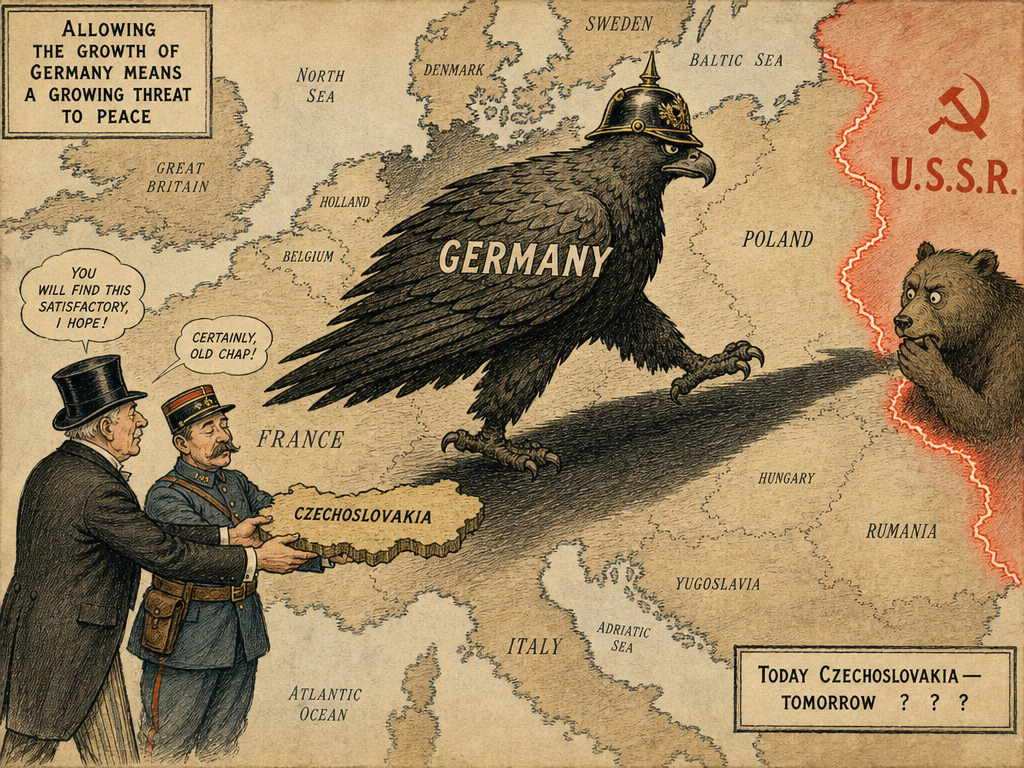
A political cartoon from a Soviet publication, produced around the time of the Munich crisis. It shows Britain and France putting Czechoslovakia in danger by giving in to Nazi Germany, with a caption reflecting the Soviet view that the Munich Agreement made Nazi Germany stronger and better able to expand eastward, closer to the USSR's own border.
The full worked answer — Nov 2020
Source A is critical of the Munich Agreement because it shows Britain and France putting Czechoslovakia in danger by allowing Nazi Germany to threaten it without any Czech representative present at the talks. The cartoon's caption reflects the Soviet Union's view that the Agreement made Nazi Germany stronger, since Hitler was allowed to take the Sudetenland without a fight.
This links to my own knowledge because the source is making the point Stalin himself made at the time: that by appeasing Hitler at Munich in September 1938, Chamberlain and Daladier had made it easier for Nazi Germany to advance towards the East, which the USSR saw as a direct threat to its own security since the Soviet Union had not been invited to the Munich talks at all.
Could you have written this? Every fact in this answer is drilled in our quizzes — the writing is the easy part once the evidence is automatic.
Practise Treaty of Versailles questionsWhat the mark scheme rewarded
- Naming a specific detail in the source, not a vague summary of 'the source is negative'
- Linking that detail directly back to the source's own message about Munich weakening the situation or endangering others
- Using contextual knowledge (dates, who was excluded from Munich, what the Agreement actually did) to explain the source's viewpoint
- No credit for facts you know about Munich that are not actually connected to what the source shows
- The Munich Agreement was signed on 29 September 1938 between Britain, France, Germany and Italy
- Czechoslovakia was not invited to the talks even though the Sudetenland was Czech territory
- The USSR was also excluded from the Munich talks, despite having a treaty of alliance with Czechoslovakia
- The Agreement let Germany annex the Sudetenland, which contained key Czech border defences and industry
- Chamberlain declared 'peace for our time' after Munich, a phrase later used to mock him once war broke out
- Hitler broke the Munich Agreement within six months by occupying the rest of Czechoslovakia in March 1939
- The USSR later signed the Nazi-Soviet Pact in August 1939, partly out of distrust after being excluded from Munich
Traps examiners saw
- Writing everything you know about Munich instead of pointing at the actual source in front of you
- Describing the source ('it shows men signing a document') without saying what that detail proves about criticism of the Agreement
- Forgetting to bring in contextual knowledge, a Level 1 answer just describes the source; Level 2 explains it
Full-mark self-check 0 of 4
1×asked“Source A is critical of the policy of appeasement. How do you know?”
“Source A is critical of the policy of appeasement. How do you know?”
What it’s really asking
Find the detail in the source that shows the writer or cartoonist thinks appeasement was wrong or dangerous, then use your contextual knowledge to explain why.
What the sources actually showed — Nov 2021
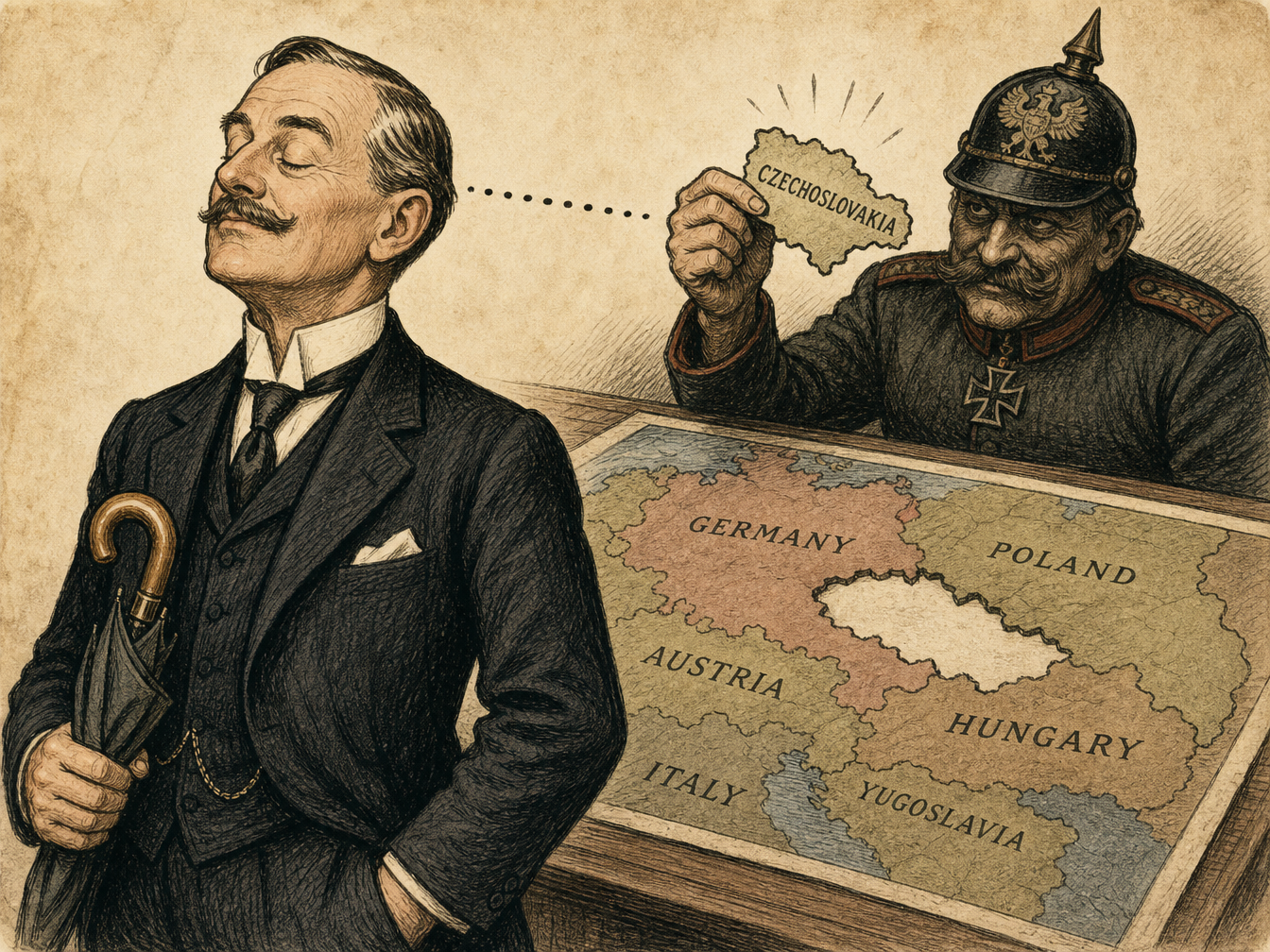
A political cartoon criticising Neville Chamberlain over the Munich Agreement, produced around the time of the Sudeten Crisis. It shows Chamberlain ignoring or turning a blind eye to what Hitler is doing, while Hitler is shown cutting up Czechoslovakia behind Chamberlain's back.
The full worked answer — Nov 2021
Look at how the cartoon builds its criticism visually rather than just what it contains: the whole point of showing Hitler cutting up Czechoslovakia behind Chamberlain's back is that we, the viewer, can see the danger that Chamberlain in the cartoon cannot. That gap between what we see and what Chamberlain sees is the cartoonist's method of accusing him of wilful blindness, not simple deception. Because it was drawn around the time of the Sudeten Crisis in September 1938, before Hitler had actually broken his word, the cartoonist is not just reporting events, he is making a prediction: that giving Hitler the Sudetenland would not satisfy him and that Chamberlain was too trusting to see it. That timing matters, because it means the criticism in Source A was a warning issued in the moment, not hindsight added after the event.
My own knowledge lets me test whether that warning turned out to be justified, rather than just retelling the story of Munich. When Chamberlain returned from the Munich Conference in September 1938 he told crowds in Britain he had secured 'peace for our time', publicly claiming the agreement had solved the problem. Source A is mocking exactly that claim before it could even be tested. Then in March 1939 Hitler occupied the rest of Czechoslovakia, breaking the promise he had made at Munich that he wanted no more territory. That proves the cartoonist's specific accusation, that Chamberlain refused to see Hitler's true intentions, was correct: within six months the ally Chamberlain trusted had shown the bad faith the cartoon had already accused him of failing to notice.
So the cartoon is not simply illustrating Munich, it is arguing a case in advance, and my contextual knowledge is what lets me judge that case rather than just repeat it: the prediction was borne out by real, named events, which is why this deserves full marks rather than a description of what the cartoon shows.
Could you have written this? Every fact in this answer is drilled in our quizzes — the writing is the easy part once the evidence is automatic.
Practise Treaty of Versailles questionsWhat the mark scheme rewarded
- Identifying a detail in the source that criticises Chamberlain, the Munich Agreement, or the whole idea of giving in to Hitler
- Explaining how that detail shows disapproval, supported by contextual knowledge, not just describing what the source contains
- Linking the criticism to what actually happened afterwards, since Hitler did break his promises
- Appeasement was the British policy of making concessions to Hitler to avoid another war
- Chamberlain met Hitler three times in September 1938 during the Sudeten Crisis
- The Munich Agreement of 29 September 1938 let Germany take the Sudetenland from Czechoslovakia without a Czech representative present
- Chamberlain declared 'peace for our time' after Munich, a phrase critics used to mock him once war broke out
- Winston Churchill was a leading critic of appeasement at the time
- Hitler broke the Munich Agreement in March 1939 by occupying the rest of Czechoslovakia
Traps examiners saw
- Explaining why YOU think appeasement was wrong instead of what the source specifically shows
- Describing the cartoon without using contextual knowledge to explain why the criticism is justified
Full-mark self-check 0 of 3
1×asked“Source A is critical of the League of Nations. How do you know?”
“Source A is critical of the League of Nations. How do you know?”
What it’s really asking
Find the detail in the source that shows criticism of the League's failure to act, and use your knowledge of the Manchurian Crisis to explain why that criticism was justified.
What the sources actually showed — June 2022
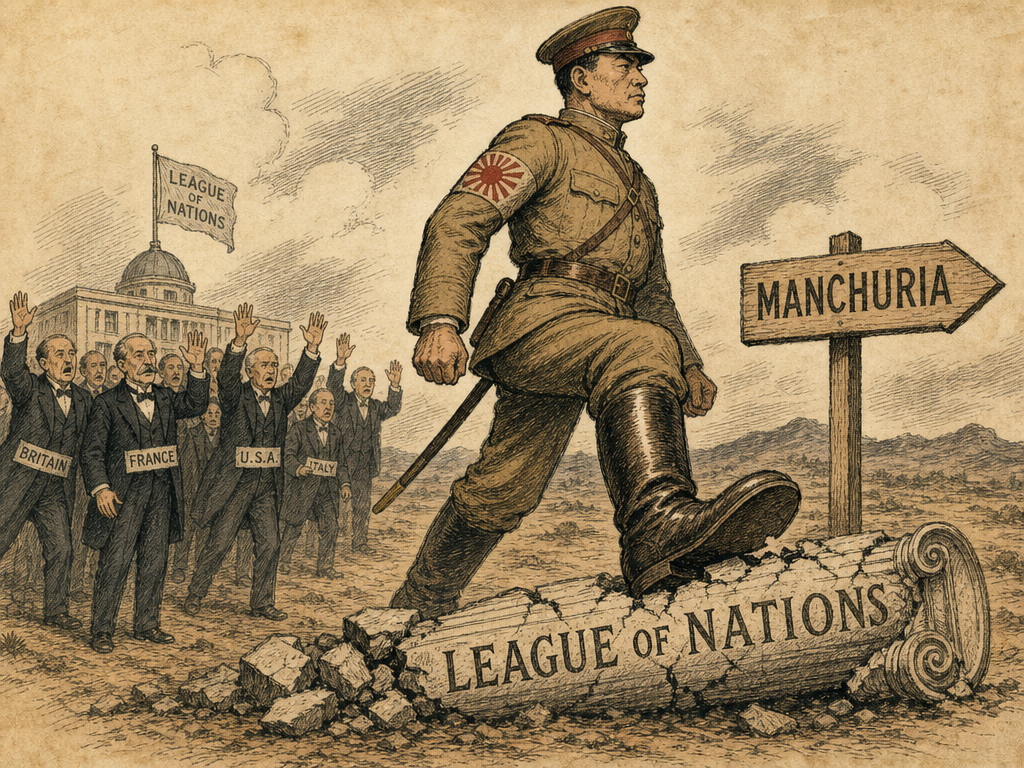
A political cartoon produced at the time of the Manchurian Crisis (1931 to 1933). Its title suggests Japan is disregarding or ignoring the League of Nations, and the image shows Japan walking over or trampling the League, implying the League had no real power to stop a determined aggressor.
The full worked answer — June 2022
Source A is critical of the League of Nations because the cartoon shows Japan walking all over the League, with a title suggesting Japan is simply ignoring it. This implies the cartoonist saw the League as powerless in the face of a strong aggressor.
This links to the Manchurian Crisis of 1931 to 1933, when Japan invaded the Chinese region of Manchuria. The League's Lytton Report condemned Japan's actions in 1932, but by the time it was published Japan had already consolidated control of the territory, and Japan simply left the League in 1933 rather than withdraw. This shows the cartoon's criticism was accurate: the League could condemn aggression but had no real mechanism to reverse it once it had happened.
Could you have written this? Every fact in this answer is drilled in our quizzes — the writing is the easy part once the evidence is automatic.
Practise Treaty of Versailles questionsWhat the mark scheme rewarded
- Picking a detail that shows the League being ignored, overpowered, or unable to act
- Linking that detail to the actual outcome of the Manchurian Crisis using specific dates and events
- Japan invaded Manchuria in September 1931
- China appealed to the League of Nations for help
- The League's Lytton Report of 1932 condemned Japan's actions but took over a year to produce
- Japan responded by leaving the League of Nations in 1933 rather than withdrawing from Manchuria
- The League had no army of its own and depended on member states to act, which they did not
- Manchuria showed other aggressive states, including Italy and Germany, that the League could be defied without serious consequence
Traps examiners saw
- Describing the cartoon's imagery without explaining what it proves about League weakness using real events
- Confusing Manchuria with Abyssinia, make sure the dates and details are for the correct crisis
Full-mark self-check 0 of 3
1×asked“Source A supports the Locarno Treaties. How do you know?”
“Source A supports the Locarno Treaties. How do you know?”
What it’s really asking
Find the detail in the source that shows approval of the 1925 Locarno Treaties, then use your contextual knowledge of what Locarno achieved to explain why that approval makes sense.
What the sources actually showed — June 2023
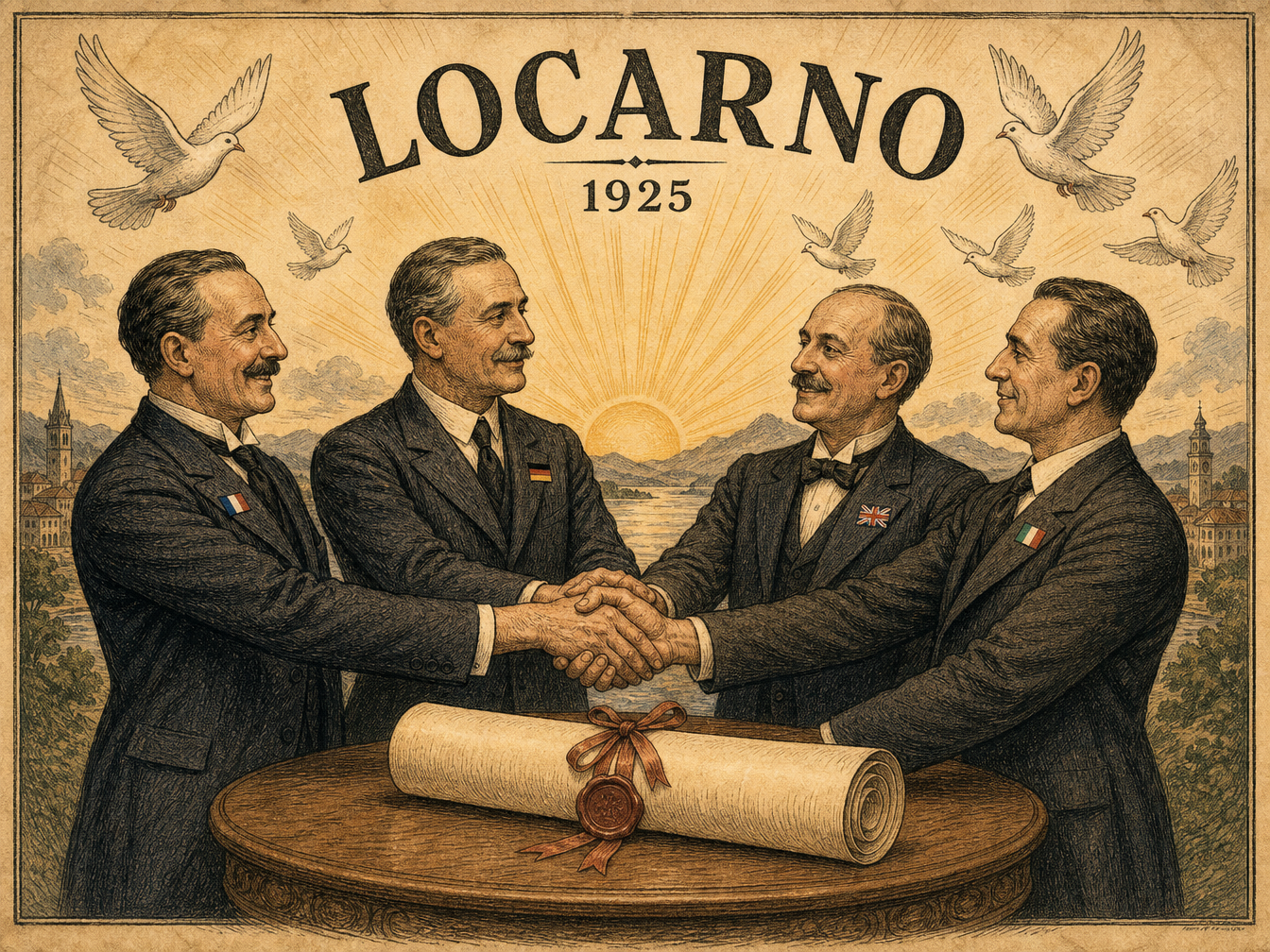
A political cartoon produced in the same year as the Locarno Treaties were signed. Its title celebrates the idea of European countries, including France and Germany, agreeing not to go to war with each other in the future.
The full worked answer — June 2023
Source A supports the Locarno Treaties because it was produced in 1925, the same year the treaties were signed, and its title celebrates France and Germany agreeing not to go to war with each other again. This shows the cartoonist viewed Locarno positively, as a genuine step towards peace between former enemies.
This links to my own knowledge because at Locarno in 1925, Germany formally accepted its western borders with France and Belgium as permanent, something it had never agreed to under the Treaty of Versailles. This reduced the resentment that had built up since 1919, since Germany was now negotiating as something closer to an equal, and it led directly to Germany being invited to join the League of Nations the following year, 1926, showing genuine improved relations rather than an imposed settlement.
Could you have written this? Every fact in this answer is drilled in our quizzes — the writing is the easy part once the evidence is automatic.
Practise Treaty of Versailles questionsWhat the mark scheme rewarded
- Picking a detail that shows optimism, cooperation, or agreement between countries
- Using the source's provenance (the date it was produced) as evidence, since it matches the actual signing of the treaties
- Explaining what Locarno actually achieved to justify why the source treats it positively
- The Locarno Treaties were signed in 1925 between Germany, France, Belgium, Britain and Italy
- Germany agreed to accept its western borders with France and Belgium as permanent
- The treaties led to Germany being invited to join the League of Nations in 1926
- This period, 1925 to 1929, is often called the 'spirit of Locarno', a time of improved international relations
- Locarno reduced the resentment caused by the Treaty of Versailles because Germany negotiated as an equal
- The eastern borders with Poland and Czechoslovakia were not guaranteed by Locarno, only promised to be settled peacefully
Traps examiners saw
- Assuming the source must be criticising Locarno because so much of this period focuses on failure, check the wording and imagery carefully, this one is positive
- Not explaining what 'supports' means here, you need detail plus explanation, not just a description of the picture
Full-mark self-check 0 of 3
The method for every Q01 — same every sittingMark bands, steps, timing
What this question type rewards
The topic changes by sitting — the mark scheme never does. Learn this once, then open your question above for that sitting’s sources and a full worked answer.
- Picking out details from the source that back up the claim in the question
- Using contextual knowledge to explain WHY the source is making that point, not just describing what it shows
The steps
- Read the claim in the question first so you know exactly what you are hunting for
- Identify one or two details in the source (words, phrases, or parts of a picture) that support that claim
- Use your contextual knowledge to explain WHY the source is showing that view, not just what it shows
- Do not just describe the source. 'This shows...' is Level 1. 'This shows... because [contextual knowledge]...' is Level 2
What was Article 231 of the Treaty of Versailles?
This question always needs you to read a source cold and pull out proof fast, then explain it with your own knowledge. Practise spotting the difference between describing a source and actually using it as evidence.
Practise Treaty of Versailles questions“How useful are Sources B and C to an historian studying...”
This is the single most predictable question on the whole paper. The sources change every sitting, but the topics keep circling back to the League of Nations, appeasement, and the Treaty of Versailles.
1×asked“How useful are Sources B and C to an historian studying the remilitarisation of the Rhineland?”
“How useful are Sources B and C to an historian studying the remilitarisation of the Rhineland?”
What it’s really asking
It wants you to judge how useful two contemporary sources are for understanding both why Germany remilitarised the Rhineland in 1936 and how Britain reacted to it.
What the sources actually showed — Nov 2020
A German government document or statement from 1936 justifying the remilitarisation of the Rhineland. It presents Germany's action as a defensive response, pointing to the 1935 mutual assistance pact between France and the USSR as a threat, and claims Hitler was reneging on the Locarno commitment to resolve disputes peacefully because Germany felt encircled.
A British source from around 1936, critical of the British government's decision not to take any action against Germany's breach of the Treaty of Versailles. It suggests the government had been fooled into believing Germany's claim that its intentions were purely peaceful.
The full worked answer — Nov 2020
Source B is useful for understanding Germany's own justification for the remilitarisation, but I need to interrogate who produced it and why before I trust its content. It presents the March 1936 remilitarisation as a defensive necessity, claiming Germany felt encircled by the Franco-Soviet mutual assistance pact signed in May 1935, and using this to argue Hitler was forced to break the Locarno Treaty of 1925 and send troops back into the demilitarised zone. As a German government statement, it had two audiences at once: reassuring the German public that Hitler was protecting them rather than provoking a war, and signalling to Britain and France that the action was reasonable so they would accept it without retaliating. A government could not admit to either audience that the real aim was testing how far Versailles could be broken, so the source's language of victimhood is not incidental, it is the whole point of the document, which limits its usefulness as a neutral account even though it is a genuine record of what Germany chose to claim in public.
My own knowledge lets me go beyond correcting the source, I can use it to argue this was a calculated gamble rather than genuine self defence. Hitler had already reintroduced conscription in March 1935 and revealed the existence of the Luftwaffe that same year, both direct breaches of Versailles that provoked only diplomatic protest notes from Britain and France, not action, so by March 1936 he had good reason to expect a similarly weak response. He also chose to move on a Saturday, when the French cabinet could not convene quickly, and instructed his generals to withdraw if France mobilised its forces, which shows this was a calculated risk with an exit plan built in, not a defensive reflex to encirclement. This means Source B's claim of being threatened does not just exaggerate the danger, it conceals a deliberate test of Anglo-French resolve, something no government justification document was ever going to admit to writing, which is exactly why a historian cannot take its content at face value.
Source C is useful because it lets a historian see how contemporaries in Britain judged their own government's response, and I can be specific about what kind of source this most plausibly is. If this is a newspaper editorial from a paper critical of the National Government, written for a politically engaged public rather than for Parliament directly, its purpose was to challenge official policy in print, which means the author had every reason to expose government inaction as a failure rather than to give a balanced account of why ministers acted as they did. This sharpens rather than weakens its value, since it captures the argument critics were actually making in 1936 that the government had let Germany get away with treaty breaking, but a historian must remember an editorial argues a case rather than records a decision, so its picture of the government being simply fooled is one side's interpretation, not a neutral description of Cabinet thinking.
I can test the claim that Britain was simply fooled using my own knowledge, and this is where Source C needs the same weight of challenge as Source B received. Baldwin's government was not naive, it was cautious because RAF expansion under the 1935 Expansion Scheme was still years from completion and British rearmament had barely begun, so ministers judged Britain was not ready for a confrontation over the Rhineland in March 1936. There was also a widely shared view in Britain, summed up in Lord Lothian's comment that Germany was only walking into its own back garden, which reflected a real belief that the Rhineland was German territory in the first place rather than proof of gullibility. Even France, despite having a peacetime army of around half a million men against the small symbolic force Hitler sent into the zone, chose not to mobilise alone without British backing, which shows British caution was shared by the one power with the military strength to act. This means Source C's accusation that the government was fooled oversimplifies a decision that also involved real strategic restraint on both sides of the Channel, so a historian has to treat it as one angry contemporary judgement rather than the full explanation.
Comparing the two sources shows a historian something neither reveals on its own: Source B exposes how German propaganda dressed aggression as defence for two different audiences, while Source C shows British domestic anger at a government caution that was itself more calculated than the source admits, so together they capture both sides of the crisis rather than one government's version of events. But I have to argue the limits of this combination rather than just declare the sources useful together. Neither source can show a historian the full truth of German decision making, since a government statement is structurally incapable of admitting deliberate risk taking, and Source C, however well informed its author was, only reflects British opinion and tells us nothing about how the French government or military actually debated intervention, despite France having the larger army in the region at the time. Given this, I judge the sources most useful when read against each other and tested against outside knowledge of conscription, the Luftwaffe reveal, the Saturday timing and France's own military caution, since alone each source flatters or attacks one side's version of events, and only by combining both with what I know does a picture emerge of a calculated German gamble meeting a divided but not simply gullible British and French response.
Could you have written this? Every fact in this answer is drilled in our quizzes — the writing is the easy part once the evidence is automatic.
Practise League of Nations questionsWhat the mark scheme rewarded
- Treating BOTH sources with equal depth on content and provenance
- Testing the German source's self-justifying content against contextual knowledge of the Locarno breach
- Using the British source's critical provenance to show contemporary doubt about appeasement-style thinking, even before Munich
- A genuine overall judgement connecting the two sources to each other, not just describing them one after another
- Hitler remilitarised the Rhineland on 7 March 1936, sending German troops into the demilitarised zone
- This broke both the Treaty of Versailles and the Locarno Treaties of 1925, which Germany had signed voluntarily
- Germany justified the move by pointing to the Franco-Soviet mutual assistance pact of May 1935 as evidence of encirclement
- Britain and France took no military action, partly because British public opinion saw the Rhineland as 'Germany's own back yard'
- France was cautious about acting alone and its own military was on a defensive footing
- The remilitarisation was a gamble; German generals later said if Britain and France had responded with force, Germany would have had to retreat
- The lack of response encouraged Hitler's confidence for later actions including Anschluss in 1938
Traps examiners saw
- Writing about the Rhineland from memory without actually reading what the two sources in front of you say
- Only judging usefulness by provenance ('it's a primary source so it's useful') without connecting that to the specific enquiry
- Treating this like Q01 and just pulling quotes out without reaching a judgement
- Running out of time because this question deserves the most words on the paper
Full-mark self-check 0 of 4
1×asked“How useful are Sources B and C to an historian studying the Treaty of Versailles?”
“How useful are Sources B and C to an historian studying the Treaty of Versailles?”
What it’s really asking
Same method as above, but here your own knowledge bank needs to be about the Big Three's aims, the terms of the Treaty, and both German and international reactions to it.
What the sources actually showed — Nov 2021
An American political cartoon from around 1919, showing Germany bound by a ball and chain, threatened with a sword representing the possibility of Allied invasion if it refused to sign. It references the Fourteen Points and the fact that the US Senate refused to ratify the final Treaty.
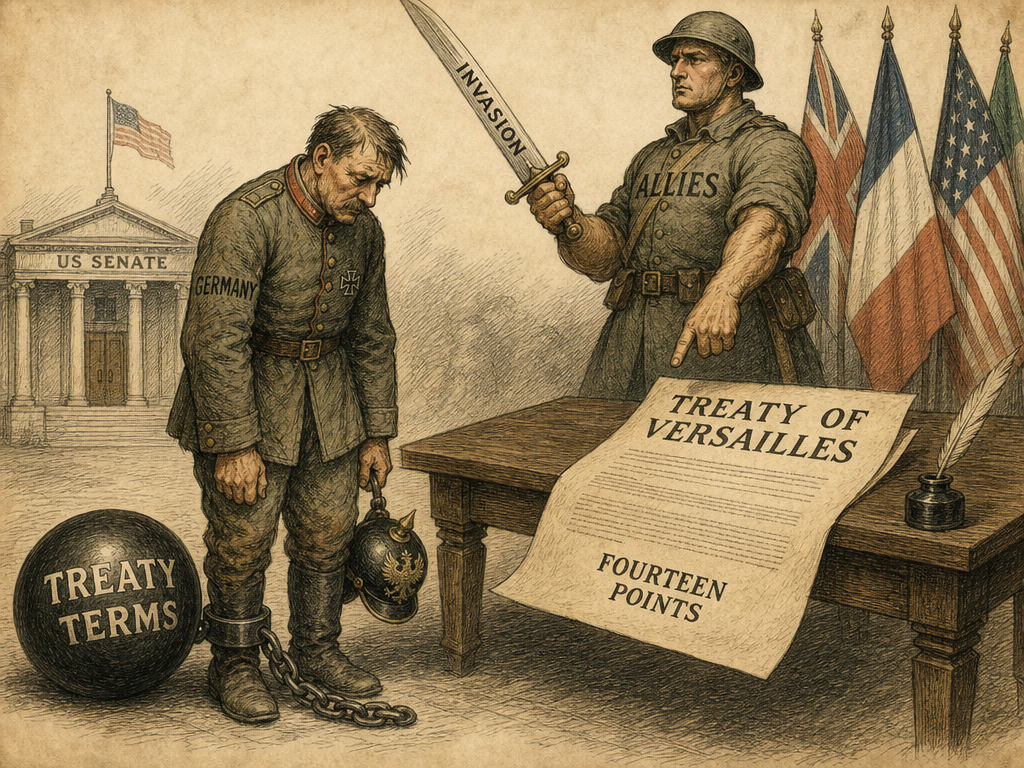
A British source from 1919, praising the work of the Big 3 in producing the Treaty of Versailles, presenting it as a settlement that would end warfare itself and defending the inclusion of Article 231, the War Guilt clause, as fair punishment for Germany trying to conquer other countries.
The full worked answer — Nov 2021
Source B is useful for showing me that criticism of the Treaty in 1919 was not confined to Germany, but I need to interrogate its provenance rather than just accept its message. It presents Germany bound by a ball and chain, threatened with a sword if it refused to sign, and it references Wilson's Fourteen Points alongside the fact that the American Senate voted against ratifying the Treaty in November 1919. As an American cartoon, its likely context is the domestic clash between Wilson's idealism, his vision of a fair peace based on the Fourteen Points and a League of Nations to prevent future wars, and the isolationist mood in the Senate led by figures such as Henry Cabot Lodge, who saw the Treaty as dragging America into future European entanglements. This tells me the source was produced for an audience already primed to see the Treaty as a betrayal of Wilson's own promises, which is exactly why the cartoon frames Germany as trapped rather than justly punished. However, this same provenance limits its usefulness. A cartoon aimed at persuading isolationist Americans is deliberately one sided, and it tells me nothing about French or British opinion, which is a real limitation for a historian studying the whole Treaty rather than one country's domestic argument about it.
Source C is useful for the opposite reason, since it shows me the British justification for the Treaty at the point it was signed in June 1919, defending Article 231, the War Guilt clause, on the grounds that Germany had tried to conquer other countries and deserved to take responsibility. As a British source produced when Britain was one of the Big Three that had drawn up the terms, its purpose looks like a defence of a settlement its own government had negotiated, which limits how neutral its judgement can be treated. But I can test its central claim against what actually happened rather than only noting bias in its tone. Source C predicts the Treaty would bring an end to war itself, yet by 1921 the Reparations Commission had fixed Germany's reparations bill at 132 billion gold marks, roughly six and a half billion pounds, a sum so large that Germany began defaulting on timber and coal deliveries within two years. When Germany fell behind on these payments, French and Belgian troops occupied the Ruhr in January 1923 to seize goods directly, which is the opposite of the peaceful settlement Source C was celebrating. This shows the source's optimism was not just biased in tone, it was factually wrong about how the Treaty would actually unfold.
Putting the two sources together, they disagree about what the Treaty would achieve, and my own knowledge lets me judge that disagreement rather than just note it. Source B does not predict hyperinflation or the Ruhr occupation through its imagery, what it actually shows me is that doubt about the Treaty's fairness already existed inside an Allied country in 1919, before any of those events had happened. What my own knowledge adds is that this contemporary doubt was subsequently vindicated by events its author could not have known about. The reparations burden fed into the hyperinflation crisis of 1923, when the German mark became worthless and the government printed money to pay striking Ruhr workers, wiping out the savings of the German middle class. This same resentment is visible in the National Socialist German Workers' Party programme of 1920, which explicitly demanded the abolition of the Treaty of Versailles, showing that anger at the settlement was already organising politically within a year of Source C being written. This is a genuinely separate strand of evidence from the reparations and Ruhr point in my second paragraph, an economic collapse versus a political mobilisation, both rooted in the same treaty but proving the point in different ways.
Overall, I think the two sources are most useful when read against each other, because their disagreement is itself revealing to a historian. Source C's confidence that the Treaty ended warfare was contradicted by events its British author could not have foreseen in June 1919, while Source B's doubt, despite coming from a one sided American cartoon that says nothing about French or British attitudes, points towards consequences that unfolded through the 1920s and fed into the conditions the Nazis later exploited. Neither source alone gives a historian a complete picture. Source C is compromised by its purpose as a defence of the Big Three's own settlement, and Source B is compromised by its narrow American audience shaped by the Wilson versus Senate argument. But together, and only once tested against my own knowledge of reparations, the Ruhr occupation and the NSDAP's 1920 demands, they let a historian see both how the Treaty was justified at the time and how quickly that justification was undermined by events. That combination of judged content, tested provenance and independent evidence is what makes them genuinely useful for this enquiry.
Could you have written this? Every fact in this answer is drilled in our quizzes — the writing is the easy part once the evidence is automatic.
Practise League of Nations questionsWhat the mark scheme rewarded
- Judging both sources on content and provenance with equal depth
- Using your own knowledge of Treaty terms and the Senate's refusal to ratify to test what the sources claim
- A clear final judgement comparing the two sources' usefulness, ideally contrasting their differing predictions about the Treaty
- The 'Big Three' were Woodrow Wilson (USA), Georges Clemenceau (France) and David Lloyd George (Britain)
- Clemenceau wanted to cripple Germany to protect France, having suffered huge losses and invasion in the war
- Lloyd George wanted a treaty firm enough to satisfy the British public but not so harsh it would prevent future trade with Germany
- Wilson wanted a fairer peace based on his Fourteen Points and the creation of the League of Nations
- The final Treaty of Versailles was signed on 28 June 1919 and included War Guilt (Article 231), reparations of 6.6 billion pounds, territorial losses, and military restrictions
- The US Senate refused to ratify the Treaty in 1919, and the USA never joined the League of Nations
- Germans were furious, calling it a 'Diktat', a dictated peace they had no power to negotiate
Traps examiners saw
- Confusing which leader wanted what, mixing up Clemenceau's severity with Wilson's leniency loses marks
- Only describing the Treaty terms instead of judging what the SOURCES specifically show a historian about it
Full-mark self-check 0 of 3
1×asked“How useful are Sources B and C to an historian studying the policy of appeasement?”
“How useful are Sources B and C to an historian studying the policy of appeasement?”
What it’s really asking
It wants you to judge how useful two contemporary sources are for understanding both the British justification for appeasement and international doubts about whether it would actually work.
What the sources actually showed — June 2022
A British source from 1938 presenting a positive view of appeasement, close to how Chamberlain presented the Munich Agreement to the people of Britain, including reference to the joint Anglo-German declaration signed alongside it that Chamberlain saw as a promise war would be avoided.
An American political cartoon from 1938, critical of appeasement. It suggests the Munich Agreement might not keep Hitler quiet for long despite his promise not to make any further territorial demands, reflecting an outside view that Chamberlain was naive to trust him.
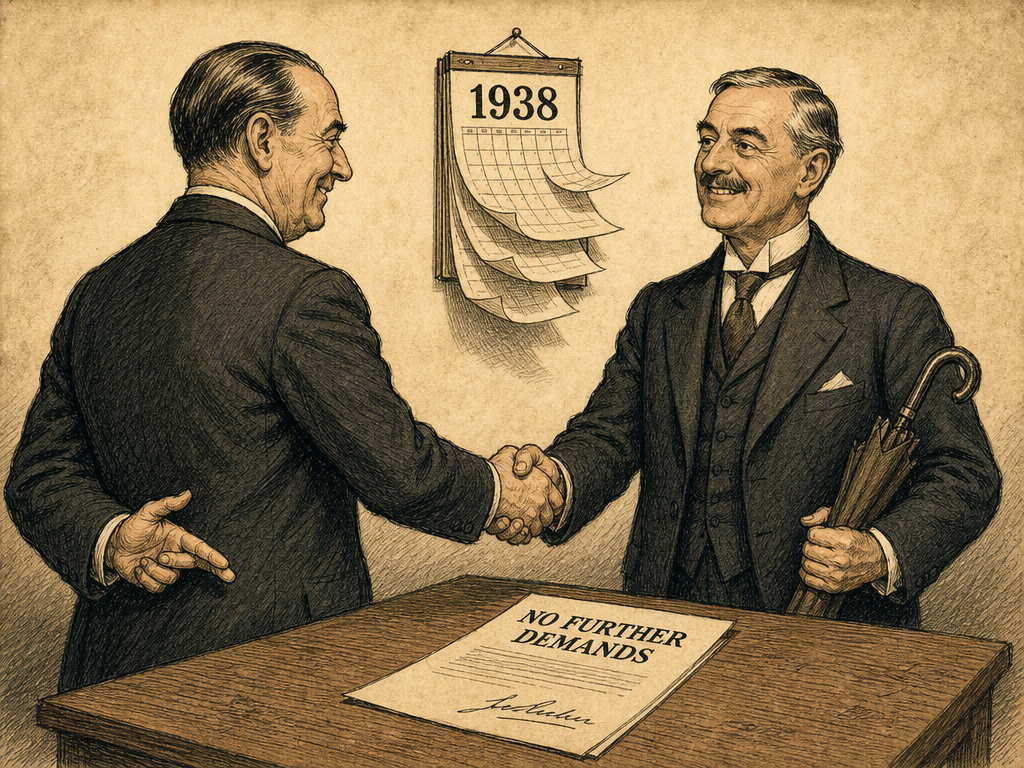
The full worked answer — June 2022
Source B is useful for showing how appeasement was justified to the British public at the time. It is dated 1938 and takes a positive line very close to how Chamberlain himself presented the Munich Agreement, including the Anglo-German declaration he signed alongside Hitler, which Chamberlain claimed was a personal guarantee that the two countries would never go to war again. This tells a historian how the government wanted the deal to be received: as a genuine diplomatic breakthrough rather than a retreat. But because Source B is so close to the official government line, a historian has to treat its confidence with caution rather than take it as neutral reporting. This matters because Chamberlain returned from Munich on 30 September 1938 and told crowds outside Downing Street that he believed it was peace for our time, a phrase that was really a political performance aimed at reassuring a public terrified of a repeat of 1914 to 1918, not a considered assessment of Hitler's real intentions. Chamberlain had already met Hitler twice before Munich, at Berchtesgaden and then at Godesberg, and on both occasions Hitler had increased his demands rather than settled for less, which suggests the promise Source B celebrates was built on a pattern that should have made trust harder to justify, not easier. So Source B is useful for showing the government's public optimism, but a historian has to read it against that background to see how selectively it was choosing to believe Hitler's word.
Source C deserves exactly the same kind of scrutiny. It is an American cartoon from 1938, and its nationality matters just as much as Source B's British origin does. The United States had no troops or territory at stake in Czechoslovakia and had taken no part in the Munich negotiations, so an American cartoonist was free to mock the agreement without having to defend a policy his own government had signed. That distance gives Source C a kind of usefulness Source B cannot offer: it is not trying to reassure a frightened public, so it can say plainly that Hitler's promise not to make further demands looked flimsy. At the same time, that same distance is a limitation. The United States was not directly threatened by Germany in 1938 and had a long tradition of staying out of European affairs, so an American observer had less at stake in believing appeasement might work, which arguably made it easier to be cynical about it from the outside. A cartoon is also a deliberately simplified and exaggerated form by its nature, built to make a single sharp point rather than represent every side of a complicated situation, so a historian cannot treat its warning as a balanced assessment either, only as a strong opinion. Its usefulness therefore lies less in it being objectively right and more in showing that scepticism about Munich already existed outside Britain in 1938, before events proved it justified.
Knowing what happened next lets me test both sources rather than simply repeat what they say. Source C's suggestion that Hitler would not stay quiet was proved right within six months: on 15 March 1939 Hitler occupied the rest of Czechoslovakia, taking Prague and ending the country's independence, which broke the very promise the Anglo-German declaration in Source B relied on. This does not mean Source C was simply correct and Source B simply wrong, though. Source B is still useful precisely because it captures how convincing the promise appeared in October 1938, when the alternative to trusting it looked like war less than twenty years after the last one had ended. Source C is useful because it shows that even without the benefit of hindsight, some contemporaries doubted Hitler's word in 1938 itself, not only after March 1939 revealed the truth. Used together rather than separately, the sources let a historian see both why appeasement was believed in and why that belief was already being challenged at the very moment it was made, which is a fuller picture than either source could give alone.
The Munich Agreement itself also needs unpacking rather than treated as something Britain alone was responsible for, which affects how far blame in Source B's optimism can be shared out. The conference on 29 to 30 September 1938 included France under Edouard Daladier alongside Britain and Germany, along with Mussolini's Italy, so Chamberlain was not acting alone in trusting Hitler, France agreed to abandon its ally too. More significantly, Czechoslovakia itself was not invited to the talks that decided to hand over the Sudetenland, and the Soviet Union, which also had a treaty obligation to defend Czechoslovakia, was excluded as well. This tells a historian that the confidence in Source B was reached by a narrow group of powers making decisions about a country that had no voice in its own fate, which helps explain why the agreement could collapse so quickly: it was never tested by the one government, Czechoslovakia's, that had most reason to resist Hitler's further demands. This detail sharpens rather than excuses the criticism in Source C, since it shows the flaw in the Munich process ran deeper than Chamberlain's personal misjudgement alone.
Overall I would judge Sources B and C together as more useful than either is alone. Source B shows how the British government justified appeasement to itself and to the public through the language of the Anglo-German declaration, but its confidence only makes sense once set against Chamberlain's escalating meetings with Hitler at Berchtesgaden and Godesberg and the narrow, excluding way the Munich conference was actually conducted. Source C's warning gains its force not just from being American and therefore less invested in Munich succeeding, but from being proved right by Hitler's occupation of Prague in March 1939, even though as a cartoon it necessarily simplifies a complex crisis into a single warning. Neither source can be trusted on its own: Source B needs testing against what a historian knows about how Munich was actually reached, and Source C needs testing against the limits of what a deliberately exaggerated cartoon can show. Used side by side and checked against contextual knowledge, though, they let a historian see both the reasoning behind appeasement and the reasons, already visible in 1938, why that reasoning would fail.
Could you have written this? Every fact in this answer is drilled in our quizzes — the writing is the easy part once the evidence is automatic.
Practise League of Nations questionsWhat the mark scheme rewarded
- Judging both sources on content and provenance with equal depth
- Using the actual outcome (March 1939 invasion of Czechoslovakia) to test Source B's optimism against Source C's scepticism
- A genuine overall judgement about why the two sources disagree and what that reveals to a historian
- Appeasement was the British policy of making concessions to Hitler to avoid another war
- The Munich Agreement was signed on 29 September 1938, allowing Germany to annex the Sudetenland
- Chamberlain and Hitler also signed a joint Anglo-German declaration at Munich, which Chamberlain presented as a peace guarantee
- Chamberlain declared 'peace for our time' on returning to Britain after Munich
- Hitler broke his promise and occupied the rest of Czechoslovakia in March 1939
- Critics such as Churchill argued appeasement only encouraged further German aggression
- The USA, not directly involved in European affairs at the time, still expressed public concern about the policy through the press
Traps examiners saw
- Only describing what each source shows without linking Source C's warning to what actually happened in March 1939
- Treating this as identical to a Rhineland or Treaty question, keep the focus specifically on appeasement and the Munich Agreement
Full-mark self-check 0 of 3
1×asked“How useful are Sources B and C to an historian studying the League of Nations?”
“How useful are Sources B and C to an historian studying the League of Nations?”
What it’s really asking
The stem is broad, so the actual sources you get could focus the enquiry on the League's wider work, its structure, or a specific crisis. Bring a full League of Nations knowledge bank covering successes AND failures to any pair of sources you are given.
What the sources actually showed — June 2023
A source from around 1919 to 1920, reflecting the idealistic hopes for the newly founded League of Nations and describing its wider role beyond just resolving disputes between countries, including its work through agencies such as an International Labour Organisation setting a minimum wage in many countries, a Health Committee tackling disease such as malaria, and an Opium Board tackling illegal drug trading.
An American political cartoon from 1931, published during the Manchurian Crisis. It criticises the League as ineffective because the USA was not a member, and its purpose seems to be encouraging America to do more to help solve the problem of Japan's invasion of Manchuria, since the League itself lacked the military or economic power to stop it.
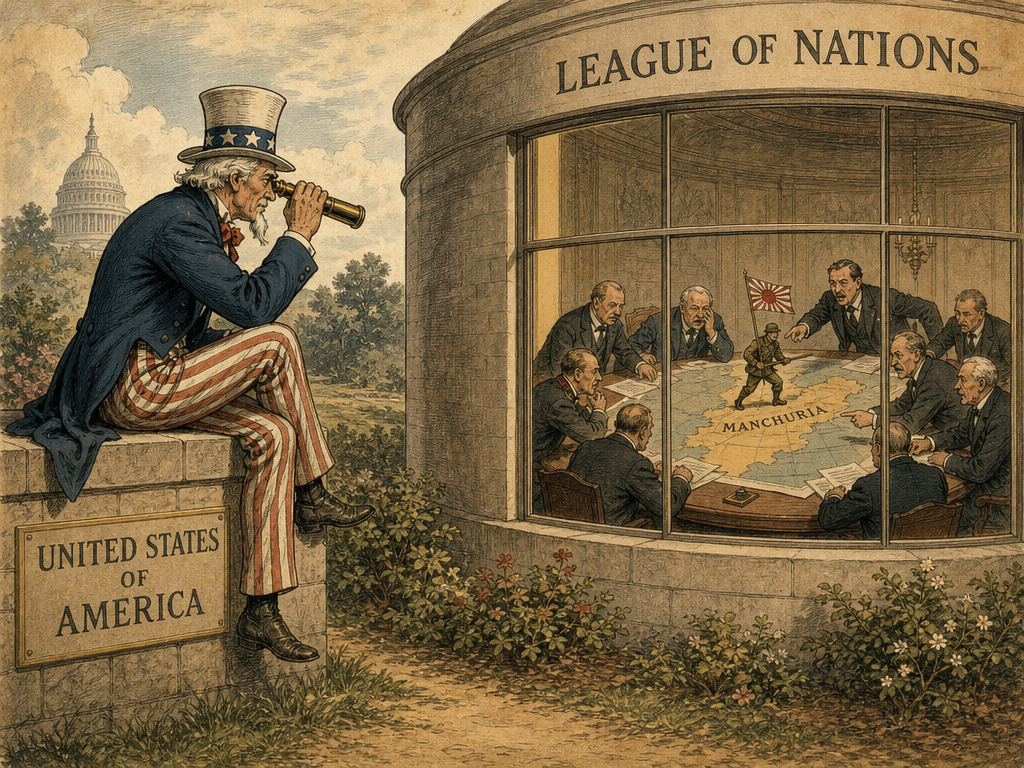
The full worked answer — June 2023
Source B is useful for showing the genuine idealism behind the League's early activity, but its provenance close to 1919 to 1920 needs testing against what actually happened over the next few years rather than jumped straight to 1931. The League's early record was actually mixed rather than uniformly optimistic. In 1921 it successfully settled the Aaland Islands dispute between Sweden and Finland, and it also organised a plebiscite that divided Upper Silesia between Germany and Poland in the same year, so the confidence expressed around 1919 to 1920 was not misplaced at first. However, by 1923 the League had already shown weakness when it failed to stop Italy's occupation of Corfu, since Mussolini simply ignored the League and dealt with France directly. This means Source B's optimism about the League's wider humanitarian work, such as the International Labour Organisation setting a minimum wage or the Health Committee tackling malaria, is useful evidence of contemporary belief in 1919 to 1920, but a historian has to recognise that this belief was already being undermined by 1923, well before the source's own implied high point.
Source C's provenance also needs interrogating rather than simply restated. It was published in America in 1931, and I know that the USA had never actually joined the League at all, since the US Senate rejected the Treaty of Versailles and Woodrow Wilson's own Covenant in 1919 and again in 1920, largely because of an isolationist mood in Congress that did not want America bound to European commitments. This matters because it tells a historian why an American cartoonist in 1931 would specifically frame the League's failure over Manchuria as America's fault for staying out, rather than blaming Japan or the League's own members directly: the cartoon is aimed at a domestic American audience and its purpose is really to argue for a change in US foreign policy, not to give a balanced verdict on the League itself. This makes Source C valuable for understanding American public opinion on isolationism in 1931, but it is one-sided as evidence about the League's actual structural weaknesses, since it ignores that Japan simply walked out of the League in 1933 rather than being expelled or physically stopped, which was really the League's core problem regardless of the USA's membership.
Comparing the two sources rather than just adding them together, I think they actually agree more than they first appear to, once contextual knowledge is applied. Source B assumes that the League's authority rests on the willing cooperation of its members, since the humanitarian agencies it praises, such as the Opium Board, depended on states choosing to comply rather than facing any real sanction. Source C exposes exactly this weakness from a different angle: without the USA, and without any independent army or economic power of its own, the League genuinely could not force Japan to leave Manchuria, so all it managed was the Lytton Report of 1932, which criticised Japan's actions but changed nothing on the ground. Read together, this shows the two sources are not simply contradictory, hope in 1919 to 1920 versus disillusionment in 1931, but connected by a single underlying structural weakness that a careful historian can trace across the whole period rather than just noticing appears at two separate moments.
Overall, I would judge Source B as more useful for understanding the range of the League's peacetime work and the sincerity of belief in it during 1919 to 1920, since as a source close to the League's founding it is not distorted by hindsight of any specific crisis, though a historian must remember it predates any test of that belief. Source C is more useful as evidence of contemporary American attitudes and the specific pressures the League faced by 1931, since as a published political cartoon aimed at persuading a domestic audience it reveals what critics believed was wrong rather than offering a neutral account, and it says nothing about the genuine successes the League still claimed elsewhere, such as its ongoing work with refugees through the Nansen passport scheme in the 1920s. Together, therefore, the two sources are most useful not as a simple story of hope turning to failure, but as evidence of two different kinds of limitation, dependence on voluntary cooperation and the absence of a major power in the USA, both of which a historian can trace as constant weaknesses running underneath the League from its creation right through to its failure over Manchuria.
Could you have written this? Every fact in this answer is drilled in our quizzes — the writing is the easy part once the evidence is automatic.
Practise League of Nations questionsWhat the mark scheme rewarded
- Treating BOTH sources with equal depth, a common mistake is writing far more about one source than the other
- Using provenance meaningfully, comparing an early idealistic source against a later source produced once the League had been tested by crisis
- Bringing in your own knowledge of League successes AND failures to test what the sources claim
- A genuine overall judgement at the end, ideally one that connects the two sources' different dates to a narrative of change over time
- The League of Nations was founded in 1919 as part of the Treaty of Versailles, with its first Assembly meeting in January 1920
- The League had 42 founding members but the USA never joined after the Senate rejected the Treaty of Versailles
- Agencies like the Health Committee tackled disease and the International Labour Organisation improved working conditions worldwide
- Successes: settled the Aaland Islands dispute between Sweden and Finland in 1921, and the Upper Silesia dispute between Germany and Poland in 1921
- Japan invaded Manchuria in 1931; the League's Lytton Report of 1932 condemned Japan, but Japan simply left the League in 1933 and kept the territory
- The League had no army of its own and relied on member countries to provide forces or impose sanctions, which they were often reluctant to do
- Structural weakness: any League decision needed unanimous agreement, making fast or strong action almost impossible
Traps examiners saw
- Writing about the League from memory without actually reading what the two sources in front of you say
- Only judging usefulness by provenance ('it's a primary source so it's useful') without connecting that to the specific enquiry
- Running out of time because this question deserves the most words on the paper
Full-mark self-check 0 of 4
The method for every Q02 — same every sittingMark bands, steps, timing
What this question type rewards
The topic changes by sitting — the mark scheme never does. Learn this once, then open your question above for that sitting’s sources and a full worked answer.
- Judging usefulness using content, provenance (who wrote it, when, why) and your own knowledge together, not any one alone
- Reaching a supported judgement rather than just describing each source in turn
The steps
- For each source, note WHAT it says (content) and WHO made it, WHEN, and WHY (provenance)
- Ask: does the provenance make this content more or less trustworthy/useful for this specific enquiry?
- Add a fact from your own knowledge that supports or challenges what each source claims
- Compare the two sources, do they agree or disagree, and what does that tell a historian?
- Finish with an overall judgement: which source, or which combination, is more useful and why
Which major country never joined the League of Nations?
You cannot predict which two sources you will get, so your knowledge of the League, appeasement and the Treaty needs to cover successes AND failures cold. This is worth 12 marks, more than any other single question except the essay.
Practise League of Nations questions“Write an account of how [event] affected international relations”
Every account question needs a clear, ordered sequence of cause and effect, not a list of facts.
1×asked“Write an account of how events in Abyssinia in 1935-36 affected the League of Nations.”
“Write an account of how events in Abyssinia in 1935-36 affected the League of Nations.”
What it’s really asking
A chronological account of Italy's invasion of Abyssinia, the League's response, and how the whole episode damaged the League's authority and credibility.
The full worked answer — Nov 2020
In October 1935, Mussolini's Italy invaded Abyssinia, using modern weapons and poison gas against a poorly equipped Abyssinian army, in an attempt to expand the Italian empire and avenge Italy's defeat there in 1896. Emperor Haile Selassie appealed personally to the League of Nations for help.
This led to the League condemning the invasion and voting for economic sanctions against Italy. However, the sanctions excluded oil, which Italy desperately needed for its war effort, and the Suez Canal remained open to Italian ships carrying troops and supplies. As a result, Mussolini's military campaign was barely affected and the League's response looked weak in practice even though it looked firm on paper.
Behind the scenes, Britain and France secretly negotiated the Hoare-Laval Pact in December 1935, offering Mussolini two-thirds of Abyssinia in exchange for ending the war, since they wanted to keep Italy as an ally against the growing threat from Hitler rather than enforce the League's own principles. When the plan leaked to the press, it caused public outrage in Britain and both Hoare and Laval were forced to resign.
Italy completed its conquest of Abyssinia by May 1936, and the events showed the League of Nations was openly sabotaged not only by the actions of a leading member like Italy, but by the secret self-interested dealing of its own strongest members, Britain and France. This left the League's authority in ruins and pushed Mussolini towards alliance with Hitler, forming the Rome-Berlin Axis in 1936, while also encouraging Hitler's own remilitarisation of the Rhineland that same year, since he had seen that neither crisis provoked real international action.
Could you have written this? Every fact in this answer is drilled in our quizzes — the writing is the easy part once the evidence is automatic.
Practise steps to war and League questionsWhat the mark scheme rewarded
- Correct order: build-up and invasion, League response, the Hoare-Laval Pact, outcome, wider consequence
- Naming the Hoare-Laval Pact as evidence that Britain and France prioritised their own interests over League principles
- Explaining the EFFECT, that the crisis proved the League would not stop a strong aggressor, encouraging further aggression from Hitler and Mussolini
- Mussolini wanted Abyssinia to expand the Italian empire in East Africa, avenging Italy's 1896 defeat there
- Italy invaded Abyssinia in October 1935 using modern weapons and poison gas against poorly-equipped Abyssinian forces
- Emperor Haile Selassie personally appealed to the League of Nations for help in 1936
- The League condemned the invasion and voted for sanctions, but the sanctions excluded oil and did not close the Suez Canal to Italian ships
- Britain and France secretly negotiated the Hoare-Laval Pact in December 1935, offering Mussolini two-thirds of Abyssinia; the plan leaked and caused public outrage
- Italy completed its conquest of Abyssinia by May 1936, and the League's authority was left in ruins
- The crisis pushed Mussolini towards alliance with Hitler, leading to the Rome-Berlin Axis in 1936
- Hitler took note that the League and its major powers would not risk real confrontation, encouraging his own remilitarisation of the Rhineland in March 1936
Traps examiners saw
- Describing only the invasion without explaining the League's failed response
- Missing the Hoare-Laval Pact, a specific and highly examinable piece of evidence for this topic
- Not linking forward to how this emboldened Hitler, the question is about EFFECT on the League, not just Abyssinia itself
Full-mark self-check 0 of 3
1×asked“Write an account of how the Nazi-Soviet Pact led to war.”
“Write an account of how the Nazi-Soviet Pact led to war.”
What it’s really asking
A chronological account of the events and calculations that led to the surprise August 1939 agreement, and precisely how that agreement then led directly to the outbreak of war days later.
The full worked answer — Nov 2021
By early 1939 Stalin had good reason to distrust Britain and France. He had been shut out of the Munich Conference of September 1938, where Chamberlain let Hitler take the Sudetenland without any Soviet say in the matter, and when Britain and France finally opened talks with Moscow about a joint anti-Hitler alliance in the spring and summer of 1939, their delegation travelled by slow boat rather than by air and had no power to actually sign anything. This convinced Stalin that the West would rather let Hitler expand eastward than commit to a real alliance with the USSR, so when Hitler's foreign minister Ribbentrop offered a deal instead, Stalin took it. This is why the Nazi-Soviet Pact, or Molotov-Ribbentrop Pact, was signed on 23 August 1939: it gave Hitler the guarantee of no Soviet resistance he needed before attacking Poland, while its secret protocol carved Poland and the Baltic states into German and Soviet spheres, giving Stalin buffer territory and time to rearm.
With the pact signed, Hitler now believed he had removed his one real strategic risk: a war on two fronts. But he also badly misjudged how Britain and France would respond, and this misjudgement is the real reason the crisis tipped into war rather than another climbdown. Munich had taught Hitler that Chamberlain's government would talk tough but ultimately not fight over Eastern Europe, since Britain and France had let the Sudetenland go in 1938 and then watched Hitler seize the rest of Czechoslovakia in March 1939 with no military response at all. Hitler therefore assumed the guarantee Britain and France gave Poland that same month, promising to defend Poland's independence, was another bluff that would collapse once he moved. Backed by the pact, he ordered the invasion of Poland on 1 September 1939, expecting the same pattern of protest without action.
This time Hitler had misjudged it. Britain and France issued an ultimatum and then declared war on Germany on 3 September 1939 when Germany refused to withdraw from Poland, honouring their March guarantee for the first time rather than repeating Munich. The Pact was therefore the final trigger of the war: it removed the last strategic risk, Soviet intervention, that had previously restrained Hitler from invading Poland, and it did so at the exact moment Hitler had convinced himself, on the basis of Munich, that the West would not fight either. It was this combination, a neutralised USSR and a fatally wrong reading of British and French resolve, that converted the March 1939 guarantee from a deterrent Hitler expected to ignore into an actual declaration of war just two days after the invasion began.
Could you have written this? Every fact in this answer is drilled in our quizzes — the writing is the easy part once the evidence is automatic.
Practise steps to war and League questionsWhat the mark scheme rewarded
- Explaining WHY both sides wanted the pact, not just stating that it happened
- Correct chronology: failed British/French talks with the USSR, secret German-Soviet negotiations, the signing, and its immediate consequence
- Naming the secret protocol dividing Poland, showing understanding of what the pact actually agreed
- Stalin distrusted Britain and France after being excluded from the Munich Agreement of September 1938
- Britain and France were slow and half-hearted in their 1939 talks with the USSR about a joint anti-Hitler alliance
- Hitler wanted to avoid a war on two fronts, so needed to neutralise the USSR before invading Poland
- The Nazi-Soviet Pact (Molotov-Ribbentrop Pact) was signed on 23 August 1939 by foreign ministers Ribbentrop and Molotov
- A secret protocol within the pact agreed to divide Poland and Eastern Europe into German and Soviet spheres of influence
- The pact removed the risk of Soviet resistance, giving Hitler the confidence to invade Poland on 1 September 1939
- Britain and France, bound by their guarantee to Poland made in March 1939, declared war on Germany on 3 September 1939
Traps examiners saw
- Explaining what the pact WAS without explaining the events and reasons that LED to it, the question wants the build-up
- Missing the irony that Nazism and Communism were bitter enemies, the account should acknowledge why this was a surprising alliance
Full-mark self-check 0 of 4
1×asked“Write an account of how the League of Nations contributed to international peace in the 1920s.”
“Write an account of how the League of Nations contributed to international peace in the 1920s.”
What it’s really asking
A chronological account of specific, successful League actions during the 1920s, showing how each contributed to reducing tension or resolving disputes peacefully.
The full worked answer — June 2022
The League's first real test of peacekeeping came in 1921 over the Aaland Islands, which both Sweden and Finland claimed as their own. Rather than letting this tip into armed conflict, the League investigated the dispute and awarded the islands to Finland on condition they stayed demilitarised, which gave Sweden the security guarantee it needed to accept the ruling peacefully. This mattered because it proved the League's machinery could actually work when both parties were smaller states willing to be bound by international arbitration rather than force, and it set a template of collective, judicial-style conflict resolution that gave the organisation early credibility going into the rest of the decade.
That credibility was tested very differently just two years later. In 1923, after an Italian general surveying the Greek-Albanian border was murdered, Mussolini's Italy bombarded and occupied the Greek island of Corfu, and Greece appealed to the League exactly as the mark scheme's model of collective security intended. Unlike Sweden and Finland, however, Italy was a major power, and Britain and France, unwilling to confront Mussolini directly and wary of pushing Italy towards other alliances, worked to have the dispute settled by the Conference of Ambassadors rather than the League itself, forcing Greece to pay compensation despite having been the victim. Where Aaland had shown the League succeeding because both sides were minor states, Corfu now showed the opposite: as soon as a Great Power was involved, the same mechanism that had worked in 1921 could be sidestepped, meaning the League's authority in the middle of the decade depended entirely on whether powerful states chose to respect it.
Despite this setback, the League's standing recovered by the middle of the decade through a mixture of diplomacy and its wider agencies. The Locarno Treaties of 1925 saw Germany, France and Belgium mutually guarantee their shared borders, with Britain and Italy acting as guarantors and Germany accepting the permanent demilitarisation of the Rhineland in exchange for eventual League membership, which followed in 1926 and brought a former enemy back into the international system the League represented. Alongside this, bodies such as the International Labour Organisation and the Health Committee built habits of international cooperation between states that had recently been at war, and this everyday collaboration helped create the underlying trust that made a political settlement like Locarno achievable in the first place. Overall, then, the League's contribution to peace across the 1920s was real but conditional rather than simply cumulative: it could resolve disputes and rebuild trust when smaller states or willing former enemies were involved, as Aaland and Locarno show, but Corfu proved it had no real power to restrain a determined Great Power, so its peacekeeping success in this decade depended far more on the goodwill of the major powers than on the strength of the League itself.
Could you have written this? Every fact in this answer is drilled in our quizzes — the writing is the easy part once the evidence is automatic.
Practise steps to war and League questionsWhat the mark scheme rewarded
- Correct order and range: specific territorial disputes settled, the League's wider agencies, and the improvement in relations through Locarno
- Naming specific disputes (Aaland Islands, Corfu) rather than describing the League's role in general terms
- Showing understanding that the contribution to peace was not uniform, since more powerful countries could still act with self-interest
- The League settled the Aaland Islands dispute between Sweden and Finland in 1921
- The League settled the Upper Silesia dispute between Germany and Poland in 1921
- The International Labour Organisation enforced minimum wage standards and improved working conditions in many countries
- The Health Committee worked to tackle the spread of diseases such as malaria
- The Corfu incident of 1923 showed the limits of the League's authority when Italy, a powerful member, was involved
- The Locarno Treaties of 1925 saw Germany accept its western borders, followed by Germany joining the League in 1926
- The period 1925 to 1929 is often called the 'spirit of Locarno', a time of genuinely improved cooperation
Traps examiners saw
- Only listing successes without dates or named countries, which reads as vague description rather than a proper account
- Ignoring the Corfu incident, which shows a more nuanced picture and helps reach the top level
Full-mark self-check 0 of 3
1×asked“Write an account of the problems facing the peacemakers in 1919.”
“Write an account of the problems facing the peacemakers in 1919.”
What it’s really asking
A chronological account of the different, often conflicting, aims and pressures the Big Three faced when negotiating the peace settlement, and how these difficulties shaped the final terms.
The full worked answer — June 2023
When the Paris Peace Conference opened in January 1919, the peacemakers faced the immediate problem that the Big Three wanted very different sorts of treaty. Clemenceau of France wanted revenge and security, demanding Germany be permanently weakened after French land had been devastated and 1.3 million French soldiers had died.
This clashed directly with Wilson of the USA, who wanted a fair peace built on his Fourteen Points, including self-determination for nations and the creation of the League of Nations, and who worried that a vengeful treaty would only create bitterness and future conflict. Lloyd George of Britain sat between these positions, wanting Germany punished enough to satisfy angry British voters but not so crippled that trade with Germany, an important British market, would suffer once peace returned.
A further problem was the principle of self-determination itself, since Wilson wanted nations to be able to rule themselves, but this was applied unevenly. It was used to justify reducing the size of Germany and its empire, for example separating German-speaking Austria from Germany, yet the same principle was never applied to the vast colonial empires of France and Britain, which the peacemakers had no intention of dismantling.
As a result of these compromises between conflicting aims and unresolved contradictions, the three leaders eventually agreed on a Treaty that satisfied none of them fully: Germany lost 13% of its European territory, was disarmed to 100,000 men, and accepted reparations of 6.6 billion pounds fixed in 1921, alongside blame under Article 231. The Treaty was then presented to Germany as a 'Diktat' on 28 June 1919, with no opportunity to negotiate the terms, meaning the very compromises designed to satisfy the Big Three left Germany with no say at all and planted deep resentment for the future.
Could you have written this? Every fact in this answer is drilled in our quizzes — the writing is the easy part once the evidence is automatic.
Practise steps to war and League questionsWhat the mark scheme rewarded
- Correct order: the conference opens January 1919, the differing aims of the Big Three, the negotiation and compromise, the final terms, Germany's reaction
- Naming each of the Big Three and at least one specific aim for each
- Explaining how disagreement and inconsistencies like uneven self-determination shaped the final, imperfect compromise
- The Paris Peace Conference opened in January 1919 with delegates from 32 countries, though Germany was not invited to take part
- Clemenceau of France wanted revenge and security, demanding Germany be permanently weakened after French land was devastated and 1.3 million French soldiers died
- Lloyd George of Britain wanted Germany punished enough to satisfy British voters but not so crippled that trade with Germany, an important British market, would suffer
- Wilson of the USA wanted a fair peace built on his Fourteen Points, including self-determination for nations and the creation of the League of Nations
- The three leaders compromised: Germany lost 13% of its European territory, was disarmed to 100,000 men, paid reparations of 6.6 billion pounds (fixed in 1921), and accepted blame under Article 231
- Self-determination was applied unevenly, for example Austria was forbidden from uniting with Germany despite being German-speaking, while new states like Czechoslovakia and Poland contained large German minorities
- The Treaty was presented to Germany as a 'Diktat' on 28 June 1919 with no opportunity to negotiate the terms
Traps examiners saw
- Focusing only on the final terms rather than the PROCESS and the differing aims that produced them
- Not naming all three leaders and their distinct goals, an account without this reads as vague description
Full-mark self-check 0 of 4
The method for every Q03 — same every sittingMark bands, steps, timing
What this question type rewards
The topic changes by sitting — the mark scheme never does. Learn this once, then open your question above for that sitting’s sources and a full worked answer.
- A clear, logical sequence of events in the right order
- Showing HOW each event led to or affected the next, not just listing what happened
The steps
- Before writing, jot down 3 to 4 key events in the correct chronological order with their dates
- Start each paragraph by stating what happened, then explain what it led to or how it affected the wider situation
- Use connective phrases: 'this led to...', 'as a result...', 'this meant that...'
- Keep it moving forward in time, do not double back or repeat yourself
- End on the clearest overall effect the sequence of events had
What did Hitler mean by 'Lebensraum'?
Every account question needs a chain of cause and effect, not a list. Practise ordering your key events with dates before you write a single sentence.
Practise steps to war and League questions“'The main reason why...' How far do you agree?”
Every essay names either the Treaty of Versailles, the League of Nations, or German rearmament as the stated factor. All three topics are essential no matter which one is named.
1×asked“'The payment of reparations was the main reason Germany objected to the Treaty of Versailles.' How far do you agree?”
“'The payment of reparations was the main reason Germany objected to the Treaty of Versailles.' How far do you agree?”
What it’s really asking
It wants you to weigh reparations against other reasons Germany objected to the Treaty, such as the War Guilt clause, territorial losses, or military restrictions, and reach a judgement on which mattered most.
The full worked answer — Nov 2020
I mostly disagree with this statement. Reparations were genuinely hated, but I think the deeper and more fundamental objection was that Germany was handed a dictated peace, decided without any German input, that stripped away territory, armed forces and national pride all at once. The clue is in the timing: Germany had already accepted the principle of paying for war damage when it signed the armistice on 11 November 1918, on the understanding that the final settlement would follow Wilson's Fourteen Points from January 1918. What actually caused the outrage in 1919 was that the peace delivered was nothing like that promise, and reparations were only one part of a much wider betrayal.
Taking reparations first: the figure was not fixed straight away, which fed German resentment for years rather than a single moment. The Reparations Commission set out in the London Schedule of Payments in 1921, pegging the total bill at 132,000 million gold marks, worth around 6,600 million pounds, a sum some economists at the time estimated would take Germany over 60 years to repay in full. This mattered because Germans experienced it as an unending sentence rather than a fixed penalty, and the resentment kept resurfacing every time a new instalment fell due, which is part of why reparations remained a live grievance right through the 1920s and into the Wall Street Crash period. This was a real and lasting economic wound, but it was also the one part of the Treaty Germany had already conceded in principle back in November 1918, which is why I do not think it was the primary source of the shock.
Far more damaging to German pride, I would argue, was the territorial and military stripping that came with the Treaty. Alsace-Lorraine was returned to France, the Saar coalfields were placed under League of Nations control for 15 years with a plebiscite promised only in 1935, and the Polish Corridor cut East Prussia off from the rest of Germany by making Danzig a Free City under League supervision. Germany also lost every one of its overseas colonies, which were redistributed as League mandates, and was banned from any future union with Austria, the Anschluss, even though many Austrians were ethnically German. On top of this, the army was capped at 100,000 men with no conscription allowed, the air force was abolished entirely, and the navy was reduced to six battleships with no submarines, while the Rhineland was demilitarised as a permanent buffer zone. None of this matched what Wilson's Fourteen Points had promised about self-determination, and losing the ability to defend the nation's own borders struck many Germans as a far greater humiliation than a repayment bill, since it removed Germany's status as a great power almost overnight.
A separate and, in my view, even more fundamental grievance was that Germany had no voice in producing the Treaty at all. German delegates were excluded from the Paris Peace Conference negotiations themselves between January and May 1919; they were only summoned to Versailles in May 1919 to be presented with the finished terms and given three weeks to accept them, with Allied forces ready to resume the war if Germany refused, which is why Germans coined the term 'Diktat' for a peace forced upon them rather than negotiated with them. This exclusion from the process was reinforced by Article 231, the War Guilt clause, which forced Germany to accept sole responsibility for causing the war and was used to justify the entire reparations bill in the first place. Unlike reparations, which at least had some precedent in the 1918 armistice, being excluded from your own peace settlement and then blamed alone for the war was a wholly new insult with no prior German agreement behind it at all, which is why I see this, alongside the territorial losses, as the more fundamental cause of German objection.
Weighing all of this up, I would rank the causes of German objection in this order: the exclusion from negotiations and the War Guilt clause first, because they attacked Germany's dignity and denied it any say in its own fate; the territorial and military clauses second, because they physically dismantled Germany's power and broken the promise of self-determination in the Fourteen Points; and reparations third, because although the financial burden was severe and long-lasting, it was the one element Germany had already conceded the principle of at the armistice, and it was itself justified using the War Guilt clause rather than standing as an independent grievance. Reparations therefore intensified German anger rather than originating it. On balance, I do not agree that reparations were the main reason for German objection: the deeper wound was that Germany had no voice in a peace that punished it territorially, militarily and morally, and reparations were simply the most visible and recurring reminder of that wider humiliation.
Could you have written this? Every fact in this answer is drilled in our quizzes — the writing is the easy part once the evidence is automatic.
Practise Treaty of Versailles and League failure essaysWhat the mark scheme rewarded
- Explaining the scale and terms of reparations with specific evidence, not just naming them
- Developing a genuine second factor, most naturally the War Guilt clause and the dictated nature of the Treaty, with its own evidence
- A judgement that explicitly compares the depth of resentment caused by each factor, ideally showing how they connect
- Reparations were fixed at 6.6 billion pounds in 1921, estimated to take over 60 years to repay in full
- Germans were suffering from starvation and economic hardship in the immediate aftermath of the war
- Article 231, the War Guilt clause, forced Germany to accept sole responsibility for causing the war
- There was no negotiation when the Treaty's terms were drawn up, and Wilson's Fourteen Points were largely ignored
- Germany was threatened with renewed fighting if it refused to sign the final terms
- Germans called the Treaty a 'Diktat', a dictated peace they had no power to negotiate
- Germany also lost 13% of its European territory and had its armed forces reduced to 100,000 men
Traps examiners saw
- Only writing about reparations and never developing a genuine second factor
- Forgetting to make an actual judgement, sitting on the fence with 'both were important' scores lower than a clear weighted judgement
- Ignoring SPaG, rushed paragraphing and spelling on this question costs marks that are separate from content
Full-mark self-check 0 of 4
1×asked“'The main reason why the League of Nations failed was because of how it was organised.' How far do you agree?”
“'The main reason why the League of Nations failed was because of how it was organised.' How far do you agree?”
What it’s really asking
It wants you to weigh the League's own built-in weaknesses (structure and organisation) against other reasons it failed, such as the absence of major powers or specific crises like Manchuria and Abyssinia.
The full worked answer — Nov 2021
I only partly agree with this statement. Organisation was a genuine structural weakness, but I am going to argue that it was not the main reason the League failed. The deeper problem was that the League never had the backing of a genuine world power behind its decisions, and even that does not fully explain 1931 to 1936 unless you also bring in how Britain and France chose to use the organisation they had. I will look at all three strands before reaching my judgement.
Taking organisation first, the structure did make fast, decisive action very difficult. The Assembly had 42 member states by the 1930s and only met once a year, and any resolution needed a unanimous vote to pass. Real power over disputes sat with the Council, made up of the four permanent members, Britain, France, Italy and Japan, plus rotating members, and a single veto from any permanent member could block action. This was compounded by the fact that the permanent members themselves acted in their own self interest rather than upholding the Covenant. When Japan invaded Manchuria in September 1931, the Lytton Report was not even published until October 1932, over a year later, and Japan's response was simply to leave the League in 1933 rather than comply. Four years later, when Italy invaded Abyssinia in October 1935, the same slow, veto prone structure meant that the Council could only agree to condemn Italy rather than physically stop it. So organisation absolutely slowed the League down and let both aggressors act with minimal consequence.
However, I think the more fundamental problem was that the League never had a great power's economic and military weight behind it, because the USA never joined. This was not an accident of organisation, it happened because the US Senate rejected the Treaty of Versailles in November 1919 and again in March 1920, after President Wilson had been the one who originally proposed the League in his Fourteen Points. Isolationist senators refused to accept Article 10, which would have committed America to defending other members militarily, so the country that had come out of the First World War as the world's largest economy simply never took its seat. The consequences of this were concrete rather than vague. When the League tried economic sanctions against Italy over Abyssinia in 1935, it banned the sale of arms, rubber and metals, but crucially left oil off the list because Britain and France feared that banning it would push Italy towards war with them directly. Even if oil had been included, the USA was not a League member and continued supplying oil to Italy throughout the invasion, which meant the sanctions that were applied could never have crippled the Italian war effort anyway. A League with the USA inside it, and its navy and its markets committed to enforcement, could have made economic pressure genuinely painful. Without that, sanctions were always going to be symbolic.
There is a third strand that ties both of these together though, and I think this is where a lot of essays miss the complexity the question is really asking for. Even a better organised League with the USA as a member would still have needed Britain and France to want to use it forcefully, and by the mid 1930s they did not. Both countries were dealing with the economic damage of the Great Depression after 1929, and both were more worried about the rise of a resurgent Germany under Hitler, who left the League himself in October 1933, than about a colonial war in Abyssinia. This is exactly why Britain and France signed the Hoare Laval Pact in December 1935, an agreement made completely outside the League's own machinery to give Mussolini most of Abyssinia in exchange for peace, which collapsed only when the press leaked it and public outrage forced both governments to abandon it. That was not a failure of organisation or of American absence, it was a deliberate choice by two powerful League members to pursue their own foreign policy interests instead of collective security, which is the same instinct that fed into the appeasement of Hitler later in the decade.
Weighing all three up, I still think the absence of a genuine world power was the most fundamental cause, because it explains why the League's tools were always going to be weak even before anyone chose whether to use them properly. But I do not think that alone is a satisfying answer, because the Hoare Laval Pact shows that Britain and France had power available and chose not to commit it, which was a decision, not a structural inevitability. Organisation, meanwhile, was more of an amplifier than a root cause: a unanimous Council vote and a slow Assembly made the League's response to Manchuria and Abyssinia slower and weaker than it needed to be, but even a faster, less veto bound League would still have run into the same wall of American absence and Anglo-French self-interest when it came to actually confronting Japan or Italy. So my overall judgement is that organisation was a real and serious weakness, but it was the second most important reason, behind the combination of American absence and the choices Britain and France made with the power they did have, because those two factors explain why the League lacked both the capacity and the will to act, while organisation only explains why it was slow.
Could you have written this? Every fact in this answer is drilled in our quizzes — the writing is the easy part once the evidence is automatic.
Practise Treaty of Versailles and League failure essaysWhat the mark scheme rewarded
- Explaining SPECIFIC structural or organisational weaknesses, e.g. the unanimity rule, no permanent army, slow Assembly and Council process
- Explaining at least one other genuine factor, such as the USA never joining, developed with its own reasoning
- Linking structural weakness to a REAL EVENT to prove it mattered, e.g. the unanimity rule slowing the response to Manchuria or Abyssinia
- A judgement that explicitly says whether organisation was the MAIN reason or whether another factor mattered more, with reasoning
- The Assembly had 42 members and only met once a year, requiring unanimous votes for a motion to be passed
- The Council could veto any motion, meaning one member could block collective action
- The League had no army of its own; it depended on member states volunteering troops or resources, which they rarely did
- The USA never joined the League after the Senate rejected the Treaty of Versailles in 1919, removing the world's strongest economy and potential military power
- Japan invaded Manchuria in 1931; the League's Lytton Report condemned Japan in 1932, but slow process meant Japan had already consolidated control and simply left the League in 1933
- Italy invaded Abyssinia in 1935; sanctions excluded oil and the Suez Canal stayed open, showing Britain and France were unwilling to enforce their own League's decisions
- Germany left the League in 1933 once Hitler came to power, removing another major power
Traps examiners saw
- Only writing about organisation and never developing a genuine second factor
- Listing multiple 'other factors' briefly instead of developing ONE alternative in real depth
- Forgetting to make an actual judgement, sitting on the fence with 'both were important' scores lower than a clear weighted judgement
- Ignoring SPaG, rushed paragraphing and spelling on this question costs marks that are separate from content
Full-mark self-check 0 of 5
1×asked“'The loss of territory was the main reason why Germans hated the Treaty of Versailles.' How far do you agree?”
“'The loss of territory was the main reason why Germans hated the Treaty of Versailles.' How far do you agree?”
What it’s really asking
It wants you to weigh Germany's loss of territory against other reasons Germans hated the Treaty, such as being excluded from negotiations, reparations, or the War Guilt clause.
The full worked answer — June 2022
I only partly agree. Germany's fury at Versailles came from several sources acting together, but if I have to weigh them, I think the exclusion from the negotiations and the War Guilt clause hurt German pride more deeply and more permanently than the territorial losses, even though the land losses were real and severe. Both were painful, but they attacked Germany in different ways: one took resources, the other took dignity, and dignity is what proved impossible to forgive.
The territorial terms were genuinely damaging and I do not think Germans invented their anger about this. Roughly one eighth of Germany's pre war population and a similar share of its territory passed to other states under the treaty signed in June 1919: Alsace Lorraine returned to France, Eupen and Malmedy went to Belgium, and northern Schleswig was ceded to Denmark after a plebiscite. The most provocative change was the creation of the Polish Corridor, which gave the new Polish state access to the Baltic at Danzig by cutting a strip of land through West Prussia, physically separating East Prussia from the rest of Germany. Alongside this, the Saar coalfield was placed under League of Nations control for fifteen years with its output going to France, and the Rhineland was permanently demilitarised, so that by the treaty's terms no German soldier could be stationed on German soil west of the Rhine. These losses mattered because they were not only symbolic, they stripped Germany of coal reserves and industrial capacity it needed to rebuild, and they left its western border undefended against future French pressure, which is exactly what happened when France occupied the Ruhr in January 1923 after Germany defaulted on reparations deliveries.
However, I think what Germans hated most was not any single clause but being denied any voice at all in the settlement, and this operated through two distinct grievances that reinforced each other. First, Germany was not permitted to take part in the negotiations at Paris and was presented with the finished treaty in May 1919 purely to sign, a process German commentators immediately branded a Diktat, a dictated peace rather than a negotiated one. When the terms were published, the German delegation led by Foreign Minister Brockdorff Rantau initially refused to sign and the government of Philipp Scheidemann resigned rather than accept them, showing how intolerable the lack of any say felt even to Germany's own political leadership. Second, and separately, Article 231 assigned Germany sole moral and legal responsibility for causing the war, a judgement most Germans regarded as factually false given that Austria Hungary and Russia had also mobilised in the summer of 1914. This clause fed directly into the Dolchstosslegende, the stab in the back myth, which claimed Germany's army had not truly been defeated in the field but had been betrayed by politicians at home, a narrative the political right used throughout the Weimar years to explain why Germany had ended up humiliated at all.
It is also worth noting that reparations formed a third strand of resentment, distinct from both territory and the Diktat, though I do not think it was the deciding factor. The Reparations Commission fixed the German bill at 132 billion gold marks in 1921, an amount contemporaries and later historians such as John Maynard Keynes argued was economically ruinous and designed to keep Germany weak for a generation rather than simply to repair war damage. Yet even this financial grievance connected back to the loss of voice, because Germany had no way to contest the figure once it had already signed a treaty it had never been allowed to negotiate. In a similar way, the territorial settlement fed the same sense of injustice from another angle: the treaty imposed the principle of self determination on Germany by carving out Poland and taking German speaking Danzig and the Sudeten Germans out of German control, yet it explicitly banned the Anschluss, the union of Austria and Germany, even though most Austrians voted for it in 1921. Germans saw this as one rule for the victors and another for the defeated, which shows territory and the sense of dictated injustice were not separate grievances but fed into one another.
Weighing all of this, I still judge the exclusion from negotiations and the War Guilt clause as the more fundamental cause of German hatred, and I think the comparison works like this: the territorial and financial losses were severe, but they were the kind of loss any defeated nation could expect and, crucially, a future government could in principle renegotiate or resist, which is exactly what happened when Germany stopped paying reparations after 1932 and Hitler reoccupied the Rhineland in 1936 without serious opposition. The Diktat and Article 231 were different in kind. They were not a policy that could later be reversed by rearming or refusing to pay, they were a permanent verdict on Germany's character and guilt, stamped onto the treaty at the moment of its creation, and no later German government could undo the fact that Germany had signed a document accepting sole blame under threat of invasion. This is why the sense of injustice outlived every other grievance: reparations were eventually cancelled at Lausanne in 1932 and the Rhineland was remilitarised within two decades, but the psychological wound of being dictated to and blamed alone for a war that most Germans believed was shared responsibility never had an equivalent moment of reversal, and it was this wound, not the map of lost territory, that Hitler exploited most effectively in his early speeches attacking the Diktat of Versailles.
Could you have written this? Every fact in this answer is drilled in our quizzes — the writing is the easy part once the evidence is automatic.
Practise Treaty of Versailles and League failure essaysWhat the mark scheme rewarded
- Specific detail on territorial losses: which lands, to whom, and why this angered Germans
- A genuinely developed second factor, for example exclusion from negotiations and the War Guilt Clause, with its own specific evidence
- A judgement comparing which caused DEEPER or more lasting resentment, and why
- 10% of Germany's European land was given to neighbouring countries, including a strip to Poland forming the Polish Corridor
- The Polish Corridor separated East Prussia from the rest of Germany, a major source of resentment
- The Saar coalfields were placed under League control for 15 years, and Germany lost all its overseas colonies
- The Rhineland was demilitarised, meaning German troops could not enter their own border region
- Article 231, the War Guilt Clause, forced Germany to accept sole responsibility for causing the war
- Germany was excluded from the negotiations and could only accept or refuse to sign the final terms
- Germans called the Treaty a 'Diktat', a dictated peace, reflecting the exclusion from the talks
Traps examiners saw
- Listing many small terms instead of developing 2 to 3 in real depth with evidence
- Not connecting territorial loss specifically to German ANGER, e.g. by mentioning the Polish Corridor's effect on East Prussia
Full-mark self-check 0 of 4
1×asked“'German rearmament was the main cause of increased tension in Europe before the Second World War.' How far do you agree?”
“'German rearmament was the main cause of increased tension in Europe before the Second World War.' How far do you agree?”
What it’s really asking
It wants you to weigh German rearmament as a cause of increased tension against other causes, most naturally Britain's policy of appeasement or Hitler's wider foreign policy of territorial expansion.
The full worked answer — June 2023
I largely disagree with this statement, because although German rearmament was the trigger that made Hitler's ambitions possible, it was the failure of collective security through the League of Nations, combined with Hitler's own pattern of unopposed expansion, that did more to raise tension to breaking point by 1939.
Rearmament clearly did increase tension. Hitler withdrew Germany from the Disarmament Conference and the League of Nations in October 1933, signalling he would no longer accept restrictions agreed at Versailles. In 1935 he announced conscription, aiming to build an army of 550,000 men, and by 1939 the German army had grown from the 100,000 permitted under Versailles to around 1.4 million men. That same year he revealed the existence of the Luftwaffe, an air force explicitly banned by the treaty, and staged the Freedom to Rearm Rally to show off new troops and weapons. He then negotiated the Anglo German Naval Agreement, which let Germany build submarines and a fleet up to 35 percent the size of the Royal Navy's. Each of these steps was a direct breach of Versailles, and because Britain and France did not act to stop any of them, Hitler learned by trial that treaty terms could be broken without real cost, which is precisely why he felt confident enough to remilitarise the Rhineland only a year later in March 1936.
However, the collapse of collective security was arguably the more fundamental cause of rising tension, because it removed any credible mechanism for opposing Hitler before his ambitions became unstoppable. The League of Nations had already been exposed as powerless when it failed to act against Japan's invasion of Manchuria in 1931 and Italy's invasion of Abyssinia in 1935 to 1936, since neither Japan nor Italy were stopped by League condemnation or weak economic sanctions. This mattered enormously for Europe because it proved to Hitler, watching from Berlin, that the international system built after 1918 would not use force to defend the peace settlement. Britain's resulting policy of appeasement, refusing to act when Hitler remilitarised the Rhineland in 1936 in breach of both Versailles and the Locarno Treaties Germany had signed voluntarily in 1925, was a direct consequence of this loss of faith in collective security rather than of rearmament itself. It mattered specifically because it removed the demilitarised buffer zone that had protected French security since 1919, and this loss directly shaped Hitler's timetable: having got away with the Rhineland unopposed, he moved to the Anschluss with Austria within two years in March 1938, judging correctly that Britain and France would again choose negotiation over confrontation.
By 1938 and 1939 it was this established pattern, appeasement following directly from a discredited League, that was driving tension towards breaking point far more than rearmament in isolation. Chamberlain's Munich Agreement of September 1938 handed Hitler the Sudetenland in exchange for a promise to seek no further territory, but when Hitler broke that promise within six months by seizing the rest of Czechoslovakia in March 1939, it was the collapse of trust in negotiation itself, not any new act of rearmament, that convinced Chamberlain appeasement had failed and pushed Britain to guarantee Poland's borders. The Nazi Soviet Pact of August 1939, in which Hitler and Stalin secretly agreed to divide Poland between them, then made invasion practically certain within days, and this too was a diplomatic manoeuvre rather than a product of German military strength on its own.
Overall, I still believe rearmament was necessary for Hitler's plans, since without an army, an air force and a navy he could never have backed his diplomacy with the threat of force. But necessary is not the same as main cause: even if Germany had rearmed exactly as it did, none of this would have raised tension to breaking point if Britain, France and the League had chosen to enforce Versailles rather than appease. It was the demonstrated unwillingness of collective security to act, first over Manchuria and Abyssinia and then over the Rhineland, that let Hitler read each step of rearmament and expansion as safe to take, and that same unwillingness that let Munich collapse and Poland become inevitable. Rearmament supplied the means, but the failure of the international system to resist it supplied the opportunity, and it is this failure of collective security and appeasement, more than the rearmament programme itself, that I judge to be the main cause of the tension that led to war in September 1939.
Could you have written this? Every fact in this answer is drilled in our quizzes — the writing is the easy part once the evidence is automatic.
Practise Treaty of Versailles and League failure essaysWhat the mark scheme rewarded
- Specific evidence on German rearmament and how it exposed weakness in the international response, for example the remilitarisation of the Rhineland
- A genuinely developed second factor, most naturally appeasement or Hitler's wider foreign policy, developed with its own dated evidence
- A judgement about whether rearmament was the trigger, or whether it was the tool for a deeper cause such as appeasement or expansionist foreign policy
- Hitler held a 'Freedom to Rearm Rally' in 1935 and began conscription into the German army
- Britain signed the Anglo-German Naval Agreement in 1935, allowing German naval expansion outside League oversight
- Hitler remilitarised the Rhineland in March 1936, breaking both the Treaty of Versailles and the Locarno Treaties
- Britain's policy of appeasement meant no action was taken against the Rhineland remilitarisation
- Hitler annexed Austria in the Anschluss of March 1938
- The Sudetenland was ceded to Germany at the Munich Agreement of September 1938
- Hitler broke his promise and invaded the rest of Czechoslovakia in March 1939, before invading Poland on 1 September 1939
Traps examiners saw
- Treating German rearmament as a totally separate topic from appeasement, in fact the two connect closely, since appeasement is largely why rearmament went unchecked
- Ignoring the specific chain of expansion (Rhineland to Austria to Sudetenland to Czechoslovakia to Poland) that shows tension escalating in stages
Full-mark self-check 0 of 4
The method for every Q04 — same every sittingMark bands, steps, timing
What this question type rewards
The topic changes by sitting — the mark scheme never does. Learn this once, then open your question above for that sitting’s sources and a full worked answer.
- Explaining the NAMED factor in depth using specific evidence
- Explaining at least one OTHER factor as a genuine alternative, not just a token mention
- A final judgement that weighs the named factor against the alternative and explains which mattered more, and why
The steps
- Plan two body paragraphs before writing: one on the NAMED factor, one on at least one OTHER factor
- For the named factor, give 2 to 3 pieces of specific evidence and explain HOW it caused the outcome in the question
- For the other factor, do the same, do not just mention it in passing
- Use comparative language throughout: 'more significant than...', 'however, arguably...', 'this was less important than...'
- Write a conclusion that gives a clear judgement AND justifies it by directly comparing the two factors
- Save 2 to 3 minutes to check spelling, punctuation and paragraphing, this is the only question with SPaG marks on this paper
What was Article 231 of the Treaty of Versailles?
Every essay names the Treaty of Versailles, League failure, or German rearmament as the given factor. You need all three topics prepared in depth, with evidence ready to compare them against each other whichever one is named.
Practise Treaty of Versailles and League failure essaysThe topics that keep coming up
Across the 4 sittings we have full papers for, these are the topics with the most exam appearances and marks at stake in Section B.
Not the primary focus in the 4 sittings we have full papers for
Manchuria as the primary focus (it has appeared as Q01 source context but not as the main Q02/Q03/Q04 topic) · Outbreak of war as a standalone account topic · Causes of the First World War (background context only)
These topics have not been the main focus of a Section B question in the papers we analysed, but can still support your essay evidence, so do not skip them entirely.
Before you revise
Are these real mark-scheme answers?
The sources are described in our own words, not reproduced, and the worked answers are written entirely by us, aimed at the top level descriptors of the real AQA mark schemes for each sitting. They are not copied from AQA's own exemplar materials, since that would breach copyright, but they are built to hit exactly what the real mark scheme rewarded that year. PrepWise is independent of AQA and not endorsed by them.
Will the exact same questions come up again this year?
Sometimes stems repeat closely, and topics like the Treaty of Versailles and the League of Nations return in some form almost every sitting. But you cannot rely on repeats alone, since the actual sources change every time even when a stem is similar. Use this page to see which TOPICS keep returning and make sure you know the evidence bank for those cold, whatever the exact wording and sources turn out to be.
How many marks do I lose if I run out of time on Q04?
Q04 is worth 20 marks including 4 SPaG marks, the biggest single question on the paper. If you are short on time, still write a clear conclusion with a judgement, even a brief one, rather than leaving the essay unfinished, an unfinished essay usually caps well below halfway.
Is PrepWise free to use for this?
Yes, PrepWise is free now. You can practise every topic on this page without paying anything.
Stop guessing, start practising the actual questions
Every topic on this page has practice questions waiting in the app, scored the way AQA actually marks them.
Start revising free