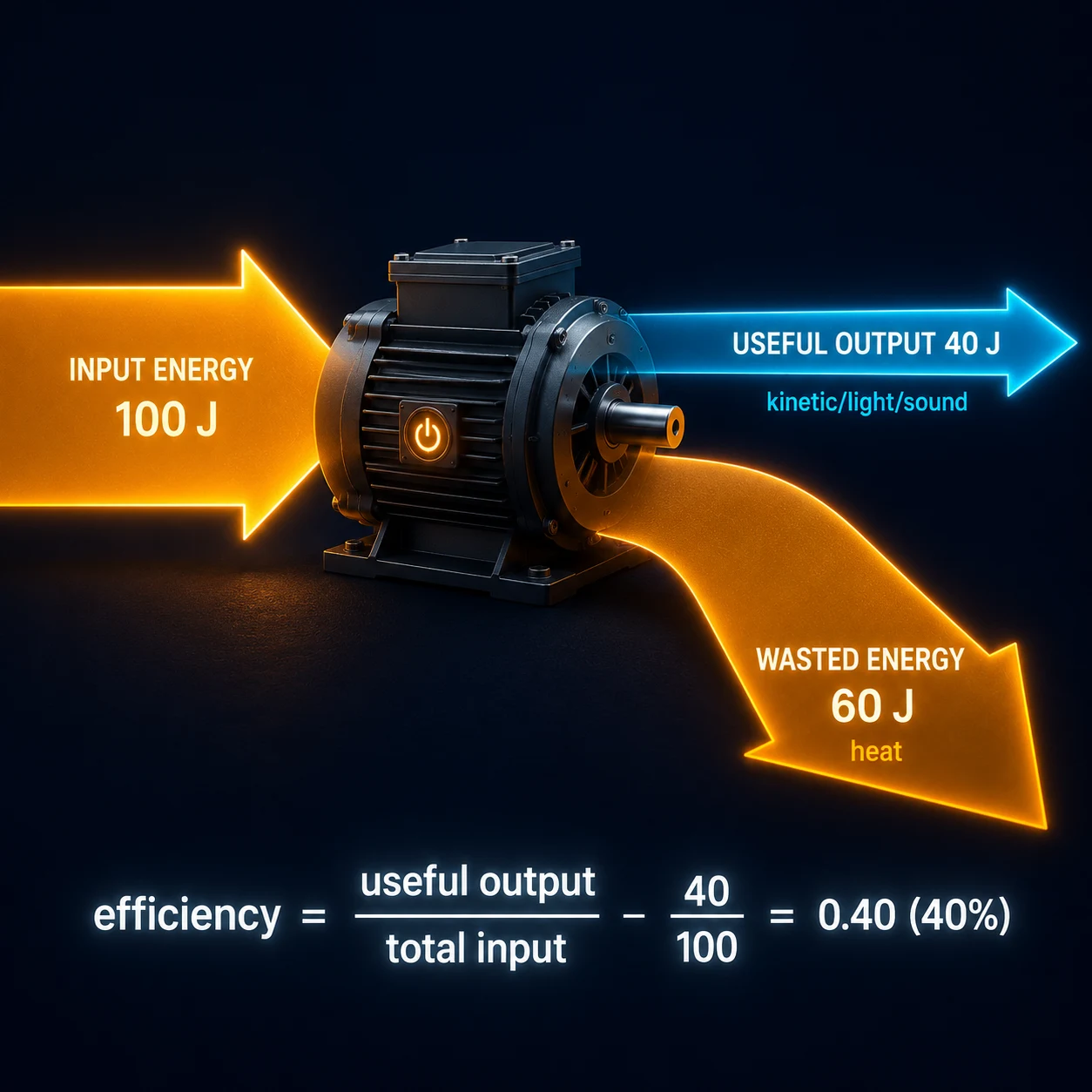
Figure 1: A Sankey diagram — arrow width is proportional to energy. 100 J in → 40 J useful (cyan) + 60 J wasted as heat (amber). Efficiency = 40%.
Efficiency is a measure of how well a device transfers input energy into useful output energy. It is expressed as a decimal (0 to 1) or as a percentage (0% to 100%).
Efficiency = Useful output energy ÷ Total input energy
To express as a percentage, multiply by 100:
Efficiency (%) = (Useful output energy ÷ Total input energy) × 100
You can also use power values instead of energy values:
Efficiency = Useful output power ÷ Total input power
Key facts about efficiency:
- Efficiency has no unit — it is a ratio (or percentage)
- Efficiency is always less than 100% (or less than 1 as a decimal)
- Wasted energy = Total input energy − Useful output energy
- Most wasted energy becomes thermal energy (heat) in the surroundings
Quick Check: A motor receives 500 J and produces 350 J of useful kinetic energy. Calculate its efficiency as a percentage.
Efficiency = (Useful output ÷ Total input) × 100 = (350 ÷ 500) × 100 = 70%. The motor is 70% efficient. Wasted energy = 500 − 350 = 150 J (likely as heat from friction).
This deep dive covers What Is Efficiency? within Efficiency for GCSE Physics. Revise Efficiency in Energy for GCSE Physics with 19 exam-style questions and 4 flashcards. This is a high-frequency topic, so it is worth revising until the explanation feels precise and repeatable. It is section 2 of 13 in this topic. Use this deep dive to connect the idea to the wider topic before moving on to questions and flashcards.
Practice questions for Efficiency
Which equation correctly defines efficiency?
Explain one method that can be used to reduce unwanted energy transfers in a machine and state how it reduces waste.