
This diagram covers DC Motor: Cross-Section within The Motor Effect for GCSE Physics. Revise The Motor Effect in Magnetism for GCSE Physics with 18 exam-style questions and 12 flashcards. This is a high-frequency topic, so it is worth revising until the explanation feels precise and repeatable. It is section 5 of 13 in this topic. Focus on the labels, the relationships between parts, and the explanation that turns the diagram into an exam-ready answer.
Topic position
Section 5 of 13
Practice
18 questions
Recall
12 flashcards
📊 DC Motor: Cross-Section
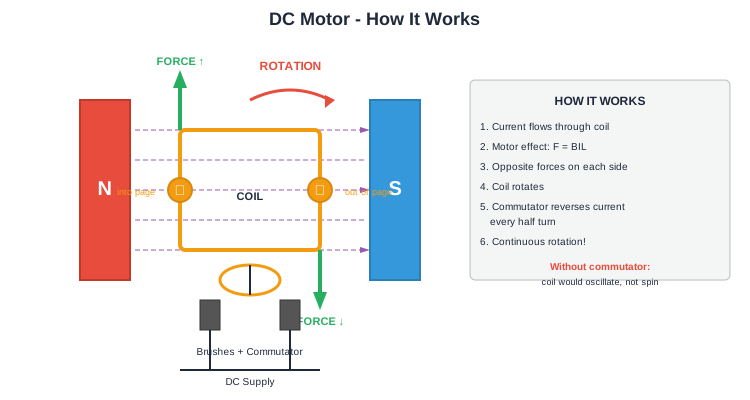
Figure 2: DC motor cross-section — the split-ring commutator reverses current every half turn to maintain continuous rotation.
KEY POINT: The commutator is essential — it reverses current every half turn so forces always push in the same rotational direction, giving continuous spin.
Quick Check: A wire carries a current of 3 A in a magnetic field of flux density 0.5 T. The length of wire in the field is 0.2 m. Calculate the force on the wire.
F = B × I × L = 0.5 × 3 × 0.2 = 0.3 N. The force acts at right angles to both the current and the magnetic field direction (use Fleming's Left-Hand Rule to find its direction).