MagnetismDiagram

Fleming's Left-Hand Rule (Motors)

Part of The Motor EffectGCSE Physics

This diagram covers Fleming's Left-Hand Rule (Motors) within The Motor Effect for GCSE Physics. Revise The Motor Effect in Magnetism for GCSE Physics with 18 exam-style questions and 12 flashcards. This is a high-frequency topic, so it is worth revising until the explanation feels precise and repeatable. It is section 3 of 13 in this topic. Focus on the labels, the relationships between parts, and the explanation that turns the diagram into an exam-ready answer.

Topic position

Section 3 of 13

Practice

18 questions

Recall

12 flashcards

📊 Fleming's Left-Hand Rule (Motors)

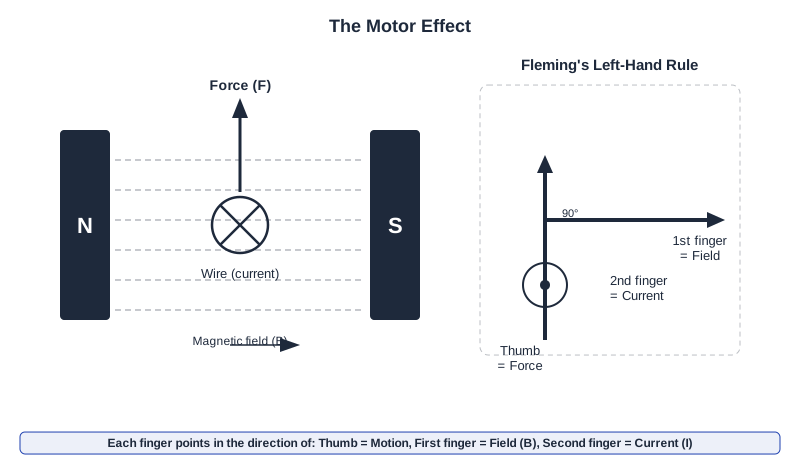
The motor effect showing a current-carrying wire between magnetic poles experiencing an upward force, alongside Fleming's Left-Hand Rule diagram showing thumb for force, first finger for magnetic field, and second finger for current direction

Figure 1: Fleming's Left-Hand Rule — use your left hand to find the direction of force on a current-carrying conductor in a magnetic field.

KEY INSIGHT: Use your LEFT hand for motors (force on a conductor). The thumb gives you the direction of the force!

Keep building this topic

Read this section alongside the surrounding pages in The Motor Effect. That gives you the full topic sequence instead of a single isolated revision point.

Practice Questions for The Motor Effect

What is the motor effect?

  • A. A force experienced by a current-carrying conductor placed in a magnetic field
  • B. The generation of a voltage when a conductor moves through a magnetic field
  • C. The heating of a wire when a large current flows through it
  • D. The attraction between two permanent magnets
1 markfoundation

Explain how Fleming's left-hand rule is used to find the direction of the force on a current-carrying conductor in a magnetic field.

2 marksstandard

Quick Recall Flashcards

Left hand: thumb =?
Motion/Force
Fleming's Left Hand: for?
Motors (force on current-carrying conductor)

Want to test your knowledge?

PrepWise has 18 exam-style questions and 12 flashcards for The Motor Effect — with adaptive difficulty and instant feedback.

Join Alpha