ForcesDiagram

Newton's Third Law Pairs

Part of Newton's Laws of MotionGCSE Physics

This diagram covers Newton's Third Law Pairs within Newton's Laws of Motion for GCSE Physics. Revise Newton's Laws of Motion in Forces for GCSE Physics with 13 exam-style questions and 15 flashcards. This is a high-frequency topic, so it is worth revising until the explanation feels precise and repeatable. It is section 7 of 15 in this topic. Focus on the labels, the relationships between parts, and the explanation that turns the diagram into an exam-ready answer.

Topic position

Section 7 of 15

Practice

13 questions

Recall

15 flashcards

📊 Newton's Third Law Pairs

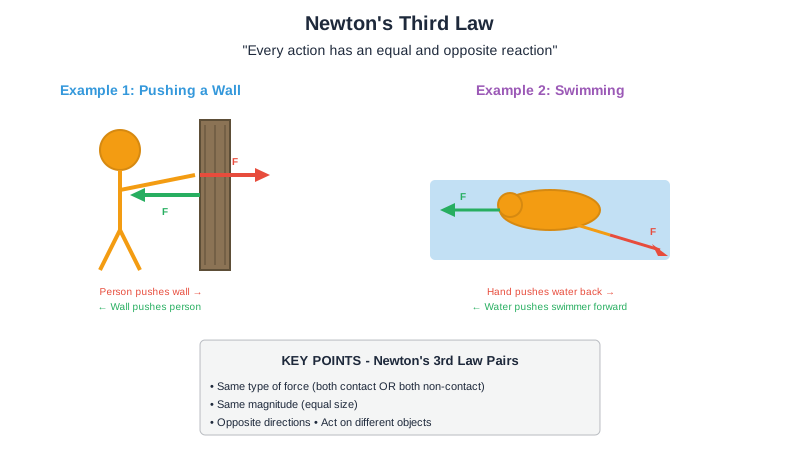
Newton's Third Law illustrated with two examples: a person pushing a wall where both push with equal and opposite forces, and a swimmer pushing water backwards while water pushes swimmer forwards, demonstrating action-reaction pairs

Figure 1: Newton's Third Law pairs — equal, opposite, different objects

KEY RULE: Third Law pairs have same magnitude, opposite direction, and MUST act on DIFFERENT objects. Weight and normal force are NOT a pair (both act on the same object).

Keep building this topic

Read this section alongside the surrounding pages in Newton's Laws of Motion. That gives you the full topic sequence instead of a single isolated revision point.

Practice Questions for Newton's Laws of Motion

According to Newton's First Law, what happens to an object when there is no resultant force acting on it?

  • A. It accelerates in the direction of motion
  • B. It remains at rest or continues moving at constant velocity
  • C. It decelerates and eventually stops
  • D. It changes direction
1 markfoundation

A spaceship is travelling through deep space far from any planets. The engines are switched off. Explain what will happen to the motion of the spaceship and why.

2 marksstandard

Quick Recall Flashcards

Key Concepts
A moment is the turning effect of a force
Key Concepts
Unit: Newton metres (Nm)

Want to test your knowledge?

PrepWise has 13 exam-style questions and 15 flashcards for Newton's Laws of Motion — with adaptive difficulty and instant feedback.

Join Alpha