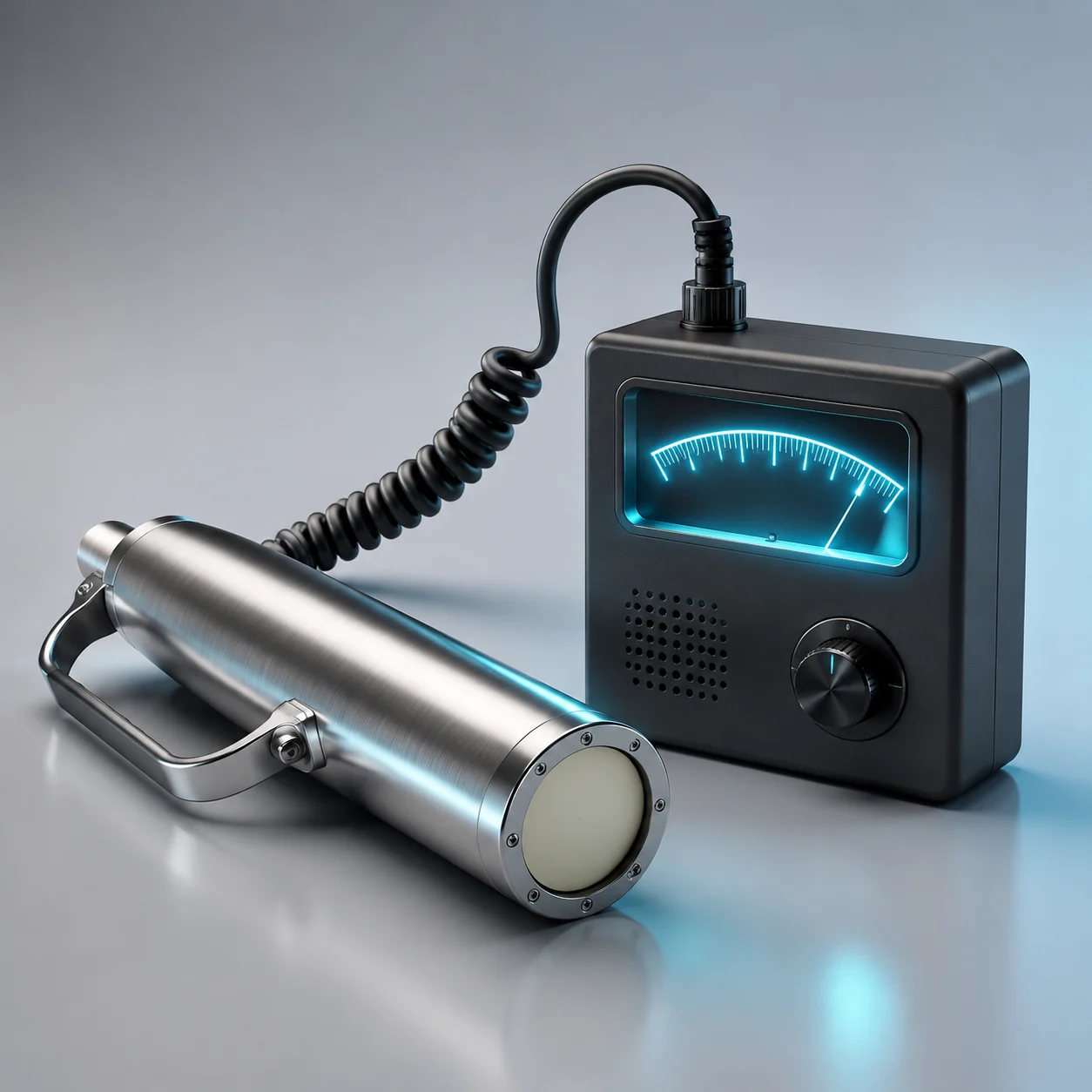
Figure 1: A Geiger-Muller counter — the brushed-steel probe at left detects radiation; the meter box at right counts and displays the rate.
Radioactivity is invisible, odourless, tasteless, and completely undetectable by human senses. Yet physicists need to measure it precisely — to determine how dangerous a source is, how quickly it is decaying, and whether a patient receiving a radioactive tracer is being exposed to a safe dose. How do you measure something your body cannot perceive?
The answer is instruments that convert radiation into something we can observe: flashes of light, electric pulses, or chemical changes in materials. Since the discovery of radioactivity by Henri Becquerel in 1896, a range of radiation detectors have been developed. The most important for GCSE are the Geiger-Muller (GM) tube and the photographic film badge. More recently, cloud chambers have become invaluable for visualising the tracks of individual particles.
Each detector has different strengths and weaknesses, and different types of radiation (alpha, beta, gamma) require different detection strategies because of their vastly different penetrating and ionising properties.
This introduction covers Detecting the Invisible: The Instruments that Revealed Radioactivity within Radiation Detection for GCSE Physics. Revise Radiation Detection in Extra Topics for GCSE Physics with 13 exam-style questions and 11 flashcards. Use this page as part of a wider topic revision path rather than treating it as an isolated fact. It is section 1 of 12 in this topic. Use this introduction to connect the idea to the wider topic before moving on to questions and flashcards.
Practice questions for Radiation Detection
What instrument is commonly used in school laboratories to detect ionising radiation?
Explain how a Geiger-Muller (GM) tube detects ionising radiation.