Detecting the Invisible: The Instruments that Revealed Radioactivity
⚛️ Detecting the Invisible: The Instruments that Revealed Radioactivity
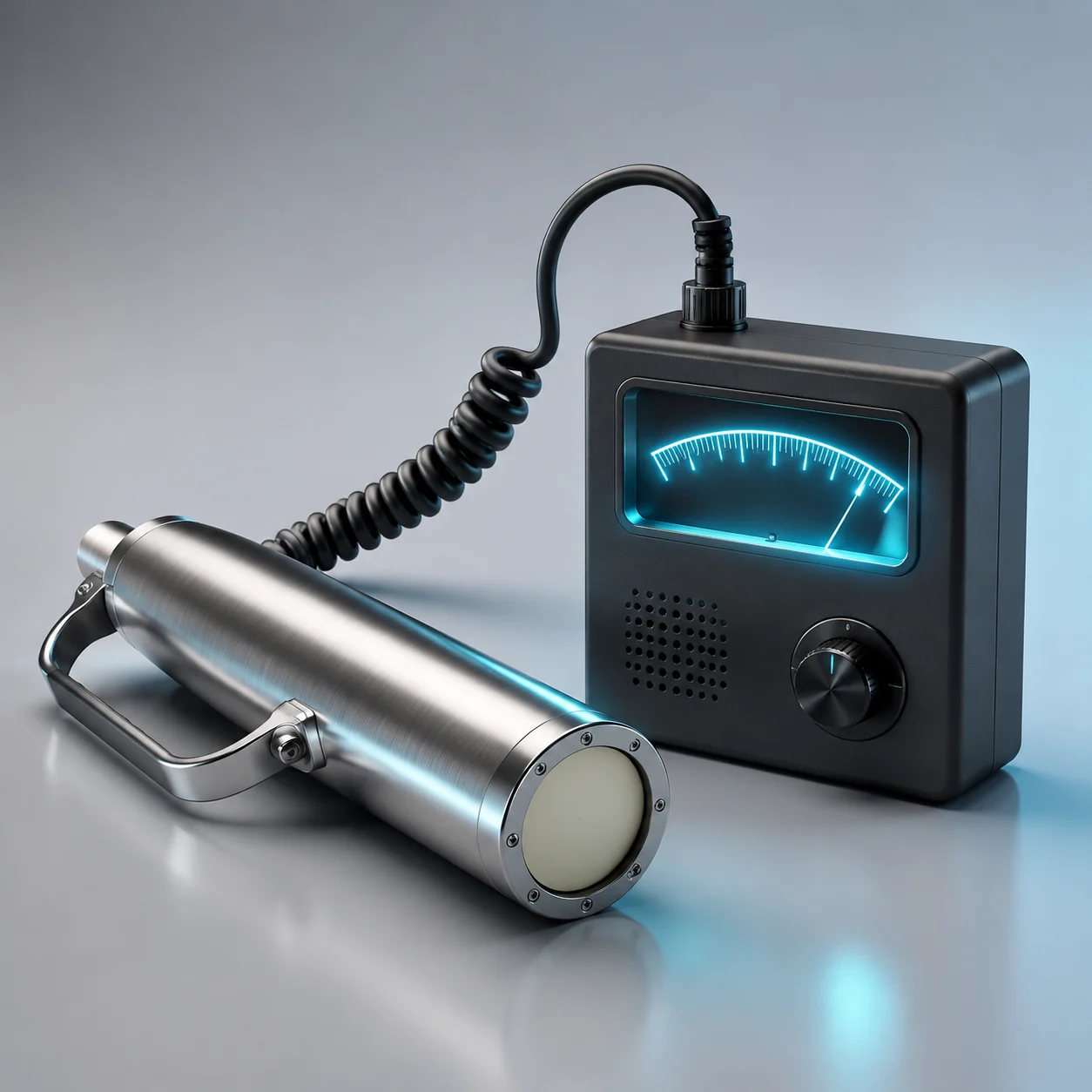
Figure 1: A Geiger-Muller counter — the brushed-steel probe at left detects radiation; the meter box at right counts and displays the rate.
Radioactivity is invisible, odourless, tasteless, and completely undetectable by human senses. Yet physicists need to measure it precisely — to determine how dangerous a source is, how quickly it is decaying, and whether a patient receiving a radioactive tracer is being exposed to a safe dose. How do you measure something your body cannot perceive?
The answer is instruments that convert radiation into something we can observe: flashes of light, electric pulses, or chemical changes in materials. Since the discovery of radioactivity by Henri Becquerel in 1896, a range of radiation detectors have been developed. The most important for GCSE are the Geiger-Muller (GM) tube and the photographic film badge. More recently, cloud chambers have become invaluable for visualising the tracks of individual particles.
Each detector has different strengths and weaknesses, and different types of radiation (alpha, beta, gamma) require different detection strategies because of their vastly different penetrating and ionising properties.
Figure 2: Inside the GM tube — radiation ionises argon gas, freed electrons accelerate to the central anode, producing a pulse of current the counter registers.
Earn the mark scheme marks
🧠 Memory Aids
Three Detectors — Three Jobs
- GM tube — Goes "click" — counts radiation events in real time
- Film badge — Film gets darker — measures dose over weeks or months
- Cloud chamber — Clouds form tracks — shows paths of individual particles
Cloud Chamber Tracks — Thick vs Thin
Alpha = Thick straight tracks (alpha is heavy, massive ionisation, stops quickly)
Beta = Thin wiggly tracks (beta is light, less ionisation, deflected by collisions)
Think: A = Alpha = Arrow-straight and thick, B = Beta = Bendy and thin
How GM Tube Works
Radiation → Ionises gas → Ions move → Current pulse → Counter clicks
Remember the word IONIC: Ionises gas → Once per particle → Now counted → Indicates count rate → Click!
Quick Check: In a cloud chamber, you observe two types of track: some thick and straight, some thin and wiggly. Identify the radiation type producing each track and explain how you can tell them apart.
Thick, straight tracks are alpha particles. Alpha particles are heavy (mass number 4) and doubly charged (+2), so they produce intense ionisation along a straight path and have a short, fixed range. Thin, wiggly tracks are beta particles. Beta particles are much lighter (electrons) and singly charged, so they ionise less intensely and are deflected more easily by collisions, creating longer, irregular paths.
Now try it yourself
Quiz · Question 1 of 13
What instrument is commonly used in school laboratories to detect ionising radiation?
Tap an answer to check it