Paper 1 Higher

PrepWiseGuide to a real paper

AQA GCSE Physics

Paper 1 Higher

June 2025
100 marks · 1 hour 45 minutes · 10 questions

A real paper, in its real order. Each description and answer is ours, so you can see how each mark is earned. Not made or approved by AQA.

The real exam gives you an equations sheet. See the equations

PrepWise guide: AQA GCSE Physics Paper 1 HigherQuestion 1

Tides and wind both turn turbines that generate electricity. 'Flow speed' means how fast the tide or the wind moves past a turbine. Figure 1 plots power output against flow speed for one tidal turbine and one wind turbine. Figure 2 shows those same two turbines where they stand. The wind turbine's rotor is 100 m across and the tidal turbine's rotor is 10 m across.
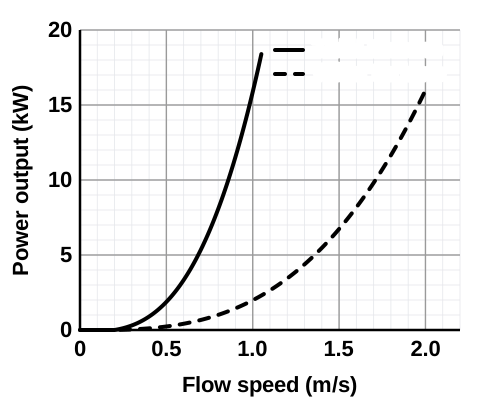
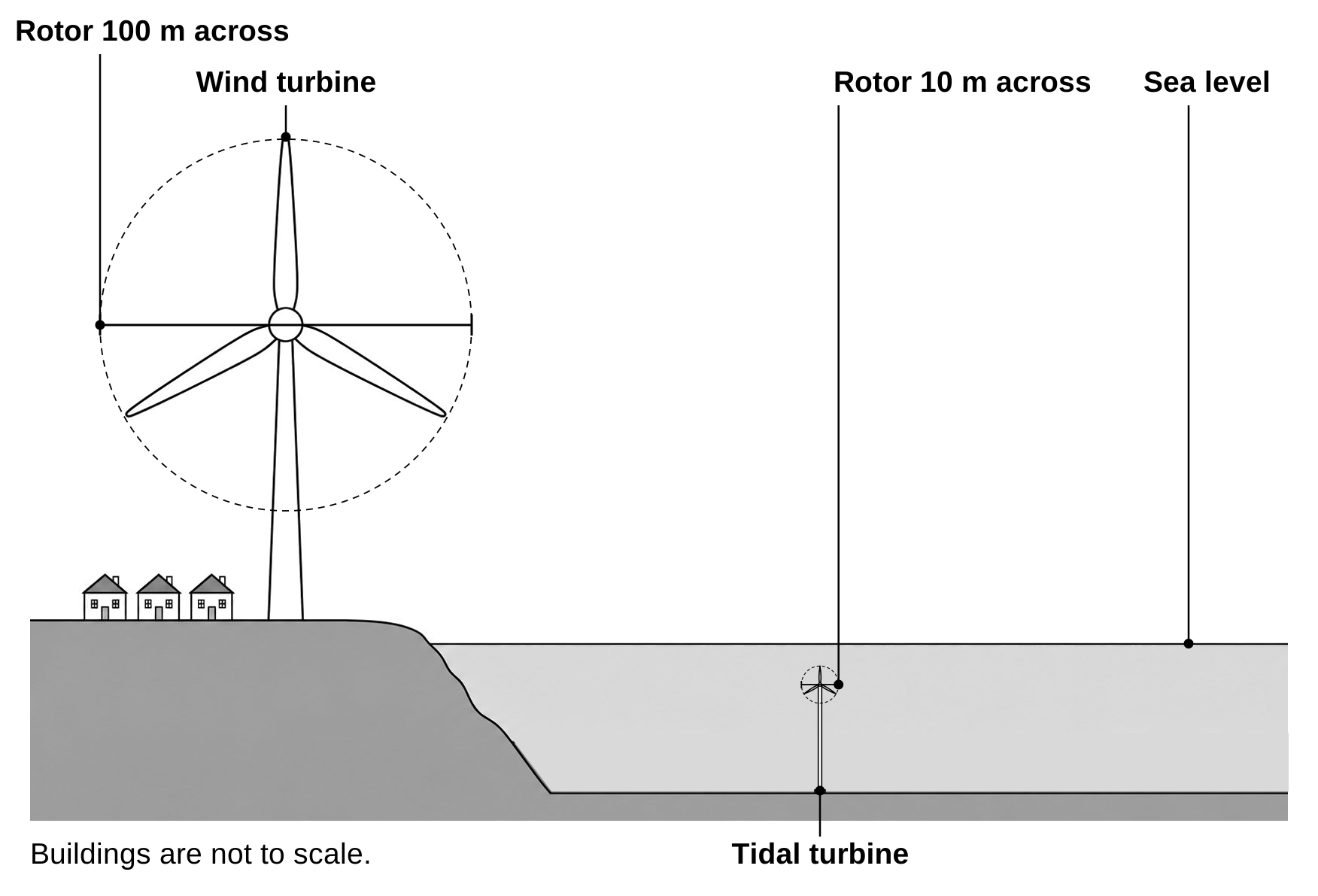
Figure 1
Line graph of power output against flow speed with one curve for a tidal turbine and one for a wind turbine.
Figure 2
Coastal scene: a wind turbine on land beside cottages, and a smaller tidal turbine under the sea.
01.1[2 marks]

How does a renewable energy resource differ from a non-renewable one?

See how you would score on Energy Resources
Show model answer for 01.1Hide model answer for 01.1

A renewable energy resource is replaced as it is used, so it can keep being used. A non-renewable energy resource exists in a limited amount, so it is used up and cannot be replaced in a useful time.

2 marks

How the marks are earned

  1. One mark: a renewable resource is replenished or replaced. Saying 'as it is used' is extra detail, not required.
  2. One mark: a non-renewable resource exists in a limited quantity, so its stock is finite.
  3. Saying only that one 'never runs out', 'will run out', 'will not last forever', has an 'infinite supply' or is 'sustainable' does not earn a mark.

Why it scores

Each half of the answer gets its own mark. The key idea is replacement against a finite stock, not a vague word like sustainable.

Revise Energy Resources
01.2[1 mark]

Write the equation that links density, mass and volume.

See how you would score on Density
Show model answer for 01.2Hide model answer for 01.2

density = mass over volume. In symbols:. ρ = m over V

1 mark

How the marks are earned

  1. Density equals mass divided by volume. Standard symbols are accepted.
Revise Density
01.3[3 marks]

The tidal turbine takes in 824 000 kg of seawater per second. Seawater has density 1030 kg/m3. Calculate the volume of that seawater.

See how you would score on Density
Show model answer for 01.3Hide model answer for 01.3

Start from the density equation:. density = mass over volume. Put in the values:. 1030 = 824 000 over V

Rearrange to get the volume on its own:. V = 824 000 over 1030

So the volume is 800 m3.

3 marks

How the marks are earned

  1. One mark: put the mass and the density into the density equation.
  2. One mark: rearrange so volume is mass divided by density.
  3. One mark: the final value, 800. The unit, cubic metres, is not needed for the mark here, but always write it.

Why it scores

Both real values in the equation earn the first mark, and they show the examiner you chose the right equation.

The volume on one side and the two values on the other earns the second mark.

The division gives the final mark. The unit is not needed for the mark here, but always write it.

Revise Density
01.4[2 marks]

Figure 1 also shows that power output rises with flow speed. State two other conclusions you can draw from it.

See how you would score on Energy Resources
Show model answer for 01.4Hide model answer for 01.4

From about 0.2 m/s up to where the tidal curve ends, at about 1.05 m/s, the tidal turbine gives a greater power output than the wind turbine at the same flow speed. Over that range, the same increase in flow speed raises the tidal power by more than it raises the wind power.

2 marks

How the marks are earned

  1. Any two, one mark each: no output at the very lowest flow speeds; the tidal curve sits above the wind curve from about 0.2 m/s up to where the tidal curve ends, at about 1.05 m/s (saying the wind turbine needs quicker flow for equal output is the same point, so it earns this mark once only); a rise in speed lifts tidal output more than wind output; output does not grow in step with speed.
  2. Remarks about dependability or efficiency earn nothing, since the graph does not show them. Saying the tide flows more slowly than the wind is wrong, and it cancels one correct conclusion even if you state that conclusion as well: the graph compares outputs at the same speed. Calling the rise exponential earns nothing.

Why it scores

Two separate conclusions, each read directly from the graph and comparing the two generators. The claim is limited to the range from about 0.2 m/s to the end of the tidal curve, because the graph says nothing beyond it. Each conclusion earns a mark.

Revise Energy Resources
01.5[4 marks]

Using Figure 2, compare the effects on the environment of the two turbines.

See how you would score on Energy Resources
Show model answer for 01.5Hide model answer for 01.5

The wind turbine stands in the open with a rotor 100 m across, so it spoils the view far more than the tidal turbine, whose 10 m rotor is hidden under the water. People nearby are also more likely to hear the wind turbine, because the sound of the tidal turbine stays under the water.

The wind turbine can kill flying birds, whereas fish and other sea life are more at risk from the tidal turbine. The wind turbine is much bigger, so it takes more raw materials to build each one. Figure 1 shows it gives less power at the same flow speed, so more of them are needed for the same output, which uses still more materials.

Levels of response, 4 marks

How the marks are earned

  1. This is level marked. For 1 or 2 marks, simple separate statements are enough. For 3 or 4 marks, the points need detail and clear reasons that are joined up, not a list.
  2. Useful comparisons: size and how visible each is, noise, the materials needed to build them, how many are needed for the same power, and the effect on wildlife.
  3. The question asks for a comparison, so link points to both turbines where you can. The scheme does not require every point to name both.

Why it scores

Each sentence links a feature (position, size) to its impact (view, noise). That logical linking is what the top level rewards.

Figure 2 shows no wildlife, so the harm to birds and to sea life comes from your own knowledge; each generator gets its own impact. The size of the wind turbines and the number needed at the same flow speed give the reason for the greater use of materials, which is the logical linking needed for the top level.

Revise Energy Resources
AQA owns the copyright in its exam questions, so we cannot copy their wording. These descriptions and answers are ours. Not made or approved by AQA.[12 marks]
PrepWise guide: AQA GCSE Physics Paper 1 HigherQuestion 2

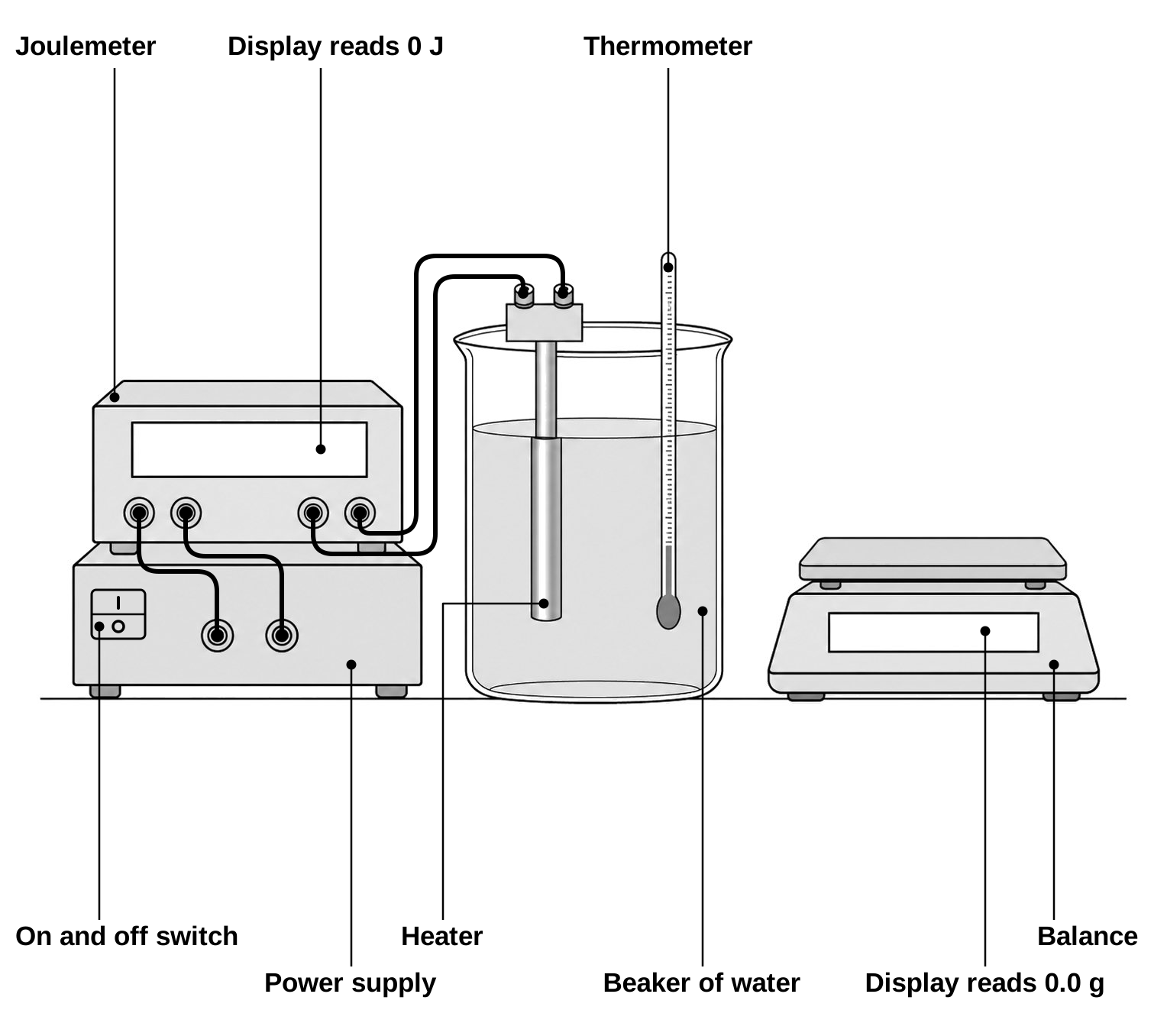
A student wants a value for water's specific heat capacity. Figure 3 shows the kit: a power supply, a joulemeter that records the energy transferred, a heater and a thermometer in a beaker of water, and a separate balance.

Figure 3
Apparatus: power supply and joulemeter joined by leads to a heater in a beaker of water with a thermometer, plus a separate balance.
02.1[1 mark]

Name one hazard that the set-up in Figure 3 presents.

See how you would score on Specific Heat Capacity
Show model answer for 02.1Hide model answer for 02.1

The hot water, which could scald skin if it spilt.

1 mark

How the marks are earned

  1. Name the hazard itself: hot water, a hot beaker, the hot heater, spilt water or broken glass.
  2. Describing the harm alone, without naming the item, does not earn the mark.
Revise Specific Heat Capacity
02.2[6 marks]

Set out a method, using Figure 3, that gives a value for water's specific heat capacity.

See how you would score on Specific Heat Capacity
Show model answer for 02.2Hide model answer for 02.2

Put the empty beaker on a balance and record its mass. Add water, record the new mass, and subtract the first reading from the second to find the mass of water.

Put the heater and thermometer in the water, with the heater fully covered, and record the starting temperature. Zero the joulemeter and switch on the power supply. After some minutes, switch off, then record the energy shown on the joulemeter and the highest temperature reached.

Change the mass from grams to kilograms. Find the temperature change by subtracting the start from the finish.. Then use this equation:. energy = mass × specific heat capacity × temperature change. Rearrange it to:. c = fraction: E over m × Δθ, end of fraction. Use it to calculate the specific heat capacity.

Levels of response, 6 marks

How the marks are earned

  1. This is level marked. For 5 or 6 marks the method must work and its steps must follow a sensible order. For 3 or 4 marks most steps appear, but the method may fail or the order may slip. For 1 or 2 marks only some steps appear, with no clear links.
  2. The top level also needs a clear way of finding the mass of water: use a balance for the empty beaker and again for the beaker with water, then subtract.
  3. Say what is read and where from: energy from the joulemeter, temperature before and after from the thermometer.
  4. Finish by using the specific heat capacity equation to calculate the answer.
  5. Extra detail, not required for a mark: changing the mass from grams to kilograms before the calculation.

Why it scores

Showing how the mass is found is essential for the top level. The mass cannot simply be assumed.

These are the key measurements, taken in a logical order. The energy and the temperature rise must come from the same period of heating, and the water carries on warming for a moment after the heater goes off.

A method is only complete when the measured values are combined with the correct equation to reach the result.

Revise Specific Heat Capacity
02.3[1 mark]

Some energy escapes from the water into the room. How could the apparatus be altered to cut this loss?

See how you would score on Specific Heat Capacity
Show model answer for 02.3Hide model answer for 02.3

Wrap the beaker in an insulating material, such as cotton wool.

1 mark

How the marks are earned

  1. Add insulation around the beaker, or put a lid on it. A named insulating material is fine, and so is swapping the beaker for an insulating cup, such as a plastic one.
Revise Specific Heat Capacity
02.4[2 marks]

The student's result is 4410 J/kg °C. The accepted value is 4200 J/kg °C. Find the percentage difference between them.

See how you would score on Specific Heat Capacity
Show model answer for 02.4Hide model answer for 02.4

Difference = 4410 − 4200. = 210 J/kg °C. Percentage difference = 210 over 4200 × 100. = 5%

2 marks

How the marks are earned

  1. One mark: find the difference between the two values, or set out the percentage calculation correctly.
  2. One mark: the correct percentage. Divide by the accepted value, not the student's value.

Why it scores

The first step finds the size of the error and the second compares it with the accepted value. Dividing by the student's value instead gives 4.76%, which is marked wrong.

Revise Specific Heat Capacity
AQA owns the copyright in its exam questions, so we cannot copy their wording. These descriptions and answers are ours. Not made or approved by AQA.[10 marks]
PrepWise guide: AQA GCSE Physics Paper 1 HigherQuestion 3

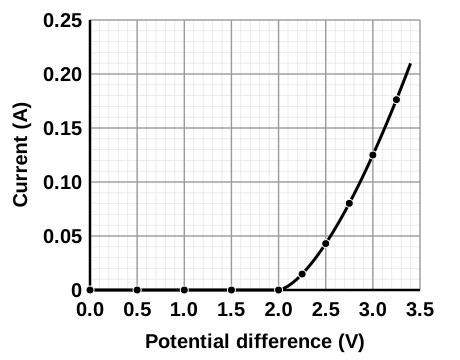
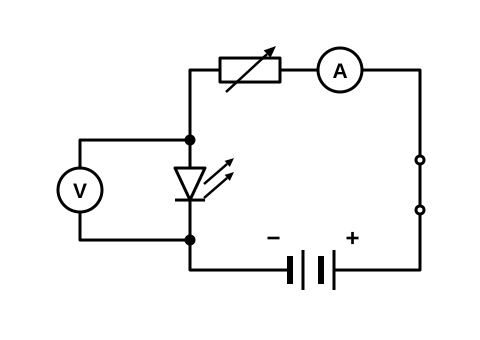
A student measures the current through an LED at different values of potential difference. Figure 4 is the circuit, with its supply connected the first way. Figure 5 is the graph of the readings.

Figure 4
Circuit diagram: a battery, switch, ammeter, variable resistor and LED in a loop, with a voltmeter connected across the LED.
Figure 5
Graph of current against potential difference for an LED. Current is zero up to 2.0 volts, then rises in a curve.
03.1[1 mark]

Using the circuit in Figure 4, name one way to change the LED's potential difference.

See how you would score on I-V Characteristics
Show model answer for 03.1Hide model answer for 03.1

Adjust the variable resistor in the circuit.

1 mark

How the marks are earned

  1. Give one practical change that alters the LED's potential difference: use or adjust the variable resistor, add or remove cells, add a second battery, pick a battery with a different potential difference, or put extra parts in the loop.
Revise I-V Characteristics
03.2[1 mark]

Which word equation is right? Tick one box.

See how you would score on Resistance & Ohm's Law
potential difference = current + resistance
potential difference = current × resistance
potential difference = current ÷ resistance
potential difference = resistance ÷ current
Show model answer for 03.2Hide model answer for 03.2

potential difference = current × resistance. In symbols:. V = I × R

1 mark

How the marks are earned

  1. One mark: tick the equation where potential difference equals current multiplied by resistance.
Revise Resistance & Ohm's Law
03.3[4 marks]

Find the LED's resistance at 3.0 V, reading from Figure 5.

See how you would score on I-V Characteristics
Show model answer for 03.3Hide model answer for 03.3

Go up from 3.0 V on the horizontal axis to the curve, then across to the vertical axis. The current is 0.125 A.

Start from this equation:. V = I × R. Put in the values:. 0.125 × R = 3.0. Rearrange for the resistance:. R = 3.0 over 0.125. = 24 Ω

4 marks

How the marks are earned

  1. One mark: read the current from the graph at the stated potential difference.
  2. One mark: substitute into V = I × R.
  3. One mark: rearrange to R = V ÷ I.
  4. One mark: the correct resistance, 24. The unit, ohms, is not needed for this mark, but always write it. For the first mark, read between 0.12 A and 0.13 A. Later marks follow your own reading between 0.10 A and 0.15 A.

Why it scores

A careful graph reading is the first mark. A small reading error is allowed, and later marks follow your own value.

The substitution, the rearrangement and the answer each earn a mark, so show all three lines.

Revise I-V Characteristics
03.4[2 marks]

The student swaps the supply connections in Figure 4. The ammeter now reads 0.0 A at every potential difference. Explain this reading.

See how you would score on I-V Characteristics
Show model answer for 03.4Hide model answer for 03.4

An LED has a very high resistance in the reverse direction. So the current is too small for the ammeter to show, and it reads 0.0 A.

2 marks

How the marks are earned

  1. One mark: the LED has a very high resistance.
  2. One mark: this very high resistance applies in the reverse direction. This mark depends on the first.
  3. If neither is scored, one mark is given for saying an LED only lets current through one way.

Why it scores

The first mark is the very high resistance, and the second links it to the reverse direction. The second mark depends on the first.

Revise I-V Characteristics
AQA owns the copyright in its exam questions, so we cannot copy their wording. These descriptions and answers are ours. Not made or approved by AQA.[8 marks]
PrepWise guide: AQA GCSE Physics Paper 1 HigherQuestion 4

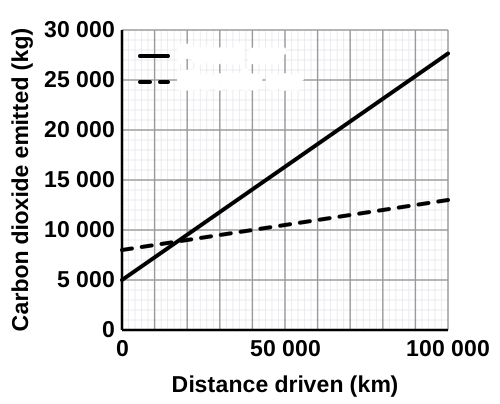
Building a car releases carbon dioxide, before it has driven any distance. Figure 6 tracks the total carbon dioxide from two cars, one petrol and one electric, as the distance each has driven grows.

Figure 6
Graph of carbon dioxide emitted against distance driven, with a straight line for a petrol car and one for an electric car.
04.1[2 marks]

Explain one way that carbon dioxide emissions harm the environment.

See how you would score on Energy Resources
Show model answer for 04.1Hide model answer for 04.1

As a greenhouse gas, carbon dioxide absorbs infrared radiation that would otherwise escape to space. More energy stays in the atmosphere, so average temperatures rise worldwide. This global warming brings changes such as higher sea levels.

2 marks

How the marks are earned

  1. One mark: it is a greenhouse gas. Absorbing infrared radiation, or causing the greenhouse effect, also earns this.
  2. One mark: this leads to global warming or climate change. Examples such as rising sea levels or more extreme weather are accepted.

Why it scores

A full explanation names the gas property first and then the environmental result. Just saying 'pollution' earns nothing.

Revise Energy Resources
04.2[1 mark]

Read from Figure 6 how much carbon dioxide building the electric car released.

See how you would score on Energy Resources
Show model answer for 04.2Hide model answer for 04.2

8000 kg. The electric car's line meets the vertical axis there, at zero distance, before the car has been driven.

1 mark

How the marks are earned

  1. Read the value where the electric car's line starts, at zero distance. The unit is not needed for the mark here, but always write it.
Revise Energy Resources
04.3[1 mark]

At one distance the two cars have released equal totals of carbon dioxide. Use Figure 6 to find this distance.

See how you would score on Energy Resources
Show model answer for 04.3Hide model answer for 04.3

17 000 km, where the two lines cross.

1 mark

How the marks are earned

  1. Read the distance at the point where the two lines meet. Anything from 16 000 km to 18 000 km is accepted.
Revise Energy Resources
04.4[2 marks]

The electric car runs from a battery and emits nothing as it moves. Explain why its total still rises with distance.

See how you would score on Energy Resources
Show model answer for 04.4Hide model answer for 04.4

The further the car goes, the more often its battery must be recharged. Some of the electricity for charging is generated in power stations that burn coal, oil or gas, and these release carbon dioxide.

2 marks

How the marks are earned

  1. One mark: the car or its battery has to be recharged.
  2. One mark: that electricity comes from burning coal, oil or gas, or fossil fuels. Saying only some of it does is extra detail.

Why it scores

The first idea is the charging, and the second links that charging to fossil fuels.

Revise Energy Resources
04.5[2 marks]

Which two energy resources release no carbon dioxide while generating electricity? Tick two boxes.

See how you would score on Energy Resources
Wood
Solar
Oil
Nuclear
Biofuel
Show model answer for 04.5Hide model answer for 04.5

Nuclear and solar. Neither burns a fuel containing carbon when it generates electricity.

2 marks

How the marks are earned

  1. One mark for ticking nuclear and one mark for ticking solar.
  2. Ticking extra boxes cancels a correct tick.

Why it scores

Wood, oil and biofuel all release carbon dioxide when they are burned to generate electricity, because each contains carbon. Only the two that burn no such fuel earn the marks.

Revise Energy Resources
AQA owns the copyright in its exam questions, so we cannot copy their wording. These descriptions and answers are ours. Not made or approved by AQA.[8 marks]
PrepWise guide: AQA GCSE Physics Paper 1 HigherQuestion 5

Lasers can heat a tiny sample of a hydrogen isotope enough to begin nuclear fusion.

05.1[2 marks]

Explain what makes two atoms isotopes of one element.

See how you would score on Atomic Structure
Show model answer for 05.1Hide model answer for 05.1

Isotopes are atoms of one element whose nuclei hold equal numbers of protons yet unequal numbers of neutrons, so their mass numbers differ.

2 marks

How the marks are earned

  1. One mark: isotopes share a proton count, which is their atomic number, so they are the same element.
  2. One mark: their neutron counts differ, which changes the mass number. Saying a different mass number also earns this.
  3. Electron numbers earn nothing.

Why it scores

Both halves are needed. Proton number fixes the element, and the neutron difference is what makes them isotopes.

Revise Atomic Structure
05.2[3 marks]

Describe the process of fusion and say where the energy it releases comes from.

See how you would score on Nuclear Fission & Fusion
Show model answer for 05.2Hide model answer for 05.2

Two light nuclei, such as hydrogen nuclei, are forced together at very high temperature and join to make a heavier nucleus, such as helium.

The new nucleus has slightly less mass than the nuclei that joined. The missing mass is converted into energy, which is released as radiation.

3 marks

How the marks are earned

  1. One mark: light nuclei, such as hydrogen nuclei, fuse, which means they join into one nucleus. Saying only that they collide or bond is not enough. A very high temperature is extra detail and is not required.
  2. One mark: the nucleus produced is heavier than either starting nucleus, for example helium.
  3. One mark: the product has slightly less mass, and that mass has become energy. Saying the energy is radiation is extra detail, not required.

Why it scores

This covers the first two points: what joins and what forms.

The mass to energy conversion is what actually releases the energy, so it is the final mark.

Revise Nuclear Fission & Fusion
05.3[2 marks]

Fusion in a reactor releases huge amounts of energy. Explain why the reactor's walls need an extremely high specific heat capacity.

See how you would score on Specific Heat Capacity
Show model answer for 05.3Hide model answer for 05.3

Specific heat capacity is the energy needed to raise the temperature of 1 kg of a material by 1 °C. When it is very high, the walls can take in huge amounts of energy yet warm only slightly. Their temperature therefore stays below their melting point.

2 marks

How the marks are earned

  1. One mark: a huge energy input produces only a small temperature rise in the walls.
  2. One mark: the walls therefore stay below their melting point. Saying they should not melt also earns this.

Why it scores

The link is energy to small temperature rise in the walls to staying below the melting point. Each step earns a mark, so the chain must be complete.

Revise Specific Heat Capacity
05.4[1 mark]

Fission can run out of control as a chain reaction. State one possible result.

See how you would score on Nuclear Fission & Fusion
Show model answer for 05.4Hide model answer for 05.4

A meltdown of the reactor.

1 mark

How the marks are earned

  1. Accept one serious outcome of a chain reaction running out of control: the reactor core melting down, a nuclear blast or bomb, or the Chernobyl or Fukushima disaster.
Revise Nuclear Fission & Fusion
AQA owns the copyright in its exam questions, so we cannot copy their wording. These descriptions and answers are ours. Not made or approved by AQA.[8 marks]
PrepWise guide: AQA GCSE Physics Paper 1 HigherQuestion 6

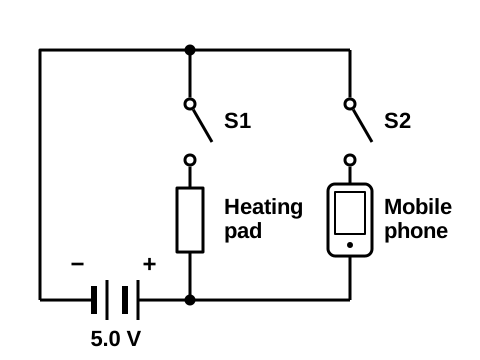
A 5.0 V battery powers the pad in a hand warmer, and it can also charge a phone. Figure 7 is the circuit: S1 controls the pad, drawn as a resistor, and S2 controls the phone.

Figure 7
Circuit diagram: a 5.0 volt battery feeding two parallel branches, switch S1 with a resistor and switch S2 with a mobile phone.
06.1[3 marks]

The 0.20 kg pad has a specific heat capacity of 1600 J/kg °C and receives 8000 J. Calculate its temperature increase.

See how you would score on Specific Heat Capacity
Show model answer for 06.1Hide model answer for 06.1

Start from this equation:. E = m × c × Δθ. Put in the values:. 8000 = 0.20 × 1600 × Δθ

Rearrange for the temperature change:. Δθ = fraction: 8000 over 0.20 × 1600, end of fraction. = 8000 over 320. = 25 °C

3 marks

How the marks are earned

  1. One mark: substitute the values into energy = mass × specific heat capacity × temperature change.
  2. One mark: rearrange to find the temperature change.
  3. One mark: the final temperature increase, 25. The unit is not needed for the mark here, but always write it.

Why it scores

The substitution mark needs the actual numbers in place.

The rearranged form earns the rearrangement mark, and the division gives the final mark. Multiply the two quantities you divide by first, so that you divide by both of them. The unit is not needed for the mark here, but always write it.

Revise Specific Heat Capacity
06.2[4 marks]

The 5.0 V battery gives the pad 180 kJ of energy. Find the charge that flows through the battery.

See how you would score on Potential Difference
Show model answer for 06.2Hide model answer for 06.2

180 kJ = 180 000 J.

Use this equation:. E = Q × V. Put in the values:. 180 000 = Q × 5.0. Rearrange for the charge:. Q = 180 000 over 5.0. = 36 000 C

4 marks

How the marks are earned

  1. One mark: change kilojoules to joules.
  2. One mark: substitute into energy transferred = charge flow × potential difference.
  3. One mark: rearrange to find the charge flow.
  4. One mark: the correct final value. The unit, coulombs, is not needed for the mark here, but always write it.

Why it scores

Units come first. Not converting loses only the conversion mark, and later marks still follow from the unconverted value.

The substitution and the rearrangement earn two working marks, and the division gives the answer. The unit is not needed for the mark here, but always write it.

Revise Potential Difference
06.3[3 marks]

Compare the battery's power output with S1 closed alone and with S1 and S2 both closed. Explain the difference.

See how you would score on Series & Parallel Circuits
Show model answer for 06.3Hide model answer for 06.3

Closing S2 as well as S1 adds a parallel branch, which gives the current another path, so the circuit's total resistance falls.

The battery's potential difference stays the same, so by this equation the current from the battery increases:. I = V over R

Battery power = current × potential difference. With the potential difference fixed and more current flowing, the battery now delivers more power than with S1 alone.

3 marks

How the marks are earned

  1. One mark: the circuit's total resistance goes down.
  2. One mark: the current from the battery goes up. This mark depends on the first.
  3. One mark: the power is greater, because the potential difference is unchanged and P = I × V. Reasoning with P = I2 × R earns nothing here unless the comparison is worked out with numbers.

Why it scores

This is the starting point. Extra paths in parallel always lower the total resistance.

This applies the equation for the current and depends on the resistance having fallen.

Naming the equation and which quantity stays fixed is what earns the final mark.

Revise Series & Parallel Circuits
AQA owns the copyright in its exam questions, so we cannot copy their wording. These descriptions and answers are ours. Not made or approved by AQA.[10 marks]
PrepWise guide: AQA GCSE Physics Paper 1 HigherQuestion 7
07.1[1 mark]

Why might scientists replace an atomic model? Tick one box.

See how you would score on Atomic Structure
A model goes out of date simply because it is old.
Experiments find results that the current model fails to account for.
A model must be replaced after a fixed number of years.
A new model is made when people find the old one hard to follow.
Show model answer for 07.1Hide model answer for 07.1

A model is replaced when experiments produce results it fails to explain.

1 mark

How the marks are earned

  1. Tick the statement saying a model changes when experiments give results the old model fails to explain.
Revise Atomic Structure
07.2[2 marks]

Early researchers were both irradiated and contaminated by radioactive materials. Describe how irradiation differs from radioactive contamination.

See how you would score on Uses & Hazards of Radiation
Show model answer for 07.2Hide model answer for 07.2

Irradiation is exposure to radiation, for example from a source outside the body, and no radioactive material stays on the person. Contamination is when radioactive atoms get onto or inside a person or object, so they keep emitting radiation there.

2 marks

How the marks are earned

  1. One mark: an irradiated person has been exposed to radiation. Saying that nothing radioactive is left behind is extra detail, not required.
  2. One mark: a contaminated person or object carries unwanted radioactive material on the surface or inside.

Why it scores

Each term needs its own definition. The key difference is whether radioactive material is present on or in the person.

Revise Uses & Hazards of Radiation
07.3[2 marks]

Polonium-210 decays to lead. Find each ?: 210Po (atomic number ?) → ?Pb (atomic number 82) + 4He (atomic number 2).

See how you would score on Radioactive Decay
Show model answer for 07.3Hide model answer for 07.3

The helium nucleus given out is an alpha particle. The product has atomic number 82, as given.. An alpha particle removes 2 protons, so for the atomic numbers to balance across the arrow, the starting element has this atomic number:. 82 + 2 = 84. The alpha particle also removes 4 from the mass number, so for the mass numbers to balance, the product has this mass number:. 210 − 4 = 206

2 marks

How the marks are earned

  1. One mark: the atomic number of the starting element, 84. Work it out from the given 82 plus the 2 protons an alpha particle takes away.
  2. One mark: the mass number of the product, 206. Work it out as 210 − 4, the mass number an alpha particle takes away.

Why it scores

Atomic numbers and mass numbers must each balance across the arrow. Checking that each total balances gives both missing numbers without guessing.

Revise Radioactive Decay
07.4[3 marks]

The half-life of polonium-210 is 138 days. Calculate how long 256 000 atoms of it take to fall to 16 000.

See how you would score on Half-Life
Show model answer for 07.4Hide model answer for 07.4

Halving 256 000 four times gives 128 000, then 64 000, then 32 000, then 16 000. So 4 half-lives are needed.

Time = 4 × 138. = 552 days

3 marks

How the marks are earned

  1. One mark: find how many half-lives are needed by repeated halving. The number is 4.
  2. One mark: multiply the number of half-lives by the length of one half-life, 138 days.
  3. One mark: the final time. The unit, days, is not needed for the mark here, but always write it.

Why it scores

Halving step by step is the safest method and makes the number of half-lives clear.

Multiplying the count by the half-life gives the time, and the answer must be in the same unit as the half-life.

Revise Half-Life
07.5[2 marks]

Half the atoms in a sample are polonium-209, half-life 125 years. The rest are polonium-210, half-life 138 days. Compare the two activities and explain.

See how you would score on Half-Life
Show model answer for 07.5Hide model answer for 07.5

Polonium-209 has the lower activity of the two isotopes, because its half-life is much longer. Each polonium-209 nucleus is less likely to decay in a given second, so with equal numbers of atoms of each isotope, polonium-209 gives fewer decays per second than polonium-210.

2 marks

How the marks are earned

  1. One mark: name polonium-209 as the isotope with the lower activity, compared with polonium-210.
  2. One mark: give its much longer half-life as the reason. This mark counts only if the comparison mark is scored.

Why it scores

The first sentence uses the word activity to name which isotope has the lower value, and gives the reason, its much longer half-life. Describing only the rate of decay is not enough.

Revise Half-Life
AQA owns the copyright in its exam questions, so we cannot copy their wording. These descriptions and answers are ours. Not made or approved by AQA.[10 marks]
PrepWise guide: AQA GCSE Physics Paper 1 HigherQuestion 8

A scientist seals some liquid nitrogen inside a container. The liquid is already at the temperature where it boils.

08.1[4 marks]

Transferring 9950 J to the boiling liquid turns 50 g of it into gas. Calculate nitrogen's specific latent heat of vaporisation.

See how you would score on Specific Latent Heat
Show model answer for 08.1Hide model answer for 08.1

50 g = 0.050 kg.

Use this equation:. E = m × L. Put in the values:. 9950 = 0.050 × L. Rearrange for the latent heat:. L = 9950 over 0.050. = 199 000 J/kg

4 marks

How the marks are earned

  1. One mark: change grams to kilograms.
  2. One mark: substitute into energy = mass × specific latent heat.
  3. One mark: rearrange to find the latent heat.
  4. One mark: the correct value. The unit, joules per kilogram, is not needed for the mark here, but always write it.

Why it scores

The equation needs the mass in kilograms. If this conversion goes wrong you lose only this mark, because later marks follow from your own mass.

Showing the substitution and the rearranged form picks up the working marks, and the division gives the final answer. The unit is not needed for the mark here, but always write it.

Revise Specific Latent Heat
08.2[3 marks]

Explain the change in the nitrogen's internal energy as it boils from liquid to gas.

See how you would score on States of Matter
Show model answer for 08.2Hide model answer for 08.2

Internal energy is the total kinetic and potential energy of all the particles. While the liquid boils, the energy supplied pulls the particles apart, so their potential energy increases.

Boiling happens at a fixed temperature, so the particles keep the same average speed and kinetic energy. Potential energy has risen and kinetic energy has not, so the overall internal energy has risen.

3 marks

How the marks are earned

  1. One mark: the particles' potential energy goes up.
  2. One mark: the particles' kinetic energy does not change. The reason, a steady temperature, is extra detail and is not required.
  3. One mark: the internal energy therefore goes up. This mark needs both earlier points.

Why it scores

Naming the correct store that changes is the key first mark.

The constant temperature shows kinetic energy is unchanged, and combining both stores gives the conclusion.

Revise States of Matter
08.3[4 marks]

The nitrogen has all boiled, and now the gas gets hotter. Explain what happens to the pressure in the sealed container.

See how you would score on Gas Pressure & Temperature
Show model answer for 08.3Hide model answer for 08.3

Heating the gas raises the mean kinetic energy of its particles, so they move faster.

Faster particles hit the walls of the container harder, so each collision exerts a larger force. They also hit the walls more often, because they move faster and the volume is fixed.

More force from more frequent collisions on the same wall area means the pressure of the gas increases.

4 marks

How the marks are earned

  1. One mark: the particles' mean kinetic energy goes up, or their mean speed goes up. Either one is enough.
  2. One mark: each collision with a wall exerts a larger force.
  3. One mark: collisions with the walls happen more often.
  4. One mark: so the pressure increases. This depends on at least one other mark.

Why it scores

This starts the chain at the correct place: temperature relates to particle energy.

Two separate effects each earn a mark. Force per collision and frequency of collisions are both needed.

The final mark links the particle effects back to pressure, so it only counts if earlier points are present.

Revise Gas Pressure & Temperature
AQA owns the copyright in its exam questions, so we cannot copy their wording. These descriptions and answers are ours. Not made or approved by AQA.[11 marks]
PrepWise guide: AQA GCSE Physics Paper 1 HigherQuestion 9

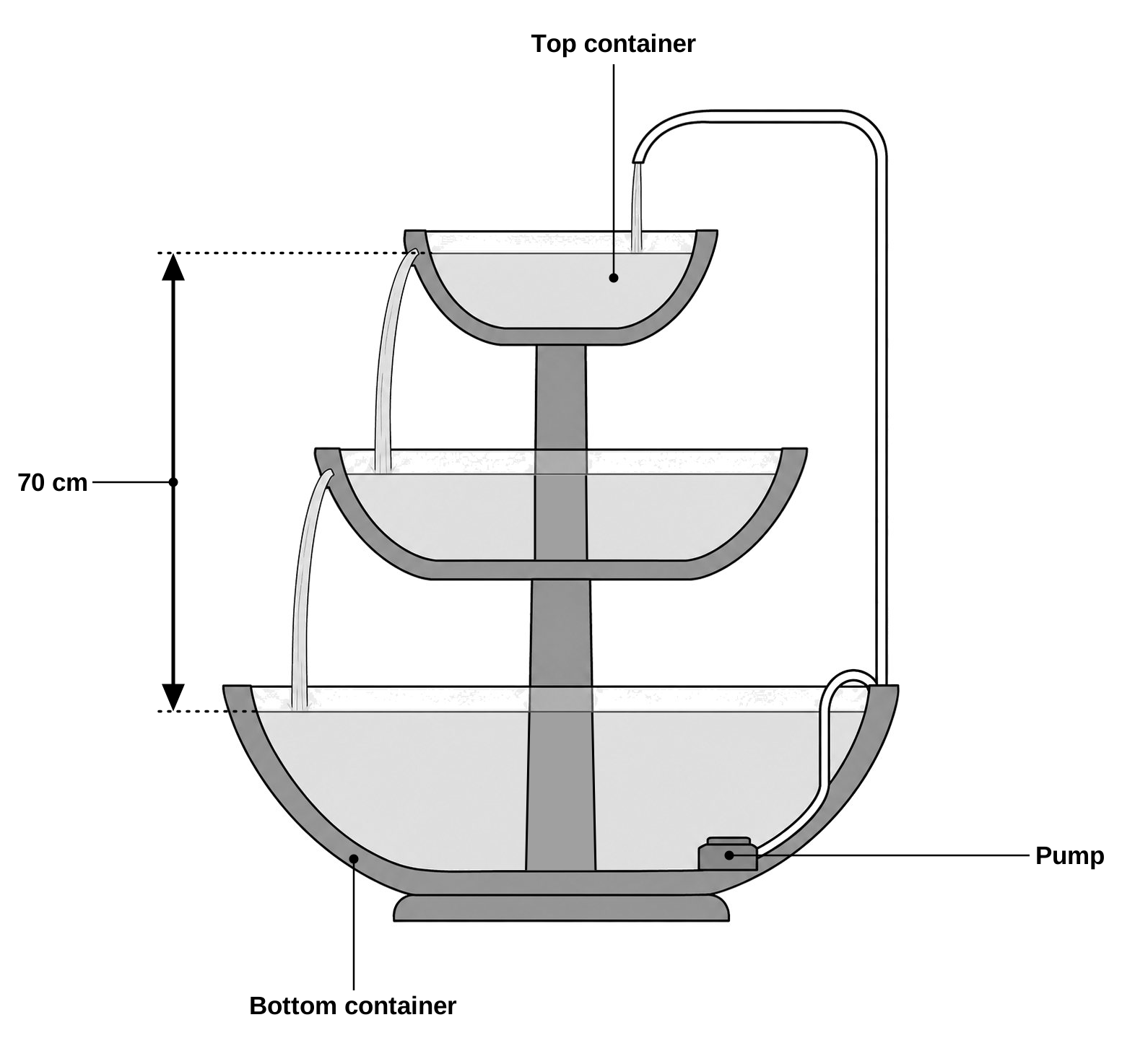
Figure 8 shows a water feature for a garden. Its electric motor drives a pump, which raises water 70 cm from the lowest container to the highest. The water then runs back down.

Figure 8
Side view of a three-tier water feature with a pump, showing a 70 centimetre height between the water levels in the bottom and top containers.
09.1[4 marks]

Each second the water gains 0.343 J as gravitational potential energy. Using g = 9.8 N/kg, calculate the mass pumped per second.

See how you would score on Gravitational Potential Energy
Show model answer for 09.1Hide model answer for 09.1

The height in Figure 8 is 70 cm, which is 0.70 m.

Gravitational potential energy = mass × gravitational field strength × height. Substituting:. 0.343 J = m × 9.8 N/kg × 0.70 m. Rearranging:. m = fraction: 0.343 J over 9.8 N/kg × 0.70 m, end of fraction. = 0.343 over 6.86. = 0.050 kg

4 marks

How the marks are earned

  1. One mark: take the height from Figure 8 and convert it to metres.
  2. One mark: substitute into the gravitational potential energy equation.
  3. One mark: rearrange to find the mass.
  4. One mark: the correct mass. The unit, kilograms, is not needed for the mark here, but always write it.

Why it scores

The first mark is for finding the right quantity in the figure and converting it. Later marks still follow if the conversion is wrong.

The marks are for the height (found in the first step), the substitution, the rearrangement and the answer. Stating the equation first keeps the order clear. The unit is not needed for the mark here, but always write it.

Revise Gravitational Potential Energy
09.2[6 marks]

The motor has a power of 4.86 W and a resistance of 6.0 Ω. Find the charge that passes through it in 30 minutes.

See how you would score on Electrical Power & Energy
Show model answer for 09.2Hide model answer for 09.2

P = I2 × R. Put in the values:. 4.86 = I2 × 6.0. Rearrange for I2:. I2 = 4.86 over 6.0. = 0.81. Taking the square root:. I = √0.81. = 0.90 A

The time is 30 minutes, so change it to seconds:. 30 × 60 = 1800 s

Q = I × t. = 0.90 × 1800. = 1620 C

6 marks

How the marks are earned

  1. One mark: substitute into power = current squared × resistance.
  2. One mark: rearrange to get current squared.
  3. One mark: find the current.
  4. One mark: change minutes to seconds.
  5. One mark: substitute into charge flow = current × time.
  6. One mark: the final charge. The unit, coulombs, is not needed for the mark here, but always write it.
  7. Later marks follow through from your own current, and from your own time if the conversion is wrong.

Why it scores

This is three marks: substituting, rearranging and finding the square root. Forgetting the square root is a common mistake.

Time must be in seconds for the charge equation.

Substituting the current and time and multiplying gives the last two marks. 1600 C is also accepted. The unit is not needed for the mark here, but always write it.

Revise Electrical Power & Energy
09.3[2 marks]

The motor is replaced by one with the same input power but a greater efficiency. Explain the effect on the water flow.

See how you would score on Efficiency
Show model answer for 09.3Hide model answer for 09.3

A more efficient motor wastes a smaller proportion of its input energy, so more of the same input power is useful. This lifts a greater mass of water each second, so the flow of water increases.

2 marks

How the marks are earned

  1. One mark: more water is lifted each second, or the flow increases. Saying only that the water moves faster does not earn this.
  2. One mark: because less energy or power is wasted, a smaller proportion of the input energy is wasted, or the useful power output is greater.

Why it scores

The cause is less wasted energy and the effect is greater useful power, which lifts more water each second.

Revise Efficiency
AQA owns the copyright in its exam questions, so we cannot copy their wording. These descriptions and answers are ours. Not made or approved by AQA.[12 marks]
PrepWise guide: AQA GCSE Physics Paper 1 HigherQuestion 10

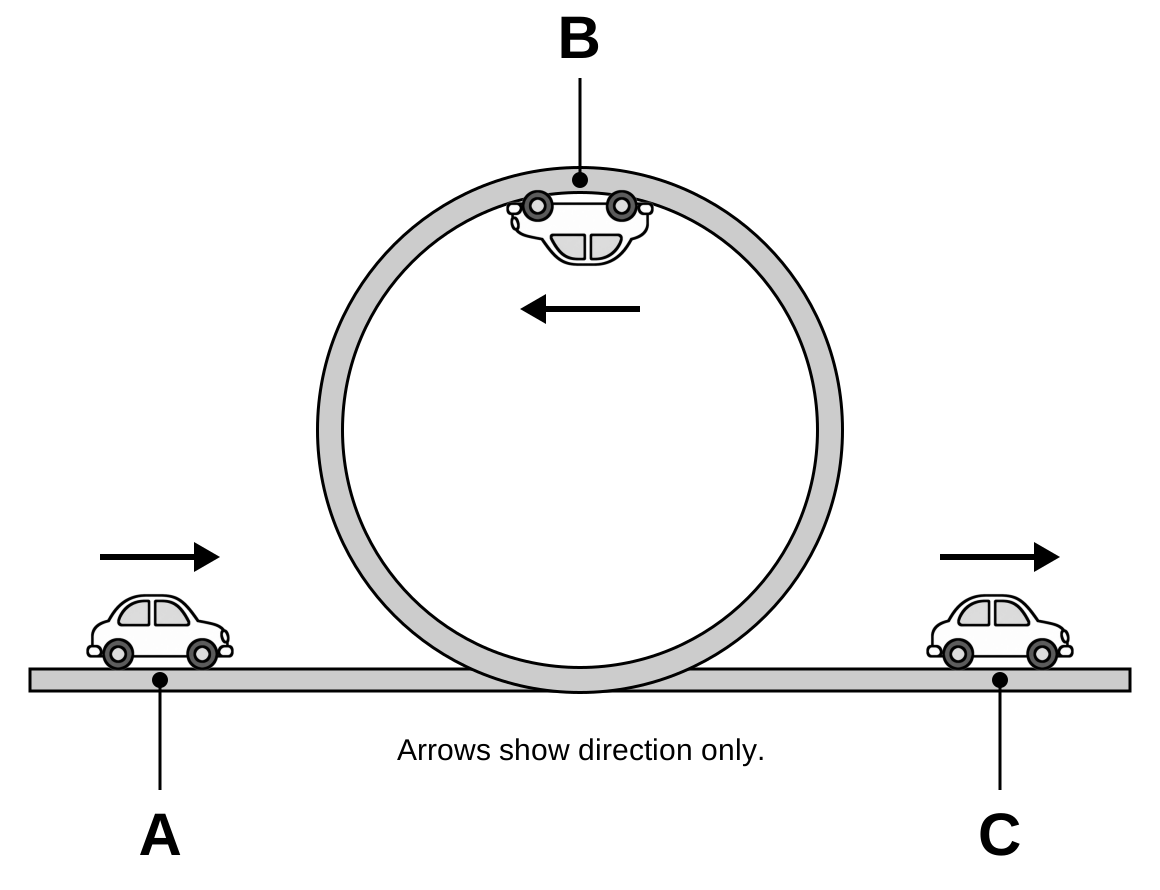
A spring launcher starts a toy car on a race track. Pulling its handle squashes the spring, and letting go passes the spring's stored energy to the car. Figure 9 shows a loop further along the track, with three marked positions.

Figure 9
Toy car track with a loop. A and C are on the flat track either side of the loop; B is at the top.
10.1[6 marks]

The spring compresses by 0.075 m. Spring constant 64 N/m, car mass 0.052 kg. Calculate the car's greatest possible speed to 2 significant figures.

See how you would score on Energy Stores & Systems
Show model answer for 10.1Hide model answer for 10.1

Elastic energy = ½ × k × e2. Here e is the compression. So:. energy = 0.5 × 64 × 0.0752. = 0.18 J

Take all of the spring's stored energy as becoming kinetic energy of the car.. Kinetic energy = ½ × m × v2. The energy is 0.18 J and m is 0.052 kg. So:. v2 = fraction: 0.18 over ½ × 0.052, end of fraction. = 0.18 over 0.026. = 6.92

Taking the square root gives about 2.63 m/s, so the speed written to two significant figures is 2.6 m/s.

6 marks

How the marks are earned

  1. One mark: substitute into elastic energy = ½ × spring constant × extension squared.
  2. One mark: the elastic energy value.
  3. One mark: substitute this energy into the kinetic energy equation.
  4. One mark: rearrange for speed squared.
  5. One mark: find the speed.
  6. One mark: round correctly to 2 significant figures. A wrong speed earns this only if your working used every value given: the compression, the spring constant and the mass.
  7. The force and acceleration route also earns marks, one at each stage: greatest force 4.8 N; greatest acceleration 92.3 m/s2; average acceleration 46.2 m/s2; speed squared from 2 × 46.2 × 0.075, about 6.923; speed about 2.631 m/s; then 2.6 m/s.

Why it scores

This uses the correct equation, with the compression as e, and gives the energy stored. On the energy route, this equation must be used for the later calculation marks to count, and those marks then follow from your own energy value.

Equating the two energies is the key idea. The maximum speed assumes no energy is wasted.

The square root gives the speed and the final mark is for rounding to the stated number of significant figures.

Revise Energy Stores & Systems
10.2[3 marks]

In Figure 9 the car runs A to B to C. Assuming no friction or air resistance, describe how its energy stores change.

See how you would score on Energy Stores & Systems
Show model answer for 10.2Hide model answer for 10.2

From A to B the car rises, so its kinetic energy decreases and its gravitational potential energy increases. Energy is transferred from the kinetic store to the gravitational potential store.

From B to C the car falls, so its gravitational potential energy decreases and its kinetic energy increases, with no energy wasted. At C the car is back at the height of A, so each store is the same size as it was at A.

3 marks

How the marks are earned

  1. One mark: on the way from A to B, the kinetic store falls.
  2. One mark: over that same stretch, the gravitational potential store grows.
  3. One mark: past B on the way to C, the gravitational potential store drains back into the kinetic store.

Why it scores

This covers both changes on the way up. Both stores need to be named with the direction of change.

This is the reverse transfer on the way down and earns the final mark.

Revise Energy Stores & Systems
10.3[2 marks]

As the car finishes, a light gate works out its speed. Which two measurements does it need? Tick two boxes.

See how you would score on Forces & Their Effects
The car's mass
How long the car takes to cross the gate
The air temperature in the room
How long the car is, front to back
The distance from start to finish of the whole track
Show model answer for 10.3Hide model answer for 10.3

How long the car is, and the time it takes to go through the gate.. Speed = distance over time. Use the car's length as the distance.

2 marks

How the marks are earned

  1. One mark for how long the car is, front to back, which is the distance it covers while it blocks the light.
  2. One mark for the time it takes to cross the gate.
  3. Ticking extra boxes cancels a correct tick.

Why it scores

Speed needs a distance and a time. The gate gives the time, and the length of the car that cuts the beam is the distance moved in that time.

Revise Forces & Their Effects
AQA owns the copyright in its exam questions, so we cannot copy their wording. These descriptions and answers are ours. Not made or approved by AQA.[11 marks]
END OF QUESTIONS100 marks total
See how you would score on Energy Resources

Our own questions on this topic, marked straight away, so you see what to revise. Free now.