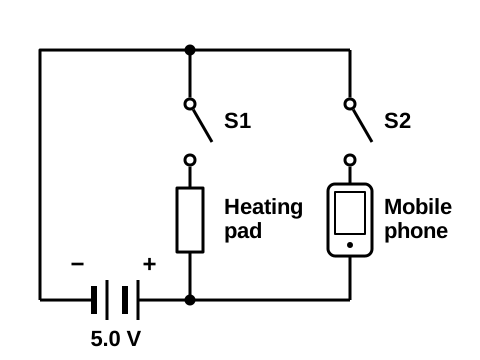
A 5.0 V battery powers the pad in a hand warmer, and it can also charge a phone. Figure 7 is the circuit: S1 controls the pad, drawn as a resistor, and S2 controls the phone.
The 0.20 kg pad has a specific heat capacity of 1600 J/kg °C and receives 8000 J. Calculate its temperature increase.
Our own questions on this topic, marked straight away, so you see what to revise. Free now.
Show model answer for 06.1Hide model answer for 06.1
Start from this equation:. E = m × c × Δθ. Put in the values:. 8000 = 0.20 × 1600 × Δθ
Rearrange for the temperature change:. Δθ = fraction: 8000 over 0.20 × 1600, end of fraction. = 8000 over 320. = 25 °C
How the marks are earned
- One mark: substitute the values into energy = mass × specific heat capacity × temperature change.
- One mark: rearrange to find the temperature change.
- One mark: the final temperature increase, 25. The unit is not needed for the mark here, but always write it.
Why it scores
The substitution mark needs the actual numbers in place.
The rearranged form earns the rearrangement mark, and the division gives the final mark. Multiply the two quantities you divide by first, so that you divide by both of them. The unit is not needed for the mark here, but always write it.
Revise Specific Heat CapacityThe 5.0 V battery gives the pad 180 kJ of energy. Find the charge that flows through the battery.
See how you would score on Potential DifferenceShow model answer for 06.2Hide model answer for 06.2
180 kJ = 180 000 J.
Use this equation:. E = Q × V. Put in the values:. 180 000 = Q × 5.0. Rearrange for the charge:. Q = 180 000 over 5.0. = 36 000 C
How the marks are earned
- One mark: change kilojoules to joules.
- One mark: substitute into energy transferred = charge flow × potential difference.
- One mark: rearrange to find the charge flow.
- One mark: the correct final value. The unit, coulombs, is not needed for the mark here, but always write it.
Why it scores
Units come first. Not converting loses only the conversion mark, and later marks still follow from the unconverted value.
The substitution and the rearrangement earn two working marks, and the division gives the answer. The unit is not needed for the mark here, but always write it.
Revise Potential DifferenceCompare the battery's power output with S1 closed alone and with S1 and S2 both closed. Explain the difference.
See how you would score on Series & Parallel CircuitsShow model answer for 06.3Hide model answer for 06.3
Closing S2 as well as S1 adds a parallel branch, which gives the current another path, so the circuit's total resistance falls.
The battery's potential difference stays the same, so by this equation the current from the battery increases:. I = V over R
Battery power = current × potential difference. With the potential difference fixed and more current flowing, the battery now delivers more power than with S1 alone.
How the marks are earned
- One mark: the circuit's total resistance goes down.
- One mark: the current from the battery goes up. This mark depends on the first.
- One mark: the power is greater, because the potential difference is unchanged and P = I × V. Reasoning with P = I2 × R earns nothing here unless the comparison is worked out with numbers.
Why it scores
This is the starting point. Extra paths in parallel always lower the total resistance.
This applies the equation for the current and depends on the resistance having fallen.
Naming the equation and which quantity stays fixed is what earns the final mark.
Revise Series & Parallel Circuits