Paper 1 Higher

PrepWiseGuide to a real paper

Edexcel GCSE Physics

Paper 1 Higher

June 2025
100 marks · 1 hour 45 minutes · 10 questions

A real paper, in its real order. Each description and answer is ours, so you can see how each mark is earned. Not made or approved by Edexcel.

The real exam gives you an equations sheet. See the equations

PrepWise guide: Edexcel GCSE Physics Paper 1 HigherQuestion 1

The topic here is infrasound and ultrasound. In Figure 1 a technician holds a device that sends out a short ultrasound pulse and detects the echo from a wall.
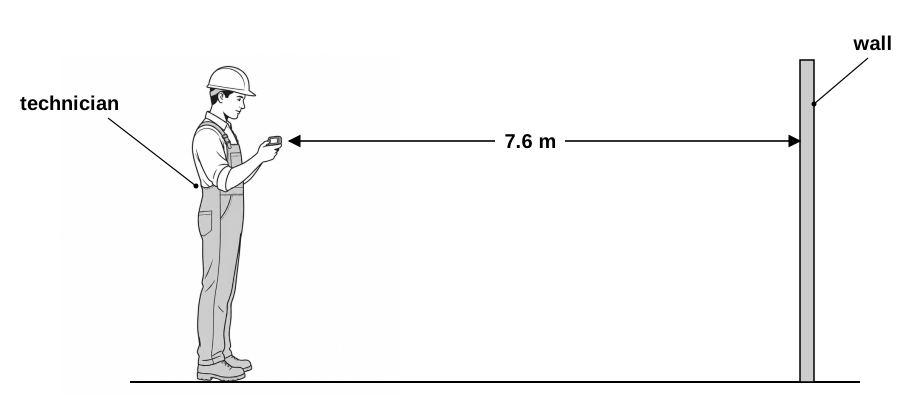
Figure 1
Side view of a technician on the left holding a hand-held device towards a tall thin wall on the right, with a double-headed arrow between the device and the wall marked 7.6 m.
01.1[1 mark]

(a) Pick the frequency that is infrasound. Tick one box.

See how you would score on Sound Waves
2.2 hertz
2.2 kilohertz
22 hertz
22 kilohertz
Show model answer for 01.1Hide model answer for 01.1

2.2 Hz. Infrasound lies below about 20 Hz, so only 2.2 Hz fits. 22 Hz is already audible, and the kilohertz values are thousands of hertz, far higher still.

1 mark

How the marks are earned

  1. Tick 2.2 Hz, the only value below 20 Hz, the lowest frequency people can hear.
Revise Sound Waves
01.2[3 marks]

(b) The wall stands 7.6 m away, and ultrasound travels at 330 m/s in air. Find the time before the echo returns.

See how you would score on Sound Waves
Show model answer for 01.2Hide model answer for 01.2

The echo comes from a pulse that goes to the wall and returns, so the total distance travelled is:. total distance = 2 × 7.6. = 15.2 m

Start with the speed equation:. speed = distance over time. Rearrange for the time:. time = distance over speed. = 15.2 over 330

The time is 0.046 s.

3 marks

How the marks are earned

  1. One mark: start from speed = distance ÷ time, in the form time = distance ÷ speed.
  2. One mark: put in the values. The pulse travels to the wall and back, so the distance is 2 × 7.6, giving (2 × 7.6) ÷ 330. Using 7.6 ÷ 330 on its own also earns this mark.
  3. One mark: the final time, 0.046 s. Any value that rounds to 0.046, such as 0.04606, is fine. Using the one-way distance gives 0.023 s, which scores only the first two marks.
  4. The right final answer on its own earns full marks.

Why it scores

Counting the journey both ways is the step most students miss. Skipping it halves the answer.

Choosing the equation and substituting the values earn the first two marks.

The last mark is for the evaluation. The one-way distance would give 0.023 s and lose it.

Revise Sound Waves
01.3[2 marks]

(c) Give a scientific reason why a person cannot hear infrasound.

See how you would score on Sound Waves
Show model answer for 01.3Hide model answer for 01.3

Infrasound has a frequency below 20 Hz. That is lower than the lowest frequency the human ear can detect, so the ear does not respond to it.

2 marks

How the marks are earned

  1. Frequency route, one mark: the frequency of infrasound is what matters.
  2. Frequency route, one mark: that frequency is too low, below the 20 Hz bottom of human hearing. Saying it is below 20 Hz earns both marks.
  3. Ear route, 2 marks instead: name a part of the ear, such as the cochlea, eardrum, ossicles, hairs or membrane (1), and say it cannot vibrate in response, for example it is too stiff or too thin to respond (1).

Why it scores

One mark names the frequency as the cause and the other says it is too low, below the hearing range. Saying the frequency is below 20 Hz covers both.

Revise Sound Waves
Edexcel owns the copyright in its exam questions, so we cannot copy their wording. These descriptions and answers are ours. Not made or approved by Edexcel.[6 marks]
PrepWise guide: Edexcel GCSE Physics Paper 1 HigherQuestion 2

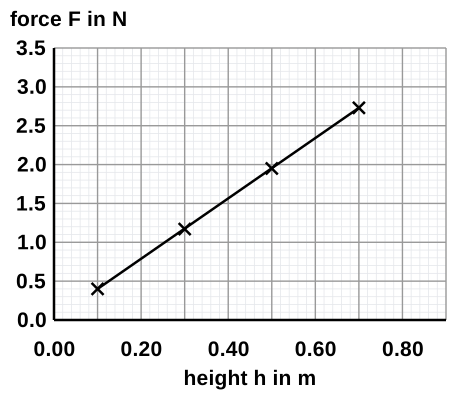
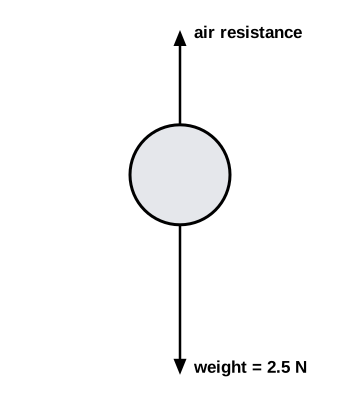
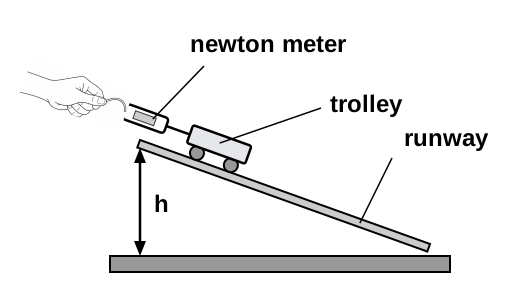
Figure 2 shows a beach ball falling through air, with a downward weight of 2.5 N and an upward air resistance. In Figure 3 students use a newton meter to hold a trolley still on a runway whose raised end is at height h. Figure 4 plots the force needed against h.

Figure 2
A beach ball with a long downward arrow labelled weight 2.5 N beneath it and a shorter upward arrow above it labelled air resistance, with no value given for air resistance.
Figure 3
Side view of a runway sloping down to the right, raised at its left end above a flat surface. A trolley sits near the high end, held by a newton meter that a hand holds. A vertical double-headed arrow labelled h shows the height of the high end.
Figure 4
Graph of force F in newtons from 0.0 to 3.5 against height h in metres from 0.00 to 0.80, with a grid. Four crosses, at h = 0.10, 0.30, 0.50 and 0.70, are joined by a straight line that rises steadily to the right.
02.1[3 marks]

(a)(i) The ball, mass 0.25 kg, has a downward resultant force of 0.92 N. Calculate its acceleration in m/s2.

See how you would score on Newton's Laws of Motion
Show model answer for 02.1Hide model answer for 02.1

Only the resultant force makes the ball accelerate, so F in the equation is 0.92 N, not the 2.5 N weight.

Start with the equation:. F = m × a. Rearrange for the acceleration:. a = F over m. = 0.92 over 0.25

a = 3.68. So the acceleration is 3.7 m/s2.

3 marks

How the marks are earned

  1. One mark: use the resultant force, 0.92 N, as F in F = m × a, not the weight. If nothing else scores, writing a = F ÷ m on its own earns one mark.
  2. One mark: rearrange and substitute, a = 0.92 ÷ 0.25. The substitution still counts if the two values are multiplied, or divided the other way round. This mark still follows if a wrong force, for example the weight or the air resistance, is used correctly in force ÷ 0.25.
  3. One mark: the acceleration, 3.7 m/s2. Any value that rounds to 3.7, such as 3.68, is fine. Using 250 g unconverted gives 0.0037, which scores two marks. A wrong force that gives 10, 14 (13.7), 6.3 or 1.8 also scores 2 marks, and negative values are ignored.
  4. The right final answer on its own earns full marks.

Why it scores

The resultant is what is left after air resistance has been taken from the weight. Choosing it earns the first mark.

The rearranged form with the values in earns the second mark.

The final mark is for the value. Leaving the mass as 250 g would give 0.0037 and lose only this mark.

Revise Newton's Laws of Motion
02.2[1 mark]

(a)(ii) With a 2.5 N weight and a 0.92 N resultant downwards, how strong is the upward drag on the ball, in N?

See how you would score on Forces & Their Effects
Show model answer for 02.2Hide model answer for 02.2

The ball falls, so the resultant is the weight minus the air resistance.. air resistance = 2.5 − 0.92. = 1.58 N. This is about 1.6 N.

1 mark

How the marks are earned

  1. Air resistance = 2.5 − 0.92 = 1.58 N. Either 1.58 N or 1.6 N is accepted.
Revise Forces & Their Effects
02.3[1 mark]

(b)(i) At h = 0.60 m the four force readings in newtons were 2.1, 2.7, 2.5 and 2.2. Find their mean.

See how you would score on Forces & Their Effects
Show model answer for 02.3Hide model answer for 02.3

Add the four readings:. total = 2.1 + 2.7 + 2.5 + 2.2. = 9.5. Divide by 4:. mean = 9.5 over 4. = 2.375. So the mean force is about 2.4 N.

1 mark

How the marks are earned

  1. Mean = total ÷ 4 = 9.5 ÷ 4 = 2.4 N. The values 2.375 and 2.38 are also accepted.
Revise Forces & Their Effects
02.4[2 marks]

(b)(ii) From Figure 4, estimate the force at a height of 0.80 m.

See how you would score on Forces & Their Effects
Show model answer for 02.4Hide model answer for 02.4

Use a ruler to continue the straight line to the gridline at 0.80 m on the h axis, then read across to the force axis. F is about 3.1 N.

2 marks

How the marks are earned

  1. One mark: carry the straight line on until it reaches h = 0.80 m.
  2. One mark: read the force there, 3.1 N. Any value from 3.05 to 3.20 N is accepted.
  3. The right final answer on its own earns full marks.

Why it scores

One mark for continuing the line and one for the reading. The crosses lie on a straight line, so extending it is fair. As a check, the gradient 3.9 N/m × 0.80 m gives 3.1 N.

Revise Forces & Their Effects
02.5[2 marks]

(b)(iii) How steep is the straight line plotted for force against height? Give the slope in N/m.

See how you would score on Forces & Their Effects
Show model answer for 02.5Hide model answer for 02.5

Take two points far apart on the line, such as (0.10 m, 0.40 N) and (0.70 m, about 2.75 N), or draw a big triangle under the line.

gradient = fraction: change in F over change in h, end of fraction. = fraction: 2.75 − 0.40 over 0.70 − 0.10, end of fraction. = 2.35 over 0.60. = 3.9 N/m

2 marks

How the marks are earned

  1. One mark: pick any two points on the line, or draw any triangle on the graph. Points far apart are better advice, but they are not required.
  2. One mark: gradient = change in F ÷ change in h, giving 3.9 N/m. Anything from 3.80 to 4.00 is accepted.
  3. The right final answer on its own earns full marks.

Why it scores

Points far apart keep the error from reading the graph small. This earns the first mark.

The evaluation earns the second mark. The gradient says how many newtons of force each extra metre of height needs.

Revise Forces & Their Effects
Edexcel owns the copyright in its exam questions, so we cannot copy their wording. These descriptions and answers are ours. Not made or approved by Edexcel.[9 marks]
PrepWise guide: Edexcel GCSE Physics Paper 1 HigherQuestion 3

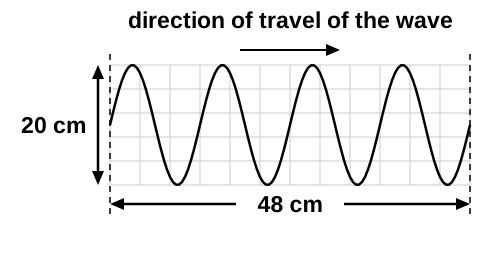
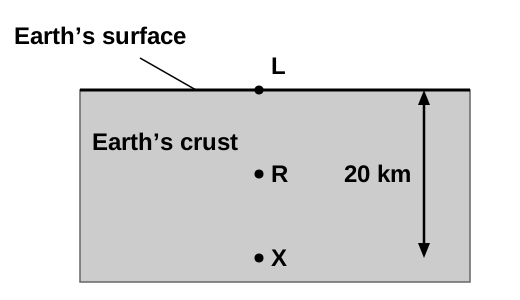
Figure 5 shows a stretch of water wave moving to the right across a tank. Figure 6 is a cross section of the Earth's crust. An earthquake starts at X, 20 km directly below L on the surface, and its transverse wave travels up to a detector at L, passing a rock at R on the way. Figure 6 is not drawn to scale.

Figure 5
Part of a water wave on a grid, moving to the right, with four complete waves. A vertical double-headed arrow at the left marked 20 cm spans the full height from lowest to highest point, and a horizontal double-headed arrow below marked 48 cm spans the whole stretch.
Figure 6
Grey block labelled Earth's crust, with its flat top labelled as the Earth's surface. Three dots lie on one vertical line: L on the surface, X at the bottom, and R part way between them. A double-headed arrow marked 20 km spans from the surface down to the level of X.
03.1[1 mark]

(a)(i) Read the amplitude, in cm, from the wave in Figure 5.

See how you would score on Wave Properties
Show model answer for 03.1Hide model answer for 03.1

Amplitude is the greatest displacement from the rest position. The 20 cm covers the climb from lowest to highest point, so the amplitude is half of it: 10 cm.

1 mark

How the marks are earned

  1. 10 cm, which is half the 20 cm height from lowest to highest point.
Revise Wave Properties
03.2[1 mark]

(a)(ii) Find the wavelength of the wave in Figure 5, in cm.

See how you would score on Wave Properties
Show model answer for 03.2Hide model answer for 03.2

Four complete waves fit along the 48 cm, so divide the length by 4:. wavelength = 48 over 4. = 12 cm

1 mark

How the marks are earned

  1. 12 cm, found from 48 cm shared between 4 complete waves.
Revise Wave Properties
03.3[2 marks]

(a)(iii) Suggest a practical way for someone observing the tank to measure how fast the wave moves.

See how you would score on Wave Properties
Show model answer for 03.3Hide model answer for 03.3

Mark a known distance along the tank and use a stopwatch to time a crest as it crosses it. Then use:. speed = distance over time

Another route is to count the waves passing a fixed point in, say, 10 seconds, giving the frequency, then multiply by the 12 cm wavelength.

2 marks

How the marks are earned

  1. One mark: time one crest as it covers a fixed, measured distance, or measure how far the wave goes in a stated time.
  2. One mark: divide the distance covered by the time taken to get the speed.
  3. Alternative route, 2 marks: count how many waves pass a point in a set time, or time a set number of waves passing a point, to get the frequency (1), then use speed = frequency × wavelength (1). The 12 cm wavelength is only an example, and the mark is for using f × λ. Saying only measure the frequency earns nothing for the first mark.

Why it scores

A measured distance with a measured time earns the first mark, and the equation earns the second.

Counting in a set time gives the frequency, and speed = frequency × wavelength turns it into a speed. Each step is worth a mark.

Revise Wave Properties
03.4[1 mark]

(b)(i) Name one transverse wave other than an earthquake wave.

See how you would score on Wave Properties
Show model answer for 03.4Hide model answer for 03.4

Light, which is an electromagnetic wave, is transverse. So are ripples on water and waves on a string.

1 mark

How the marks are earned

  1. Any one: an electromagnetic wave (or a named one: radio, microwave, infrared, visible light, ultraviolet, X-ray, gamma); ripples on water; a wave on a string. Sea, ocean or tidal waves are also accepted. A wave on a spring or another seismic wave earns nothing.
Revise Wave Properties
03.5[2 marks]

(b)(ii) Describe how the passing wave moves the rock at R. A sketch on Figure 6 may help.

See how you would score on Seismic Waves
Show model answer for 03.5Hide model answer for 03.5

The wave shakes the rock at R to and fro about where it sits. Because the wave is transverse, that shaking lies across the wave's path, side to side while the wave climbs.

2 marks

How the marks are earned

  1. One mark: the rock vibrates, oscillating or shaking about its position.
  2. One mark: the vibration lies perpendicular to the wave's line of travel, so side to side here as the wave rises. Drawing a horizontal two-headed arrow on R earns both marks. Vertical or back-and-forth movement still counts as vibration, and in and out counts as sideways. Later damage, such as the rock breaking up, earns nothing.

Why it scores

The vibration is one mark and its direction is the other. On Figure 6 a horizontal double-headed arrow through R shows both, since the wave moves up the page.

Revise Seismic Waves
03.6[2 marks]

(b)(iii) At 4500 m/s the wave needs another 3.8 s to get from R to L. Find the distance X to R in m.

See how you would score on Seismic Waves
Show model answer for 03.6Hide model answer for 03.6

From R to L the wave travels for 3.8 s at 4500 m/s, so that stretch is:. distance = 4500 × 3.8. = 17 100 m

The whole path is:. 20 km = 20 000 m. So X to R is:. distance = 20 000 − 17 100. = 2900 m. This is about 3000 m.

2 marks

How the marks are earned

  1. One mark: distance from R to L = speed × time = 4500 × 3.8 = 17 100 m. Giving 17 000 m is also accepted.
  2. One mark: distance from X to R = 20 000 − 17 100 = 2900 m, about 3000 m. Any number that rounds to 3000 is accepted. This mark follows through from the first mark.
  3. Alternative route, 2 marks: the time from X to L is 20 000 ÷ 4500 = 4.44 s (1); then X to R is (4.44 − 3.8) × 4500, about 2900 m (2880 with 4.44), which rounds to 3000 (1).
  4. The right final answer on its own earns full marks.

Why it scores

This is the distance still to go when the wave passes R. It earns the first mark.

Subtracting the stretch from R to L from the full 20 000 m earns the second mark. Using 17 000 m gives exactly 3000 m.

Revise Seismic Waves
Edexcel owns the copyright in its exam questions, so we cannot copy their wording. These descriptions and answers are ours. Not made or approved by Edexcel.[9 marks]
PrepWise guide: Edexcel GCSE Physics Paper 1 HigherQuestion 4

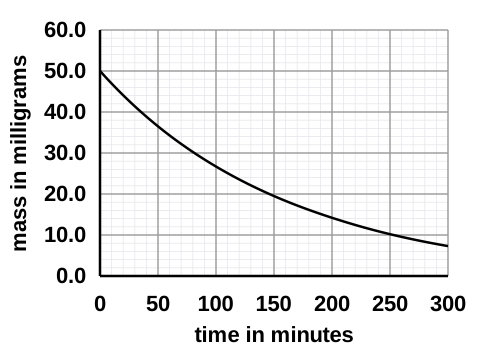
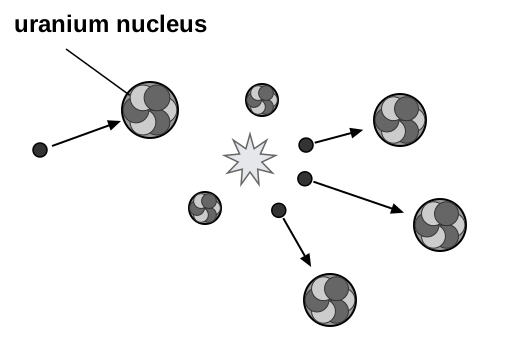
Radioactivity and nuclear energy have many uses, from food safety to power stations. Fluorine-18 is a radioactive isotope used in PET scans. Figure 7 shows how the mass of a sample of fluorine-18 falls with time. Figure 8 shows a fission chain reaction starting at a uranium nucleus.

Figure 7
Graph of mass of fluorine-18 in milligrams, from 0.0 to 60.0, against time in minutes, from 0 to 300, with a grid. A smooth curve starts at 50.0 mg at time 0 and falls, getting less steep as time goes on.
Figure 8
A neutron arrives at a nucleus labelled uranium nucleus at the top left. The nucleus breaks into two smaller nuclei, and several neutrons spread outwards with arrows, some heading towards further uranium nuclei.
04.1[1 mark]

(a)(i) Pick the description that fits gamma rays used to kill bacteria in food. Tick one box.

See how you would score on Uses & Hazards of Radiation
Ionising particles
Ionising radiation
Particles that do not ionise
Radiation that does not ionise
Show model answer for 04.1Hide model answer for 04.1

Ionising radiation. Gamma rays are waves, not particles, and they ionise, which is how they damage and kill the bacteria.

1 mark

How the marks are earned

  1. Tick ionising radiation.
Revise Uses & Hazards of Radiation
04.2[1 mark]

(a)(ii) Pick the part of a nuclear reactor that absorbs neutrons. Tick one box.

See how you would score on Nuclear Fission & Fusion
Control rods
Coolant
Moderator
PET scanner
Show model answer for 04.2Hide model answer for 04.2

Control rods. They soak up neutrons, so lowering them in slows the chain reaction. The moderator slows neutrons and the coolant carries heat away. A PET scanner is a medical machine, not part of a reactor.

1 mark

How the marks are earned

  1. Tick control rods.
Revise Nuclear Fission & Fusion
04.3[2 marks]

(b)(i) Use Figure 7 to find the percentage of the original fluorine-18 left after 150 minutes.

See how you would score on Half-Life
Show model answer for 04.3Hide model answer for 04.3

At 150 minutes the curve reads about 19.5 mg. The sample started at 50 mg, so the fraction left is:. fraction = 19.5 over 50

percentage = 19.5 over 50 × 100. = 39 percent

2 marks

How the marks are earned

  1. One mark: read the mass at 150 minutes, about 19.5 mg (19 to 20 accepted), and compare it with the starting 50 mg as a fraction or a percentage.
  2. One mark: the percentage, 39 percent. Any value from 38 to 40 percent is accepted.
  3. The right final answer on its own earns full marks.

Why it scores

Reading the graph and setting up the fraction earns the first mark.

The second mark is for the evaluation. A reading of 19 or 20 mg gives 38 or 40 percent, which still counts.

Revise Half-Life
04.4[2 marks]

(b)(ii) A positron from fluorine-18 meets an electron. Describe the outcome.

See how you would score on Radioactive Decay
Show model answer for 04.4Hide model answer for 04.4

The positron and electron collide and annihilate, destroying each other. Their mass is turned into energy, which leaves as a pair of gamma rays.

2 marks

How the marks are earned

  1. Any two, one mark each: they collide; they annihilate, destroying each other (the charges cancelling or neutralising is also accepted); a pair of gamma rays is released, or energy is released. Words such as meet, combine or attract earn nothing, and neither does light.

Why it scores

Any two of colliding, annihilating and giving out gamma rays or energy earn the marks.

Revise Radioactive Decay
04.5[3 marks]

(c) One neutron reaches one uranium nucleus in Figure 8. Say what follows, and why.

See how you would score on Nuclear Fission & Fusion
Show model answer for 04.5Hide model answer for 04.5

The uranium nucleus absorbs the neutron and becomes unstable. It then splits into two smaller nuclei and gives out energy, with more neutrons released. Those neutrons can go on to split other uranium nuclei.

3 marks

How the marks are earned

  1. Any three, one mark each: the nucleus takes in the neutron (hits, collides with or joins are also accepted); this makes the nucleus unstable; it breaks up or splits, and naming two other nuclei is optional; more neutrons are released; gamma rays or energy are released.
  2. A lone mark is available if nothing else scores: the freed neutrons strike further nuclei. Writing atom for nucleus loses the unstable mark.

Why it scores

Absorbing the neutron, becoming unstable, splitting, and releasing neutrons or energy are the ideas, and three of them earn the three marks. The unstable mark must be about the nucleus, not the atom.

Revise Nuclear Fission & Fusion
04.6[2 marks]

(d) Finland made 4.4 GW from nuclear plants in 2023, the UK 8.9 GW. Find Finland's output divided by the UK's, to 2 significant figures.

See how you would score on Energy Resources
Show model answer for 04.6Hide model answer for 04.6

ratio = fraction: Finland power over UK power, end of fraction. = 4.4 over 8.9

4.4 over 8.9 = 0.4944. This is 0.49 to 2 significant figures.

2 marks

How the marks are earned

  1. One mark: the substitution, 4.4 ÷ 8.9 (the powers of ten cancel).
  2. One mark: the value to 2 significant figures, 0.49. Ratio forms such as 4.4 : 8.9, 44 : 89 and 0.49 : 1 are accepted, and this paper's scheme also takes 1.0 : 0.49.
  3. The right final answer on its own earns full marks.

Why it scores

Both values in the right order earn the first mark. The units are the same, so they cancel.

The second mark is for the evaluation and the correct rounding. Finland's output is a little under half the UK's.

Revise Energy Resources
Edexcel owns the copyright in its exam questions, so we cannot copy their wording. These descriptions and answers are ours. Not made or approved by Edexcel.[11 marks]
PrepWise guide: Edexcel GCSE Physics Paper 1 HigherQuestion 5

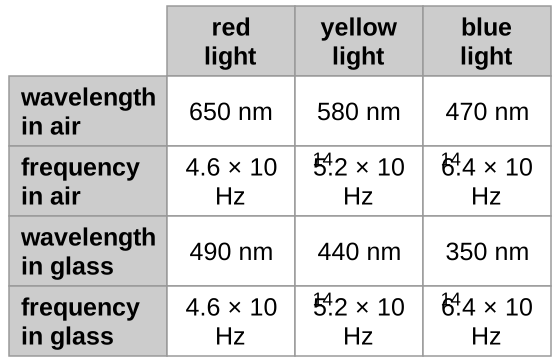
Glass slows light and bends its path as it enters. For an experiment on this, a student can use a ray box, which gives one thin beam, and a rectangular block of glass. Figure 9 lists wavelength and frequency for red, yellow and blue light, measured in air and again in glass.

Figure 9
Table with a column each for red, yellow and blue light. Wavelengths in air are 650, 580 and 470 nm. Frequencies in air are 4.6, 5.2 and 6.4 × 10^14 Hz. Wavelengths in glass are 490, 440 and 350 nm. Frequencies in glass are 4.6, 5.2 and 6.4 × 10^14 Hz.
05.1[4 marks]

(a) Describe a method with a ray box and glass block to trace a ray bending in the glass. A labelled sketch may help.

See how you would score on Reflection & Refraction
Show model answer for 05.1Hide model answer for 05.1

Lay the glass block on a sheet of paper and draw round its outline. Switch on the ray box and aim its narrow ray at one face of the block.

Mark a cross where the ray enters the block and another where it leaves. Remove the block and join the two crosses with a ruler. That line is the refracted ray inside the glass.

4 marks

How the marks are earned

  1. Any four, one mark each: set the block on a sheet of paper and trace its outline; point the ray box so its beam strikes the block (a labelled sketch of block and ray box also earns this); put a cross at the spot where the beam goes in, or along the incoming beam; put a cross at the spot where it comes out, or along the outgoing beam; draw a straight line between the two crosses.
  2. If neither the entry nor the exit is marked, simply drawing the light rays earns one mark.

Why it scores

Drawing round the block fixes where the glass sits, and aiming the ray at it starts the refraction. These earn two marks.

The entry mark, the exit mark and the joining line each earn a mark, and only four are available in all.

Revise Reflection & Refraction
05.2[1 mark]

(b)(i) Use Figure 9 to say how wavelength changes when light passes from glass into air.

See how you would score on Reflection & Refraction
Show model answer for 05.2Hide model answer for 05.2

The wavelength increases. Each colour has a longer wavelength in air than in glass, for example blue light goes from 350 nm to 470 nm.

1 mark

How the marks are earned

  1. It gets longer, for example blue light goes from 350 nm to 470 nm. Quoting the values is accepted, and so is saying it gets shorter going from air into glass.
Revise Reflection & Refraction
05.3[1 mark]

(b)(ii) Use Figure 9 to say how frequency changes when light passes from glass into air.

See how you would score on Reflection & Refraction
Show model answer for 05.3Hide model answer for 05.3

The frequency stays the same. Each colour has an identical frequency in air and in glass, for example blue light is 6.4 × 10¹⁴ Hz in both.

1 mark

How the marks are earned

  1. It does not change. It stays the same, and quoting the matching values is accepted.
Revise Reflection & Refraction
05.4[3 marks]

(b)(iii) Blue light moves at 3.0 × 10⁸ m/s in air. Using Figure 9, find the change in its speed in glass.

See how you would score on Wave Properties
Show model answer for 05.4Hide model answer for 05.4

Change nanometres to metres:. 350 nm = 350 × 10-9 m. Use the wave speed equation for blue light in glass:. v = f × λ. v = 6.4 × 1014 × 350 × 10-9. = 2.24 × 10⁸ m/s

change in speed = 3.0 × 10⁸ − 2.24 × 10⁸. = 7.6 × 10⁷ m/s. So the light slows by about 7.6 × 10⁷ m/s.

3 marks

How the marks are earned

  1. One mark: speed in glass = frequency × wavelength = 6.4 × 1014 × 350 × 10-9.
  2. One mark: the speed in glass, 2.2 × 10⁸ m/s. Any value that rounds to this, such as 2.24 × 10⁸, is accepted.
  3. One mark: subtract from the air speed, 3.0 × 10⁸ − 2.24 × 108 = 7.6 × 10⁷ m/s. This mark does not depend on the earlier ones.
  4. Alternative route, 3 marks: the wavelength falls by 470 − 350 = 120 nm (1); change in speed = 6.4 × 1014 × 120 × 10-9 (1); 7.7 × 10⁷ m/s (1). The value 7.6 × 10⁷ also scores all 3. The last mark follows through from your own change in wavelength.
  5. The right final answer on its own earns full marks.

Why it scores

The substitution earns one mark and the speed in glass earns the next. The frequency is the same in air and glass, so 6.4 × 10¹⁴ Hz is right for both.

The subtraction from the air speed earns the last mark. Working with the 120 nm change in wavelength gives 7.7 × 10⁷, which is also accepted.

Revise Wave Properties
Edexcel owns the copyright in its exam questions, so we cannot copy their wording. These descriptions and answers are ours. Not made or approved by Edexcel.[9 marks]
PrepWise guide: Edexcel GCSE Physics Paper 1 HigherQuestion 6

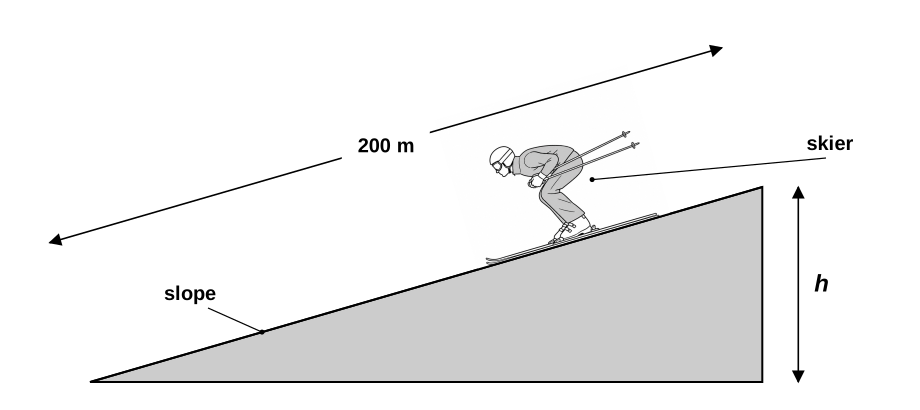
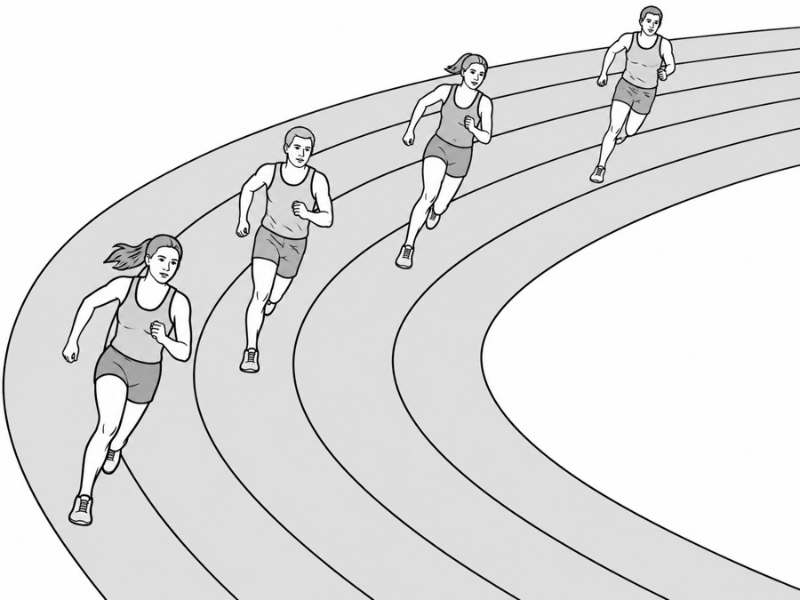
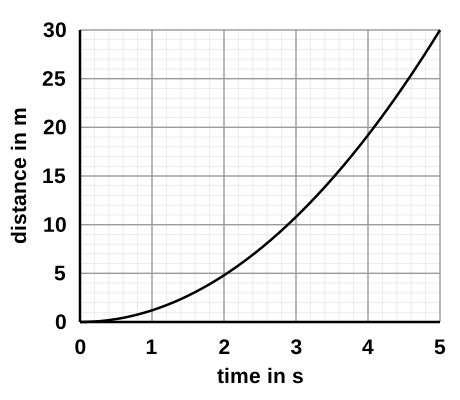
In Figure 10 a skier slides down a straight slope that drops through a height h. In Figure 11 runners keep a steady speed round a bend. Figure 12 plots distance against time for one runner starting a race on a straight.

Figure 10
Right-angled triangle slope rising to the right with a skier on the sloping side. A double-headed arrow along the sloping side is marked 200 m, and a vertical double-headed arrow at the high end is marked h.
Figure 11
View from above of a curved running track with several lanes and a line of runners spread across the lanes as they go round the bend.
Figure 12
Graph of distance in metres, from 0 to 30, against time in seconds, from 0 to 5, with a grid. A smooth curve starts flat at the origin, gets steadily steeper, and reaches 30 m at 5 s.
06.1[2 marks]

(a)(i) A 70 kg skier loses 39 000 J of gravitational potential energy. Taking g as 10 N/kg, find the height h in m.

See how you would score on Gravitational Potential Energy
Show model answer for 06.1Hide model answer for 06.1

Start with the equation:. change in GPE = m × g × h. Rearrange for the height:. h = fraction: change in GPE over m × g, end of fraction. = fraction: 39 000 over 70 × 10, end of fraction

h = 39 000 over 700. = 55.7. So the height is about 56 m.

2 marks

How the marks are earned

  1. One mark: rearrange change in GPE = m × g × h to h = change in GPE ÷ (m × g), giving 39 000 ÷ (70 × 10).
  2. One mark: the height, 56 m. Any value that rounds to 56, such as 55.71, is accepted, and 57 m (56.85) is accepted if g = 9.8 N/kg is used.
  3. The right final answer on its own earns full marks.

Why it scores

The rearrangement earns the first mark.

The second mark is for the evaluation. The energy is divided by both the mass and g, so multiply those two first.

Revise Gravitational Potential Energy
06.2[3 marks]

(a)(ii) From rest, the skier reaches 27 m/s at the bottom. Using Figure 10, find the acceleration along the slope.

See how you would score on Newton's Laws of Motion
Show model answer for 06.2Hide model answer for 06.2

The skier starts from rest, so:. u = 0. Use this equation:. v2 − u2 = 2 × a × x. The values are:. v = 27 m/s. x = 200 m. Here x is the length of the slope.

Rearrange for the acceleration:. a = fraction: 272 over 2 × 200, end of fraction. = 729 over 400. = 1.8 m/s2

3 marks

How the marks are earned

  1. One mark: choose v2 − u2 = 2 × a × x, which links speeds, acceleration and distance.
  2. One mark: rearrange to a = (v2 − u2) ÷ (2 × x), with 272 and 200 in place. The part (a)(i) height in place of 200 m is also given this mark, but not the final mark.
  3. One mark: the acceleration, 1.8 m/s2. Any value that rounds to 1.8, such as 1.8225, is accepted.
  4. Alternative route, 3 marks: the average speed is 13.5 m/s, so the time is 200 ÷ 13.5 = 14.8 s (1); a = 27 ÷ 14.8 (1); a = 1.8 m/s2 (1).
  5. The right final answer on its own earns full marks.

Why it scores

This equation uses distance instead of time, which suits the data. The slope length is the distance the skier travels, not the height h.

The rearranged form and the evaluated acceleration earn two marks.

Revise Newton's Laws of Motion
06.3[2 marks]

(a)(iii) Explain how to work out how much energy the skier dissipates from top to bottom.

See how you would score on Energy Stores & Systems
Show model answer for 06.3Hide model answer for 06.3

Find the skier's gravitational potential energy at the start and the kinetic energy at the finish. Subtract the second from the first: the result is the amount that has been dissipated as thermal energy.

Here the kinetic energy at the bottom is:. kinetic energy = ½ × 70 × 272. = 25 515 J. So the energy dissipated is:. energy dissipated = 39 000 − 25 515. = 13 485 J

2 marks

How the marks are earned

  1. One mark: find the gravitational potential energy at the top and the kinetic energy at the bottom.
  2. One mark: subtract the one from the other. Subtracting any two energies is accepted, and a difference is accepted for subtracting. For example 39 000 − 25 515 = 13 485 J earns both marks.

Why it scores

Naming both energies earns one mark and the subtraction earns the other.

This shows the method with the real numbers. The missing energy has gone to the surroundings as thermal energy.

Revise Energy Stores & Systems
06.4[1 mark]

(b)(i) State why an athlete's velocity changes when the speed is constant round a bend.

See how you would score on Forces & Their Effects
Show model answer for 06.4Hide model answer for 06.4

Velocity is a vector, with direction as well as size. Round the bend the runner's direction keeps changing, so the velocity changes even though the speed does not.

1 mark

How the marks are earned

  1. The direction of travel keeps changing. Saying velocity has direction as well as size, so it is a vector, is also accepted. A changing speed is not the reason.
Revise Forces & Their Effects
06.5[2 marks]

(b)(ii) Find the gradient of the curve in Figure 12 at 2.5 s, in m/s.

See how you would score on Newton's Laws of Motion
Show model answer for 06.5Hide model answer for 06.5

At 2.5 s the curve is at about 7.5 m. Lay a ruler so it just touches the curve there without crossing it, and draw the tangent.

Take a large triangle on the tangent, for example from (1.5 s, 1.5 m) to (3.5 s, 13.5 m).. gradient = 12 over 2.0. = 6.0 m/s

2 marks

How the marks are earned

  1. One mark: at the 2.5 s point, add a straight line that just touches the curve without cutting it. The long side of a triangle drawn on the tangent also counts.
  2. One mark: work out the gradient of that tangent, 6.0 m/s. Any value from 5.0 to 7.0 m/s is accepted. This mark needs the tangent.

Why it scores

A tangent shows the slope of the curve at that single instant. It earns the first mark.

The gradient of a distance against time graph is speed, so the runner is moving at about 6 m/s at 2.5 s. The evaluation earns the second mark.

Revise Newton's Laws of Motion
Edexcel owns the copyright in its exam questions, so we cannot copy their wording. These descriptions and answers are ours. Not made or approved by Edexcel.[10 marks]
PrepWise guide: Edexcel GCSE Physics Paper 1 HigherQuestion 7

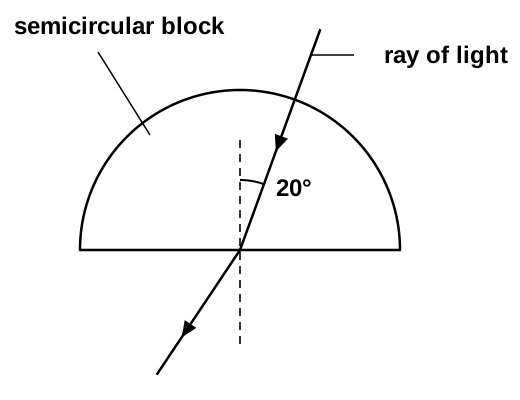
Figure 13 shows a ray of light aimed at the centre of the flat edge of a half-round plastic block, meeting the dashed normal at 20 degrees. The critical angle of this plastic is 38 degrees. Ceres is a small world in the asteroid belt, circling the Sun on a path beyond Mars and inside Jupiter's orbit.

Figure 13
Half-round plastic block with its flat edge at the bottom. A ray crosses the curved surface and meets the centre of the flat edge, making 20 degrees with a dashed vertical normal, then leaves below the flat edge bending away from the normal.
07.1[2 marks]

(a) How does a lens's power relate to its focal length, and how does the shape of a stronger lens differ?

See how you would score on Lenses & Images
Show model answer for 07.1Hide model answer for 07.1

The more powerful the lens, the shorter its focal length. A more powerful lens is also more strongly curved, so it looks thicker or fatter.

2 marks

How the marks are earned

  1. One mark: the shorter the focal length, the greater the lens's power.
  2. One mark: a stronger lens has surfaces that curve more sharply (a smaller radius of curvature), so it is thicker or fatter. Describing a converging lens as more convex, or a diverging one as more concave, is also accepted.

Why it scores

One mark is for the link to focal length and one for the link to shape. A stronger lens bends light more sharply, so it brings rays to a focus closer to the lens.

Revise Lenses & Images
07.2[1 mark]

(b)(i) Name a situation in which a lens makes a virtual image.

See how you would score on Lenses & Images
Show model answer for 07.2Hide model answer for 07.2

The magnified image seen through a magnifying glass, a converging lens held with the object closer than its focal length, is virtual. The image in a diverging lens is virtual too.

1 mark

How the marks are earned

  1. One from: what you see through a magnifying glass, which is a converging lens with the object inside its focal length; or anything seen through a diverging lens. A telescope, microscope or pair of glasses on its own earns nothing.
Revise Lenses & Images
07.3[1 mark]

(b)(ii) Name a situation in which a lens makes a real image.

See how you would score on Lenses & Images
Show model answer for 07.3Hide model answer for 07.3

The image on the retina of the eye is real. So is the image a camera lens forms, or a projector's image on a screen, because the object is farther than the focal length.

1 mark

How the marks are earned

  1. One from: the image of a distant object made by a converging lens; the photograph or image in a camera; the image from a projector; the image on the retina of the eye. A phone on its own earns nothing.
Revise Lenses & Images
07.4[3 marks]

(c) The angle at the flat edge rises from 20 to 50 degrees, the critical angle being 38 degrees. Describe what happens to the ray.

See how you would score on Reflection & Refraction
Show model answer for 07.4Hide model answer for 07.4

From 20 degrees up to 38 degrees the ray still leaves the flat edge, bending away from the normal, and the angle outside gets bigger as the angle inside does. At exactly 38 degrees the angle outside is 90 degrees and the ray runs along the flat edge.

Above 38 degrees, up to 50 degrees, no light leaves. The ray is totally internally reflected back into the block, and the angle of reflection equals the angle of incidence.

3 marks

How the marks are earned

  1. Any three, one mark each: as the angle inside the block grows, the angle outside grows too, with the ray outside bending further from the normal and towards the block's surface; at 38 degrees the angle outside is 90 degrees, so the ray runs along the flat edge; above 38 degrees the ray is reflected back into the block (total internal reflection); above 38 degrees the angle of reflection equals the angle of incidence.
  2. Marks can come from a labelled diagram. Weak partial reflections are not credited.

Why it scores

A growing angle outside earns one mark. The ray running along the edge at the critical angle earns another.

Reflection back into the block earns one mark, and the equal angles can earn another. Any three ideas give full marks.

Revise Reflection & Refraction
07.5[4 marks]

(d) Ceres receives radiation from the Sun, yet its average temperature stays constant. Explain why.

See how you would score on Black Body Radiation
Show model answer for 07.5Hide model answer for 07.5

Ceres absorbs radiation from the Sun, which transfers energy to it. Ceres also emits radiation of its own, and the hotter it gets, the faster it emits.

The temperature stops changing when the rate at which Ceres emits radiation equals the rate at which it absorbs it. Then it gains and loses energy at the same speed.

4 marks

How the marks are earned

  1. Four marks from these five ideas: Ceres takes in radiation or thermal energy from the Sun, and heat, energy transferred to Ceres, Ceres gaining energy and the Sun heating it all count (1); Ceres also gives out radiation or thermal energy (1); the hotter it is, the faster it radiates (1); the temperature holds steady once radiation is emitted as fast as it is absorbed (1); and rate or power is mentioned in the third or fourth idea (1).
  2. One statement alone, that the temperature stays steady when radiation is emitted as fast as it is absorbed, scores all 4 marks. Saying only that Ceres receives radiation earns nothing, because the question already says so.
  3. Giving out, losing, releasing and dissipating all count as emitting, and power counts for rate. If absorption is greater than emission so the temperature rises, the first two marks are earned.

Why it scores

Absorbing and emitting are the first two marks. Emission rising with temperature is the third.

Equal rates is the key mark, and it must mention rate or power. If absorption beat emission the temperature would rise.

Revise Black Body Radiation
Edexcel owns the copyright in its exam questions, so we cannot copy their wording. These descriptions and answers are ours. Not made or approved by Edexcel.[11 marks]
PrepWise guide: Edexcel GCSE Physics Paper 1 HigherQuestion 8

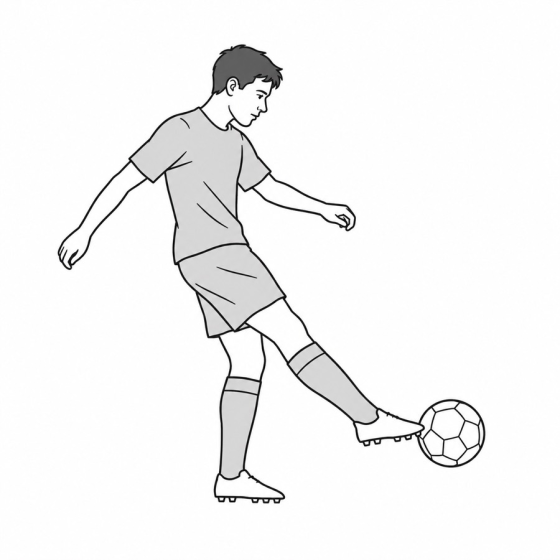
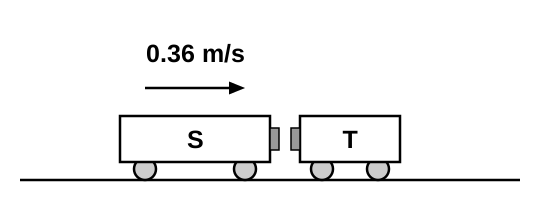
In Figure 14 a footballer kicks a stationary ball of mass 0.43 kg. The kick pushes on the ball with 2700 N and the ball leaves at 36 m/s. In Figure 15 trolley S moves at 0.36 m/s towards a stationary trolley T on a level track. The two stick together and move off as one.

Figure 14
A footballer, seen from the side, with one boot touching a football at the moment of a kick.
Figure 15
Two toy trolleys on a straight horizontal track. Trolley S on the left has an arrow above it pointing right, labelled 0.36 m/s. Trolley T on the right has no arrow. Their facing ends are close together.
08.1[3 marks]

(a)(i) The 0.43 kg ball leaves the kick at 36 m/s. Find its momentum and state the unit.

See how you would score on Momentum
Show model answer for 08.1Hide model answer for 08.1

Use the equation:. p = m × v. momentum = 0.43 × 36. = 15.48. This is about 15.

The unit is kg m/s.

3 marks

How the marks are earned

  1. One mark: use momentum = mass × velocity.
  2. One mark: the value, 15, from 0.43 × 36. Any value that rounds to 15, such as 15.48 or 15.5, is accepted. The correct value alone earns two marks.
  3. One mark: the unit, kg m/s (also written kg m s-1).

Why it scores

Choosing the equation earns one mark and the value earns another.

The unit is a separate mark. It comes from mass in kg times velocity in m/s.

Revise Momentum
08.2[2 marks]

(a)(ii) The kick force is 2700 N. Find how long the foot touches the ball, in seconds.

See how you would score on Force & Collisions
Show model answer for 08.2Hide model answer for 08.2

The ball starts at rest, so its change in momentum is the 15 kg m/s found in part (a)(i).. Use this equation:. force = fraction: change in momentum over time, end of fraction. Rearrange for the time:. time = fraction: change in momentum over force, end of fraction. = 15 over 2700

time = 0.0056 s. So the foot touches the ball for just over half a hundredth of a second.

2 marks

How the marks are earned

  1. One mark: use force = change in momentum ÷ time, so time = 15 ÷ 2700. The route through F = m × a and a = (v − u) ÷ t also earns this mark.
  2. One mark: the time, 0.0056 s. Any value that rounds to 0.0056, such as 0.005555, is accepted. Using 15.48 gives 0.0057 s, also accepted, and the answer follows through from your part (a)(i) value.
  3. The right final answer on its own earns full marks.

Why it scores

The equation and the change in momentum earn the first mark. Starting from rest means the change equals the final momentum.

The second mark is for the evaluation. The contact is very brief because the force is large.

Revise Force & Collisions
08.3[3 marks]

(a)(iii) Describe the pair of forces between foot and ball, using Newton's third law.

See how you would score on Newton's Laws of Motion
Show model answer for 08.3Hide model answer for 08.3

The foot pushes on the ball with 2700 N, and at the same moment the ball pushes back on the foot with a force of the same size in the opposite direction.

The two forces act on different objects, so they never cancel each other. The ball accelerates because of the force on it.

3 marks

How the marks are earned

  1. One mark: the two forces are equal and opposite (action and reaction being equal and opposite is accepted).
  2. One mark: one force is the push of the foot on the ball.
  3. One mark: the other force is the push of the ball on the foot.
  4. Saying the force on the ball equals the force on the foot earns 2 marks, and adding that they point in opposite directions earns 3.

Why it scores

Naming both forces as acting on different objects earns two marks, and saying they are equal and opposite earns the third.

This guards against a common slip. A pair of equal and opposite forces on two bodies does not mean nothing moves.

Revise Newton's Laws of Motion
08.4[3 marks]

(b) Using momentum, explain why S and T move off slower together than S moved alone before.

See how you would score on Momentum
Show model answer for 08.4Hide model answer for 08.4

The total momentum of the system stays the same through the collision. The total after equals the momentum S had before.

momentum = mass × velocity. After they stick, the moving mass is that of S and T together, which is bigger. The same momentum shared over a bigger mass means a smaller velocity.

3 marks

How the marks are earned

  1. One mark: momentum is conserved, so the total before the collision equals the total after.
  2. One mark: momentum = mass × velocity.
  3. One mark: once they have joined, the moving mass is larger.

Why it scores

Momentum being conserved earns the first mark.

The equation earns one mark and the bigger moving mass earns the other. The lower velocity follows from them.

Revise Momentum
Edexcel owns the copyright in its exam questions, so we cannot copy their wording. These descriptions and answers are ours. Not made or approved by Edexcel.[11 marks]
PrepWise guide: Edexcel GCSE Physics Paper 1 HigherQuestion 9

The isotope carbon-14 decays by giving out beta minus particles.

09.1[1 mark]

(a)(i) Pick the unit used for the activity of a radioactive sample. Tick one box.

See how you would score on Radioactive Decay
Pa
N m
Gs
Bq
Show model answer for 09.1Hide model answer for 09.1

Bq, the becquerel, which is one decay per second. Pa is the unit of pressure, N m is the unit of a moment, and Gs is a billion seconds.

1 mark

How the marks are earned

  1. Tick Bq, the becquerel.
Revise Radioactive Decay
09.2[1 mark]

(a)(ii) Pick the order of the three radiations from least to most penetrating. Tick one box.

See how you would score on Radioactive Decay
Alpha the least, then beta, then gamma the most
Alpha the least, then gamma, then beta the most
Gamma the least, then beta, then alpha the most
Gamma the least, then alpha, then beta the most
Show model answer for 09.2Hide model answer for 09.2

Alpha, then beta, then gamma. Alpha is stopped by paper, beta by a thin sheet of aluminium, and gamma only by thick lead or concrete.

1 mark

How the marks are earned

  1. Tick alpha, beta, gamma, with alpha the least penetrating.
Revise Radioactive Decay
09.3[2 marks]

(a)(iii) A beta minus particle of mass 9.1 × 10⁻³¹ kg moves at 3.8 × 10⁶ m/s. Find its kinetic energy in J.

See how you would score on Kinetic Energy
Show model answer for 09.3Hide model answer for 09.3

Use the kinetic energy equation:. kinetic energy = ½ × m × v2. The values are:. m = 9.1 × 10⁻³¹ kg. v = 3.8 × 10⁶ m/s. Square v before anything else.

(3.8 × 10⁶)2 = 1.444 × 10¹³. kinetic energy = ½ × 9.1 × 10-31 × 1.444 × 1013. = 6.6 × 10⁻¹⁸ J

2 marks

How the marks are earned

  1. One mark: select kinetic energy = ½ × mass × speed squared.
  2. One mark: the kinetic energy, 6.6 × 10⁻¹⁸ J. Any value that rounds to this, such as 6.5702 × 10⁻¹⁸, is accepted.
  3. The right final answer on its own earns full marks.

Why it scores

Choosing the equation earns the first mark. The speed is squared before it is multiplied by the mass.

The evaluation earns the second mark. The tiny answer fits a particle with a tiny mass.

Revise Kinetic Energy
09.4[2 marks]

(b) Describe the change inside a nucleus when it emits a beta plus particle.

See how you would score on Radioactive Decay
Show model answer for 09.4Hide model answer for 09.4

A proton in the nucleus turns into a neutron, and a positron, the beta plus particle, is emitted.

2 marks

How the marks are earned

  1. One mark: a proton in the nucleus changes.
  2. One mark: it becomes a neutron. Writing p → n earns both marks. Saying the charge, or the atomic number, goes down by 1, the mass number is unchanged, or the neutron number goes up by 1 is also accepted. If nothing else scores, the reverse change, n → p, earns one mark.

Why it scores

One mark is for the proton and the other is for it becoming a neutron. The atomic number falls by 1 and the mass number stays the same.

Revise Radioactive Decay
09.5[6 marks]

(c) Compare alpha and gamma radiation: what each is, and how each kind of decay affects the original nucleus.

See how you would score on Radioactive Decay
Show model answer for 09.5Hide model answer for 09.5

An alpha particle is a helium nucleus: 2 protons and 2 neutrons stuck together, with a charge of plus 2. When a nucleus emits one, its proton number falls by 2 and its mass number falls by 4, so it becomes a different element.

Gamma radiation is a high frequency, short wavelength electromagnetic wave with no charge and no mass. Gamma emission does not change the proton number or the mass number, so the element is the same, but the nucleus loses energy and becomes more stable.

In comparison, alpha is strongly ionising but stopped by paper, while gamma is weakly ionising but needs thick lead to stop it.

Levels of response, 6 marks

How the marks are earned

  1. This is level marked. For 5 to 6 marks, give a detailed comparison covering what one radiation is and how its decay changes the nucleus, plus either what or how for the other. For 3 to 4 marks, give a limited comparison: what both are, or the effect on the nucleus of both, or what and how for just one, or what one is together with the effect of the other. For 1 to 2 marks, give isolated facts about alpha or gamma.
  2. Alpha: a helium nucleus, made of 2 protons and 2 neutrons, with charge plus 2. Its decay lowers the proton number by 2 and the mass number by 4, so the element changes.
  3. Gamma: an electromagnetic wave with very high frequency and short wavelength, carrying no charge and no mass. Its decay leaves the proton and mass numbers alone, so the element stays the same, though the nucleus rearranges, loses energy and becomes more stable.
  4. Ionising and penetrating: alpha ionises heavily but barely penetrates, and is blocked by paper or a few centimetres of air; gamma ionises weakly but penetrates deeply, and needs thick lead. A statement about ionising or penetrating can replace one about nature or effect, though only for a lower mark within a level.

Why it scores

This gives both the nature of alpha and its effect on the nucleus, accurately and with numbers. That alone builds a strong base for the top level.

This covers the nature of gamma and its effect, and it sets up the contrast. Alpha changes the nucleus. Gamma does not.

These can stand in for a nature or an effect, but only at the lower end of a level. This answer does not need them.

Revise Radioactive Decay
Edexcel owns the copyright in its exam questions, so we cannot copy their wording. These descriptions and answers are ours. Not made or approved by Edexcel.[12 marks]
PrepWise guide: Edexcel GCSE Physics Paper 1 HigherQuestion 10

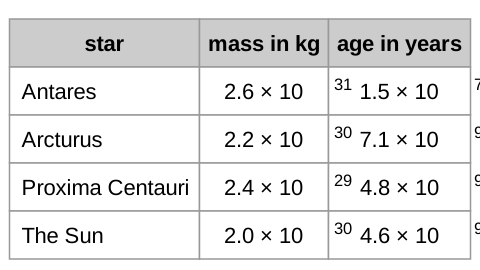
Figure 16 gives the mass and age of four stars. Stars shine because of nuclear fusion, and the Big Bang theory describes how the Universe began.

Figure 16
Table of four stars with their mass in kilograms and age in years. Antares has mass 2.6 × 10^31 and age 1.5 × 10^7. Arcturus has 2.2 × 10^30 and 7.1 × 10^9. Proxima Centauri has 2.4 × 10^29 and 4.8 × 10^9. The Sun has 2.0 × 10^30 and 4.6 × 10^9.
10.1[1 mark]

(a)(i) From Figure 16, name the star most likely to end its life as a black hole.

See how you would score on Life Cycle of Stars
Show model answer for 10.1Hide model answer for 10.1

Antares. It is by far the most massive star in the table.

1 mark

How the marks are earned

  1. Antares. A phonetic spelling is accepted.
Revise Life Cycle of Stars
10.2[1 mark]

(a)(ii) Give a reason from Figure 16 for your choice of star.

See how you would score on Life Cycle of Stars
Show model answer for 10.2Hide model answer for 10.2

Antares has the largest mass in the table, 2.6 × 1031 kg, which is more than ten times the Sun's mass. Only a very massive star ends as a black hole.

1 mark

How the marks are earned

  1. It has the greatest mass in the table, far more than the Sun. Saying it is much heavier than the Sun is accepted. Biggest on its own, or its age, earns nothing.
Revise Life Cycle of Stars
10.3[2 marks]

(b)(i) Describe what nuclear fusion is.

See how you would score on Nuclear Fission & Fusion
Show model answer for 10.3Hide model answer for 10.3

Fusion is when two small nuclei join together to form one larger nucleus, as when hydrogen nuclei fuse into helium nuclei in the Sun.

2 marks

How the marks are earned

  1. One mark: small nuclei join together (fuse or combine). Atoms or particles in place of nuclei earn nothing.
  2. One mark: to make a larger nucleus. Hydrogen nuclei joining to form helium nuclei is accepted as an example.

Why it scores

One mark is for the nuclei joining and the other is for the larger nucleus that results. Some mass turns into energy in the process.

Revise Nuclear Fission & Fusion
10.4[2 marks]

(b)(ii) The Sun radiates 3.9 × 1026 J each second. With c = 3.0 × 10⁸ m/s, find the mass this equals, with unit.

See how you would score on Nuclear Fission & Fusion
Show model answer for 10.4Hide model answer for 10.4

Start with the equation:. E = m × c2. Rearrange for the mass:. m = E over c2. = fraction: 3.9 × 1026 over (3.0 × 10⁸)2, end of fraction. = fraction: 3.9 × 1026 over 9.0 × 10¹⁶, end of fraction

m = 4.3 × 10⁹ kg.

2 marks

How the marks are earned

  1. One mark: rearrange E = m × c2 to m = E ÷ c2, giving m = 3.9 × 1026 ÷ (3.0 × 10⁸)2.
  2. One mark: the mass lost with its unit, 4.3 × 10⁹ kg, or anything rounding to it, for instance 4.333 × 10⁹ kg. Leaving off the unit, or giving an incorrect one, gives just one mark in all.
  3. The right final answer, with its unit, on its own earns full marks.

Why it scores

The rearranged form with the values in earns the first mark. The speed of light is squared before dividing.

The second mark needs the unit as well as the value. The Sun loses roughly four million tonnes of mass every second.

Revise Nuclear Fission & Fusion
10.5[6 marks]

(c) Choose two observations that back the Big Bang model of the Universe, and say how each one backs it.

See how you would score on Red Shift & Big Bang
Show model answer for 10.5Hide model answer for 10.5

Red-shift is one piece of evidence. Light from distant galaxies arrives with a longer wavelength, shifted towards the red end of the spectrum. This means the galaxies are moving away from us. The further away a galaxy is, the bigger its red-shift, so the faster it is receding.

Red-shift shows the whole Universe is expanding, so everything was once much closer together. That fits the Big Bang theory, in which space started out tiny, hot and dense and has been expanding ever since.

The second piece is the cosmic microwave background radiation: microwaves arriving from all over the sky. They are a relic of the early, very hot Universe, stretched and cooled as space grew. This backs the idea of a definite beginning.

Levels of response, 6 marks

How the marks are earned

  1. This is level marked. Read it from the weakest answer up. For 1 to 2 marks, a student only names two items from this list: a claim of the theory, red-shift, the cosmic microwave background radiation. For 3 to 4 marks, one piece of evidence is named and either described, meaning what is observed, or tied to the claim it backs, and the other piece is named. For 5 to 6 marks, one piece of evidence is named, described and tied to the claim it backs, and the other piece is named too.
  2. Red-shift described: light from distant galaxies has a longer wavelength, or a lower frequency, than it started with.
  3. Red-shift as support: the shift means the galaxies are moving away from us and from each other; a bigger shift means faster motion; more distant galaxies show a bigger shift; so the Universe is expanding.
  4. Cosmic microwave background radiation described: microwave radiation detected coming from every direction in space.
  5. Cosmic microwave background radiation as support: it is a relic of the Universe's earliest time, it points to cooling since then, and it shows there was a definite beginning.

Why it scores

This identifies the evidence, describes it, and links it to the theory in a chain. The pattern of distance and speed is what points to expansion.

Linking the evidence to the theory's central claim turns a description into an explanation. It is the step that reaches the top level.

Identifying a second, separate piece of evidence is needed for the top level, and adding what it shows earns further credit.

Revise Red Shift & Big Bang
Edexcel owns the copyright in its exam questions, so we cannot copy their wording. These descriptions and answers are ours. Not made or approved by Edexcel.[12 marks]
END OF QUESTIONS100 marks total
See how you would score on Radioactive Decay

Our own questions on this topic, marked straight away, so you see what to revise. Free now.