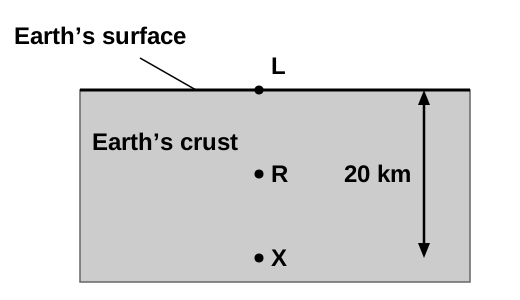
Figure 5 shows a stretch of water wave moving to the right across a tank. Figure 6 is a cross section of the Earth's crust. An earthquake starts at X, 20 km directly below L on the surface, and its transverse wave travels up to a detector at L, passing a rock at R on the way. Figure 6 is not drawn to scale.
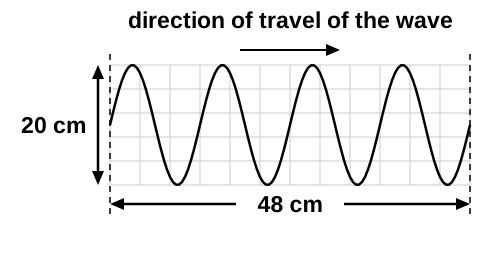
(a)(i) Read the amplitude, in cm, from the wave in Figure 5.
Our own questions on this topic, marked straight away, so you see what to revise. Free now.
Show model answer for 03.1Hide model answer for 03.1
Amplitude is the greatest displacement from the rest position. The 20 cm covers the climb from lowest to highest point, so the amplitude is half of it: 10 cm.
How the marks are earned
- 10 cm, which is half the 20 cm height from lowest to highest point.
(a)(ii) Find the wavelength of the wave in Figure 5, in cm.
See how you would score on Wave PropertiesShow model answer for 03.2Hide model answer for 03.2
Four complete waves fit along the 48 cm, so divide the length by 4:. wavelength = 48 over 4. = 12 cm
How the marks are earned
- 12 cm, found from 48 cm shared between 4 complete waves.
(a)(iii) Suggest a practical way for someone observing the tank to measure how fast the wave moves.
See how you would score on Wave PropertiesShow model answer for 03.3Hide model answer for 03.3
Mark a known distance along the tank and use a stopwatch to time a crest as it crosses it. Then use:. speed = distance over time
Another route is to count the waves passing a fixed point in, say, 10 seconds, giving the frequency, then multiply by the 12 cm wavelength.
How the marks are earned
- One mark: time one crest as it covers a fixed, measured distance, or measure how far the wave goes in a stated time.
- One mark: divide the distance covered by the time taken to get the speed.
- Alternative route, 2 marks: count how many waves pass a point in a set time, or time a set number of waves passing a point, to get the frequency (1), then use speed = frequency × wavelength (1). The 12 cm wavelength is only an example, and the mark is for using f × λ. Saying only measure the frequency earns nothing for the first mark.
Why it scores
A measured distance with a measured time earns the first mark, and the equation earns the second.
Counting in a set time gives the frequency, and speed = frequency × wavelength turns it into a speed. Each step is worth a mark.
Revise Wave Properties(b)(i) Name one transverse wave other than an earthquake wave.
See how you would score on Wave PropertiesShow model answer for 03.4Hide model answer for 03.4
Light, which is an electromagnetic wave, is transverse. So are ripples on water and waves on a string.
How the marks are earned
- Any one: an electromagnetic wave (or a named one: radio, microwave, infrared, visible light, ultraviolet, X-ray, gamma); ripples on water; a wave on a string. Sea, ocean or tidal waves are also accepted. A wave on a spring or another seismic wave earns nothing.
(b)(ii) Describe how the passing wave moves the rock at R. A sketch on Figure 6 may help.
See how you would score on Seismic WavesShow model answer for 03.5Hide model answer for 03.5
The wave shakes the rock at R to and fro about where it sits. Because the wave is transverse, that shaking lies across the wave's path, side to side while the wave climbs.
How the marks are earned
- One mark: the rock vibrates, oscillating or shaking about its position.
- One mark: the vibration lies perpendicular to the wave's line of travel, so side to side here as the wave rises. Drawing a horizontal two-headed arrow on R earns both marks. Vertical or back-and-forth movement still counts as vibration, and in and out counts as sideways. Later damage, such as the rock breaking up, earns nothing.
Why it scores
The vibration is one mark and its direction is the other. On Figure 6 a horizontal double-headed arrow through R shows both, since the wave moves up the page.
Revise Seismic Waves(b)(iii) At 4500 m/s the wave needs another 3.8 s to get from R to L. Find the distance X to R in m.
See how you would score on Seismic WavesShow model answer for 03.6Hide model answer for 03.6
From R to L the wave travels for 3.8 s at 4500 m/s, so that stretch is:. distance = 4500 × 3.8. = 17 100 m
The whole path is:. 20 km = 20 000 m. So X to R is:. distance = 20 000 − 17 100. = 2900 m. This is about 3000 m.
How the marks are earned
- One mark: distance from R to L = speed × time = 4500 × 3.8 = 17 100 m. Giving 17 000 m is also accepted.
- One mark: distance from X to R = 20 000 − 17 100 = 2900 m, about 3000 m. Any number that rounds to 3000 is accepted. This mark follows through from the first mark.
- Alternative route, 2 marks: the time from X to L is 20 000 ÷ 4500 = 4.44 s (1); then X to R is (4.44 − 3.8) × 4500, about 2900 m (2880 with 4.44), which rounds to 3000 (1).
- The right final answer on its own earns full marks.
Why it scores
This is the distance still to go when the wave passes R. It earns the first mark.
Subtracting the stretch from R to L from the full 20 000 m earns the second mark. Using 17 000 m gives exactly 3000 m.
Revise Seismic Waves