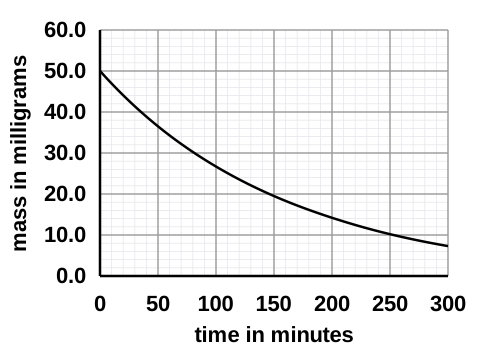
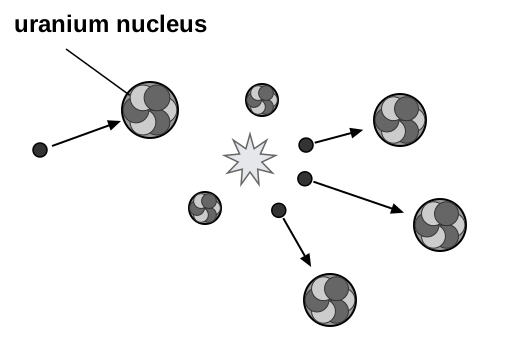
Radioactivity and nuclear energy have many uses, from food safety to power stations. Fluorine-18 is a radioactive isotope used in PET scans. Figure 7 shows how the mass of a sample of fluorine-18 falls with time. Figure 8 shows a fission chain reaction starting at a uranium nucleus.
(a)(i) Pick the description that fits gamma rays used to kill bacteria in food. Tick one box.
Our own questions on this topic, marked straight away, so you see what to revise. Free now.
Show model answer for 04.1Hide model answer for 04.1
Ionising radiation. Gamma rays are waves, not particles, and they ionise, which is how they damage and kill the bacteria.
(a)(ii) Pick the part of a nuclear reactor that absorbs neutrons. Tick one box.
See how you would score on Nuclear Fission & FusionShow model answer for 04.2Hide model answer for 04.2
Control rods. They soak up neutrons, so lowering them in slows the chain reaction. The moderator slows neutrons and the coolant carries heat away. A PET scanner is a medical machine, not part of a reactor.
(b)(i) Use Figure 7 to find the percentage of the original fluorine-18 left after 150 minutes.
See how you would score on Half-LifeShow model answer for 04.3Hide model answer for 04.3
At 150 minutes the curve reads about 19.5 mg. The sample started at 50 mg, so the fraction left is:. fraction = 19.5 over 50
percentage = 19.5 over 50 × 100. = 39 percent
How the marks are earned
- One mark: read the mass at 150 minutes, about 19.5 mg (19 to 20 accepted), and compare it with the starting 50 mg as a fraction or a percentage.
- One mark: the percentage, 39 percent. Any value from 38 to 40 percent is accepted.
- The right final answer on its own earns full marks.
Why it scores
Reading the graph and setting up the fraction earns the first mark.
The second mark is for the evaluation. A reading of 19 or 20 mg gives 38 or 40 percent, which still counts.
Revise Half-Life(b)(ii) A positron from fluorine-18 meets an electron. Describe the outcome.
See how you would score on Radioactive DecayShow model answer for 04.4Hide model answer for 04.4
The positron and electron collide and annihilate, destroying each other. Their mass is turned into energy, which leaves as a pair of gamma rays.
How the marks are earned
- Any two, one mark each: they collide; they annihilate, destroying each other (the charges cancelling or neutralising is also accepted); a pair of gamma rays is released, or energy is released. Words such as meet, combine or attract earn nothing, and neither does light.
Why it scores
Any two of colliding, annihilating and giving out gamma rays or energy earn the marks.
Revise Radioactive Decay(c) One neutron reaches one uranium nucleus in Figure 8. Say what follows, and why.
See how you would score on Nuclear Fission & FusionShow model answer for 04.5Hide model answer for 04.5
The uranium nucleus absorbs the neutron and becomes unstable. It then splits into two smaller nuclei and gives out energy, with more neutrons released. Those neutrons can go on to split other uranium nuclei.
How the marks are earned
- Any three, one mark each: the nucleus takes in the neutron (hits, collides with or joins are also accepted); this makes the nucleus unstable; it breaks up or splits, and naming two other nuclei is optional; more neutrons are released; gamma rays or energy are released.
- A lone mark is available if nothing else scores: the freed neutrons strike further nuclei. Writing atom for nucleus loses the unstable mark.
Why it scores
Absorbing the neutron, becoming unstable, splitting, and releasing neutrons or energy are the ideas, and three of them earn the three marks. The unstable mark must be about the nucleus, not the atom.
Revise Nuclear Fission & Fusion(d) Finland made 4.4 GW from nuclear plants in 2023, the UK 8.9 GW. Find Finland's output divided by the UK's, to 2 significant figures.
See how you would score on Energy ResourcesShow model answer for 04.6Hide model answer for 04.6
ratio = fraction: Finland power over UK power, end of fraction. = 4.4 over 8.9
4.4 over 8.9 = 0.4944. This is 0.49 to 2 significant figures.
How the marks are earned
- One mark: the substitution, 4.4 ÷ 8.9 (the powers of ten cancel).
- One mark: the value to 2 significant figures, 0.49. Ratio forms such as 4.4 : 8.9, 44 : 89 and 0.49 : 1 are accepted, and this paper's scheme also takes 1.0 : 0.49.
- The right final answer on its own earns full marks.
Why it scores
Both values in the right order earn the first mark. The units are the same, so they cancel.
The second mark is for the evaluation and the correct rounding. Finland's output is a little under half the UK's.
Revise Energy Resources