Why the Earth Wire Saves Lives
🔌 Why the Earth Wire Saves Lives
UK three-pin plug — click each wire or component to see its function, colour code, and exam tips.
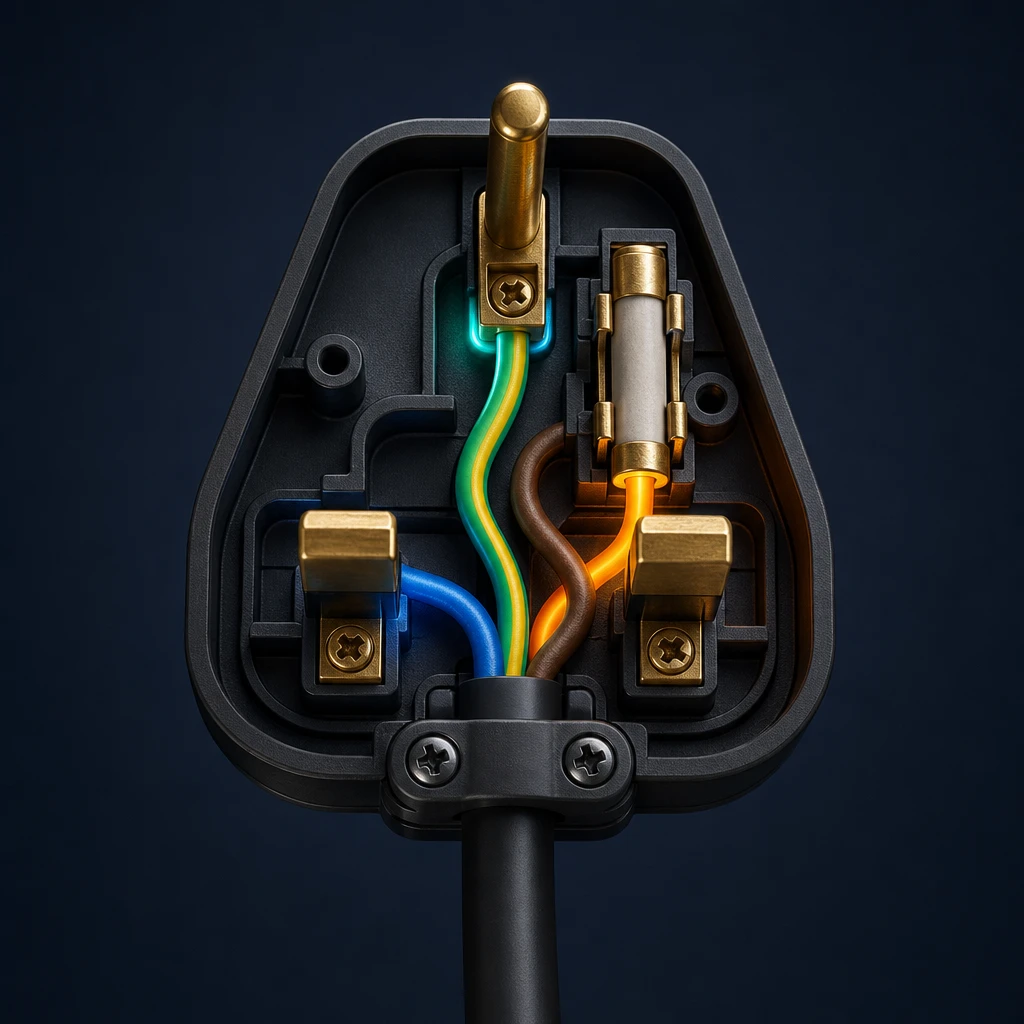
- 1Live wire (brown) —
- 2Neutral wire (blue) —
- 3Earth wire (green/yellow) —
- 4Fuse —
Figure 1: UK three-pin plug — click each wire or component to see its function, colour code, and exam tips.
Essential values (memorise these):
Earn the mark scheme marks
🧠 Memory Aid
Wire colours — "Brown Lives, Blue Neutral, Green-Yellow Earth":
Brown = Live (Be careful — it's Lethal!)
Blue = Neutral (think: bland/safe at 0 V)
Green/Yellow = Earth (think: grass and sun = the earth and ground)
Fuse selection rule — "Just Above, Never Below":
Calculate the normal current using I = P/V. Choose the fuse that is just above this value from the available options (3 A, 5 A, 13 A). Never choose one that's below — it would blow immediately. Never choose one that's much higher — it won't protect.
Earth wire purpose — "Earth Escapes, Fuse Finishes":
The Earth wire provides an escape route for fault current. The large current then causes the Fuse to Finish (melt), cutting the circuit.
Now try it yourself
Quiz · Question 1 of 18
What does AC stand for, and how does it differ from DC?
Tap an answer to check it
This topic in real past papers
Every real exam question we've found on mains electricity & safety, with a full worked answer.