Pearson Edexcel GCSE Physics Paper 2, Higher Tier (1PH0/2H)Paper 2: every question, answered
We read the actual Pearson Edexcel Physics Paper 2 Higher Tier papers and mark schemes for June 2019, June 2022 and June 2023. Below is what each real electricity, magnetism and particle model topic has actually asked, exactly as it was worded, and a complete worked answer written to the top of the real mark scheme for every sitting we have. Use this to see exactly how full marks are earned, not a generic revision summary.
Questions quoted for analysis. Diagrams and figures described in our own words, not reproduced. Mark scheme content translated into plain English, never copied. PrepWise is independent and not endorsed by Pearson Edexcel.
The paper is a template
Same 15 question types, every sitting“Reading a thermistor's circuit symbol, calculating resistance from a results table, and judging whether a component is ohmic”
In June 2019 this was a lamp's current-voltage table with a non-ohmic conclusion to judge. In June 2022 it became a full thermistor resistance-versus-temperature investigation with a tangent gradient calculation.
1×asked“Which of these symbols is used to represent a thermistor in an electrical circuit? A student investigates how the current in a lamp changes with the potential difference across the lamp. The student uses the results to calculate the resistance of the lamp. One value of resistance is missing from the table. Calculate the value of resistance that is missing from the table. The student writes this conclusion: 'The resistance of the lamp is directly proportional to the potential difference.' Comment on the student's conclusion. Use information from the table in your answer.”
“Which of these symbols is used to represent a thermistor in an electrical circuit? A student investigates how the current in a lamp changes with the potential difference across the lamp. The student uses the results to calculate the resistance of the lamp. One value of resistance is missing from the table. Calculate the value of resistance that is missing from the table. The student writes this conclusion: 'The resistance of the lamp is directly proportional to the potential difference.' Comment on the student's conclusion. Use information from the table in your answer.”
What it’s really asking
It wants the correct thermistor symbol, a straightforward V=IR calculation using the table's own numbers, and a genuine test of the proportionality claim against the actual data rather than a yes or no answer.
What the sources actually showed — June 2019
A table of results with potential difference from 1.0V to 6.0V, the corresponding current from 0.09A to 0.30A, and the calculated resistance for each row from 11 ohms up to 20 ohms, with the resistance value at 5.0V left blank.
| potential difference in V | current in A | resistance in Ω |
|---|---|---|
| 1 | 0.09 | 11 |
| 2 | 0.14 | 14 |
| 3 | 0.18 | 17 |
| 4 | 0.22 | 18 |
| 5 | 0.26 | ? |
| 6 | 0.3 | 20 |
The full worked answer — June 2019
The correct symbol for a thermistor is the one that shows a resistor with a diagonal line through it and no arrow, since a thermistor's resistance depends on temperature rather than light, which rules out the light-dependent resistor and diode symbols shown as other options.
At a potential difference of 5.0V the current is 0.26A, so substituting into resistance = potential difference divided by current gives resistance = 5.0 divided by 0.26 = 19.2, which rounds to 19 ohms.
The student's conclusion is not correct, because directly proportional would mean that doubling the potential difference should double the resistance, but the table does not show this: going from 1.0V to 2.0V the resistance only rises from 11 to 14 ohms rather than doubling to 22 ohms, and going from 3.0V to 6.0V it only rises from 17 to 20 ohms rather than doubling to 34 ohms. The resistance does increase as the potential difference increases, but not in the same proportion, which is what you would expect from a filament lamp that gets hotter as more current flows through it.
Could you have written this? Every fact in this answer is drilled in our quizzes — the writing is the easy part once the evidence is automatic.
Practise IV characteristics questionsWhat the mark scheme rewarded
- Choosing the correct thermistor symbol
- Substituting the table's own values into resistance = potential difference divided by current, then rearranging correctly
- Recognising that the data shows resistance rising but not doubling when potential difference doubles
- Using actual numbers from the table to support the conclusion, not just describing the trend in words
- Resistance = potential difference divided by current, V = IR rearranged
- Directly proportional means doubling one quantity exactly doubles the other
- A filament lamp's resistance increases as it heats up, so its current-voltage graph curves rather than staying a straight line through the origin
Traps examiners saw
- Confusing the thermistor symbol with the light-dependent resistor symbol
- Simply agreeing or disagreeing with the conclusion without quoting real numbers from the table
Full-mark self-check 0 of 3
1×asked“Which of these shows the correct circuit symbol for a thermistor? A student investigates how the resistance of a thermistor varies with temperature. Describe how the resistance of this thermistor varies with temperature. Draw the tangent to the curve at a temperature of 30°C, to find the rate of change of resistance with temperature at 30°C. State the unit. Explain one improvement in measurement that the student could make in the investigation. In this investigation, the resistance can be measured in two ways: Method 1, use an ohmmeter; Method 2, use an ammeter and a voltmeter. Explain why method 2 gives more precise results than method 1.”
“Which of these shows the correct circuit symbol for a thermistor? A student investigates how the resistance of a thermistor varies with temperature. Describe how the resistance of this thermistor varies with temperature. Draw the tangent to the curve at a temperature of 30°C, to find the rate of change of resistance with temperature at 30°C. State the unit. Explain one improvement in measurement that the student could make in the investigation. In this investigation, the resistance can be measured in two ways: Method 1, use an ohmmeter; Method 2, use an ammeter and a voltmeter. Explain why method 2 gives more precise results than method 1.”
What it’s really asking
It wants the correct thermistor symbol, a description of the resistance-temperature curve, a tangent-based gradient calculation with its unit, a genuine measurement improvement, and a reasoned comparison of precision between two methods.
What the sources actually showed — June 2022
A graph of resistance in kilohms, falling from about 6.8 kilohms at 5 degrees Celsius down to about 1.7 kilohms at 55 degrees Celsius, plotted as a smoothly decreasing curve that gets less steep as temperature rises.
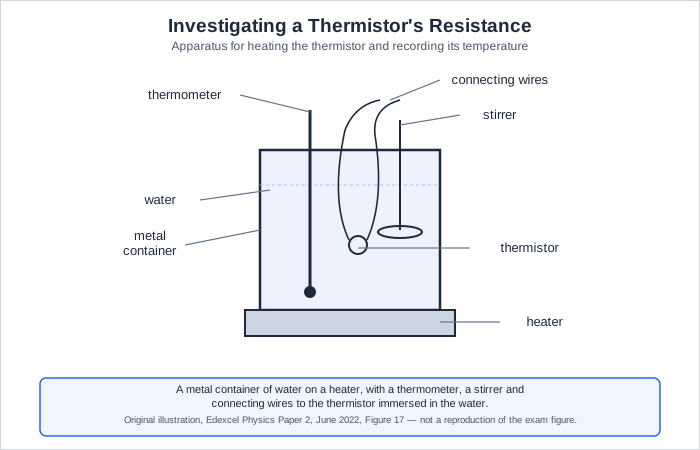
Apparatus showing a metal container of water on a heater, with a thermometer, a stirrer, and connecting wires to the thermistor immersed in the water.
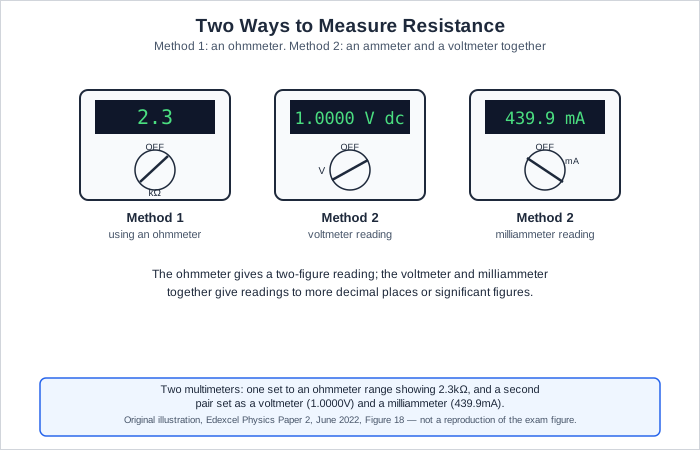
Two multimeters, one set to an ohmmeter range showing a two-figure reading in kilohms, and a second pair of meters set as a voltmeter and a milliammeter each giving readings to more decimal places or significant figures than the ohmmeter.
The full worked answer — June 2022
The correct symbol for a thermistor is the resistor symbol with a diagonal line through it and no arrowhead, which distinguishes it from the light-dependent resistor, variable resistor and diode symbols also shown. As temperature increases, the resistance of this thermistor decreases, and the graph shows this is a non-linear relationship, since the curve is steep at low temperatures and becomes less steep as temperature rises, rather than falling at a constant rate.
Drawing a tangent to the curve exactly at 30°C and forming a right-angled triangle underneath it, the resistance falls by roughly 4.6 kilohms over a temperature range of about 50°C along that tangent, giving a rate of change of resistance with temperature of approximately negative 0.09 kilohms per degree Celsius, since the mark scheme accepts any value between about 0.087 and 0.097 for this gradient. The unit for this rate of change is kilohms per degree Celsius.
One improvement would be to place the thermometer closer to the thermistor itself, since this ensures the thermometer is measuring the same temperature that the thermistor is actually experiencing rather than a slightly different part of the water. For the precision comparison, method 2 gives more precise results than method 1 because the voltmeter and ammeter readings are given to more significant figures and decimal places than the ohmmeter's reading, so the resistance calculated by dividing the voltmeter reading by the ammeter reading can also be stated to more significant figures than the direct ohmmeter reading allows.
Could you have written this? Every fact in this answer is drilled in our quizzes — the writing is the easy part once the evidence is automatic.
Practise IV characteristics questionsWhat the mark scheme rewarded
- Selecting the thermistor symbol correctly
- Describing both the decreasing trend and the non-linear, flattening shape of the curve
- Drawing a tangent at exactly 30°C and reading its gradient with the correct unit
- Naming a genuine improvement with a matching reason
- Linking the ammeter and voltmeter's greater decimal precision to a more precise calculated resistance
- A thermistor's resistance falls as temperature rises, in a non-linear way
- A tangent gives the gradient of a curve at one specific point, unlike a chord between two points
- More decimal places or significant figures in a raw reading allow a more precise calculated result
Traps examiners saw
- Describing the curve as a straight line falling at a steady rate
- Saying method 2 is simply 'more accurate' without linking this to the number of significant figures or decimal places available
Full-mark self-check 0 of 3
The method for every Q3/Q8 — same every sittingMark bands, steps, timing
What this question type rewards
The topic changes by sitting — the mark scheme never does. Learn this once, then open your question above for that sitting’s sources and a full worked answer.
- Recognising component symbols correctly, especially thermistors, from the way their resistance depends on a condition
- Substituting a results table's own numbers into V=IR rather than guessing
- Testing a stated conclusion against the actual numbers in the table rather than accepting or rejecting it on sight
- Reading a curved graph's gradient using a tangent, not just eyeballing the curve
The steps
- Identify what property the component's resistance depends on before choosing its symbol
- Substitute the table's own values into the rearranged resistance equation
- Pick two rows of the table and check whether doubling one quantity doubles the other, rather than assuming
- For a tangent gradient, draw a right-angled triangle at the exact point asked for and read the change in y over the change in x
What does an I-V characteristic graph show for a component?
IV characteristics questions always want the data tested against a claim, not just described, so practise checking whether doubling one quantity really does double another.
Practise IV characteristics questions“Adding a component so a fixed-output power supply can provide any potential difference, not just whole-number steps”
This appeared in June 2019 as a short circuit-design question following on from a lamp resistance investigation.
1×asked“The student used a power supply that had fixed output voltage settings. Each of these outputs was a whole number of volts. Describe how the student could add a component to the circuit that would provide a continuously variable voltage across the lamp.”
“The student used a power supply that had fixed output voltage settings. Each of these outputs was a whole number of volts. Describe how the student could add a component to the circuit that would provide a continuously variable voltage across the lamp.”
What it’s really asking
It wants a genuine component added to the circuit, in the correct position, that lets the potential difference across the lamp be adjusted smoothly rather than in fixed steps.
The full worked answer — June 2019
The student should add a variable resistor in series with the lamp. Since a variable resistor's resistance can be adjusted smoothly rather than in fixed steps, the share of the fixed supply voltage that appears across the lamp can then also be adjusted smoothly, giving a continuously variable voltage instead of only the whole number settings the power supply itself provides.
Could you have written this? Every fact in this answer is drilled in our quizzes — the writing is the easy part once the evidence is automatic.
Practise potential difference questionsWhat the mark scheme rewarded
- Naming a variable resistor or a potential divider as the added component
- Placing a variable resistor in series with the lamp, or a potential divider in parallel with the power supply
- A variable resistor placed in series shares the fixed supply voltage differently as its resistance changes
- A potential divider placed across the supply can tap off any fraction of the supply voltage
Traps examiners saw
- Suggesting a fixed resistor or a different power supply, which does not give continuous adjustment
- Naming the right component but placing it in the wrong part of the circuit
Full-mark self-check 0 of 2
The method for every Q3(b)(iii) — same every sittingMark bands, steps, timing
What this question type rewards
The topic changes by sitting — the mark scheme never does. Learn this once, then open your question above for that sitting’s sources and a full worked answer.
- Naming a genuine component that gives continuously variable potential difference
- Placing that component correctly in the circuit, in series or across the supply depending on which component is chosen
The steps
- Decide between a variable resistor in series or a potential divider across the supply
- State clearly where in the circuit the extra component goes
Which of the following is the correct definition of potential difference?
Continuously variable voltage questions always want a named component in the right place, so practise the difference between a series variable resistor and a parallel potential divider.
Practise potential difference questions“Rearranging V=IR for resistance, and running the full required practical measuring how a wire's resistance depends on its length”
A single quick resistance calculation appeared in June 2022, then the full required practical on the resistance of a wire, including circuit diagram, apparatus, graph reading and a safety explanation, became the whole of Question 2 in June 2023.
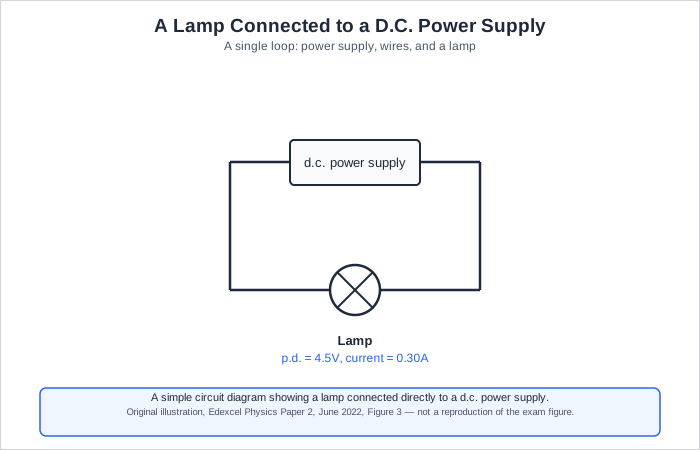
1×asked“Figure 3 shows a lamp connected to a d.c. power supply. The power supply provides a potential difference of 4.5V. The current in the lamp is 0.30A. Calculate the resistance of the lamp. Use the equation R=V/I.”
“Figure 3 shows a lamp connected to a d.c. power supply. The power supply provides a potential difference of 4.5V. The current in the lamp is 0.30A. Calculate the resistance of the lamp. Use the equation R=V/I.”
What it’s really asking
It wants a direct substitution of the given potential difference and current into the resistance equation.
What the sources actually showed — June 2022
A simple circuit diagram showing a lamp connected directly to a d.c. power supply.
The full worked answer — June 2022
Substituting directly into R = V divided by I gives R = 4.5 divided by 0.30 = 15 ohms.
Could you have written this? Every fact in this answer is drilled in our quizzes — the writing is the easy part once the evidence is automatic.
Practise resistance and Ohm's law questionsWhat the mark scheme rewarded
- Correctly substituting potential difference and current into R=V/I
- R = V divided by I is the direct rearrangement of V = IR for resistance
Traps examiners saw
- Dividing current by potential difference instead of the other way round
Full-mark self-check 0 of 1
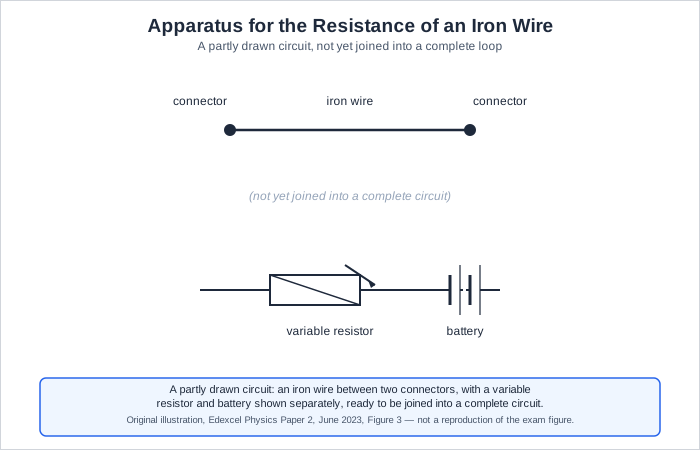
1×asked“Figure 3 shows some of the apparatus that students use to determine the resistance of a piece of iron wire. Add connecting wires, a voltmeter and an ammeter to complete the circuit so that the students can determine the resistance of the piece of iron wire. The students extend the investigation to determine how the resistance of the iron wire changes with its length. Give the name of one additional piece of apparatus the students would need. Figure 4 shows a graph of the results. Draw a straight line of best fit. Use Figure 4 to estimate the resistance of a 100cm length of the iron wire. The variable resistor shown in Figure 3 is used to prevent the iron wire from becoming too hot. Explain how the variable resistor is used to prevent the iron wire from becoming too hot. The potential difference across another piece of wire is 1.56V. The current in the wire is 0.45A. Calculate the resistance of this piece of wire. Use the equation V=I x R.”
“Figure 3 shows some of the apparatus that students use to determine the resistance of a piece of iron wire. Add connecting wires, a voltmeter and an ammeter to complete the circuit so that the students can determine the resistance of the piece of iron wire. The students extend the investigation to determine how the resistance of the iron wire changes with its length. Give the name of one additional piece of apparatus the students would need. Figure 4 shows a graph of the results. Draw a straight line of best fit. Use Figure 4 to estimate the resistance of a 100cm length of the iron wire. The variable resistor shown in Figure 3 is used to prevent the iron wire from becoming too hot. Explain how the variable resistor is used to prevent the iron wire from becoming too hot. The potential difference across another piece of wire is 1.56V. The current in the wire is 0.45A. Calculate the resistance of this piece of wire. Use the equation V=I x R.”
What it’s really asking
It wants a completed circuit diagram for measuring wire resistance, the extra apparatus needed to vary the length, reading resistance off a straight-line graph, an explanation of how a variable resistor prevents overheating, and a direct V=IR calculation.
What the sources actually showed — June 2023
A partly drawn circuit showing an iron wire between two connectors, with a variable resistor and a battery shown separately, ready to be joined into a complete circuit.
A graph of resistance in ohms against length in centimetres, with data points rising in a roughly straight line from about 0.3 ohms at 10cm up to about 2.7 ohms at 90cm.
The full worked answer — June 2023
To complete the circuit I connect a voltmeter across the iron wire, in parallel with it, and an ammeter in series with the iron wire, so the ammeter reads the current flowing through the wire and the voltmeter reads the potential difference across just that wire.
To investigate how resistance changes with length, the students would also need a metre rule, so that they can measure and mark out different lengths of the wire to test.
Drawing a straight line of best fit through the plotted points and extending it a little further, the resistance of a 100cm length can be estimated at around 3.0 ohms, following the same roughly straight-line trend shown by the shorter lengths already plotted.
The variable resistor increases the total resistance of the circuit, which keeps the current flowing through the iron wire small. Since a larger current would raise the temperature of the iron wire more, keeping the current small using the variable resistor is what prevents the wire from overheating.
Rearranging V = I x R for resistance gives R = V divided by I, so R = 1.56 divided by 0.45 = 3.47, which rounds to 3.5 ohms.
Could you have written this? Every fact in this answer is drilled in our quizzes — the writing is the easy part once the evidence is automatic.
Practise resistance and Ohm's law questionsWhat the mark scheme rewarded
- A voltmeter in parallel with the wire and an ammeter in series with it
- Naming a metre rule, or another way of measuring or marking out length
- An estimate for 100cm within the accepted range from the line of best fit
- Linking increased resistance to reduced current, and reduced current to less heating
- Correctly rearranging and evaluating V=IR
- An ammeter always goes in series, a voltmeter always goes in parallel with the component being measured
- A variable resistor increases circuit resistance, which by V=IR reduces the current for a fixed supply voltage
- The heating effect of a current increases with the size of the current
Traps examiners saw
- Drawing the ammeter in parallel or the voltmeter in series by mistake
- Saying the variable resistor 'reduces heat' without explaining the current link that causes this
Full-mark self-check 0 of 4
The method for every Q2(a)(i)/Q2 — same every sittingMark bands, steps, timing
What this question type rewards
The topic changes by sitting — the mark scheme never does. Learn this once, then open your question above for that sitting’s sources and a full worked answer.
- Substituting given values into R=V/I correctly
- Completing a circuit diagram with the ammeter in series and voltmeter in parallel with the wire
- Reading a straight-line graph correctly, including sensible extrapolation
- Explaining how a variable resistor protects a wire from overheating by limiting current
The steps
- Substitute the given voltage and current directly into R=V/I
- For a resistance-of-a-wire circuit, always draw the ammeter in series with the wire and the voltmeter across it
- Use the gradient of the graph to estimate values beyond the plotted range
- Link a variable resistor's effect on current directly to the heating effect of that current
Which of the following best describes electrical resistance?
Resistance of a wire questions always test the required practical circuit as much as the calculation, so practise drawing the ammeter and voltmeter in the right places.
Practise resistance and Ohm's law questions“Explaining why a lamp gets dimmer once a second identical lamp is added in series with it”
This appeared in June 2022 as a state-and-explain question following directly from a single-lamp circuit.
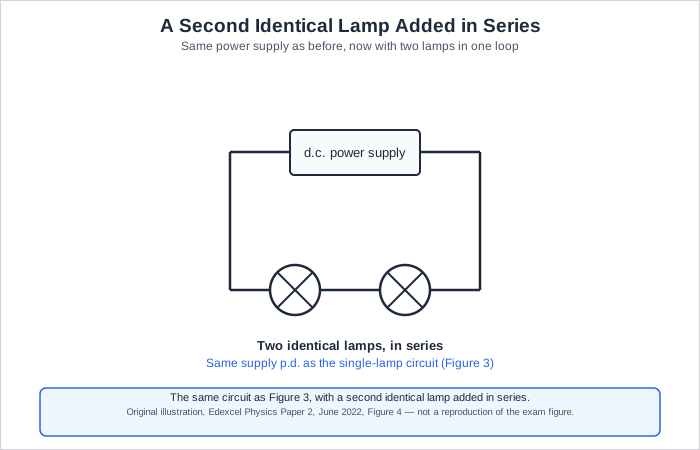
1×asked“Another identical lamp is added to the circuit, as shown in Figure 4. The power supply provides the same potential difference as it provided in the circuit in Figure 3. State and explain the difference between the brightness of the lamp in Figure 3 and the brightness of a lamp in Figure 4.”
“Another identical lamp is added to the circuit, as shown in Figure 4. The power supply provides the same potential difference as it provided in the circuit in Figure 3. State and explain the difference between the brightness of the lamp in Figure 3 and the brightness of a lamp in Figure 4.”
What it’s really asking
It wants a chain of reasoning from added resistance, through reduced current or shared voltage, to reduced brightness, not just a bare statement that the lamp is dimmer.
What the sources actually showed — June 2022
The same circuit as Figure 3, but with a second identical lamp added in series with the first, both connected to the same d.c. power supply.
The full worked answer — June 2022
The lamp in Figure 4 is dimmer than the lamp in Figure 3. Adding a second identical lamp in series increases the total resistance of the circuit, and since the power supply provides the same potential difference as before, this bigger resistance means the current in the circuit is now smaller. With the current reduced, and the supply's potential difference now shared between the two lamps rather than being applied fully across just one, each lamp receives less power than the single lamp did, which is why each one glows more dimly.
Could you have written this? Every fact in this answer is drilled in our quizzes — the writing is the easy part once the evidence is automatic.
Practise series and parallel circuits questionsWhat the mark scheme rewarded
- Stating the lamp in the two-lamp circuit is dimmer
- Linking this to reduced current caused by the added resistance
- Linking this to the shared potential difference or reduced power at each lamp
- Adding components in series always increases total resistance
- For a fixed supply potential difference, a bigger total resistance means a smaller current
- In series, the supply's potential difference is shared between the components rather than each getting the full amount
Traps examiners saw
- Just saying 'it is dimmer' without explaining why using resistance, current or shared voltage
Full-mark self-check 0 of 2
The method for every Q2(b) — same every sittingMark bands, steps, timing
What this question type rewards
The topic changes by sitting — the mark scheme never does. Learn this once, then open your question above for that sitting’s sources and a full worked answer.
- Linking together at least three of resistance, current, shared potential difference and brightness rather than stating just one
The steps
- State what happens to total resistance first
- Link that resistance change to current
- Link the smaller current, or the shared potential difference, to each lamp's power and brightness
In a series circuit, what is true about the current at all points?
Series circuit brightness questions always want resistance, current and shared voltage linked together, so practise the whole chain rather than one isolated fact.
Practise series and parallel circuits questions“Calculating power supplied to a lamp, and testing a manufacturer's claim about charging time using the energy, current and voltage equation”
A direct power calculation appeared in June 2022. In June 2023 the same relationship between energy, current and voltage was used to test a real claim about charging time.
1×asked“The power supply provides a potential difference (voltage) of 4.5V. The current in the lamp is 0.30A. Calculate the power supplied to the lamp.”
“The power supply provides a potential difference (voltage) of 4.5V. The current in the lamp is 0.30A. Calculate the power supplied to the lamp.”
What it’s really asking
It wants power calculated directly from the given potential difference and current.
The full worked answer — June 2022
Using power = potential difference multiplied by current, power = 4.5 multiplied by 0.30 = 1.35W, which rounds to 1.4W.
Could you have written this? Every fact in this answer is drilled in our quizzes — the writing is the easy part once the evidence is automatic.
Practise electrical power and energy questionsWhat the mark scheme rewarded
- Selecting power = potential difference multiplied by current
- Substituting correctly and evaluating to 1.4W
- Power = potential difference multiplied by current is one of three equivalent forms of the power equation
Traps examiners saw
- Using the resistance from an earlier part of the question rather than the given potential difference and current directly
Full-mark self-check 0 of 1
1×asked“The charging point provides an average current of 15.0A to the battery, at a potential difference (voltage) of 400V. It is claimed that 126MJ of energy can be transferred to the battery in less than 6 hours. Comment on this claim. Use this equation to support your answer: t = E divided by (I x V).”
“The charging point provides an average current of 15.0A to the battery, at a potential difference (voltage) of 400V. It is claimed that 126MJ of energy can be transferred to the battery in less than 6 hours. Comment on this claim. Use this equation to support your answer: t = E divided by (I x V).”
What it’s really asking
It wants the given equation rearranged and used to calculate the actual charging time, converted into hours, then compared directly against the claimed 6 hours to reach a supported conclusion.
The full worked answer — June 2023
Substituting into t = E divided by (I multiplied by V) gives t = 126,000,000 divided by (15.0 multiplied by 400) = 126,000,000 divided by 6000 = 21,000 seconds. Converting this to hours, 21,000 divided by 3600 = 5.8 hours. Since 5.8 hours is less than the claimed 6 hours, the claim is justified.
Could you have written this? Every fact in this answer is drilled in our quizzes — the writing is the easy part once the evidence is automatic.
Practise electrical power and energy questionsWhat the mark scheme rewarded
- Correctly substituting energy, current and potential difference into the given equation
- Converting the answer in seconds into hours before comparing it with the claim
- Reaching a conclusion that directly refers back to the calculated time versus the claimed 6 hours
- t = E divided by (I multiplied by V) rearranges the energy transferred equation E = I x V x t for time
- There are 3600 seconds in one hour
Traps examiners saw
- Forgetting to convert the answer from seconds into hours before comparing it with the claim
- Stating a number without explicitly saying whether the claim is justified or not
Full-mark self-check 0 of 3
The method for every Q2(a)(ii)/Q8(b)(i) — same every sittingMark bands, steps, timing
What this question type rewards
The topic changes by sitting — the mark scheme never does. Learn this once, then open your question above for that sitting’s sources and a full worked answer.
- Selecting a correct working form of the power equation and substituting given values
- Rearranging t = E divided by (I multiplied by V) correctly and converting seconds to hours
- Reaching a clear, numerically supported conclusion about whether a claim is justified
The steps
- Choose whichever version of the power equation matches the values you have been given
- Convert your final answer to the units asked for before comparing it with the claim
- State explicitly whether the claim is or is not justified based on your number
What is the unit of electrical power?
Power and energy claim questions always want your number compared explicitly against the claim, so practise finishing with a clear justified or not justified statement.
Practise electrical power and energy questions“How an earth wire and a fuse together protect someone when a fault makes the live wire touch a kettle's metal case”
This appeared in June 2019 as the paper's Level of Response question on mains safety, worth 6 marks across three named levels.
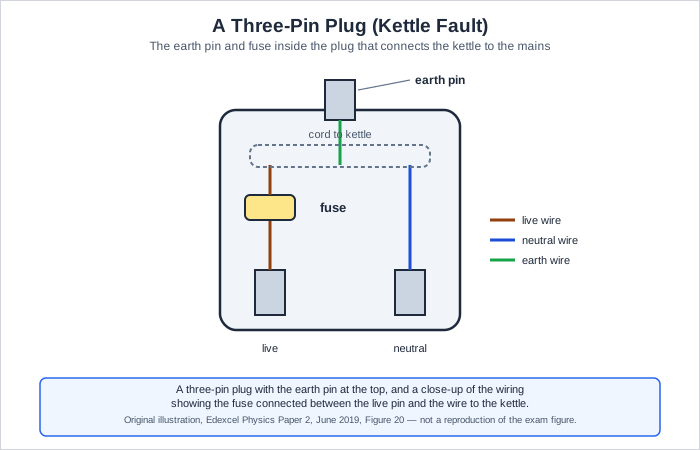
1×asked“Figure 20 shows the three-pin plug used to connect the kettle to the mains. A fault occurs in the kettle causing the live wire to touch the metal case of the kettle. Explain how the safety features of the plug operate when this fault occurs.”
“Figure 20 shows the three-pin plug used to connect the kettle to the mains. A fault occurs in the kettle causing the live wire to touch the metal case of the kettle. Explain how the safety features of the plug operate when this fault occurs.”
What it’s really asking
It wants the earth wire's mechanism and the fuse's mechanism both explained in causal detail, from the fault occurring through to the supply being safely disconnected.
What the sources actually showed — June 2019
A three-pin plug showing the earth pin at the top, and a close-up of the wiring inside the plug showing the fuse connected between the live pin and the wire going to the appliance.
The full worked answer — June 2019
The earth wire is connected directly to the kettle's metal case, and since metal is a good conductor, once the live wire touches the case, the case becomes connected to the live supply through the earth wire's very low resistance path. Because this earth path has such low resistance, a very large current flows straight down to earth rather than through anyone touching the appliance, and the earth wire keeps the metal case held at earth potential rather than at the dangerous voltage of the live wire, so a person touching the case does not get a shock, since there is no potential difference between the case and earth to drive a current through them.
The fuse itself is a thin piece of wire connected inside the plug between the live pin and the wire that goes into the kettle. The temperature this wire reaches depends on the size of the current flowing through it, and the same very large fault current that flows to earth also flows through the thin fuse wire, heating it up rapidly. Once the fuse wire's temperature rises above its melting point, it melts and breaks, which disconnects the live supply to the kettle completely, so the kettle can no longer carry mains voltage anywhere inside it, and the surge is also prevented from damaging the house's own wiring.
The two features work together in sequence: it is the earth wire's low resistance that lets such a large fault current flow in the first place, by giving the current somewhere to go other than through a person, and it is that same surge of current which then heats up and blows the fuse, permanently isolating the kettle from the mains supply.
Could you have written this? Every fact in this answer is drilled in our quizzes — the writing is the easy part once the evidence is automatic.
Practise mains electricity safety questionsWhat the mark scheme rewarded
- Explaining that the earth wire's low resistance to earth keeps the case at earth potential, preventing a shock
- Explaining that the same large fault current heats the thin fuse wire beyond its melting point, breaking the circuit
- Explaining that this disconnects the live supply and protects the house wiring from damage
- Metal cases are earthed via a low-resistance earth wire so they cannot reach a dangerous potential
- A fuse is a thin wire that melts once the current through it gets large enough
- A blown fuse disconnects the live supply completely
Traps examiners saw
- Explaining only the earth wire or only the fuse in detail while barely mentioning the other
- Saying the fuse 'stops the shock' directly, rather than explaining that it disconnects the supply after the earth wire has already prevented the shock
Full-mark self-check 0 of 3
The method for every Q10(b) — same every sittingMark bands, steps, timing
What this question type rewards
The topic changes by sitting — the mark scheme never does. Learn this once, then open your question above for that sitting’s sources and a full worked answer.
- Explaining the earth wire's mechanism in full detail, not just naming it
- Explaining the fuse's mechanism in full detail, not just naming it
- Covering both the earth wire and the fuse for the top level, one may be more developed than the other
The steps
- Explain how the earth wire's low resistance keeps the metal case at earth potential so no shock occurs
- Explain how the same fault current melts the fuse and disconnects the supply
- Make sure both mechanisms appear, not just one
What does AC stand for, and how does it differ from DC?
Mains safety questions always want both the earth wire and the fuse explained in detail, so practise linking each mechanism all the way through to why it protects someone.
Practise mains electricity safety questions“Comparing the rate and direction of charge flow between a mains kettle and a battery-powered immersion heater, and calculating charge from energy and voltage”
The charge-flow comparison appeared in June 2019, and a direct charge calculation using E=QV appeared in June 2023.
1×asked“The current in the heating element of the kettle is 8.3A. State two differences between the movement of charge in the heating element of the kettle and the movement of charge in the immersion heater.”
“The current in the heating element of the kettle is 8.3A. State two differences between the movement of charge in the heating element of the kettle and the movement of charge in the immersion heater.”
What it’s really asking
It wants two genuinely different comparisons between the mains-powered kettle and the battery-powered immersion heater, covering both the rate and the direction of charge flow.
The full worked answer — June 2019
First, the rate of flow of charge is different: since the current in the immersion heater is 14A, 14 coulombs of charge flow through it every second, but since the current in the kettle's heating element is only 8.3A, only 8.3 coulombs flow through it every second, so charge flows faster in the immersion heater. Second, the direction of charge flow is different: the immersion heater runs from a battery, so charge always flows in the same direction through it, whereas the kettle runs from the mains, so the direction of charge flow in its heating element keeps reversing back and forth many times a second, since mains electricity is alternating current.
Could you have written this? Every fact in this answer is drilled in our quizzes — the writing is the easy part once the evidence is automatic.
Practise current and charge questionsWhat the mark scheme rewarded
- Comparing the rate of charge flow using the two given current values
- Comparing the direction of charge flow, linking it to alternating versus direct current rather than just naming AC and DC
- Current in amps is the rate of flow of charge in coulombs per second
- Direct current flows in one direction only, alternating current reverses direction repeatedly
Traps examiners saw
- Simply stating 'one is AC and one is DC' without explaining what that means for the direction of charge flow
Full-mark self-check 0 of 2
1×asked“Calculate the total charge that moves into the battery while it is being recharged. Use the equation E = Q x V.”
“Calculate the total charge that moves into the battery while it is being recharged. Use the equation E = Q x V.”
What it’s really asking
It wants E=QV rearranged for charge, then the given energy and voltage substituted directly.
The full worked answer — June 2023
Rearranging E = Q x V for charge gives Q = E divided by V, so Q = 126,000,000 divided by 400 = 315,000 coulombs.
Could you have written this? Every fact in this answer is drilled in our quizzes — the writing is the easy part once the evidence is automatic.
Practise current and charge questionsWhat the mark scheme rewarded
- Correctly rearranging E=QV to isolate charge
- Substituting and evaluating using the energy in joules and the voltage in volts
- E=QV rearranges to Q = E divided by V for charge
Traps examiners saw
- Multiplying energy by voltage instead of dividing
Full-mark self-check 0 of 1
The method for every Q10(a)(ii)/Q8(b)(ii) — same every sittingMark bands, steps, timing
What this question type rewards
The topic changes by sitting — the mark scheme never does. Learn this once, then open your question above for that sitting’s sources and a full worked answer.
- Naming two genuinely different comparisons, not two versions of the same point
- Rearranging E=QV correctly for charge
The steps
- Compare the rate of charge flow using the two given current values directly
- Compare the direction of charge flow, remembering AC keeps reversing while DC does not
- Rearrange the energy equation for charge before substituting
What is electric current?
Charge questions always want two genuinely distinct comparisons or a clean rearrangement, so practise both the AC versus DC reasoning and the E=QV rearrangement.
Practise current and charge questions“Tracing the field around a current-carrying wire, comparing a bar magnet's field with a uniform field, and sketching the Earth's own magnetic field”
This recurs in every real sitting we have, from plotting compass investigations in June 2019, through bar magnet and Earth field sketches in June 2022, to two repelling magnets in June 2023.
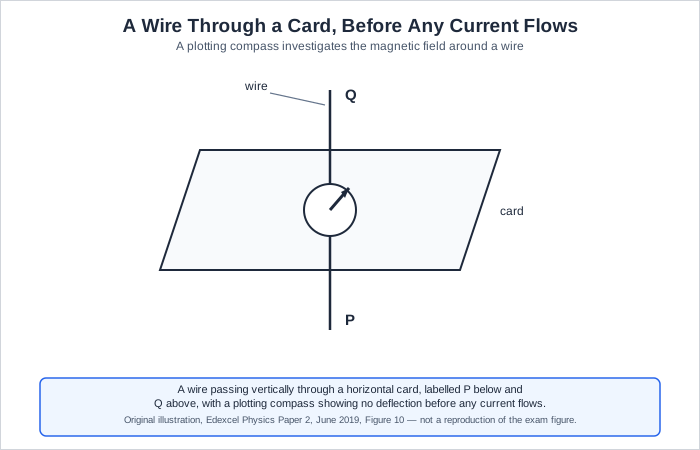
1×asked“A student uses a plotting compass to investigate the magnetic field around a wire. Figure 10 shows the wire going straight through a card. Which of these shows a possible direction of the compass needle when there is a current in the wire going from P to Q? Describe how the student could develop the investigation to find the shape of the magnetic field produced by the current.”
“A student uses a plotting compass to investigate the magnetic field around a wire. Figure 10 shows the wire going straight through a card. Which of these shows a possible direction of the compass needle when there is a current in the wire going from P to Q? Describe how the student could develop the investigation to find the shape of the magnetic field produced by the current.”
What it’s really asking
It wants the compass direction identified using the right-hand rule for a straight wire, then a full plotting-compass method described for mapping out the entire field shape.
What the sources actually showed — June 2019
A wire passing vertically through a horizontal card, labelled P below the card and Q above it, with a plotting compass resting on the card showing no deflection before any current flows.
The full worked answer — June 2019
With current flowing from P to Q, the magnetic field around the wire forms circles, and the compass needle lines up tangent to that circular field, pointing in the direction shown by option A.
To find the shape of the whole field, the student should mark the direction the compass needle points to at one position on the card, then move the compass to a new position so its tail sits directly over that mark, and record the new direction it points to there. Repeating this process traces out a series of marks that, once joined together, reveal the field forms a complete circle around the wire, and repeating the whole process again starting from a different distance from the wire reveals a family of concentric circles.
Could you have written this? Every fact in this answer is drilled in our quizzes — the writing is the easy part once the evidence is automatic.
Practise magnetic field questionsWhat the mark scheme rewarded
- Choosing the compass direction consistent with a circular field tangent to the compass needle
- Recording one compass position, iterating the compass along the field, and joining the marks to reveal the overall shape
- The magnetic field around a straight current-carrying wire forms concentric circles centred on the wire
- A plotting compass always aligns tangent to the field line at its position
Traps examiners saw
- Choosing a compass direction that points radially towards or away from the wire rather than tangentially around it
- Describing only a single compass reading rather than the full method for tracing the whole field
Full-mark self-check 0 of 2
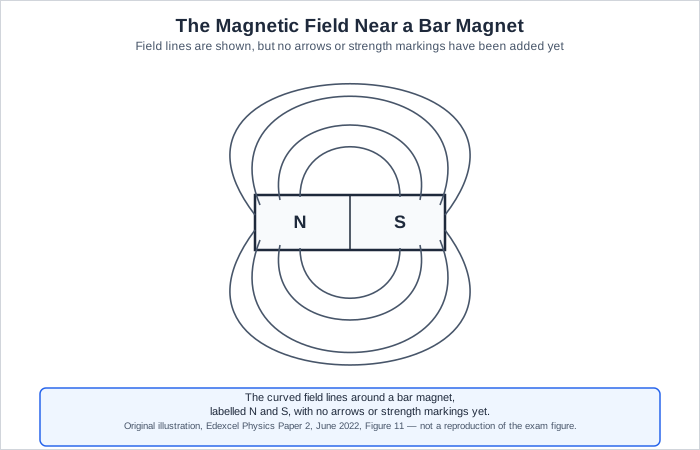
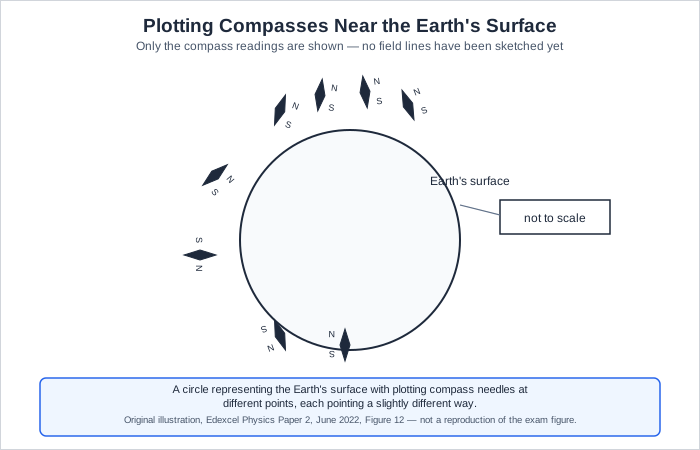
1×asked“Figure 11 shows the shape of the magnetic field near a bar magnet. Draw arrows on the field lines to show the direction of the magnetic field. Place a letter X on Figure 11 at a place where the magnetic field is strongest. Describe two differences between the magnetic field shown in Figure 11 and a uniform magnetic field. State how a uniform magnetic field may be obtained in a school laboratory. Figure 12 shows the directions of some plotting compass needles placed at different points near the Earth's surface. Sketch, on Figure 12, the Earth's magnetic field outside and inside the Earth. State which part of the Earth generates its magnetic field.”
“Figure 11 shows the shape of the magnetic field near a bar magnet. Draw arrows on the field lines to show the direction of the magnetic field. Place a letter X on Figure 11 at a place where the magnetic field is strongest. Describe two differences between the magnetic field shown in Figure 11 and a uniform magnetic field. State how a uniform magnetic field may be obtained in a school laboratory. Figure 12 shows the directions of some plotting compass needles placed at different points near the Earth's surface. Sketch, on Figure 12, the Earth's magnetic field outside and inside the Earth. State which part of the Earth generates its magnetic field.”
What it’s really asking
It wants field direction and strongest-point marked on a bar magnet's field, two real differences from a uniform field, a genuine way to produce a uniform field, and the Earth's own field sketched with its origin named.
What the sources actually showed — June 2022
The curved field lines around a bar magnet, labelled N at one end and S at the other, with no arrows or strength markings shown yet.
A circle representing the Earth's surface with several plotting compass needles shown at different points around it, each pointing in a slightly different direction, but with no field lines drawn yet.
The full worked answer — June 2022
Since field lines point away from a north pole and towards a south pole, I draw at least two arrows on the curved lines pointing away from the N end of the magnet and around towards the S end. The field is strongest right at the poles, where the lines are most tightly bunched together, so I mark the X immediately next to the N pole.
Two differences from a uniform field: first, the bar magnet's field lines curve and change direction from point to point, whereas a uniform field's lines are straight and all point the same way everywhere; second, the bar magnet's field lines are close together near the poles and spread further apart away from the magnet, showing the field varies in strength, whereas a uniform field has evenly spaced lines of exactly the same strength throughout.
A uniform magnetic field can be produced in a school laboratory between two flat Magnadur magnets facing each other with opposite poles, or equally inside a long solenoid carrying a steady current.
Sketching the Earth's field, I draw at least two field lines outside the Earth that match the directions shown by the compass needles, curving from one imaginary magnetic pole round to the other with arrows in the correct direction, and I continue at least two of these lines inside the Earth towards the imaginary poles, leaving a gap where the solid Earth itself is drawn. The Earth's magnetic field is generated by its magnetic outer core.
Could you have written this? Every fact in this answer is drilled in our quizzes — the writing is the easy part once the evidence is automatic.
Practise magnetic field questionsWhat the mark scheme rewarded
- Arrows pointing away from the N pole and into the S pole
- The X placed right at a pole, where the field lines converge
- Two genuinely distinct differences from a uniform field, such as direction variation and strength variation
- A genuine real method for producing a uniform field
- Field lines matching the shown compass directions outside the Earth, continuing inside towards imaginary poles
- Naming the magnetic outer core as the source of the Earth's field
- Field lines always point away from a north pole and towards a south pole
- A uniform field has parallel, equally spaced, equal-strength field lines
- Helmholtz coils, Magnadur magnets or a long solenoid all produce a uniform field in a school lab
- The Earth's magnetic field is generated by its magnetic outer core, made of moving molten material
Traps examiners saw
- Drawing an arrow pointing into the N pole rather than away from it
- Naming only one difference from a uniform field, or restating the same difference in two different ways
Full-mark self-check 0 of 4
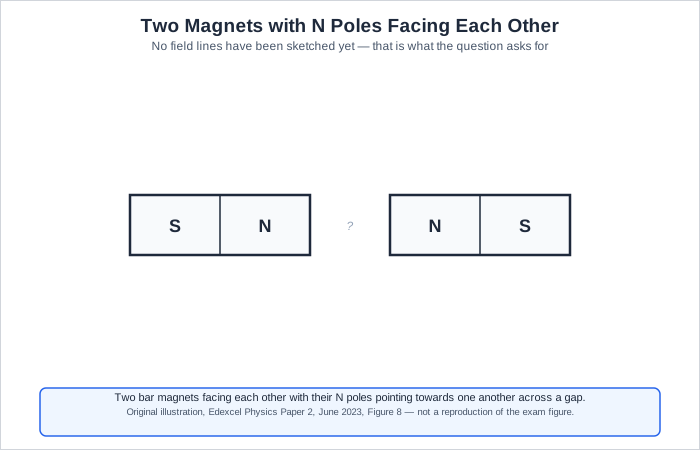
1×asked“Figure 8 shows two magnets with their N poles facing each other. On Figure 8, draw the shape and direction of the magnetic field between the two magnets.”
“Figure 8 shows two magnets with their N poles facing each other. On Figure 8, draw the shape and direction of the magnetic field between the two magnets.”
What it’s really asking
It wants field lines drawn showing that two like poles repel, bowing outward away from the gap rather than joining straight across it.
What the sources actually showed — June 2023
Two bar magnets facing each other with their N poles pointing towards one another across a gap, and their S poles at the outer ends.
The full worked answer — June 2023
Since both magnets have their N poles facing each other, the two fields repel rather than joining up directly between the poles, so between the two magnets I draw at least four curved field lines that bow outward away from the gap, two curving upward and two curving downward, with none of them crossing straight across the middle. The arrows on these lines point away from each N pole, since field lines always point away from a north pole.
Could you have written this? Every fact in this answer is drilled in our quizzes — the writing is the easy part once the evidence is automatic.
Practise magnetic field questionsWhat the mark scheme rewarded
- At least four field lines that do not cross, bowing outward rather than connecting the two poles directly
- At least two arrows pointing away from the N poles
- Two like poles repel, so their field lines do not join directly between them
- Field lines always point away from a north pole
Traps examiners saw
- Drawing straight lines connecting the two N poles directly, which is only correct for opposite poles attracting
Full-mark self-check 0 of 2
The method for every Q5(a)/Q5(a)(b)(c)/Q5(a) — same every sittingMark bands, steps, timing
What this question type rewards
The topic changes by sitting — the mark scheme never does. Learn this once, then open your question above for that sitting’s sources and a full worked answer.
- Using the plotting compass method correctly to trace out an unknown field shape
- Naming genuinely different features that distinguish a uniform field from a bar magnet's field
- Sketching field lines that curve realistically and point in the correct direction, away from north poles
The steps
- For an unknown field, mark where the compass points, move the compass so its tail sits over that mark, then repeat
- Compare direction, shape, spacing and strength between a uniform field and a bar magnet's field
- Draw arrows on field lines pointing away from north poles and into south poles
What happens when two like magnetic poles (e.g. north and north) are brought close together?
Magnetic field questions always want the plotting compass method or the correct arrow direction, so practise tracing field shapes and remembering arrows point away from N poles.
Practise magnetic field questions“Using Fleming's left-hand rule and F=BIl to find forces and lengths, and comparing the motor effect in a loudspeaker with electromagnetic induction in a microphone”
A direct force-and-reaction-pair question with an F=BIl calculation appeared in June 2019, a similar F=BIl calculation reappeared in June 2022 and June 2023, and June 2023 also carried the paper's Level of Response question comparing a loudspeaker with a microphone.
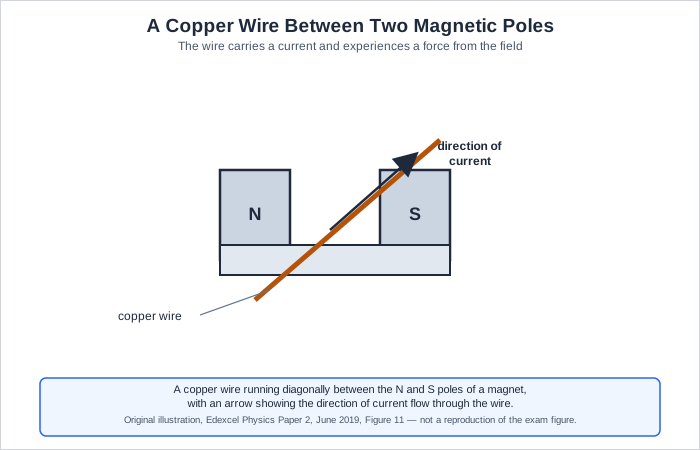
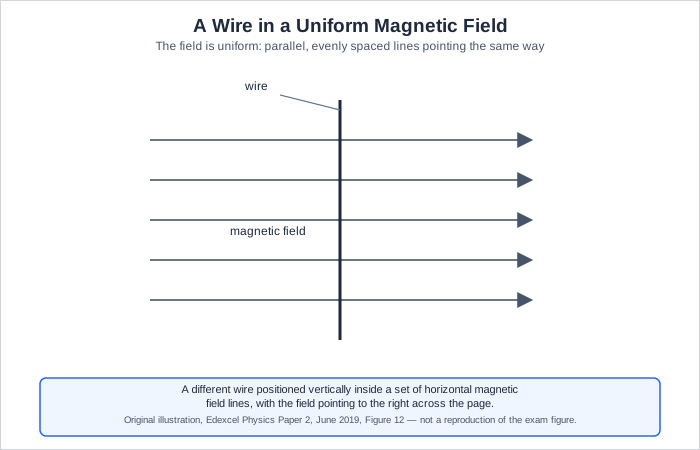
1×asked“Figure 11 shows a copper wire between two magnetic poles. The current in the wire is in the direction shown by the arrow. The wire experiences a force due to the magnetic field. The direction of the force due to the magnetic field is... The interaction between the magnetic fields produced by the magnet and the current in the wire produces forces on the magnet and the wire. Compare these two forces. Figure 12 shows a different wire inside a uniform magnetic field. The magnetic flux density of the magnetic field is 0.72 N/A m. The length of the wire inside the field is 30mm. The size of the force due to the magnetic field on the wire is 0.045N. Calculate the size of the current in the wire.”
“Figure 11 shows a copper wire between two magnetic poles. The current in the wire is in the direction shown by the arrow. The wire experiences a force due to the magnetic field. The direction of the force due to the magnetic field is... The interaction between the magnetic fields produced by the magnet and the current in the wire produces forces on the magnet and the wire. Compare these two forces. Figure 12 shows a different wire inside a uniform magnetic field. The magnetic flux density of the magnetic field is 0.72 N/A m. The length of the wire inside the field is 30mm. The size of the force due to the magnetic field on the wire is 0.045N. Calculate the size of the current in the wire.”
What it’s really asking
It wants the force direction found using Fleming's left-hand rule, the reaction force on the magnet compared correctly using Newton's third law, and F=BIl rearranged for current.
What the sources actually showed — June 2019
A copper wire running diagonally between the N and S poles of a magnet, with an arrow showing the direction of current flow through the wire.
A wire positioned vertically inside a set of horizontal magnetic field lines, with the field pointing to the right across the page.
The full worked answer — June 2019
Using Fleming's left-hand rule with the magnetic field running from the N pole to the S pole and the current flowing in the direction shown by the arrow, the force on the wire acts upwards. By Newton's third law, the force the wire pushes back on the magnet with is exactly equal in size and opposite in direction, so the magnet itself experiences an equal force acting downwards.
Rearranging F = B x I x l for current gives I = F divided by (B multiplied by l), and converting the wire's length to metres, I = 0.045 divided by (0.72 multiplied by 0.030) = 0.045 divided by 0.0216 = 2.08, which rounds to 2.1A.
Could you have written this? Every fact in this answer is drilled in our quizzes — the writing is the easy part once the evidence is automatic.
Practise the motor effect questionsWhat the mark scheme rewarded
- Choosing the force direction consistent with Fleming's left-hand rule
- Stating the two forces are equal in size and opposite in direction
- Rearranging F=BIl for current and converting the length into metres before substituting
- Fleming's left-hand rule: First finger Field, seCond finger Current, thuMb Motion
- Newton's third law gives every force an equal and opposite reaction force
- F = B x I x l must use length in metres, so millimetres need converting first
Traps examiners saw
- Forgetting to convert the wire's length from millimetres into metres before substituting
- Saying the forces are simply 'equal' without also stating they are opposite in direction
Full-mark self-check 0 of 3
1×asked“A wire is placed at right angles to the Earth's magnetic field. The wire is 0.600m long and carries a current of 93.1mA. The force on the wire is 1.11 x 10^-5 N. Calculate the magnetic flux density of the Earth's magnetic field. Use the equation F = B x I x l.”
“A wire is placed at right angles to the Earth's magnetic field. The wire is 0.600m long and carries a current of 93.1mA. The force on the wire is 1.11 x 10^-5 N. Calculate the magnetic flux density of the Earth's magnetic field. Use the equation F = B x I x l.”
What it’s really asking
It wants F=BIl rearranged for magnetic flux density, with the current converted from milliamps to amps before substituting.
The full worked answer — June 2022
Rearranging F = B x I x l for magnetic flux density gives B = F divided by (I multiplied by l), and converting the current to amps, B = (1.11 x 10^-5) divided by (0.0931 multiplied by 0.600) = (1.11 x 10^-5) divided by 0.05586 = 1.99 x 10^-4, which rounds to 2.0 x 10^-4 T.
Could you have written this? Every fact in this answer is drilled in our quizzes — the writing is the easy part once the evidence is automatic.
Practise the motor effect questionsWhat the mark scheme rewarded
- Rearranging F=BIl to isolate magnetic flux density
- Converting the current from milliamps to amps before substituting
- 1 mA = 0.001A, so 93.1mA = 0.0931A
Traps examiners saw
- Substituting 93.1 directly as amps instead of converting from milliamps first
Full-mark self-check 0 of 1
1×asked“Figure 10 shows a current-carrying wire between the poles of a magnet. The magnet and the wire each experience a force when there is a current in the wire. State the direction of the force on the wire. State the direction of the force on the magnet. The force on the wire is 0.15N. The current in the wire is 2.7A. The magnet produces a field with a magnetic flux density of 0.50T. Calculate the length of the wire in the magnetic field. Use an equation selected from the list of equations given at the end of the question paper.”
“Figure 10 shows a current-carrying wire between the poles of a magnet. The magnet and the wire each experience a force when there is a current in the wire. State the direction of the force on the wire. State the direction of the force on the magnet. The force on the wire is 0.15N. The current in the wire is 2.7A. The magnet produces a field with a magnetic flux density of 0.50T. Calculate the length of the wire in the magnetic field. Use an equation selected from the list of equations given at the end of the question paper.”
What it’s really asking
It wants the force directions on the wire and magnet stated correctly, using Fleming's left-hand rule and Newton's third law, then F=BIl rearranged for length.
What the sources actually showed — June 2023
A horseshoe magnet with N and S poles labelled, and a current-carrying wire passing diagonally through the gap between the poles, with an arrow showing the direction of current flow.
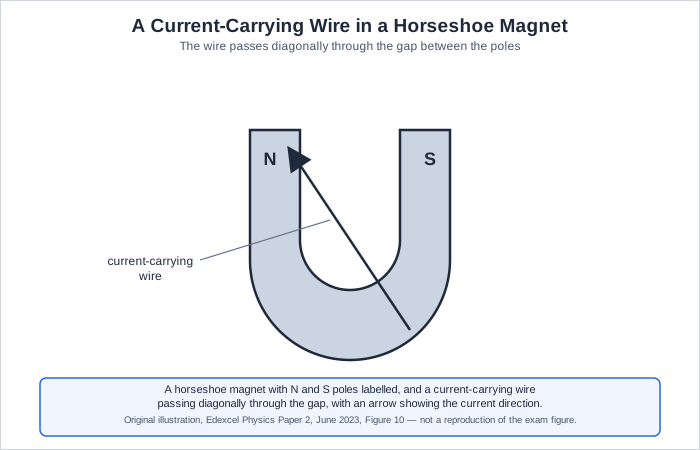
The full worked answer — June 2023
Using Fleming's left-hand rule with the field running from the N pole to the S pole and the current flowing in the direction shown, the force on the wire itself acts upwards. By Newton's third law, the wire pushes back on the magnet with an equal and opposite reaction force, so the force on the magnet acts downwards.
Rearranging F = B x I x l for length gives l = F divided by (B multiplied by I), so l = 0.15 divided by (0.50 multiplied by 2.7) = 0.15 divided by 1.35 = 0.111, which rounds to 0.11m.
Could you have written this? Every fact in this answer is drilled in our quizzes — the writing is the easy part once the evidence is automatic.
Practise the motor effect questionsWhat the mark scheme rewarded
- Stating the force on the wire is upwards and the force on the magnet is downwards
- Rearranging F=BIl for length and evaluating correctly
- Fleming's left-hand rule gives the direction of the force on a current-carrying wire in a field
- Newton's third law gives the reaction force on the magnet
Traps examiners saw
- Getting the force direction on the wire or the magnet backwards
- Substituting into F=BIl without rearranging for length first
Full-mark self-check 0 of 2
1×asked“Figure 26 shows a picture of an electrical device and a simplified drawing of the important parts. The device can be used as a loudspeaker or it can be used as a microphone. Compare how the device operates when used as a loudspeaker with how the device operates when used as a microphone.”
“Figure 26 shows a picture of an electrical device and a simplified drawing of the important parts. The device can be used as a loudspeaker or it can be used as a microphone. Compare how the device operates when used as a loudspeaker with how the device operates when used as a microphone.”
What it’s really asking
It wants a fully developed comparison of the motor effect in a loudspeaker with electromagnetic induction in a microphone, using the same device.
What the sources actually showed — June 2023
A photograph of a loudspeaker unit next to a simplified drawing showing a permanent magnet, a coil of wire wound around part of the magnet, a movable cone attached to the coil, and connecting wires leading out to external circuitry.
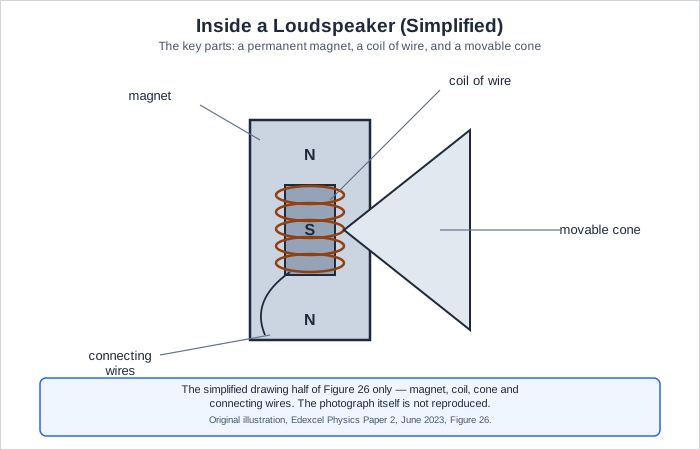
The full worked answer — June 2023
When the device is used as a loudspeaker, it is an output device that turns an electrical signal into sound. An alternating current representing the sound signal is fed into the coil of wire, which sits inside the permanent magnet's field, and because this current keeps reversing direction it produces a changing magnetic field around the coil that is constantly attracted to and repelled by the magnet's fixed field. This is the motor effect: the alternating current forces the coil, and the movable cone attached to it, to push and pull back and forth repeatedly, with the rate of alternation setting the frequency of the sound produced and the size of the current setting how loud it is.
When the same device is used as a microphone instead, it works in reverse and becomes an input device that takes sound in rather than giving it out. Sound arriving at the cone is vibrations of the air, and these vibrations push and pull the cone, and the coil attached to it, back and forth through the magnet's field. Because the coil is now being physically moved through the field rather than being driven by a current, this is electromagnetic induction rather than the motor effect: the moving coil generates an alternating potential difference across its own wires, producing an alternating current signal that matches the original sound, with louder or higher-pitched sound producing a bigger amplitude or higher frequency in that induced signal.
Could you have written this? Every fact in this answer is drilled in our quizzes — the writing is the easy part once the evidence is automatic.
Practise the motor effect questionsWhat the mark scheme rewarded
- Explaining the loudspeaker's motor effect mechanism in full detail, including how frequency and amplitude of sound relate to the alternating current
- Explaining the microphone's induction mechanism in full detail, including how the induced signal relates to the sound's amplitude and frequency
- Referencing both devices, since one device developed alone caps the answer below the top level
- A loudspeaker uses the motor effect, an alternating current in a coil in a magnetic field
- A microphone uses electromagnetic induction, a coil moved through a magnetic field by sound
Traps examiners saw
- Explaining only the loudspeaker or only the microphone in detail
- Mixing up which device uses the motor effect and which uses electromagnetic induction
Full-mark self-check 0 of 2
The method for every Q5(b)/Q5(d)/Q5(c)+Q10(c) — same every sittingMark bands, steps, timing
What this question type rewards
The topic changes by sitting — the mark scheme never does. Learn this once, then open your question above for that sitting’s sources and a full worked answer.
- Applying Fleming's left-hand rule correctly to find the direction of the force on a current-carrying wire
- Recognising that the reaction force on the magnet is equal and opposite to the force on the wire
- Rearranging F=BIl correctly for current or for length
- Explaining both the loudspeaker's and the microphone's mechanism in full causal detail for the Level of Response question
The steps
- Use Fleming's left-hand rule with field, current and force in the correct order
- Remember Newton's third law gives the magnet an equal and opposite reaction force
- Rearrange F=BIl for whichever quantity is missing
- For the loudspeaker/microphone comparison, explain the full causal chain for each device separately, then link them together
What is the motor effect?
Motor effect questions always want Fleming's left-hand rule applied correctly and, for the loudspeaker versus microphone comparison, both devices explained in full detail, so practise the full causal chain for each.
Practise the motor effect questions“Setting up a magnet-and-coil demonstration, explaining what a centre-zero meter shows as a magnet is pushed in and out, and explaining why a dynamo becomes harder to turn once a lamp is connected”
This recurs in all three real sittings, from a teacher's classroom demonstration in June 2019, through a model dynamo connected to an ammeter in June 2022, to a model dynamo connected to a lamp in June 2023.
1×asked“A teacher is demonstrating electromagnetic induction. The teacher has a bar magnet, a coil of wire and a sensitive voltmeter. Draw a diagram to show how the teacher should arrange the apparatus. Explain how the teacher could use this apparatus to demonstrate the factors affecting the size and direction of the induced potential difference.”
“A teacher is demonstrating electromagnetic induction. The teacher has a bar magnet, a coil of wire and a sensitive voltmeter. Draw a diagram to show how the teacher should arrange the apparatus. Explain how the teacher could use this apparatus to demonstrate the factors affecting the size and direction of the induced potential difference.”
What it’s really asking
It wants a correct apparatus arrangement, then paired explanations of what changes direction of movement does to the induced pd's direction, and what changes speed of movement does to the induced pd's size.
The full worked answer — June 2019
I would connect the coil of wire across the terminals of the sensitive voltmeter, with the bar magnet held so it can be pushed in and pulled out along the axis of the coil.
To show what affects the direction of the induced pd, I would push the magnet into the coil and then pull it back out again, and note that the voltmeter needle deflects one way for one direction of movement and the opposite way for the other, showing the induced pd reverses direction. To show what affects the size of the induced pd, I would move the magnet into the coil quickly on one trial and slowly on another, and note that the voltmeter gives a much bigger reading for the faster movement than for the slower one, showing that a faster rate of change of the magnetic field induces a bigger potential difference.
Could you have written this? Every fact in this answer is drilled in our quizzes — the writing is the easy part once the evidence is automatic.
Practise electromagnetic induction questionsWhat the mark scheme rewarded
- A diagram with the coil connected across the meter and the magnet able to move along the coil's axis
- Linking direction of magnet movement to the direction the meter deflects
- Linking speed of magnet movement, or number of coil turns, to the size of the meter's reading
- Moving a magnet into a coil induces a pd in one direction, moving it out induces a pd in the opposite direction
- A faster rate of change of magnetic field through a coil induces a bigger potential difference
Traps examiners saw
- Describing only one factor, direction or size, rather than both
Full-mark self-check 0 of 3
1×asked“Figure 20 shows a magnet and a coil. The coil is connected to a sensitive centre-zero ammeter. Explain what will be observed on the meter when the magnet is pushed in and pulled out of the coil, repeatedly.”
“Figure 20 shows a magnet and a coil. The coil is connected to a sensitive centre-zero ammeter. Explain what will be observed on the meter when the magnet is pushed in and pulled out of the coil, repeatedly.”
What it’s really asking
It wants the needle's oscillating behaviour linked to the changing magnetic field induced by the magnet repeatedly entering and leaving the coil.
What the sources actually showed — June 2022
A coil of wire connected to a centre-zero microammeter, with a bar magnet positioned so it can be pushed towards and pulled away from one end of the coil.
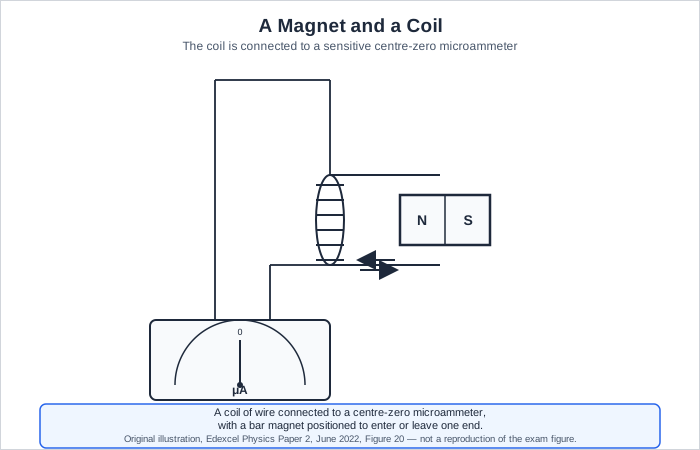
The full worked answer — June 2022
As the magnet is repeatedly pushed in and pulled out of the coil, the needle on the meter oscillates, swinging to either side of the centre zero position, first one way and then the other, in response to the magnet's pole entering the coil and then leaving it again. This happens because the changing magnetic field through the coil, caused by the magnet moving in and out, induces an alternating potential difference and so an alternating current in the coil, and the direction of this induced current depends on whether a pole is entering or leaving, which is why the needle swings the opposite way for each motion.
Could you have written this? Every fact in this answer is drilled in our quizzes — the writing is the easy part once the evidence is automatic.
Practise electromagnetic induction questionsWhat the mark scheme rewarded
- Describing the needle oscillating to either side of the centre zero position
- Linking this to the pole entering and leaving the coil
- Linking this to an induced, alternating pd or current
- A changing magnetic field through a coil induces a potential difference, and so a current, in that coil
- Reversing the direction of relative motion reverses the direction of the induced current
Traps examiners saw
- Saying only 'the needle moves' without describing the oscillation either side of zero
Full-mark self-check 0 of 2
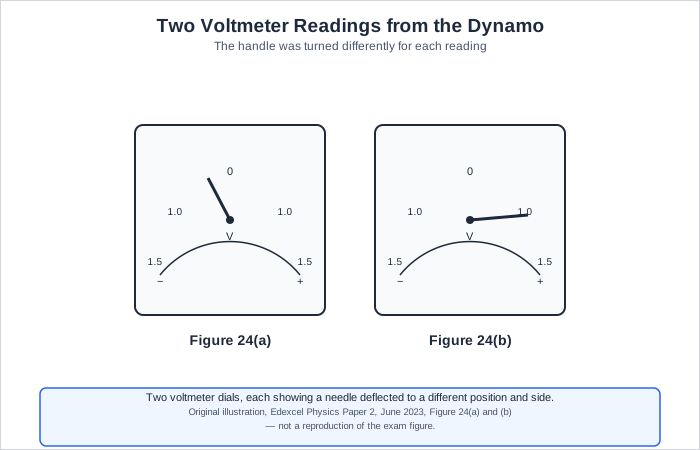
1×asked“Figure 23 shows a model dynamo. The dynamo contains a coil of wire that can spin inside a permanent magnet. The dynamo produces a D.C. output. A teacher connects a voltmeter to the terminals of the dynamo. The teacher rotates the handle to make the coil spin inside the magnet. Figure 24(a) shows the reading on the voltmeter. The teacher then rotates the handle differently. Figure 24(b) shows the new reading on the voltmeter. Which row of the table shows how the rotation of the handle has changed between (a) and (b)? The teacher connects the dynamo to a lamp. It is now more difficult for the teacher to rotate the handle. Explain why it is more difficult to turn the dynamo when it is connected to a lamp.”
“Figure 23 shows a model dynamo. The dynamo contains a coil of wire that can spin inside a permanent magnet. The dynamo produces a D.C. output. A teacher connects a voltmeter to the terminals of the dynamo. The teacher rotates the handle to make the coil spin inside the magnet. Figure 24(a) shows the reading on the voltmeter. The teacher then rotates the handle differently. Figure 24(b) shows the new reading on the voltmeter. Which row of the table shows how the rotation of the handle has changed between (a) and (b)? The teacher connects the dynamo to a lamp. It is now more difficult for the teacher to rotate the handle. Explain why it is more difficult to turn the dynamo when it is connected to a lamp.”
What it’s really asking
It wants the two voltmeter readings compared to identify how the handle's speed and direction changed, then a genuine explanation of why connecting a lamp makes the dynamo harder to turn.
What the sources actually showed — June 2023
A hand-cranked model dynamo with a handle, connected by wires to a voltmeter.
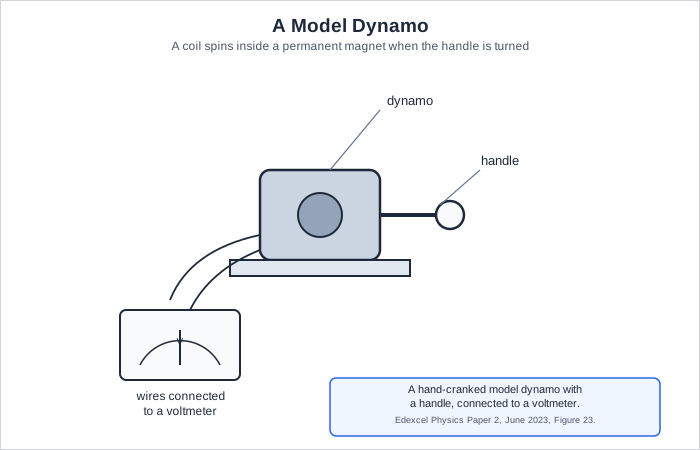
Two voltmeter dials, each showing a needle deflected to a different position and side, representing two different readings taken as the handle was turned differently each time.
The full worked answer — June 2023
Comparing the two voltmeter readings, the needle deflects further in (b) than in (a) and to the opposite side, so the handle in (a) was turned more slowly than in (b), and in the opposite direction to (b), matching the row that shows slower and opposite.
Once the dynamo is connected to a lamp, turning the handle becomes harder because the induced current now flowing in the coil creates its own magnetic field, and this field interacts with the permanent magnet's field to produce a force that opposes the coil's motion, so the teacher must do extra work to keep turning the handle against that opposing force.
Could you have written this? Every fact in this answer is drilled in our quizzes — the writing is the easy part once the evidence is automatic.
Practise electromagnetic induction questionsWhat the mark scheme rewarded
- Correctly comparing both the speed and the direction of rotation between the two readings
- Linking the induced current's own magnetic field to an opposing force on the coil, or linking the extra energy transferred to the lamp to extra work needed
- A bigger voltmeter deflection means a faster rate of change of magnetic field, so a faster rotation
- An induced current always creates its own magnetic field, which opposes the motion that created it
Traps examiners saw
- Comparing only the size of the deflection without also comparing which side it deflects to
Full-mark self-check 0 of 2
The method for every Q6(a)/Q10(a)/Q10(a) — same every sittingMark bands, steps, timing
What this question type rewards
The topic changes by sitting — the mark scheme never does. Learn this once, then open your question above for that sitting’s sources and a full worked answer.
- Setting up the coil and magnet correctly so a pd can be induced between them
- Linking direction of motion to direction of induced pd, and speed of motion (or number of turns) to size of induced pd
- Linking the induced current's own magnetic field, or the transfer of energy to a lamp, to why turning becomes harder
The steps
- Connect the meter across the coil and set the magnet up so it can move along the coil's axis
- Change one factor at a time, direction then speed, and note what changes on the meter
- For the 'harder to turn' explanation, use either the interacting-fields route or the energy-transfer route consistently
What is electromagnetic induction?
Electromagnetic induction questions always want direction and size explained separately, so practise linking each factor to its own observed effect.
Practise electromagnetic induction questions“Calculating a transformer's missing voltage, current or number of turns, and explaining how step-up and step-down transformers make the National Grid efficient”
Turns-ratio calculations appear in every real sitting we have, and June 2022 also carried the paper's Level of Response question on how the whole National Grid system minimises energy loss.
1×asked“There is a changing magnetic field in the core of a transformer. Describe the cause of the changing magnetic field in the core of the transformer. A potential difference of 230V is applied across the primary coil of a transformer. There is a potential difference of 15V across the secondary coil. The primary coil has 2000 turns. Calculate the number of turns in the secondary coil.”
“There is a changing magnetic field in the core of a transformer. Describe the cause of the changing magnetic field in the core of the transformer. A potential difference of 230V is applied across the primary coil of a transformer. There is a potential difference of 15V across the secondary coil. The primary coil has 2000 turns. Calculate the number of turns in the secondary coil.”
What it’s really asking
It wants the alternating current in the primary coil linked to the changing field, then Vp/Np=Vs/Ns rearranged for the number of secondary turns.
The full worked answer — June 2019
The changing magnetic field in the transformer's core is caused by the alternating current in the primary coil, since an alternating current is constantly changing in size and direction, which produces a magnetic field around the primary coil that is likewise constantly changing.
Rearranging Vp divided by Np equals Vs divided by Ns for the number of secondary turns gives Ns = (Np multiplied by Vs) divided by Vp, so Ns = (2000 multiplied by 15) divided by 230 = 30,000 divided by 230 = 130.4, which rounds to 130 turns.
Could you have written this? Every fact in this answer is drilled in our quizzes — the writing is the easy part once the evidence is automatic.
Practise transformers and National Grid questionsWhat the mark scheme rewarded
- Linking alternating current in the primary coil to a constantly changing magnetic field
- Correctly rearranging and evaluating Vp/Np=Vs/Ns for the number of secondary turns
- Alternating current constantly changes size and direction, unlike direct current
- Vp/Np=Vs/Ns links the voltage and turns ratio of a transformer's two coils
Traps examiners saw
- Just saying 'the current is alternating' without linking this to why the field itself changes
Full-mark self-check 0 of 2
1×asked“Figure 21 shows a transformer. The number of turns on the primary coil is 700. The potential difference across the primary coil is 230V. The number of turns on the secondary coil is 400. The secondary current is 1.75A. Calculate the current in the primary coil. Use the information given and equations selected from the list of equations. The transformer is 100% efficient. Figure 22 shows how electricity is delivered efficiently from a power station (P) to homes (T). Using Figure 22, explain the stages in the process of delivering electricity efficiently from P to T. Your answer should include details of the effects that Q, R and S have on efficiency.”
“Figure 21 shows a transformer. The number of turns on the primary coil is 700. The potential difference across the primary coil is 230V. The number of turns on the secondary coil is 400. The secondary current is 1.75A. Calculate the current in the primary coil. Use the information given and equations selected from the list of equations. The transformer is 100% efficient. Figure 22 shows how electricity is delivered efficiently from a power station (P) to homes (T). Using Figure 22, explain the stages in the process of delivering electricity efficiently from P to T. Your answer should include details of the effects that Q, R and S have on efficiency.”
What it’s really asking
It wants the secondary voltage found first, then the power-conservation equation used to find the primary current, followed by a full account of how step-up transformers, transmission lines and step-down transformers together deliver electricity efficiently.
What the sources actually showed — June 2022
A transformer with a primary coil of 700 turns at 230V and a secondary coil of 400 turns carrying 1.75A, wound around a shared iron core.
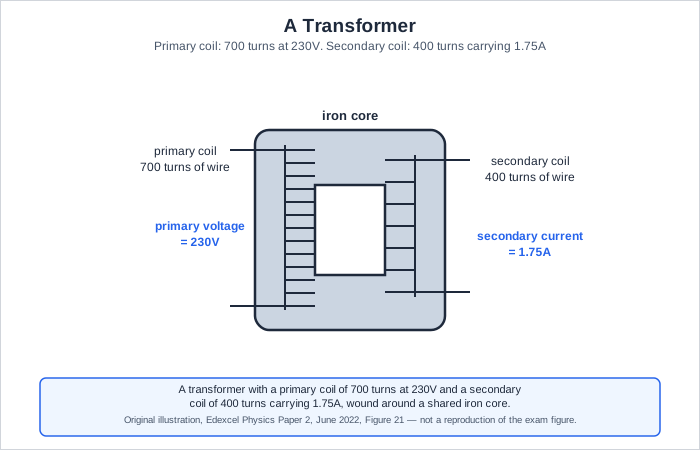
A diagram showing a power station labelled P, connected to a step-up transformer at Q, then pylons carrying transmission lines labelled R across the countryside, then a step-down transformer at S, delivering electricity to a house labelled T.
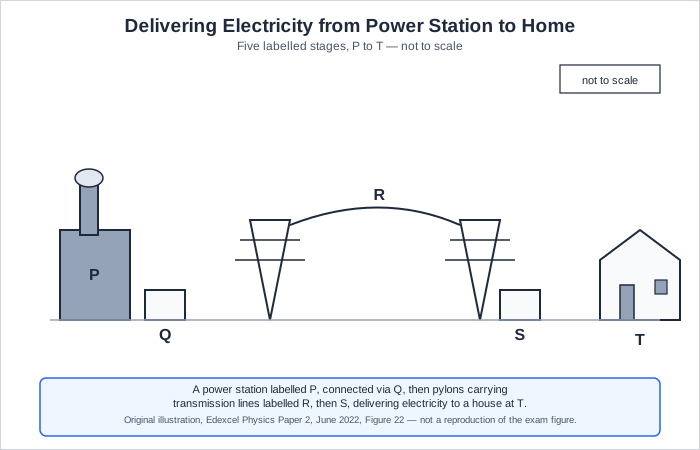
The full worked answer — June 2022
First I find the secondary voltage using Vp divided by Np equals Vs divided by Ns: Vs = (Ns multiplied by Vp) divided by Np = (400 multiplied by 230) divided by 700 = 131.4V. Since the transformer is 100% efficient, power in equals power out, so Vp multiplied by Ip equals Vs multiplied by Is, giving Ip = (Vs multiplied by Is) divided by Vp = (131.4 multiplied by 1.75) divided by 230 = 230.0 divided by 230 = 1.00A.
At the power station, P, electricity is generated at a moderate voltage, and Q is a step-up transformer that increases this voltage hugely before it enters the transmission line, so that the current flowing along that line for the same delivered power can be made much smaller, since power equals current multiplied by voltage.
R represents the transmission line itself, carrying electricity over a long distance. Because the current in this line has been made so much smaller by stepping up the voltage at Q, far less energy is wasted as heat in the wires, since the power lost to heating a wire depends on the current squared, so a smaller current wastes dramatically less energy; the smaller current also means a smaller potential difference is dropped along the length of the cable, since a wire's own voltage drop depends on the current flowing through it multiplied by its resistance.
At S, a step-down transformer reduces the very high transmission voltage back down to the standard 230V that is safe to use in a house, ready to supply appliances at T. Both Q and S are transformers built from coils of wire wound around a shared iron core, and although real transformers are never perfectly 100% efficient, this step-up-then-step-down arrangement across the whole system minimises the much larger losses that would otherwise occur if electricity were transmitted at its original, lower generating voltage with a correspondingly bigger current.
Could you have written this? Every fact in this answer is drilled in our quizzes — the writing is the easy part once the evidence is automatic.
Practise transformers and National Grid questionsWhat the mark scheme rewarded
- Using the turns-ratio equation to find the secondary voltage, then power conservation to find the primary current
- Explaining that Q steps up the voltage to reduce the current in the transmission line
- Explaining that R's reduced current means less energy lost to heating and a smaller voltage drop
- Explaining that S steps the voltage back down for safe domestic use
- Vp/Np=Vs/Ns and Vp x Ip=Vs x Is together let you move between voltage, current and turns on either coil
- Power lost to heating a wire is proportional to the current squared, so halving current quarters the heating loss
- Domestic mains supply in the UK is 230V
Traps examiners saw
- Forgetting that a 100% efficient transformer means input power equals output power, not input voltage equals output voltage
- Naming Q, R and S without explaining what effect each one actually has on efficiency
Full-mark self-check 0 of 2
1×asked“Figure 25 shows a transformer. The number of turns on the primary coil, Np = 800. The potential difference across the primary coil, Vp = 230V. The number of turns on the secondary coil, Ns = 18. Calculate the potential difference across the secondary coil. Use an equation selected from the list of equations at the end of the paper.”
“Figure 25 shows a transformer. The number of turns on the primary coil, Np = 800. The potential difference across the primary coil, Vp = 230V. The number of turns on the secondary coil, Ns = 18. Calculate the potential difference across the secondary coil. Use an equation selected from the list of equations at the end of the paper.”
What it’s really asking
It wants Vp/Np=Vs/Ns rearranged directly for the secondary voltage.
What the sources actually showed — June 2023
A transformer with a primary coil of 800 turns wound around one side of a soft iron core, and a secondary coil of 18 turns wound around the other side.
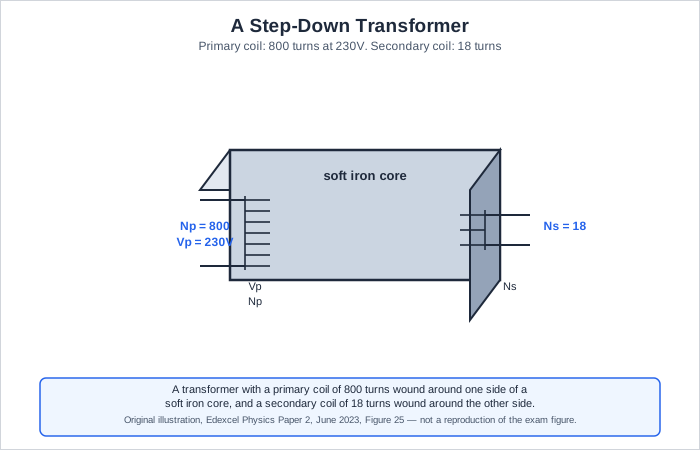
The full worked answer — June 2023
Rearranging Vp divided by Np equals Vs divided by Ns for the secondary voltage gives Vs = (Ns multiplied by Vp) divided by Np, so Vs = (18 multiplied by 230) divided by 800 = 4140 divided by 800 = 5.175, which rounds to 5.2V.
Could you have written this? Every fact in this answer is drilled in our quizzes — the writing is the easy part once the evidence is automatic.
Practise transformers and National Grid questionsWhat the mark scheme rewarded
- Correctly rearranging Vp/Np=Vs/Ns to isolate the secondary voltage
- Substituting and evaluating to 5.2V
- Vp/Np=Vs/Ns rearranges to Vs = (Ns multiplied by Vp) divided by Np
Traps examiners saw
- Mixing up which coil's turns and voltage go on which side of the ratio
Full-mark self-check 0 of 1
The method for every Q6(b)/Q10(b)(c)/Q10(b) — same every sittingMark bands, steps, timing
What this question type rewards
The topic changes by sitting — the mark scheme never does. Learn this once, then open your question above for that sitting’s sources and a full worked answer.
- Explaining that the changing magnetic field in a transformer's core is caused by alternating current in the primary coil
- Rearranging Vp/Np=Vs/Ns, or Vp x Ip=Vs x Is, correctly for whichever quantity is missing
- Linking step-up transformers, reduced current, reduced heating losses and step-down transformers together for the National Grid explanation
The steps
- Identify which transformer equation matches the values you are given
- Rearrange before substituting, and evaluate carefully
- For the National Grid explanation, work through the system in order: generation, step-up, transmission, step-down, use
What is the function of a step-up transformer in the National Grid?
Transformer and National Grid questions always want step-up, transmission and step-down all explained together, so practise linking reduced current directly to reduced heating loss.
Practise transformers and National Grid questions“Describing an accurate displacement method for density, calculating density and mass from displaced volume, and explaining why the method fails for a floating object”
This recurs in every real sitting we have, from measuring the density of glass marbles in June 2019, through an iron lump and a piece of wood in June 2022, to a direct density calculation and a method-improvement question in June 2023.
1×asked“A student measures the density of glass. The student has a bag of marbles, all made from the same type of glass, a weighing balance, and a plastic measuring cylinder containing water. Describe how the student could find, as accurately as possible, the density of the glass used for the marbles. The graph in Figure 13 shows how the volume of 1kg of water changes with temperature. Describe how the density of water changes with temperature over the range of temperature shown. Calculations are not required.”
“A student measures the density of glass. The student has a bag of marbles, all made from the same type of glass, a weighing balance, and a plastic measuring cylinder containing water. Describe how the student could find, as accurately as possible, the density of the glass used for the marbles. The graph in Figure 13 shows how the volume of 1kg of water changes with temperature. Describe how the density of water changes with temperature over the range of temperature shown. Calculations are not required.”
What it’s really asking
It wants the full displacement method for finding density accurately using several marbles, and a description of how water's density peaks at 4°C using the shape of the given volume-temperature graph.
What the sources actually showed — June 2019
A graph plotting the volume of 1kg of water in cubic centimetres against temperature from 0°C to 11°C, showing the volume dip to a minimum at 4°C before rising again on either side.
The full worked answer — June 2019
I would weigh a number of marbles together on the balance to find their total mass, since using several marbles rather than just one improves the accuracy of the measurement. Then I would lower the marbles fully into the water in the measuring cylinder and record the water level before and after adding them, so the difference between the two readings gives the volume of water displaced, which equals the volume of the marbles. Finally I would calculate the density of the glass by dividing the total mass of the marbles by this volume, using density = mass divided by volume.
Since the graph shows the volume of a fixed 1kg mass of water is smallest at 4°C, the density of water must be at its greatest at exactly 4°C, because density is mass divided by volume and the mass stays fixed. Below 4°C, as temperature rises towards 4°C the volume keeps falling, so density keeps increasing; then above 4°C, as temperature keeps rising the volume starts increasing again, so density decreases.
Could you have written this? Every fact in this answer is drilled in our quizzes — the writing is the easy part once the evidence is automatic.
Practise density questionsWhat the mark scheme rewarded
- Weighing the marbles, finding the displaced volume, and dividing mass by volume
- Using several marbles together to improve accuracy
- Describing density increasing up to 4°C, peaking there, and decreasing above it
- Density = mass divided by volume
- The volume of water displaced by a fully submerged object equals that object's own volume
- Water is unusual in reaching its maximum density at 4°C rather than at its freezing point
Traps examiners saw
- Forgetting to record the water level before adding the marbles, leaving nothing to subtract from
- Only describing part of the density-temperature relationship, missing the peak at 4°C
Full-mark self-check 0 of 3
1×asked“Figure 5 shows some water in a measuring cylinder and a lump of iron. The lump of iron is lowered fully into the water. The water level in the measuring cylinder rises to 530cm3. The density of iron is 7.9g/cm3. Calculate the mass of the lump of iron. Use the equation density = mass divided by volume. Give your answer to 2 significant figures. A piece of wood has a similar shape and volume to the lump of iron. The density of the wood is 0.82g/cm3. The density of water is 1.00g/cm3. Explain why the method used to determine the mass of the iron cannot be used to determine the mass of the piece of wood.”
“Figure 5 shows some water in a measuring cylinder and a lump of iron. The lump of iron is lowered fully into the water. The water level in the measuring cylinder rises to 530cm3. The density of iron is 7.9g/cm3. Calculate the mass of the lump of iron. Use the equation density = mass divided by volume. Give your answer to 2 significant figures. A piece of wood has a similar shape and volume to the lump of iron. The density of the wood is 0.82g/cm3. The density of water is 1.00g/cm3. Explain why the method used to determine the mass of the iron cannot be used to determine the mass of the piece of wood.”
What it’s really asking
It wants the iron's mass found from its displaced volume and known density, then a comparison of densities to explain why the same displacement method fails once the object floats.
What the sources actually showed — June 2022
A measuring cylinder with a scale marked in cubic centimetres, showing water at an initial level, and a separate irregular lump of iron ready to be lowered into it.
The full worked answer — June 2022
Reading the measuring cylinder, the water level rises from 490cm3 to 530cm3 once the iron is added, so the lump of iron displaces 530 minus 490 = 40cm3 of water, which is the iron's own volume. Rearranging density = mass divided by volume for mass gives mass = density multiplied by volume, so mass = 7.9 multiplied by 40 = 316g, which rounds to 320g to 2 significant figures.
Because the density of the wood, 0.82g/cm3, is less than the density of water, 1.00g/cm3, the wood would float rather than sink fully like the iron did, so it would only displace a volume of water equal to the part of the wood that is actually submerged, not the wood's whole real volume. This would give a wrongly small displaced volume reading, and so an inaccurate mass calculation.
Could you have written this? Every fact in this answer is drilled in our quizzes — the writing is the easy part once the evidence is automatic.
Practise density questionsWhat the mark scheme rewarded
- Correctly finding the displaced volume from the two water levels
- Rearranging density=mass/volume for mass and rounding to 2 significant figures
- Comparing the wood's density with water's density, linking the lower density to floating and an incomplete displacement reading
- An object with a lower density than water floats; an object with a higher density than water sinks
- Water displacement only measures the volume of the part of an object that is actually underwater
Traps examiners saw
- Forgetting to subtract the starting water level from the final level
- Saying the method 'does not work for wood' without explaining that floating means only part of the object is submerged
Full-mark self-check 0 of 3
1×asked“An object has a mass of 7.22 x 10^-2 kg and a volume of 2.69 x 10^-5 m3. Calculate the density of the object. Use the equation density = mass divided by volume. State the unit. A student determines the volume of a piece of metal by measuring the volume of water that it displaces. The student's description is incomplete. Suggest two sentences that the student could have included to provide a more complete description of the correct procedure.”
“An object has a mass of 7.22 x 10^-2 kg and a volume of 2.69 x 10^-5 m3. Calculate the density of the object. Use the equation density = mass divided by volume. State the unit. A student determines the volume of a piece of metal by measuring the volume of water that it displaces. The student's description is incomplete. Suggest two sentences that the student could have included to provide a more complete description of the correct procedure.”
What it’s really asking
It wants a direct density calculation with the correct unit, and two genuinely missing steps added to an incomplete displacement method: an initial reading, and subtracting the two readings.
The full worked answer — June 2023
Substituting directly into density = mass divided by volume gives density = (7.22 x 10^-2) divided by (2.69 x 10^-5) = 2684, which rounds to 2680kg/m3, with the unit kilograms per cubic metre since mass is in kilograms and volume is in cubic metres.
Two sentences the student should have added: first, 'I took a reading of the water level in the measuring cylinder before adding the metal', since without an initial reading there is nothing to compare the new level against; and second, 'I subtracted the first reading from the new reading to find the volume of the metal', since the new level on its own is the volume of the water plus the metal together, not the metal's volume by itself.
Could you have written this? Every fact in this answer is drilled in our quizzes — the writing is the easy part once the evidence is automatic.
Practise density questionsWhat the mark scheme rewarded
- Substituting mass and volume correctly and giving the answer with a consistent unit
- Adding an initial water-level reading before the metal is added
- Adding the step of subtracting the two readings to find the metal's volume
- Density = mass divided by volume, with mass in kilograms and volume in cubic metres giving kg/m3
- Water displacement always needs a before-and-after reading, with the volume found by subtracting one from the other
Traps examiners saw
- Giving a value for density but forgetting to state a unit at all
- Repeating a step the student's description already included, rather than adding a genuinely missing one
Full-mark self-check 0 of 2
The method for every Q7(a)(b)(iii)/Q3(b)(c)/Q3(b)(d) — same every sittingMark bands, steps, timing
What this question type rewards
The topic changes by sitting — the mark scheme never does. Learn this once, then open your question above for that sitting’s sources and a full worked answer.
- Describing the full displacement method: mass, volume by displacement, then dividing
- Substituting correctly into density = mass divided by volume in either direction
- Recognising that displacement only measures the volume of the submerged part of a floating object
The steps
- Weigh the object or objects first
- Record the water level before and after fully submerging the object, and subtract to get the displaced volume
- Divide mass by volume, or rearrange for mass or volume as the question asks
- For a floating object, check whether the whole object is actually underwater
What is the correct equation for density?
Density questions always want the full displacement method, before-and-after readings subtracted, so practise stating every step rather than skipping straight to the calculation.
Practise density questions“Recognising sublimation, converting a temperature to kelvin, and describing how particles move in a liquid”
Sublimation and particle-arrangement questions appeared in both June 2022 and June 2023.
1×asked“When water boils and turns into steam, there are changes in the arrangement of particles and the density. Which of these shows the changes? Describe what happens when a substance experiences sublimation.”
“When water boils and turns into steam, there are changes in the arrangement of particles and the density. Which of these shows the changes? Describe what happens when a substance experiences sublimation.”
What it’s really asking
It wants the correct combination of increased particle spacing and decreased density when water becomes steam, and a two-part description of sublimation as a direct solid-to-gas change.
The full worked answer — June 2022
When water boils to become steam, the particles end up much further apart than they were in liquid water, which is why steam's density is far less than liquid water's, even though it is made of exactly the same particles.
Sublimation is when a solid changes directly into a gas without ever passing through the liquid state in between, for example solid carbon dioxide turning straight into gas.
Could you have written this? Every fact in this answer is drilled in our quizzes — the writing is the easy part once the evidence is automatic.
Practise states of matter questionsWhat the mark scheme rewarded
- Choosing bigger particle spacing together with lower density for steam versus water
- Describing sublimation as a direct solid-to-gas change with no liquid stage
- Gas particles are much further apart than liquid particles, giving gases a much lower density
- Sublimation and its reverse, deposition, both skip the liquid state entirely
Traps examiners saw
- Choosing bigger spacing but the wrong density direction, or the reverse
Full-mark self-check 0 of 2
1×asked“Which of these means changing state from solid directly to gas? Aluminium has a melting point of 660°C. The absolute zero of temperature is -273°C. Calculate the melting point of aluminium in kelvin. Describe the motion of particles in liquid aluminium (above 660°C).”
“Which of these means changing state from solid directly to gas? Aluminium has a melting point of 660°C. The absolute zero of temperature is -273°C. Calculate the melting point of aluminium in kelvin. Describe the motion of particles in liquid aluminium (above 660°C).”
What it’s really asking
It wants the term sublimating identified, a straightforward addition to convert to kelvin, and at least two genuine features of random, colliding, fast-moving liquid particle motion.
The full worked answer — June 2023
The correct term for changing directly from solid to gas is sublimating. Converting aluminium's melting point to kelvin, I add 273 to 660, giving 933K.
In liquid aluminium above 660°C, the particles move around randomly in all directions at a range of different speeds, constantly colliding and sliding past each other, moving noticeably faster overall than the particles did when the aluminium was still a solid.
Could you have written this? Every fact in this answer is drilled in our quizzes — the writing is the easy part once the evidence is automatic.
Practise states of matter questionsWhat the mark scheme rewarded
- Choosing sublimating as the term for a direct solid-to-gas change
- Adding 273 to the Celsius value to convert to kelvin
- Describing at least two of random motion, a range of speeds, colliding particles, or faster motion than in a solid
- Kelvin = Celsius + 273
- Liquid particles move faster, more randomly and with more collisions than particles in the same substance's solid state
Traps examiners saw
- Subtracting 273 instead of adding it
- Describing only that liquid particles 'vibrate', which does not credit the random, colliding, faster motion the mark scheme wants
Full-mark self-check 0 of 2
The method for every Q3(a)(d)/Q3(a)(c) — same every sittingMark bands, steps, timing
What this question type rewards
The topic changes by sitting — the mark scheme never does. Learn this once, then open your question above for that sitting’s sources and a full worked answer.
- Knowing that sublimation is a direct solid-to-gas change with no liquid stage in between
- Adding 273 correctly to convert a Celsius temperature into kelvin
- Describing liquid particle motion as random, at a range of speeds, colliding, and faster than in a solid
The steps
- Check whether a described change of state skips the liquid stage entirely
- Add 273 to a Celsius value to convert it to kelvin
- Cover at least two distinct features of particle motion, not the same idea twice
In which state of matter are particles arranged in a regular pattern and only vibrate about fixed positions?
States of matter questions always want a genuine change-of-state feature or two distinct particle-motion features named, so practise being specific rather than vague.
Practise states of matter questions“Working out a starting temperature and a specific latent heat from a heating investigation, and explaining the conceptual difference between specific heat capacity and specific latent heat”
In June 2019, this appeared as two adjacent calculations in the same heating-water investigation. In June 2022 it became a conceptual explanation plus a practical accuracy question about reading the final temperature correctly.
1×asked“A beaker contains 0.25kg of water at room temperature. The beaker of water is heated until the water reaches boiling point (100°C). The specific heat capacity of water is 4200 J/kg°C. The total amount of thermal energy supplied to the water is 84000J. Calculate the temperature of the water before it was heated. Use an equation selected from the list of equations at the end of this paper. The heating continues until 0.15kg of the water has turned into steam. The thermal energy needed to turn the boiling water into steam is 0.34MJ. Calculate the specific latent heat of vaporisation of water. Use an equation selected from the list of equations at the end of this paper.”
“A beaker contains 0.25kg of water at room temperature. The beaker of water is heated until the water reaches boiling point (100°C). The specific heat capacity of water is 4200 J/kg°C. The total amount of thermal energy supplied to the water is 84000J. Calculate the temperature of the water before it was heated. Use an equation selected from the list of equations at the end of this paper. The heating continues until 0.15kg of the water has turned into steam. The thermal energy needed to turn the boiling water into steam is 0.34MJ. Calculate the specific latent heat of vaporisation of water. Use an equation selected from the list of equations at the end of this paper.”
What it’s really asking
It wants the change in thermal energy equation rearranged to find the temperature before heating, immediately followed by the change-of-state equation rearranged to find the specific latent heat of vaporisation, using the same heating experiment.
The full worked answer — June 2019
Rearranging change in thermal energy = mass x specific heat capacity x change in temperature for the temperature rise gives change in temperature = thermal energy divided by (mass multiplied by specific heat capacity), so change in temperature = 84000 divided by (0.25 multiplied by 4200) = 84000 divided by 1050 = 80°C. Since the water finished at boiling point, 100°C, and rose by 80°C to reach that, its temperature before heating must have been 100 minus 80 = 20°C.
Rearranging thermal energy for a change of state = mass x specific latent heat for the specific latent heat gives specific latent heat = thermal energy divided by mass, so specific latent heat = 0.34 divided by 0.15 = 2.27, which rounds to 2.3MJ/kg.
Could you have written this? Every fact in this answer is drilled in our quizzes — the writing is the easy part once the evidence is automatic.
Practise specific heat capacity and specific latent heat questionsWhat the mark scheme rewarded
- Rearranging the thermal energy equation for the temperature rise, then subtracting it from the final boiling temperature
- Rearranging thermal energy for a change of state for the specific latent heat, then evaluating
- Change in thermal energy = mass x specific heat capacity x change in temperature
- Thermal energy for a change of state = mass x specific latent heat
Traps examiners saw
- Stopping at the 80°C temperature rise and forgetting to subtract it from 100°C to find the starting temperature
Full-mark self-check 0 of 2
1×asked“Explain the difference between the term 'specific heat capacity' and the term 'specific latent heat' when applied to heating substances. Figure 19 shows some apparatus that may be used to determine the specific heat capacity of water. A student measures the initial temperature of the water. The power supply is switched on for 10 minutes and then switched off. Explain how the student should then obtain an accurate reading for the final temperature of the water, to be used in the calculation of the specific heat capacity.”
“Explain the difference between the term 'specific heat capacity' and the term 'specific latent heat' when applied to heating substances. Figure 19 shows some apparatus that may be used to determine the specific heat capacity of water. A student measures the initial temperature of the water. The power supply is switched on for 10 minutes and then switched off. Explain how the student should then obtain an accurate reading for the final temperature of the water, to be used in the calculation of the specific heat capacity.”
What it’s really asking
It wants the conceptual difference between the two quantities explained clearly, and a genuine practical reason why the final temperature reading must be delayed and taken at its peak rather than immediately after switching off.
What the sources actually showed — June 2022
A joulemeter connected to a heater inside an insulated metal container of water, with a thermometer and a stirrer also inserted into the water.
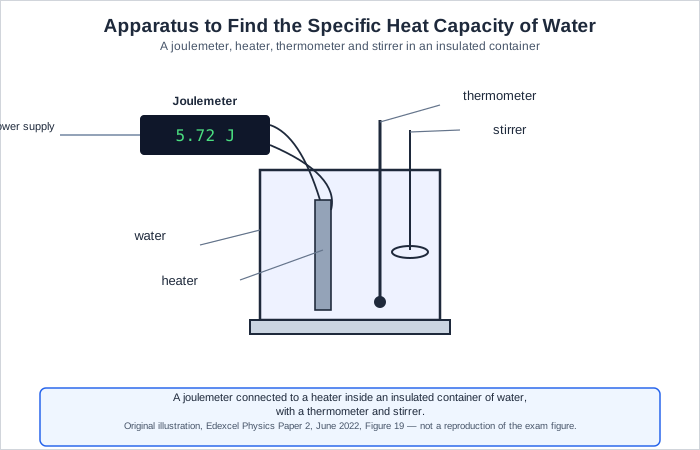
The full worked answer — June 2022
Specific heat capacity is about the energy needed to change a substance's temperature, heating it up or cooling it down, without it changing state, whereas specific latent heat is about the energy needed to change a substance's state altogether, such as melting or boiling it, without its temperature changing at all during that change.
After switching off the power supply, the student should keep stirring the water and keep watching the thermometer for some time afterwards, rather than reading it immediately, because it takes time for the heat that has already been supplied to spread all the way through the water by conduction and convection, so the temperature will keep rising for a while even with the heater off. The student should record the highest, peak temperature the thermometer reaches once it stops climbing any further, reading the scale at eye level to avoid a parallax error.
Could you have written this? Every fact in this answer is drilled in our quizzes — the writing is the easy part once the evidence is automatic.
Practise specific heat capacity and specific latent heat questionsWhat the mark scheme rewarded
- Linking specific heat capacity to temperature change and specific latent heat to change of state
- Explaining that conduction and convection take time, so the temperature keeps rising after the heater is switched off
- Recording the peak temperature once it stops changing, read at eye level
- Specific heat capacity and specific latent heat are both measured in energy per kilogram, but for different kinds of change
- Heat continues to spread through a liquid by conduction and convection even after the heat source is removed
Traps examiners saw
- Reading the thermometer immediately after switching off, before the temperature has finished rising
Full-mark self-check 0 of 2
The method for every Q7(b)(i)(ii)/Q9(a)(b) — same every sittingMark bands, steps, timing
What this question type rewards
The topic changes by sitting — the mark scheme never does. Learn this once, then open your question above for that sitting’s sources and a full worked answer.
- Rearranging change in thermal energy = mass x specific heat capacity x change in temperature correctly
- Rearranging thermal energy for a change of state = mass x specific latent heat correctly
- Explaining that specific heat capacity concerns temperature change while specific latent heat concerns change of state
- Knowing that a heated system keeps changing temperature for a while after the heater is switched off, so the peak reading must be waited for
The steps
- Rearrange the thermal energy equation for the unknown, substitute, then evaluate
- Check whether the question wants the temperature before heating or the temperature rise itself
- For specific latent heat, remember there is no temperature change involved at all
- For an accurate final temperature, keep stirring and watching until the reading stops changing
What is specific latent heat?
Specific heat capacity and specific latent heat questions always want the right equation rearranged for exactly what is asked, so check whether you need the rise or the starting value before you finish.
Practise specific heat capacity and specific latent heat questions“Explaining how heating a gas at constant volume increases both the particles' average kinetic energy and the pressure they exert”
This appeared in June 2022 as the paper's Level of Response question on the particle model of a gas.
1×asked“A container of gas is at room temperature. The gas is then heated. The volume of the container remains the same. By considering changes in velocities of the gas particles, explain how the temperature increase affects the average kinetic energy of the particles, and the pressure the particles exert on the walls of the container.”
“A container of gas is at room temperature. The gas is then heated. The volume of the container remains the same. By considering changes in velocities of the gas particles, explain how the temperature increase affects the average kinetic energy of the particles, and the pressure the particles exert on the walls of the container.”
What it’s really asking
It wants the increase in average particle speed linked to a genuine increase in kinetic energy, and then that same increase in speed linked to a bigger pressure through both a bigger force per collision and more frequent collisions.
The full worked answer — June 2022
When the gas is heated, energy is transferred into the particles, which makes them move around with greater average velocities than before. Since kinetic energy is given by kinetic energy = half multiplied by mass multiplied by velocity squared, and the mass of each gas particle stays fixed, this increase in average speed directly means the average kinetic energy of the particles has increased, because kinetic energy depends on velocity squared, so even a modest increase in speed produces a real increase in the particles' kinetic energy.
Because the container's volume stays exactly the same, the faster-moving particles are now confined in the same space but hitting the container's walls with greater force each time they collide, since a faster particle undergoes a bigger change in momentum on each impact. Since pressure is defined as force divided by area, and the wall's area has not changed, this bigger average force per collision on its own would already increase the pressure the gas exerts.
On top of that, the faster particles also cross the fixed-size container and strike its walls more often in a given time, since they are travelling further each second, so the number of collisions per second on each wall increases as well. Both effects work in the same direction together, more force per collision and more collisions per second, which is why heating a gas at constant volume produces a genuinely bigger increase in pressure than either effect on its own.
Could you have written this? Every fact in this answer is drilled in our quizzes — the writing is the easy part once the evidence is automatic.
Practise gas pressure and particle theory questionsWhat the mark scheme rewarded
- Linking increased temperature to increased average particle speed, and speed to kinetic energy via KE=½mv²
- Explaining that faster particles hit the container's walls with more force per collision
- Explaining that faster particles also collide with the walls more often, since the container's size is fixed
- Covering both the kinetic energy and both parts of the pressure argument for the top band
- Kinetic energy = half multiplied by mass multiplied by velocity squared
- Pressure = force divided by area, so a bigger force on a fixed area gives a bigger pressure
- A faster particle in a fixed-size container collides with the walls more often, not just more forcefully
Traps examiners saw
- Explaining only that particles move faster, without linking this to kinetic energy using the equation
- Explaining only the bigger force per collision, and missing the separate point about more frequent collisions
Full-mark self-check 0 of 3
The method for every Q9(c) — same every sittingMark bands, steps, timing
What this question type rewards
The topic changes by sitting — the mark scheme never does. Learn this once, then open your question above for that sitting’s sources and a full worked answer.
- Linking greater particle speed directly to greater kinetic energy using KE=½mv²
- Explaining that faster particles hit the walls with more force per collision
- Explaining that faster particles also hit the walls more often, since they cross the fixed-size container more quickly
- Covering both the kinetic energy strand and both parts of the pressure strand for the top level
The steps
- Link increased temperature to increased average particle speed
- Link increased speed to increased kinetic energy via KE=½mv²
- Explain that faster particles hit the walls with more force per collision
- Explain that faster particles also collide with the walls more frequently, since the container's volume is fixed
A sealed gas container is heated. What happens to the pressure of the gas inside?
Gas pressure questions always want both the force-per-collision argument and the frequency-of-collision argument, so practise explaining both halves rather than just one.
Practise gas pressure and particle theory questionsThe topics that keep coming up
Across the June 2019, June 2022 and June 2023 sittings we have full papers for, these are the electricity, magnetism and particle model topics with real questions in every, or almost every, sitting, so they carry the most weight to prepare for.
Not covered on this page
Static electricity · Moments, levers and fluid pressure · Kinetic energy and gravitational potential energy calculations · Efficiency calculations
The real papers we analysed also included static electricity, forces (moments, fluid pressure, springs, pulleys) and energy (kinetic energy, gravitational potential energy, efficiency) questions. Those topics belong to Physics Paper 1 in this specification, not Paper 2, so they are covered on our Paper 1 exam-questions page instead of here.
Before you revise
Are these real mark-scheme answers?
The stems are quoted from the real Pearson Edexcel papers, the diagrams and figures are described in our own words, and every worked answer is written entirely by us, aimed at the top of the real mark scheme for each question. Nothing here is copied from Pearson's own exemplar material, since that would breach copyright, but each answer is built to hit exactly what the real mark scheme rewarded. PrepWise is independent of Pearson Edexcel and not endorsed by them.
Why does this page skip forces, energy and static electricity questions from these same papers?
Physics Paper 2 does include forces, energy and static electricity content alongside electricity, magnetism and particle model content, since Edexcel mixes topics across both papers. This page is scoped to the electricity, magnetism and particle model topics that have their own dedicated topic pages on PrepWise; the forces and energy content from these same sittings is covered separately.
Will the exact same questions come up again this year?
Sometimes a very similar calculation reappears with different numbers, and topics like magnetic fields, the motor effect, electromagnetic induction and density return in some form almost every sitting. But you cannot rely on exact repeats, so use this page to learn which TOPICS keep returning and practise the underlying method, since the specific numbers in the question will very likely change.
How are the Level of Response questions on this paper different from the rest?
Each real sitting includes at least one extended, Level of Response question worth 6 marks, graded against three named bands rather than simple point marking. These cover mains electricity safety, gas pressure and particle theory, the National Grid, and comparing a loudspeaker with a microphone across the three sittings we have. These need a genuinely detailed, logically structured answer covering every strand the mark scheme asks for, not just a list of isolated facts.
Is PrepWise free to use for this?
Yes, PrepWise is free now. You can practise every topic on this page without paying anything.
Does this page cover every electricity and magnetism question from these three papers?
Almost all of them, but not quite every single sub-part. Three real, in-scope questions are not yet built into a cluster here: a resistance calculation for an immersion heater (June 2019), a circuit-diagram drawing question for measuring the resistance of a length of wire (June 2022), and a short explanation of the forces on a floating magnet (June 2023). We are honest about this gap rather than silently pretending full coverage, and plan to add them in a future update.
Stop guessing, start practising the actual questions
Every topic on this page has practice questions waiting in the app, scored the way Edexcel actually marks them.
Start revising free