Test yourself on Red Shift & Big Bang with exam style questions, marked instantly.
Flashcards that come back just before you would forget them.
A revision plan that remembers what you know and shows what to do next.
See which topics you have nailed and which need another look.
Quiz yourself on Red Shift & Big BangGet your flashcardsBuild my revision planTrack my progress🚀 The Universe is Running Away

Figure 1: Galaxies at increasing distances — notice how the colour shifts from blue-white (nearby) to red (far away). This is red-shift, caused by the expansion of space stretching the wavelength of the light reaching us.
In 1929, the American astronomer Edwin Hubble made a discovery that overturned everything scientists thought they knew about the universe. By carefully analysing the light from distant galaxies, he found that nearly every galaxy is moving away from us — and that the further away a galaxy is, the faster it is receding. The universe is not static. It is expanding.
Think of it like a balloon being inflated. Draw dots on the surface of the balloon to represent galaxies. As the balloon inflates, every dot moves away from every other dot — and dots that were further apart to begin with move apart faster. No single dot is at the centre; the expansion is happening everywhere, in all directions.
If you run this expansion backwards in time — like rewinding a film — all the galaxies come together at a single point. Go back far enough, about 13.8 billion years, and everything in the observable universe was compressed into an unimaginably hot, dense state. Then it expanded rapidly. This was the Big Bang — not an explosion in space, but the creation of space itself.
🚀 Red Shift — Light from a Moving Source

Figure 1: The Doppler effect for light. A source moving away produces red shift (longer wavelengths), and a source moving towards you produces blue shift (shorter wavelengths). The light we receive has a longer wavelength than the light the galaxy gave out, so it is shifted towards the red end of the spectrum.
Red shift is the light equivalent of the Doppler effect — the change in observed frequency or wavelength of a wave when the source and observer are moving relative to each other.
How Red Shift Works
When a galaxy moves away from us, the light waves it emits are stretched as they travel through space — their wavelength increases. Longer wavelengths in the visible spectrum appear red, so this stretching is called red shift.
When a galaxy moves towards us, light waves are compressed — their wavelength decreases. Shorter wavelengths appear blue, so this is called blue shift (only observed in galaxies very close to us, like the Andromeda Galaxy, which is heading towards the Milky Way).
How We Detect Red Shift
Scientists detect red shift by analysing the absorption spectrum of starlight. Every element absorbs specific wavelengths of light, creating dark lines at known positions in the spectrum. When a galaxy is red-shifted, all these lines are shifted towards the red (longer wavelength) end of the spectrum by the same proportion. By measuring how far the lines have shifted, scientists can calculate the galaxy's velocity.
🚀 Evidence for an Expanding Universe

Figure 2: The further away a galaxy is, the faster it is moving away and the more its light is red-shifted.
Hubble's Key Observations
By measuring the red shift of hundreds of galaxies, Hubble established three key facts:
- The light from almost all distant galaxies is red-shifted
- This means almost all galaxies are moving away from us
- The greater the distance to a galaxy, the greater its red shift — meaning more distant galaxies are moving away faster
This pattern is evidence that the universe is expanding. If the galaxies are moving apart now, they must have been closer together in the past, which is where the Big Bang theory starts.
What the Expansion Really Means
It is important to understand that galaxies are not moving through space away from us. Space itself is expanding, carrying the galaxies with it. This is why every galaxy (beyond our local group) is receding, and why more distant ones appear to recede faster — there is simply more space between them and us that is expanding.
Quick Check: Astronomers measure the spectrum of a distant galaxy and find that all absorption lines are shifted towards longer wavelengths compared to laboratory measurements. What does this tell them about the galaxy?
The galaxy is red-shifted, meaning it is moving away from us. The light waves have been stretched to longer (redder) wavelengths as the galaxy recedes. This is evidence that the universe is expanding.
⚙️ The Big Bang Theory
The Big Bang theory describes the origin of the universe from an extremely hot, dense state approximately 13.8 billion years ago. It is the leading scientific explanation for the origin of the universe, supported by multiple independent lines of evidence.
The Logic of the Big Bang
If the universe is currently expanding (as shown by red shift), then at earlier times it must have been smaller. Running the expansion backwards:
- 1 billion years ago — universe was smaller
- 5 billion years ago — much smaller
- 10 billion years ago — very much smaller
- 13.8 billion years ago — all matter, energy, space, and time compressed into an incredibly hot, dense state, then rapidly expanded
The Big Bang was not an explosion in space — it was the creation of space (and time, and matter, and energy). There was no "before" the Big Bang in the usual sense because time itself began at that moment.
What Happened After the Big Bang
In the first fraction of a second, the universe was unimaginably hot and dense — too hot for even subatomic particles to exist. As it expanded and cooled over the following minutes, hours, and millions of years:
- First seconds: protons and neutrons formed
- First few minutes: protons and neutrons fused to form hydrogen and helium nuclei
- About 380,000 years: universe cooled enough for electrons to combine with nuclei, forming neutral atoms — releasing the light that became the CMBR
- Hundreds of millions of years: gravity caused hydrogen and helium to clump into the first stars and galaxies
🚀 Cosmic Microwave Background Radiation (CMBR)
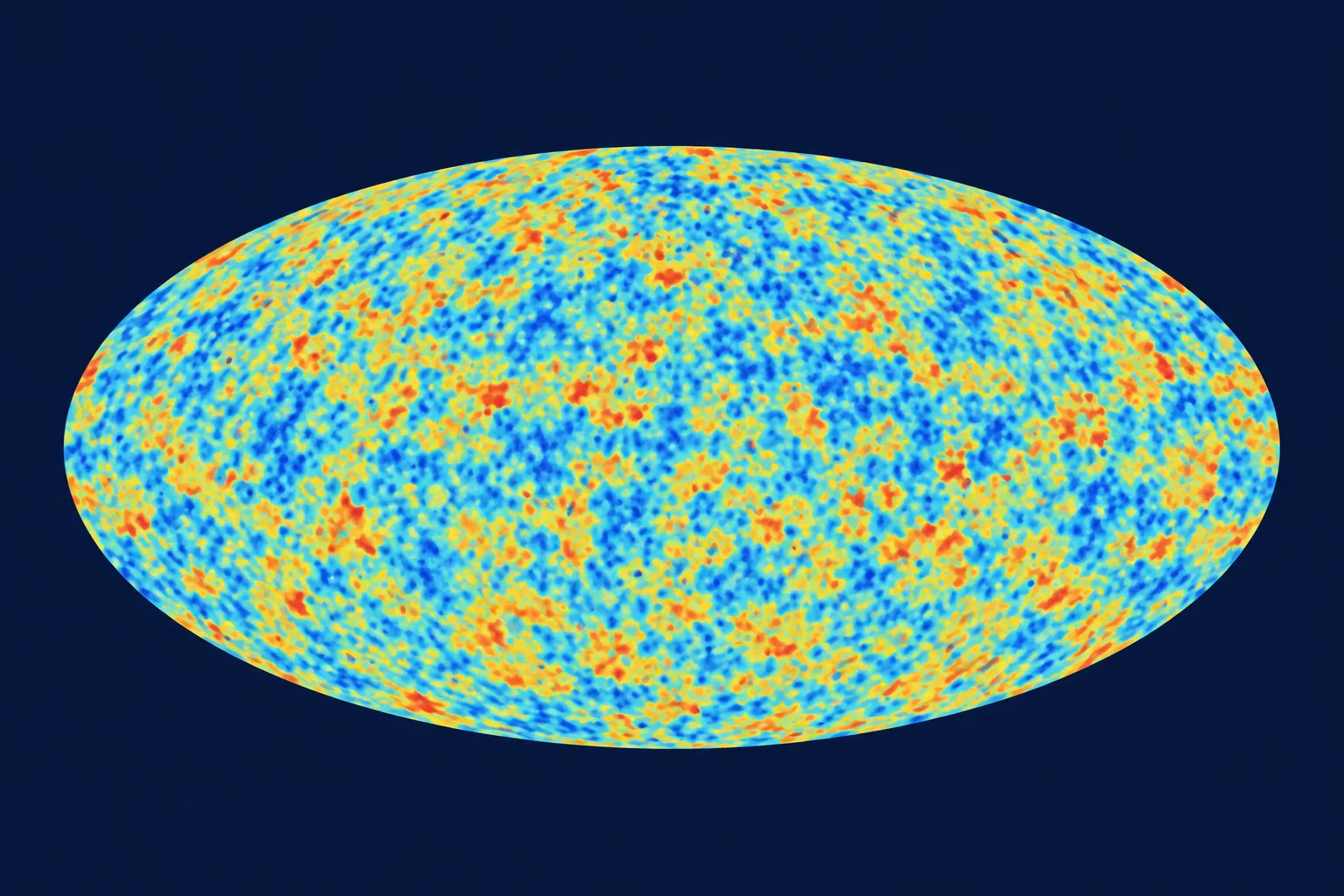
Figure 3: The cosmic microwave background across the whole sky, in false colour. The colours show very small differences in its temperature.
The second major piece of evidence for the Big Bang is the Cosmic Microwave Background Radiation (CMBR). This is faint microwave radiation that comes from every direction in space equally.
What the CMBR Is
About 380,000 years after the Big Bang, the universe had cooled enough for electrons to combine with atomic nuclei to form neutral atoms for the first time. Before this point, the universe was opaque: light could not travel freely because it kept hitting charged particles. When neutral atoms formed, this radiation was suddenly free to travel through space. This radiation forms the CMBR.
The universe has been expanding and cooling for 13.8 billion years since then, stretching this radiation to much longer (cooler) wavelengths. What began as very high-energy radiation is now detected as low-energy microwave radiation at a temperature of about 2.7 K (just above absolute zero).
Why the CMBR is Strong Evidence
- The existence of the CMBR was predicted by Big Bang theory before it was discovered — this is very strong scientific evidence
- It comes from all directions equally — consistent with a universe that began everywhere simultaneously
- Its temperature (2.7 K) matches theoretical predictions almost exactly
- It was discovered accidentally in 1965 by Arno Penzias and Robert Wilson, who initially thought it was interference from pigeon droppings in their antenna
🚀 Evidence for the Big Bang — Summary
| Evidence | What it shows | Why it supports Big Bang |
|---|---|---|
| Red shift of galaxies | Galaxies moving away; more distant = faster recession | Universe is currently expanding — consistent with Big Bang origin |
| CMBR (2.7 K microwaves) | Faint microwave radiation from all directions | Predicted by Big Bang theory; the cooled afterglow of the early hot universe |
| Abundance of hydrogen and helium | Universe is roughly 75% hydrogen, 25% helium by mass | Matches the amounts predicted by Big Bang theory |
📖 Key Terms
- Red shift
- The increase in wavelength (shift towards the red end of the spectrum) of light from a source moving away from the observer. Caused by the Doppler effect for light.
- Doppler effect
- The change in observed frequency/wavelength of a wave when the source and observer are moving relative to each other. Light from a receding source is red-shifted; from an approaching source it is blue-shifted.
- Expanding universe
- The observation that the universe is getting larger over time — space itself is stretching, carrying galaxies apart from each other.
- Big Bang
- The prevailing cosmological model for the origin of the universe, describing it as beginning from an extremely hot, dense state about 13.8 billion years ago, followed by rapid expansion.
- Cosmic Microwave Background Radiation (CMBR)
- Faint microwave radiation detected from all directions in space, at a temperature of about 2.7 K. The cooled-down afterglow of the early hot universe; strong evidence for the Big Bang.
- Absorption spectrum
- Dark lines in the spectrum of a star or galaxy, caused by specific elements absorbing specific wavelengths. The positions of these lines shift with red shift, allowing recession velocity to be measured.
📋 Key Facts
- Light from distant galaxies is red-shifted — wavelength has increased
- Red shift shows galaxies are moving away from us
- The greater the distance, the greater the red shift (and recession speed)
- The universe is approximately 13.8 billion years old
- The Big Bang was not an explosion in space — it was the creation of space
- The CMBR is detected at 2.7 K from all directions
- CMBR was predicted before it was discovered — very strong scientific evidence
- Space itself is expanding — galaxies are not moving through space, they are carried with space
- The Andromeda Galaxy is blue-shifted (moving towards us) — part of our local group
- Most galaxies beyond the local group are red-shifted — the universe is expanding everywhere
⚠️ Common Misconceptions
Misconception 1: "The Big Bang was an explosion in space"
The Big Bang was not an explosion of matter in pre-existing space. Space itself did not exist before the Big Bang — the Big Bang was the creation of space (and time and matter and energy). There is no "place" in space where the Big Bang happened — it happened everywhere simultaneously, because everywhere was the same point.
Misconception 2: "Galaxies are moving through space away from us"
Galaxies are not moving through space — space itself is expanding, carrying the galaxies with it. This is a crucial distinction. The analogy is points drawn on a balloon: the points do not move along the surface; the surface itself grows. This explains why distant galaxies recede faster — there is more space between them and us that is expanding.
Misconception 3: "All galaxies are red-shifted"
Most galaxies are red-shifted, but not all. The Andromeda Galaxy (and other members of our Local Group) is actually blue-shifted — it is gravitationally bound to the Milky Way and moving towards us. Local gravitational interactions can overcome the universal expansion for nearby galaxies.
Misconception 4: "CMBR is just background noise or interference"
The CMBR was famously mistaken for interference when first detected by Penzias and Wilson in 1965 (they even cleaned pigeon droppings from their antenna hoping to eliminate it). It is in fact real radiation — the cooled-down afterglow of the Big Bang — and one of the most important discoveries in the history of cosmology.
🧠 Memory Aids
Red Shift Direction — "Red means Running Away"
Red = longer wavelength = source moving away. Think of a red flashing light on the back of a retreating ambulance — red light means going away from you. Red shift = galaxy running away.
Two Pieces of Evidence for Big Bang — "Red CMBR"
The two main pieces of evidence are: Red shift (galaxies moving apart — universe expanding) and CMBR (afterglow radiation from hot early universe). Remember them together as a pair: "Red and Warm" — Red shift shows expansion, CMBR shows the warmth that remains.
CMBR Temperature — "3 Degrees"
The CMBR temperature is about 2.7 K — just remember "nearly 3 degrees above absolute zero." It is incredibly cold because the universe has been cooling and expanding for nearly 14 billion years since the Big Bang.
Quick Check: State two pieces of evidence that support the Big Bang theory and briefly explain what each piece of evidence shows.
1. Red shift of galaxies: Almost all galaxies show red-shifted light, meaning they are moving away from us. More distant galaxies are receding faster. This shows the universe is currently expanding — which is consistent with it having originated in a Big Bang. 2. Cosmic Microwave Background Radiation (CMBR): Faint microwave radiation is detected from all directions in space at about 2.7 K. This is the cooled-down afterglow of the extremely hot early universe. It was predicted by Big Bang theory before it was discovered, making it very strong supporting evidence.
🎓 Higher Tier: Why Distant Galaxies Show More Red-Shift
Space itself is stretching, and it stretches the light waves travelling through it. A galaxy that is further away has more space between it and us, so its light is stretched more and has a bigger red-shift.
The faster a galaxy is moving away, the bigger its red-shift. Astronomers measure bigger red-shifts for more distant galaxies, so more distant galaxies are moving away faster. This is evidence that the universe is expanding, and that it began with the Big Bang.
🎯 Exam Focus: Red Shift and Big Bang
Red-shift and the Big Bang are Physics only (separate science) content on all four boards. The questions ask you to explain and describe, not to calculate. Expect real galaxy spectra and red-shift measurements as the context.
On AQA (8463) this is examined in Paper 2.
Most Common Question Types
- Explain what red shift is and what it tells us about the universe [3-4 marks]
- State two pieces of evidence for the Big Bang [2 marks]
- Explain what the CMBR is and why it is evidence for the Big Bang [3 marks]
- Describe what happens to wavelength when a galaxy moves away [2 marks]
- Explain why more distant galaxies have greater red shift [2 marks]
What Examiners Want to See
For "explain what red shift tells us" questions, a full-mark answer needs: wavelength increases as galaxy moves away → this is red shift → more distant galaxies have greater red shift → so they are moving away faster → the universe is expanding. For CMBR, examiners want to see: it comes from all directions, it was predicted before discovery, and it is the cooled remnant of the early hot universe.
💡 Exam Tips for Red Shift and Big Bang
🎯 Common Question Types:
- Explain red shift and what it shows about galaxy motion [3 marks]
- State two pieces of evidence for the Big Bang [2 marks]
- Explain the CMBR as evidence for the Big Bang [3 marks]
- Explain why more distant galaxies have greater red shift [2 marks]
- Describe what an absorption spectrum is and how red shift is measured [3 marks]
📝 Key Command Words:
- Explain — give the physics reason and chain of logic
- State — brief answer, no explanation needed
- Describe — say what happens without giving full reasons
- Evaluate — consider the strength of evidence, not just describe it
- Suggest — reason from principles to a plausible answer
⚠️ Common Mistakes to Avoid:
- Saying galaxies move "through space" away from us — space itself is expanding
- Forgetting that greater red shift = greater distance = faster recession
- Saying CMBR comes from a specific direction — it comes from ALL directions
- Describing the Big Bang as "an explosion in space" — it was the creation of space
- Confusing red shift (moving away, longer wavelength) with blue shift (moving towards, shorter wavelength)
Make this stick
Signing in gives access to all PrepWise features.