In Figure 5, a pair of parallel rays meets a lens. F is the lens's principal focus. The James Webb Space Telescope orbits the Sun.
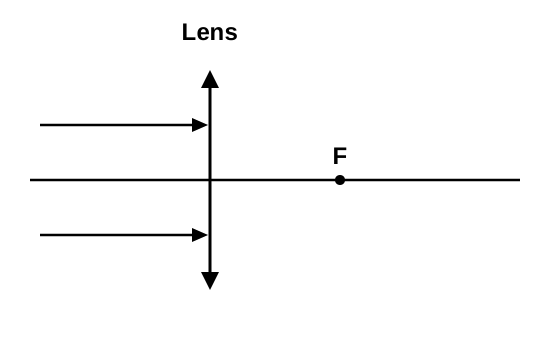
Name the lens that the symbol in Figure 5 stands for.
Our own questions on this topic, marked straight away, so you see what to revise. Free now.
Show model answer for 04.1Hide model answer for 04.1
A convex lens, also called a converging lens, because it brings parallel rays together.
How the marks are earned
- Convex. Calling it a converging lens is also accepted.
Draw both rays on past the lens in Figure 5 to show what the lens does to them.
See how you would score on Lenses & ImagesShow model answer for 04.2Hide model answer for 04.2
Each ray bends at the lens towards the principal axis. Both then run on to cross exactly at F.
How the marks are earned
- One mark: both rays bend inward after the lens, towards the axis.
- One mark: both rays pass through the principal focus F, so they cross there.
Why it scores
Parallel rays through a convex lens meet at the principal focus. Bending towards the axis earns one mark and ending at F earns the other.
Revise Lenses & ImagesRadiation of wavelength 0.60 µm travels at 3.0 × 10⁸ m/s. Calculate its frequency in hertz.
See how you would score on Electromagnetic SpectrumShow model answer for 04.3Hide model answer for 04.3
0.60 µm = 0.60 × 10⁻⁶ m.
Use this equation:. v = f × λ. Put in the values:. 3.0 × 108 = f × 0.60 × 10⁻⁶. Rearrange for f:. f = fraction: 3.0 × 10⁸ over 0.60 × 10⁻⁶, end of fraction. = 5.0 × 10¹⁴ Hz
How the marks are earned
- One mark: change micrometres to metres, 0.60 µm = 0.60 × 10⁻⁶ m.
- One mark: put the values into wave speed = frequency × wavelength.
- One mark: rearrange to frequency = wave speed ÷ wavelength.
- One mark: the final frequency, 5.0 × 10¹⁴ Hz. Later marks still follow if the wavelength was not converted.
Why it scores
The equation needs metres. Skipping the conversion loses only this mark.
The substitution, the rearranged form and the evaluated answer each earn a mark. Divide by the whole wavelength, 0.60 × 10⁻⁶. Use brackets if you type it into a calculator.
Revise Electromagnetic SpectrumRed-shift of far galaxies means one property of the waves has grown. Name that property.
See how you would score on Red Shift & Big BangShow model answer for 04.4Hide model answer for 04.4
Wavelength. Red-shifted light has its wavelength stretched towards the red end of the spectrum.
Choose the true explanation for the red-shift seen in distant galaxies. Tick one box.
See how you would score on Red Shift & Big BangShow model answer for 04.5Hide model answer for 04.5
The galaxies are moving away from us, and that motion stretches the waves they emit to longer wavelengths.
How the marks are earned
- Tick the option saying distant galaxies are travelling away from ours.
One galaxy has the largest red-shift ever seen. What does this tell you about its distance?
See how you would score on Red Shift & Big BangShow model answer for 04.6Hide model answer for 04.6
It is the most distant galaxy seen so far. A bigger red-shift means it is moving away faster, and farther galaxies move away faster.
How the marks are earned
- It is farther away than any other galaxy observed so far.
The telescope orbits the Sun at constant speed, yet its velocity changes. Explain why.
See how you would score on OrbitsShow model answer for 04.7Hide model answer for 04.7
The Sun's gravity pulls the telescope towards the centre of its orbit, so a resultant force always acts on it. That force makes the telescope accelerate towards the centre.
Velocity has a direction as well as a size. The speed stays constant, but the direction of travel keeps turning as it goes round, so the velocity changes.
How the marks are earned
- One mark: the Sun's gravity gives an unbalanced force, directed to the middle of the orbit.
- One mark: so the telescope accelerates towards the centre. Saying only that acceleration changes the speed earns nothing.
- One mark: the direction of motion keeps changing, so the velocity changes.
Why it scores
Naming the force, then the acceleration it causes, gives the first two marks.
The last mark needs the link between a changing direction and a changing velocity.
Revise Orbits