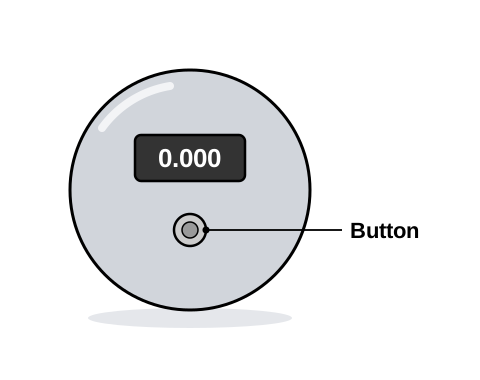
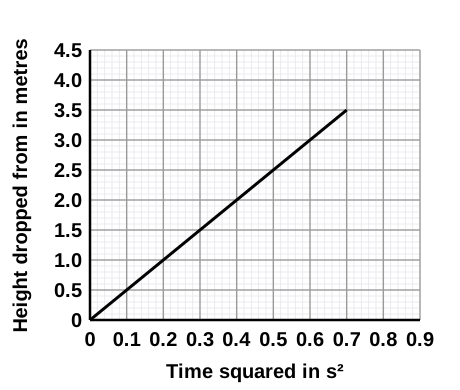
A student drops a ball with a built-in timer: pressing its button starts the clock, and the clock stops when the ball lands. Each height is tried more than once. Figure 3 shows the ball. Figure 4 plots drop height against time squared.
Five drops from one height gave times in seconds: 0.49, 0.51, 0.58, 0.56, 0.61. Find the uncertainty in the time, as ± a value.
Our own questions on this topic, marked straight away, so you see what to revise. Free now.
Show model answer for 03.1Hide model answer for 03.1
Find the range:. range = 0.61 − 0.49. = 0.12 s. The uncertainty is half the range:. uncertainty = ± 0.12 over 2. = ± 0.06 s
How the marks are earned
- One mark: find the range, 0.61 − 0.49 = 0.12. Finding the mean, 0.55, also earns this.
- One mark: the uncertainty is half the range, ± 0.06. The unit, seconds, is not needed for the mark here, but always write it.
Why it scores
Half the range is the usual measure. It matches the biggest gap between the mean, 0.55 s, and any one reading, which is 0.61 − 0.55 = 0.06 s.
Revise Newton's Laws of MotionThe times vary from drop to drop. Which kind of error makes repeat readings scatter? Tick one box.
See how you would score on Newton's Laws of MotionShow model answer for 03.2Hide model answer for 03.2
Random error. It makes repeat readings fall unpredictably on both sides of the true value.
Suggest one cause of the scatter in the repeat times.
See how you would score on Newton's Laws of MotionShow model answer for 03.3Hide model answer for 03.3
The delay between pressing the button and letting go of the ball was different each time.
How the marks are earned
- Any one cause that changes from drop to drop: the release height was slightly different; the ball was given a small push; the delay between pressing the button and letting go changed; the clock did not stop at the instant of landing.
Figure 4 plots drop height against time squared. Use its gradient, with acceleration = 2 × gradient, to find the ball's acceleration.
See how you would score on Newton's Laws of MotionShow model answer for 03.4Hide model answer for 03.4
Read a point on the line, for example height 3.5 m at time squared 0.70 s2.. The line starts at the origin, so find the gradient:. gradient = 3.5 over 0.70. = 5.0
Acceleration is 2 × gradient:. acceleration = 2 × 5.0. = 10 m/s2
How the marks are earned
- One mark: read a matching height and time squared from the line, such as 3.5 m at 0.70 s2.
- One mark: gradient = height ÷ time squared = 5.0.
- One mark: acceleration = 2 × 5.0 = 10 m/s2 (10.0). Working this out from your own gradient also earns it, provided the gradient was height change divided by time squared change.
Why it scores
A point read well away from the origin gives an accurate gradient. Two marks are for the reading and the division.
The final mark is for using the doubling relation given. The unit is not needed for the mark here, but always write it.
Revise Newton's Laws of Motion