Friction is the right choice. It acts where two surfaces touch and rub, so it is a contact force. The electrostatic, gravitational and magnetic forces all act across a gap with nothing touching, so they are non-contact forces and each one fails.
1 mark
How the marks are earned
Choose friction between two surfaces, because it acts only where objects touch.
One answer only: two answers earn nothing, and a circled or underlined right option counts if the box is blank.
The energy gained is found from:. energy gained = mass × field strength × height. Multiplying the three:. 500 × 10 = 5000. 5000 × 50 = 250 000 J. That is the last option. 2500 joules comes from dividing the mass by 10 first, which is not the rule. 5000 joules leaves out the height. 25 000 joules leaves out the field strength.
1 mark
How the marks are earned
Choose 250 000 joules: the energy gained is the beam's mass, times the field strength, times the height it rises, so 500 kg at 10 N/kg lifted 50 m gives 250 000 joules.
The right option alone earns the mark with no working needed. One answer only: two answers earn nothing, and a circled or underlined right option counts if the box is blank.
Weight = mass × gravitational field strength. = 80 × 1.6. = 128 N. That is the third option. 8.0 N comes from dividing the mass by 10, and 50 N from dividing the mass by 1.6, but weight is found by multiplying. 800 N multiplies by 10, the field strength on Earth, so it is the astronaut's weight on Earth, not on the Moon.
1 mark
How the marks are earned
Choose 128 N: weight = mass × gravitational field strength = 80 × 1.6 = 128 N.
The right option alone earns the mark with no working needed. One answer only: two answers earn nothing, and a circled or underlined right option counts if the box is blank.
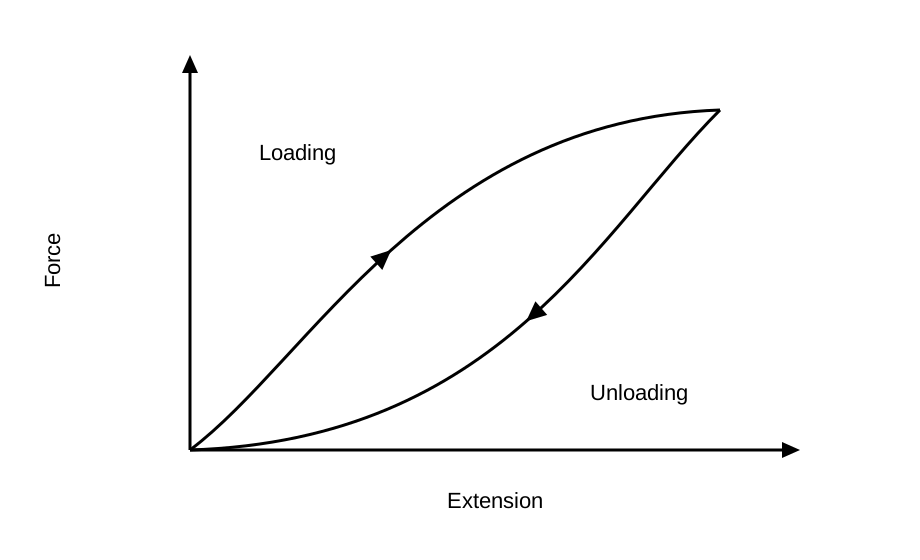
The band is elastic, because when the force is taken off, the unloading curve comes back to the origin, so the band returns to its original length. Hooke's law needs force proportional to extension, which is a straight line through the origin, and both curves bend, so it is not obeyed. That is the first option. The two options that say Hooke's law is obeyed fail because the curves are not straight. The two plastic options fail because plastic deformation would leave the band permanently stretched, with some extension left at zero force. The loop shows that loading and unloading differ, but the band still ends at the origin.
1 mark
How the marks are earned
Choose elastic deformation with Hooke's law not obeyed: both curves return to zero extension, and neither is a straight line through the origin.
One answer only: two answers earn nothing, and a circled or underlined right option counts if the box is blank.
PrepWise guide: OCR A GCSE Physics Paper 3 HigherQuestion 5
A wire carrying current sits in a magnetic field. The force depends on the field strength (flux density), the current and the length of wire in the field. Each choice gives all three.
05[1 mark]
Pick the row where the wire feels the smallest force.
Force = magnetic field strength × current × length. So multiply the three numbers in each row. The units are the same in every row, so the products compare directly.. First row:. 6 × 4 × 0.8 = 19.2. Second row:. 8 × 4 × 0.5 = 16. Third row:. 8 × 5 × 0.4 = 16. Last row:. 12 × 6 × 0.2 = 14.4. The last row is the smallest, which in newtons is 0.0144 N. The first row has the weakest field, but its long wire gives the biggest force, so choosing by one value alone fails. The second and third rows tie at 0.016 N, both larger than the last row.
1 mark
How the marks are earned
Choose the last row, 12 mT, 6 A, 0.2 m: force = field strength × current × length gives 12 × 6 × 0.2 = 14.4, the smallest of the four (0.0144 N).
The right option alone earns the mark with no working needed. One answer only: two answers earn nothing, and a circled or underlined right option counts if the box is blank.
PrepWise guide: OCR A GCSE Physics Paper 3 HigherQuestion 6
An object stays motionless in the water of a pool, a metre beneath the surface, with nothing else touching it. Water pushes up on it with upthrust, and its weight pulls it down.
06[1 mark]
Pick the statement that describes the vertical forces on the object while it stays still.
A still object has no acceleration, so the resultant force is zero. The upward force, upthrust, must therefore equal the downward force, its weight. That is the third option. Water resistance only acts while something moves through the water, so for a still object it is zero, and the first two options compare upthrust with the wrong force. Upthrust greater than weight would leave a resultant force upwards, and the object would rise instead of staying still.
1 mark
How the marks are earned
Choose upthrust equals weight: the object is not moving, so the upward and downward forces balance.
One answer only: two answers earn nothing, and a circled or underlined right option counts if the box is blank.
Velocity is speed in a given direction. The speed is constant, but the train's direction keeps turning round the track, so its velocity is changing. Displacement is the straight-line distance and direction from the start, and this changes as the train moves round. That is the first option. The second option treats velocity like speed and forgets direction. The last two options say displacement is constant, which would mean the train had not moved relative to its start.
1 mark
How the marks are earned
Choose displacement changing and velocity changing: the train's straight-line distance and direction from the start keep changing, and its direction of travel keeps changing.
One answer only: two answers earn nothing, and a circled or underlined right option counts if the box is blank.
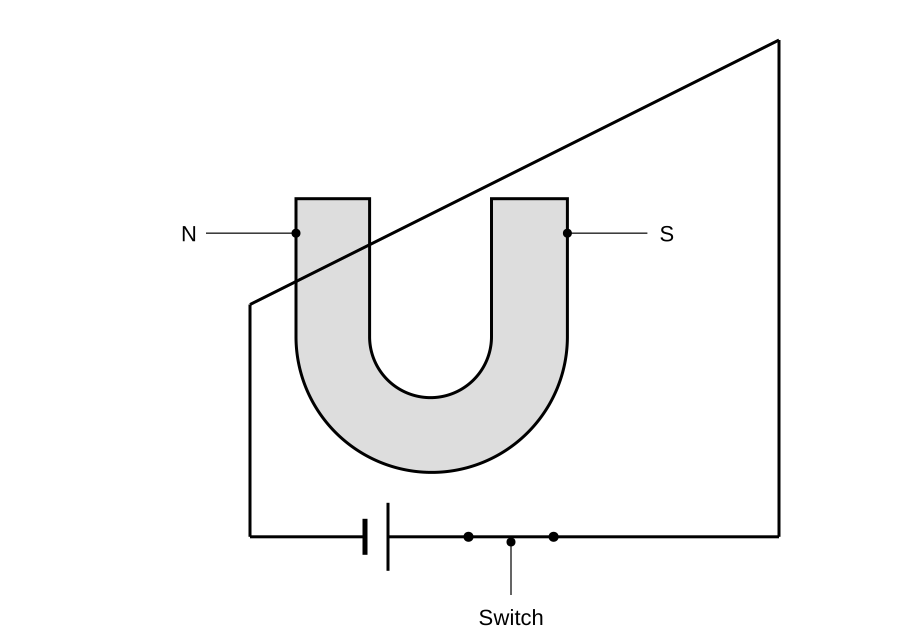
The field between the poles runs from north to south, so from left to right. Conventional current leaves the battery at its positive end, the longer line on the right, and so flows along the wire through the gap towards the viewer. Fleming's left hand rule has the first finger along the field (right), the second finger along the current (towards you), and the thumb then shows the force: upwards. That is the last option. Down would come from reversing the current, for example by starting from the wrong end of the battery. Left and right cannot be right, because the force is at right angles to both the field and the current, and the field already points left to right.
1 mark
How the marks are earned
Choose up: with the field running left to right and the current flowing towards you along the wire, Fleming's left hand rule gives a push upwards.
One answer only: two answers earn nothing, and a circled or underlined right option counts if the box is blank.
PrepWise guide: OCR A GCSE Physics Paper 3 HigherQuestion 9
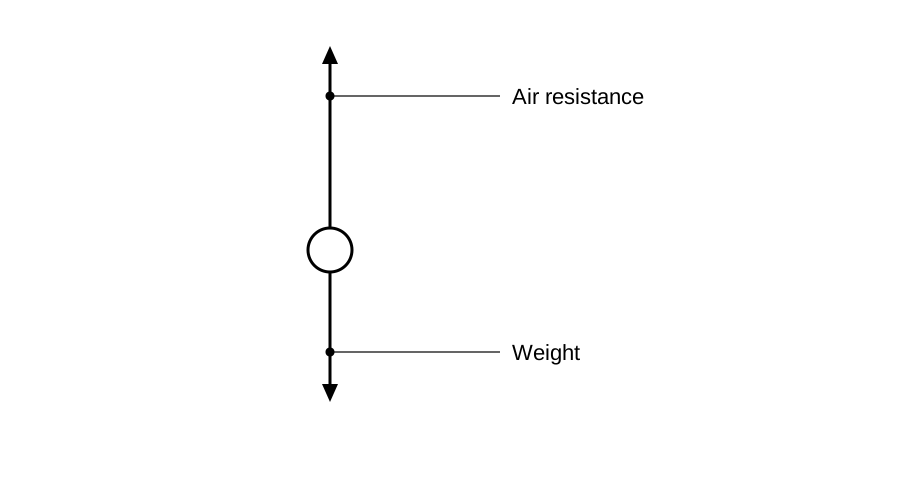
A skydiver has jumped out of an aircraft and has been falling for some time. Figure 3 shows the two forces on the skydiver at one moment: air resistance acting upwards and weight acting downwards.
Figure 3
09[1 mark]
Use Figure 3 to pick how the skydiver's speed is changing and which way they are moving.
In Figure 3 the upward air resistance arrow is longer than the downward weight arrow, so the resultant force points up. The skydiver fell out of a plane, so they are moving down, and an upward force acts against that motion, slowing them down. That is the first option. Speeding up while moving downwards would need the weight arrow to be the longer one, as it is early in a jump. A resultant force upwards changes the speed, but it does not turn a falling skydiver into one who is moving upwards, so both the upward options fail.
1 mark
How the marks are earned
Choose slowing down while moving downwards: the air resistance arrow is longer than the weight arrow, so the resultant force is upwards, against the downward motion.
One answer only: two answers earn nothing, and a circled or underlined right option counts if the box is blank.
PrepWise guide: OCR A GCSE Physics Paper 3 HigherQuestion 10
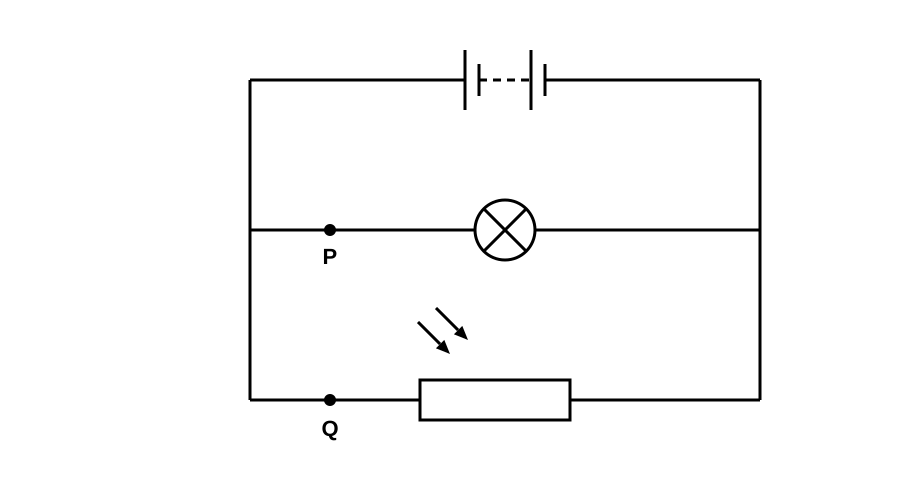
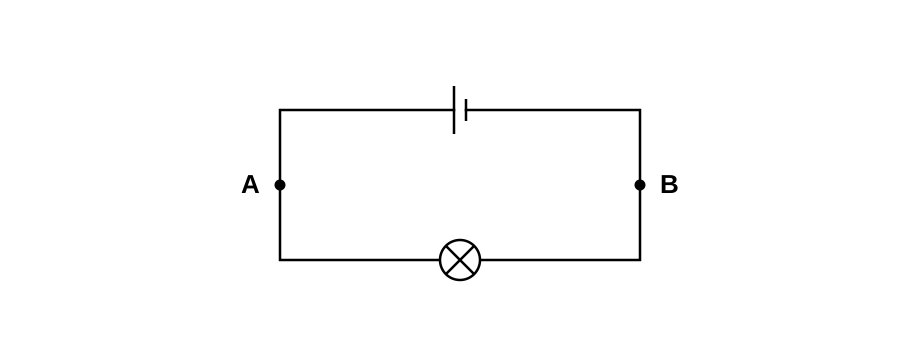
The topic here is the LDR. Figure 4 shows a battery with a fixed p.d. across two parallel branches, one holding a lamp and one holding an LDR. Point P is on the lamp branch and point Q is on the LDR branch.
Figure 4
10[1 mark]
More light now falls on the LDR. Choose the row showing how the currents at P and at Q respond.
Current at P stays the same, current at Q decreases
Current at P stays the same, current at Q increases
Current at P stays the same, current at Q stays the same
Show model answerHide model answer
Each parallel branch gets the full p.d. of the battery, which is fixed. The lamp's resistance does not change, so the current at P stays the same, and a change in the other branch cannot alter it. In brighter light the LDR's resistance falls, and with the same p.d. across it, this equation gives more current at Q:. current = p.d. over resistance. That is the third option. The first option wrongly links the two branches. The second has the LDR's behaviour backwards. The fourth forgets that the LDR's resistance changes with light.
1 mark
How the marks are earned
Choose P stays the same and Q increases: the LDR's resistance falls in brighter light, and with the same p.d. across it, more current flows in its branch.
One answer only: two answers earn nothing, and a circled or underlined right option counts if the box is blank.
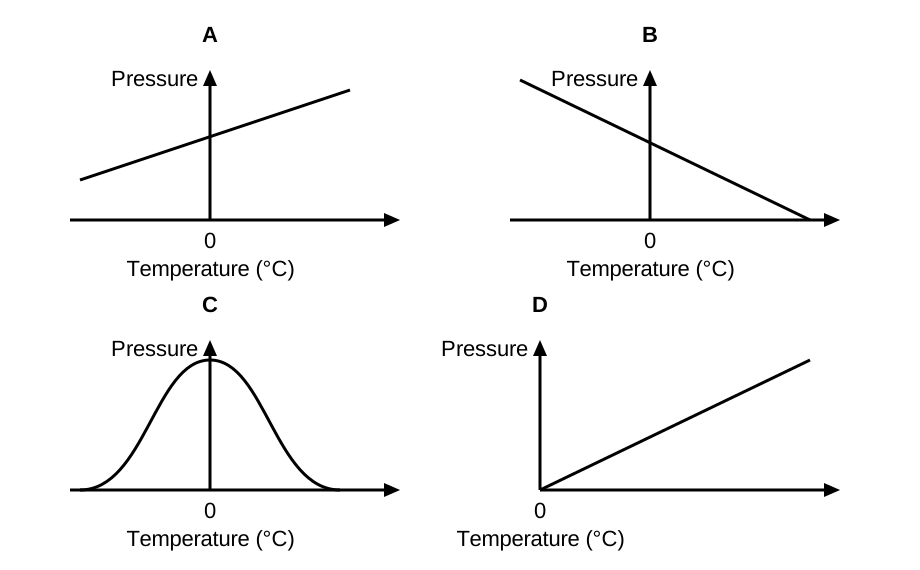
When the gas is warmed, its particles move faster and hit the container walls harder and more often, so pressure rises steadily, giving a straight line sloping upwards. The gas still has pressure at 0 degrees Celsius, so the line cuts the pressure axis above zero. That is graph A. Graph D also rises, but it starts at the origin, which would mean zero pressure at 0 degrees Celsius. A line through the origin only happens if temperature is measured from absolute zero, on the kelvin scale. Graph B shows pressure falling as the gas heats, and graph C has pressure highest at 0 degrees Celsius and falling either side, so neither matches the particle model.
1 mark
How the marks are earned
Choose graph A: pressure rises steadily as temperature rises, giving a rising straight line that does not pass through the origin because the axis is in degrees Celsius.
One answer only: two answers earn nothing, and a circled or underlined right option counts if the box is blank.
The resultant is smallest when the forces pull against each other:. 8.0 − 5.0 = 3.0 N. It is largest when they act in the same direction and add:. 8.0 + 5.0 = 13.0 N. That is the second option. The first option has the right minimum but forgets that the forces can add, and takes the larger force alone as the maximum. The third option treats the two forces as the extremes themselves. The fourth has the right maximum but forgets that the forces can subtract.
1 mark
How the marks are earned
Choose smallest 3.0 N and largest 13.0 N: opposite directions give 8.0 − 5.0 = 3.0 N, and the same direction gives 8.0 + 5.0 = 13.0 N.
One answer only: two answers earn nothing, and a circled or underlined right option counts if the box is blank.
Inertia is the tendency of an object to keep moving as it is, or to stay at rest. It measures how hard it is to change the object's velocity, by speeding it up, slowing it down or turning it. That is the third option. The larger the mass, the greater the inertia. Density, mass and weight are properties of the object, and a force on it does not aim to change them, so the other three options fail.
1 mark
How the marks are earned
Choose how hard it is to alter the object's velocity: inertia is the resistance to a change in motion, in speed or direction.
One answer only: two answers earn nothing, and a circled or underlined right option counts if the box is blank.
The diver goes down:. 7.0 − 3.0 = 4.0 m. Pressure change = height × density × gravitational field strength. = 4.0 × 1000 × 10. = 40 000 Pa. That is the third option. 4000 Pa leaves out the field strength, 4.0 × 1000. 30 000 Pa is the pressure at 3.0 m only, and 70 000 Pa is the pressure at 7.0 m. Both of those are pressures at one depth, not the change between the two depths.
1 mark
How the marks are earned
Choose 40 000 pascals: the change in depth is 4.0 m, and pressure change = height × density × gravitational field strength = 4.0 × 1000 × 10.
The right option alone earns the mark with no working needed. One answer only: two answers earn nothing, and a circled or underlined right option counts if the box is blank.
PrepWise guide: OCR A GCSE Physics Paper 3 HigherQuestion 15
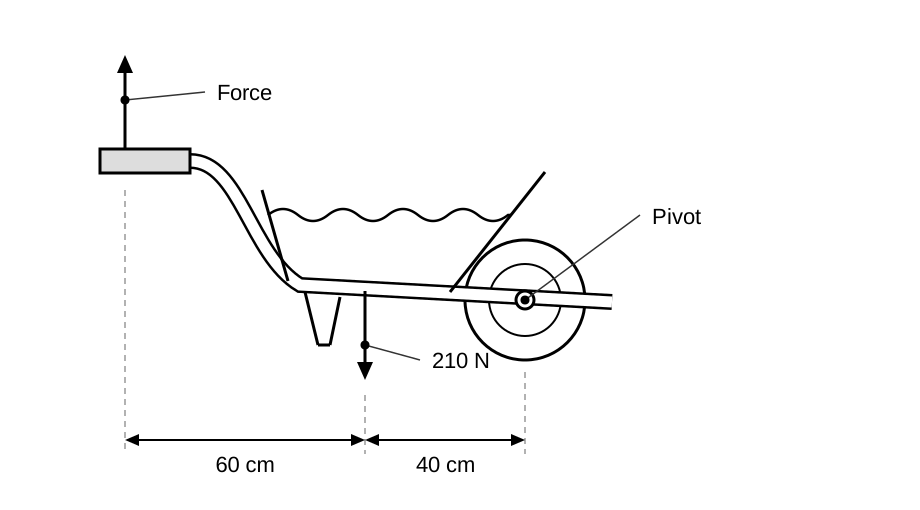
The topic here is levers. Figure 6 shows a loaded wheelbarrow. The wheel's axle is the pivot, and the load's weight acts between the handles and the wheel.
Figure 6
15[1 mark]
Using Figure 6, find the smallest upward force needed at the handles to lift the 210 N load, in N.
At the point of lifting, the turning effects about the pivot balance: force × distance on one side equals force × distance on the other. The load is 40 cm from the pivot. The handle force is this far from the pivot:. 60 + 40 = 100 cm. force × 100 = 210 × 40. Rearrange for the force:. force = fraction: 210 × 40 over 100, end of fraction. = 8400 over 100. = 84 N. That is the first option. 126 N uses 60 cm as the load's distance. 140 N divides by 60 cm instead of 100 cm. 210 N assumes the gardener holds the whole load, but the wheel takes much of the weight, so a much smaller force is enough.
1 mark
How the marks are earned
Choose 84 N: take moments about the pivot, with the load 0.40 m from it and the handle force 1.00 m from it, so force × 1.00 = 210 × 0.40.
The right option alone earns the mark with no working needed. One answer only: two answers earn nothing, and a circled or underlined right option counts if the box is blank.
PrepWise guide: OCR A GCSE Physics Paper 3 HigherQuestion 16
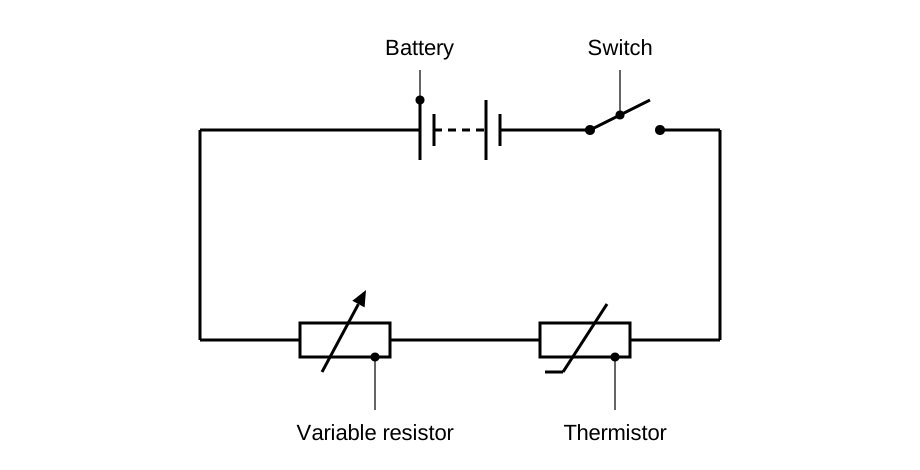
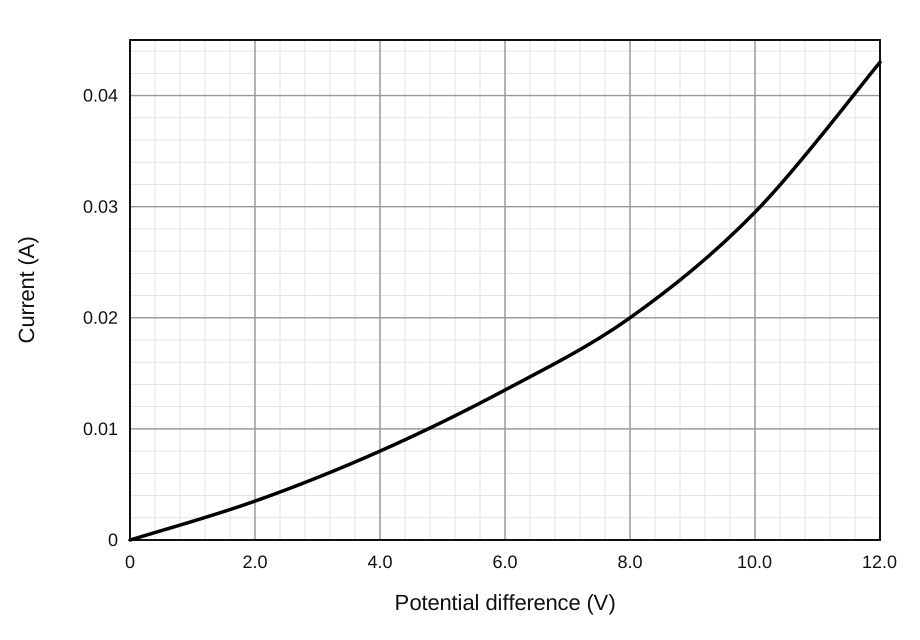
A student studies how the current in a thermistor depends on the potential difference across it. Figure 7 shows the circuit built so far, with no meters in it. Figure 8 shows the student's readings plotted as a graph.
Figure 7Figure 8
16.1[3 marks]
(a)(i) Sketch the two meters needed on Figure 7: one to measure the thermistor's current, one for its p.d.
Show model answer for 16.1Hide model answer for 16.1
The drawing must show a circle marked A set into the main loop, for example in the wire between the variable resistor and the thermistor, with the loop passing through it. It must also show a circle marked V joined by two extra wires, one to each end of the thermistor, so the voltmeter sits on a side branch around the thermistor.
3 marks
How the marks are earned
One mark: each meter has its proper symbol, a circle holding A for the ammeter and a circle holding V for the voltmeter. Their position does not matter for this mark.
One mark: the ammeter sits in the single loop, inserted into any wire, so the thermistor's current runs through it as well (series).
One mark: the voltmeter is connected in parallel, with one wire from each side of the thermistor. It may also span the ammeter as well as the thermistor, but it must not be across the battery, the variable resistor or the switch.
Why it scores
An ammeter measures the current that flows through it, so it goes in series. A voltmeter measures the potential difference between two points, so it goes in parallel with the component being tested. The thermistor is the part under investigation, so the voltmeter goes across only that.
Show model answer for 16.2Hide model answer for 16.2
The first box. Changing the variable resistor changes the total resistance of the circuit, so the current changes, and the thermistor then takes a different potential difference. The battery's own potential difference stays the same.
1 mark
How the marks are earned
Tick the box about current: the resistor's job is to vary how much current flows round the loop.
Show model answer for 16.3Hide model answer for 16.3
A current heats the components. The resistance of a thermistor changes with temperature, so a warming thermistor would spoil the results. Switching off between readings lets everything stay at room temperature, so each reading is accurate.
1 mark
How the marks are earned
The components, especially the thermistor, would otherwise warm up, so switching off keeps them at room temperature. Saying it gives more accurate readings is also accepted. Saying it saves energy earns nothing.
Show model answer for 16.4Hide model answer for 16.4
Raising the p.d. across the thermistor drives more current through it. The curve steepens along its length, so each extra volt adds more current than the one before. It bends upward instead of being straight.
2 marks
How the marks are earned
One mark: the current goes up as the potential difference goes up (or comes down as it comes down). The symbols V and p.d., or the word voltage, are fine in place of the full name; so is the symbol A or I for the current. Using the coulomb's symbol for current is not accepted.
One mark: it rises at a faster rate, so the line gets steeper as the potential difference increases. Saying the graph is non-linear or curved also earns this mark. Saying only proportional, directly proportional or inversely proportional earns nothing.
Other way round, worth both marks: raising the current makes the potential difference grow more slowly.
Why it scores
One mark is for the direction of the trend. The second is for describing the shape: a steepening curve means the current rises faster than the potential difference does, which is why the line is not straight.
Show model answer for 16.5Hide model answer for 16.5
It decreases. Resistance is potential difference divided by current. On Figure 8 the current grows faster than the potential difference, so the ratio falls. A larger current also warms the thermistor, and a warm thermistor has lower resistance.
1 mark
How the marks are earned
The resistance decreases, which is why the current rises faster than the potential difference.
Show model answer for 16.7Hide model answer for 16.7
Potential difference = current × resistance. resistance = fraction: potential difference over current, end of fraction
Put in the numbers:. resistance = fraction: 8.0 V over 0.02 A, end of fraction
Resistance = 400 Ω.
3 marks
How the marks are earned
One mark: use potential difference = current × resistance, in the form resistance = potential difference ÷ current.
One mark: substitute the values: 8.0 ÷ 0.02. Putting them into the unrearranged equation, 8.0 = 0.02 × resistance, also earns this mark. The rearranging and substituting can come in either order.
One mark: the answer 400. The unit, ohms, is printed on the answer line and is not needed for this mark. A wrong current from the earlier part, carried forward correctly, still earns this mark.
The correct answer, 400 Ω, on the answer line earns full marks.
Why it scores
This earns the equation mark, for resistance = potential difference ÷ current. You can also put the numbers into potential difference = current × resistance first and rearrange after, because the order does not matter.
Substituting the value you read from Figure 8 earns the second mark. If your reading was slightly different, your own value is used.
The last mark is for the answer, 400. The unit is printed on the answer line and is not needed for the mark. The right answer alone, with no working, earns all 3 marks.
Show model answer for 17.1Hide model answer for 17.1
Place the block on a balance and read its mass. Measure the length, width and height of the block with a ruler. Multiply length × width × height to find the volume.
3 marks
How the marks are earned
One mark: find the mass with a balance (scales are also accepted). Saying only 'weigh it' earns nothing.
Then any two of these: measure the three sides of the block (any names for the three sides are accepted); use a ruler, tape measure or similar to do it; multiply length × width × height to get the volume.
A displacement method, such as a Eureka can, earns nothing.
Why it scores
The balance gives the mass. For a regular block the three measurements with a ruler give the volume once multiplied together. Together these give the two quantities needed for density. A displacement can would not work well because polystyrene floats and is easily squashed.
Show model answer for 17.2Hide model answer for 17.2
Density = mass over volume. volume = mass over density
Volume = fraction: 0.60 kg over 50 kg/m3, end of fraction
Volume = 0.012 m3.
3 marks
How the marks are earned
One mark: use density = mass ÷ volume, written in any form, for example volume = mass ÷ density.
One mark: rearrange and substitute: 0.60 ÷ 50.
One mark: the volume 0.012 (the unit, cubic metres, is optional). The right digits, 1.2, with a wrong power of ten earn 2 marks.
The correct answer, 0.012 m3, on the answer line earns full marks.
Why it scores
Writing the density equation, in any form, earns the first mark. Rearranging to volume = mass ÷ density is credited together with the substitution on the next line.
Rearranging and substituting the values together earn the second mark: 0.60 ÷ 50.
This is the final mark. The answer alone earns all 3 marks. 1.2 × 10⁻² m3 is the same value.
Show model answer for 18.4Hide model answer for 18.4
Because nearly all the alpha particles went straight on, the atom must be mostly gaps, with a very small nucleus.
Some alpha particles being deflected shows that the atom has a positively charged centre, the nucleus, which repels the positively charged alpha particles.
3 marks
How the marks are earned
One mark: the straight-through particles show the atom is largely empty space (a tiny nucleus is also accepted).
One mark: the deflections show that part of the atom is positively charged. Saying positive charge is enough.
One mark: naming a nucleus. Saying it is small, dense or at the centre is good physics but is not needed.
If none of these marks is earned, one mark is allowed for any correct conclusion given for the wrong observation.
Why it scores
If the atom were a solid ball, as in the plum pudding model, the particles would not pass through so easily. This earns the first mark.
Alpha particles are positive, and like charges repel. Only a concentrated positive charge could turn a fast alpha particle aside. This earns the other two marks: positive charge, and nucleus.
Show model answer for 18.5Hide model answer for 18.5
Each atom is a sphere, and in a line the atoms touch across their full width, so each uses its diameter:. 2 × 1.0 × 10-10 = 2.0 × 10⁻¹⁰ m. For 20 atoms:. 20 × 2.0 × 10-10 = 4.0 × 10⁻⁹ m
2 marks
How the marks are earned
One mark: each atom takes up its diameter, twice the radius, so the length is 2 × 1.0 × 10-10 × 20.
One mark: the answer 4.0 × 10⁻⁹ m.
Using the radius instead of the diameter, giving 2.0 × 10⁻⁹ m, earns 1 mark. A correct value not in standard form, such as 0.000000004 or 40 × 10-10, earns 1 mark.
The correct answer, 4.0 × 10⁻⁹ m, on the answer line earns full marks.
Why it scores
The common slip is using the radius, which gives half the true length and only 1 mark. Standard form needs one digit before the decimal point, here 4.0, times a power of ten.
PrepWise guide: OCR A GCSE Physics Paper 3 HigherQuestion 19
A student explores the field between magnets. Figure 9 shows two magnet ends facing one another, a north pole on the left and a south pole on the right.
Figure 9
19.1[1 mark]
(a)(i) Iron filings can show a field's pattern. Name a different piece of equipment for investigating the field.
Show model answer for 19.1Hide model answer for 19.1
A plotting compass. Its needle lines up with the field, so moving it around the magnets shows the field direction at each point.
1 mark
How the marks are earned
A plotting compass. Iron filings and a pencil earn nothing. A second magnet earns the mark only if its use is explained, for example by noting which way it is pushed or pulled.
Show model answer for 19.2Hide model answer for 19.2
The drawing must show four or more lines running across the gap from the face of the north pole on the left to the face of the south pole on the right. The two middle lines are straight and parallel. The next line above and the next line below curve outwards, bulging away from the middle before meeting the poles. Every line carries an arrowhead pointing to the right, from north to south.
3 marks
How the marks are earned
One mark: at least 2 field lines drawn across the gap, joining the north pole to the south pole. Lines to unseen poles or back to the same magnet do not count, but they do not cancel the mark.
Shape mark: four or more lines in the gap, with the middle two running straight across and the outer pair bowing outwards, one above and one below. Straightness and curvature are judged by eye.
Direction mark: show the field's direction with an arrowhead on at least one line, heading from the north pole to the south pole. No line may carry an arrow that says the opposite.
Why it scores
Field lines always run from a north pole to a south pole. They are straight and evenly spaced where the field is strongest, in the middle of the gap, and they bow outwards towards the edges where the field spreads out and weakens.
Show model answer for 19.3Hide model answer for 19.3
The insulation stops current crossing between neighbouring turns, or into the iron nail, so a short circuit is avoided and the current goes all the way round the coil.
1 mark
How the marks are earned
Any one of: to avoid a short circuit; to stop current flowing in the iron nail; to stop the nail becoming live. Unqualified safety, danger, heat or shock earn nothing.
Show model answer for 19.4Hide model answer for 19.4
The number of turns of wire. More turns in the coil make a stronger field. A larger current, or an iron core, would also strengthen it.
1 mark
How the marks are earned
Any one: the number of turns of wire, the length of the wire, the current, the potential difference, the thickness (cross-sectional area) of the wire, or changing or removing the iron core.
Show model answer for 20.1Hide model answer for 20.1
The drawing must show one arrowhead on the wire pointing clockwise. In Figure 10 the short plate of the cell, on the right, is the negative terminal, so the electrons leave there, move right along the top wire, down through B, left through the lamp and up through A.
1 mark
How the marks are earned
One mark: an arrow drawn on the circuit wires pointing clockwise (over the top to the right, down the right side, back along the bottom and up the left side). It may be placed anywhere along the loop.
Show model answer for 20.4Hide model answer for 20.4
Its p.d., the voltage across the lamp. Multiplying current by time gives the charge moved, and every coulomb delivers energy equal to that p.d., so:. energy = p.d. × current × time
1 mark
How the marks are earned
Potential difference (voltage, V). Resistance or power are also accepted. The first quantity written is the one marked.
PrepWise guide: OCR A GCSE Physics Paper 3 HigherQuestion 21
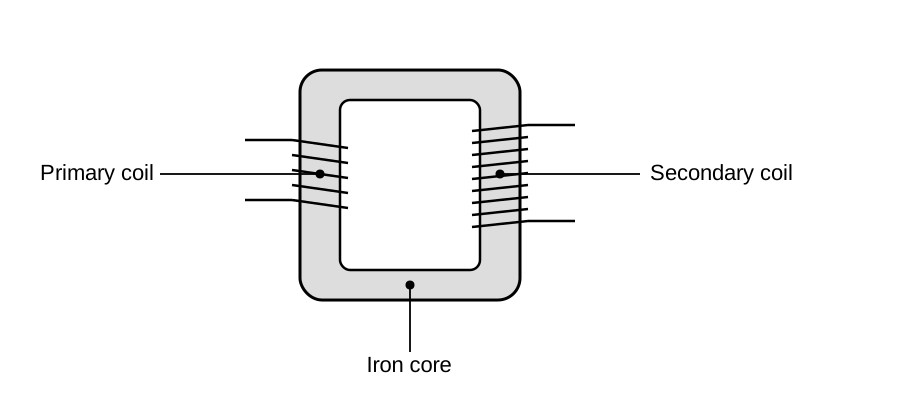
A transformer changes the potential difference of an electrical supply. Figure 11 shows a simple transformer: an iron core with a primary coil on the left and a secondary coil on the right.
Figure 11
21.1[2 marks]
(a) Four steps describe how a transformer works. Step C is first. Give the order of the remaining three letters.
A: A p.d. that alternates is induced in the secondary coil
B: The iron core carries a magnetic field that keeps changing
C: The primary coil has an alternating p.d. applied to its two ends
D: An alternating current flows in the primary coil
Show model answer for 21.1Hide model answer for 21.1
Order: C, D, B, A. The alternating p.d. in step C pushes a current that keeps reversing through the primary coil (D). That current gives the iron core a magnetic field that never stops changing (B). The varying field links with the secondary coil, so a p.d. that alternates is induced across it (A).
2 marks
How the marks are earned
The order is C, D, B, A. All three of D, B, A in the right place earn 2 marks.
One or two of the three in the right place earn 1 mark.
Why it scores
Each step causes the next: p.d., then current, then a changing field, then an induced p.d. A p.d. is induced only where a changing field passes, so induction in the secondary has to come last.
Show model answer for 21.2Hide model answer for 21.2
Direct current flows one way at a steady size, so the magnetic field it makes in the iron core is steady and does not change. A p.d. is induced in the secondary coil only by a changing magnetic field, so none is induced and the transformer gives no output.
2 marks
How the marks are earned
One mark: direct current always runs the same way round and never reverses. Voltage or p.d. may stand in for current. The word electricity alone earns nothing.
One mark: the field in the core never varies; it stays steady. Writing that no magnetic field is induced earns nothing.
Why it scores
The first mark is for the steady one-way current and the second for the link to a field that does not change. Induction needs a changing field, which only alternating current gives.
Show model answer for 21.3Hide model answer for 21.3
fraction: primary p.d. over secondary p.d., end of fraction = fraction: primary turns over secondary turns, end of fraction. Rearranged:. secondary turns = fraction: primary turns × secondary p.d. over primary p.d., end of fraction
Secondary turns = fraction: 25 × 4600 over 230, end of fraction
Secondary turns = 25 × 20. = 500 turns
3 marks
How the marks are earned
One mark: any rearrangement of the transformer equation, for example secondary turns = primary turns × secondary p.d. ÷ primary p.d., or Ns/Np = Vs/Vp. The unrearranged ratio Vp/Vs = Np/Ns alone does not earn this mark.
One mark: substitute: 25 × 4600 ÷ 230. Correct numbers in any arrangement of the equation earn this mark.
One mark: 500 turns.
The correct answer, 500, on the answer line earns full marks.
Why it scores
Rearranging the equation to find the secondary turns earns the first mark. The unrearranged ratio alone earns nothing.
Substituting the three values earns the second mark.
The p.d. rises by a factor of 20, so the turns rise by the same factor. The right answer alone earns all 3 marks.
Show model answer for 21.4Hide model answer for 21.4
A high p.d. can drive a large current through a person's body, giving an electric shock that can stop the heart.
1 mark
How the marks are earned
It can give an electric shock. Electrocution or cardiac arrest are also accepted. 'Dangerous' or 'can kill you' on their own, heat, burns and fires earn nothing.
1: A wire carrying current in a magnetic field is made to turn
2: A wire moving through a magnetic field has a p.d. induced across it
3: Pressure changes in a sound wave become changing current in a circuit
4: Changing current in a circuit becomes pressure changes in a sound wave
Show model answer for 21.5Hide model answer for 21.5
Generator and 2: a wire cutting across field lines gets a p.d. induced in it. Motor and 1: a wire with current inside a field feels a force and spins. Microphone and 3: sound pressure changes become a changing current. Headphones and 4: a changing current becomes sound pressure changes.
2 marks
How the marks are earned
All four pairs right earn 2 marks: generator with 2, headphones with 4, microphone with 3, motor with 1.
Two or three pairs right earn 1 mark.
Why it scores
A generator and a motor are opposites: one makes a p.d. from movement, the other movement from a current. A microphone and headphones are opposites too: sound into signal, and signal into sound.
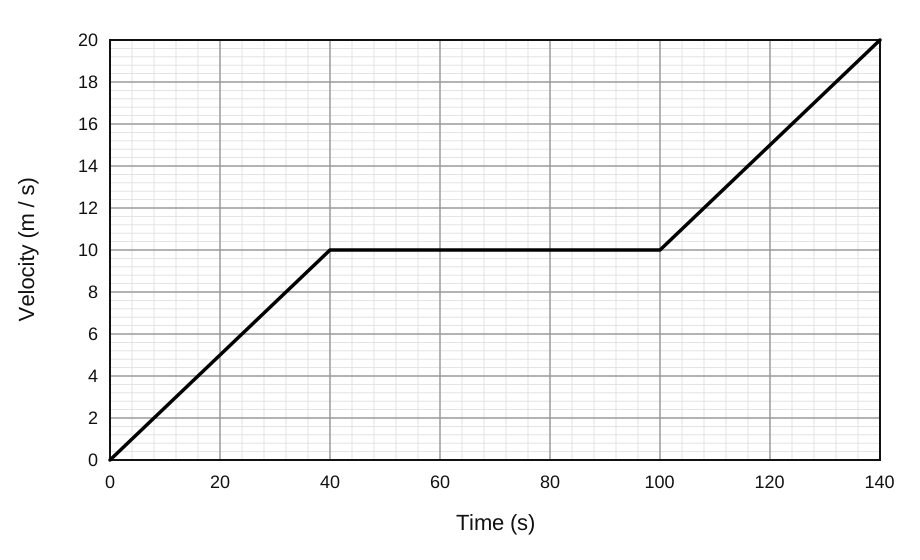
From 0 to 40 s the line slopes straight up, so the train starts from rest and its velocity rises at a constant rate: it has constant acceleration.. Acceleration = fraction: change in velocity over time, end of fraction. = 10 over 40. = 0.25 m/s2. The distance is the area under the line, a triangle:. ½ × 40 × 10 = 200 m. This is the same as average speed 5 m/s × 40 s.. The train accelerates because the forward driving force is bigger than the resistive forces, so there is a resultant forward force.
Between 40 s and 100 s the line is level at 10 m/s: the speed holds steady, so there is no acceleration.. Distance = speed × time. = 10 × 60. = 600 m. A steady speed means balanced forces: the driving force equals the resistive forces, so the resultant force is zero.
From 100 to 140 s the line slopes up again, from 10 to 20 m/s, so the train accelerates again at a constant rate.. Acceleration = 10 over 40. = 0.25 m/s2. This is the same as the first stage, so the slopes match. The distance is the average speed × the time:. 15 m/s × 40 s = 600 m. The area under the line gives the same distance:. Rectangle:. 10 × 40 = 400 m. Triangle:. ½ × 40 × 10 = 200 m. 400 + 200 = 600 m. The driving force again exceeds the resistive forces.
Overall, the velocity is always positive, so the train never changes direction. The total distance in 140 s is:. 200 + 600 + 600 = 1400 m. That is 1.4 km.
Levels of response, 6 marks
How the marks are earned
Level marked. Top level (5 to 6 marks): all three stages are described and analysed, and acceleration and distance are both calculated correctly. Middle level (3 to 4): the description and analysis are clear and one of acceleration or distance is calculated. Bottom level (1 to 2): the description is basic and a calculation is attempted, or the calculations are correct with little description. The science sets the level. Within a level, the higher mark needs a clear, logical answer backed by evidence from the graph; weak structure gives the lower mark of that level.
Description: the train speeds up steadily from 0 to 40 s, moves at a steady speed from 40 s to 100 s, then speeds up steadily again from 100 s to 140 s. It always moves in the same direction and never reverses.
Analysis: a straight sloping line means constant acceleration, a flat line means constant velocity and so zero acceleration, and the first and third stages have the same acceleration because their slopes are the same.
Calculations: acceleration is 0.25 m/s2 in the first and in the third stage. Distance is 200 m in the first stage, 600 m in the second and 600 m in the third, so 1400 m (1.4 km) in total.
Why it scores
This stage gives a description (constant acceleration from rest), the first acceleration and the first distance, with a reason from forces. Quoting the equation and the numbers with units is what earns the calculation credit.
A flat line is zero acceleration, not 'stopped'. Explaining it by balanced forces links the graph to Newton's first law and shows analysis, not only description.
Spotting that the slopes are equal and so the accelerations are equal is the analysis step that separates the top level from a plain description. Both graph readings and the arithmetic are needed here.
A short summary ties the three stages together with the total distance. A clear, ordered answer like this, stage by stage, is the well-developed line of reasoning the top level asks for.
PrepWise guide: OCR A GCSE Physics Paper 3 HigherQuestion 23
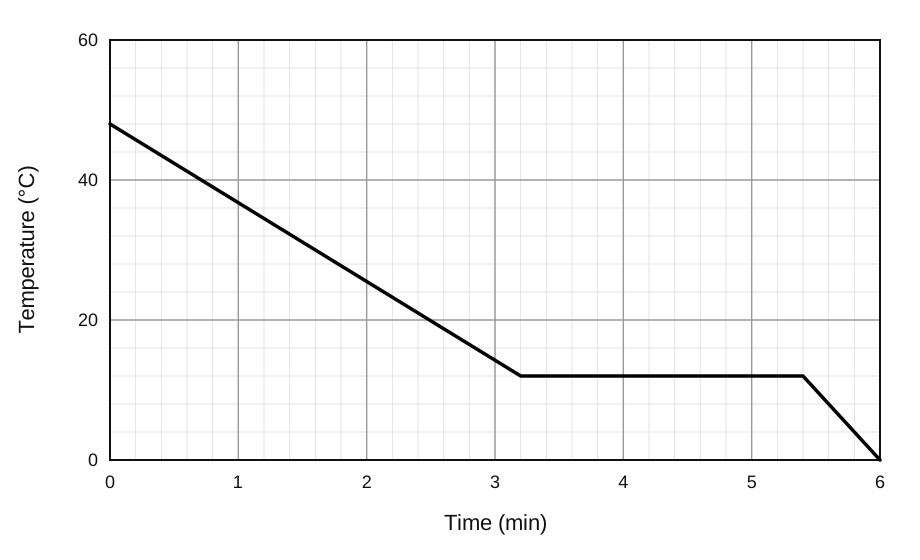
A scientist studies how liquids cool in a freezer. Figure 13 shows how the temperature of 200 g of liquid A changes with time. Liquid B and a portable freezer come later.
Figure 13
23.1[1 mark]
(a)(i) Read the starting temperature of liquid A from Figure 13.
Show model answer for 23.3Hide model answer for 23.3
Energy = mass × specific heat capacity × temperature change.
The mass is:. 200 g = 0.200 kg
The temperature change is:. 48 − 12 = 36 °C
Put the numbers in:. energy = 0.200 × 3750 × 36
Energy = 27 000 J.
4 marks
How the marks are earned
One mark: change the mass to kilograms, 200 g = 0.200 kg.
One mark: the temperature change, 48 − 12 = 36 °C. Values carried forward from your answers to 23.1 and 23.2 are accepted.
One mark: substitute into energy = mass × specific heat capacity × temperature change: 0.200 × 3750 × 36. Writing 0.2 for 0.200, or (48 − 12) in place of 36, is also fine, and your own carried forward values are used. Writing the equation alone earns no mark.
One mark: the energy, 27 000 (27 kJ is also accepted). The unit J is printed on the answer line and is not needed. A minus sign is ignored.
The correct answer, 27 000 J, on the answer line earns full marks. Leaving the mass in grams, giving 2.7 × 10⁷ J, earns 3 marks.
Why it scores
Choosing the equation sets up the working. It earns no mark on its own.
Specific heat capacity is per kilogram, so grams must be converted. Forgetting loses a mark and makes the answer 1000 times too big.
The liquid cools only from 48 °C down to its freezing point at 12 °C, so the flat section is not included. This earns the second mark.
Substituting the mass in kilograms, the specific heat capacity and the temperature change earns the third mark.
The final mark is the energy, 27 000. The unit, joules, is printed on the answer line and is not needed for the mark. The right answer alone earns all 4 marks.
Show model answer for 23.5Hide model answer for 23.5
The freezer is not 100% efficient, and the warm surroundings also transfer energy into it, so it must transfer more energy than the minimum to cool liquid B.
1 mark
How the marks are earned
Any one reason: the machine wastes some energy so is under 100% efficient, warmth leaks in from outside, or the insulation is poor. Also accepted: some energy cools the freezer itself or other contents. Merely saying energy is lost to the surroundings earns nothing, unless linked to the motor's efficiency.
Show model answer for 23.6Hide model answer for 23.6
Power = current2 × resistance. current2 = power over resistance. current = √(power over resistance)
Current = √(240 over 0.80). = √300
Current = 17.32 A. That is 17 A to 2 significant figures.
4 marks
How the marks are earned
One mark: use power = current squared × resistance, in any form.
One mark: substitute in the equation: 240 = current2 × 0.80, or a rearranged form such as the square root of (240 ÷ 0.80).
One mark: the unrounded value 17.32 A (any number of significant figures).
One mark: round to 2 significant figures, 17 A. A wrongly calculated value correctly rounded to 2 significant figures earns this mark if the working is shown. Rounding alone, with no working, earns nothing.
The correct answer, 17 A, on the answer line earns full marks. Forgetting the square root, giving 300 A, earns 2 marks.
Why it scores
The equation has current squared, so the final step is a square root. Choosing it earns the first mark.
Substituting and dividing earns the second mark. Stopping at 300 is the common slip, and earns 2 marks in all.
One mark is for the square root and one is for the rounding. The right answer alone earns all 4 marks.
PrepWise guide: OCR A GCSE Physics Paper 3 HigherQuestion 24
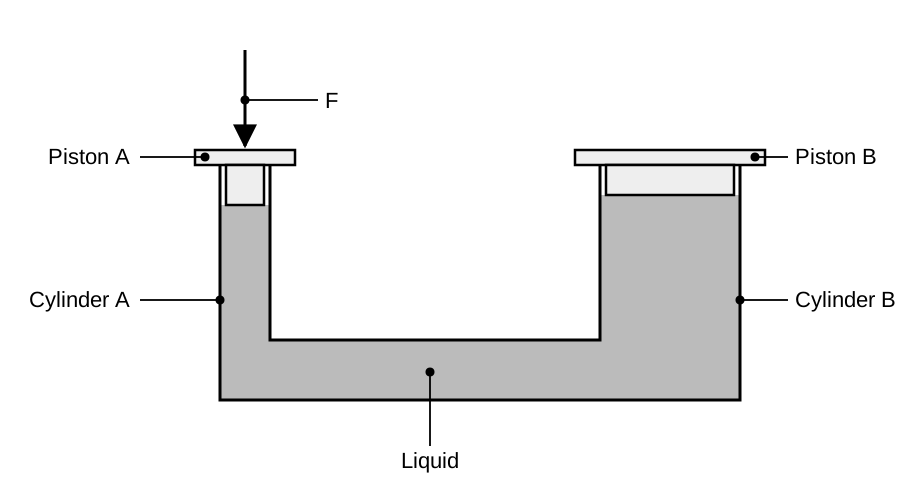
A mechanic raises cars with a hydraulic lift. Figure 14 models it as two connected cylinders of liquid, A and B, each with a piston, with a force F applied to piston A.
Figure 14
24.1[1 mark]
(a) Compare the pressure in cylinder A with the pressure in cylinder B. Tick one box.
Show model answer for 24.1Hide model answer for 24.1
The third box. A pressure applied to a liquid in a closed space is passed on equally through the whole liquid, so the pressure is the same in both cylinders.
1 mark
How the marks are earned
Tick the third box: the pressure in A equals the pressure in B.
Show model answer for 24.2Hide model answer for 24.2
Pressure = force over area. For piston A:. pressure = fraction: 1000 N over 2.0 × 10⁻⁴ m2, end of fraction. = 5.0 × 10⁶ Pa
The liquid passes the pressure on equally, so the pressure on piston B is also 5.0 × 10⁶ Pa.. Force = pressure × area. = 5.0 × 106 Pa × 10 × 10-4 m2. = 5000 N
4 marks
How the marks are earned
One mark: pressure in A = force ÷ area with the numbers put in, 1000 ÷ 2.0 × 10⁻⁴.
One mark: the pressure in A is 5.0 × 10⁶ Pa (5 000 000 Pa).
One mark: the pressure in B is the same, so force on B = pressure × area of B, with the numbers put in: 5.0 × 106 × 10 × 10-4. A wrong pressure for A carried forward correctly earns this mark.
One mark: the force, 5000 N.
A ratio route earns full marks: the area ratio is 10 × 10-4 ÷ 2.0 × 10-4 = 5, so the force is 5 × 1000 = 5000 N. So does equating force ÷ area for A and for B and rearranging for the force on B.
The correct answer, 5000 N, on the answer line earns full marks.
Why it scores
Two marks: putting the numbers into pressure = force ÷ area, and the pressure worked out.
Two marks: the equal pressure used in force = pressure × area with the numbers put in, then the force. This is a force multiplier: piston B has 5 times the area, so it gets 5 times the force. The right answer alone earns all 4 marks.
Cookies. Essential ones keep you signed in. With your OK we'd also use a few to see which pages help people find us, never to follow you elsewhere. Cookie policy