Figure 10 shows a cell driving a lamp, with points A and B marked on opposite sides of the circuit.
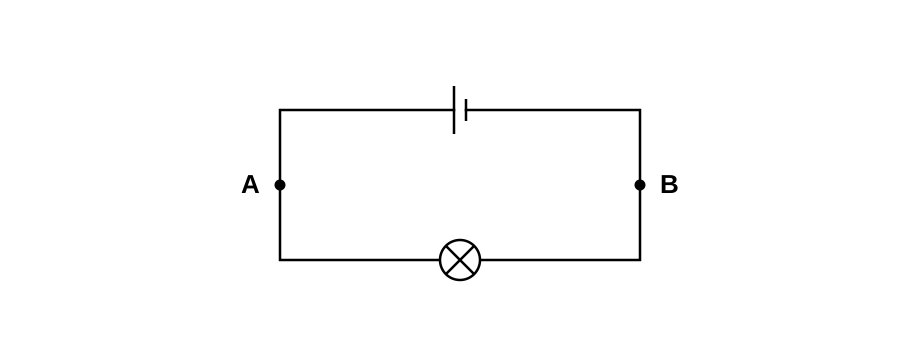
(a) Draw an arrow on Figure 10 showing which way the electrons move round the circuit.
Our own questions on this topic, marked straight away, so you see what to revise. Free now.
Show model answer for 20.1Hide model answer for 20.1
The drawing must show one arrowhead on the wire pointing clockwise. In Figure 10 the short plate of the cell, on the right, is the negative terminal, so the electrons leave there, move right along the top wire, down through B, left through the lamp and up through A.
How the marks are earned
- One mark: an arrow drawn on the circuit wires pointing clockwise (over the top to the right, down the right side, back along the bottom and up the left side). It may be placed anywhere along the loop.
(b) Compare the current at A with the current at B. Tick one box.
See how you would score on Series & Parallel CircuitsShow model answer for 20.2Hide model answer for 20.2
The third box. This is a series circuit with one loop, so the current is the same everywhere in it. Charge is not used up, only energy is transferred.
How the marks are earned
- Tick the third box: the current at A equals the current at B.
(c) Find the charge passing through the lamp after 30 s at 0.45 A. Give the unit.
See how you would score on Current & ChargeShow model answer for 20.3Hide model answer for 20.3
Charge flow = current × time.
Charge flow = 0.45 A × 30 s.
Charge flow = 13.5.
The unit is the coulomb, C. The answer is 13.5 C.
How the marks are earned
- One mark: use charge = current × time.
- One mark: substitute: 0.45 × 30.
- One mark: the value 13.5. The rounded value 14 is also accepted.
- One mark, independent of the others: the unit, coulombs (C).
- The correct answer, 13.5 C, on the answer line earns full marks.
Why it scores
This is the equation mark. The equation is given in words and symbols on the equation sheet.
Substituting the two values earns the second mark.
The number alone earns the third mark. 14 is accepted.
The unit mark is separate. A correct number with no unit, or the wrong unit, loses only this mark. The right answer with unit earns all 4.
Revise Current & Charge(d) Energy transferred needs one more quantity alongside the current and time. Name it.
See how you would score on Potential DifferenceShow model answer for 20.4Hide model answer for 20.4
Its p.d., the voltage across the lamp. Multiplying current by time gives the charge moved, and every coulomb delivers energy equal to that p.d., so:. energy = p.d. × current × time
How the marks are earned
- Potential difference (voltage, V). Resistance or power are also accepted. The first quantity written is the one marked.