A transformer changes the potential difference of an electrical supply. Figure 11 shows a simple transformer: an iron core with a primary coil on the left and a secondary coil on the right.
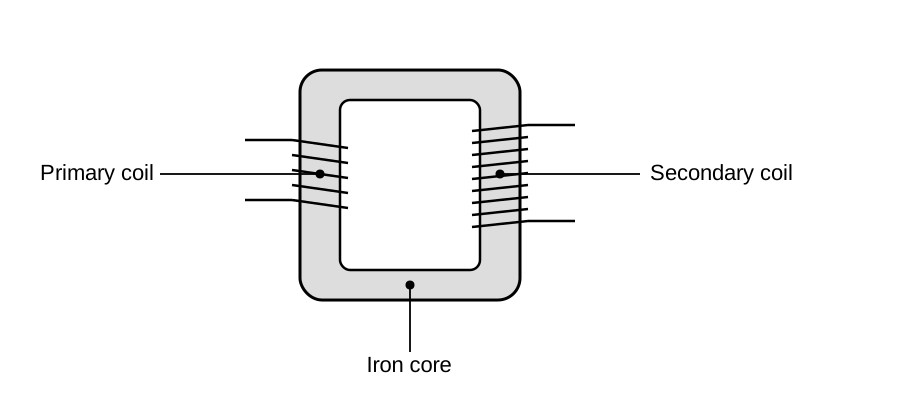
(a) Four steps describe how a transformer works. Step C is first. Give the order of the remaining three letters.
Our own questions on this topic, marked straight away, so you see what to revise. Free now.
Show model answer for 21.1Hide model answer for 21.1
Order: C, D, B, A. The alternating p.d. in step C pushes a current that keeps reversing through the primary coil (D). That current gives the iron core a magnetic field that never stops changing (B). The varying field links with the secondary coil, so a p.d. that alternates is induced across it (A).
How the marks are earned
- The order is C, D, B, A. All three of D, B, A in the right place earn 2 marks.
- One or two of the three in the right place earn 1 mark.
Why it scores
Each step causes the next: p.d., then current, then a changing field, then an induced p.d. A p.d. is induced only where a changing field passes, so induction in the secondary has to come last.
Revise Electromagnetic Induction(b) Explain why a transformer gives no output when it is supplied with direct current (d.c.).
See how you would score on Electromagnetic InductionShow model answer for 21.2Hide model answer for 21.2
Direct current flows one way at a steady size, so the magnetic field it makes in the iron core is steady and does not change. A p.d. is induced in the secondary coil only by a changing magnetic field, so none is induced and the transformer gives no output.
How the marks are earned
- One mark: direct current always runs the same way round and never reverses. Voltage or p.d. may stand in for current. The word electricity alone earns nothing.
- One mark: the field in the core never varies; it stays steady. Writing that no magnetic field is induced earns nothing.
Why it scores
The first mark is for the steady one-way current and the second for the link to a field that does not change. Induction needs a changing field, which only alternating current gives.
Revise Electromagnetic Induction(c) A step-up transformer raises 230 V to 4600 V and its primary coil has 25 turns. Find the secondary turns.
See how you would score on National Grid & TransformersShow model answer for 21.3Hide model answer for 21.3
fraction: primary p.d. over secondary p.d., end of fraction = fraction: primary turns over secondary turns, end of fraction. Rearranged:. secondary turns = fraction: primary turns × secondary p.d. over primary p.d., end of fraction
Secondary turns = fraction: 25 × 4600 over 230, end of fraction
Secondary turns = 25 × 20. = 500 turns
How the marks are earned
- One mark: any rearrangement of the transformer equation, for example secondary turns = primary turns × secondary p.d. ÷ primary p.d., or Ns/Np = Vs/Vp. The unrearranged ratio Vp/Vs = Np/Ns alone does not earn this mark.
- One mark: substitute: 25 × 4600 ÷ 230. Correct numbers in any arrangement of the equation earn this mark.
- One mark: 500 turns.
- The correct answer, 500, on the answer line earns full marks.
Why it scores
Rearranging the equation to find the secondary turns earns the first mark. The unrearranged ratio alone earns nothing.
Substituting the three values earns the second mark.
The p.d. rises by a factor of 20, so the turns rise by the same factor. The right answer alone earns all 3 marks.
Revise National Grid & Transformers(d) Name one harm a person risks from a very high p.d.
See how you would score on Mains Electricity & SafetyShow model answer for 21.4Hide model answer for 21.4
A high p.d. can drive a large current through a person's body, giving an electric shock that can stop the heart.
How the marks are earned
- It can give an electric shock. Electrocution or cardiac arrest are also accepted. 'Dangerous' or 'can kill you' on their own, heat, burns and fires earn nothing.
(e) Pair every device with the sentence that says what it does. Give four pairs.
See how you would score on Electromagnetic InductionShow model answer for 21.5Hide model answer for 21.5
Generator and 2: a wire cutting across field lines gets a p.d. induced in it. Motor and 1: a wire with current inside a field feels a force and spins. Microphone and 3: sound pressure changes become a changing current. Headphones and 4: a changing current becomes sound pressure changes.
How the marks are earned
- All four pairs right earn 2 marks: generator with 2, headphones with 4, microphone with 3, motor with 1.
- Two or three pairs right earn 1 mark.
Why it scores
A generator and a motor are opposites: one makes a p.d. from movement, the other movement from a current. A microphone and headphones are opposites too: sound into signal, and signal into sound.
Revise Electromagnetic Induction