Figure 12 plots a train's velocity against time for 140 s of travel along flat, straight rails.
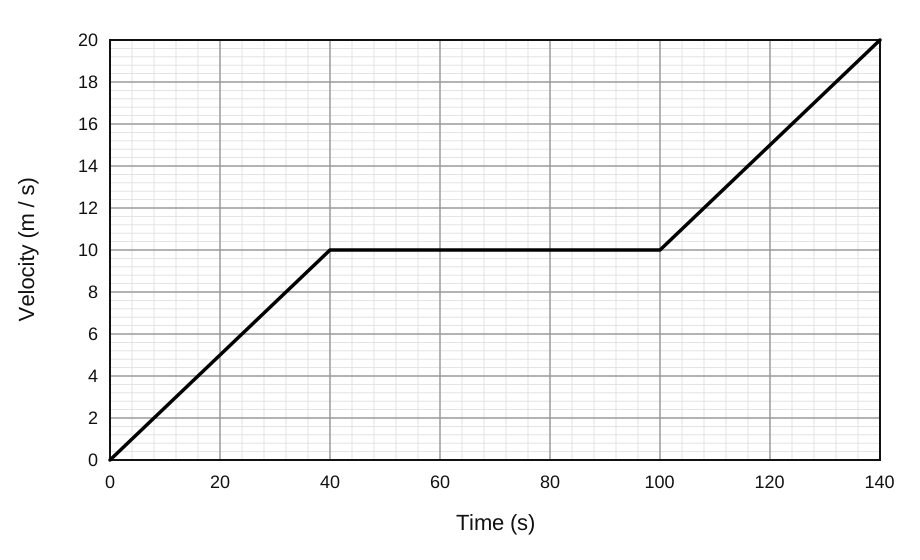
Use Figure 12 to say what the train does in each stage and why, with its accelerations and the distance it covers.
Our own questions on this topic, marked straight away, so you see what to revise. Free now.
Show model answerHide model answer
From 0 to 40 s the line slopes straight up, so the train starts from rest and its velocity rises at a constant rate: it has constant acceleration.. Acceleration = fraction: change in velocity over time, end of fraction. = 10 over 40. = 0.25 m/s2. The distance is the area under the line, a triangle:. ½ × 40 × 10 = 200 m. This is the same as average speed 5 m/s × 40 s.. The train accelerates because the forward driving force is bigger than the resistive forces, so there is a resultant forward force.
Between 40 s and 100 s the line is level at 10 m/s: the speed holds steady, so there is no acceleration.. Distance = speed × time. = 10 × 60. = 600 m. A steady speed means balanced forces: the driving force equals the resistive forces, so the resultant force is zero.
From 100 to 140 s the line slopes up again, from 10 to 20 m/s, so the train accelerates again at a constant rate.. Acceleration = 10 over 40. = 0.25 m/s2. This is the same as the first stage, so the slopes match. The distance is the average speed × the time:. 15 m/s × 40 s = 600 m. The area under the line gives the same distance:. Rectangle:. 10 × 40 = 400 m. Triangle:. ½ × 40 × 10 = 200 m. 400 + 200 = 600 m. The driving force again exceeds the resistive forces.
Overall, the velocity is always positive, so the train never changes direction. The total distance in 140 s is:. 200 + 600 + 600 = 1400 m. That is 1.4 km.
How the marks are earned
- Level marked. Top level (5 to 6 marks): all three stages are described and analysed, and acceleration and distance are both calculated correctly. Middle level (3 to 4): the description and analysis are clear and one of acceleration or distance is calculated. Bottom level (1 to 2): the description is basic and a calculation is attempted, or the calculations are correct with little description. The science sets the level. Within a level, the higher mark needs a clear, logical answer backed by evidence from the graph; weak structure gives the lower mark of that level.
- Description: the train speeds up steadily from 0 to 40 s, moves at a steady speed from 40 s to 100 s, then speeds up steadily again from 100 s to 140 s. It always moves in the same direction and never reverses.
- Analysis: a straight sloping line means constant acceleration, a flat line means constant velocity and so zero acceleration, and the first and third stages have the same acceleration because their slopes are the same.
- Calculations: acceleration is 0.25 m/s2 in the first and in the third stage. Distance is 200 m in the first stage, 600 m in the second and 600 m in the third, so 1400 m (1.4 km) in total.
Why it scores
This stage gives a description (constant acceleration from rest), the first acceleration and the first distance, with a reason from forces. Quoting the equation and the numbers with units is what earns the calculation credit.
A flat line is zero acceleration, not 'stopped'. Explaining it by balanced forces links the graph to Newton's first law and shows analysis, not only description.
Spotting that the slopes are equal and so the accelerations are equal is the analysis step that separates the top level from a plain description. Both graph readings and the arithmetic are needed here.
A short summary ties the three stages together with the total distance. A clear, ordered answer like this, stage by stage, is the well-developed line of reasoning the top level asks for.
Revise Newton's Laws of Motion