A scientist studies how liquids cool in a freezer. Figure 13 shows how the temperature of 200 g of liquid A changes with time. Liquid B and a portable freezer come later.
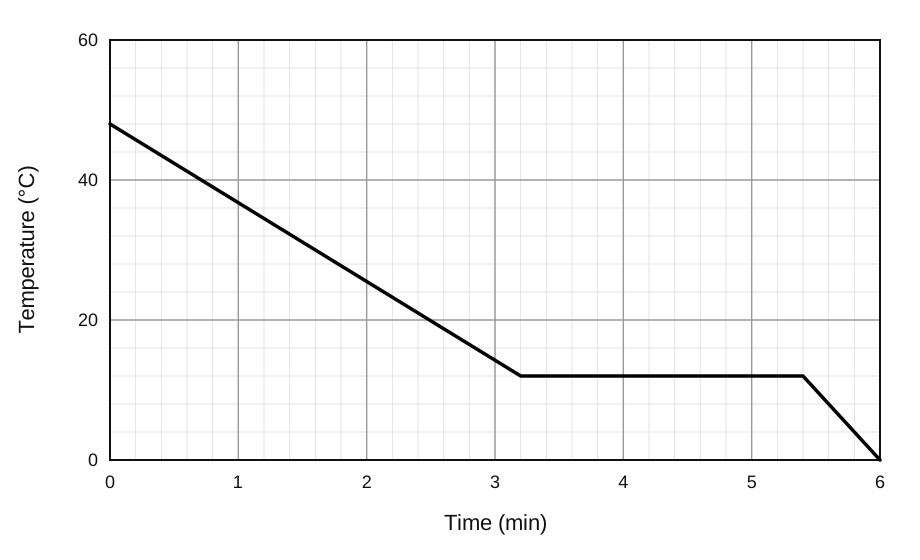
(a)(i) Read the starting temperature of liquid A from Figure 13.
Our own questions on this topic, marked straight away, so you see what to revise. Free now.
Show model answer for 23.1Hide model answer for 23.1
48 °C. At time zero the line starts at 48 on the temperature axis.
How the marks are earned
- 48 °C, where the line meets the temperature axis at time zero.
(a)(ii) Use Figure 13 to find the temperature at which liquid A freezes.
See how you would score on Specific Latent HeatShow model answer for 23.2Hide model answer for 23.2
12 °C. The temperature stays constant while the liquid freezes, so the flat section of the line shows the freezing point.
How the marks are earned
- 12 °C, the temperature of the flat part of the line.
(a)(iii) Liquid A has specific heat capacity 3750 J/kg °C. Find the energy it loses cooling from its starting temperature to the start of freezing.
See how you would score on Specific Heat CapacityShow model answer for 23.3Hide model answer for 23.3
Energy = mass × specific heat capacity × temperature change.
The mass is:. 200 g = 0.200 kg
The temperature change is:. 48 − 12 = 36 °C
Put the numbers in:. energy = 0.200 × 3750 × 36
Energy = 27 000 J.
How the marks are earned
- One mark: change the mass to kilograms, 200 g = 0.200 kg.
- One mark: the temperature change, 48 − 12 = 36 °C. Values carried forward from your answers to 23.1 and 23.2 are accepted.
- One mark: substitute into energy = mass × specific heat capacity × temperature change: 0.200 × 3750 × 36. Writing 0.2 for 0.200, or (48 − 12) in place of 36, is also fine, and your own carried forward values are used. Writing the equation alone earns no mark.
- One mark: the energy, 27 000 (27 kJ is also accepted). The unit J is printed on the answer line and is not needed. A minus sign is ignored.
- The correct answer, 27 000 J, on the answer line earns full marks. Leaving the mass in grams, giving 2.7 × 10⁷ J, earns 3 marks.
Why it scores
Choosing the equation sets up the working. It earns no mark on its own.
Specific heat capacity is per kilogram, so grams must be converted. Forgetting loses a mark and makes the answer 1000 times too big.
The liquid cools only from 48 °C down to its freezing point at 12 °C, so the flat section is not included. This earns the second mark.
Substituting the mass in kilograms, the specific heat capacity and the temperature change earns the third mark.
The final mark is the energy, 27 000. The unit, joules, is printed on the answer line and is not needed for the mark. The right answer alone earns all 4 marks.
Revise Specific Heat Capacity(b)(i) Liquid B needs 54 kJ to reach its freezing point, taking 360 s. Find the freezer's minimum power.
See how you would score on PowerShow model answer for 23.4Hide model answer for 23.4
Energy transferred = power × time. power = energy over time
The energy is:. 54 kJ = 54 × 1000. = 54 000 J
Power = fraction: 54 000 J over 360 s, end of fraction
Power = 150 W.
How the marks are earned
- One mark: use energy transferred = power × time, in the form power = energy ÷ time.
- One mark: change 54 kJ to 54 000 J.
- One mark: substitute: 54 000 ÷ 360.
- One mark: the power, 150 W. Not changing kJ to J, giving 1.5 × 10 to some other power, earns 3 marks.
- The correct answer, 150 W, on the answer line earns full marks.
Why it scores
Rearranging for power earns the equation mark.
Joules are needed for watts. Missing the conversion gives an answer 1000 times too small.
Substituting the values earns the third mark.
The last mark is the answer. The right answer alone earns all 4 marks.
Revise Power(b)(ii) The real freezer power exceeds the minimum you found. Give one reason.
See how you would score on EfficiencyShow model answer for 23.5Hide model answer for 23.5
The freezer is not 100% efficient, and the warm surroundings also transfer energy into it, so it must transfer more energy than the minimum to cool liquid B.
How the marks are earned
- Any one reason: the machine wastes some energy so is under 100% efficient, warmth leaks in from outside, or the insulation is poor. Also accepted: some energy cools the freezer itself or other contents. Merely saying energy is lost to the surroundings earns nothing, unless linked to the motor's efficiency.
(c) A portable freezer has power 240 W and its parts have total resistance 0.80 Ω. Find the current, to 2 significant figures.
See how you would score on Electrical Power & EnergyShow model answer for 23.6Hide model answer for 23.6
Power = current2 × resistance. current2 = power over resistance. current = √(power over resistance)
Current = √(240 over 0.80). = √300
Current = 17.32 A. That is 17 A to 2 significant figures.
How the marks are earned
- One mark: use power = current squared × resistance, in any form.
- One mark: substitute in the equation: 240 = current2 × 0.80, or a rearranged form such as the square root of (240 ÷ 0.80).
- One mark: the unrounded value 17.32 A (any number of significant figures).
- One mark: round to 2 significant figures, 17 A. A wrongly calculated value correctly rounded to 2 significant figures earns this mark if the working is shown. Rounding alone, with no working, earns nothing.
- The correct answer, 17 A, on the answer line earns full marks. Forgetting the square root, giving 300 A, earns 2 marks.
Why it scores
The equation has current squared, so the final step is a square root. Choosing it earns the first mark.
Substituting and dividing earns the second mark. Stopping at 300 is the common slip, and earns 2 marks in all.
One mark is for the square root and one is for the rounding. The right answer alone earns all 4 marks.
Revise Electrical Power & Energy