Paper 2 Higher

PrepWiseGuide to a real paper

AQA GCSE Physics

Paper 2 Higher

June 2025
100 marks · 1 hour 45 minutes · 9 questions

A real paper, in its real order. Each description and answer is ours, so you can see how each mark is earned. Not made or approved by AQA.

The real exam gives you an equations sheet. See the equations

PrepWise guide: AQA GCSE Physics Paper 2 HigherQuestion 1

A lightning strike gives a flash we see and a thunderclap we hear. The flash reaches us as visible light and the thunder as sound.

01.1[6 marks]

How are light and sound alike as waves, and how do they differ? Cover both.

See how you would score on Wave Properties
Show model answer for 01.1Hide model answer for 01.1

Light is an electromagnetic wave and needs no material, so it can cross a vacuum. Sound is a mechanical wave: it moves by particles passing on vibrations, so it needs a medium and cannot cross empty space.

Light is transverse, with vibrations at right angles to the way the wave travels. Sound is longitudinal, with particles vibrating back and forth along the way the wave travels.

In air, light travels at about 3.0 × 10⁸ m/s and sound at about 330 m/s, so light is vastly faster. Light has a much higher frequency and a much shorter wavelength than sound. Going from air into a solid, sound speeds up but light slows down.

Both kinds of wave can be reflected, refracted and diffracted, and both transfer energy without moving material along with them.

Levels of response, 6 marks

How the marks are earned

  1. This is level marked. For 4 to 6 marks, give accurate facts in enough detail to build a clear account. For 1 to 3 marks, give bare statements that never link up.
  2. Differences worth stating: light is electromagnetic and crosses a vacuum, while sound is mechanical and needs a medium; light is transverse and sound is longitudinal; light is far faster in air; light has the higher frequency and the shorter wavelength; in solids sound speeds up and light slows down.
  3. Similarities worth stating: both can reflect, refract and diffract, and both carry energy from place to place.
  4. A full account usually covers both likenesses and differences.

Why it scores

Wave type and the need for a medium are two separate differences. Each is a clear, accurate fact.

Direction of vibration is the standard way to tell the two apart, and it needs the direction named.

Quoting speeds and comparing frequency and wavelength turns a bare statement into detailed, accurate content.

Similarities are credited as well as differences. A full-mark answer has both.

Revise Wave Properties
01.2[1 mark]

Pick the correct relation between speed v, distance s and time t. Tick one box.

See how you would score on Wave Properties
v = s × t
v = s ÷ t
v = t ÷ s
Show model answer for 01.2Hide model answer for 01.2

v = s over t. Speed is distance divided by time.

1 mark

How the marks are earned

  1. Tick the relation where speed is distance divided by time.
Revise Wave Properties
01.3[3 marks]

A lightning strike is 13 200 metres from an observer, and sound travels through air at 330 m/s. Calculate the thunder's travel time.

See how you would score on Sound Waves
Show model answer for 01.3Hide model answer for 01.3

Start from this equation:. speed = distance over time. Put in the values:. 330 = 13 200 over t

Rearrange to get time alone:. t = 13 200 over 330

So the time is 40 s.

3 marks

How the marks are earned

  1. One mark: put the speed and the distance into speed = distance ÷ time.
  2. One mark: rearrange so time is distance divided by speed.
  3. One mark: the final time, 40. The unit, seconds, is not needed for the mark here, but always write it.

Why it scores

Both real values placed in the equation earn the first mark.

Time on its own on one side, with the two values on the other, earns the second mark.

The division gives the final mark. The unit is not needed for the mark here, but always write it.

Revise Sound Waves
AQA owns the copyright in its exam questions, so we cannot copy their wording. These descriptions and answers are ours. Not made or approved by AQA.[10 marks]
PrepWise guide: AQA GCSE Physics Paper 2 HigherQuestion 2

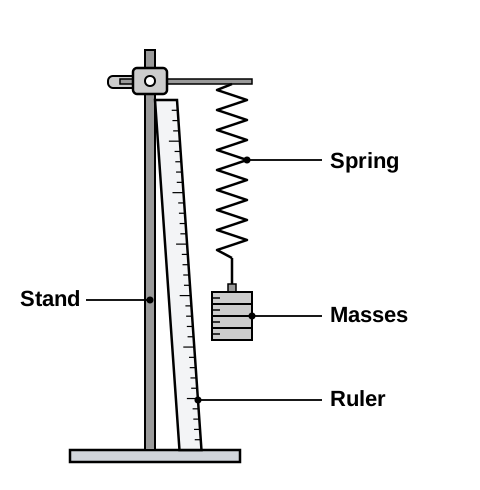
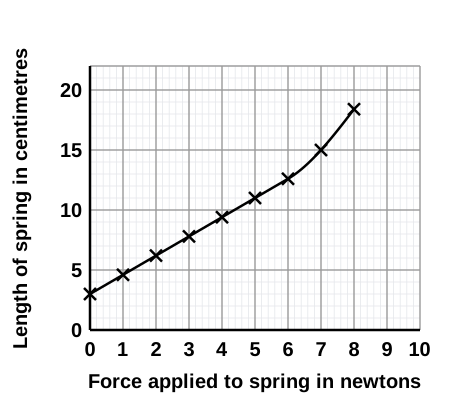
A student hangs masses from a spring on a stand and measures the spring's length with a ruler. Figure 1 shows the rig, with the ruler held by hand beside the spring (the hand is not drawn). Figure 2 plots the spring's length against the force from the masses.

Figure 1
Retort stand with a clamped horizontal arm holding a spring, masses on a hook below it, and a ruler beside the spring, tilted, a gap away from it and not clamped; the hand holding it is not drawn.
Figure 2
Graph of spring length in centimetres against force in newtons. The line starts at 3.0 centimetres, rises steadily to 6 newtons, then curves upward.
02.1[1 mark]

Name the independent variable the student changes in this practical.

See how you would score on Forces & Their Effects
Show model answer for 02.1Hide model answer for 02.1

The pull on the spring, supplied by the masses' weight, is what the student chooses to vary.

1 mark

How the marks are earned

  1. The force on the spring, which is the weight of the hanging masses. Saying the mass hung on the spring is also accepted.
Revise Forces & Their Effects
02.2[2 marks]

Describe one way someone could be hurt in this set-up, and one precaution that makes it less likely.

See how you would score on Forces & Their Effects
Show model answer for 02.2Hide model answer for 02.2

A heavy stack of masses could tip the stand over and hit the student. Clamping the base of the stand to the bench stops it tipping.

2 marks

How the marks are earned

  1. One mark: a named harm from the set-up, such as the stand tipping over onto the student, masses dropping on a foot, or the spring snapping.
  2. One mark: a precaution that matches that harm, such as clamping the stand's base to the bench, keeping the masses small in number, standing up so the student can move away quickly, or wearing eye protection against a snapping spring.

Why it scores

The precaution must answer the risk named. A snapping spring would be matched by goggles instead.

Revise Forces & Their Effects
02.3[2 marks]

Give two changes to how the spring's length is read that would make the readings more accurate.

See how you would score on Forces & Their Effects
Show model answer for 02.3Hide model answer for 02.3

Clamp the ruler upright right beside the spring, and fix a pointer to the bottom of the spring so the reading is taken at one clear point.

2 marks

How the marks are earned

  1. Any two, one mark each: hold the ruler upright; fix the ruler in a clamp next to the spring; fix a pointer to the bottom of the spring to read against the scale; use a ruler with finer divisions.

Why it scores

A tilted, hand-held ruler away from the spring gives readings that wander. Fixing it upright and close, and marking the spring's end, removes that error. A finer ruler would also help.

Revise Forces & Their Effects
02.4[1 mark]

The line in Figure 2 meets the length axis at 3.0 cm, not at zero. Give the reason it misses the origin.

See how you would score on Forces & Their Effects
Show model answer for 02.4Hide model answer for 02.4

With no force on it the spring is already about 3.0 cm long. The graph shows length, not extension, so the line cannot start at zero.

1 mark

How the marks are earned

  1. The spring already has a length with no force on it, so its length is not zero. Equivalent: length, not extension, was plotted.
Revise Forces & Their Effects
02.5[2 marks]

After 6.0 N each extra newton stretches this spring more than before. Explain the cause.

See how you would score on Forces & Their Effects
Show model answer for 02.5Hide model answer for 02.5

Past 6.0 N the spring is overstretched and does not return to its original length (inelastic). Extension stops being in proportion to force, so each extra newton adds more length than the last.

2 marks

How the marks are earned

  1. One mark: the spring has been stretched past what it can recover from, so it is permanently deformed (inelastic).
  2. One mark: so extension is no longer in proportion to force. Saying it has passed its limit of proportionality, or no longer follows Hooke's law, also earns this.

Why it scores

The first idea is the physical change in the spring. The second is its effect on the graph, which is the loss of proportionality.

Revise Forces & Their Effects
02.6[1 mark]

Which relation links force F, spring constant k and extension e? Tick one box.

See how you would score on Forces & Their Effects
F = k × e
F = e ÷ k
F = k ÷ e
Show model answer for 02.6Hide model answer for 02.6

F = k × e. Force is spring constant multiplied by extension.

1 mark

How the marks are earned

  1. Tick the relation where force is spring constant multiplied by extension.
Revise Forces & Their Effects
02.7[3 marks]

A 4.0 N pull extends the spring by 0.064 m. Work out k, the spring constant, in N/m.

See how you would score on Forces & Their Effects
Show model answer for 02.7Hide model answer for 02.7

Start from this equation:. F = k × e. Put in the values:. 4.0 = k × 0.064

Rearrange for k:. k = 4.0 over 0.064. = 62.5 N/m

3 marks

How the marks are earned

  1. One mark: put the force and the extension into F = k × e.
  2. One mark: rearrange to k = F ÷ e.
  3. One mark: the final value, 62.5, with 63 also accepted. The unit, newtons per metre, is not needed for the mark here, but always write it.

Why it scores

Both real values in the equation earn the first mark. The extension is already in metres, so no conversion is needed.

The rearranged form earns the second mark and the division gives the last. Check against Figure 2: at 4.0 N the length is 9.4 cm, so the extension is 9.4 − 3.0 = 6.4 cm = 0.064 m.

Revise Forces & Their Effects
AQA owns the copyright in its exam questions, so we cannot copy their wording. These descriptions and answers are ours. Not made or approved by AQA.[12 marks]
PrepWise guide: AQA GCSE Physics Paper 2 HigherQuestion 3

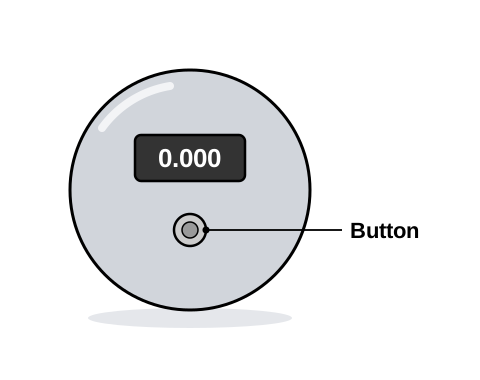
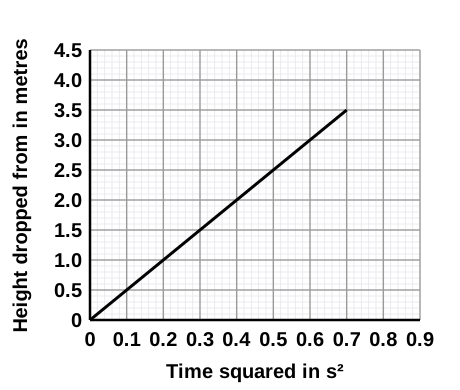
A student drops a ball with a built-in timer: pressing its button starts the clock, and the clock stops when the ball lands. Each height is tried more than once. Figure 3 shows the ball. Figure 4 plots drop height against time squared.

Figure 3
Line drawing of a ball with a small digital timer window reading 0.000 and a button beneath it.
Figure 4
Straight line graph through the origin of drop height in metres against time squared in seconds squared, reaching 3.5 metres at 0.70.
03.1[2 marks]

Five drops from one height gave times in seconds: 0.49, 0.51, 0.58, 0.56, 0.61. Find the uncertainty in the time, as ± a value.

See how you would score on Newton's Laws of Motion
Show model answer for 03.1Hide model answer for 03.1

Find the range:. range = 0.61 − 0.49. = 0.12 s. The uncertainty is half the range:. uncertainty = ± 0.12 over 2. = ± 0.06 s

2 marks

How the marks are earned

  1. One mark: find the range, 0.61 − 0.49 = 0.12. Finding the mean, 0.55, also earns this.
  2. One mark: the uncertainty is half the range, ± 0.06. The unit, seconds, is not needed for the mark here, but always write it.

Why it scores

Half the range is the usual measure. It matches the biggest gap between the mean, 0.55 s, and any one reading, which is 0.61 − 0.55 = 0.06 s.

Revise Newton's Laws of Motion
03.2[1 mark]

The times vary from drop to drop. Which kind of error makes repeat readings scatter? Tick one box.

See how you would score on Newton's Laws of Motion
Random error
Systematic error
Zero error
Show model answer for 03.2Hide model answer for 03.2

Random error. It makes repeat readings fall unpredictably on both sides of the true value.

1 mark

How the marks are earned

  1. Tick random error.
Revise Newton's Laws of Motion
03.3[1 mark]

Suggest one cause of the scatter in the repeat times.

See how you would score on Newton's Laws of Motion
Show model answer for 03.3Hide model answer for 03.3

The delay between pressing the button and letting go of the ball was different each time.

1 mark

How the marks are earned

  1. Any one cause that changes from drop to drop: the release height was slightly different; the ball was given a small push; the delay between pressing the button and letting go changed; the clock did not stop at the instant of landing.
Revise Newton's Laws of Motion
03.4[3 marks]

Figure 4 plots drop height against time squared. Use its gradient, with acceleration = 2 × gradient, to find the ball's acceleration.

See how you would score on Newton's Laws of Motion
Show model answer for 03.4Hide model answer for 03.4

Read a point on the line, for example height 3.5 m at time squared 0.70 s2.. The line starts at the origin, so find the gradient:. gradient = 3.5 over 0.70. = 5.0

Acceleration is 2 × gradient:. acceleration = 2 × 5.0. = 10 m/s2

3 marks

How the marks are earned

  1. One mark: read a matching height and time squared from the line, such as 3.5 m at 0.70 s2.
  2. One mark: gradient = height ÷ time squared = 5.0.
  3. One mark: acceleration = 2 × 5.0 = 10 m/s2 (10.0). Working this out from your own gradient also earns it, provided the gradient was height change divided by time squared change.

Why it scores

A point read well away from the origin gives an accurate gradient. Two marks are for the reading and the division.

The final mark is for using the doubling relation given. The unit is not needed for the mark here, but always write it.

Revise Newton's Laws of Motion
AQA owns the copyright in its exam questions, so we cannot copy their wording. These descriptions and answers are ours. Not made or approved by AQA.[7 marks]
PrepWise guide: AQA GCSE Physics Paper 2 HigherQuestion 4

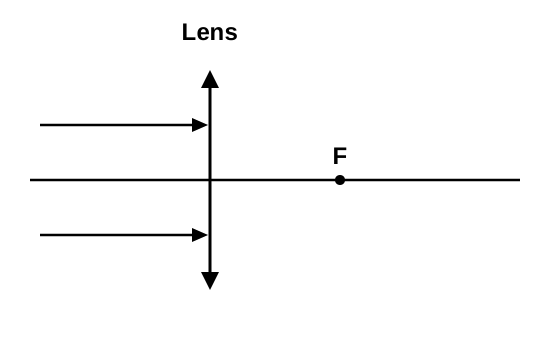
In Figure 5, a pair of parallel rays meets a lens. F is the lens's principal focus. The James Webb Space Telescope orbits the Sun.

Figure 5
Ray diagram: two horizontal parallel rays arrive at a lens drawn as a vertical line with an outward-pointing arrowhead at each end, on a principal axis with a point F marked to the right of the lens. The rays stop at the lens.
04.1[1 mark]

Name the lens that the symbol in Figure 5 stands for.

See how you would score on Lenses & Images
Show model answer for 04.1Hide model answer for 04.1

A convex lens, also called a converging lens, because it brings parallel rays together.

1 mark

How the marks are earned

  1. Convex. Calling it a converging lens is also accepted.
Revise Lenses & Images
04.2[2 marks]

Draw both rays on past the lens in Figure 5 to show what the lens does to them.

See how you would score on Lenses & Images
Show model answer for 04.2Hide model answer for 04.2

Each ray bends at the lens towards the principal axis. Both then run on to cross exactly at F.

2 marks

How the marks are earned

  1. One mark: both rays bend inward after the lens, towards the axis.
  2. One mark: both rays pass through the principal focus F, so they cross there.

Why it scores

Parallel rays through a convex lens meet at the principal focus. Bending towards the axis earns one mark and ending at F earns the other.

Revise Lenses & Images
04.3[4 marks]

Radiation of wavelength 0.60 µm travels at 3.0 × 10⁸ m/s. Calculate its frequency in hertz.

See how you would score on Electromagnetic Spectrum
Show model answer for 04.3Hide model answer for 04.3

0.60 µm = 0.60 × 10⁻⁶ m.

Use this equation:. v = f × λ. Put in the values:. 3.0 × 108 = f × 0.60 × 10⁻⁶. Rearrange for f:. f = fraction: 3.0 × 10⁸ over 0.60 × 10⁻⁶, end of fraction. = 5.0 × 10¹⁴ Hz

4 marks

How the marks are earned

  1. One mark: change micrometres to metres, 0.60 µm = 0.60 × 10⁻⁶ m.
  2. One mark: put the values into wave speed = frequency × wavelength.
  3. One mark: rearrange to frequency = wave speed ÷ wavelength.
  4. One mark: the final frequency, 5.0 × 10¹⁴ Hz. Later marks still follow if the wavelength was not converted.

Why it scores

The equation needs metres. Skipping the conversion loses only this mark.

The substitution, the rearranged form and the evaluated answer each earn a mark. Divide by the whole wavelength, 0.60 × 10⁻⁶. Use brackets if you type it into a calculator.

Revise Electromagnetic Spectrum
04.4[1 mark]

Red-shift of far galaxies means one property of the waves has grown. Name that property.

See how you would score on Red Shift & Big Bang
Show model answer for 04.4Hide model answer for 04.4

Wavelength. Red-shifted light has its wavelength stretched towards the red end of the spectrum.

1 mark

How the marks are earned

  1. Wavelength.
Revise Red Shift & Big Bang
04.5[1 mark]

Choose the true explanation for the red-shift seen in distant galaxies. Tick one box.

See how you would score on Red Shift & Big Bang
Every far galaxy looks red to us.
Distant galaxies are travelling away from ours.
Far galaxies move as fast as light does.
Show model answer for 04.5Hide model answer for 04.5

The galaxies are moving away from us, and that motion stretches the waves they emit to longer wavelengths.

1 mark

How the marks are earned

  1. Tick the option saying distant galaxies are travelling away from ours.
Revise Red Shift & Big Bang
04.6[1 mark]

One galaxy has the largest red-shift ever seen. What does this tell you about its distance?

See how you would score on Red Shift & Big Bang
Show model answer for 04.6Hide model answer for 04.6

It is the most distant galaxy seen so far. A bigger red-shift means it is moving away faster, and farther galaxies move away faster.

1 mark

How the marks are earned

  1. It is farther away than any other galaxy observed so far.
Revise Red Shift & Big Bang
04.7[3 marks]

The telescope orbits the Sun at constant speed, yet its velocity changes. Explain why.

See how you would score on Orbits
Show model answer for 04.7Hide model answer for 04.7

The Sun's gravity pulls the telescope towards the centre of its orbit, so a resultant force always acts on it. That force makes the telescope accelerate towards the centre.

Velocity has a direction as well as a size. The speed stays constant, but the direction of travel keeps turning as it goes round, so the velocity changes.

3 marks

How the marks are earned

  1. One mark: the Sun's gravity gives an unbalanced force, directed to the middle of the orbit.
  2. One mark: so the telescope accelerates towards the centre. Saying only that acceleration changes the speed earns nothing.
  3. One mark: the direction of motion keeps changing, so the velocity changes.

Why it scores

Naming the force, then the acceleration it causes, gives the first two marks.

The last mark needs the link between a changing direction and a changing velocity.

Revise Orbits
AQA owns the copyright in its exam questions, so we cannot copy their wording. These descriptions and answers are ours. Not made or approved by AQA.[13 marks]
PrepWise guide: AQA GCSE Physics Paper 2 HigherQuestion 5

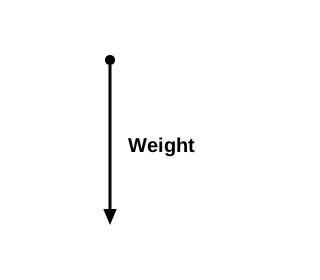
A record-attempt skydiver starts a fall from 40 km up. Figure 6 begins a free-body diagram for a moment soon after the jump.

Figure 6
A single dot with a downward arrow below it labelled weight. No other arrow is drawn.
05.1[2 marks]

Figure 6 shows only the weight of a skydiver still speeding up. Add the second force: arrow and label.

See how you would score on Forces & Their Effects
Show model answer for 05.1Hide model answer for 05.1

Draw one arrow upwards from the dot, shorter than the weight arrow, and label it air resistance (drag).

2 marks

How the marks are earned

  1. One mark: one arrow from the dot, pointing straight up, drawn shorter than the weight arrow.
  2. One mark: the arrow labelled air resistance. Drag is also accepted.

Why it scores

The skydiver is still accelerating downwards, so the resultant force is downwards. That means the upward force must be smaller than the weight.

Revise Forces & Their Effects
05.2[4 marks]

The skydiver starts from rest with a mean acceleration of 0.64 m/s2 for 2.5 minutes. Calculate the velocity reached.

See how you would score on Newton's Laws of Motion
Show model answer for 05.2Hide model answer for 05.2

2.5 minutes = 2.5 × 60. = 150 s

Use this equation:. acceleration = fraction: change in velocity over time, end of fraction. Put in the values:. 0.64 = fraction: v − 0 over 150, end of fraction. Rearrange for v:. v = 0.64 × 150. = 96 m/s

4 marks

How the marks are earned

  1. One mark: change minutes to seconds, 2.5 minutes = 150 s.
  2. One mark: put the values into acceleration = change in velocity ÷ time.
  3. One mark: rearrange to find the velocity, v = 0.64 × 150.
  4. One mark: the final velocity, 96. Later marks still follow if the time was not converted.

Why it scores

Acceleration in m/s2 needs the time in seconds. Missing this loses only this mark.

The initial velocity is zero, so the change in velocity is just v. The substitution, rearrangement and answer each earn a mark.

Revise Newton's Laws of Motion
05.3[4 marks]

Explain why the speed of a falling skydiver stops increasing and becomes constant.

See how you would score on Terminal Velocity
Show model answer for 05.3Hide model answer for 05.3

At the start only weight acts. As the skydiver speeds up, the air resistance grows. This goes on until the air resistance is equal to the weight, pointing the opposite way.

The two forces then cancel, so the resultant force is zero. With no resultant force there is no acceleration, so the skydiver keeps a constant velocity: terminal velocity.

4 marks

How the marks are earned

  1. One mark: as the skydiver's speed rises, air resistance rises.
  2. One mark: this continues until the air resistance equals the weight, acting in the opposite direction.
  3. One mark: so the resultant force is zero.
  4. One mark: so the acceleration is zero, and the velocity stays constant.

Why it scores

Two marks: air resistance rising with speed, then reaching the same size as the weight.

Two further marks: zero resultant force, then zero acceleration and constant velocity. Each step must follow from the one before.

Revise Terminal Velocity
05.4[2 marks]

Explain why the air pressure on the skydiver grows as the fall continues.

See how you would score on Pressure
Show model answer for 05.4Hide model answer for 05.4

The lower the skydiver falls, the more air there is above, and that air has more weight pressing down. Pressure is force divided by area, so the pressure on the skydiver increases.

2 marks

How the marks are earned

  1. One mark: as the skydiver falls, more air lies above, so the weight of the air above rises. Saying the mass or number of air particles above rises also earns this.
  2. One mark: pressure is force divided by area, so the pressure is greater.
  3. Alternative route, 2 marks: the air around the skydiver gets denser as the fall goes on (1), so air particles strike the skydiver more often and the pressure rises (1).

Why it scores

The first mark is for the growing weight of air above. The second links that force to pressure through p = F ÷ A.

Revise Pressure
05.5[4 marks]

Forces on the skydiver: 240 N up, 200 N left. Draw a scaled vector diagram and find the resultant's size and angle to vertical.

See how you would score on Forces & Their Effects
Show model answer for 05.5Hide model answer for 05.5

Choose a scale, such as 1 cm for 40 N. Draw a line 6.0 cm long upwards for 240 N. From its tip draw a line 5.0 cm long to the left for 200 N. The arrow from the start to the end is the resultant.

The resultant measures about 7.8 cm, so it is about 312 N. Its angle to the vertical is about 40 degrees, towards the left.

4 marks

How the marks are earned

  1. One mark: a scale drawing of a triangle or parallelogram, with the 240 N side clearly longer than the 200 N side.
  2. One mark: the resultant drawn in the right direction, up and to the left.
  3. One mark: the size of the resultant, anywhere from 300 N to 320 N.
  4. One mark: the angle to the vertical, anywhere from 38 degrees to 42 degrees.

Why it scores

A scale that makes the diagram large keeps the measurement accurate. The two forces must join tip to tail, with the vertical one longer.

A calculation checks the measurement: the square root of (2402 + 2002) is 312 N, and the angle whose tangent is 200 ÷ 240 is 39.8 degrees.

Revise Forces & Their Effects
AQA owns the copyright in its exam questions, so we cannot copy their wording. These descriptions and answers are ours. Not made or approved by AQA.[16 marks]
PrepWise guide: AQA GCSE Physics Paper 2 HigherQuestion 6

Cars X and Y are the same in every way except mass, and X is the heavier.

06.1[1 mark]

Compare the greatest acceleration car X can reach with that of car Y.

See how you would score on Newton's Laws of Motion
Show model answer for 06.1Hide model answer for 06.1

Car X can accelerate less than car Y.. The cars can apply the same greatest force.. acceleration = force over mass. So more mass gives less acceleration.

1 mark

How the marks are earned

  1. Car X has the smaller greatest acceleration.
Revise Newton's Laws of Motion
06.2[3 marks]

A crash stops a car almost at once. Explain how an inflating air bag lowers the chance of the driver being injured.

See how you would score on Force & Collisions
Show model answer for 06.2Hide model answer for 06.2

The air bag cushions the driver, so the driver slows to a stop over a longer time. Their momentum falls by the same amount, but it happens more gradually.

The slower change of momentum means gentler deceleration. Since force is the rate at which momentum changes, the driver feels less force and injury is less likely.

3 marks

How the marks are earned

  1. One mark: the bag makes the driver take longer to stop. Saying the momentum change is the same but takes place over a longer time earns this mark and the next one too.
  2. One mark: either the momentum changes more slowly, or the driver decelerates less sharply.
  3. One mark: the driver therefore feels less force.

Why it scores

A longer stopping time is the starting idea, and it is worth the first mark.

Rate of change of momentum links the time to the force. Each step earns its own mark.

Revise Force & Collisions
06.3[5 marks]

A 1400 kg car slows evenly from 18 m/s to rest over 24 m of braking. Find the resultant force acting on it.

See how you would score on Newton's Laws of Motion
Show model answer for 06.3Hide model answer for 06.3

Use this equation, with final speed 0 and initial speed 18 m/s:. v2 − u2 = 2 × a × s. Put in the values:. 0 − 182 = 2 × a × 24

Rearrange for a:. a = fraction: −324 over 48, end of fraction. = −6.75 m/s2. The minus sign shows the car is slowing: the deceleration is 6.75 m/s2.

Use this equation, with the size of the deceleration:. F = m × a. Put in the values:. F = 1400 × 6.75. = 9450 N

5 marks

How the marks are earned

  1. One mark: put the values into v2 − u2 = 2 × a × s, giving 0 − 182 = 2 × a × 24.
  2. One mark: rearrange to find a, a = −324 ÷ 48.
  3. One mark: the deceleration, 6.75 m/s2 (the acceleration is −6.75).
  4. One mark: put the mass and acceleration into F = m × a, so F = 1400 × 6.75.
  5. One mark: the final force, 9450 N. An energy route also earns full marks: kinetic energy 226 800 J = F × 24 gives 9450 N.
  6. A route through time also earns full marks, five in all: the car averages 9 m/s, half of 18 (1); 24 = 9 × t (1); so the stop lasts 24 ÷ 9 s, about 2.67 s; keep the unrounded value (1); force is momentum lost per second, 1400 × 18 = 25 200 kg m/s ÷ (24 ÷ 9) s (1); so the force is 9450 N (1).

Why it scores

This equation has the distance, not the time, so it suits the data. Both real values in place earn the first mark.

The rearranged form and the evaluated acceleration earn two marks.

The substitution and the final value earn the last two marks. Check by energy: half × 1400 × 182 = 226 800 J, and 226 800 ÷ 24 = 9450 N.

Revise Newton's Laws of Motion
06.4[2 marks]

The brakes get hotter as the car slows. Explain why.

See how you would score on Work Done & Energy Transfer
Show model answer for 06.4Hide model answer for 06.4

Friction between the brake pads and the wheel does work as the car slows. This transfers kinetic energy from the car to the thermal store of the brakes, so their temperature rises.

2 marks

How the marks are earned

  1. One mark: friction in the brakes does work. Friction on its own earns nothing.
  2. One mark: some of the car's kinetic energy is transferred to the thermal store of the brakes.

Why it scores

Work done by friction is the mechanism, and the energy transfer is the result. Both parts are needed.

Revise Work Done & Energy Transfer
06.5[2 marks]

A driver brakes so hard that the deceleration is very large. Give two risks this creates.

See how you would score on Stopping Distances
Show model answer for 06.5Hide model answer for 06.5

The brakes could overheat, and the driver could lose control of the car, for example by skidding.

2 marks

How the marks are earned

  1. One mark: the brakes may overheat.
  2. One mark: the driver may lose control of the car.

Why it scores

A large deceleration needs a large braking force. That brings much more heating in the brakes and a risk of the tyres losing grip.

Revise Stopping Distances
AQA owns the copyright in its exam questions, so we cannot copy their wording. These descriptions and answers are ours. Not made or approved by AQA.[13 marks]
PrepWise guide: AQA GCSE Physics Paper 2 HigherQuestion 7

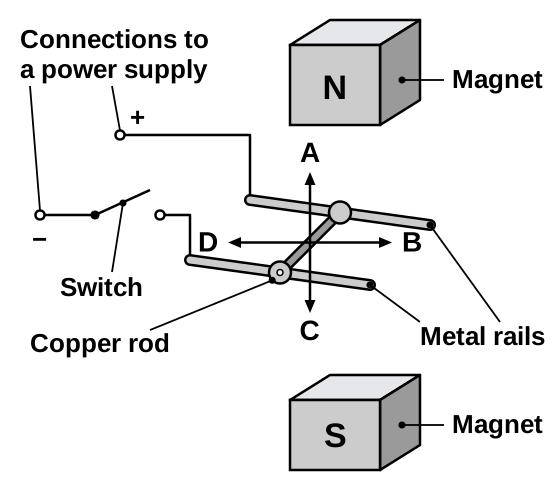
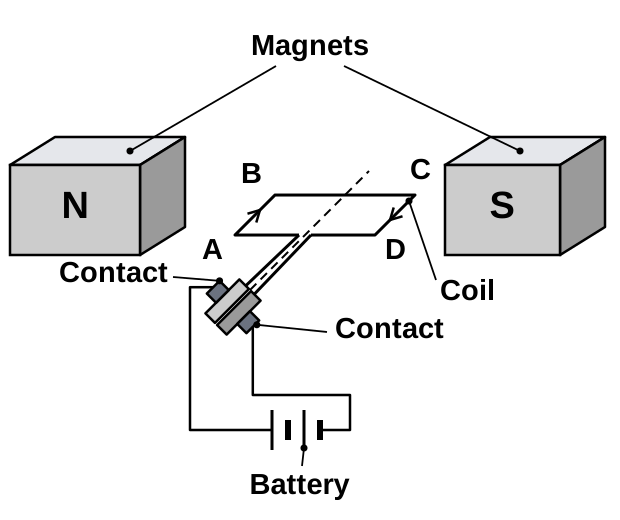
Figure 7 draws the switch open. Once it is closed, current flows along a copper rod resting on two parallel rails, which sit between a north pole above and a south pole below. Figure 7 marks four directions, A to D. Figure 8 shows a basic motor: a coil between two magnets, wired to a battery through two contacts.

Figure 7
A copper rod across two rails, a north pole above and a south pole below, the positive terminal joined to the rear rail and the negative terminal joined through a switch to the front rail, and four arrows A to D at the rod; the switch is drawn open.
Figure 8
A rectangular coil with corners lettered A, B, C and D, between a north pole on the left and a south pole on the right, wired to a battery through two contacts. Arrows show the current going from A to B and from C to D.
07.1[1 mark]

Using the magnet poles and the current direction in Figure 7, pick the arrow, A to D, that shows how the rod accelerates.

See how you would score on The Motor Effect
A (up)
B (right, along the rails)
C (down)
D (left, along the rails)
Show model answer for 07.1Hide model answer for 07.1

B. The field points from the north pole down to the south pole. The current runs from the positive terminal along the rear rail, then across the rod towards the front rail. Fleming's left-hand rule gives a force to the right, along the rails.

1 mark

How the marks are earned

  1. Tick B.
Revise The Motor Effect
07.2[5 marks]

Rod mass 5.0 g, length in the field 0.070 m, flux density 0.30 T, current 2.0 A. Calculate its initial acceleration.

See how you would score on The Motor Effect
Show model answer for 07.2Hide model answer for 07.2

Use this equation:. F = B × I × l. Put in current 2.0 A, flux density 0.30 T and length 0.070 m:. F = 2.0 × 0.30 × 0.070. = 0.042 N

Change the mass to kilograms:. 5.0 g = 0.0050 kg. Use this equation:. F = m × a. Put in the values:. 0.042 = 0.0050 × a. Rearrange for a:. a = 0.042 over 0.0050. = 8.4 m/s2

5 marks

How the marks are earned

  1. One mark: substitute the flux density, current and length into F = B × I × l.
  2. One mark: the force, 0.042 N.
  3. One mark: change grams to kilograms and put into F = m × a, so 0.042 = 0.0050 × a.
  4. One mark: rearrange to a = 0.042 ÷ 0.0050.
  5. One mark: the final acceleration, 8.4 m/s2. Later marks still follow if the mass was not converted.

Why it scores

Two marks: the substitution into the motor effect equation and its value.

Three marks: the mass conversion with its substitution, the rearrangement and the final value. The unit is not needed for the mark here, but always write it.

Revise The Motor Effect
07.3[4 marks]

Explain how the magnets' field and the coil's own field keep the coil of Figure 8 turning the same way.

See how you would score on The Motor Effect
Show model answer for 07.3Hide model answer for 07.3

The magnetic field of the coil's current interacts with the field of the magnets, giving a force on side AB and a force on side CD. The current in AB is opposite to that in CD, so one force pushes up and the other pushes down, and the coil rotates.

At each half turn the split-ring commutator hands each coil end over to the other contact, so the current direction around the coil flips. The force on each side then points the other way, which keeps the turning effect in one direction and the coil spinning.

4 marks

How the marks are earned

  1. One mark: the two magnetic fields interact and give forces on the sides AB and CD of the coil. An answer about a generator earns nothing.
  2. One mark: the current in AB is opposite to that in CD, so the forces on them point in opposite directions and turn the coil.
  3. One mark: every half turn, each end of the coil moves to the opposite contact. Saying the split-ring commutator makes this swap each half turn earns the mark; naming it alone does not.
  4. One mark: the current through each side flips, so each force flips too, and the turning carries on the same way.

Why it scores

Two marks: forces from the interacting fields, and the opposite forces on opposite sides that give a turning effect.

Without the swap, the forces would pull the coil back and it would stop. Two marks: the commutator swap, and the reversed current and forces.

Revise The Motor Effect
07.4[2 marks]

The coil in Figure 8 lies flat. Explain why no turning effect acts on it when it stands upright.

See how you would score on The Motor Effect
Show model answer for 07.4Hide model answer for 07.4

Upright, the gaps in the split ring meet the contacts, so no current flows in the coil. With no current there is no magnetic force on the coil, so there is no moment.

2 marks

How the marks are earned

  1. One mark: no current flows in the coil.
  2. One mark: so no magnetic force acts, and so there is no moment. This mark depends on the first.

Why it scores

The first mark is the loss of current and the second is the consequence. The second mark depends on the first.

Revise The Motor Effect
AQA owns the copyright in its exam questions, so we cannot copy their wording. These descriptions and answers are ours. Not made or approved by AQA.[12 marks]
PrepWise guide: AQA GCSE Physics Paper 2 HigherQuestion 8

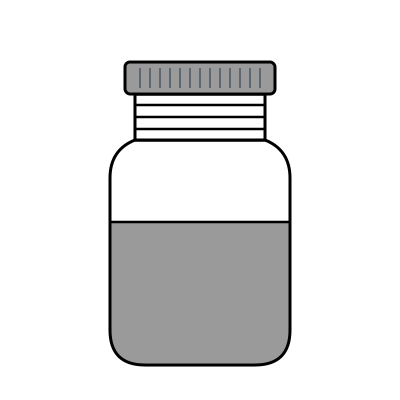
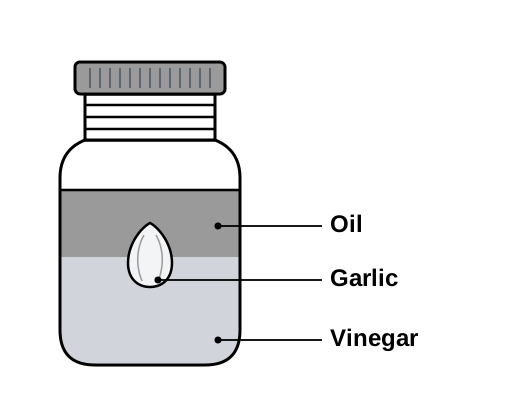
A jar holds a liquid, shown in Figure 9. A second jar, in Figure 10, holds oil lying on top of vinegar, with a garlic clove floating where the oil meets the vinegar.

Figure 9
A glass jar with a screw top, filled with a liquid to about two thirds of its height.
Figure 10
A jar with a layer of oil above a layer of vinegar and a garlic clove floating where the two layers meet.
08.1[1 mark]

Liquid presses on its container. How is that push directed compared with the wall's surface?

See how you would score on Pressure
Show model answer for 08.1Hide model answer for 08.1

The force is at right angles to the wall (normal to the surface), pushing outwards.

1 mark

How the marks are earned

  1. At right angles to the wall, which can also be called normal to the surface.
Revise Pressure
08.2[4 marks]

The liquid weighs 1.50 N and exerts 774 N/m2 on the jar's base. Find the base area, to 3 significant figures.

See how you would score on Pressure
Show model answer for 08.2Hide model answer for 08.2

The weight of the liquid is the force on the base.. Use this equation:. p = F over A. Put in the values:. 774 = 1.50 over A

Rearrange for A:. A = 1.50 over 774. = 0.0019379 m2. To 3 significant figures:. = 0.00194 m2

4 marks

How the marks are earned

  1. One mark: put the values into pressure = force ÷ area, 774 = 1.50 ÷ A.
  2. One mark: rearrange to A = 1.50 ÷ 774.
  3. One mark: the unrounded value, 0.0019379.
  4. One mark: round to 3 significant figures, 0.00194. The unit, square metres, is not needed for the mark here, but always write it.

Why it scores

Both real values in the equation earn the first mark.

The rearranged form, the evaluated area and the correct rounding each earn a mark. The first significant figure is the 1 after the leading zeros.

Revise Pressure
08.3[4 marks]

Explain why the liquids exert an upthrust on the garlic clove.

See how you would score on Pressure
Show model answer for 08.3Hide model answer for 08.3

Deeper liquid is under higher pressure, and vinegar is denser than oil. So the pressure on the clove's lower face is greater than on its upper face.

Since force is pressure × area, the push up on the bottom surface beats the push down on the top surface. The leftover upward push is the upthrust.

4 marks

How the marks are earned

  1. One mark: pressure in a liquid grows with depth. A denser vinegar than oil also earns this.
  2. One mark: the vinegar below pushes on the clove at a higher pressure than the oil above does.
  3. One mark: so the force pushing up on the underside is greater than the force pushing down on the top.
  4. One mark: this net upward force is what we call upthrust. It needs the pressure point or the force point first.

Why it scores

The depth and density link gives the first mark, and the pressure comparison gives the second.

Two marks: the unbalanced forces, then naming their difference as upthrust.

Revise Pressure
AQA owns the copyright in its exam questions, so we cannot copy their wording. These descriptions and answers are ours. Not made or approved by AQA.[9 marks]
PrepWise guide: AQA GCSE Physics Paper 2 HigherQuestion 9

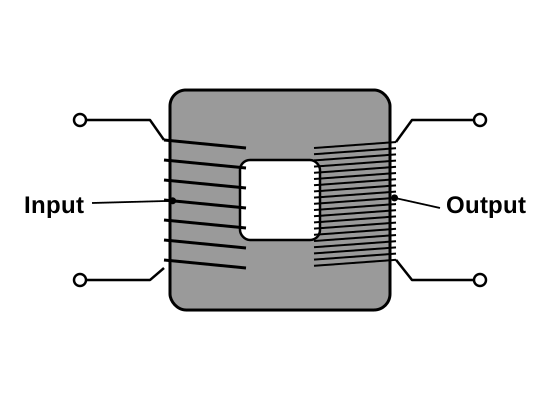
A transformer has an iron core with a primary (input) coil and a secondary (output) coil, shown in Figure 11.

Figure 11
A square transformer core with an input coil of few turns on the left and an output coil of many turns on the right, each with two terminals.
09.1[1 mark]

Give the reason an iron core is used in the transformer.

See how you would score on National Grid & Transformers
Show model answer for 09.1Hide model answer for 09.1

Iron is magnetically soft: it is magnetised easily and loses its magnetism easily. So it carries the alternating magnetic field from the primary coil to the secondary coil.

1 mark

How the marks are earned

  1. Iron is magnetically soft, so it gains and loses magnetism readily. Saying just magnetic, or a good conductor, earns no mark.
Revise National Grid & Transformers
09.2[4 marks]

Primary coil: 345 turns. Secondary coil: 6000 turns and 400 kV across it. Find the primary potential difference in volts.

See how you would score on National Grid & Transformers
Show model answer for 09.2Hide model answer for 09.2

400 kV = 400 000 V.

The potential differences are in the same ratio as the turns:. Vp over 400 000 = 345 over 6000. Rearrange for Vp:. Vp = 345 over 6000 × 400 000. = 23 000 V

4 marks

How the marks are earned

  1. One mark: change kilovolts to volts, 400 kV = 400 000 V.
  2. One mark: put the values into Vp ÷ Vs = Np ÷ Ns, so Vp ÷ 400 000 = 345 ÷ 6000.
  3. One mark: rearrange to Vp = 400 000 × 345 ÷ 6000.
  4. One mark: the final potential difference, 23 000 V. Later marks still follow if the secondary potential difference was not converted.

Why it scores

The answer is asked for in volts, so convert first. Missing this loses only this mark.

The substitution, the rearranged form and the evaluated answer each earn a mark. The primary has fewer turns, so its potential difference is smaller. That matches the answer.

Revise National Grid & Transformers
09.3[3 marks]

Alternating current runs through the primary. Explain how this gives the secondary coil an alternating potential difference.

See how you would score on National Grid & Transformers
Show model answer for 09.3Hide model answer for 09.3

Current that keeps reversing in the primary builds a field that keeps changing, and the iron core guides that field through the secondary coil.

The secondary coil is in this changing field, so its turns cut through the field lines. That induces a potential difference across its ends. The field keeps reversing, so the induced potential difference also alternates.

3 marks

How the marks are earned

  1. One mark: the core carries a magnetic field that keeps changing, created by the a.c. in the primary.
  2. One mark: the secondary coil lies in this changing field, so its wire cuts through the field lines.
  3. One mark: this induces a potential difference between the two terminals of the secondary.

Why it scores

A changing field in the core is the first mark. A steady current would make a steady field and no induction.

Cutting the field earns the second mark and the induced potential difference earns the third. The reversing field is why the output alternates.

Revise National Grid & Transformers
AQA owns the copyright in its exam questions, so we cannot copy their wording. These descriptions and answers are ours. Not made or approved by AQA.[8 marks]
END OF QUESTIONS100 marks total
See how you would score on Forces & Their Effects

Our own questions on this topic, marked straight away, so you see what to revise. Free now.