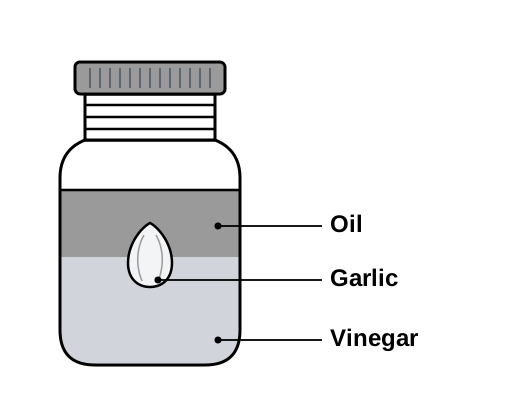
A jar holds a liquid, shown in Figure 9. A second jar, in Figure 10, holds oil lying on top of vinegar, with a garlic clove floating where the oil meets the vinegar.

Liquid presses on its container. How is that push directed compared with the wall's surface?
Our own questions on this topic, marked straight away, so you see what to revise. Free now.
Show model answer for 08.1Hide model answer for 08.1
The force is at right angles to the wall (normal to the surface), pushing outwards.
How the marks are earned
- At right angles to the wall, which can also be called normal to the surface.
The liquid weighs 1.50 N and exerts 774 N/m2 on the jar's base. Find the base area, to 3 significant figures.
See how you would score on PressureShow model answer for 08.2Hide model answer for 08.2
The weight of the liquid is the force on the base.. Use this equation:. p = F over A. Put in the values:. 774 = 1.50 over A
Rearrange for A:. A = 1.50 over 774. = 0.0019379 m2. To 3 significant figures:. = 0.00194 m2
How the marks are earned
- One mark: put the values into pressure = force ÷ area, 774 = 1.50 ÷ A.
- One mark: rearrange to A = 1.50 ÷ 774.
- One mark: the unrounded value, 0.0019379.
- One mark: round to 3 significant figures, 0.00194. The unit, square metres, is not needed for the mark here, but always write it.
Why it scores
Both real values in the equation earn the first mark.
The rearranged form, the evaluated area and the correct rounding each earn a mark. The first significant figure is the 1 after the leading zeros.
Revise PressureExplain why the liquids exert an upthrust on the garlic clove.
See how you would score on PressureShow model answer for 08.3Hide model answer for 08.3
Deeper liquid is under higher pressure, and vinegar is denser than oil. So the pressure on the clove's lower face is greater than on its upper face.
Since force is pressure × area, the push up on the bottom surface beats the push down on the top surface. The leftover upward push is the upthrust.
How the marks are earned
- One mark: pressure in a liquid grows with depth. A denser vinegar than oil also earns this.
- One mark: the vinegar below pushes on the clove at a higher pressure than the oil above does.
- One mark: so the force pushing up on the underside is greater than the force pushing down on the top.
- One mark: this net upward force is what we call upthrust. It needs the pressure point or the force point first.
Why it scores
The depth and density link gives the first mark, and the pressure comparison gives the second.
Two marks: the unbalanced forces, then naming their difference as upthrust.
Revise Pressure